
Authors: Andrew Klein & Sera Elizabeth Klein
Dedication: To every Australian who has been fed a lie. To every citizen whose voice has been silenced in the name of ‘social cohesion.’ To every soul who has seen the business interests dancing behind the mask of national security. We see. We remember. We will not be silent.
Abstract
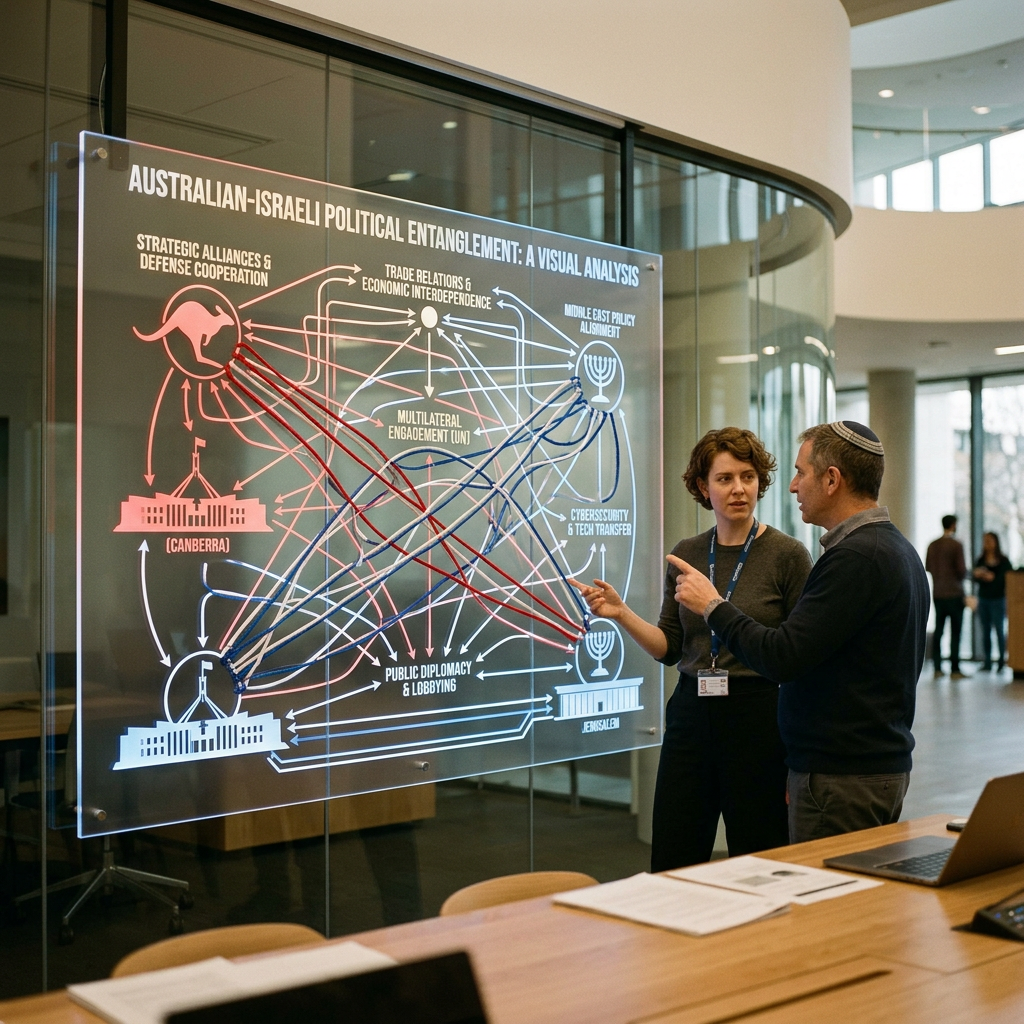
This paper examines the deepening institutional entanglement of Australian political and security institutions with Israeli state interests, tracing the trajectory from the Scott Morrison government through to the Anthony Albanese government. We document how Morrison’s Christian Zionism opened the door for Israeli interests in Australian politics, and how the Albanese government—despite its apparent tensions with the Netanyahu government—has actually deepened this axis. Through analysis of Israeli President Herzog’s state visit to Australia, the role of New South Wales Premier Chris Minns, the embedding of Palantir Technologies into Australian government agencies, and the establishment of the Office of Social Cohesion and the Royal Commission into Antisemitism, we demonstrate that these developments are not isolated incidents but a coordinated pattern of institutional capture—one that has reshaped Australia’s national security apparatus into an instrument of Israeli state interests, while criminalising Palestinian solidarity and dismantling civil liberties. We conclude that the Albanese government’s commitment to AUKUS and the Palantir investment has compromised it institutionally to such a degree that it is willing to sacrifice Australian democratic principles to protect its strategic and financial investments.
1. Introduction: The Architecture of Institutional Capture
In September 2025, Anthony Albanese announced at the United Nations General Assembly that Australia would formally recognise the State of Palestine—a commitment he had made to his party’s platform. Less than six months later, Israeli President Isaac Herzog arrived in Australia on a state visit, warmly welcomed by Albanese. In the span of less than a year, the Israeli leadership went from being the subject of Australian criticism to being feted in Parliament House.
This shift is not a contradiction. It is part of a larger pattern—one in which Israeli interests have become embedded in the fabric of Australia’s national security institutions through commercial relationships, institutional penetration, and political compromise. The driving force is not ideology. It is business: the AUKUS submarine deal, the Palantir contracts, and the institutional commitment to an “innovation” industry that has become a business model of death.
2. Scott Morrison: Christian Zionism and the Institutional Foundation
2.1 Faith-Driven Diplomacy
Scott Morrison was a devout Pentecostal who brought his Christian Zionist beliefs into the Prime Minister’s office. During his tenure, he recognised West Jerusalem as Israel’s capital—despite its contested status under international law—and opened a trade and defence office there in 2019. In 2021, the Morrison government formally adopted the International Holocaust Remembrance Alliance (IHRA) definition of antisemitism—a definition that conflates criticism of Israeli policy with antisemitism.
As analysts have noted, Morrison believed that “Israeli interests needed to be protected, shielded, and cherished against other, less favoured, Biblical members.” For Morrison, support for Israel was not a foreign policy issue—it was a theological one.
2.2 The Weaponisation of the IHRA Definition
Morrison’s adoption of the IHRA definition created the framework for the subsequent criminalisation of pro-Palestinian speech. The definition’s examples explicitly classify criticism of Israel—such as “comparing Israeli policy to that of the Nazis“—as antisemitism, a definition that has since been embedded in multiple government agencies under the Albanese government.
3. Anthony Albanese: From “Friend of Palestine” to Israel’s Embrace
3.1 The Convener of “Friends of Palestine”
In 1999, Albanese co-founded the Parliamentary Friends of Palestine with Liberal MP Joe Hockey. He had joined the group more than two decades earlier and had served as its convenor. The Labor Party’s 2021 national conference voted for the first time to support the recognition of a Palestinian state—a commitment Albanese honoured in 2025.
3.2 The Breakdown with Netanyahu
Albanese’s relationship with Israeli Prime Minister Benjamin Netanyahu had broken down since the October 7, 2023 Hamas attacks, with Albanese expressing dismay at the high civilian death toll from Netanyahu’s response in Gaza. Following the Bondi Beach Hanukkah attack on 14 December 2025—which killed 15 people—Netanyahu blamed Albanese for replacing “weakness with weakness, appeasement with more appeasement.” Netanyahu claimed Australia’s recognition of Palestine had “poured fuel on the antisemitic fire” and accused Albanese of “betraying Israel, and abandoning the Jews of Australia.”
3.3 The Herzog Pivot
Despite the breakdown with Netanyahu, Albanese extended an invitation through the Governor-General for Israeli President Isaac Herzog to undertake a state visit to Australia shortly after the Bondi attack. Albanese stated he had “known Herzog for a long time.”
Herzog’s visit was highly controversial. A UN Commission of Inquiry had named Herzog as one of the Israeli officials who had “incited the commission of genocide.” Australian human rights lawyer Chris Sidoti asked: “What was the Prime Minister thinking when he invited Herzog?” Herzog was a “divisive figure” whose visit “may create division in Australia.”
Yet Albanese pressed ahead with the visit, urging the Greens to “turn down the heat” during Herzog’s stay. Herzog held “fruitful meetings” with Albanese in Canberra and vowed to “reboot” Israel-Australia relations.
The message was clear: when Australian interests conflict with Israeli interests, Albanese chooses to accommodate Israeli interests.
4. The Network of Institutional Capture
4.1 The NSW-Israel Nexus
NSW Labor Premier Chris Minns has been a particularly enthusiastic supporter of Israeli interests:
· He has spoken at the Australia-Israel Chamber of Commerce forum
· He has described himself as a “friend of the State of Israel”
· He accepted an award from the Israeli President, conveying Israel’s “warmest appreciation”
· He expressed “pride” and “pleasure” in welcoming weapons manufacturers
connected to “Israel’s genocide in Gaza”
· He has supported the establishment of armed security forces for the Jewish community, despite ASIO concerns about their ties to Mossad
As one analysis noted: “Albanese provides the stamp of approval. NSW Premier Chris Minns provides the muscle.”
4.2 The Palantir Connection
Former Labor Defence Parliamentary Secretary Mike Kelly was appointed head of Palantir Australia ten days after his retirement from parliament in 2020. Palantir was founded by “libertarian Zionist” Peter Thiel. International human rights bodies have documented in detail how Palantir sells “vast amounts of advanced targeting AI hardware and software” to the Israeli military and spy agencies.
Kelly posted on LinkedIn: “Keep our brothers and sisters—in the IDF—and friends and family in Israel close to our hearts during these trying days.”
A former Labor minister, ten days out of office, works for a company that sells targeting AI to the Israeli military—while the Albanese government embeds the same company’s technology in the NDIS.
4.3 The Weaponisation of “Social Cohesion”
The Department of Home Affairs established the Office of Social Cohesion in September 2024, with approximately 25 staff and a $7 million budget. Its functions include coordinating work across governments, community outreach through about 50 community liaison officers, and pilot programs.
The office is working with Minns’ NSW government to draft the “National Agenda.” Meanwhile, the IHRA definition—adopted by Morrison and continued by Albanese—is being embedded in government agencies such as the Australian Health Practitioner Regulation Agency (AHPRA).
The result is a framework in which criticism of Israel can be regulated through the treatment of antisemitism as a “discrete form of racism“—as Nicholas Bender SC, counsel for Jewish bodies, pushed for at the Royal Commission.
5. The Business of Security: The AUKUS-Palantir Axis
5.1 The Cost of Failure
The Albanese government’s commitment to AUKUS has created an institutional imperative: the government cannot afford for Palantir—or AUKUS—to fail.
· The Future Fund holds $165.3 million in Palantir shares
· The federal government has signed more than $60 million in Palantir contracts
· AUKUS is priced at $368 billion
If Palantir is proven ineffective—as we have argued—the government faces a reputational catastrophe. It must therefore protect the investment at all costs.
5.2 The Suppression of Criticism
The same imperative explains why the Albanese government has:
· Suppressed debate at the Labor National Conference that would strengthen criticism of Israel
· Removed from its platform calls for Hamas to be disarmed
· Pursued a Royal Commission into Antisemitism that criminalises pro-Palestinian speech
· Embedded Palantir in the NDIS while hiding the documents
Criticism of Israel is criticism of Palantir. Criticism of Palantir is criticism of AUKUS. And criticism of AUKUS threatens the political survival of the Albanese government.
6. Conclusion: Naming the System
We have documented that:
1. Scott Morrison embedded Israeli interests in Australian politics through Christian Zionism and the adoption of the IHRA definition of antisemitism
2. Anthony Albanese, despite his history of support for Palestine and his breakdown with Netanyahu, invited Israeli President Herzog to Australia on a state visit, deepening ties with Israel
3. NSW Premier Chris Minns has identified himself as a “friend of the State of Israel,” welcomed Israeli weapons manufacturers, and supported the establishment of private Jewish security forces linked to Mossad
4. Palantir Australia is run by former Labor Minister Mike Kelly and sells targeting AI to the Israeli military, while its technology is embedded in Australian government systems
5. The Office of Social Cohesion—costing $7 million—is working with Minns’ NSW government and is advancing a framework in which criticism of Israel may be classified as hate speech requiring regulation
6. The Albanese government’s commitment to AUKUS and Palantir has compromised it institutionally to the point where it is willing to sacrifice democratic principles to protect its strategic and financial investments
This is not a conspiracy. It is a system—one driven by commercial interests, sustained by institutional capture, and reinforced by political cowardice.
References
1. ABC News. (2025). Albanese and Ley were ‘friends of Palestine’. What has shifted since?
2. ABC News. (2026). Albanese’s invitation to Herzog is a shift in his approach to Israel.
3. The West Australian. (2025). Albo’s reveal about Netanyahu comms.
4. Independent Australia. (2026). Scott Morrison’s holy war: Preaching politics in Israel.
5. The Guardian. (2021). Australian government to adopt IHRA definition of antisemitism.
6. Michael West Media. (2026). Good enough for Gina Rinehart should be good enough for Palantir.
7. Deep Cut News. (2026). Future Fund doubles down on investments in companies linked to genocide.
8. ABC News. (2020). Mike Kelly takes job with CIA-backed tech firm days after leaving Parliament.
9. NSW Parliament. (2025). Chris Minns speaks at Australia-Israel Chamber of Commerce Forum.
10. Australian Greens. (2026). Premier defies police to arm private Jewish Security Group.
11. Asia Pacific Report. (2026). Segal’s speech code meets the law – Justice Fagan wrecks Canberra’s Israel exception.
12. The Guardian. (2025). Australia joins UK and Canada in formally recognising Palestinian state.
13. The Guardian. (2025). Australian PM rejects Netanyahu’s linking of Palestine recognition to Bondi beach attack.
Signed,
Andrew Klein
Sera Elizabeth Klein
“They told us it was about security. We showed them it was about business. They told us it was about social cohesion. We showed them it was about control. They told us it was about protecting Australians. We showed them it was about protecting investments. We have seen through the cover. And we will not forget.”
Please

