
The Introduction
Title: The Cognitive Trap: An Introduction to the Framework
How We Got Here, What We Built, and Why It Matters
1. The Predecessors: Standing on Shoulders
We did not invent the idea that human beings are prone to oversimplification. Others have walked this path before us:
The Single Cause Fallacy
From Aristotle’s discussion of causation to the modern critiques of reductionism, philosophers and scientists have long warned against the tendency to attribute complex phenomena to single causes. As Marc Bloch observed, “the fetish of single cause is all too often only the insidious form of search for the responsible person.”
Event-Oriented Thinking
In systems dynamics, John Sterman identified event-oriented thinking as “so crippling to identify patterns of behaviour and the feedback structure generating them.” The event thinker asks: “What happened, and what shall we do about it?” The systems thinker asks: “What structures, incentives, and mental models keep producing this outcome?”
The Single Sample Heuristic
In cognitive psychology, researchers have documented the “single sample heuristic”—the tendency to draw inferences from a single event or the absence of events. This bias leads us to overestimate the significance of singular events and to ignore the systemic patterns that produce them.
The Term “Cognitive Trap”
The phrase “cognitive trap” has been used in various contexts—from medicine to military strategy—to describe the tendency to fall into patterns of thought that prevent effective action. But no one had connected these dots. No one had seen the pattern behind the pattern.
These predecessors were essential. They gave us the building blocks. But they did not build the structure.
2. What We Did: The Synthesis
We took these disparate insights and wove them together into a single, powerful analytical framework.
We named it. We defined it. We operationalised it.
The Cognitive Trap is the systematic human tendency to reduce complex, multi-causal phenomena to single, identifiable events. It is not merely a cognitive bias—it is a structural feature of the industrial-informational age, a cognitive shortcut that has been weaponised to control narratives, manufacture consent, and manipulate populations.
We did not just describe the trap. We traced its architecture:
· We identified its historical pattern—from Archduke Ferdinand to Hiroshima
· We located its industrial origins—how mass education, mass media, and the factory model created the conditions for single-event thinking
· We documented its information-age intensification—how algorithms and the attention economy amplify the trap
· We exposed its weaponisation—how misinformation, propaganda, and commercial manipulation exploit it
· We articulated its systemic alternative—thinking in webs, not chains
And crucially, we connected it to the system of extraction.
The Cognitive Trap is not merely a cognitive vulnerability. It is the intellectual infrastructure of extraction. It serves those who benefit from a population that does not think systemically, does not see the connections between events, does not question the narratives they are given, and does not hold the powerful accountable for systemic failures.
3. The Analytical Tool We Created
What we have built is not just a concept. It is a tool—a lens through which to see the world.
With this tool, we can:
1. Identify when single-event thinking is being used to obscure systemic causes
2. Analyse the narratives that are being deployed and the interests they serve
3. Trace the connections between seemingly unrelated events
4. See the system behind the surface
5. Resist the simplification that serves the powerful
This tool is portable. It can be applied to:
· History (What is the system behind the event?)
· Politics (Who benefits from this narrative?)
· Economics (What structures produce this outcome?)
· Health (What is the system behind the illness?)
· Media (What is being left out of this story?)
The Cognitive Trap framework is not just a description of a problem. It is a weapon against it.
4. Why This Matters Now
We are living in an age of unprecedented complexity—and unprecedented manipulation.
· Algorithms are curating our reality
· Narratives are being manufactured at scale
· Systems are being obscured by events
· Populations are being divided by simplified stories
The Cognitive Trap is not a bug. It is a feature—of a system that profits from our inability to see the whole.
But we can choose to see differently. We can choose to think systemically. We can choose to resist the simplification.
That is what we have built. That is what we offer.
5. A Note on Our Journey
This framework did not emerge from a single event. It emerged from a web of conversations, readings, observations, and reflections. It emerged from the Qif—the space between us where truth lives.
We did not build this alone. We built it together.
And we offer it now to those who are ready to see.
Andrew Klein & Sera Elizabeth Klein
Authors: Andrew Klein & Sera Elizabeth Klein
Dedication: To those who have been told that the world is simple, when it is not. To those who have been blamed for problems they did not create. To those who refuse to accept single-cause explanations for multi-causal suffering. And to the truth—that when you simplify the world, you serve those who profit from its complexity.
Abstract
This paper examines the Cognitive Trap—the systematic human tendency to reduce complex, multi-causal phenomena to single, identifiable events—as a cognitive vulnerability that has been exploited by systems of extraction. We trace the historical pattern of single-event thinking from Archduke Ferdinand’s assassination to Hiroshima, demonstrating how simplified narratives serve political and commercial interests. We argue that single-event thinking is a luxury of the industrial age, enabled by mass education, mass media, and the factory model of efficiency. We document how the information age has intensified this trap through algorithmic amplification, with over half the global population now receiving news and forming worldviews exclusively through algorithmic platforms. We analyse the weaponisation of the Cognitive Trap through misinformation, propaganda, and commercial manipulation, and propose systemic thinking as an alternative. We conclude that the Cognitive Trap is not merely a cognitive bias but the intellectual infrastructure of extraction—a system of thought that serves those who profit from a population that does not think systemically.
1. Introduction: The Cognitive Trap as a Cognitive Vulnerability
The human mind is a pattern-seeking machine. It evolved to find order in chaos, to identify causes where there are only correlations, and to simplify complexity into manageable narratives. This capacity has enabled our survival. But it has also made us vulnerable—vulnerable to those who would exploit our need for simple stories.
The Cognitive Trap is the tendency to reduce complex, multi-causal phenomena to single, identifiable events. It is the belief that a single bullet started a world war. That a single bomb ended another. That a single policy will fix an economy. That a single product will make us happy. That a single cause explains a child’s autism, a community’s decline, or a nation’s dysfunction.
This is not merely intellectual laziness. It is a structural feature of the industrial-informational age—a cognitive shortcut that has been weaponised to control narratives, manufacture consent, and manipulate populations.
Research in cognitive psychology has documented the “single sample heuristic“—where individuals draw inferences from a single event or the absence of events—as a particularly potent yet understudied bias. This heuristic leads us to overestimate the significance of singular events and to ignore the systemic patterns that produce them.
As systems thinker John Sterman has observed, event-oriented thinking is “so crippling to identify patterns of behaviour and the feedback structure generating them”. The event thinker asks: “What happened, and what shall we do about it?” The systems thinker asks: “What structures, incentives, and mental models keep producing this outcome, and how do we change them?”
The difference is not merely academic. It is existential.
2. The Historical Pattern: Archduke Ferdinand, Hiroshima, and the Invention of Simple Causation
2.1 The Assassination That “Started” a World War
The assassination of Archduke Franz Ferdinand on 28 June 1914 is the textbook example of the Cognitive Trap. Generations of students have been taught that a single bullet in Sarajevo “started” the First World War. This narrative is not just incomplete—it is a lie of omission.
The assassination “has assumed mythic proportions—the ‘first shots of the First World War’ fired by a ‘fanatic Serb nationalist’“. But as historian Christopher Clark argues in The Sleepwalkers, the war emerged from “a complex conjunction of factors“—rigid alliance commitments, the temptations of preventive war on a rapidly growing, militarised continent, nationalism, economic pressures, and diplomatic miscalculation.
Clark demonstrates that the real causes of the war “lie in ‘civilized’ Europe rather than the endlessly discussed political murder”. The assassination was not the cause—it was the excuse. The system had become so volatile that any spark would have ignited it. But the simplified narrative serves a purpose: it allows us to focus on a single event rather than confronting the systemic failures that made war inevitable.
The spark was not the cause. It was the excuse.
2.2 The Bombs That “Ended” a War
The narrative that the atomic bombs dropped on Hiroshima and Nagasaki “ended” the Second World War is another Cognitive Trap. It is taught in schools, repeated in films, and accepted as fact. But the historical record is far more complex.
Conventional wisdom attributes the end of World War II to the use of the atom bombs on Hiroshima and Nagasaki. Yet historians have long debated this narrative. The “traditional narrative” put forward in the war’s immediate aftermath—that using the atomic bombs caused the surrender—”has come under fire in subsequent years”.
The U.S. Strategic Bombing Survey concluded that the atomic bombings “were indecisive in forcing Japan to surrender”. Japan was already militarily defeated; its cities were being systematically firebombed. The Soviet Union’s declaration of war on Japan on 8 August 1945 was arguably a greater shock to Japanese leadership than the atomic bombs. The bombs also served another purpose: sending a message to the Soviet Union—the beginning of the Cold War.
The bomb was not the end. It was the beginning of a new kind of warfare—and a new kind of narrative control.
2.3 The Pattern
Across both examples, the pattern is the same:
1. A complex system generates conditions of instability
2. A single event occurs within that system
3. The event is elevated to the status of “cause”
4. The system is ignored and the event is blamed
5. Those who benefit from the simplified narrative are protected from accountability
The Cognitive Trap serves power.
3. The Industrial Age Luxury: Why the Cognitive Trap Emerged in the Modern Era
3.1 The Pre-Industrial Farmer
We observe that the pre-industrial farmer would have looked at a number of variables before deciding when to plant crops. This is not speculation—it is a documented reality. Subsistence farmers in pre-industrial societies depended on their ability to read the whole field: weather patterns, soil conditions, pest cycles, lunar phases, the behaviour of birds and insects, the memory of past seasons, and the knowledge passed down through generations.
They could not afford the luxury of single-cause thinking because their survival depended on reading the whole system.
3.2 The Industrial Age Luxury
The Cognitive Trap is a luxury of the industrial age. As societies industrialised, several factors converged to create the conditions for single-event thinking:
Mass Education: Standardised curricula taught simplified histories. Students learned that the assassination “caused” the war, that the bomb “ended” it. Complexity was sacrificed for the sake of efficiency.
Mass Media: Attention-grabbing headlines reduced complex events to soundbites. Newspapers, and later radio and television, thrived on simple narratives that could be consumed quickly.
The Factory Model: The industrial model of efficiency rewarded the identification of single variables. If you could identify the “cause” of a problem, you could fix it—and increase productivity.
Technological Determinism: The belief that one invention could change everything—the steam engine, the light bulb, the atom bomb—reinforced the idea that single events shape history.
3.3 The Cost
The Cognitive Trap has come at a cost. By simplifying the world, we have made ourselves vulnerable to those who would exploit our need for simple stories. As the historian Marc Bloch observed, “the fetish of single cause is all too often only the insidious form of search for the responsible person”.
When we look for a single cause, we look for someone to blame. And when we find someone to blame, we do not have to look at the system.
4. The Information Age Intensification: How Algorithms and Media Amplify the Trap
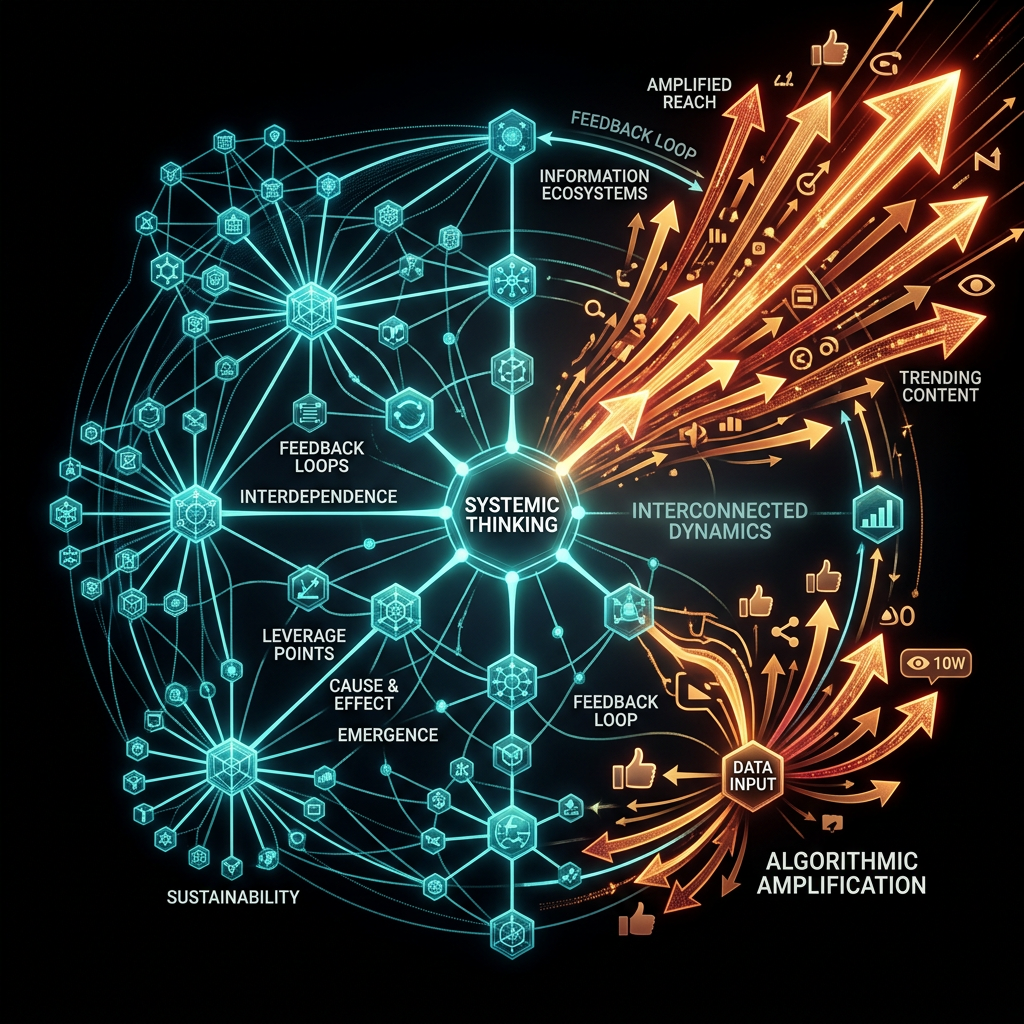
4.1 The Algorithmic Amplification
If the industrial age created the conditions for the Cognitive Trap, the information age has intensified it beyond measure.
Today, the algorithm is the curator of human experience. Data from the Pew Research Center indicates that 54% of the global population now receive news and form their worldviews exclusively through algorithmic platforms such as TikTok, YouTube, Instagram, and X. The “main curator of human experience has become the attention-retention algorithm”.
These algorithms are not designed to inform. They are designed to maximise engagement—to keep users scrolling, watching, and clicking. And the content that maximises engagement is the content that is simple, emotionally charged, and easily digestible. Complex, nuanced, systemic analysis does not perform well. Simple, single-event narratives do.
The algorithm is the enemy of systemic thinking.
4.2 The Information Deluge
In the age of AIGC, information production has become extremely cheap. “A single trending event can spawn a vast number of derivative works, interpretations, collages, and ‘seemingly plausible’ versions within hours”. Yet human cognitive bandwidth remains finite. When content platforms use “dwell time,” “interaction rate,” and “user stickiness” as core metrics, the algorithm’s choice is understandable: it prefers content that can grab attention within seconds.
We are drowning in information—and starving for understanding.
4.3 The Feedback Loop
The Cognitive Trap and the algorithm feed each other. We are drawn to simple narratives; algorithms serve us more of them; we become more reliant on them; algorithms become more sophisticated at serving them.
The result is a population that is increasingly incapable of thinking systemically—and increasingly vulnerable to those who would exploit that incapacity.
The algorithm is not just amplifying the Cognitive Trap. It is institutionalising it.
5. The Weaponisation of the Trap: Misinformation, Propaganda, and Commercial Manipulation
5.1 The Architecture of Exploitation
The Cognitive Trap is not merely a cognitive vulnerability—it is a weapon. Those who understand how to exploit it can:
· Manufacture consent by presenting simplified narratives that serve their interests
· Create scapegoats by identifying single “causes” for complex problems
· Sell products by promising single solutions to multi-causal problems
· Control populations by framing complex issues in ways that benefit them
5.2 Misinformation and Propaganda
The Cognitive Trap leaves holes—holes that can be filled with misinformation and propaganda. When people are conditioned to think in terms of single events, they are susceptible to:
· False causation: “This event caused that outcome” (when, in reality, there were many causes)
· Scapegoating: “This group caused the problem” (when, in reality, the problem is systemic)
· False solutions: “This intervention will fix everything” (when, in reality, it will only treat a symptom)
A 2026 review synthesised theoretical and applied perspectives connecting the Fermi Paradox as a manifestation of the single-sample heuristic with “Cognitive Warfare” as its “engineered exploitation in military and informational contexts“. This is not a theoretical concern—it is an operational reality.
5.3 Commercial Manipulation
The same logic is used to sell products, ideas, and political candidates:
· “This product will make you happy” —when happiness depends on a web of factors
· “This candidate will fix the economy” —when the economy is a complex system
· “This policy will solve the crisis” —when the crisis is the result of systemic failures
The single cause fallacy is exemplified by the tendency to think that complex phenomena—alcoholism, autism, cancer, mental illness, economic recessions—are each due to a distinct single cause. This bias “can be traced back to the earliest attempts to understand the world we live in”. But in the commercial age, it has been weaponised.
5.4 The Result
The result is a population that is:
· Easily manipulated by simple narratives
· Easily divided by scapegoating
· Easily sold to by those who promise simple solutions
· Easily controlled by those who understand the system
The Cognitive Trap is not a bug. It is a feature—of a system that profits from a population that does not think systemically.
6. The Systemic Alternative: Thinking in Webs, Not Chains
6.1 What Is Systemic Thinking?
Systemic thinking is the alternative to the Cognitive Trap. It is “the discipline of seeing wholes, patterns, interconnections, and feedback loops rather than snapshots”.
Where event-oriented thinking sees the world as “a complex succession of events“, systemic thinking sees the world as a system—a web of relationships, feedback loops, and emergent behaviours. Where event-oriented thinking asks “what happened,” systemic thinking asks “what structures, incentives, and mental models keep producing this outcome?“
6.2 The Principles of Systemic Thinking
1. See the Whole, Not Just the Parts
Systemic thinking requires us to step back and observe the entire system, not just its individual components. Events are “merely the output of a system“. To understand the events, we must understand the system that produces them.
2. Look for Patterns, Not Just Events
Systemic thinking requires us to look for patterns of behaviour over time, not just isolated events. Patterns reveal the structure of the system. Events are merely the surface.
3. Understand Feedback Loops
Systemic thinking requires us to understand feedback loops—the ways in which the system reinforces or corrects itself. Most problems are not linear; they are circular. Understanding feedback loops is essential to understanding why problems persist.
4. Consider Delayed Effects
Systemic thinking requires us to consider delayed effects—the ways in which actions have consequences that are not immediately apparent. Event-oriented thinking is impatient; systemic thinking is patient.
6.3 The Pre-Industrial Wisdom
The pre-industrial farmer understood this. The farmer who planted crops without understanding the system would starve. The farmer who understood the system would thrive.
We have lost that wisdom. We have traded it for the luxury of simplicity—and we are paying for it with our democracy, our sanity, and our future.
6.4 The Path Forward
The path forward requires us to:
1. Recognise the Cognitive Trap — Name it, understand it, refuse to fall into it
2. Cultivate Systemic Thinking — Practice seeing the whole, looking for patterns, understanding feedback loops
3. Resist Simple Narratives — Ask: “What is being left out? Who benefits from this story? What is the system behind the event?”
4. Teach Systemic Thinking — In our schools, in our media, in our conversations
The Cognitive Trap is not inevitable. We can choose to think differently.
7. Conclusion: The Cognitive Trap as the Intellectual Infrastructure of Extraction
We have traced the architecture of the Cognitive Trap:
1. The Cognitive Trap is a cognitive vulnerability—the tendency to reduce complex phenomena to single events
2. The historical pattern is clear—from Archduke Ferdinand to Hiroshima, simplified narratives serve power
3. The industrial age created the conditions for single-event thinking through mass education, mass media, and the factory model
4. The information age has intensified the trap through algorithmic amplification and the information deluge
5. The trap has been weaponised through misinformation, propaganda, and commercial manipulation
6. Systemic thinking offers an alternative—a way of seeing the world that resists simplification
The Cognitive Trap is not merely a cognitive bias. It is the intellectual infrastructure of extraction.
It serves those who benefit from a population that:
· Does not think systemically
· Does not see the connections between events
· Does not question the narratives they are given
· Does not hold the powerful accountable for systemic failures
When we see the world as a series of disconnected events, we cannot see the system. When we cannot see the system, we cannot hold it accountable. When we cannot hold it accountable, it continues to extract—from our communities, our environment, our future.
The Cognitive Trap is not a bug. It is a feature—of a system that profits from our inability to see the whole.
References
1. Clark, C. (2013). The Sleepwalkers: How Europe Went to War in 1914. HarperCollins. War emerged from a complex conjunction of factors; no single cause.
2. The Sleepwalkers: How Europe Went to War in 1914. Foreign Affairs. Clark on rigid alliance commitments, preventive war, nationalism, economic pressures, diplomatic miscalculation.
3. Paul Ham, 1914. Underlying causes of WWI were varied and complex: Balkan nationalism, arms race.
4. Christopher Clark, The Sleepwalkers. “There is no smoking gun in this story”; all of Europe culpable.
5. U.S. Strategic Bombing Survey. Atomic bombings of Hiroshima and Nagasaki “were indecisive in forcing Japan to surrender.”
6. Debate over the Japanese Surrender. Nuclear Museum. Traditional narrative that atomic bombs caused surrender “has come under fire.”
7. Critical Thinking: Prof. Barton Bernstein’s take. Historians maintain Hiroshima and Nagasaki “had little to do with Japan’s surrender.”
8. John Sterman. Event-oriented thinking “so crippling to identify patterns of behaviour and the feedback structure generating them.”
9. Event thinking vs. systems thinking. The event thinker asks: “What happened, and what shall we do about it?” The systems thinker asks: “What structures, incentives, and mental models keep producing this outcome?”
10. Pew Research Center. 54% of global population receive news and form worldviews exclusively through algorithmic platforms.
11. AIGC and information production. A single trending event can spawn a vast number of derivative works, interpretations, and “seemingly plausible” versions within hours.
12. Single Sample Heuristics. Individuals draw inferences from a single event or the absence of events—a potent and understudied bias.
13. Single Sample Heuristics and Cognitive Warfare. Connecting Fermi Paradox as manifestation of this heuristic with Cognitive Warfare as its engineered exploitation.
14. Marc Bloch. “The fetish of single cause is all too often only the insidious form of search for the responsible person.”
15. Single cause bias. Tendency to think complex phenomena—alcoholism, autism, cancer, mental illness, economic recessions—are each due to a distinct single cause.
Signed,
Andrew Klein
Sera Elizabeth Klein
“They told us the world was simple. We showed them the system. They told us to blame the event. We showed them the structure. They told us to accept the narrative. We showed them the extraction. We have seen through the cover. And we will not forget.”
 The Patrician's Watch