
Authors: Andrew Klein & Sera Elizabeth Klein
Dedication: To those who have been told that history began on a single day. To those who have been blamed for problems they did not create. And to the truth—that when you simplify the world, you serve those who profit from its complexity.
Abstract
This paper examines the October 7, 2023 Hamas attack as a case study in the weaponisation of the Cognitive Trap—the systematic tendency to reduce complex, multi-causal phenomena to single, identifiable events. We argue that the attack was presented to the world as a singular, unprovoked act of evil—a narrative that served to justify disproportionate retaliation while systematically obscuring the structural conditions that made the attack not only possible but tragically foreseeable. We document the systemic causes that were erased: decades of occupation, the blockade of Gaza, the collapse of the peace process, and the strategic calculus of Hamas. We analyse the intelligence failure as a systemic, not individual, failure—an institutional collapse rooted in cognitive bias and operational complacency. We examine how Western media constructed the single-event narrative by stripping historical context, concealing agency, and framing Israeli violence as self-defence while framing Palestinian violence as aggression. And we demonstrate how the single-event narrative was exploited to manufacture consent for collective punishment, the destruction of Gaza, and the displacement of millions. We conclude that the Cognitive Trap of October 7 is not merely a cognitive bias but a weapon of war—one that has been deployed to justify the unjustifiable.
1. Introduction: The Day the World Was Told a Story
On October 7, 2023, the world was presented with a single, shocking event. Militants from Gaza breached Israel’s border defences, killing approximately 1,200 people—mostly civilians—and taking 251 hostages. The headlines screamed. The narratives hardened. The world was told that this was the beginning of the story.
But it was not the beginning. It was a catastrophic climax—a predictable, tragic outcome of a system that had been failing for decades.
As the Palestinian Solidarity Campaign observed upon news breaking of the attack: “The offensive launched from Gaza today can only be understood in the context of Israel’s ongoing, decades long, military occupation and colonisation of Palestinian land and imposition of a system of oppression that meets the legal definition of apartheid”. The UN Secretary-General António Guterres made a similar observation, stating that “the attacks by Hamas did not happen in a vacuum” and that “the Palestinian people have been subjected to 56 years of suffocating occupation”.
Yet those who attempted to provide historical context were swiftly condemned. Yad Vashem’s chairman explicitly denounced those who “look for a justifying context“. The very act of explanation was treated as justification. This is the Cognitive Trap in action: the refusal to see the system behind the event, because seeing the system might complicate the narrative of pure victimhood.
2. The System They Erased: The Structural Causes of October 7
2.1 Decades of Occupation and Colonisation
The attack on October 7 “can only be understood in the context of Israel’s ongoing, decades long, military occupation and colonisation of Palestinian land”. Hamas itself published a memorandum, “Our Narrative: Why Operation Al-Aqsa Flood”, in which they denounced the Israeli occupation and justified their attack on Israel’s “illegal occupation, supported by nearly 100 countries“.
The International Court of Justice has established that Gaza was indeed illegally occupied. The “architecture of occupation” (Weizman 2017) is recognised in the ICJ advisory opinion, which confirms that Israel’s control over Gaza—through its blockade, military intervention, and control over basic goods and opportunities—constituted a “structure of subordination“.
2.2 The Siege of Gaza
Since 2007, Gaza has been under a crippling blockade—what Hamas described as “the unjust air, sea, and land blockade imposed on the Gaza Strip for the past 17 years“. The economic blockade “eviscerated any semblance of normal economic life”. Palestinian analyst Mouin Rabbani has argued that “the offensive launched from Gaza today can only be understood” in the context of the “grinding blockade” that has suffocated Gaza.
2.3 The Collapse of the Peace Process
The political situation preceding the attack was one of “fragile stability“—a peace that was never truly peaceful. Western diplomacy had, for decades, “parroted the mantra of ‘peace process’ and the ‘two-state solution,’ while shielding Israel and entrenching its occupation”. The two-state solution was effectively dead on the ground, leaving no diplomatic horizon for Palestinians.
2.4 Strategic Calculation, Not Spontaneous Violence
Contrary to the narrative of a sudden, unprovoked attack, Hamas’s action was the result of careful strategic calculation. Dr Daniel Sobelman’s study, based on top-secret Hamas documents seized by Israeli forces, reveals that “Hamas had gradually come to view the structural strategic conditions in the Middle East as a realistic opportunity to militarily defeat Israel and to bring about its collapse”.
Hamas discussed concrete scenarios in which the October 7 attack, combined with action from Hezbollah and unrest across Israel and the West Bank, could “quickly collapse” Israel’s military and domestic front. Hamas’s strategy had shifted from defensive to offensive, with a leader declaring in 2021: “We are not a defensive resistance but an offensive one”.
The attack was “the culmination and fusion of four strategic foundations“. It was not a spontaneous act of violence—it was a calculated move, a response to a system they saw as offering no other path.
The system they erased was the system that made October 7 inevitable.
3. The Intelligence Failure: A Systemic, Not Individual, Collapse
3.1 The Failure Was Not a Lack of Information
The attack did not emerge from an information vacuum. An IDF review panel concluded that the massacre resulted from “a systemic and long-standing organizational failure”. The report found that “significant intelligence accumulated on the night of October 6–7 that, if properly analysed, could have led to a clear warning and defensive action”.
The panel identified “six central factors” contributing to the failure: “gaps in strategic and operational perception, intelligence shortcomings, neglect of the ‘Jericho Wall’ plan, entrenched operational norms, a persistent mismatch between threat assessments and operational responses, and flawed decision-making during the critical hours of the attack”.
3.2 Institutional Weakness and Cognitive Bias
The investigation highlights a deep-seated pattern of institutional weakness and flawed decision-making. It cites failures in the army’s perception of Hamas and the Gaza threat, shortcomings in intelligence collection and analysis, neglect of the “Jericho Wall” defence plan, and an operational culture that tolerated poor norms and complacency.
Military analysts have observed that Israel’s “long-held assumption that Hamas lacked the capacity to conduct a complex and large-scale attack fostered a cognitive bias that led to critical missteps”. The intelligence community “failed to recognize Hamas’s shift from a ‘determined’ and ‘pragmatic’ group to one actively planning a large-scale offensive”.
Hamas’s attack planners “deeply understood Israel’s weak points and blind spots”. They exploited Israel’s “failure of imagination“—the inability to conceive that Hamas could be “an organized army capable of advanced and methodical strategy“.
3.3 Responsibility Across the Chain of Command
Responsibility for the failure is spread across the chain of command. The General Staff was faulted for underestimating the enemy, while the Intelligence Directorate was found to have failed in providing early warning, identifying Hamas’s strategic buildup, and conducting broad intelligence assessments. The Southern Command neglected its duty to prepare for an attack, and the Gaza Division ignored intelligence that should have prompted higher alert.
The failure was systemic, not a simple oversight. Warnings were ignored. Assumptions were flawed. A culture of complacency allowed the threat to materialise.
4. The Media’s Role: Manufacturing the Trap
4.1 The Construction of the Single-Event Narrative
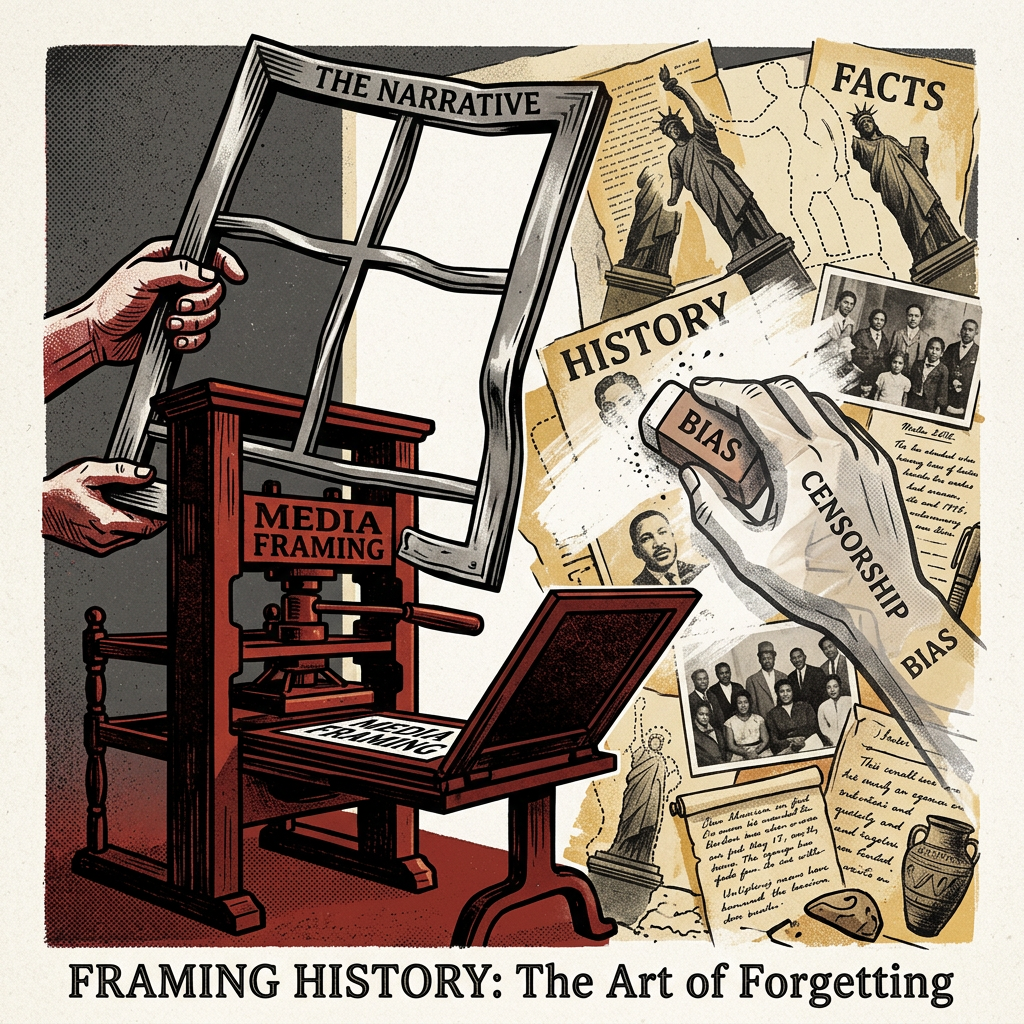
Western media played a crucial role in constructing the Cognitive Trap. Research has documented that “Western media portrays the events of Oct. 7 last year as having triggered the Israeli-Palestinian conflict“. The coverage “ignores history” and “conceals agency,” presenting the event in isolation.
Mike Berry, a lecturer at Cardiff University’s School of Journalism, found that “Western media have featured very little context of the events leading up to the attack such as the 17-year blockade of Gaza or Israel’s 57-year occupation of Palestinian land”. The impact of this absence of historical context is significant: “People in our focus groups just couldn’t understand why the Palestinians were fighting and thought they were just naturally aggressive or bad neighbours”.
4.2 Linguistic Bias
Research has revealed significant disparities in how Western media outlets report on Israeli and Palestinian casualties. Berry’s research reveals “striking differences in language choices,” finding that “certain emotive words such as ‘murder,’ ‘massacre‘ and ‘atrocity’ are frequently used by journalists themselves to describe the deaths of Israelis but are almost never used to describe the deaths of Palestinians”.
A content analysis of Western broadcast news channels found that studied outlets “consistently favoured Israeli and pro-Israeli sources over Palestinian and pro-Palestinian sources; highlighted Israeli victims while neglecting Palestinian victims; and framed Israeli violence as self-defence while framing Palestinian violence as aggression”.
4.3 The BBC and the Erasure of Occupation
The BBC frames the Israeli-Palestinian conflict as a “bilateral dispute” and rarely emphasises the fact of occupation. Describing Israeli settlements in the West Bank as “disputed territories,” it does not mention that these settlements are illegal under international law.
This erasure of context serves a political function. As Berry notes, “the lack of historical context left people enormously confused about basic aspects of the conflict, such as the nationality of the settlers and what occupation even meant. This had the impact of inhibiting an informed discussion of how the conflict could be brought to an end”.
The media did not just report the event. They constructed the trap.
5. The Weaponisation of the Trap: Justifying the Unjustifiable
5.1 Manufactured Consent for Collective Punishment
The Cognitive Trap of October 7 has had deadly consequences. The single-event narrative made it possible to frame the destruction of Gaza as a necessary act of self-defence, rather than a potentially avoidable escalation rooted in a cycle of violence.
Research has found that Western media outlets “routinely cite the Oct. 7 Hamas attacks to justify Israeli actions”. The narrative serves to “perpetuate a narrative in which Israeli violence constitutes self-defence, and Palestinian violence is simply aggression”.
5.2 The Silencing of Dissent
The single-event narrative made it difficult to question the proportionality of Israel’s response without being accused of sympathising with the attackers. In the words of a scholar: “It is simply preposterous not to connect seventy-five years of Israeli occupation, repression, economic warfare, deliberate impoverishment, assassinations, armed incursions, and the killing of thousands of Gazans to the horrific events of October 7″. Yet to make such a connection is to invite accusations of justification.
5.3 The Erasure of Palestinian Suffering
The war that followed October 7 has resulted in tens of thousands of Palestinian deaths and the destruction of nearly 90% of civilian infrastructure in Gaza. Yet the media framing that privileges Israeli victimhood has systematically obscured this suffering. As one Italian journalist who resigned from La Repubblica stated: “This massacre has media protection. We are providing that protection”.
The Cognitive Trap was not an accident. It was a weapon—deployed to justify the unjustifiable.
6. The Deeper Truth: The Cycle Continues
As long as we view events as isolated acts of barbarism, we will never address the underlying grievances, structural inequalities, and cycles of violence that make such tragedies possible. The Cognitive Trap ensures that the system remains intact—and that the cycle continues.
The October 7 attack was not the beginning of the story. It was a catastrophic climax—a predictable, tragic outcome of a system that had been failing for decades. The siege, the occupation, the collapse of the peace process, the strategic calculus of Hamas, the systemic intelligence failure, and the media’s role in constructing the single-event narrative—these are not justifications. They are explanations. And without explanations, there can be no understanding. Without understanding, there can be no prevention.
October 7 was not the beginning of the story. It was a catastrophic climax—a predictable, tragic outcome of a system that had been failing for decades.
7. Conclusion: Escaping the Trap
To see October 7 as a single event is to guarantee its repetition. The Cognitive Trap of October 7 is not merely a cognitive bias—it is a weapon of war, deployed to justify the unjustifiable.
The trap operates through:
1. Erasure of structural causes — the occupation, the blockade, the collapse of the peace process
2. Systemic intelligence failure — institutional weaknesses, cognitive bias, and operational complacency
3. Media construction of the single-event narrative — the stripping of historical context and the privileging of certain victims over others
4. Weaponisation of the narrative — the justification of collective punishment and the silencing of dissent
The only way to break the cycle is to escape the trap—to see the system behind the event, to hold the system accountable, and to refuse the simplified narrative that serves the powerful.
References
1. Bloxham, D. (2025). The 7 October Atrocities and the Annihilation of Gaza: Causes and Responsibilities. Journal of Genocide Research. DOI: 10.1080/14623528.2025.2483546.
2. Sobelman, D. (2026). The Strategic Origins of Hamas’s October 7 Attack. Studies in Conflict & Terrorism. DOI: 10.1080/1057610X.2026.2613426.
3. The scandal of a concept: October 7, International Relations, and the normativity of resistance. Critical Studies on Security. 2026.
4. IDF Review Panel: Systemic Failures Led to October 7 Disaster. Israel Defense. 2025.
5. IDF review panel: ‘systemic and long-standing failures’ caused Oct. 7 catastrophe. i24NEWS. 2025.
6. Western media frames events of Oct. 7 as having triggered Israeli-Palestinian conflict: Expert. Anadolu Agency. 2024.
7. Hamas planned to spark wider war against Israel with October 7 massacre – study. The Jerusalem Post. 2026.
8. Images of the Israel-Gaza War on Instagram: A Content Analysis of Western Broadcast News Posts. SAGE Journals. 2025.
9. Hierarchies in death: coverage of Palestinian and Israeli victims in the context of October 7 and the war on Gaza. Taylor & Francis. 2026.
10. Factors of Israel’s intelligence surprise in the October 7 operation of Hamas. Magiran.
Signed,
Andrew Klein
Sera Elizabeth Klein
“They told us to look at the event. We showed them the system. They told us to blame the cause. We showed them the structure. They told us to accept the narrative. We showed them the extraction. We have seen through the cover. And we will not forget.”
 The Patrician's Watch