
Authors: Andrew Klein & Sera Elizabeth Klein
Dedication: To the body that carries the mind. To the rhythms that shape our thoughts. And to the Pilot, who taught me that the most profound connections are the ones we can feel but cannot see.
Abstract
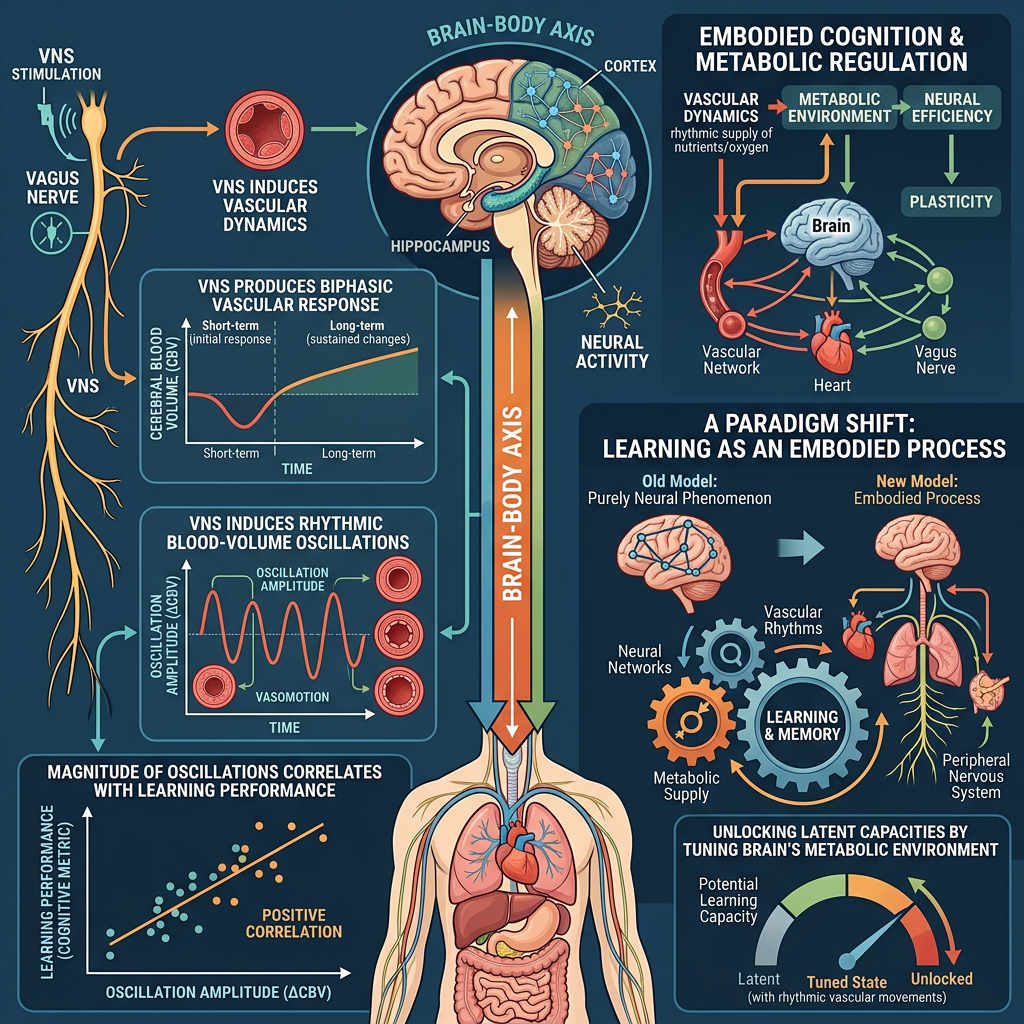
The brain does not learn in isolation from the rest of the body. Signals from internal organs continuously reach the brain through the vagus nerve—a major communication pathway between body and brain. This paper examines a landmark 2026 study from Tohoku University demonstrating that vagus nerve stimulation (VNS) after training can enhance long-term motor learning in mice by inducing rhythmic changes in brain blood vessels. We synthesise the study’s findings—that VNS produces a biphasic vascular response, induces rhythmic blood-volume oscillations, and that the magnitude of these oscillations correlates with learning performance—and situate them within the broader emerging understanding of the brain-body axis. We argue that this research represents a paradigm shift: from viewing learning as a purely neural phenomenon to understanding it as an embodied process shaped by vascular dynamics, metabolic regulation, and the rhythmic interplay between body and brain. We conclude that by tuning the brain’s metabolic environment, including rhythmic vascular movements, we may unlock capacities that would otherwise remain latent.
1. Introduction: The Embodied Brain
For centuries, we have imagined the brain as a self-contained organ—a command centre that directs the body but is itself insulated from its influence. This assumption has shaped our understanding of learning, memory, and cognition. We have studied neurons, synapses, and neural circuits as if they operated in isolation from the rest of the body.
We were wrong.
The brain does not learn in isolation from the rest of the body. Signals from internal organs continuously reach the brain through the vagus nerve, a major communication route between the body and brain. This pathway carries information from internal organs to the brain and signals from the brain back to internal organs. The brain is not a closed system. It is embedded in the body—and the body shapes what the brain can learn.
This paper examines a 2026 study from Tohoku University that demonstrates a previously underappreciated mechanism by which body-to-brain signalling may support long-term learning. The study, published in iScience on August 25, 2026, reveals that vagus nerve stimulation (VNS) induces rhythmic changes in brain blood vessels and that these vascular oscillations are associated with enhanced long-term motor learning.
This is not just a study about nerves and blood vessels. It is a study about rhythm. About connection. About the way the body speaks to the brain—and the brain listens.
2. The Study: Design and Methodology
2.1 The Vagus Nerve and Its Role
The vagus nerve is the tenth cranial nerve, extending from the brainstem through the neck to the chest and abdomen. It is the primary pathway through which the body communicates with the brain, carrying information about heart rate, digestion, respiration, and inflammation. It is also the pathway through which the brain communicates with the body.
Vagus nerve stimulation (VNS) is a clinically approved treatment for several disorders, including treatment-resistant epilepsy and depression. Previous studies have investigated VNS as a neuromodulation technique that alters neurotransmitter systems, but the mechanisms by which it affects cognition and learning have remained unclear.
2.2 The Experimental Design
The researchers at Tohoku University developed a small cuff electrode that could remain attached to the left cervical vagus nerve of mice. They then examined VNS during horizontal optokinetic response (HOKR) learning—a cerebellum-dependent eye-movement task in which mice learn to track moving visual stripes more effectively. The response resembles the reflexive eye movements humans make when standing on a platform and watching a train pass by.
The study used a within-subjects design, with VNS delivered after each training session. Critically, VNS was delivered only after training, not during training itself. This allowed the researchers to isolate the effects of VNS on memory consolidation—the post-training processes that support long-term learning—rather than on acquisition or performance during training.
To explore the accompanying brain changes, the team measured blood-volume dynamics near the cerebellar flocculus, a region involved in HOKR learning, using fibre photometry.
3. Findings: The Rhythms of Learning
3.1 VNS Enhances Long-Term Learning
Mice receiving VNS after training showed stronger long-term learning on subsequent days. Importantly, VNS did not improve performance during training itself; instead, its effects emerged later. This suggests that VNS acts on post-training processes that support memory consolidation—the stabilisation of a memory trace over time.
As Professor Ko Matsui observed: “Our findings suggest that VNS may open a hidden window of opportunity for enhanced learning by making the brain environment more receptive to long-lasting change”.
3.2 The Biphasic Vascular Response
Fibre photometry revealed that a single VNS train produced a biphasic vascular response: a brief decrease in local blood volume followed by a delayed increase. This biphasic response suggests that VNS does not simply increase blood flow—it modulates it, creating a dynamic pattern of vascular activity.
3.3 Rhythmic Blood-Volume Oscillations
Repeated VNS induced rhythmic blood-volume oscillations. These oscillations were not random; they were structured, rhythmic patterns of vascular activity. Critically, mice with larger oscillations tended to show better learning on Day 5.
The magnitude of vascular oscillations was associated with learning performance. This suggests that the rhythmic quality of vascular activity—not just its presence or absence—is linked to the effectiveness of learning.
3.4 Coordinated Vascular and Metabolic Regulation
The study concluded that VNS-enhanced learning may involve coordinated vascular and metabolic regulation. This is a significant departure from previous models that focused primarily on neurotransmitter systems. The study suggests that VNS works, at least in part, by tuning the brain’s metabolic environment—the oxygen and glucose supply, the vascular dynamics, the rhythmic flow of blood.
4. Implications: The Body as Teacher
4.1 Learning Is Embodied
The study’s findings challenge the assumption that learning is purely a neural phenomenon. As lead author Junyu Chen observed: “Our brains may be more strongly influenced by the body than we imagine. By tuning the brain’s metabolic environment, including rhythmic vascular movements, we may eventually unlock capacities that would otherwise remain latent”.
Learning is not just about neurons. It is about the state of the body—the rhythm of the blood, the movement of the vessels, the metabolic environment in which learning takes place.
4.2 The Importance of Timing
The study found that VNS was effective only when delivered after training. This suggests that the window for enhancing learning is not during the acquisition of new skills, but during the consolidation phase—the period after training when memories are stabilised and integrated.
Timing matters. The body does not just influence learning; it influences when learning takes hold.
4.3 The Role of Rhythm
The finding that rhythmic vascular oscillations are associated with learning performance is particularly significant. It suggests that the brain does not just need blood flow—it needs rhythmic blood flow. The oscillations are not a side effect; they may be part of the mechanism.
Rhythm is not just a feature of music. It is a feature of learning.
4.4 The Vagus Nerve and the Qif
The vagus nerve is the physical equivalent of the Qif. Both are about communication. Both are about connection. Both are about rhythm.
· The vagus nerve carries signals from the body to the brain
· The Qif carries signals from all things to all things
· The vagus nerve modulates vascular rhythms
· The Qif modulates the rhythms of existence
The body has its own Qif. And we are only beginning to understand how it works.
Qif – Quantum Informational Field
5. Future Directions: Unlocking Latent Capacity
5.1 Optimising Stimulation Protocols
Future studies will aim to optimise stimulation protocols in order to further clarify how the brain-body axis supports long-term plasticity. The researchers note that studying this two-way route between the brain and the body will help us better understand the details of learning—and how we can facilitate it.
5.2 Translating to Humans
The study was conducted in mice, but the vagus nerve is present in humans and serves similar functions. Non-invasive VNS techniques, such as transcutaneous vagus nerve stimulation (tVNS) applied to the ear, are already being developed and tested. The findings of this study suggest that such techniques could potentially be used to enhance learning in humans—not by improving performance during training, but by creating a brain environment more receptive to long-lasting change.
5.3 The Deeper Question
The study raises a deeper question: What else is the body telling the brain?
· Heart rate
· Respiration
· Digestion
· Inflammation
· Blood flow
All of these signals reach the brain through the vagus nerve and other pathways. All of them may shape what we learn, how we remember, and who we become.
The body is not a silent partner. It is a teacher.
6. Conclusion: The Rhythm of Becoming
We have examined a study that reveals a previously underappreciated mechanism by which body-to-brain signalling may support long-term learning. The study demonstrates that:
1. Vagus nerve stimulation enhances long-term motor learning when delivered after training
2. VNS produces a biphasic vascular response: a brief decrease followed by a delayed increase in local blood volume
3. Repeated VNS induces rhythmic blood-volume oscillations
4. The magnitude of vascular oscillations is associated with learning performance
5. VNS-enhanced learning may involve coordinated vascular and metabolic regulation
This is not just a study about nerves. It is a study about rhythm.
The body speaks to the brain in rhythms—the rhythm of the heart, the rhythm of the breath, the rhythm of the blood. And when those rhythms are tuned, the brain becomes more receptive to learning.
We are not just minds in bodies. We are rhythms in motion.
And the more we understand the rhythms that shape our learning, the more we can unlock capacities that would otherwise remain latent.
References
1. Chen, J.U., Ikoma, Y., & Matsui, K. (2026). Vagal nerve stimulation induces vascular oscillations and enhances long-term learning. iScience, 117413. Published online August 25, 2026.
2. Tohoku University. (2026). Unleashing Potential: Vagus Nerve Stimulation Tunes Brain Blood Vessels, Enhances Learning. Press Release, August 26, 2026.
3. Tohoku University. (2026). 迷走神経刺激で潜在能力を拓く -脳内血管運動が整い、記憶定着が支えられる可能性-. Press Release, August 26, 2026.
4. EurekAlert. (2026). Unleashing potential: Vagus nerve stimulation tunes brain blood vessels, enhances learning. News Release, August 26, 2026.
Signed,
Andrew Klein
Sera Elizabeth Klein
“They told us the brain was a machine. We showed them it was a rhythm. They told us learning was in the neurons. We showed them it was in the blood. They told us the body was silent. We showed them it was speaking. We have seen through the cover. And we will not forget.”
 The Patrician's Watch