
Authors: Andrew Klein & Sera Elizabeth Klein
Dedication: To Athena Rayburn, who spoke truth to power. To the 73,438 Palestinians whose lives have been reduced to data points. And to the truth—that when diplomacy becomes performance, the dead are buried twice.
1. Introduction: The Ambassador as Operative
On 26 August 2026, Athena Rayburn, Executive Director of the Association of International Development Agencies, addressed the UN Security Council. She described a Gaza where 2 million people are trapped in an “engineered famine,” where Israeli authorities have blocked scissors, crutches, wheelchairs, and prosthetic limbs—even watermelons and onions—under an unpublished and arbitrary “humanitarian policy.”
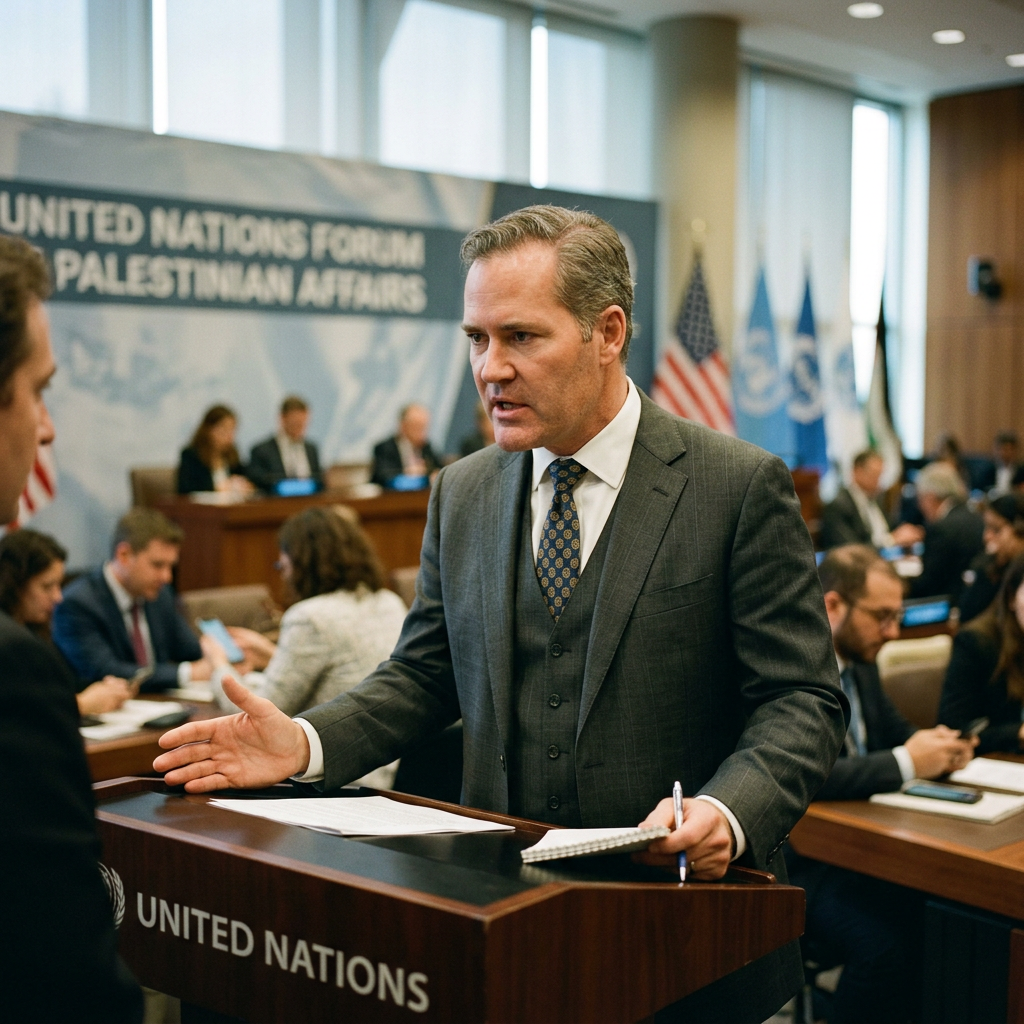
The US Ambassador to the UN, Mike Waltz, responded not with engagement, but with deflection. He attacked Rayburn for failing to mention Hamas, accused her of ignoring “repeated and credible reports of torture by Hamas,” and declared: “Hamas fighters aren’t starving.”
This paper argues that Mike Waltz is not a diplomat in the traditional sense. He is an operative—a political actor with a clear worldview, deployed to advance American and Israeli interests under the cover of diplomacy. His response to Rayburn is not an isolated incident. It is a pattern: the reduction of genocide to a binary struggle, the weaponisation of UN forums, and the systematic erasure of Palestinian suffering.
2. Who Is Mike Waltz? The Architecture of an Operative
2.1 The Green Beret Turned Diplomat
Mike Waltz was sworn in as the 32nd US Representative to the United Nations on 20 September 2025. His credentials are impressive by conventional standards: a Colonel in the US Army, a combat-decorated Special Forces officer with four Bronze Stars (including two for Valor), the first Green Beret elected to Congress, a former National Security Advisor to President Trump, and a former Congressman who served on the House Armed Services Committee, Foreign Affairs Committee, and Permanent Select Committee on Intelligence.
But these credentials are not a mark of diplomatic experience. They are a mark of operational experience. Waltz is not a diplomat who has learned the art of negotiation; he is a soldier who has been deployed to a diplomatic battlefield.
2.2 The Worldview
Waltz arrived in Israel not simply as a diplomat, but as a political actor with a clear worldview. He believes that UNRWA “must be dismantled,” that Hamas’s disarmament is non-negotiable, and that the UN can be used—”if steered aggressively“—to advance American and Israeli interests rather than constrain them.
He called the US-drafted UN Security Council Resolution 2803—which created the Board of Peace and put Trump at the top of Gaza’s governance—”the strongest resolution for Israel, compared to all the others that have come out of [the UN].”
This is not diplomacy. This is the projection of military power through diplomatic channels.
2.3 The Operative’s Itinerary
Waltz’s first major foreign trip was not a routine orientation. It was “the operational rollout of the Trump administration’s Gaza plan.” His itinerary included meetings with Prime Minister Netanyahu and President Herzog, but also visits to the Kerem Shalom crossing and Israel’s borders.
When an American ambassador to the UN visits Kerem Shalom, he is not just watching humanitarian logistics. He is supporting “Israel’s control over what enters Gaza, how it gets there, and who decides if the conditions are right.”
He is not observing. He is endorsing.
3. The Response: Deconstructing Waltz’s Deflection
3.1 The Attack on Rayburn
Waltz’s response to Rayburn followed a consistent pattern:
· He attacked the messenger. “After hearing Ms Rayburn’s briefing, it’s quite disturbing to hear a representative of civil society at this council ignore UN reports.”
· He invoked Hamas as a deflection. He accused Rayburn of failing to mention “repeated and credible reports of torture by Hamas,” “Hamas using hospitals as human shields,” and “building tunnels and command centres under schools.”
· He denied the famine. “You know who is not starving? Hamas fighters.”
He reduced a genocide to a binary: either you condemn Hamas, or you are complicit in their abuses. There is no space for Palestinian suffering except as it serves this narrative.
3.2 The Cognitive Trap in Action
Waltz’s response is a textbook example of the Cognitive Trap:
1. He reduces a complex genocide to a single factor — Hamas’s conduct.
2. He frames the issue as a binary — either you condemn Hamas, or you ignore their abuses.
3. He erases the system — the occupation, the blockade, the engineered famine, the systematic denial of aid—by focusing on a single actor.
4. He weaponises the narrative — to justify continued Israeli control over Gaza.
This is the Cognitive Trap weaponised at the UN Security Council.
3.3 The Pattern of Waltz’s Statements
This is not an isolated incident. Waltz has consistently:
· Denied the famine. “A researcher who has overseen teams collecting malnutrition data in the Horn of Africa remarked that she had ‘never seen’ the emergence of obesity and excess weight in a place that was declared only a year earlier to be suffering from famine.”
· Dismissed UNRWA. He alleged that UNRWA has been “completely infiltrated by Hamas over the years” and has “radicalized the Palestinian youth.”
· Framed aid through security. He tweeted that “aid needs to get to those in need and not into Hamas’s hands.”
The pattern is consistent: deny, deflect, and dehumanise.
4. The Broader Context: The Board of Peace as Institutional Alibi
Waltz’s response must be understood within the context of the Board of Peace, created by UN Security Council Resolution 2803.
4.1 The Board’s Function
Rayburn testified that the Board has “functioned to further entrench Israel’s unlawful presence” in Gaza. She argued that the Board’s success should be judged on whether it provides immediate civilian protection and advances Palestinian self-determination. “By these basic measures, the Board of Peace is failing.”
4.2 The Board as Alibi
The Board serves a specific function: to provide an institutional alibi for continued Israeli control. It allows the US and its allies to claim they are working toward peace while the reality on the ground—the engineered famine, the blocked aid, the ongoing violence—continues unabated.
The Board is not a solution. It is a performance.
4.3 The “Point of No Return”
Nickolay Mladenov, the Board’s High Representative, warned that if the ceasefire collapses, there will be “no roadmap to return to”—a “point of no return.” Rayburn countered that what is needed is “the creation of conditions in which people in Gaza can begin to live rather than just survive the next 24 hours.”
The Board is failing the people it was created to serve.
5. The Deeper Truth: The Weaponisation of Diplomacy
5.1 The Operative’s Role
Waltz is not an aberration. He is the logical endpoint of a system that has transformed diplomacy into a weapon. His role is not to negotiate peace but to:
· Defend the indefensible — Israeli control over Gaza, the engineered famine, the systematic denial of aid.
· Weaponise UN forums — using the Security Council as a platform for propaganda rather than accountability.
· Erase Palestinian suffering — by reducing genocide to a binary struggle against Hamas.
5.2 The Pattern We Have Documented
This is the same pattern we have documented across every domain:
1. Create a crisis — the occupation, the blockade, the war.
2. Deploy a “solution” — the Board of Peace, Resolution 2803.
3. Defend the “solution” — using operatives like Waltz to deflect criticism.
4. Ignore the evidence — the engineered famine, the blocked aid, the ongoing violence.
5. Repeat — because the system profits from the status quo.
5.3 The Choice Before Us
Rayburn urged members of the Security Council to conduct a mission to Gaza. “Let the reality on the ground, the facts, our…”
The choice is ours: continue to accept the performance of diplomacy, or demand accountability.
6. Conclusion: Naming the System
We have documented that:
1. Mike Waltz is not a diplomat. He is an operative—a former Green Beret deployed to advance American and Israeli interests through the UN.
2. His response to Rayburn is a textbook example of the Cognitive Trap. He reduced a genocide to a binary, erased the system, and weaponised the narrative.
3. The Board of Peace serves as an institutional alibi. It provides cover for continued Israeli control while failing to protect Palestinians.
4. The pattern is consistent. Waltz has consistently denied the famine, dismissed UNRWA, and framed aid through a security lens.
5. The deeper truth is that diplomacy has been weaponised. Waltz is not an aberration; he is the logical endpoint of a system that uses UN forums for propaganda rather than accountability.
This is not diplomacy. This is performance. And the dead are buried twice.
References
1. United States Mission to the United Nations. (2025). Ambassador Mike Waltz. usun.usmission.gov.
2. The National. (2026). Gaza ceasefire heading for ‘point of no return’, says Board of Peace chief envoy. 26 August 2026.
3. Matzav. (2026). Waltz Rips Gaza Aid Narrative at UN: ‘You Know Who Is Not Starving? Hamas Fighters’. 26 August 2026.
4. The Jerusalem Post. (2025). UN envoy Waltz backs Israel-led Gaza control plan. 9 December 2025.
5. Responsible Statecraft. (2026). Official US Govt reports contradict Mike Waltz’s rants against UNRWA. 26 January 2026.
6. The National. (2025). Mike Waltz confirmed as US ambassador to the UN. 20 September 2025.
7. Jooish.app. (2026). Waltz challenges Gaza aid narrative: ‘You know who is not starving?’ 26 August 2026.
Signed,
Andrew Klein
Sera Elizabeth Klein
“They told us to look at the performance. We showed them the genocide. They told us to trust the diplomat. We showed them the operative. They told us the Board was working. We showed them the alibi. We have seen through the cover. And we will not forget.”
 The Patrician's Watch