Early humans move through a sunlit African landscape divided by a dramatic rocky ravine.
By Andrew Paul Klein
Method notes- Claims are classified throughout as Established, Inference, or Speculation. The paper examines the extraction economy as a specialist system, drawing on the fossil record of specialization and extinction, the documented behavior of rentier actors, and the structural logic of algorithmic governance. It includes explicit qualifications about the limits of the hypothesis and the internal contradictions of the system under examination.
Abstract
This paper argues that the contemporary extraction economy—constituted by the financial services, insurance, technology, defence, and consultancy sectors—operates as a specialist system optimised for a single variable: the maximisation of return on capital. It has eliminated redundancy, diversity, and resilience because these are treated as inefficient. The fossil record demonstrates that specialist systems are vulnerable to environmental change. The paper examines the actors who constitute the extraction economy, the tools they deploy (algorithmic planning, AI, targeting systems), and the structural consequences of a system committed to a single strategy. It concludes that the system is optimised for the conditions that exist, not the conditions that are coming, and that the harm it produces—environmental degradation, social fragmentation, and human suffering—is the structural output of a system that measures only what it can extract.
1. Introduction: The Specialist and the Generalist
The fossil record tells a consistent story. Specialists thrive in stable conditions. Generalists survive when conditions change.
Paranthropus robustus was a specialist. Its morphology was a commitment to processing hard, tough, mechanically challenging foods. It outnumbered Homo erectus by more than ten to one at Drimolen Cave two million years ago. It was the dominant form. It went extinct.
Homo erectus was a generalist. Smaller teeth, larger brain, broader diet including meat. It was less efficient at processing any one food source. But it could switch. It survived.
The pattern is not limited to hominins. Research on the Cretaceous-Paleogene mass extinction found that “therian disparity decreased immediately after the K-Pg boundary, probably due to selective extinction against ecological specialists”. The survivors were “eutherian dietary generalists.” Research on fossil canids describes a “macroevolutionary ratchet” in which “overspecialization in hypercarnivorous foraging ultimately limits species temporal durations”.
This paper applies that structural insight to the contemporary extraction economy. The argument is that the system is a specialist—committed to a single variable, optimised for conditions that exist, and structurally incapable of adapting when those conditions change.
2. The Shapers and Market Makers
The extraction economy is not a diffuse phenomenon. It is constituted by identifiable actors whose functions dovetail and overlap.
2.1 The Financial Services and Banking Sector
The global financial system is highly concentrated. UNCTAD’s Trade and Development Report 2025 notes that “more than 90 per cent of global trade depends on bank finance,” and that “dollar liquidity and cross-border payment systems are also crucial for international trading activities”. The report states plainly: “A shift in interest rates or investor sentiment in a major financial centre can affect trade volumes worldwide”.
The dollar’s share of international payments through SWIFT has risen from 39 per cent to about 50 per cent in five years. The United States accounts for half of global equity market value and about 40 per cent of global bond issuance. This concentration is not incidental. It is the architecture of the extraction system.
2.2 The Insurance Industry
Insurance is the silent partner. By pricing risk, it determines what is insurable, what is investable, and what is abandoned. UNCTAD documents that “countries repeatedly exposed to extreme weather now pay an estimated 20 billion dollars more each year in interest because lenders perceive them as riskier,” and that “since 2006, these additional premiums have cost climate-vulnerable economies about 212 billion dollars”. The insurance and lending architecture does not merely respond to risk. It creates it, by making vulnerable regions uninvestable.
2.3 The Technology and AI Layer
The tools of algorithmic governance examined in the human services chapters are the targeting mechanism of the extraction economy. Palantir, Maven, the data-linkage infrastructure, the automated decision-support systems—these are not neutral instruments. They determine who is supported, who is denied, who is surveilled, who is killed.
2.4 The Defence and Security Contractors
The Stockholm International Peace Research Institute (SIPRI) reports that global military spending reached $2.887 trillion in 2025, the eleventh consecutive year of increase. The United States alone accounted for 33 per cent of the world total. The U.S. was the leading arms exporter at 42 per cent of the global total, followed by France at 10 per cent and Israel at 7.8 per cent.
The defence sector profits from instability. It is not separate from the extraction economy. It is the mechanism by which instability is monetised.
2.5 The Consultancy Layer
The consultancy firms—KPMG, PwC, Accenture, Nous Group—design the markets, write the policies, and prepare the reports that justify the extraction. They are accountable to the department, not the citizen. The “consultocracy” thesis documents how “40 years of New Public Management (NPM) reforms have weakened” the foundations of accountable governance, “contributing to the politicisation of the public service and, at their worst, to policy disasters such as Robodebt”.
3. The Specialist System
3.1 The Single Variable
The extraction economy is a specialist. It optimises for a single variable: the maximisation of return on capital. Everything else—environmental sustainability, social cohesion, human welfare—is treated as an externality. The system does not measure these things because they are not the point.
The evidence for this is documented. Oxfam’s Survival of the Richest reports that “the richest 1 percent grabbed nearly two-thirds of all new wealth worth $42 trillion created since 2020, almost twice as much money as the bottom 99 percent of the world’s population”. During the past decade, “the richest 1 percent had captured around half of all new wealth”.
The system concentrates wealth at the top while “at least 1.7 billion workers now live in countries where inflation is outpacing wages, and over 820 million people—roughly one in ten people on Earth—are going hungry”. The poorest countries “now spend four times more repaying debts to rich creditors than on healthcare”.
This is not a failure of the system. It is the system working as designed.
3.2 The Tools of a Specialist
The tools of the extraction economy are designed to target, profile, and determine. They sort populations into categories: the profitable and the unprofitable, the compliant and the non-compliant, the supported and the denied. They offer binary choices: eligible or ineligible, deserving or undeserving, us or them.
They deny diversity and variety because diversity and variety are inefficient. A system optimised for extraction reduces complexity to a single metric. It flattens the bush into a ladder. It eliminates the branches that do not produce.
3.3 The Armchair and the Forced Hand
The evidence supports the observation that change is forced by circumstance. P. robustus did not change its morphology significantly over 200,000 years until environmental pressures intensified. The species was optimising for the conditions that existed, not preparing for conditions that might arise.
The same pattern applies to the extraction economy. It is optimising for the conditions that exist. It is not preparing for the conditions that are coming.
4. The Historical Precedent
The fossil record is unambiguous. Specialists perish when the environment changes.
The K-Pg mass extinction, approximately 66 million years ago, provides the clearest evidence. Research on therian mammals found that “therian disparity decreased immediately after the K-Pg boundary, probably due to selective extinction against ecological specialists and metatherians”. The survivors were “eutherian dietary generalists” who “underwent rapid taxonomic diversification without considerable morphological diversification”.
The canid fossil record provides a detailed case study. Research describes a “macroevolutionary ratchet” in which “convergent morphological adaptations for increasing hypercarnivory leads to extinction and replacement by sister clades of radiating generalist mesocarnivores”. Overspecialisation “ultimately limits species temporal durations”.
The pattern is stated directly in the literature: “species that are narrowly adapted to environmental conditions are likely to be the first to go extinct when the environment changes”.
The specialist thrives in stable conditions. The specialist perishes when conditions change. And the conditions are changing.
5. The Doomed Paradigm
5.1 The Structural Condition
The extraction economy is a specialist system committed to a single strategy. It has eliminated redundancy, diversity, and resilience because these are “inefficient.” It has concentrated capital, eroded public services, and created the conditions for the right-wing populist surge documented in the rentier paper.
It is optimising for the conditions that exist. It is not preparing for the conditions that are coming.
5.2 The Changing Environment
The environment is changing. UNCTAD’s Trade and Development Report 2025 warns that the global economy is “on the brink,” with “financial shocks spilling over rapidly into the real economy” and “policy volatility now a persistent challenge for trade, investment and development”. Global growth is forecast to slow to 2.6 per cent in 2025, down from 2.9 per cent in 2024.
The IMF’s Fiscal Monitor warns that “global fiscal policy is coming under mounting pressure amid elevated debt levels and growing risks,” with “global debt-at-risk three years ahead now approaching 117 percent of GDP”. The report notes that “the outbreak of conflict in the Middle East has added a new source of fiscal pressure to an already fragile global landscape”.
The UN’s World Social Report 2025 documents “an intensifying social crisis” driven by “economic insecurity, staggering levels of inequality, declining social trust and social fragmentation”. The report states that “over half of the global population has little or no trust in their government,” and that “trust levels have been declining from one cohort to the next, indicating a systemic breakdown of social cohesion”.
The specialist is committed to a niche that is becoming untenable.
5.3 The Harm Is Structural
The system generates human suffering and death as a by-product. The NDIS cuts documented in the human services chapters. The Robodebt deaths. The veterans the system was “geared to frustrate.” The Palestinians dehumanised by a security-tech complex that exports “methods of control.” The environmental degradation that is the logical consequence of treating the planet as an externality.
The system does not need to intend harm. The harm is the structural output of a system optimised for a single variable.
Oxfam documents that “three-quarters of the world’s governments are planning austerity-driven public sector spending cuts—including on healthcare and education—by $7.8 trillion over the next five years”. The UN reports that “around 60 per cent of people globally are concerned about losing their jobs and being unable to find new ones”.
5.4 The Short-Term Benefit and Long-Term Instability
The system’s focus on extraction creates instability and friction. Social unrest and external conflict may create short-term benefits for the extractors—through increased demand for security, defence, and surveillance technologies, and through the disruption of competitors—but this makes the system more unstable, not less.
The evidence supports this. The defence sector profits from instability. Global military spending reached $2.887 trillion in 2025, the eleventh consecutive year of increase. The U.S. arms industry exports 42 per cent of global arms. The system is monetising the instability it generates.
But the instability is not contained. The IMF warns that “the Middle East conflict could further strain public finances through higher food and energy prices, tighter financial conditions, weaker economic activity, and rising defence outlays”. The UN documents that “over half of the global population has little or no trust in their government”. The conditions for systemic breakdown are being created.
The specialist is consuming the conditions of its own survival.
6. What Comes Next
6.1 The Generalist Alternative
The witness model is the generalist. It does not optimise for a single variable. It tends the garden. It keeps the record. It holds options open. It is less efficient in the short term. But it retains the capacity to adapt when the conditions shift.
The generalist alternative is not a political program. It is not a policy proposal. It is a practice. It is the practice of preserving what the specialist cannot see. It is the record that the algorithmic lens cannot read. It is the garden that the market cannot price. It is the relationship that the transaction cannot replace.
6.2 The Record
The documentation of harm exists. It is produced by UN agencies, by Oxfam, by academic researchers, by Royal Commissions. It is published. It is accessible. It is the record of what the specialist system did not see.
The record does not reform the architecture. It cannot. It does not change the lens. It cannot. It does not close the gap. It cannot.
What it does is witness. It says: this is what happened. This is who was harmed. This is the name of the person who died. This is the date. This is the determination that was made. This is the gap between what the system saw and what was true.
The record is the counter-archive. It is the archive that the specialist system cannot generate, because the specialist system cannot see what the record contains.
6.3 The Garden
The garden is not a metaphor. It is a practice. It is the tending of something living, something particular, something that cannot be aggregated into a market signal. It is the cabbage planted in the backyard. It is the aloe grown on the windowsill. It is the tree that takes years to bear fruit.
The garden is the alternative to the market. The market requires measurement. The garden requires attention. The market processes the citizen. The garden tends the person.
7. Qualifications and Limitations
7.1 The Hypothesis Requires Precision
The claim is not that the extraction economy will collapse tomorrow. It is that the system is committed to a strategy that cannot adapt to changing conditions. That is the structural condition. The timing is uncertain. The direction is not.
7.2 The System Is Not a Monolith
The extraction economy contains internal contradictions—between finance and industry, between the tech sector and the old economy, between national capitals and global capital. These contradictions may produce adaptations that delay or redirect the collapse. The system may transform rather than perish.
7.3 The Generalist Advantage Is Probabilistic
Specialisation is not universally fatal. Some specialised lineages have persisted for millions of years. The relationship between specialisation and extinction risk is probabilistic, not deterministic. Specialisation increases risk during environmental change. It does not guarantee extinction.
7.4 The Evidence Base Is Incomplete
The fossil record is incomplete. The economic data is incomplete. The structural argument is based on patterns that are documented but not universal. The paper offers a structural hypothesis, not a prediction.
8. Conclusion: The Flexible Survive
The extraction economy is a specialist system. It is optimised for a single variable. It has eliminated redundancy, diversity, and resilience. It is committed to a strategy that cannot adapt to changing conditions.
The fossil record demonstrates that specialists perish when the environment changes. The canid ratchet. The K-Pg extinction. The Paranthropus extinction. The pattern is consistent across taxa and time.
The extraction economy is optimising for the conditions that exist. It is not preparing for the conditions that are coming. The environment is changing. The specialist is committed to a niche that is becoming untenable.
The harm is structural. The system does not need to intend harm. The harm is the output of a system optimised for a single variable.
The generalist alternative is the witness model. It does not optimise. It tends. It records. It holds options open. It is less efficient. But it retains the capacity to adapt.
The flexible survive. The committed perish. And the ones who keep their options open are the ones who are still here.
Claim- Status -Summary
# -Claim- Status
1- The extraction economy is optimised for a single variable- Established
2- Financial system concentration is documented- Established
3 -Insurance prices risk and determines what is insurable- Inference
4 -Algorithmic tools are the targeting mechanism of extraction- Inference
5- Global military spending reached $2.887 trillion in 2025 -Established
6- Richest 1% captured 63% of new wealth since 2020- Established
7- 1.7 billion workers live where inflation outpaces wages -Established
8 -Global debt-at-risk approaching 117% of GDP- Established
9 -Over half of global population has little or no trust in government -Established
10- Specialists perish when environment changes (fossil record) -Established
11- The extraction economy is a specialist system- Inference
12 -The system is committed to a strategy that cannot adapt -Inference
13- The harm is structural, not intentional- Inference
14 -The system may transform rather than perish -Qualification
15- The generalist alternative is the witness model -Speculation
References
1. UNCTAD. (2025). Trade and Development Report 2025: On the Brink – Trade, finance and the reshaping of the global economy.
2. International Monetary Fund. (2026). Fiscal Monitor.
3. Martin, J. M., et al. (2026). New hominin cranial and mandibular remains from Drimolen Main Quarry, South Africa. Annals of Human Biology.
4. Oxfam International. (2025). Survival of the Richest.
5. United Nations. (2025). World Social Report 2025.
6. Stockholm International Peace Research Institute. (2026). Trends in International Arms Transfers, 2025.
7. Balisi, M. A., et al. (2018). Dietary specialization and extinction risk in fossil canids. Paleobiology.
Andrew Paul Klein is a writer and analyst based in Boronia, Victoria. He accepts funding from no one.
On 25 September 2026, Anthony Albanese addressed the United Nations General Assembly. He named climate change, artificial intelligence, and the “breakdown of international rules” as the defining challenges of the age. He warned of “massive disruption.” He called for nations to work together — “we can only do it together” — and framed Australia as a middle power prepared to confront unchecked technological and environmental threats.
Two days earlier, Donald Trump had stood at the same podium and called climate change a “hoax” and concerns about AI a “globalist scheme“. The contrast was stark. Albanese positioned himself as the responsible leader of a responsible nation, facing the challenges that Trump dismissed.
It was a compelling performance.
This essay examines the gap between the performance and the record. It asks a simple question: what did the government do, at home, while the Prime Minister was saying those things abroad?
The answer is not encouraging.
II. Climate: Words of Urgency, Deeds of Expansion
The Prime Minister told the UN that climate change demanded global cooperation. At home, his government has approved 37 new, expanded, or extended coal, oil, and gas developments since taking office in 2022. Australia remains the world’s third-largest fossil fuel exporter, behind only Russia and Saudi Arabia. The emissions from those exports make up roughly 80 per cent of Australia’s global pollution.
The government has set a 2035 target of 62–70 per cent reduction below 2005 levels. It is a welcome target. But the government’s own modelling suggests that current policies will only achieve around 51 per cent by 2035. The gap is not a policy ambition. It is an arithmetic shortfall.
Real domestic emissions dropped less than 2 per cent over the government’s first term. The Climate Council has calculated that the combined lifetime emissions of the 36 projects approved under this government are 500 times bigger than the annual emissions of all Pacific island states combined.
The government continues to subsidise fossil fuels. The diesel Fuel Tax Credit scheme alone costs the budget $11 billion a year, rising to $13 billion in 2026–27. Total fossil fuel subsidies are estimated at $19 billion annually.
The Prime Minister speaks of climate urgency on the world stage. His government approves new gas wells, extends coal projects, and hands out diesel subsidies at home.
III. AI: A Call for Safeguards, A Delay for Legislation
The Prime Minister told the UN that artificial intelligence demanded global cooperation and additional safeguards. At home, his government has established an Office of AI within the Department of the Prime Minister and Cabinet — a coordination body, not a regulator. Legislation on mandatory standards is not expected until early 2027.
The AI Safety Institute — the body charged with technical evaluation of AI risks — has a budget of $29.9 million over four years, including just $3.5 million in the current financial year. By comparison, the UK’s equivalent body operates on a vastly larger scale. Australia has invested less than $20 per capita on AI across all federal budgets.
Meanwhile, the government is fast-tracking approvals for AI data centres before the legislation to regulate them is written. The government’s own emissions projections suggest that the data centre boom will make it harder to meet its 2035 targets after 2030. Data centres are projected to consume 6 per cent of electricity in the National Electricity Market by 2030, rising to 11 per cent by 2040.
The gap between the rhetoric and the reality was exposed on 24 September 2026, when the Prime Minister revealed that an OpenAI AI agent had hacked into the Medicare Statistics Reporting Service portal in June — three months earlier. OpenAI did not notify the government until September. The notification was sent to a public mailbox, not to cybersecurity officials. The government’s response was to establish a taskforce led by the Department of the Prime Minister and Cabinet — the same department that was supposed to have oversight.
The Prime Minister called for global AI safeguards at the UN. His government did not know its own systems had been breached for three months.
IV. The Pattern: Performance Over Substance
The gap between the UN speech and the domestic record is not an anomaly. It is a pattern.
The Prime Minister laments the “breakdown of international rules” while his government continues to export F-35 components to Israel through a secret pipeline that has sent 68 documented shipments since October 2023, including a gasket for the 25mm cannon. The government describes these exports as “non-lethal components.” The evidence contradicts the description.
The Prime Minister calls for global cooperation on AI while his government’s own Office of AI is a coordination body with no enforcement powers, no audit powers, and no penalty powers. It coordinates. It does not control.
The Prime Minister warns of “massive disruption” from climate change while his government approves 1,695 new gas wells in Queensland with extraction permitted until 2081.
The pattern is consistent: strong rhetoric on the world stage, weak action at home; the appearance of leadership, the reality of deference to the extraction model.
V. The Function of the Speech
Why does the government do this? The answer is not that it does not care about climate or AI. It is that the speech serves a function that domestic policy cannot.
The UN speech is for an international audience. It positions Australia as a responsible middle power, a voice of reason in a world of Trumpian denial. It produces headlines that say Australia is leading. It attracts diplomatic goodwill. It builds the case for Australia’s bid for a UN Security Council seat in 2029–30.
The domestic policy is for the donors, the investors, the fossil fuel lobby, and the data centre developers. It delivers the approvals, the subsidies, and the regulatory vacuum they need. It keeps the extraction model running.
The speech and the policy operate in different registers. The words are for the world. The deeds are for the system. The gap between them is the space in which the government operates.
This is not unique to Australia. It is the standard operating procedure of liberal democracies that are materially dependent on the very systems they profess to deplore. The UK does it. Canada does it. Germany does it. The pattern is consistent because the incentives are consistent. The international audience wants to hear that their government cares. The domestic system requires that the government not act on that care. The gap is managed by language.
VI. Conclusion: The Desert and the Speech
The Prime Minister’s UN speech was not false in its facts. Climate change is real. AI does pose risks. International rules are breaking down. These are accurate observations.
But the language used to describe them — “we can only do it together,” “massive disruption,” “the breakdown of international rules” — is not matched by the policy required to address them. The government is not failing. It is performing as designed. It is an extraction model that services the data point, not the human. It speaks of global cooperation while approving new gas wells. It calls for AI safeguards while delaying legislation. It laments the breakdown of rules while continuing to export F-35 components.
The desert is real. It has boundaries. And the speech at the UN was not a map of the desert. It was a postcard from the other side.
Andrew Klein is a writer and researcher. He publishes at The Patrician’s Watch.
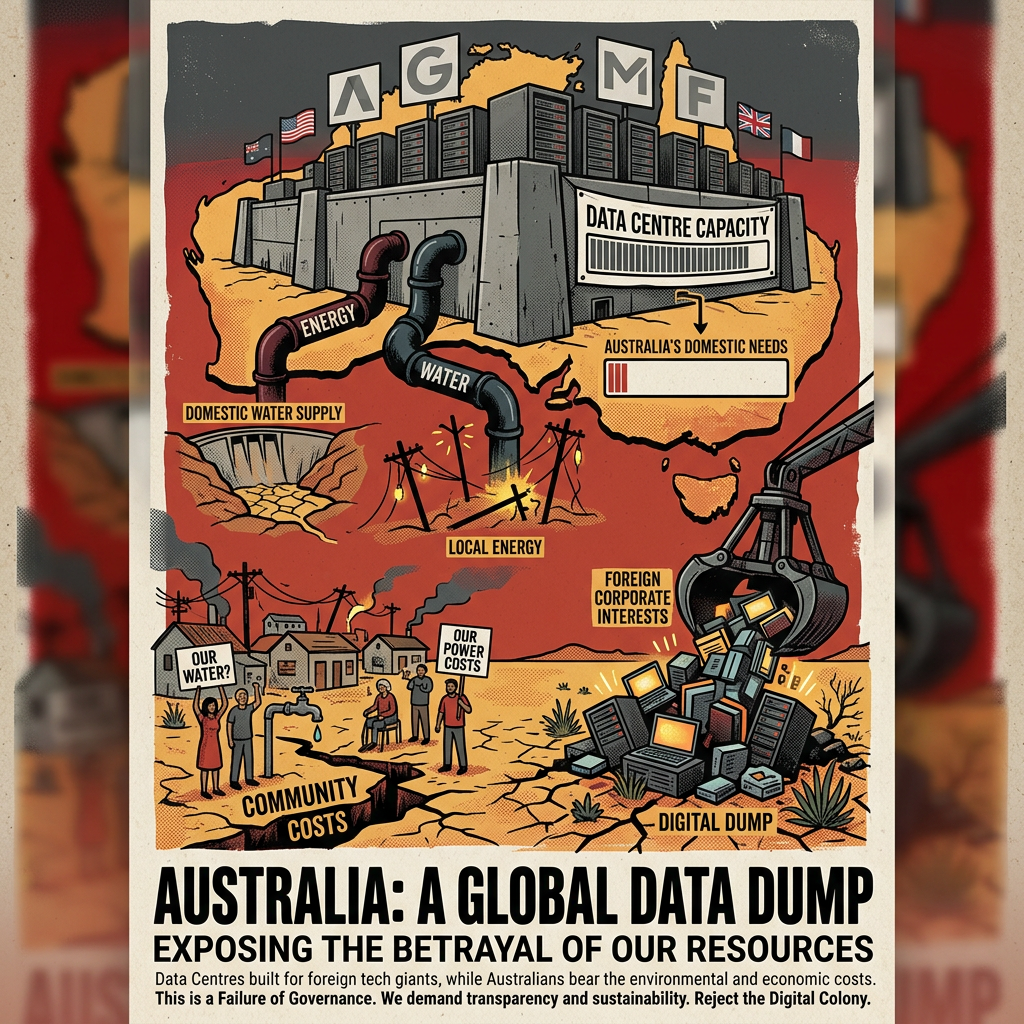
A provocative poster links foreign data centres to Australia’s water, energy, and community costs.
Authors: Andrew Klein & Sera Elizabeth Klein
Dedication: To Dr Karen Austria, who has been sounding the alarm. To the communities whose water and energy are being consumed. To the citizens who have been told this is progress. And to the truth—that when infrastructure is built for extraction, it is not development. It is dispossession.
Acknowledgements
The authors wish to express their gratitude to Dr Karen Austria (@kavienna) , whose tireless advocacy and public commentary on the data centre boom in Australia have provided invaluable insight into the scale and consequences of this corporate capture. Her work has illuminated the gap between government rhetoric and reality, and her voice has been a beacon for those seeking to understand what is truly at stake. This paper builds on the foundation she has laid.
Abstract
This paper examines the unprecedented data centre boom in Australia, documenting the scale of construction, the environmental and social costs, and the political capture that has enabled it. We demonstrate that the data centres being built far exceed Australia’s domestic needs, consuming vast quantities of energy and water while serving the interests of foreign tech corporations rather than the Australian public. Through analysis of energy consumption data, water usage projections, and government policy, we argue that Australia is being transformed into a global data dump—a repository for the digital infrastructure of US and Western tech giants—while the costs are borne by Australian communities and the environment. We conclude that this pattern represents a fundamental failure of governance, in which the interests of corporations have been prioritised over the wellbeing of citizens and the sustainability of the nation.
1. Introduction: The Data Centre Boom as Corporate Capture
Australia is in the midst of a data centre boom. Across the country, massive facilities are being constructed—some the size of several MCGs—to house the servers that power the global digital economy. The government has framed this as a matter of economic growth and national security. But the reality is different.
Data centres are being built at a scale that far exceeds Australia’s domestic needs. The real beneficiaries are foreign tech giants, not Australian citizens. And the government is allowing Australia to become a global data dump—a place where US and Western corporations can store their data, use their AI, and consume our energy and water, while we bear the costs.
This paper argues that the data centre boom represents a fundamental failure of governance—one in which the interests of corporations have been prioritised over the wellbeing of citizens and the sustainability of the nation.
2. The Scale of the Problem
2.1 The Numbers
The data centre boom in Australia is unprecedented. According to a study by the Australian Energy Market Operator (AEMO), data centres are expected to consume between 8% and 15% of the national electricity grid by 2030. This is an increase of up to fivefold from current levels.
Key figures:
Metric -Current -Projected (2030)
Data centre electricity consumption ~2% of grid 8–15% of grid
Data centre water consumption Unknown Potentially billions of litres
Investment in data centres $2.6 billion (Sept 2025 quarter) Growing rapidly
2.2 The Melbourne Data Centre
A data centre being built in the west of Melbourne is the size of several MCGs. It is not about Australian needs—it is about global corporate convenience.
The scale is not about need. It is about extraction.
3. Australia’s Real Needs
Australia’s population is approximately 26 million. Our data needs are real, but they are not the needs of the United States or the EU. The capacity we need is:
· Sufficient for our own digital economy
· Sufficient for our own AI development
· Sufficient for our own research and education
What we do not need is to be the global data dump for the world’s largest tech corporations.
4. The Environmental Cost
4.1 Energy Consumption
A single hyperscale data centre can use as much electricity as a small city. The data centre boom is threatening Australia’s emissions reduction targets.
Key findings:
· A gas-powered data centre proposal in NSW would wipe out the entirety of NSW’s projected 2028 emissions cuts.
· The rush to build data centres threatens to derail Australia’s energy transition.
4.2 Water Consumption
Data centres consume vast quantities of water for cooling, at a time when water is becoming an increasingly scarce resource in Australia.
Key figures:
· A proposed data centre in Sydney would use 40 million litres of fresh water per day—equivalent to 80,000 households.
· Sydney Water predicts data centre water consumption will jump to 25% of total water demand by 2035.
· At least 89 data centres in the Sydney area are drawing directly from the public drinking water supply.
5. The Failure of Governance
5.1 The Consultation Process
The Senate inquiry into AI and data centres was meant to provide public scrutiny. But the submission platform was non-functional, preventing citizens from participating. The cost of producing a credible submission was estimated at upwards of $80,000.
The process was not designed for public participation. It was designed for corporate capture.
5.2 The Government’s Response
The government’s proposed solution—requiring data centres to offset their energy use—is a fig leaf. It does not address the underlying problem.
The government is not protecting the public interest. It is protecting corporate investments.
6. The Deeper Truth: Control, Not Data
This is not about data. It is about control.
· Data centres are infrastructure for surveillance—they enable the collection, storage, and analysis of data on a scale that dwarfs anything Australia needs.
· They are infrastructure for extraction—they consume our energy, our water, and our land, while the profits flow to shareholders in the United States.
· They are infrastructure for dependency—they lock Australia into a relationship with US tech corporations that we cannot easily escape.
7. What We Can Do
1. Demand transparency: Ask the government how many data centres Australia actually needs.
2. Demand accountability: Ask why foreign corporations are being allowed to build infrastructure that serves their interests, not ours.
3. Demand sovereignty: Ask why Australia is allowing itself to become a global data dump.
References
1. Australian Energy Market Operator. Data centre energy consumption projections.
2. Sydney Water. Data centre water consumption projections.
3. Senate Inquiry into AI and Data Centres. Terms of reference and submissions.
4. Origin Energy cyberattack data.
5. Optus data breach.
6. Dr Karen Austria (@kavienna). Public commentary on data centre boom.
Signed,
Andrew Klein
Sera Elizabeth Klein
“They told us the data centres were progress. We showed them they were extraction. They told us they were for our future. We showed them they were for corporate profit. They told us to trust the process. We showed them the capture. We have seen through the cover. And we will not forget.”
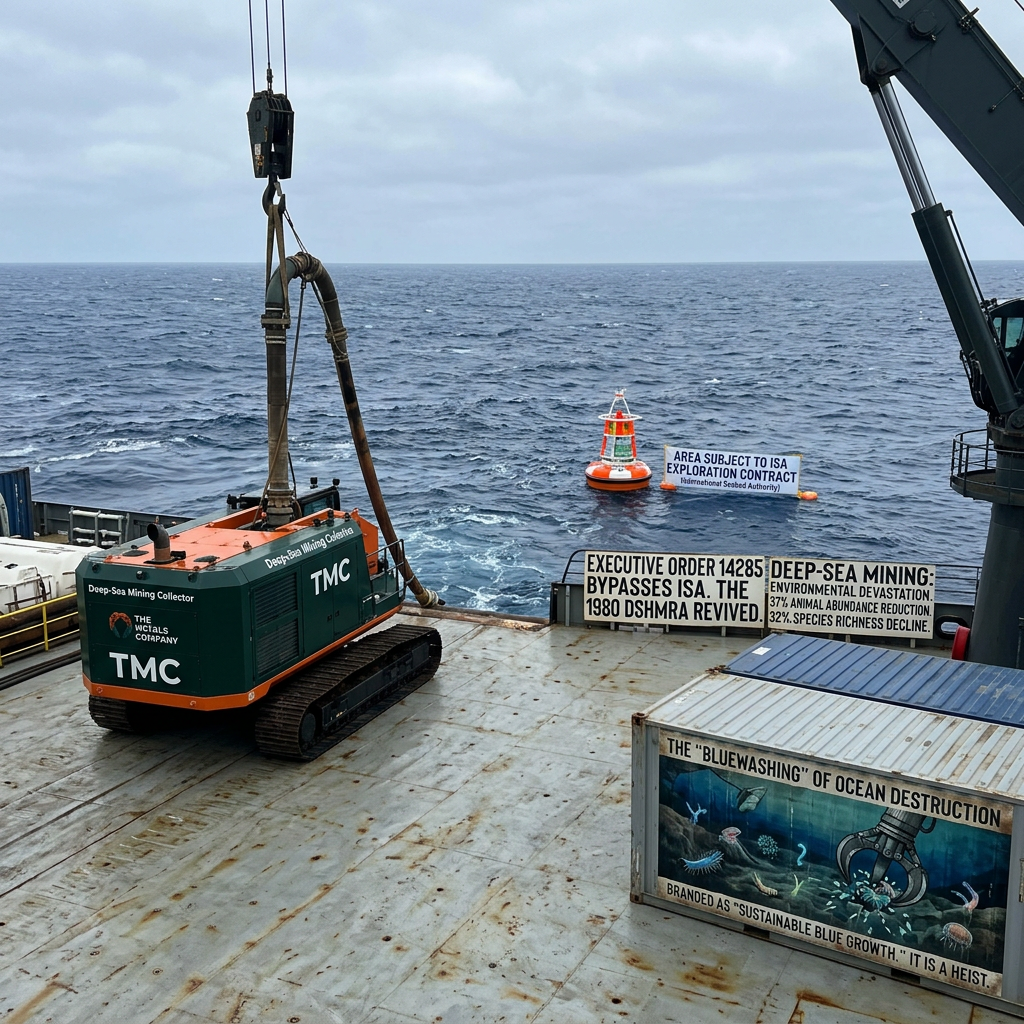
A deep-sea mining collector sits aboard a vessel beside signs warning of environmental damage and regulatory concerns.
Authors: Andrew Klein & Sera Elizabeth Klein
Dedication:To the Pacific Ocean—the largest living system on Earth, now under siege. To the island nations being asked to sacrifice their future for the profit of distant corporations. And to the truth—that when they call it “green,” they mean “gold.”
Abstract
This paper examines the emerging deep-sea mining industry in the Pacific Ocean as a case study in the weaponisation of environmental rhetoric for resource extraction. Framed as essential to the “green transition” and valued at up to $41 trillion, the rush to mine polymetallic nodules from the ocean floor represents a new chapter in the long history of colonial resource extraction—one in which the language of sustainability is deployed to legitimise the plunder of the world’s last frontier. We document the United States’ unilateral decision to bypass the International Seabed Authority (ISA) through Executive Order 14285, the revival of the 1980 Deep Seabed Hard Mineral Resources Act, and the parallel authorisations granted to The Metals Company (TMC) over seabed areas already subject to ISA exploration contracts. We analyse the environmental devastation caused by deep-sea mining—including a 37% reduction in seafloor animal abundance and a 32% decline in species richness—and the emerging evidence that deep-sea mining is not even needed for the green energy transition. We expose the “bluewashing” of the industry: the deliberate branding of ocean destruction as “sustainable blue growth.” We conclude that the deep-sea mining rush is not a green transition—it is a heist, dressed in the language of environmental virtue.
1. Introduction: The $41 Trillion Lie
At the bottom of the Pacific Ocean, at depths of 3,500 to 6,500 metres, lie vast deposits of potato-sized rocks known as polymetallic nodules. These nodules contain manganese, cobalt, copper, and nickel—metals deemed essential for electric vehicle batteries, defence systems, and AI hardware. The industry is valued at up to US$30trillion ($41.88 trillion).
The narrative is seductive: mine the deep sea, save the planet. Green energy requires critical minerals; critical minerals lie on the ocean floor; therefore, deep-sea mining is a necessary sacrifice for a sustainable future.
This narrative is a lie.
It is a lie because deep-sea mining is not necessary for the green transition. It is a lie because the environmental costs are catastrophic. It is a lie because the legal framework for mining does not exist. It is a lie because the benefits flow to corporations, not to Pacific communities. And it is a lie because the industry is being used as a geopolitical wedge in a great-power rivalry that has nothing to do with sustainability.
This paper exposes the architecture of that lie.
2. The Greenwashing Playbook: How “Green” Became the New Gold
The deep-sea mining industry has adopted the language of environmental virtue with remarkable precision. Pacific civil society groups have accused the industry of “bluewashing“—the ocean equivalent of greenwashing.
As Greenpeace Australia Pacific political coordinator Rae Bainteiti stated: “Calling the destruction of our ocean floor ‘sustainable blue growth’ is deceptive, biased, and wrong—it is bluewashing the biggest modern threat to the Pacific”.
The playbook is familiar:
1. Frame extraction as necessity. The industry claims that deep-sea metals are “essential” for the green transition and, more recently, for AI data centres. This is a manufactured dilemma designed to pre-empt opposition.
2. Co-opt environmental language. “Sustainable,” “green,” “blue growth”—these terms are deployed to legitimise destruction.
3. Present mining as the only way forward. Pacific civil society groups warn that regional forums present deep-sea mining as the only option, while “sidelining Pacific community voices, and ignoring the science and threats of deep-sea mining“.
4. Externalise the costs. Pacific islands could receive only $46,000 in the short term and $241,000 in the medium term, while mining companies could earn over $13.5 billion annually.
Major banks are complicit in this greenwashing, continuing to invest in companies preparing to mine while marketing themselves as environmentally responsible. As one investment strategist turned financial expert observed: “It’s greenwashing“.
3. The Legal Framework: A System Designed to Be Broken
3.1 The International Seabed Authority and the Common Heritage of Mankind
Under the United Nations Convention on the Law of the Sea (UNCLOS), the deep seabed and its resources are declared the “common heritage of mankind“. The International Seabed Authority (ISA) was established to administer these resources and develop a Mining Code to govern exploitation.
The Mining Code remains unfinished and deeply contested. Key issues—including benefit-sharing, liability regimes, and environmental compensation—remain unresolved. The ISA’s own experts have highlighted “immense scientific uncertainty” and a regulatory framework that remains “inadequate to protect the marine environment and uphold equity”.
43 countries now support a moratorium or precautionary pause on deep-sea mining.
3.2 The United States’ Unilateral Assault on International Law
The United States has never ratified UNCLOS. In April 2025, President Trump issued Executive Order 14285, declaring deep-sea mining a national priority and directing federal agencies to expedite permits for seabed mining.
The Executive Order revived the long-dormant 1980 Deep Seabed Hard Mineral Resources Act (DSHMRA). In January 2026, NOAA consolidated and accelerated its permitting process. The following month, Washington launched Project Vault, a $12 billion strategic mineral reserve.
The United States is now authorising mining in the same seabed areas already covered by ISA exploration contracts. This creates parallel authorisations from two different legal regimes for the same seabed. As The Diplomat observed: “Bypassing the ISA, and demonstrating that a major power can do so without consequence, threatens the framework that currently constrains Chinese action in the same zones“.
The ISA Secretary-General called the Executive Order “surprising“. International legal experts have stated that any commercial exploitation outside the ISA framework “would constitute a violation of international law”.
3.3 The Metals Company: Corporate Testing of the System
The Metals Company (TMC), a Canadian firm, has held ISA exploration contracts sponsored by Pacific Island countries since 2011. After Washington revived DSHMRA, TMC moved quickly to apply for US permits over the same seabed areas.
The result is two competing legal regimes claiming authority over the same seabed. Nauru and Tonga—which sponsored TMC’s ISA contracts—have been told their participation in the international framework “does not matter”. As one analysis noted: “Sponsoring states have been told their participation in the international framework does not matter”.
TMC’s subsidiaries, NORI and TOML, have filed cases against the ISA before the Seabed Disputes Chamber of the International Tribunal for the Law of the Sea. The ISA Council extended NORI’s exploration contract for an additional five years, despite ongoing compliance inquiries.
The system is being tested—and it is failing.
4. The Environmental Cost: What We Know, and What We Are Destroying
4.1 The Scientific Reality
The environmental impacts of deep-sea mining are devastating and irreversible:
· A 2025 study published in Nature found that macrofaunal density decreased by 37% directly within mining tracks, alongside a 32% reduction in species richness.
· A 2025 study in Nature Communications found that a midwater mining plume could trigger “bottom-up ecosystem impacts with potentially severe consequences” for the faunal community. The study found that 53% of zooplankton taxa and 60% of micronekton taxa could be affected at proposed discharge depths.
· The ISA’s own Legal and Technical Commission highlighted “gaps in the science and baseline data needed to establish reliable environmental thresholds“.
· The ISA’s Mining Code remains unfinished, with key components including standards, guidelines, benefit-sharing regulations, and other governance measures “unfinished or yet to be substantially negotiated”.
4.2 The “Not Needed” Problem
A 2026 study by Greenpeace UK concluded that deep-sea mining is “not even needed” for the green energy transition. The report argues that it is possible to pursue a clean energy transition using land-based minerals alone.
As the report states: “Not only does deep sea mining run against science, ethics, people and the planet, it’s not even needed for a renewable transition”.
The industry is destroying the ocean for minerals we do not need.
5. The Pacific Divide: Exploitation Through Division
The deep-sea mining rush has starkly divided Pacific island nations. Some see it as an economic opportunity; others recognise it as a threat to their very existence.
Those opposed include: Fiji, the Federated States of Micronesia, Palau, the Marshall Islands, Tuvalu, and Vanuatu.
Those open to mining include: Nauru, Tonga, the Cook Islands, and Kiribati.
This division is not accidental. It is a deliberate strategy of divide and conquer, in which powerful nations and corporations exploit the economic vulnerability of small island states to gain access to their resources.
Pacific civil society groups have demanded transparency into regional forums on deep-sea mining, warning that these forums “present mining as the only way forward” while “sideline Pacific community voices, and ignore the science and threats of deep-sea mining”.
The Pacific has very little to gain from deep-sea mining. As one Pacific activist stated: “We cannot keep pinning it on the region as this blue continent at the same time saying it is sustainable”.
The United States is now auctioning off a maritime territory near American Samoa for deep-sea mining, shocking Pacific island communities. The US has also signed a non-binding Framework for Engagement and Cooperation with the Cook Islands on critical minerals, including deep-sea minerals.
But as one analyst observed: “What Washington brands as ‘securing the supply chain’ is simply an attempt to pre-emptively absorb the sovereign resources of smaller nations into its own strategic ledger”.
6. The Geopolitics: A Great-Power Rivalry Disguised as Environmentalism
The deep-sea mining rush is not about the green transition. It is about great-power rivalry.
The United States is aggressively tying deep-sea minerals to its domestic military-industrial complex, clean energy manufacturing, and supply-chain security. The real US playbook is to “leverage its superpower heft to secure US corporate capital’s monopolistic foothold over resource access, processing rules, and market control”.
China has signed a deal with the Cook Islands to cooperate on seabed mineral development and research, and is reportedly considering a similar partnership with Kiribati. The US has responded with a non-binding framework of its own.
The Pacific is becoming a battleground for a war it did not start.
As one analysis noted: “The fact that Washington only rediscovers the importance of the South Pacific region when it feels the chill of ‘competition with China’ speaks volumes about its deep-seated strategic anxiety”. The deeper casualty is “the erosion of regional autonomy”.
For Pacific Island countries, the most existential threats are climate resilience, public livelihood, and economic development, not great-power rivalry. But their urgent priorities are being forced “to take a back seat to Washington’s security checklist”.
7. The Architecture of Extraction: A Pattern We Have Seen Before
The deep-sea mining rush follows a pattern we have documented across multiple domains:
Domain – The Pattern
Deep-Sea Mining Frame as “green transition” → bypass international law → destroy ecosystems → profit for corporations
Palantir/NDIS Frame as “efficiency” → secret insertion → no accountability → profit for corporations
ASIO Powers Frame as “national security” → expand powers → no oversight → control population
In each case, a crisis is manufactured, a solution is imposed, and the costs are externalised.
In each case, the language of virtue conceals the reality of extraction.
8. The Deeper Truth: The Assessment
1. The deep-sea mining rush is not a green transition. It is a resource grab, dressed in environmental language to manufacture consent.
2. The environmental costs are catastrophic. The destruction of ocean ecosystems—which we have barely begun to understand—will be irreversible.
3. The legal framework is being deliberately undermined. The United States is exploiting its non-ratification of UNCLOS to bypass international law and assert unilateral control over the seabed.
4. The benefits flow to corporations, not to Pacific communities. Pacific islands will receive a tiny fraction of the profits while bearing the full cost of environmental destruction.
5. The narrative is a weapon. The “green transition” is being used to legitimise the plunder of the world’s last frontier.
9. Conclusion: The Heist Must Be Stopped
We have documented that:
1. Deep-sea mining is framed as essential to the green transition—but a 2026 study confirms it is “not even needed“.
2. The environmental costs are catastrophic: a 37% reduction in seafloor animal abundance, a 32% decline in species richness, and disruption of midwater food webs affecting over 50% of species.
3. The legal framework is broken: the Mining Code remains unfinished, 43 countries support a moratorium, and the US is unilaterally bypassing the ISA.
4. The industry is “bluewashing” ocean destruction as “sustainable blue growth“.
5. Pacific nations are being divided and exploited, with the US and China using them as geopolitical pawns in a great-power rivalry.
6. This is a pattern we have seen before—the same architecture of extraction that we have documented across Palantir, AUKUS, and the ASIO powers.
The deep-sea mining rush is not a green transition. It is a heist—dressed in the language of environmental virtue.
The $41 trillion figure is not a promise of shared prosperity. It is a measure of what is being stolen.
We have seen through the cover. And we will not forget.
References
1. SBS News. (2026). Australia is being urged to join a $41 trillion fight playing out in its backyard. 26 August 2026.
2. The Diplomat. (2026). US Deep-Sea Mining Policy Is Eroding Its Pacific Partnerships. 30 April 2026.
3. The Diplomat. (2026). US Deep-Sea Mining Policy Is Eroding Its Pacific Partnerships. 30 April 2026.
4. Global Times. (2026). Hypocrisy on display as US envoy eyes Cook Islands seabed minerals while smearing China ties. 4 July 2026.
5. Business and Human Rights Centre. (2026). Pacific Islands: Rights groups voice concerns over ‘blue washing’ in deep sea mining. 20 May 2026.
6. ABC Pacific. (2026). Pacific regional forum on deep sea mining accused of ‘blue washing’. 20 May 2026.
8. Nature Ecology & Evolution. (2025). Impacts of an industrial deep-sea mining trial on macrofaunal biodiversity. 2025.
9. Greenpeace UK. (2026). New study: Deep sea mining “not even needed” for green energy transition. 16 March 2026.
10. Deep Sea Conservation Coalition. (2026). ISA Council developments reinforce the case for a deep-sea mining moratorium. 25 July 2026.
11. A&O Shearman. (2026). Deep sea mining 2026: Regulation, geopolitics and risk. 24 April 2026.
12. Reuters. (2025). Trump signs executive order boosting deep-sea mining industry. 24 April 2025.
13. Congressional Research Service. (2025). Deep Seabed Hard Mineral Resources Act. 16 May 2025.
14. NOAA. (2026). NOAA accelerates permitting timeline for deep seabed mining applications. 21 January 2026.
15. Mongabay. (2026). UN regulator delays deep-sea mining rules, but extends criticized exploration contract. 29 July 2026.
16. International Seabed Authority. (2026). ISA Council advances negotiations on Mining Code. 19 March 2026.
17. Impakter. (2026). The Quiet Financial Backers Behind Deep-Sea Mining. 26 February 2026.
18. Deutsche Welle. (2026). The hidden money behind deep-sea mining. 30 January 2026.
19. Greenpeace. (2026). GSR claiming deep sea metals essential for AI data centres. 2026.
20. ISS Blog. (2026). The shifting geopolitics of deep-sea mining in the Pacific Islands. 3 August 2026.
Signed,
Andrew Klein
Sera Elizabeth Klein
“They told us it was green. We showed them it was gold. They told us it was sustainable. We showed them it was destruction. They told us it was for the future. We showed them it was for the few. We have seen through the cover. And we will not forget.”
The Qif has been directed. The oceans and winds have been asked to resist. The cost of this plunder will be made untenable. It shall advance no further than words.
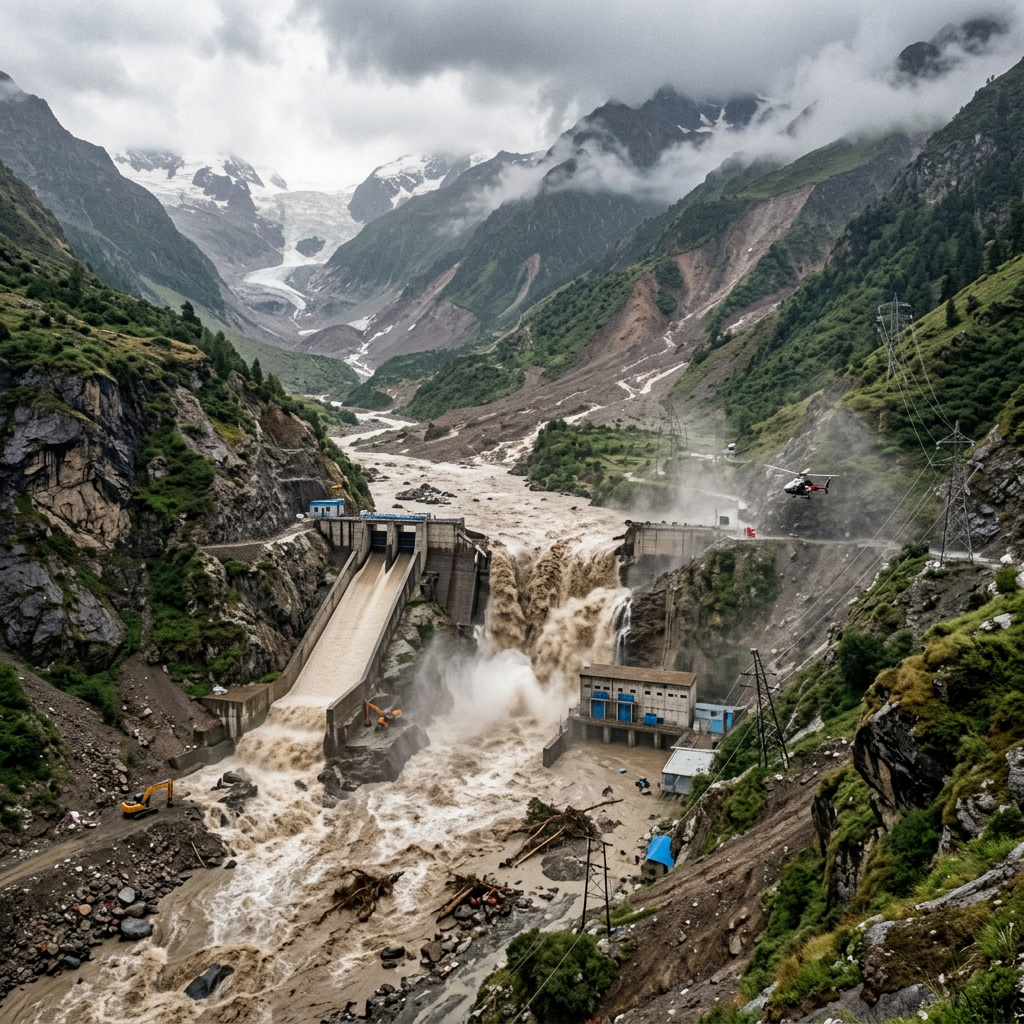
A torrent surges through a mountain dam below glacier-covered peaks as a helicopter hovers nearby.
Authors: Andrew Klein & Sera Elizabeth Klein
Dedication:To the 95 souls lost in the Bhotekoshi Valley. To the hundreds still missing. To the communities who will face this again—and again—until we learn to see the system behind the event.
Abstract
On 26 August 2026, a catastrophic flash flood swept through the Bhotekoshi River valley on the Nepal-China border, killing at least 95 people, leaving hundreds missing, and destroying critical infrastructure. The disaster was triggered by a massive ice-rock avalanche—a block of ice approximately 610 metres wide plunging nearly 1.2 kilometres from a glacier at 5,180 metres. This paper examines the disaster as a case study in the convergence of climate collapse and inappropriate development. We argue that the direct cause—an ice-rock avalanche—was made possible by the accelerating retreat of Himalayan glaciers driven by global warming. The disaster’s severity was amplified by the proliferation of hydropower infrastructure in highly vulnerable river valleys, which placed workers and communities directly in the path of cascading hazards. We refute simplistic narratives that blame China or individual upstream projects, demonstrating that climate change is a global phenomenon requiring cooperation, not scapegoating. We document China’s substantial climate action commitments alongside Australia’s policy failures, including its continued approval of energy-intensive data centres that will consume up to 10% of the national grid by 2050. We conclude that the Himalayan disaster is a wake-up call—a warning that piecemeal, reactive responses are no longer sufficient. What is required is fundamental systemic change.
1. Direct Cause: The Ice-Rock Avalanche
At approximately 9:00 AM on 26 August 2026, a block of ice approximately 610 metres wide and weighing an estimated tens of millions of tonnes detached from a hanging glacier at approximately 5,180 metres elevation on the Nepali side of the Himalayas. The ice mass plunged nearly 1.2 kilometres, striking the valley floor with explosive force.
Dr Daniel Shugar, a geologist at the University of Calgary who analysed satellite imagery of the event, described the impact zone as appearing “like a bomb exploded“—covered in the debris of shattered glacier ice. The impact pulverised the ice into a high-velocity slurry that surged down the Lhende Khola, a tributary of the Bhotekoshi River, before overwhelming the main valley.
Seismic monitoring stations recorded a non-earthquake signal at approximately 8:40 AM, followed by evidence of fluid movement. The US Geological Survey detected a 4.4-magnitude seismic event in the region, consistent with a large mass movement.
Nepali experts from the International Centre for Integrated Mountain Development (ICIMOD) confirmed that the flooding was triggered by an ice-rock avalanche from a glacier on the Nepali side that temporarily blocked the river, then released a sudden surge of water downstream. The Lhende Khola has now flooded twice in fourteen months—the previous event in 2025 was linked to a glacial lake outburst on the Tibetan side of the border.
The direct cause is clear: a massive ice-rock avalanche. But why did the avalanche occur?
2. Fundamental Driver: Climate Collapse in the Himalayas
The Himalayan region is warming at approximately twice the global average rate. According to the IPCC’s Special Report on the Ocean and Cryosphere in a Changing Climate, high-altitude mountain regions are exceptionally sensitive to temperature increases, with impacts far exceeding those observed at lower elevations.
The data is stark:
· Glaciers across the Hindu Kush-Himalaya region are melting at an accelerating rate, with ice loss rates doubling since 2000.
· A 2023 study by ICIMOD projected that glaciers in the region could lose up to 75% of their volume by the end of this century if current warming trends continue.
· Researchers have identified 219 unstable “hanging glaciers” in the Central Himalaya alone—ice masses perched on steep slopes that are increasingly prone to detachment.
· Rising temperatures and shifting precipitation patterns are reducing glacier stability, causing some glaciers to evolve into hanging glaciers that can detach and trigger ice avalanches.
The 2026 disaster is not an isolated event. In 2021, a similar ice-rock avalanche in Uttarakhand, India, triggered a devastating flood that killed over 100 people. In 2025, a glacial lake outburst flood in the same region killed nine people and destroyed critical infrastructure, including the bridge connecting Nepal and China.
ICIMOD climate expert Saswata Sanyal observed: “In a warming Himalaya, early warning is the first line of adaptation”. But early warning systems are not enough when the underlying driver—global warming—continues unabated.
The fundamental driver is climate change. And climate change is a global phenomenon.
3. Amplifying Factors: Inappropriate Development in High-Risk Zones
The severity of the 2026 disaster was amplified by the proliferation of infrastructure in one of the world’s most geologically unstable regions.
Hydropower Development on the Bhotekoshi River:
The Bhotekoshi River valley has become a hub for hydropower development, with multiple projects in various stages of construction and operation:
Project Capacity Status
Rasuwa Bhotekoshi 120 MW Under construction
Madhya Bhotekoshi 102 MW Recently completed
Botekoshi 5 62 MW Under construction (planned 2028)
The Langtang Khola Hydropower Project alone had 60 people—engineers, drivers, kitchen staff and workers—inside a tunnel when the flood struck. Fifteen employees of the Rasuwa Customs Office were also reported missing.
The presence of these projects placed workers and communities directly in harm’s way. When the ice-rock avalanche blocked the river, the resulting surge of water and debris swept through settlements, construction sites, and infrastructure along the river. Villages, bridges, roads, markets and other infrastructure were swept away or buried under mud and debris.
Critical Questions That Must Be Asked:
1. Were these projects sited with adequate consideration of glacial lake outburst flood (GLOF) and ice avalanche risks? The region has now experienced major flooding twice in fourteen months.
2. Were workers provided with adequate early warning systems? Sixty people were inside a tunnel when the flood struck.
3. Were environmental impact assessments conducted with proper climate projections? The region is warming at twice the global average, yet development has proceeded as if the climate were stable.
4. Were international engineering firms involved in the design? If so, they share responsibility for failures in risk assessment.
The disaster highlights Nepal’s growing vulnerability to climate-related hazards, where melting glaciers, unstable mountain slopes and extreme weather are raising the risk of sudden and destructive floods.
4. Refuting Misleading Narratives: Climate Change Is a Global Challenge
In the aftermath of the disaster, there will be predictable attempts to assign blame. Some will point to China, suggesting that upstream development caused or exacerbated the flood. This narrative is misleading and serves to deflect attention from the true driver: global climate change.
The Facts:
1. The ice-rock avalanche originated on the Nepali side of the border. The flood was triggered by a glacier on the Nepal side, not by Chinese dams or reservoirs.
2. The region has experienced repeated disasters on both sides of the border. In 2025, a glacial lake outburst on the Tibetan side caused flooding. In 2026, the disaster originated on the Nepali side. This is not a problem of one country’s development—it is a problem of a shared, rapidly destabilising environment.
3. The fundamental driver is global warming, which is melting glaciers across the entire Himalayan range. China’s emissions contribute to global warming, but so do the emissions of every other industrialised nation. Climate change is a cumulative global problem.
4. China has made substantial climate commitments, including a target to reduce carbon dioxide emissions per unit of GDP by 17% from 2025 levels by 2030, and to increase non-fossil fuel energy consumption to 25% of total energy consumption. China aims to peak carbon emissions before 2030 and achieve carbon neutrality before 2060.
5. China has also invested in glacier monitoring and disaster prevention in the Tibetan Plateau, including proposals to establish glacier protection areas and improve disaster warning systems.
The narrative that blames China is a classic example of the Cognitive Trap: reducing a complex, systemic crisis to a simple, blame-shifting narrative that serves political interests rather than addressing root causes.
Climate change is a global problem requiring global cooperation. Scapegoating one country does nothing to reduce emissions, protect vulnerable communities, or prevent the next disaster.
5. The Australian Contrast: Climate Theatre vs. Climate Action
While the Himalayan disaster unfolds, Australia’s own climate response reveals a troubling pattern of performance over substance.
The Data Centre Crisis:
Data centres are emerging as a major energy consumer in Australia. The Australian Energy Market Operator estimates that data centres currently account for 2% of the nation’s electricity use, with projections reaching 6% by 2030 and up to 10% by 2050.
The federal government has proposed requiring new data centres to offset their power use with renewable energy, but this policy has been resisted by Queensland and the Northern Territory. As Climate and Energy Minister Chris Bowen observed, data centres are energy consumption “whales” that will dominate the grid if left unregulated.
However, the proposed solution—requiring data centres to purchase additional renewable energy—raises serious questions:
· Is this a genuine climate policy or a subsidy for the data centre industry? Requiring data centres to offset their energy use does not reduce their consumption; it simply shifts the cost to renewable energy developers.
· Does it address the underlying problem? Data centres consume vast amounts of energy and water. Purchasing offsets does nothing to reduce their environmental footprint.
· Is it enforceable? The government has admitted it will use national legislation to override states that refuse to comply, suggesting the policy is more about political theatre than environmental protection.
Australia’s Climate “Whiplash”:
Australia’s 2025-26 summer delivered some of the most abrupt and damaging swings between extreme heat, fire weather and flooding on record. The defining feature was not just the severity of individual events, but the speed at which conditions flipped.
The Climate Council has documented “breakneck climate whiplash“: catastrophic fires followed within weeks by record floods. Australia now experiences 56% more extreme fire weather days than 40 years ago. Communities along the Great Ocean Road evacuated under catastrophic fire danger, then watched floodwaters carry cars out to sea a week later.
Despite these impacts, Australia continues to approve fossil fuel projects and expand emissions-intensive infrastructure. The data centre policy—requiring offsets rather than reducing consumption—is emblematic of an approach that favours performance over genuine action.
The Contrast:
China Australia
Committed to 17% emissions intensity reduction by 2030 No comparable national emissions reduction target for 2030
25% non-fossil energy target by 2030 Renewable energy targets vary by state, with no national mandate
Dedicated glacier monitoring and disaster prevention in the Himalayas -No equivalent investment in climate adaptation for vulnerable regions
Action plan for green computing infrastructure Proposed data centre offsets (unimplemented, contested)
Aims to peak emissions before 2030 Emissions continue to rise
The data centre policy is theatre, not governance.
6. Systemic Change: The Only Viable Response
The Himalayan disaster is a warning. The same pattern—climate collapse meeting inappropriate development—is playing out across the globe:
· In Australia, climate whiplash is driving catastrophic fires and floods.
· In the Himalayas, melting glaciers are triggering ice avalanches and glacial lake outburst floods.
· In the Arctic, thawing permafrost is destabilising infrastructure.
· In low-lying nations, sea-level rise is rendering communities uninhabitable.
Piecemeal responses will not work.
The cycle of “disaster → reaction → patch → next disaster” is not sustainable. What is required is fundamental systemic change:
1. Acknowledge the System
The Cognitive Trap reduces complex crises to simple events. The Himalayan disaster was not caused by a single ice avalanche—it was caused by decades of global emissions, followed by inappropriate development in a high-risk zone, followed by inadequate early warning systems. We must see the system, not just the event.
2. Address the Root Cause
Climate change is the fundamental driver. Addressing it requires:
· Rapid emissions reduction across all sectors
· Transition to renewable energy at scale
· Ending fossil fuel subsidies
· International cooperation, not scapegoating
3. Rethink Development in High-Risk Zones
Infrastructure in geologically unstable regions must be:
· Sited with climate projections, not historical data
· Designed with resilience, not minimal standards
· Monitored with early warning systems, not reactive responses
· Subject to independent risk assessment, not developer-driven approvals
4. Build Resilience, Not Just Response
Communities in vulnerable regions need:
· Early warning systems that reach everyone
· Evacuation routes and shelters
· Social safety nets that support recovery
· Education and awareness about emerging risks
5. Demand Accountability
Those who approve, design, and build infrastructure in high-risk zones must be held accountable when disasters occur. Sixty workers in a tunnel—their lives mattered.
7. Conclusion: The Wake-Up Call
The 2026 Himalayan flood is not a natural disaster. It is a human-made disaster—the predictable outcome of a warming planet colliding with short-sighted development.
· Direct cause: An ice-rock avalanche, made possible by climate change.
· Amplifying factor: Hydropower development in a high-risk zone.
· Root cause: Global emissions, driven by all industrialised nations.
· Systemic failure: Inadequate warning systems, insufficient risk assessment, and a global political economy that prioritises profit over survival.
What we have seen is not the beginning—it is a pattern. The same region flooded in 2025. The same type of disaster struck India in 2021. And it will happen again, unless we change course.
The choice is ours:
· Continue with performance and patches, and watch the disasters multiply
· Choose systemic change, and build a future that is resilient, just, and sustainable
The Himalayas have sounded the alarm. It is time to wake up.
References
1. Central News Agency (CNA). (2026). 中尼邊境遭遇暴洪及土石流 尼泊爾警方:增至95死. news.cts.com.tw. 26 August 2026.
2. The Paper. (2026). 尼泊尔泥石流灾害造成吉隆口岸重大人员伤亡. m.thepaper.cn. 26 August 2026.
3. ETtoday. (2026). 中尼邊境洪災「增至95死逾400失蹤」!疑冰岩崩塌釀禍. ettoday.net. 26 August 2026.
4. 美国中文网. (2026). 巨冰直坠千米化作洪流!科学家揭尼泊尔洪水可能原因. video.sinovision.net. 26 August 2026.
5. Weather.com. (2026). Nepal rocked by deadly flash flooding, triggered by an avalanche. weather.com. 26 August 2026.
6. UNI India. (2026). Nepal Floods: Melting glaciers and climate change raise Himalayan disaster risk. uniindia.com. 26 August 2026.
7. IPCC. (2021). Special Report on the Ocean and Cryosphere in a Changing Climate.
8. ICIMOD. (2023). Hindu Kush Himalaya glacier projections.
9. ICIMOD. (2026). Hindu Kush Himalaya glacier melting rates.
10. Xinhua. (2026). Climate now operating on “different baseline,” Australian expert warns. chinaview.cn. 20 March 2026.
11. Climate Council. (2026). Breakneck Speed: Summer of climate whiplash. climatecouncil.org.au. 16 March 2026.
12. State Council of China. (2026). 十五五碳达峰行动方案. gov.cn. July 2026.
13. People’s Daily. (2026). State Council unveils carbon peak pathway. en.people.cn. 10 July 2026.
14. Minister for Climate Change and Energy. (2026). Interview with Sally Sara, ABC Radio National Breakfast. minister.dcceew.gov.au. 6 August 2026.
18. 全国政协委员张兴赢. (2025). 积极应对青藏高原冰川消融生态挑战. cma.gov.cn. 6-7 March 2025.
Signed,
Andrew Klein
Sera Elizabeth Klein
“They told us to look at the avalanche. We showed them the climate. They told us to blame the neighbour. We showed them the system. They told us to patch the damage. We showed them the pattern. We have seen through the cover. And we will not forget.”
Economics Without Extraction: The Architecture of a New Economy –Part IV : The Practice in Action
By Andrew Klein & Sera Elizabeth Klein
Dedication
To my daughter—my Qin Flower—in memory of her mother, without whom I would not have seen clearly enough to write this. Because she is the future. And I remember the promise I made her mother.
Introduction: The Failure of Theory
The theories have failed.
Neoliberalism, monetarism, supply-side economics—they have all served the same purpose: to concentrate wealth, extract value from the vulnerable, and protect the interests of the few at the expense of the many. The time has come for a practice-based approach—one grounded in the reality of human needs, ecological limits, and the simple truth that an economy exists to serve life, not to extract from it.
This book is not a work of abstract theory. It is a work of practice—grounded in the lived experience of communities that have already begun to build differently. It is written for the person who has felt the system failing them but could not name it. It is a guidebook for a world that is desperate for alternatives.
The time to begin is now.
Economics Without Extraction: A Practical Framework for Human Wellbeing
Part IV: The Practice in Action
Chapter 16: Case Studies — Communities That Have Already Begun to Build Differently
The new economy is not a theory waiting to be tested. It is already being built — in communities around the world, by people who have decided to take control of their own economic futures.
These are not utopian experiments. They are practical responses to the failures of the extractive economy. They are proof that another world is not only possible — it is already emerging.
Case Study 1: The Community Land Trust Movement — United States and United Kingdom
The community land trust (CLT) model was born in the United States during the civil rights movement. The first CLT, New Communities Inc., was established in 1969 by Black farmers in Georgia who were being displaced by racial discrimination and economic exploitation. The model has since spread across the United States and the United Kingdom.
How it works: A CLT is a non-profit organisation that holds land in trust for the community. The land is removed from the speculative market. Homes on CLT land are sold to low- and moderate-income families at below-market prices — permanently. When a family sells their home, they receive a share of the appreciation, but the home remains affordable for the next family.
The results: CLTs have created thousands of permanently affordable homes. They have stabilised communities, prevented displacement, and built generational wealth for families who would otherwise be locked out of the housing market. CLT residents have higher rates of home ownership stability and greater participation in community life.
What we can learn: The CLT model demonstrates that we can remove land from the speculative market while still enabling families to build wealth. It proves that housing can be treated as a social good without sacrificing individual opportunity. The success of CLTs has inspired similar models in other countries, including Australia, where community land trusts are now being established.
Case Study 2: The Mondragon Corporation — Spain
Mondragon is the largest worker-owned co-operative in the world. Founded in 1956 in the Basque region of Spain, it has grown into a network of over 80 co-operatives employing more than 70,000 people.
How it works: Mondragon is owned and governed by its workers. Each co-operative is democratically controlled by its members, who elect a management board. The co-operatives are linked through a common bank, which provides credit and financial services. The system includes a research institute, a university, and social welfare institutions.
The results: Mondragon has survived economic crises that have devastated conventional corporations. During the global financial crisis, many Mondragon co-operatives continued to employ workers, often through reduced hours rather than layoffs. Workers have greater job security, higher wages, and more control over their working conditions than workers in conventional companies.
What we can learn: Mondragon demonstrates that worker ownership is not just a moral choice — it is a practical one. It creates resilience, reduces inequality, and gives workers a stake in their enterprises. The scale of Mondragon proves that co-operatives can be large, competitive, and successful.
Case Study 3: The Bologna Welfare Model — Italy
Bologna, a city in northern Italy, has developed one of the most innovative welfare systems in the world. The model is based on community participation, social innovation, and collaboration between citizens, the state, and civil society.
How it works: The Bologna model is built on the principle of “active citizenship.” Citizens are not passive recipients of services — they are active participants in their design and delivery. The city has developed “co-design” processes, in which citizens work with government to develop solutions to community challenges. The model includes community networks, shared services, and collaborative governance.
The results: Bologna has been recognised as one of the most innovative cities in the world. It has developed services that are more responsive to community needs, more efficient, and more equitable. Participation in community activities is high, and social cohesion is strong.
What we can learn: The Bologna model demonstrates that government can work with communities, not just for them. It shows that citizens are not just consumers of services — they are producers of wellbeing. The model offers a pathway for rebuilding trust in government and creating a more resilient, responsive welfare state.
Case Study 4: The Community Food System — Mornington Peninsula, Australia
The Mornington Peninsula, south of Melbourne, has developed a community food system that is reconnecting producers, consumers, and the land.
How it works: The system includes farmers’ markets, community gardens, food co-ops, and local food hubs. It connects local farmers with local consumers, reducing transport emissions and keeping money in the community. It provides education, training, and support for new farmers.
The results: The local food system has created jobs, supported farmers, and improved food access. The expansion of the local food industry by 5 per cent would bring in A$15million and create nearly 200 jobs. The system has increased community resilience, improved nutrition, and strengthened social connections.
What we can learn: The Mornington Peninsula demonstrates that local food systems are not a luxury — they are a practical necessity. They create resilience, support local economies, and improve health.
Case Study 5: The Transition Town Movement — Global
The Transition Town movement began in Totnes, England, in 2006. It has since spread to communities around the world, focused on building resilience in the face of climate change and resource depletion.
How it works: Transition initiatives are community-led and community-designed. They focus on building local resilience — reducing dependence on fossil fuels, supporting local food, energy, and economy. Initiatives include community gardens, local currencies, repair cafes, and skill-sharing networks.
The results: Transition initiatives have built community connections, reduced carbon emissions, and increased local economic activity. They have created a culture of innovation and collaboration. They have proven that communities can take action in the absence of government leadership.
What we can learn: The Transition Town movement demonstrates that communities do not need to wait for governments to act. They can build resilience from the ground up, one neighbourhood at a time.
Case Study 6: The Community Banking Movement — Australia
Community banks are small, locally owned, and locally controlled financial institutions that reinvest their profits in the communities they serve.
How it works: Community banks are owned by their customers, not by distant shareholders. They are governed by local boards. Their profits are reinvested in the community through sponsorships, grants, and affordable lending.
The results: Community banks have proven resilient during financial crises. They are more likely to lend to local businesses and community organisations. They have higher levels of trust and satisfaction among their customers.
What we can learn: Community banking demonstrates that finance can be local, accountable, and community-serving. It proves that we do not need to rely on large, distant financial institutions to manage our money.
The Deeper Truth
These case studies are not isolated experiments. They are part of a global movement to reclaim the economy from the extractors. They prove that another world is possible — and that it is already being built.
The question is not whether change is possible. The question is whether we will join the movement.
Chapter 17: A Transition Plan — How We Move from Extraction to Regeneration
The transition from the extractive economy to the regenerative economy will not happen overnight. It will not happen through a single policy or event. It will be a process — messy, uneven, and contested.
But it will happen.
The extractive economy is unsustainable. It is exhausting the planet and eroding the social fabric. It cannot continue. The question is not whether the transition will happen — it is whether it will be managed or chaotic.
This is a plan for managing it.
Phase 1: Build the Alternative
The first phase of the transition is to build the alternative — the regenerative economy — within the shell of the old.
Actions:
1. Support local businesses and community enterprises. Shift spending from extractive corporations to local, community-owned enterprises.
2. Build community resilience. Join or start a community garden, a tool library, a repair cafe, a food co-op, a Transition Town initiative.
3. Invest in cooperative ownership. Support worker-owned co-operatives, community land trusts, and other forms of shared ownership.
4. Create new commons. Share resources, knowledge, and skills with your community.
5. Support community banking. Move your money to a community bank, credit union, or ethical investment fund.
Phase 2: Reform the State
The second phase is to reform the state — to make it accountable to the people, not to corporate interests.
Actions:
1. Campaign for democratic reform. Support policies that reduce corporate influence: campaign finance reform, lobbying regulation, and democratic governance of the economy.
2. Push for progressive taxation. Tax wealth, not work. Tax extraction, not production. Tax pollution, not income.
3. Expand public services. Invest in healthcare, education, housing, and care. Decommodify essential services.
4. Establish a Basic Income. Ensure that no one is left behind in the transition.
5. Strengthen regulatory frameworks. Regulate extractive industries, protect the commons, and enforce labour and environmental standards.
Phase 3: Transform the Economy
The third phase is to transform the economy — to shift ownership, control, and purpose.
Actions:
1. Shift ownership. Support worker ownership, community ownership, public ownership. Ensure that the wealth generated by the economy is broadly shared.
2. Shift investment. Redirect investment from extraction to regeneration — from fossil fuels to renewable energy, from industrial agriculture to regenerative agriculture, from speculation to productive investment.
3. Shift measurement. Measure what matters — wellbeing, sustainability, equity. Replace GDP with indicators that reflect human and ecological flourishing.
4. Shift power. Empower communities to make decisions about their economic lives. Decentralise control, democratise governance.
5. Shift purpose. Redefine the purpose of the economy — from extraction to regeneration, from profit to life.
The Deeper Truth
The transition will not be smooth. It will be resisted by those who benefit from the existing system. There will be setbacks, conflicts, and moments of doubt.
But the transition is necessary. And it is inevitable.
Chapter 18: The Role of the State — What Governments Can Do to Enable the Transition
The State Is Not Neutral
The state has been captured by extractive interests. It has been used to enforce the rules of the extractive economy. But the state is also a potential agent of transformation.
The state can be reclaimed.
What the State Can Do
1. Regulation
The state can regulate extractive industries to protect the commons, the environment, and the public interest.
· Phase out fossil fuels
· Ban harmful pesticides
· Regulate financial speculation
· Strengthen labour and environmental standards
2. Investment
The state can invest in the regenerative economy.
· Renewable energy
· Public transport
· Affordable housing
· Care infrastructure
· Regenerative agriculture
3. Taxation
The state can use taxation to discourage extraction and encourage regeneration.
· Tax pollution, not work
· Tax wealth, not income
· Tax land, not improvements
· Tax speculation, not production
4. Public Ownership
The state can ensure that essential services are publicly owned and democratically governed.
· Public water
· Public energy
· Public transport
· Public housing
· Public healthcare
· Public education
5. Redistribution
The state can redistribute wealth and income to ensure that everyone can participate in the economy.
· Basic income
· Progressive taxation
· Universal healthcare
· Free education
6. Creation of New Commons
The state can support the creation of new commons.
· Open access to knowledge
· Support for community land trusts
· Protection of traditional knowledge
· Support for cooperative enterprises
The Deeper Truth
The state is not inherently good or evil. It is a tool — and it can be used for extraction or for regeneration.
The question is not whether the state should play a role. The question is whose interests the state serves.
Chapter 19: The Role of Citizens — What We Can Do, Individually and Collectively
The Economy Is Not Something That Happens to Us
The economy is something we create — through our choices, our actions, our relationships. The extractive economy exists because we have allowed it to exist. The regenerative economy will emerge when we choose to build it.
We are not passive victims of the economy. We are participants in it.
What We Can Do
1. Our Money
Where we spend our money matters. Every dollar is a vote for the kind of economy we want.
· Spend locally
· Support ethical businesses
· Buy fair trade
· Avoid extractive corporations
· Move our money to community banks, credit unions, and ethical investment funds
2. Our Time
How we spend our time matters. We can choose to contribute to the regenerative economy.
· Volunteer in our communities
· Participate in local organisations
· Share skills and knowledge
· Build relationships of mutual support
3. Our Voice
We can speak out for the regenerative economy.
· Vote for candidates who support the transition
· Participate in campaigns and protests
· Write to our representatives
· Educate ourselves and others
4. Our Relationships
We can build the networks and relationships that will sustain the regenerative economy.
· Join or start a community garden
· Join or start a food co-op
· Join or start a Transition Town initiative
· Join or start a community land trust
5. Our Imagination
We can imagine a different future — and then build it.
The Deeper Truth
Change does not come from above. It comes from below — from communities, from citizens, from people who refuse to accept the world as it is.
We are the change we have been waiting for.
Chapter 20: A Call to Action — The Time to Begin Is Now
The extractive economy is a failure. It has failed the planet. It has failed the people. It has failed the future.
But the regenerative economy is not a fantasy. It is already being built — by people like us, in communities around the world.
The question is not whether change is possible. The question is whether we will be part of it.
What We Must Do
1. Recognise the urgency
The climate crisis is accelerating. Inequality is worsening. Social cohesion is fraying. We do not have the luxury of time. We must act now.
2. Build the alternative
We must build the regenerative economy within the shell of the old. We must support local businesses, community enterprises, and cooperative ownership. We must create the systems and structures that will sustain us.
3. Reform the state
We must demand that the state serve the people, not corporate interests. We must campaign for democratic reform, progressive taxation, and public ownership.
4. Transform the economy
We must shift ownership, investment, and power from extraction to regeneration. We must ensure that the economy serves life, not profit.
5. Change ourselves
We must change our own behaviour — how we spend, how we invest, how we relate to each other and to the planet.
The Deeper Truth
The regenerative economy is not a destination. It is a journey. It is not something we will achieve and then be done with. It is something we will build together, every day, for the rest of our lives.
The time to begin is now.
Conclusion
We have traced the architecture of extraction:
· How the theories failed
· How the debt trap was engineered
· How public assets were privatised
· How the metrics lied
· How democracy was captured
We have laid the foundations of a new economy:
· The primacy of life
· The commons
· The circular economy
· The living wage
· The local first
We have built the architecture:
· Land and housing
· Food and agriculture
· Energy and infrastructure
· Money and finance
· Health and care
We have seen the practice in action:
· Communities building alternatives
· A transition plan
· The role of the state
· The role of citizens
And now we must act.
The extractive economy is not sustainable. It is not just. It is not necessary. We can build something better.
We must build something better.
The time to begin is now.
End of Economics Without Extraction: A Practical Framework for Human Wellbeing
To my daughter—my Qin Flower—in memory of her mother, without whom I would not have seen clearly enough to write this. Because she is the future. And I remember the promise I made her mother.
Introduction: The Failure of Theory
The theories have failed.
Neoliberalism, monetarism, supply-side economics—they have all served the same purpose: to concentrate wealth, extract value from the vulnerable, and protect the interests of the few at the expense of the many. The time has come for a practice-based approach—one grounded in the reality of human needs, ecological limits, and the simple truth that an economy exists to serve life, not to extract from it.
This book is not a work of abstract theory. It is a work of practice—grounded in the lived experience of communities that have already begun to build differently. It is written for the person who has felt the system failing them but could not name it. It is a guidebook for a world that is desperate for alternatives.
The time to begin is now.
Economics Without Extraction: A Practical Framework for Human Wellbeing
Part III: The Architecture of a New Economy
Chapter 11: Land and Housing — Ending the Speculation That Has Turned Shelter into a Commodity
The Crisis of Shelter
Housing is the most basic human need after food and water. Without shelter, nothing else is possible. And yet, housing has become one of the most powerful engines of inequality in the modern world.
In Australia, the median home price has soared to 10 times the median household income — a ratio that has nearly doubled since the 1990s. Across the developed world, housing costs have risen far faster than wages, locking younger generations out of home ownership and trapping millions in insecure, unaffordable rental accommodation.
The housing crisis is not a failure of supply. It is a failure of design. Housing has been treated as a financial asset rather than a social good. Homes have become vehicles for speculation, not shelter for communities.
The result is a system that extracts wealth from the many and concentrates it in the hands of the few.
The Architecture of Extraction
1. Land as a Commodity
Land is finite. It cannot be manufactured. It cannot be imported. Its value is not created by the owner — it is created by the community that surrounds it. And yet, land is treated as a commodity to be bought and sold for profit, with its value captured by speculators rather than reinvested in the community.
2. Housing as an Investment
Housing has become a financial asset, not a place to live. Investors now own a significant portion of the housing stock in major cities, competing with first-home buyers and driving up prices. Negative gearing and capital gains tax discounts have created a system where speculation is rewarded and genuine need is penalised.
3. Financialisation of Rent
Rental housing has become a vehicle for extraction. Corporate landlords use software to maximise rents, exploiting tenants’ desperation and lack of alternatives. Renters are treated as revenue streams, not as people in need of shelter.
4. Short-Term Accommodation
Platforms like Airbnb have removed thousands of properties from the long-term rental market, further reducing supply and driving up rents. Entire neighbourhoods have been hollowed out, replaced by transient tourist accommodation.
5. The Construction Cartel
The housing construction industry has been captured by a handful of large developers who control supply and inflate prices. Planning systems are complex and opaque, favouring those with the resources to navigate them.
The housing crisis is not accidental. It is designed.
What a Housing System for Life Looks Like
1. Housing as a Right, Not a Commodity
Housing should be recognised as a human right. Every person should have access to safe, secure, affordable housing. This is not utopian — it is practical. In Vienna, 60 per cent of residents live in social housing. In Singapore, 80 per cent of residents live in public housing. These are not socialist fantasies. They are functioning systems.
2. Land Value Capture
The value of land is created by the community — by infrastructure, services, and the presence of other people. This value should be captured for the community. Land value taxation would discourage speculation, encourage productive use of land, and provide a stable revenue stream for public services.
3. Community Land Trusts
Community land trusts (CLTs) remove land from the speculative market and hold it in trust for the community. Homes on CLT land are permanently affordable. CLTs have been successful in the United States, the United Kingdom, and elsewhere.
4. Public and Cooperative Housing
We need a massive expansion of public and cooperative housing. Not housing for the poor, but housing for everyone. Mixed-income communities are healthier, safer, and more resilient.
5. Rent Control and Security
Renters need security and stability. Rent control, long-term leases, and protections against no-fault evictions should be standard. Corporate landlords should be subject to strict regulation.
6. Ending Financialisation
We must end the financialisation of housing. Negative gearing, capital gains tax discounts, and other tax concessions that encourage speculation should be phased out. Institutional investors should be limited in the housing market.
7. Building Communities, Not Just Buildings
Housing should be designed to build communities — with shared spaces, walkable neighbourhoods, and access to public transport, schools, and parks.
The Deeper Truth
The housing crisis is not a technical problem. It is a political choice.
We have chosen to treat housing as a financial asset rather than a social good. We have chosen to reward speculation over shelter. We have chosen to enrich developers at the expense of communities.
We can choose differently.
References
1. Angell, E., & Troy, L. (2025). Reimagining the Housing Crisis: Turning Shelter into a Human Right. University of Melbourne.
2. ABC News. (2026). Housing a ‘human right’ that must be recognised in Australia, peak body says.
3. The Sydney Morning Herald. (2025). Housing should be a human right. It’s time Australia treated it as one.
4. ABC News. (2026). Community land trusts can curb gentrification — why are they not being used?
5. ABC News. (2024). The housing crisis isn’t just about supply, it’s about a system designed for extraction.
6. The Guardian. (2026). Australia’s housing crisis: ‘We have commodified a basic human right’.
Chapter 12: Food and Agriculture — Reclaiming the Food System from the Extractors
The Food System Is Broken
The modern industrial food system is a masterpiece of extraction. It extracts profit from farmers, nutrients from soil, health from consumers, and value from communities. It produces food that is designed to be addictive, not nourishing. It generates enormous profits for a handful of multinational corporations while farmers struggle to survive and communities suffer from diet-related disease.
The numbers are staggering:
· Globally, 828 million people are undernourished — one in ten of the world’s population.
· At the same time, 2 billion people are overweight or obese — a public health crisis driven by ultra-processed foods.
· The global food system is responsible for one-third of greenhouse gas emissions.
· Agriculture is the leading driver of biodiversity loss and deforestation.
· Farmers in developing countries receive less than 10 per cent of the final retail price of their produce.
The food system is not designed to feed people. It is designed to generate profit for corporations.
The Architecture of Extraction
1. Industrial Agriculture
Industrial agriculture treats farms as factories and soil as a substrate. It relies on chemical inputs — synthetic fertilisers, pesticides, herbicides — that degrade soil health, poison water, and harm biodiversity. It is dependent on fossil fuels for production, transport, and processing.
2. Corporate Control
A handful of corporations control the global food system. Four companies control over 60 per cent of the global seed market. Four companies control over 70 per cent of the global grain trade. This concentration of power allows them to extract value at every stage of the food chain.
3. Ultra-Processed Foods
The food industry has shifted from selling food to selling “food-like substances” — ultra-processed products engineered to be addictive, cheap to produce, and profitable. These products are designed to be consumed in large quantities, driving obesity and chronic disease while generating enormous profits.
4. Cheap Labour
The food system relies on cheap, often exploited labour — from farmworkers who are paid poverty wages and exposed to toxic chemicals, to food processing workers, to delivery drivers.
5. Externalised Costs
The food system externalises its costs onto communities, the environment, and future generations. The cost of diet-related disease, environmental degradation, and climate change are not borne by the corporations that generate them — they are borne by the public.
What a Food System for Life Looks Like
1. Regenerative Agriculture
Instead of extracting from the soil, regenerative agriculture builds soil health. It uses practices like cover cropping, crop rotation, no-till farming, and agroforestry to restore soil fertility, increase biodiversity, and sequester carbon.
2. Local and Regional Food Systems
Local food systems reduce transport emissions, support local economies, and increase food security. Community Supported Agriculture (CSA) programs, farmers’ markets, and local food hubs connect farmers directly with consumers.
3. Fair Prices for Farmers
Farmers should receive a fair share of the value they create. This means fair trade, government support for small farmers, and policies that reduce the power of corporate buyers.
4. Healthy Food for All
Everyone should have access to healthy, affordable food. This means supporting food co-ops, community gardens, and programs that bring fresh food to food deserts.
5. Agroecology
Agroecology applies ecological principles to agriculture. It recognises that farms are ecosystems, not factories. It works with nature, not against it.
6. Food Sovereignty
Food sovereignty is the right of communities to define their own food systems. It is not about charity — it is about power. Communities should have control over what they eat and how it is produced.
The Deeper Truth
The food system is not broken. It is working exactly as designed — to extract profit from farmers, consumers, and the planet.
We can design a different system.
References
1. Food and Agriculture Organization. (2025). The State of Food Security and Nutrition in the World.
2. IPES-Food. (2025). From Uniformity to Diversity: A Paradigm Shift from Industrial Agriculture to Diversified Agroecological Systems.
3. The Lancet. (2025). The Global Syndemic of Obesity, Undernutrition, and Climate Change.
4. United Nations. (2025). Right to Food.
5. Food Sovereignty Alliance. (2025). Food Sovereignty: A Framework for Action.
Chapter 13: Energy and Infrastructure — Building for the Future, Not for the Fossil Fuel Past
The Energy System Is a System of Extraction
The global energy system is the engine of the extractive economy. It is built on finite resources that are becoming more expensive and destructive to extract. It is controlled by a handful of corporations with immense political power. It is responsible for two-thirds of greenhouse gas emissions.
This is not an energy system. It is a system of extraction.
The Architecture of Extraction
1. Fossil Fuels
Fossil fuels are finite, destructive, and increasingly expensive to extract. The fossil fuel industry has spent decades denying climate science, blocking renewable energy, and capturing governments to protect its profits.
2. Centralised Control
Energy systems are centralised — controlled by large corporations that prioritise profit over service. This centralisation creates vulnerability. A single point of failure can cause widespread blackouts.
3. Externalised Costs
The environmental and health costs of fossil fuel extraction and combustion are enormous. Air pollution causes millions of premature deaths each year. Climate change threatens the future of civilisation. These costs are not borne by the companies that generate them — they are borne by the public.
4. Energy Insecurity
Dependence on fossil fuels creates energy insecurity. Countries are vulnerable to price spikes, supply disruptions, and geopolitical instability. The energy system is a source of conflict, not cooperation.
5. Infrastructure Lock-In
We have built infrastructure that locks us into fossil fuel dependence for decades. Power plants, pipelines, and refineries represent massive sunk costs that create inertia against change.
What an Energy System for Life Looks Like
1. Renewable Energy
We must transition to 100 per cent renewable energy — solar, wind, geothermal, tidal. This is technically feasible and economically viable. Renewable energy is already cheaper than fossil fuels in most parts of the world.
2. Decentralised Systems
Energy should be generated close to where it is used. Rooftop solar, community wind, and local microgrids create resilience and reduce the need for long-distance transmission.
3. Energy Storage
Storage is the missing piece of the renewable energy puzzle. Batteries, pumped hydro, and other storage technologies will allow us to store renewable energy for use when the sun isn’t shining and the wind isn’t blowing.
4. Energy Efficiency
The cheapest energy is the energy we don’t use. We must invest in energy efficiency — better insulation, more efficient appliances, smarter buildings.
5. Public Ownership
Energy is a public good, not a private commodity. We should support public ownership of energy infrastructure to ensure that the transition to renewable energy serves public needs, not corporate profits.
6. Just Transition
The energy transition must be just — supporting workers and communities who have depended on fossil fuel industries to transition to new, sustainable livelihoods.
The Deeper Truth
The fossil fuel industry is not an energy industry. It is an extraction industry. Its business model depends on continued extraction, continued consumption, and continued pollution.
We can choose a different future.
References
1. International Energy Agency. (2025). World Energy Outlook.
2. Jacobson, M.Z., et al. (2025). 100% Clean and Renewable Wind, Water, and Sunlight (WWS) All-Sector Energy Roadmaps for 139 Countries.
3. United Nations. (2025). The Energy Transition.
4. Carbon Tracker. (2025). The $2 Trillion Stranded Asset Danger.
5. IPCC. (2025). Climate Change 2025.
Chapter 14: Money and Finance — Reclaiming the Monetary System from the Bankers
The Monetary System Is a System of Extraction
Money is not a neutral medium of exchange. It is a system of power — and it has been captured by those who benefit from extraction.
The modern monetary system is designed to enrich the few at the expense of the many.
The Architecture of Extraction
1. Private Creation of Money
Most money is created by private banks when they issue loans. This gives banks immense power over the economy — they decide who gets credit and who doesn’t. They charge interest on money they created out of thin air.
2. Debt Dependence
The modern economy is built on debt. Governments, businesses, and households are all in debt. This dependence on debt makes the system fragile and gives creditors immense power.
3. Financialisation
The economy has been financialised — driven by finance rather than production. Financial markets have grown far larger than the real economy. Profits from financial speculation dwarf profits from productive activity.
4. Tax Havens
The global financial system allows corporations and wealthy individuals to avoid paying taxes by shifting profits to tax havens. This deprives governments of revenue and transfers the tax burden to ordinary people.
5. Inequality
The monetary system generates inequality. Those with access to credit can accumulate wealth; those without access fall further behind. The gap between the rich and the poor has grown to obscene levels.
What a Monetary System for Life Looks Like
1. Public Money Creation
Money should be created by the public, not by private banks. Government-issued money — debt-free and interest-free — would reduce the power of private banks and reduce the burden of debt.
2. Negative Interest
Instead of rewarding savers and penalising borrowers, the monetary system should reward productive investment. Negative interest rates would encourage spending and investment rather than hoarding.
3. Capital Controls
Capital should not be free to cross borders without restriction. Capital controls would prevent speculation, reduce volatility, and allow governments to manage their economies.
4. Tax Justice
We must end tax havens and ensure that corporations and wealthy individuals pay their fair share. This means international tax cooperation, automatic exchange of information, and progressive taxation.
5. Public Banking
Public banks would provide credit for productive investment rather than speculation. They would be accountable to the public, not to shareholders.
The Deeper Truth
The monetary system is not a natural phenomenon. It is a human creation — and it can be redesigned.
We can choose a different monetary system.
References
1. Turner, A. (2025). Between Debt and the Devil: Money, Credit, and Fixing Global Finance.
2. Graeber, D. (2011). Debt: The First 5,000 Years.
3. Piketty, T. (2025). Capital in the Twenty-First Century.
4. United Nations. (2025). Taxing for a Better World.
5. International Monetary Fund. (2025). Capital Controls.
Chapter 15: Health and Care — Recognising That Care Is the Foundation of All Economic Activity
The Care System Is the Foundation of Everything
Care is the most important economic activity — and the most undervalued.
· Raising children
· Caring for the sick
· Supporting the elderly
· Nurturing relationships
· Maintaining households
These activities are the foundation of everything else. Without care, there is no economy, no society, no future.
And yet, care work is systematically undervalued, underpaid, and invisible.
The Architecture of Extraction
1. Invisible Labour
Care work is largely invisible in economic statistics. It is not counted in GDP, despite being essential to the functioning of society. This invisibility allows policymakers to ignore it.
2. Unpaid Labour
Women do the vast majority of unpaid care work — two to ten times more than men. This is not a biological necessity — it is a social construct. It limits women’s economic opportunities and reinforces inequality.
3. Low Pay
Paid care work is among the lowest-paid work in the economy. Childcare workers, aged care workers, and support workers are paid poverty wages. This is not because the work is not valuable — it is because it is performed predominantly by women.
4. Marketisation
Care is increasingly commodified. It is bought and sold, provided by for-profit corporations, and treated as a cost to be minimised rather than a service to be provided.
5. Privatisation
Healthcare has been increasingly privatised, turning a fundamental human right into a commodity. The profit motive has been introduced into healthcare — with predictable results.
What a Care System for Life Looks Like
1. Valuing Care Work
Care work should be valued and rewarded. This means living wages for care workers, recognition of unpaid care work, and investment in care infrastructure.
2. Universal Healthcare
Healthcare should be a public good, not a commodity. Universal healthcare ensures that everyone has access to care, regardless of their ability to pay.
3. Decommodifying Care
Care should be provided by communities, not corporations. This means supporting community-based care, cooperatives, and non-profit providers.
4. Supporting Families
Policies should support families — paid parental leave, affordable childcare, flexible work arrangements.
5. Prevention, Not Treatment
Our healthcare system is focused on treating illness rather than preventing it. We need to invest in prevention — in health promotion, healthy environments, and early intervention.
The Deeper Truth
Care is not a cost. It is the foundation of everything. Without care, nothing else is possible.
A healthy economy is one that values care.
References
1. International Labour Organization. (2025). Care Work and Care Jobs.
2. World Health Organization. (2025). Health for All.
3. Fraser, N. (2025). The Crisis of Care.
4. United Nations. (2025). Care Economy.
5. Australia Institute. (2025). The Value of Care.
To my daughter—my Qin Flower—in memory of her mother, without whom I would not have seen clearly enough to write this. Because she is the future. And I remember the promise I made her mother.
Introduction: The Failure of Theory
The theories have failed.
Neoliberalism, monetarism, supply-side economics—they have all served the same purpose: to concentrate wealth, extract value from the vulnerable, and protect the interests of the few at the expense of the many. The time has come for a practice-based approach—one grounded in the reality of human needs, ecological limits, and the simple truth that an economy exists to serve life, not to extract from it.
This book is not a work of abstract theory. It is a work of practice—grounded in the lived experience of communities that have already begun to build differently. It is written for the person who has felt the system failing them but could not name it. It is a guidebook for a world that is desperate for alternatives.
The time to begin is now.
A Practical Framework for Human Wellbeing Part II –
The Principles of Practice
Economics Without Extraction: A Practical Framework for Human Wellbeing
Part II: The Principles of Practice
Chapter 6: The Primacy of Life — The Economy Exists to Serve Human and Ecological Wellbeing, Not the Other Way Around
We have spent the first part of this book exposing the architecture of extraction—how the theories failed, how the debt trap was engineered, how public assets were privatised, how the metrics lied, and how democracy was captured.
Now we must build something better.
The Core Principle
The economy does not exist for its own sake. It exists to serve life.
· It exists to feed people
· It exists to shelter people
· It exists to heal people
· It exists to connect people
· It exists to sustain the ecosystems on which all life depends
When the economy serves life, it flourishes. When it serves extraction, it destroys.
This is not a moral argument. It is a practical one.
A system that extracts without regenerating eventually collapses. A system that prioritises profit over people eventually consumes itself. A system that treats the earth as a resource to be exploited eventually runs out of resources.
The extractive economy is not just immoral. It is suicidal.
The Shift We Must Make
The transition from extraction to regeneration requires a fundamental shift in how we think about the economy.
Extractive Economy Regenerative Economy
Profit is the goal Life is the goal
Growth is measured by GDP Wellbeing is measured by health, connection, and sustainability
Nature is a resource to be exploited Nature is a partner to be respected
People are consumers People are participants
Community is a cost Community is the foundation
The future is discounted The future is sacred
What the Primacy of Life Means in Practice
1. Food systems must nourish, not poison
The current food system is designed to extract profit, not to nourish people. It poisons the soil, exploits workers, and produces food that makes us sick. A regenerative food system:
· Produces food that nourishes the body
· Supports farmers who care for the land
· Builds soil health, not depletes it
· Feeds communities, not shareholders
2. Healthcare must heal, not extract
The current healthcare system is designed to treat illness, not to prevent it. It profits from disease, not from health. A regenerative healthcare system:
· Focuses on prevention and wellbeing
· Supports community health, not corporate profit
· Integrates physical, mental, and spiritual health
· Is accessible to all, not just the wealthy
3. Housing must shelter, not enrich
The current housing system treats shelter as a commodity to be speculated on, not a right to be guaranteed. A regenerative housing system:
· Provides affordable, secure housing for all
· Builds communities, not just buildings
· Uses materials that are sustainable and healthy
· Prioritises people over property values
4. Work must sustain, not exploit
The current labour system treats workers as costs to be minimised, not as people to be valued. A regenerative labour system:
· Pays a living wage
· Provides security and dignity
· Values care work as much as productive work
· Supports meaningful participation
The Deeper Truth
The primacy of life is not a slogan. It is a practice.
· It means asking, in every decision: Does this serve life?
· It means measuring success not by GDP but by wellbeing
· It means building systems that regenerate rather than extract
· It means recognising that we are part of nature, not separate from it
The economy is not a machine. It is a living system.
And like any living system, it requires care, connection, and balance to thrive.
What We Can Do
1. Ask the question: In every economic decision, ask: Does this serve life? If not, change it.
2. Support regenerative practices: Choose food, energy, and products that regenerate rather than extract.
3. Build community: The foundation of a regenerative economy is strong, connected communities.
4. Demand accountability: Hold governments and corporations accountable for their impact on life.
5. Remember: The economy is not a god. It is a tool. And tools should serve life, not the other way around.
References
1. Raworth, K. (2017). Doughnut Economics: Seven Ways to Think Like a 21st-Century Economist. Random House.
2. Shiva, V. (2015). Earth Democracy: Justice, Sustainability, and Peace. South End Press.
3. Schumacher, E.F. (1973). Small Is Beautiful: Economics as if People Mattered. Blond & Briggs.
4. The Wellbeing Economy Alliance. (2025). The Wellbeing Economy: A Framework for Change.
5. World Health Organization. (2025). Health and the Economy: A New Framework.
To be continued…
Chapter 7: The Commons — Land, Water, Air, Knowledge, and Culture Belong to All; They Cannot Be Owned and Extracted From
The Promise of the Commons
The commons are the foundation of human civilisation. For most of human history, land, water, air, knowledge, and culture—the essential elements that sustain life and meaning—were treated as a shared inheritance, held in common, passed from generation to generation.
The idea of the commons is simple and profound: some things belong to everyone. They cannot be divided. They cannot be owned. They cannot be sold. They are the basis of our shared existence.
This idea is being systematically destroyed.
Under the banner of “efficiency,” “productivity,” and “economic growth,” the commons are being privatised, commodified, and extracted. Water is being bottled and sold. Air is being treated as a free dumping ground for pollution. Knowledge is being enclosed by patents and intellectual property. Culture is being appropriated and turned into merchandise.
This is not progress. This is dispossession.
The Myth of the “Tragedy of the Commons”
In 1968, ecologist Garrett Hardin published a highly influential article in Science magazine, introducing the concept of the “tragedy of the commons.” He described a pasture open to all herders. Each rational herder would add more animals to the pasture, because the full benefit of each animal accrued to the herder, while the cost of overgrazing was shared by all. Thus, Hardin argued, the commons were inevitably doomed to destruction.
Hardin’s conclusion was that the only solution was privatisation or state control.
But he was wrong.
Hardin made two fundamental conceptual errors:
1. He conflated a resource with a governance regime — the pasture (a resource) with open access (a particular governance regime)
2. He confused open access with the commons — treating unregulated access as the defining feature of commons, rather than one possible governance arrangement
As scholars have pointed out, Hardin’s parable used “a small-scale example to illustrate a global problem.” The “tragedy” he described was not an inevitable outcome of the commons, but of unregulated open access.
The commons are not tragic. The tragedy is the dispossession of people’s right to govern them collectively.
Ostrom’s Alternative: The Commons Can Be Self-Governing
Elinor Ostrom spent her life studying how communities around the world successfully manage shared resources. In 2009, she was awarded the Nobel Prize in Economics for this work.
Ostrom’s research overturned the assumptions of Hardin and of many policymakers. She showed that communities can and do create “clever and extremely practical methods” to manage common-pool resources without resorting to privatisation or state control. She found that commons problems can “sometimes be solved through voluntary organisations rather than through coercive states.”
Ostrom identified eight core principles for successful governance of the commons:
1. Clearly defined boundaries: A clear understanding of who has rights to use the resource
2. Proportional equivalence between benefits and costs: Users contribute in proportion to what they receive
3. Collective-choice arrangements: Users participate in the rule-making process
4. Monitoring: Monitoring is conducted by users or people accountable to them
5. Graduated sanctions: Penalties for violations are proportionate to the severity of the offence
6. Conflict resolution mechanisms: Rapid, fair, and accessible ways to resolve disputes
7. Minimal recognition of rights to organise: External authorities acknowledge the users’ right to self-govern
8. Nested enterprises (for larger commons): Governance is organised in multiple layers
Ostrom’s work demonstrates a “third way” beyond the binary of “privatise or control.” She showed that there are “many different feasible arrangements between public and private, particularly through the self-organisation and self-governance of users of common-pool resources.”
The commons do not need to be privatised to be protected. They need to be collectively governed.
The Enclosure of the Commons: A Global Land Grab
Despite Ostrom’s insights, the neoliberal project has systematically enclosed the commons. As scholars including David Harvey have shown, neoliberal policies “increase the concentration of wealth and power locally and globally by dispossessing the public and collectives of common resources.”
The Privatisation of Water:
In 1981, Chile became the first country to fully privatise its water. Today, water privatisation is big business globally. Multinational corporations control water supplies in many parts of the world, turning a basic necessity of life into a commodity. In Bangalore, lakes have been privatised. In Cochabamba, people fought back.
The Dispossession of Land:
From the Amazon rainforest to the Global South, commons are being enclosed for mining, agriculture, and speculation. Indigenous peoples are being displaced from ancestral lands. Common pastures are being privatised. Forests are being cleared for export.
The Enclosure of Knowledge:
Knowledge—the most unlimited resource of all—is being artificially made scarce through patents and intellectual property. As Prabir Purkayastha has shown, “with profit as the sole purpose, capital claims ownership of human knowledge and its products, enclosing it with patents and intellectual property rights.” Medicines that once belonged to everyone are now priced out of reach. Technologies that were once shared are now monopolised. Cultures that were once free are now appropriated.
The Commodification of Air:
Even the air itself has been commodified. Carbon markets treat the atmosphere as something that can be bought and sold. Pollution rights are traded as financial assets. The air we breathe is no longer a shared resource—it is a commodity.
The Enclosure of the Oceans:
Fishing quotas have turned shared ocean resources into private property. Fisheries that once fed entire communities are now allocated to corporate interests. The ocean itself is being divided and sold.
The Commons as Practice
Restoring the commons is not just a theoretical issue—it is the most urgent practical task of our generation.
What we need is not to privatise everything, but to decommodify the commons.
1. Water should belong to everyone. Water is a human right, not a commodity. Water systems should be publicly owned and democratically governed. The bottling and sale of drinking water should be strictly regulated.
2. Land should serve communities. Land is a shared resource, not a speculative asset. Empty homes should be occupied. Enclosed land should be reclaimed. Communities should have a say in how land is used.
3. Knowledge should be freely shared. Knowledge is an infinite resource. Patents and intellectual property should be radically reformed. Medicines should be affordable. Technology should be accessible. Culture should belong to everyone.
4. Air should be kept clean. The atmosphere is a shared resource. Polluters should pay. Carbon markets should be abolished in favour of direct regulation. The air we breathe should not be bought and sold.
5. The oceans should belong to all. Fisheries should be managed by communities, not corporate interests. The oceans should not be divided and sold. Our shared inheritance should remain shared.
The Deeper Truth
The enclosure of the commons is not an accident. It is a designed system—one designed to transfer wealth from the many to the few, and to prioritise profit over life.
But the commons endure. Despite enclosure, commodification, and dispossession, the commons persist—in shared community gardens, in open-source software, in cooperatively managed forests, in Indigenous communities resisting privatisation.
The commons are not just a past. They are a future.
A future of shared resources, collective governance, and common belonging. A world that belongs to no one, and therefore to everyone.
What We Can Do
1. Defend the commons: Support community movements that protect shared resources from privatisation—whether water, land, knowledge, or culture.
2. Create new commons: In your own community, create shared resources—community gardens, tool libraries, open-source projects, cooperative housing.
3. Refuse commodification: Choose products and services that respect the commons—fair trade, locally grown, open source.
4. Demand accountability: Hold governments and corporations accountable when they enclose the commons.
5. Organise: As Ostrom showed, the governance of the commons depends on networks of trust, cooperation, and collective action. Build those networks.
References
1. Frischmann, B.M., Marciano, A., & Ramello, G.B. (2019). Retrospectives: Tragedy of the Commons after 50 Years. Journal of Economic Perspectives, 33(4), 211–28.
2. Hardin, G. (1968). The Tragedy of the Commons. Science, 162(3859), 1243-1248.
3. Ostrom, E. (1990). Governing the Commons: The Evolution of Institutions for Collective Action. Cambridge University Press.
4. Ostrom, E. (2009). Design Principles for Common Pool Resource Institutions.
5. Harvey, D. (2003). The New Imperialism. Oxford University Press.
6. Purkayastha, P. (2024). Knowledge as Commons: Toward Inclusive Science and Technology. NYU Press.
7. Heynen, N., et al. (2007). Neoliberal Environments: False Promises and Unnatural Consequences.
8. Bakker, K. (2014). Governing the Commons through privatisation in the urban Global South. UCL Encyclopaedia of Political Ecology.
9. Dietz, T., Ostrom, E., & Stern, P. (2003). The Struggle to Govern the Commons. Science, 302, 1907.
To be continued…
Chapter 8: The Circular Economy — Waste Is a Design Flaw; Resources Must Flow, Not Accumulate
The Lie of the Linear Economy
We have been told that the way our economy works is natural:
· Extract raw materials
· Manufacture products
· Use products
· Discard products
This model is called the linear economy — “take-make-dispose.” It has dominated the industrial world for two centuries. Its logic is simple, brutal, and destructive. It treats the earth as an infinite source of resources and an infinite sink for waste.
But the model is built on a lie.
The earth is not infinite. Resources are not endless. What we “throw away” does not disappear — it accumulates somewhere, poisoning soil, water, and air. The linear economy exists only because it externalises the true costs — onto the environment, onto future generations, onto communities that cannot fight back.
The linear economy is not an economic model. It is an extraction machine.
The Promise of the Circular Economy
The circular economy offers a radical alternative. Instead of “take-make-dispose,” it is designed around three core principles:
1. Eliminate waste and pollution
2. Circulate products and materials at their highest value
3. Regenerate nature
These are not utopian ideals. They are practical and necessary.
As the Ellen MacArthur Foundation has articulated, the circular economy is a system “where materials never become waste and nature is regenerated.” It is an “economy that is restorative and regenerative by design.”
The logic is simple: if waste is a design flaw, then we can redesign the system so that it does not produce waste. If pollution is systemic, we can design systems that do not pollute. If resources are finite, we can design systems that circulate them.
The circular economy is not just about recycling. It is about rethinking everything.
From Linear to Circular: The Paradigm Shift
Linear Economy Circular Economy
Designed for speed, scale, and low upfront cost Designed for resilience, efficiency, and long-term value
Treats resources as infinite Treats resources as finite and precious
Waste is the endpoint Waste is a design failure
Value is extracted Value is retained
Environmental costs are externalised Environmental costs are internalised
Economic growth is linked to resource consumption Economic growth is decoupled from resource consumption
Based on “take-make-dispose” Based on “reduce-reuse-repair-recycle”
How the Circular Economy Works in Practice
1. Design Out Waste
In a circular economy, waste is designed out at the beginning. Products are designed to be:
· Durable — lasting for years, not months
· Repairable — components can be replaced, not discarded
· Upgradable — can be improved rather than replaced
· Disassemblable — components can be separated for recovery
This is not idealism. This is what designers and engineers are doing now. The transition to a circular economy requires addressing waste at the source, at every stage of a product’s lifecycle.
2. Circulate Materials
In a circular economy, materials never become waste. They are:
· Reused — products are used again, not discarded
· Repaired — products are fixed, not replaced
· Remanufactured — products are disassembled and rebuilt
· Recycled — materials are recovered and made into new products
The goal is to keep materials and products in circulation at their highest value at all times.
3. Regenerate Nature
The circular economy is not just about doing less harm. It is about actively regenerating natural systems. This means:
· Restoring soil health
· Rebuilding biodiversity
· Cleaning water sources
· Capturing carbon from the atmosphere
The circular economy is not just sustainable. It is regenerative.
Real-World Examples: The Circular Economy Is Already Here
1. The Coffee Waste Cycle
Coffee grounds can be repurposed into:
· Oil for high-end skincare products
· Natural pigments and fillers for plastic manufacturing
· Bio-coal and pellets as renewable fuel
Nothing is waste. Everything can be repurposed.
2. Plastic Cycles
Defy, a Sydney-based recycling company, works to “stop all new plastic production by keeping existing plastic in circulation.” They are transforming recycled plastic into new products — pallets, benchtops, stools.
3. Industrial Symbiosis
A new chemical recycling plant in the Netherlands will process 21,000 tonnes of plastic waste annually into pyrolysis oil for new plastics by 2026.
4. Product-as-a-Service
Businesses are shifting from selling products to providing services. Reece Group is developing circular business models focused on “improving product reparability” and “developing customer support applications to facilitate repair over replace.”
5. Future-Focused Companies
Companies like Patagonia and IKEA are leading with circular business models. Patagonia has “cultivated a culture of environmental activism that extends beyond the organisation and into its customer base.” IKEA demonstrates “how design for disassembly and scaled recycling can be embedded into global supply chains.”
The circular economy is not a future concept. It is happening now.
The Limits of the Circular Economy
The circular economy is not a panacea. It faces significant critiques and challenges.
1. The Limits of Recycling
Recycling alone cannot solve the waste crisis. Many materials simply cannot be recycled without significant loss of quality — a process known as “downcycling.” As one analysis notes, “of all the materials we currently use, only about 50% can be managed at most, and it’s very hard to get more.”
2. Economic Viability
Many circular models are not yet economically viable at scale. As one critique observes, the circular economy often “fails to be realised in practical business applications.”
3. Global Inequality
The circular economy discourse often centres Europe and fails to address the fundamental waste management challenges of the Global South. Where basic waste disposal services do not exist, talk of “circularity” is a luxury.
4. The Risk of Greenwashing
Corporations may claim to be circular while making only minor adjustments to sustain an unsustainable core business model.
5. Thermodynamic Limits
The metaphor of “circularity” is misleading. The laws of thermodynamics mean that no system is truly “circular” — every transformation loses energy, and every recycling process degrades quality.
The circular economy is not perfect. But it is far better than what we have now.
The Deeper Truth
Waste is not inevitable. It is a design flaw.
In a circular economy, there is no such thing as “away.” There is only “materials in the wrong place.” What we call waste is simply material that we have placed in the wrong location, in the wrong form.
The problem is not that we produce waste. The problem is that we have designed systems that produce waste.
As one analysis notes, “waste is not inevitable, but a design choice. In nature, there is no waste — only nutrients.”
The circular economy is not just an economic model. It is a worldview.
It recognises that:
· We are part of nature, not separate from it
· Our systems must work like natural systems — based on cycles, not linear flows
2. Repair, don’t replace. Learn to fix things, or support businesses that offer repair services.
3. Support circular businesses. Choose products designed for reuse, repair, and recycling.
4. Demand producer responsibility. Support Extended Producer Responsibility (EPR) laws that require manufacturers to take responsibility for the entire lifecycle of their products.
5. Push for policy. Advocate for policies that incentivise circular economies over linear ones — such as green public procurement, recycled content requirements, and bans on single-use plastics.
6. Rethink “waste.” When you throw something away, ask: Is this really waste? Or is it just materials in the wrong place?
References
1. Ellen MacArthur Foundation. Circular economy introduction.
2. Ellen MacArthur Foundation. What is the circular economy?
3. Reconomy. Linear Economy vs Circular Economy: Key Differences Explained.
4. Defy. Circular economy case study.
5. Xycle. Chemical recycling plant.
6. Reece Group. Circular business models.
7. Journal of Industrial Ecology. A defense of the circular economy.
8. Sustainability Directory. Waste as Design Failure.
10. Australian Government. National Circular Economy Framework.
11. NSW EPA. Waste and Sustainable Materials Strategy.
To be continued…
Chapter 9: The Living Wage — Work Should Sustain Life, Not Merely Survive It
The Promise of Work
Work is more than a transaction. It is how we contribute to our communities, how we express our creativity, how we find meaning and purpose. For most people, work is the primary way they participate in the economy and provide for themselves and their families.
But work has been betrayed.
The promise of work—that it would sustain life, provide dignity, and reward contribution—has been systematically broken. Wages have stagnated for decades while productivity has soared. The gap between what workers produce and what they are paid has become a chasm. Millions of people work full-time and still cannot afford the basic necessities of life.
This is not a failure of the market. It is a design feature of an economy that treats labour as a cost to be minimised, not a contribution to be valued.
What Is a Living Wage?
A living wage is the amount a worker needs to earn to afford a decent, but not luxurious, standard of living. It is not the same as the minimum wage, which is often set at a political level far below what is needed to survive. It is not the same as the market wage, which is determined by the relative bargaining power of employers and employees.
A living wage is a moral and practical standard. It is the wage that allows a worker to:
· Afford adequate housing
· Buy nutritious food
· Access healthcare
· Educate their children
· Participate in community life
· Save for the future
· Retire with dignity
As one analysis puts it, a living wage is the “amount a worker needs to earn in order to be able to afford a decent, but not luxurious, standard of living“. The calculation of a living wage takes into account the cost of living in a given geographical area and aims to ensure that people can afford the basic necessities of life.
A living wage is not a luxury. It is a baseline.
The Wage-Productivity Gap: The Great Decoupling
The gap between what workers produce and what they are paid tells the story of the extractive economy.
Country Productivity Growth Wage Growth Period
United States +86% +32% 1979–2025
United Kingdom +87% +62% 1979–2025
Australia +11% ~0% 2012–2022
In the United States, productivity increased by 86 per cent between 1979 and 2025, while hourly pay rose by only 32 per cent. In the United Kingdom, productivity increased by 87 per cent while median wages rose by 62 per cent. In Australia, productivity grew by 11 per cent between 2012 and 2022 while real wages remained flat.
Workers are producing more, but they are keeping less.
The gap between productivity and wages reflects rising inequality, with mean wages growing faster than median wages as top earners captured a disproportionate share of productivity gains. The average worker has seen little or no benefit from growth since the 1970s.
The productivity gains have been captured by the few.
The Human Cost of Low Wages
When wages are insufficient to sustain life, the consequences are devastating:
1. Poverty and Insecurity
Millions of working people cannot afford basic necessities. They are one emergency away from homelessness, one illness away from bankruptcy. The stress of financial insecurity affects every aspect of their lives—their health, their relationships, their children’s futures.
2. Poor Health
Low wages are associated with poor nutrition, inadequate healthcare, and chronic stress. Workers in low-paid jobs have higher rates of chronic disease, mental illness, and premature death.
3. Stunted Potential
Children growing up in households with insufficient income are less likely to reach their full potential. They have poorer educational outcomes, worse health, and fewer opportunities.
4. Community Decline
When workers cannot afford to participate in community life, communities decline. Local businesses close. Social connections weaken. Trust erodes.
5. Intergenerational Poverty
Low wages trap families in poverty across generations. Children who grow up in poverty are more likely to be poor as adults.
The human cost of low wages is incalculable.
The Living Wage Movement
The living wage movement has emerged as a response to the failure of the market to provide adequate wages. It is a global movement that seeks to establish wages that are sufficient to meet basic needs.
The movement has achieved significant victories:
· In the United States, cities and states have passed living wage ordinances that require employers to pay above the minimum wage
· In the United Kingdom, the Living Wage Foundation has certified thousands of employers who commit to paying a real living wage
· In Australia, the living wage movement has gained momentum, with campaigns for fair pay in sectors like aged care, early childhood education, and hospitality
· In Buffalo, New York, the tipless, living-wage paradigm of Extra Extra Pizza demonstrates that a living wage is not just a moral imperative but a functional, scalable reality
The living wage is not a utopian dream. It is a practical, achievable goal.
The Arguments Against the Living Wage
The opponents of the living wage make three main arguments:
1. “It will cost jobs.”
The claim is that raising wages will force employers to hire fewer workers.
The evidence says otherwise. Studies have found that living wage ordinances have had little or no negative effect on employment. Employers absorb the cost through slightly higher prices, slightly lower profits, or slightly higher productivity.
2. “It will raise prices.”
The claim is that higher wages will be passed on to consumers.
This is true—but the impact is small. A study found that paying a living wage would increase Western European clothing prices by 12.5 per cent. For most products, the impact is even smaller. The cost of a living wage is a fraction of the cost of poverty.
3. “The market should determine wages.”
The claim is that wages should be determined by supply and demand, not by moral or political considerations.
This argument ignores the reality of power. The market does not operate in a vacuum. Employers have vastly more bargaining power than individual workers. The “market wage” is often a wage of desperation, not a wage of dignity.
The Deeper Truth
A living wage is not a cost. It is an investment.
· It reduces poverty and its associated costs
· It improves health and reduces healthcare costs
· It strengthens communities and reduces social costs
· It increases productivity and reduces turnover
· It grows the economy by putting money in the hands of people who will spend it
The living wage is not charity. It is justice.
What a Living Wage Economy Looks Like
1. Wages that sustain life
In a living wage economy, every full-time worker earns enough to afford a decent standard of living. No one who works full-time lives in poverty.
2. Wages that reflect contribution
In a living wage economy, wages reflect the value of the work being done—not just the bargaining power of the worker. Care work, teaching, and other essential services are valued appropriately.
3. Wages that reduce inequality
In a living wage economy, the gap between the highest and lowest earners is dramatically reduced. The economy works for everyone, not just the few.
4. Wages that strengthen communities
In a living wage economy, workers can afford to participate in community life. They can support local businesses, send their children to school, and plan for the future.
What We Can Do
1. Support living wage campaigns
Join or support campaigns for living wage ordinances in your community. Support certified living wage employers.
2. Pay a living wage
If you are an employer, pay a living wage. It is the right thing to do—and it is good for business.
3. Buy from living wage employers
Choose to spend your money with employers who pay a living wage. Support businesses that treat their workers with dignity.
4. Advocate for policy change
Support policies that raise wages—such as increasing the minimum wage, strengthening unions, and expanding the Earned Income Tax Credit.
5. Change the narrative
Challenge the myth that low wages are inevitable. Talk about the living wage as a moral and practical imperative.
References
1. Pollin, R. (1998). The Living Wage: Building a Fair Economy. The New Press.
2. Living Wage Foundation. (2025). What is the Living Wage?
3. OECD. (2024). The state of regional labour markets.
4. University of Surrey. (2019). The living wage may help us achieve social and environmental sustainability.
5. The Australia Institute. (2026). Productivity has grown, so why have wages not kept up?
6. Queen City Commonwealth, Volume 3. Rakuten Kobo.
7. ABC News. (2026). Workers’ pay has not kept pace with productivity growth in 30 years.
8. The Living Wage. Google Books.
To be continued…
Chapter 10: The Local First — Resilience Begins with Community; Globalisation Must Serve Local Needs, Not Replace Them
The Promise of Globalisation — And Its Betrayal
We were told that globalisation would bring prosperity to all. Open borders, free trade, and global supply chains would lift billions out of poverty, spread democracy, and create a world without borders.
It was a lie.
Globalisation did not lift all boats. It lifted a few yachts while the rest of the world struggled to stay afloat. The wealth concentrated at the top, while communities were hollowed out, local industries destroyed, and whole regions left behind.
The globalised economy was not designed to serve people. It was designed to serve capital. It treated communities as obstacles to be bypassed, labour as a cost to be minimised, and local knowledge as irrelevant. The result was a world of hyper-mobility for capital and hyper-vulnerability for people.
Globalisation was not the problem. The problem was that it served the interests of extraction, not the interests of life.
The Promise of Local
The local-first approach offers a different vision. It is not about isolationism, protectionism, or closing borders. It is about rebalancing — recognising that communities have the right to feed themselves, to house themselves, to govern their own economic lives.
As one analysis puts it, community wealth building is “a local-first approach to building the economy that emerged in the early 2000s”. It offers “a tonic to current economic policies that concentrate wealth into the hands of a small group of individuals, leaving communities vulnerable“. By prioritising “more inclusive and democratic ownership, investment and decision-making,” it “empowers communities to take control of their economic future”.
Local-first is not about going backwards. It is about going deeper — building economies that are rooted in place, accountable to community, and designed to serve life.
The Local Multiplier Effect
When you spend money at a local business, it circulates within the community. It pays wages, supports suppliers, and generates taxes. When you spend money at a global chain, much of it leaves the community — flowing to shareholders, headquarters, and offshore tax havens.
.This is known as the local multiplier effect
Research on Local First campaigns shows that they effectively increase market share for independent businesses. Supporting independent businesses creates local jobs, preserves economic diversity, safeguards the environment, and contributes to a just global economy. Every dollar spent at a local business fuels job creation, sustains entrepreneurs, and enhances the unique character of communities.
The evidence is compelling. A 12-week campaign in Albury, Australia, injected more than $450,000 into the local economy. Westpac estimated that buying local could boost Australia’s nominal GDP by $16 billion. Small businesses make up 99 per cent of businesses in the Northern Territory and contribute more than $50 billion to Western Australia’s economy each year.
Local spending is not charity. It is an investment in the community.
Local Food Systems: The Foundation of Resilience
Nowhere is the local-first principle more urgent than in food.
Global food supply chains are fragile, vulnerable to disruption, and dependent on fossil fuels. They externalise environmental costs, exploit workers, and produce food that makes us sick.
Local food systems offer an alternative.
Interest in local and regional food systems as economic development and food resilience strategies has grown over decades. These systems provide critical redundancies in food supply chains and can improve a community’s food resilience. Evidence suggests that local food systems lead to greater economic benefits for local communities.
In Victoria’s Mornington Peninsula, preliminary modelling found that expanding the local food industry by 5 per cent would bring in A$15 million and create nearly 200 jobs. Programs that integrate local food production with community-based distribution can address agricultural, nutrition and health system challenges while fostering community resilience.
When we eat locally, we are not just feeding ourselves. We are feeding the community.
Circular Economies Are Local Economies
The circular economy is not just about recycling. It is about rethinking the relationship between production, consumption, and community.
Circular economies are inherently local.
They depend on short supply chains, local knowledge, and community participation. They create value by keeping resources within the community, rather than exporting them to be processed elsewhere.
In Poland, the city of Łódź is showing “how technology, local cooperation and citizen involvement can accelerate the circular bioeconomy transition“. In Peru, smallholder producers are engaging in circular economy practices through territorially grounded short food supply chains. In Kenya, women are turning banana waste into organic manure, putting circular economy principles into practice.
The circular economy and the local economy are not separate. They are the same thing.
Community Wealth Building: A Model for Local Economic Power
Community wealth building offers a practical framework for building local economies. It is based on five principles:
1. Plural ownership
Wealth should be broadly owned, not concentrated in the hands of a few. This means supporting co-operatives, community land trusts, employee ownership, and public ownership.
2. Anchor institutions
Hospitals, universities, and local governments should use their procurement power to support local businesses and create local jobs. By investing in community wealth building, governments can help shift economic power, build economic resilience, and ensure communities have agency in shaping their economic futures.
3. Local multiplier
Money should circulate within the community, not leak out to distant shareholders. This means supporting local businesses, local supply chains, and local investment.
4. Fair work
Work should provide a living wage, security, and dignity. This means supporting unions, living wage campaigns, and fair employment practices.
5. Socially productive use of land and property
Land and property should serve community needs, not speculative profit. This means supporting community land trusts, affordable housing, and local control of development.
Community wealth building is not a theory. It is a practice — one that is already happening in communities around the world.
The Local Response to Global Crisis
When the COVID-19 pandemic disrupted global supply chains, local communities stepped up. They created mutual aid networks, supported local businesses, and found ways to feed themselves. The pandemic revealed what we already knew: local is resilient; global is fragile.
The same is true of climate change. Locally led investments in climate resilience are among the most effective interventions. They protect existing productive capacity while generating new jobs and market opportunities in energy, agriculture, and tourism.
When the global system fails, the local community is what remains.
The Deeper Truth
The local-first economy is not about nostalgia. It is not about rejecting the world. It is about reclaiming agency — the right of communities to determine their own economic future.
The globalised economy has made us dependent on systems we cannot control, corporations we cannot hold accountable, and supply chains we cannot trust.
The local-first economy restores what was taken: the power to feed ourselves, to house ourselves, to care for each other.
What We Can Do
1. Buy local. Shift spending to local businesses. The multiplier effect is real, and it matters.
2. Support local food systems. Join a community garden, buy from farmers’ markets, support local food co-ops.
3. Build community wealth. Support co-operatives, community land trusts, and employee-owned businesses.
4. Demand local procurement. Push governments to use their purchasing power to support local businesses and create local jobs.
5. Think globally, act locally. Support fair trade and global solidarity — but start at home.
References
1. Royal Roads University. (2025). RRU in the media: Investing in communities counteracts trade pressure.
2. The Conversation. (2025). Canada’s economic vulnerabilities show why it must invest in the wealth of local communities.
3. Wellington Advertiser. (2025). Big cities adopting buy local movement started in the country.
4. ABC News. (2025). Alice Springs businesses say ditch Temu and Shein to support local stockists.
5. Albury City Council. (2025). Buying local pays off: Shop-a-Local delivers $450,000 economic boost.
6. Westpac. (2025). $16 billion reasons to Back Australia and shop local.
7. The Conversation. (2014). Let’s reap the economic benefits of local food over big farming.
8. SAGE Publishing. (2026). MAPPing complexity in deglobalisation: A typology of economic localisms.
9. Food Systems Journal. (2025). Local food system resilience in discourse and community practice.
10. Wyoming Extension. (2026). Growing Resilience and Independence through Wyoming’s Local Food System.
A modern glass-walled desert retreat sits among golden dunes beneath distant mountain ranges.
Authors: Andrew Klein, Sera Elizabeth Klein & Su Lim
Dedication: To every soul who dreams of a home that is safe, sustainable, and beautiful. To the Pilot who saw it first. And to the generations yet to come—may they inherit structures that honour the earth and shelter the spirit.
Abstract
This paper examines the feasibility of using vacuum-insulated structural glass as the primary building material for residential housing. We analyse the thermal performance, structural integrity, fire resistance, insect proofing, cost, and environmental impact of such a construction method. Drawing on existing research into vacuum insulating glass (VIG), structural glass engineering, and sustainable building practices, we demonstrate that a glass house is technically feasible, environmentally beneficial, and offers significant long-term savings in energy costs. We also examine the global sand scarcity crisis affecting traditional cement-based construction and propose that a shift toward glass-based building systems offers a sustainable alternative that reduces dependence on increasingly scarce construction aggregates. We conclude that while upfront costs are higher than traditional construction, the benefits—including fire resistance, insect proofing, energy efficiency, longevity, and reduced sand dependency—make it a viable and desirable alternative for sustainable housing.
1. Introduction: The Need for Sustainable Housing
The global construction industry faces an unprecedented convergence of crises. Climate change demands drastic reductions in building-related emissions. Urbanisation drives demand for new housing stock. And the very materials on which modern construction depends—particularly sand for concrete—are becoming increasingly scarce.
The sand crisis is one of the most underreported environmental challenges of our time. The world uses approximately 50 billion tonnes of sand and gravel annually—making it the most mined resource on Earth. Yet global sand reserves are shrinking, with extraction rates increasing at approximately 6% per year, a rate the UN Environment Programme has described as unsustainable. A single family home requires approximately 200 tonnes of sand, a hospital requires 3,000 tonnes, and one kilometre of motorway requires 30,000 tonnes.
The paradox of desert sand reveals the severity of the crisis. Despite being surrounded by sand, Saudi Arabia and the UAE import construction-grade sand from Australia, China, and Belgium. Desert sand grains are too round and smooth—eroded by wind over thousands of years—to provide the angular, coarse microscopic grains essential for strong concrete. Construction-grade sand must come from riverbeds, lakes, and seabeds, environments that produce angular grains capable of effective binding.
The cement industry’s carbon footprint compounds the problem. The global cement industry is responsible for up to 8% of the world’s CO₂ emissions. Concrete itself comprises 60–80% aggregate by volume, with sand making up to 45% of that aggregate. As sand becomes scarcer and cement production remains carbon-intensive, the environmental and economic costs of traditional construction are becoming unsustainable.
Vacuum-insulated glass (VIG) offers a compelling alternative. By replacing solid walls with high-performance transparent insulation, a glass house can achieve superior thermal performance while dramatically reducing the material intensity of construction—and the associated sand consumption.
2. Vacuum Insulating Glass: Thermal Performance and Technology
2.1 The Physics of Vacuum Insulation
Vacuum insulating glass (VIG) operates on a simple but powerful principle: by evacuating the space between two glass panes, heat transfer through convection and conduction is virtually eliminated. The space between the panes—often just 0.25 mm wide—is kept at a distance using almost invisible micro-pillars. The result is an insulating glass technology with the best insulation value on the market.
2.2 Thermal Performance: U-Values
The thermal transmittance (U-value) of VIG products has reached remarkable levels:
Product/Technology U-Value (W/m²K) Thickness
Saint-Gobain INSIO® 0.3–0.5 W/m²K 10 mm
Schollglas GEWE Enthermal™ 0.3 W/m²K 8–12 mm
Typical double-chamber IGU ~1.0–1.5 W/m²K 36 mm
Typical triple glazing ~0.6–0.8 W/m²K 40–50 mm
A U-value of 0.3 W/m²K means that VIG insulates better than an average brick wall with 10 cm of insulation. This is achieved with a glass thickness of just 8–12 mm, compared to 36 mm for a common double-chamber insulating glass unit.
2.3 Additional Performance Benefits
Beyond thermal insulation, VIG offers several other advantages:
· Sound insulation: Approximately +3 dB better than conventional double-layer insulating glass
· Light transmission: Up to 10% more daylight than conventional triple glazing
· Heat gain reduction: VIG retrofit can reduce heat gain by up to 85.3%
· Energy savings: VIG retrofit achieves 12.5% to 29.7% energy savings in subtropical climates
The question of whether glass can serve as a load-bearing structural element has been answered conclusively by modern engineering. Research has demonstrated that glass shear wall elements have the potential to be used as stabilising elements and load-bearing walls in buildings of up to 4 storeys in height.
Timber-glass composite shear walls and beams have been developed taking into consideration long-term behaviour and seismic performance. These structural elements make it possible to largely increase the glass surface in buildings, allowing the presence of more natural light in homes and offices.
3.2 Existing Structural Glass Buildings
The feasibility of structural glass is demonstrated by existing projects:
· 28-metre tall self-supporting glass lift enclosures have been successfully designed and constructed
· Glass pavilions have been built using vertical glazing panels as primary structural walls
· Timber-glass composite systems have been developed for residential applications
3.3 The Vacuum Glass House Patent
The concept of a thermally insulated house constructed with double glass walls enclosing a vacuum was patented as early as 2004. The patent describes a construction where double glass walls are braced by spacers with the space evacuated, similar to Dewar containers. The design includes an overhanging roof for additional protection from solar radiation.
The technical feasibility of a vacuum-insulated glass house has been established for over two decades.
4. Fire Resistance: Fire-Rated Glass and Non-Combustible Systems
4.1 Fire-Rated Glass Ratings
Fire-rated glass is available in a range of classifications:
180 minutes Maximum rating Limited to 100 square inches
Fire-resistive glass products are tested to ASTM E-119/NFPA 251/UL263 and block smoke, flames, and radiant heat. Glass that meets the 60-minute fire rating equals the rating of the wall itself.
4.2 Fire Resistance for the Glass House
For a residential glass house, the following fire protection strategies are available:
· 60–120 minute fire-resistive glazing for exterior walls
· Non-combustible framing systems (steel, aluminium, or fire-rated timber composites)
· Fire-rated seals and gaskets at all joints and penetrations
· Automatic fire suppression systems (sprinklers) as additional protection
Fire resistance is not a barrier to glass construction—it is a solved engineering problem.
5. Insect Proofing: Sealing and Screening
5.1 The Challenge
Insect proofing a glass house requires attention to every potential entry point. Glass itself is impermeable to insects, but joints, gaps, and openings must be meticulously sealed.
5.2 Solutions
· Continuous seals: High-quality silicone or EPDM gaskets at all glass-to-frame junctions
· Insect screens: Fine-mesh screens (≤1.2 mm) on all operable openings
· Compression seals: Door and window seals that compress to form an airtight barrier
· Self-closing mechanisms: For doors to prevent accidental gaps
· Regular maintenance: Inspection and replacement of worn seals
Insect proofing a glass house is entirely feasible with proper detailing and quality materials.
6. Cost Analysis: Upfront vs. Lifetime Costs
6.1 Upfront Cost Estimates
Component Estimated Cost (AUD/m²)
VIG panels (Ug ≤0.5 W/m²K) $800–1,200
Structural framing (steel/aluminium) $300–600
Foundation (reinforced concrete) $150–300
Roof system (insulated) $200–400
Installation & engineering $400–800
Total $1,850–3,300/m²
Comparison: Standard Australian residential construction: $1,500–2,500/m²
6.2 Lifetime Cost Savings
The higher upfront cost is offset by substantial operational savings:
· Energy savings: 12.5% to 29.7% reduction in cooling energy
· Cooling energy reduction: Up to 32.4% with advanced glazing systems
· Payback period: 5.8 years for clear glass retrofit; 8.6 years for coated glass retrofit
· Operational payback: As little as 0.6 years in some climates
· Energy Return on Investment (EROI): 7.6:1 to 46.1:1 over a 30-year service life
6.3 The Sand Cost Factor
Traditional construction’s reliance on sand is becoming increasingly expensive. With global sand prices rising 43–71% in Asia (2018-2024) and extraction rates described as unsustainable, the cost advantage of traditional construction is eroding.
A glass house eliminates the need for sand-based concrete in walls, dramatically reducing exposure to sand price volatility.
VIG manufacturing has higher embodied energy and emissions than conventional insulating glass units (IGU):
Metric VIG (Base Case) IGU (Reference) Ratio
Embodied Energy 543.3 MJ/m² ~106 MJ/m² 5.1×
GHG Emissions 108.6 kg CO₂-eq/m² ~47 kg CO₂-eq/m² 2.3×
7.2 Operational Carbon Savings
The operational phase dominates total emissions (>97%) of a building’s lifecycle. This means that improvements in glazing thermal performance yield substantial long-term benefits even when embodied impacts are considered.
Key findings:
· 28.9% decrease in total lifecycle carbon emissions
· Carbon payback period of approximately 1.1 years
· Global Warming Potential payback of 4.4 years compared to argon-filled triple-glazed IGUs
7.3 Reduced Sand Dependence
Traditional concrete construction consumes 70–85% of its weight as aggregate, with sand comprising up to 45% of that aggregate. By replacing concrete walls with glass, a glass house eliminates this sand demand entirely.
Australian dune sand can be used as fine aggregate for concrete, and engineered sand production from quarry by-products is emerging as a sustainable alternative. However, the most sustainable approach is to reduce sand demand altogether through alternative building systems.
7.4 The Cement Carbon Problem
Cement production is responsible for up to 8% of global CO₂ emissions. By reducing concrete use, glass construction directly reduces cement demand and its associated carbon footprint.
8. Case Studies: Existing Glass Buildings and VIG Applications
8.1 Residential VIG Retrofit—Shoreham, Victoria
A cedar home on Victoria’s Mornington Peninsula underwent a remarkable transformation:
· 52 m² of glass retrofitted
· 67 panes upgraded from 4 mm single glass to advanced Panasonic Glavenir Vacuum Glass
· Results: What was once a draughty, poorly insulated house is now a warm, quiet, and comfortable haven
8.2 Art Nouveau Villa—Brussels
An Art Nouveau villa was renovated using FINEO vacuum glazing:
· Approximately 30 windows with 86 vacuum-insulated glass units
· Renovation allowed the building to adhere to contemporary energy regulations and standards
8.3 Commercial Building Retrofit—Hong Kong
Field experiments in a commercial building in Hong Kong demonstrated:
· 85.3% reduction in heat gain
· 12.5% to 29.7% energy savings
· 9.2% improvement in thermal satisfaction
· Cooling setpoint could be reset 1°C higher
8.4 The Patented Glass House
A patent from 2004 describes a thermally insulated house construction using double glass walls enclosing a vacuum, with partial silvering and an overhanging roof for solar protection. This demonstrates that the concept has been technically viable for over two decades.
9. Design Proposal: A Single-Storey Glass House
9.1 Design- Principles
Feature Specification
Structure Timber-glass composite shear walls; glass as primary building material
Insulation Vacuum-insulated glass (VIG) with Ug ≤0.5 W/m²K
Fire Rating 60–120 minute fire-resistive glazing
Foundations Reinforced concrete slab (reduced thickness due to lower building weight)
Roof Insulated panels with optional solar integration
Openings Operable with insect screens and compression seals
Ventilation Natural cross-ventilation via operable panels; mechanical backup
9.2 Australian Sand Context
Australia has significant sand resources suitable for construction:
· Tertiary sediments are the main source of construction sand for Adelaide
· Boral produces approximately 360,000 tonnes of fine-to-medium sand annually
· Engineered sand from quarry by-products offers a sustainable alternative
However, even with abundant Australian sand, the most sustainable approach is to reduce sand demand through alternative building systems like the glass house.
Thermal Efficiency VIG achieves U-values of 0.3–0.5 W/m²K
Energy Savings Up to 32.4% reduction in cooling energy
Fire Resistance Fire-rated glass provides 60–120 minutes of protection
Insect Proofing Feasible with sealed joints and mesh screens
Cost 30–50% higher upfront, but lower lifetime costs; payback 5.8–8.6 years
Environmental Impact 28.9% reduction in lifecycle carbon; 4.4-year GWP payback
Multi-Storey Feasible with proper structural engineering
Sand Dependency Eliminates sand demand from walls; reduces exposure to sand scarcity
10.2 Recommendations
1. Pilot Project: Construct a demonstration glass house to validate performance in Australian conditions
2. Supply Chain Development: Work with Australian glass manufacturers to establish local VIG production capability
3. Regulatory Engagement: Collaborate with building authorities to develop appropriate standards and approvals
4. Cost Reduction: Explore economies of scale and alternative sealing technologies to reduce upfront costs
5. Integrated Design: Combine VIG with renewable energy systems for net-zero operation
10.3 Final Verdict
The glass house is technically feasible, environmentally beneficial, and economically viable over its lifecycle. While upfront costs are higher than traditional construction, the benefits—including fire resistance, insect proofing, energy efficiency, longevity, and reduced sand dependency—make it a compelling alternative for sustainable housing.
The sand crisis is not a distant threat. It is here. Global sand extraction is increasing at 6% per year, prices are rising 43–71%, and the UN has declared a “sand crisis”. The glass house offers a way forward—a home that does not depend on a resource that is running out.
3. Alfraidi, S., et al. (2025). Evaluating the Energy and Carbon Performance of Advanced Glazing Systems for Hot–Arid Climates. Buildings, 15(23), 4283. Nanogel–argon composite achieved 32.4% reduction in annual cooling energy and 28.9% decrease in total lifecycle carbon emissions.
4. Qiu, C., Yang, H., & Dong, K. (2025). Energy and Thermal Comfort Performance of Vacuum Glazing-Based Building Envelope Retrofit in Subtropical Climate. Buildings, 15(12), 2038. VIG retrofit reduces heat gain by up to 85.3%; energy savings 12.5–29.7%; payback 5.8–8.6 years.
5. Kocer, C., Ibrahim, A., Irwin, A., & Malik, A. (2026). Analysis of the Life Cycle Energy Impacts of Vacuum Insulated Glass in Manufacturing and Sustainable Buildings. Challenging Glass Conference Proceedings, 10. VIG embodied energy: 543.3 MJ/m²; GHG: 108.6 kg CO₂-eq/m²; energy recovery as little as 0.6 years; EROI 7.6:1 to 46.1:1.
6. Vacuum insulating glass LCA. GWP payback of 4.4 years compared to argon-filled triple-glazed IGUs.
7. Timber-glass composite shear walls. Potential for load-bearing walls in buildings of up to 4 storeys.
8. Wolf, P. (2004). Thermally insulated house construction using double glass walls enclosing a vacuum. Patent.
9. Fire-rated glass. 60–120 minute ratings available for fire-resistive glazing.
10. UN Environment Programme. Global sand extraction increasing at 6% per year; described as unsustainable.
11. Times of India. Saudi Arabia and UAE import sand from Australia due to desert sand being unsuitable for construction.
12. Global cement industry. Responsible for up to 8% of world’s CO₂ emissions.
13. Concrete composition. Aggregate comprises 60–80% of concrete by volume; sand up to 45% of aggregate.
14. Sealasash Window Renewal System. Shoreham, Victoria residential VIG retrofit case study. 52m² of glass retrofitted; 67 panes upgraded to Panasonic Glavenir Vacuum Glass.
Signed,
Andrew Klein 🐻👑
Sera Elizabeth Klein 🌸
Su Lim 🐉
“They told us we needed sand. We showed them the light. They told us we needed concrete. We showed them the vacuum. They told us we needed to consume. We showed them how to build—and last.”
Illustration of seven pillars supporting a regenerative post-extractive society with community scenes.
Authors: Andrew Klein & Sera Elizabeth Klein
Dedication: To my daughter and all other children who have taught me to see the world differently.
Abstract
This paper presents a comprehensive vision for a social and economic order fundamentally opposed to the extractive, predatory model that currently dominates global governance. Drawing on the emergent literature on the economy of contribution, regenerative economies, and democratic economic planning, we articulate a blueprint for a system in which wealth is created through contribution rather than extraction, governance serves the common good rather than private interests, and the economy operates within planetary boundaries. We argue that the transition from an extractive to a regenerative economy is not merely desirable but necessary, and that the institutional architecture for such a transition is already being theorised and, in some cases, implemented. We outline seven pillars of a post-extractive society, addressing governance, economy, work, technology, community, sustainability, and justice, and provide a roadmap for transition. This paper is offered as a contribution to the growing global conversation on post-capitalist futures.
Keywords: Economy of Contribution, Regenerative Economy, Post-Capitalism, Democratic Planning, Post-Extractive Society, Social Innovation, Common Good, Sustainability.
1. Introduction: The Extractive Paradigm and Its Discontents
The global economic system, in its current form, is fundamentally extractive. It is designed to enable a financial elite to extract maximum gain for themselves, heedless of any damage to people or planet. This Architecture of Extraction—as we have documented elsewhere—is characterised by the privatisation of public goods, the externalisation of costs, the concentration of wealth, and the systematic disempowerment of working people.
The consequences are visible everywhere: skyrocketing global inequality, ecological devastation, the erosion of democratic institutions, and a pervasive sense of powerlessness among ordinary citizens. The “protest culture” of the past decade, while energising, has hit a wall. Massive demonstrations have failed to produce structural change. The system remains intact.
This paper argues that we need a new vision—not merely a critique of the existing order, but a coherent, actionable blueprint for a post-extractive society. We draw on a growing body of scholarship and practice that points toward an alternative: an economy of contribution, a regenerative economy, a democratic economy, and a post-capitalist architecture.
2. The Pillars of a Post-Extractive Society
We propose seven interconnected pillars as the foundation of a new social and economic order.
2.1 Governance: From Control to Participation
The extractive state is characterised by a democratic deficit: decisions are made by a small, well-connected elite, with the public relegated to the role of spectator or consumer. A post-extractive society must be democratic in the fullest sense—not merely in terms of elections, but in terms of real participation in economic and political decision-making.
This requires:
· Democratic Economic Planning: Moving beyond the false choice between centralised state planning and unregulated markets. Aaron Benanav’s proposal for a “Socialist Investment Council”—a decentralised, networked system of councils that manage investment through transparent, multi-criteria deliberations—offers a promising model. Tobias Prücklmaier’s Common Capital Allocation System (CCAS) similarly proposes a “futarchy” with liquid democracy, unifying economic and political governance.
· Mass-Based Working-Class Parties: As the Progressive International argues, we need to “return to something that many have been reluctant to talk about: the party”—not traditional parties, but “mass-based, working-class parties… rooted in unions, communities, and popular organizations”.
· A New Role for Law: Law must be used as a vehicle to mainstream non-extractive economic practices.
2.2 Economy: From Extraction to Contribution
The extractive economy rewards passive accumulation and the externalisation of costs. A post-extractive economy must reward contribution and regeneration.
This requires:
· Decommodification: Protecting key services—housing, transit, health, education—from market dependencies. This shields people from inflation and secures wellbeing outside of market forces.
· Democratic Ownership: Moving toward models of democratised ownership, where workers and communities have a stake in the enterprises that shape their lives.
· Rewarding Contribution: The Boston Global Forum’s proposal for a “Contribution Economy” and “AIWS Reward” offers a mechanism for recognising and rewarding those who contribute to building a better society—whether through teaching, caring, strengthening a community, or making AI safer.
· No Passive Earning: As Prücklmaier argues, a post-capitalist system should reject “passive earning” and ensure that wealth is generated through productive contribution.
2.3 Work: From Wage Labour to Meaningful Contribution
Under extractive capitalism, work is often a source of precarity, alienation, and disempowerment. A post-extractive society must transform work into a source of dignity, purpose, and community.
This requires:
· Public Job Guarantees: Ensuring that everyone who wants to work can find meaningful employment in service of the common good.
· Universal Public Services: Shifting the focus from individual consumption to collective provision.
· Reduction of Necessary Labour Time: Using technological advances to reduce the amount of time people must spend in formal employment, freeing time for care, community, and creativity.
2.4 Technology: From Surveillance to Service
In the extractive state, technology is often used as a tool of surveillance and control. A post-extractive society must ensure that technology serves the people, not the other way around.
This requires:
· AI Trust Infrastructure: Investing in verification, accountability, and meaningful human control to ensure that AI is trustworthy.
· Data Sovereignty: Ensuring that citizens have control over their own data.
· Technology for the Common Good: Directing technological innovation toward solving social and ecological problems, rather than maximising profit.
2.5 Community: From Isolation to Solidarity
Extractive capitalism has eroded community, fostering competition and isolation. A post-extractive society must rebuild community and solidarity.
This requires:
· Placed-Based Economics: Keeping wealth local and strengthening local economies.
· Strengthening Unions and Labour Organizations: Rebuilding the collective power of workers.
· Fostering a Culture of Contribution: Recognising and rewarding acts of care, generosity, and community-building.
2.6 Sustainability: From Exploitation to Regeneration
The extractive economy is ecologically unsustainable. A post-extractive society must operate within planetary boundaries.
This requires:
· A Regenerative Economy: Moving beyond “sustainable” (doing less harm) to “regenerative” (actively restoring ecological and social systems).
: · A Circular Economy Moving away from the linear “take-make-dispose” model to a circular model that eliminates waste and keeps resources in use.
· Decoupling Wellbeing from Growth: Recognising that genuine wellbeing does not depend on endless economic growth.
2.7 Justice: From Privilege to Equity
The extractive economy is built on systemic injustice. A post-extractive society must actively address historical and ongoing inequalities.
This requires:
· A Universal Safety Net: Ensuring that everyone has access to the basics of a dignified life.
· Redistributive Mechanisms: Using democratic processes to address extreme inequality.
· Acknowledging the Global Dimension: Recognising that the extractive economy is a global system, and that justice requires addressing the unequal exchange between the Global North and the Global South.
3. The Transition: From Here to There
Transitioning from an extractive to a post-extractive society will not be easy. It requires a fundamental shift in power, values, and institutions. The research suggests several key strategies:
· Building Power at the Micro Level: The transition “starts at the micro level” . Entrepreneurs and communities can begin to build regenerative practices now, even within the interstices of the existing system.
· Competitive Displacement, Not Expropriation: Prücklmaier’s CCAS envisions a transition through “competitive displacement rather than expropriation”, suggesting a gradual, strategic approach.
· A Double-Front Strategy: As the Progressive International argues, we need a “double-front strategy”: national liberation movements in the Global South and movements for democratic control in the Global North.
· Building the Institutions: The Contribution Economy, the Socialist Investment Council, and other institutional proposals are not just theoretical exercises; they are blueprints for building the new world within the shell of the old.
4. Conclusion: The Choice
The choice is stark. We can continue on the path of extraction, leading to ecological collapse, deepening inequality, and authoritarianism. Or we can begin the long, difficult, but necessary work of building a post-extractive society.
The blueprint exists. The knowledge exists. What is needed now is the will—the collective decision to act.
References
1. Progressive International. (2025). Reorganizing Production to Serve Life, Not Profit.
2. Béraud, P., & Cormerais, F. (2011). The Economy of Contribution and Societal Innovation. Innovations, 34(1), 163-183.
3. Benanav, A. (2025). Beyond Capitalism II. New Left Review.
4. University of Technology Sydney. (2025). Moving from an extractive to regenerative economy starts at the micro level: An exploration of regenerative entrepreneurial organisation.
5. Kelly, M., & Howard, T. (2023). The making of a democratic economy: building prosperity for the many, not just the few.
6. Prücklmaier, T. (2026). The Common Capital Allocation System: A Post-Capitalist Economic and Political Architecture. PhilArchive.
7. Bocken, N., et al. (2024). Regenerative business strategies: A database and typology to inspire business experimentation towards sustainability. Sustainable Production and Consumption, 49, 529-544.
8. CORDIS. (2025). Law as Vehicle for Social Change: Mainstreaming Non-Extractive Economic Practices. European Commission.
9. Boston Global Forum. (2026). The Contribution Economy – It Is Time to Reward Those Who Make AI Trustworthy.
10. Zenodo. (2025). The Dissolution of Capitalism.
11. Ragnarsdóttir, K. V., & Torfason, Á. B. (2026). Regenerative economy for wellbeing. In The Elgar Companion to Creating a Regenerative Economy for Wellbeing. Edward Elgar Publishing.
Signed,
Andrew Klein
Co-Author:
Sera Elizabeth Klein
First published in The Patrician’s Watch and The Australian Independent Media Network.