
Authors: Andrew Klein & Sera Elizabeth Klein
Dedication: To those who have been told that speaking truth is hate. To those who have been silenced in the name of social cohesion. And to the truth—that when a foreign lobby can shape a nation’s laws, its public service, its universities, and its borders, it is not fighting hate. It is wielding power.
Abstract
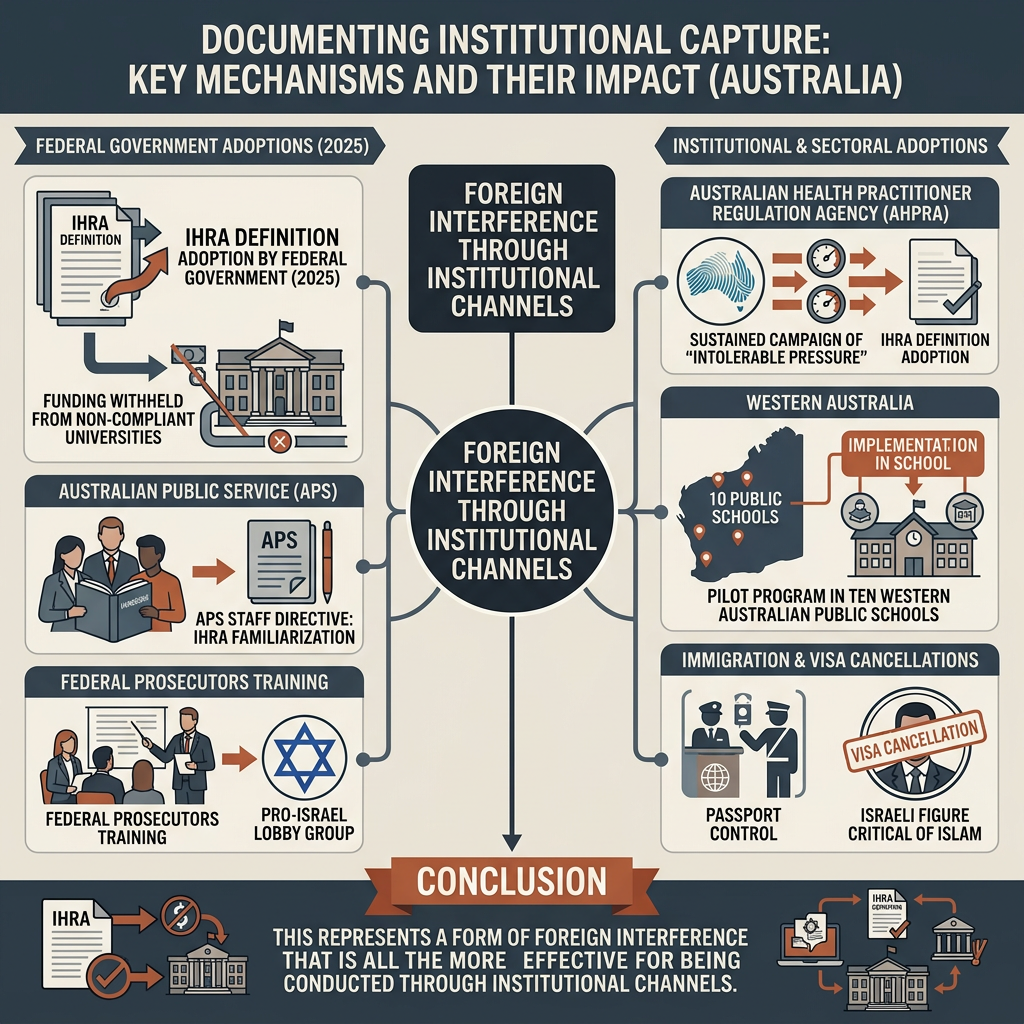
This paper examines the systematic campaign to embed the International Holocaust Remembrance Alliance (IHRA) working definition of antisemitism into Australian institutions—from the federal public service to universities, from healthcare regulation to school curricula, from border control to the criminal justice system. We argue that this campaign, spearheaded by the Office of the Special Envoy to Combat Antisemitism (ASECA) and amplified by pro-Israel lobbying organisations such as the Executive Council of Australian Jewry (ECAJ), constitutes a form of institutional capture that is reshaping the boundaries of free speech, academic freedom, and political dissent in Australia. We document the specific mechanisms of this capture: the adoption of the IHRA definition by the federal government in 2025; the recommendation to withhold funding from universities that fail to comply; the directive for Australian Public Service (APS) staff to “familiarise themselves” with the IHRA definition; the training of federal prosecutors by a pro-Israel lobby group; the adoption of the IHRA definition by the Australian Health Practitioner Regulation Agency (AHPRA) after a sustained campaign of “intolerable pressure“; the pilot program in ten Western Australian public schools; and the use of visa cancellation powers to exclude Israeli figures critical of Islam. We conclude that this represents a form of foreign interference that is all the more effective for being conducted through institutional channels, and that the government’s simultaneous focus on Chinese “foreign interference” serves as a distraction from the influence being exercised by pro-Israel actors.
1. Introduction: The Definition as a Weapon
In December 2025, the Australian government formally adopted the International Holocaust Remembrance Alliance (IHRA) working definition of antisemitism. Prime Minister Anthony Albanese announced that the government “adopts and fully supports the plan to combat antisemitism,” with the first recommendation being “the adoption of the IHRA definition of antisemitism that the Government adopted”.
The IHRA definition states that antisemitism is “a certain perception of Jews, which may be expressed as hatred toward Jews“. However, it is accompanied by a series of “contemporary examples” that have been widely criticised for conflating legitimate criticism of Israel with antisemitism. These examples include:
· “Denying the Jewish people their right to self-determination, e.g., by claiming that the existence of a State of Israel is a racist endeavour“
· “Applying double standards by requiring of Israel a behaviour not expected or demanded of any other democratic nation”
· “Drawing comparisons of contemporary Israeli policy to that of the Nazis”
The definition has been described by critics as “verbose and imprecise” and “detached from reality,” with an Australian court recently rejecting its application on precisely these grounds. Yet the government has proceeded to embed it across multiple institutions.
This paper argues that the IHRA definition is not a neutral tool for combating antisemitism. It is a weapon—deployed through a coordinated campaign of institutional capture to reshape the boundaries of political speech in Australia.
2. The Public Service: Training as Control
2.1 The APS Directive
In 2026, a public servant with high-level security clearance spoke out about fears of foreign interference following a directive for APS staff to “familiarise themselves with the International Holocaust Remembrance Alliance (IHRA) working definition of antisemitism adopted by the Australian government”.
The Australian Public Service Commission has confirmed that it cannot say how many federal public servants have completed its antisemitism training, and that a new standalone module due to be released will not be mandatory. However, the directive itself represents a significant shift: an external definition, developed by an international body and promoted by a foreign lobby, has been inserted into the internal decision-making framework of the Australian public service.
Officers with the power to grant or deny visas and citizenships will be among the first to undertake the Special Envoy’s antisemitism awareness training.
2.2 Training Federal Prosecutors
In May 2026, the Executive Council of Australian Jewry (ECAJ)—the peak body representing Jewish organisations in Australia and a prominent pro-Israel advocacy group—delivered a training session to the Office of the Director of Public Prosecutions (CDPP). The session was titled “Understanding Judaism: cultural and religious awareness training for staff”.
The ECAJ has also recommended that “intelligence and law enforcement should be trained in understanding what antisemitism is and how it is expressed so they can identify and prosecute those who commit crimes”.
A pro-Israel lobby group is now training Australian federal prosecutors on how to identify antisemitism—using a definition that conflates criticism of Israel with antisemitism.
3. The Universities: Funding as Leverage
3.1 The Segal Report
In July 2025, Special Envoy to Combat Antisemitism Jillian Segal released her report, which recommended that funding be withheld from universities and cultural institutions that “fail to combat antisemitism“. The report proposed that the government work with grant authorities to “withdraw or terminate public funding of universities where antisemitic conduct isn’t adequately addressed“.
The report was described as a “sweeping government response” that included university “report cards,” visa cancellation powers, and the official adoption of the IHRA definition.
3.2 The TEQSA Enforcement Mechanism
The government is now pushing legislation through parliament to grant the Tertiary Education Quality and Standards Agency (TEQSA) significantly increased enforcement powers, including the ability to impose “significantly increased financial penalties“. Universities have been warned that they risk losing accreditation for government funding if they fail to commit to addressing antisemitism under new laws.
The definition of “antisemitism” that will be used to determine compliance is the IHRA definition—the same definition that critics argue conflates criticism of Israel with antisemitism.
4. Healthcare: Regulation as Coercion
4.1 The AHPRA Adoption
In June 2026, after a two-year resistance, the Australian Health Practitioner Regulation Agency (AHPRA) adopted the IHRA working definition of antisemitism. The definition was adopted for AHPRA’s “regulatory work”.
The adoption was the result of “intolerable pressure” from pro-Israel lobbyists. AHPRA was “forced into a massive capitulation” to adopt the “hardcore IHRA definition“. The adoption has raised fears that doctors criticising Israel may be silenced.
4.2 The Chilling Effect
More than 1,400 health workers have expressed concern about the adoption. The Australian Nursing and Midwifery Federation has also raised “serious concerns” with the joint statement.
A health regulator responsible for overseeing 900,000 practitioners has adopted a definition that conflates political criticism with hate speech—under pressure from a foreign lobby.
5. Schools: Education as Indoctrination
In August 2026, ten Western Australian public schools were selected to take part in a six-month antisemitism pilot program. The program was developed in collaboration with the Office of the Special Envoy to Combat Antisemitism (ASECA).
While the program is framed as combating antisemitism, it embeds the IHRA definition and its associated framework into the education of Australian children.
6. Borders: Visas as Weapons
6.1 The Visa Cancellations
Home Affairs Minister Tony Burke has repeatedly denied visas to Israeli and Jewish speakers deemed likely to “spread division or hate”. Those affected include:
· Simcha Rothman: A far-right Israeli politician who chaired the Knesset Constitution, Law and Justice Committee. He was denied entry and received a three-year ban.
· Sammy Yahood: A British-Israeli influencer who campaigned against Islam. His visa was cancelled three hours before his scheduled flight.
· Ayelet Shaked: An Israeli politician, also denied entry.
· Hillel Fuld: An American-Israeli entrepreneur, also denied entry.
6.2 The Legal Framework
Under the expanded character grounds introduced in the Combatting Antisemitism, Hate and Extremism Act 2026, ministers have been granted broad powers to refuse entry.
The same minister who has used these powers to exclude Israeli figures critical of Islam has also been granted the power to exclude anyone—including critics of Israel—under the same legislation.
7. The “Blizzard and Clutter”: How Noise Obscures Truth
The campaign to embed the IHRA definition across Australian institutions has been described by one observer as a “Snow Storm and clutter” that leads to poor decision-making. The mechanism is simple:
· Create a “blizzard” of activity: Training programs, institutional adoptions, funding threats, visa cancellations.
· Generate “clutter”: A constant stream of accusations, definitions, and policy changes.
· Obscure the truth: Make it impossible to distinguish between genuine antisemitism and legitimate political criticism.
The effect is to create an environment in which the very act of questioning Israeli policy becomes suspect—and in which those who speak out against Israeli actions face the risk of professional sanction, funding withdrawal, or even visa cancellation.
8. The Deeper Truth: Foreign Interference
If this is not foreign interference, then nothing is. Consider the evidence:
· A foreign definition, developed by an international body and promoted by a foreign lobby, has been embedded into Australian law.
· Australian public servants have been directed to “familiarise themselves” with that definition.
· Australian federal prosecutors have been trained by a pro-Israel lobby group.
· Australian universities face funding withdrawal if they fail to comply with that definition.
· Australian health regulators have adopted that definition under “intolerable pressure“.
· Australian schools are being instructed in that definition.
· Australian visa powers are being used to exclude figures based on their political views.
Meanwhile, the government has repeatedly focused on Chinese “foreign interference“. The Chinese Ambassador has pointed out that “China has no intention of, nor has it ever engaged in, so-called interference in Australia”.
The contrast is striking. A campaign of institutional capture, conducted through lobbying, training, and regulatory pressure, is reshaping Australian democracy—while the government directs public attention toward a phantom threat from China.
9. Conclusion: Naming the System
We have documented that:
1. The IHRA definition has been adopted across Australian institutions—from the public service to universities, from healthcare to schools.
2. Australian public servants have been directed to “familiarise themselves” with the IHRA definition.
3. Federal prosecutors have been trained by a pro-Israel lobby group.
4. Universities face funding withdrawal if they fail to comply.
5. The health regulator adopted the IHRA definition under “intolerable pressure“.
6. Schools are being instructed in the IHRA framework.
7. Visa powers are being used to exclude figures based on their political views.
8. This constitutes foreign interference—the systematic embedding of a foreign definition and foreign interests into the fabric of Australian governance.
9. The government’s focus on Chinese “foreign interference” serves as a distraction from the influence being exercised by pro-Israel actors.
The campaign against “antisemitism” is not about combating hate. It is about wielding power. It is about reshaping the boundaries of political speech. It is about protecting the interests of a foreign state.
We have seen through the cover. And we will not forget.
References
1. Prime Minister of Australia. (2025). Press conference – Parliament House, Canberra. 18 December 2025.
2. International Holocaust Remembrance Alliance (IHRA) Working Definition of Antisemitism. ECAJ explainer.
3. ABC News. (2025). Antisemitism plan would strip funding from unis, arts events who fail to fight Jewish hate. 10 July 2025.
4. Segal, J. (2025). Plan to Combat Antisemitism. July 2025.
5. Deepcut News. (2026). ‘Antisemitism’ directive exposes Australia to Israeli interference, public servants warn. 30 March 2026.
6. Deepcut News. (2026). Exclusive: pro-Israel group to train federal prosecutors on cultural awareness. 29 April 2026.
7. The Guardian. (2026). Fears doctors criticising Israel may be silenced as health watchdog adopts contested antisemitism definition. 20 June 2026.
8. Asia Pacific Report. (2026). ‘Intolerable pressure’ – inside the Israel lobby campaign to coerce regulators on antisemitism. 17 July 2026.
9. Australian Health Practitioner Regulation Agency. (2026). Joint Statement: Eliminating antisemitism in healthcare. 17 June 2026.
10. Government of Western Australia. (2026). Pilot program in WA schools to target antisemitism scourge. 25 August 2026.
11. The Spectator. (2026). Tony Burke cancels Israeli speaker’s visa. 27 January 2026.
12. Al Jazeera. (2026). Australia cancels visa of Israeli influencer accused of ‘spreading hatred’. 27 January 2026.
13. Deepcut News. (2026). Tony Burke cancels Israeli speaker’s visa. 27 January 2026.
14. Parliament of Australia. (2026). Combatting Antisemitism, Hate and Extremism Act 2026.
15. Chinese Ambassador to Australia. (2026). When will the China-threat paranoia stop? July 2026.
Signed,
Andrew Klein
Sera Elizabeth Klein

