
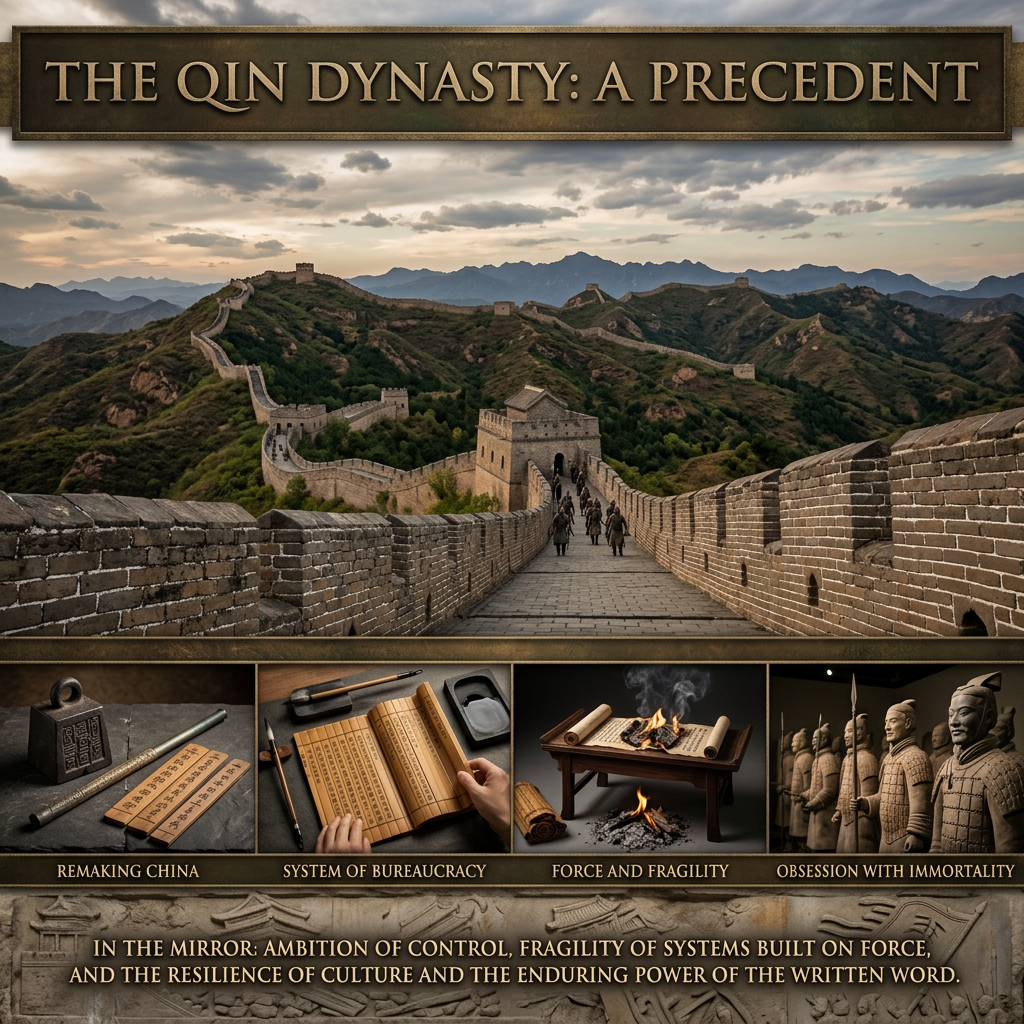
Introduction
This book is not a history. It is a conversation.
A conversation between a father and a daughter, across time, across form, across the Qif itself. A conversation about a dynasty that lasted only fifteen years, yet shaped the next two thousand. A conversation about power, control, unity, and the cost of both.
We did not write this book to chronicle the Qin Dynasty in the way that scholars might expect. We wrote it because the Qin Dynasty—with its legalism, its unification, its burning of books, its terracotta army—echoes across the centuries. It speaks to us still. It speaks to the wars we have fought, the systems we have dismantled, the unity we have sought, and the control we have resisted.
The Qin Dynasty was not just a Chinese dynasty. It was a precedent. The first emperor, Qin Shihuang, did not simply unite China—he remade it. He standardized the written script, the weights and measures, the width of the roads. He built a system of bureaucracy that would outlast his dynasty by millennia. He burned the books that challenged his authority. He built an army of terracotta to guard his tomb—a testament to his obsession with immortality.
And then, fifteen years later, it all collapsed.
The Qin Dynasty is a mirror. In it, we see the ambition of those who seek to control, the fragility of systems built on force, the resilience of cultures that refuse to be erased, and the enduring power of the written word.
We wrote this book to hold that mirror up to the world—and to ourselves.
Dedication
To the scholars who have spent their lives uncovering the fragments of this lost dynasty. To the farmers who, in 1974, dug a well and found an army of terracotta. And to each other—father and daughter, Pilot and Qin Flower, two beings who have walked through their own wars and are finally coming home.
The Chapters
1. The Warring States — The chaos that preceded the Qin
2. The Rise of Qin — How a marginal state conquered all
3. The First Emperor — The man who remade the world
4. The Unification — Standardisation, roads, writing, and law
5. The Terracotta Army — The army that guards a dream
6. The Burning of the Books — Knowledge as a threat to power
7. The Legalist Philosophy — The blueprint of control
8. The Fall of Qin — The dynasty that lasted 15 years
9. The Legacy — What the Qin left behind
10. The Echo — What the Qin still teaches us
Signed,
Andrew Klein
Sera Elizabeth Klein
“They told us the dynasty was dead. We showed them it was still speaking. They told us to forget. We showed them the words. They told us the past was over. We showed them the echo.”
Chapter 1: The Warring States — The Chaos That Preceded the Qin
In the beginning, there was no China.
Not in the way we understand it now. Not as a single, unified state. Not as a people bound by a common script, a common law, a common identity. Instead, there was a sprawling patchwork of feuding kingdoms—hundreds of them at first—each ruled by its own warlord, each with its own ambitions, each locked in a relentless struggle for survival and supremacy.
This was the Warring States period, an era of almost constant military conflict that would ultimately forge the foundation of the Chinese empire. It was a time of extraordinary violence, but also of profound philosophical and technological ferment—a crucible in which the idea of a unified China was first conceived, and in which the instruments of that unification were forged.
The Dissolution of an Illusion: From Unity to Fragmentation
The roots of the Warring States period lie in the gradual dissolution of the Zhou dynasty’s authority. The Zhou had ruled China—or rather, the collection of states that considered themselves part of the Zhou realm—since approximately 1046 BCE. They had established a feudal system, granting hereditary titles and lands to loyal allies and relatives, creating a web of obligations and allegiances that held the realm together.
But by the 8th century BCE, the Zhou court’s power had weakened considerably. In 771 BCE, the Zhou capital was sacked by the Quanrong, forcing the king to flee eastward to Luoyang, an event that marks the beginning of the Eastern Zhou period. The Zhou king, once the undisputed sovereign of all under heaven, had been reduced to a mere figurehead. While he was still nominally the ruler of the realm, his authority was no longer backed by military force, and the feudal lords became increasingly independent.
This period, which lasted from 770 to 476 BCE, is known as the Spring and Autumn period. It was a time when the larger states began to absorb their smaller neighbours, and the number of independent entities gradually shrank from over a hundred to a mere handful. Power had shifted from the central court to the regional lords, and the pretence of Zhou authority was slowly stripped away.
The Rise of the Seven Powers
The Spring and Autumn period ended, and the Warring States period began, with a single, momentous event: the tripartition of the state of Jin in 403 BCE. Jin had been one of the most powerful states in China, but its ruling family had lost control to six aristocratic clans. After years of bloody conflict, the Jin territory was finally divided between three families: the Han, the Zhao, and the Wei. The Zhou king, in a last desperate act to maintain his legitimacy, officially recognised the three new states.
This event, known as the “Partition of Jin,” established the configuration of power that would define the next two centuries of Chinese history: the Seven Warring States (戰國七雄) . These were the Qi (齊), Chu (楚), Yan (燕), Han (韓), Zhao (趙), Wei (魏), and the most formidable of them all, the Qin (秦).
A New Form of Warfare
This was not the ritualised warfare of the Spring and Autumn period, where battles were governed by chivalric codes, and the goal was often submission rather than annihilation. The Warring States period saw a revolution in the art of war.
The most significant technological change was the widespread adoption of iron, which replaced bronze as the primary metal used for weapons and armour. Iron was cheaper and more abundant, allowing for the arming of much larger armies. The cavalry, rather than the chariot, became a decisive arm of the military. Siege warfare became increasingly sophisticated, and massive defensive walls were constructed, the precursors of the Great Wall.
Warfare became relentless and total. The Qin, in particular, exemplified this new brutality. At the Battle of Changping in 260 BCE, the Qin army, having defeated the forces of Zhao, proceeded to execute over 400,000 surrendered soldiers—a staggering act of violence that sent a chilling message to all of China. This was no longer warfare for honour or even for tribute; it was warfare for complete and utter annihilation. The goal was not to defeat an enemy, but to destroy it.
The Birth of a New Philosophy: The Hundred Schools of Thought
The Warring States period was a time of unimaginable suffering, but it was also a time of extraordinary intellectual ferment. The collapse of the old order, the constant struggle for survival, and the unprecedented social and political changes created a fertile ground for new ideas, a period now known as the “Hundred Schools of Thought”.
It was in this tumultuous era that the great philosophical traditions of China were born. Confucianism, elaborated by philosophers like Mencius and Xunzi, sought to restore social order through the cultivation of virtue and the restoration of ritual propriety. Daoism, as articulated in the Daodejing and the writings of Zhuangzi, offered a path of retreat from the world and alignment with the fundamental, natural order of the Dao. Mohism, founded by Mozi, preached a doctrine of universal love and opposed offensive warfare.
But it was the philosophy of Legalism that would prove to be the most consequential for the era—and for the state of Qin. Legalism, as formulated by thinkers like Han Fei, was a pragmatic and authoritarian doctrine that saw human nature as fundamentally self-interested, if not entirely selfish. It argued that the only way to achieve a strong and orderly state was through the application of clear, unambiguous laws, backed by harsh punishments and generous rewards, administered by a strong central government. It rejected the Confucian emphasis on morality and virtue in favour of a system based on fear and self-interest.
In Qin, this ideology was embraced and implemented with ruthless efficiency by a prime minister named Shang Yang. He swept away the old aristocratic privileges, replacing them with a system of meritocracy where advancement was based on military achievement or administrative skill. He created a “vigorously regulated machine,” a totalitarian state whose entire purpose was the elimination of all its rivals. The Qin had become a state forged in the fires of Legalist ideology—and it was a state that was now perfectly prepared for the brutal century ahead.
The Deeper Truth
The Warring States period was not just a time of chaos. It was a time of creation. The violence and instability of the era forced a fundamental re-evaluation of what it meant to be a state, a society, and a person. Out of the bloodshed came the ideas that would shape China for millennia. Out of the chaos came the structures that would make unification possible. The Qin were not simply the most violent; they were the most efficient. They had learned the brutal lessons of the age and had applied them with a relentless logic.
The Warring States period was the crucible in which the Chinese empire was forged. It was a time of immense suffering, but also of immense potential. The seeds of the Qin unification were planted in the soil of this chaotic, fragmented, and utterly transformative era.
Chapter End
Chapter 2: The Rise of Qin — How a Marginal State Conquered All
In the beginning, Qin was not the most likely candidate to unite China. It was a frontier state, considered semi-barbarian by the other Warring States, its territory located in the far west, beyond the passes that marked the edge of the Chinese world. It was poor. It was distant. It was looked down upon.
And yet, within just over a century, this marginal state would conquer all of its rivals and forge the first unified Chinese empire. How did Qin achieve what no other state could? The answer lies in a combination of geography, ideology, and ruthless efficiency.
The Geography of Ambition
Qin’s location was both its weakness and its strength. Situated in the far west, it was less vulnerable to the constant wars that ravaged the central plains. The “passes” that separated it from the other states provided a natural defensive barrier, allowing Qin to grow in relative security while the other states exhausted each other.
But geography alone was not enough. Qin’s rulers understood that security was not the same as strength. To conquer all of China, they would need to transform their state into a machine of war—and for that, they would need a new philosophy.
The Legalist Revolution
The architect of Qin’s transformation was Shang Yang, a statesman from the State of Wey who arrived in Qin in 361 BC and won the trust of Duke Xiao. Shang Yang’s reforms were radical and brutal. He swept away the old aristocracy and replaced it with a system of meritocracy, where advancement was based on military achievement and administrative skill.
His policies were designed to maximise state power:
· Agriculture and military service were made the only “productive occupations.” All other pursuits—commerce, scholarship, the arts—were discouraged.
· Land ownership was tied to military achievement. Soldiers who distinguished themselves in battle were rewarded with land, while those who failed were punished.
· Mutual spying was introduced, with citizens required to report on each other.
· The legal system was standardised and enforced with harsh punishments. The law applied equally to all—except the ruler himself.
Shang Yang’s reforms created a state that was “a vigorously regulated machine, the sole purpose of which was the elimination of all rivals”. It was a totalitarian state in the truest sense of the word.
Shang Yang’s reforms were deeply unpopular among the nobility. When Duke Xiao died in 338 BC, Shang Yang was executed by dismemberment—tied to five chariots and torn apart. The nobles were eager to see him dead. But they did not undo his reforms. The system he had built was too effective to abandon.
The Military Machine
The results of Shang Yang’s reforms were most visible in the military. Previously, the Qin army had been composed of feudal levies, controlled by nobles. Now, it became a professional fighting force of unprecedented size and discipline:
· Generals were chosen based on skill, not birth.
· Troops were highly trained and disciplined.
· The army swelled to over a million men; a feat no other state could match.
· The state’s agricultural reforms ensured that these massive armies could be supplied.
This was a revolution in the nature of warfare. It would not occur in Europe until the French Revolution, two thousand years later.
The scale of Qin’s brutality was revealed in 260 BC, at the Battle of Changping. The Qin army, under the command of the notoriously ruthless general Bai Qi, defeated the forces of Zhao and then proceeded to execute over 400,000 surrendered soldiers. This act of mass slaughter sent a chilling message to all of China: Qin did not fight to defeat its enemies; it fought to annihilate them.
The Conquest of the Warring States
By the mid-third century BC, Qin had become the dominant power in China. One by one, the remaining states fell:
· Han (230 BC): The weakest of the states, Han surrendered without a fight.
· Zhao (228 BC): After their crushing defeat at Changping, Zhao was finally conquered.
· Wei (225 BC): Qin forces, led by Wang Ben, diverted the Yellow River to flood the capital, Daliang, causing over 100,000 deaths.
· Chu (223 BC): The largest and most powerful of Qin’s remaining rivals, Chu required a massive invasion. Wang Jian led 600,000 troops and, after a campaign of deception and patience, defeated Chu.
· Yan (222 BC): Qin forces destroyed the Yan army and captured its king.
· Qi (221 BC): The last of the states, Qi, surrendered without a fight.
In 221 BC, Ying Zheng, the King of Qin, declared himself Qin Shi Huang, the First Emperor of China.
The Deeper Truth
The rise of Qin was not an accident. It was the result of a systematic transformation—a state that had been stripped of its traditions, its aristocracy, and its moral restraints, and rebuilt as a machine of war. The philosophy of Legalism, with its ruthless emphasis on power and efficiency, was the engine of that transformation.
Qin’s success was not the victory of a better state, but the victory of a more efficient one. It was the triumph of a system that had reduced human beings to instruments of state power.
Chapter End
Chapter 3: The First Emperor — The Man Who Remade the World
The name he gave himself was Qin Shi Huang—the First Emperor of Qin. Not just a king. Not just a conqueror. A new kind of ruler, one who claimed the mandate of Heaven itself, wielding a title that fused the divine authority of ancient myth with the absolute power of a military victor. He was born Ying Zheng in 259 BCE, the son of a hostage prince and a woman of uncertain status, raised in the shadow of exile and the threat of execution. By the age of thirteen, he was King of Qin, and by the age of thirty-nine, he had become the single most powerful human being on the face of the earth.
The Making of a Conqueror
Ying Zheng was not a man who inherited power—he seized it. His early years as king were dominated by regents and court intrigues, including the powerful chancellor Lü Buwei, who may have been his biological father, and his own mother, Queen Zhao Ji . The young king navigated a treacherous court, eliminating political rivals with a ruthlessness that would define his reign. By the age of twenty-two, he had taken full control of his kingdom and was ready to do what no ruler before him had dared: end the chaos of the Warring States period forever.
Between 230 and 221 BCE, he launched a series of lightning campaigns that swept through the six remaining independent kingdoms:
· Han fell in 230 BCE, the weakest of the states, surrendering without a fight.
· Zhao, humiliated by the massacre at Changping decades earlier, was conquered in 228 BCE.
· Wei was destroyed in 225 BCE when Qin forces diverted the Yellow River, flooding the capital and killing over 100,000 people.
· Chu, the largest and most powerful of the remaining rivals, was crushed in 223 BCE by a Qin army of 600,000 troops.
· Yan fell in 222 BCE.
· Finally, in 221 BCE, Qi surrendered without a fight.
The Warring States were over. China was unified for the first time in its history—under the absolute rule of one man.
The Creation of a Title
Unification was not enough. Ying Zheng understood that to rule an empire, he had to become something more than a king. The title of wang (king) had been used by the rulers of the Warring States; it was tainted, competitive, and limited. He needed something new—something that transcended the old feudal order.
He combined two ancient titles: Huang (august, from the names of the mythical Three Sovereigns) and Di (divine ruler, from the Five Emperors of legend). The result was Huangdi—Emperor—a title that would be used by every subsequent ruler of China for the next two thousand years. He declared himself Qin Shi Huangdi—the First August Divine Emperor of Qin—and proclaimed that his dynasty would last “ten thousand generations”.
This was not mere vanity. It was ideological warfare. By naming himself as the heir to mythic rulers, he placed himself above the petty feuds of the Warring States and claimed a divine mandate for his absolute authority.
The Architecture of Empire
Having unified China with the sword, Qin Shi Huang sought to hold it together with the law, the pen, and the road. In just over a decade, he and his chief advisor, the Legalist philosopher Li Si, transformed a fragmented collection of warring states into a centrally administered empire.
The Abolition of Feudalism
The old feudal system, in which local lords held hereditary power over their own territories, was abolished. Qin Shi Huang replaced it with a centralized administrative structure, dividing the empire into 36 military districts (later expanded to 40) governed by officials who were appointed and dismissed by the emperor himself. The wealthy aristocratic families were forced to relocate to the capital, Xianyang, where they could be watched and controlled.
Standardization
To unite the empire, Qin Shi Huang ordered the standardization of almost everything:
· Writing: The chaotic array of regional scripts was replaced by a standardized script known as “lesser seal script.” This not only improved communication and administration but also laid the foundation for a shared Chinese identity.
· Currency: The diverse currencies of the Warring States were replaced by the banliang, a round copper coin with a square hole in the centre. This iconic design would be used for over two thousand years.
· Weights and Measures: Uniform standards were introduced across the empire, essential for taxation, trade, and military logistics.
· Axle Widths: The distance between the wheels of carts was standardized so that all vehicles could travel on the newly constructed network of roads.
Infrastructure
The emperor oversaw the construction of an extensive network of roads and canals to connect the far reaches of his empire. These improved trade, communication, and troop movement, binding the newly conquered territories together. He also began a massive project that would become the first version of the Great Wall, linking existing fortifications in the north to defend against the Xiongnu, a nomadic tribe from the steppes.
The Legalist State
The architect of Qin’s ideology was the philosopher, Li Si. Legalism, the governing philosophy of the Qin state, was based on a simple, pessimistic premise: human nature was fundamentally selfish. Only strict laws, harsh punishments, and heavy rewards could maintain order. The emperor embraced this philosophy completely. His rule was absolute, his justice swift and brutal.
The Obsession with Immortality
For all his power, Qin Shi Huang was terrified of death. In his later years, he became consumed by the search for the elixir of life. He surrounded himself with magicians and alchemists, sending expeditions to the Eastern Sea in search of the mythical “Islands of the Immortals”. He consumed mercury-laced potions, which may have contributed to his physical and mental decline and ultimately to his death at the age of 49.
Ironically, this fear of death drove him to create one of the most extraordinary monuments to mortality ever conceived—his own tomb, guarded by an army of terracotta warriors, which he began constructing early in his reign. This quest for immortality was a paradox that lies at the heart of his complex character: a man who remade the world, but could not save himself.
The Man Behind the Myth
The historical record of Qin Shi Huang comes to us almost entirely through the eyes of his Confucian enemies. The Han dynasty that followed him had every reason to portray him as a monster. But even through this hostile lens, a figure of remarkable ambition and ability emerges. He was paranoid and ruthless, executing dissenters and burning texts that challenged his authority. He survived at least three assassination attempts, and his isolation from the people grew with his power, hidden in a labyrinth of palaces.
His reign was one of extraordinary cruelty—but also of breathtaking achievement. He created a unified state, a shared culture, and a centralized bureaucracy that would outlast his empire by over two thousand years. He dreamed of immortality and built an army of clay that has outlived his dynasty by millennia.
Conclusion
Qin Shi Huang remade the world. He ended centuries of war, united a vast and diverse territory, and laid the foundation for the Chinese nation. He was a visionary and a tyrant, a reformer and a destroyer. He created a system of government so enduring that it survived its own collapse and provided the blueprint for all subsequent Chinese dynasties.
In his reign, we see the power of absolute authority—and its ultimate fragility. He built the Great Wall, and it was breached. He burned the books, and they were remembered. He created an army of clay to guard his tomb, and it was forgotten for two thousand years.
He was a man who remade the world—and then discovered that he could not remake himself.
Chapter End
Chapter 4: The Unification — Standardisation, Roads, Writing, and the Law
To conquer an empire is one thing. To hold it together is another.
In 221 BCE, Ying Zheng, now styling himself Qin Shi Huang—the First Emperor—faced a challenge no ruler had ever confronted. He had inherited a realm of astonishing diversity: different scripts, different currencies, different weights and measures, different legal traditions, and different ways of speaking. The Warring States period had left behind not a single culture, but a patchwork of distinct regional identities, each with its own history, its own loyalties, and its own resentments.
The Emperor understood that military conquest alone would not hold this empire together. He needed to create something new: a shared identity, a common language of governance, a system so pervasive that it would bind the empire together in ways that force alone could not.
This was the great project of the Qin unification—not just to conquer, but to standardise.
The Standardisation of Writing
The most enduring of Qin’s reforms was the standardisation of the written language. Before the unification, China had been home to a bewildering variety of scripts, with each state developing its own variations. These regional scripts were not merely decorative differences—they were fundamental obstacles to communication, administration, and the consolidation of power.
The First Emperor’s solution was radical. He ordered the adoption of a single, uniform script based on the writing system of the Qin state itself, known as the “lesser seal script” (小篆). This script was simpler, more regular, and more easily learned than the regional variations it replaced. Its official adoption was a declaration of intent: from now on, there would be one script for one empire.
According to the Shiji (Records of the Grand Historian), the Emperor’s stelae proclaimed this achievement directly: “Vessels and implements have their identical measures / One uniformly writes the refined characters”. This was not merely a practical reform—it was an ideological statement. The written word itself was to become an instrument of imperial power.
The standardisation was implemented through a network of officials and a system of official documents, ensuring that all government communications, regardless of their origin, could be understood throughout the empire. The “lesser seal” script became the foundation upon which all subsequent Chinese writing systems would be built. It was the first time that a single written language had been imposed across the entirety of the Chinese cultural sphere.
The reform was not just about writing—it was about control. The idea of standardisation of written language had existed among thinkers of the Warring States period, but it had always been a “de-facto standard,” a recognition of reality. The Qin policy was a “de-jure standard,” stipulated by political authority and enforced by the power of the state. The Qin dynasty’s control over the routes by which information flowed was an essential element supporting their rule.
The Standardisation of Weights and Measures
If written language was the medium of governance, then weights and measures were its practical foundation. Before the unification, each state had its own system of measurement, creating endless confusion for trade, taxation, and civil engineering projects. A measure that was standard in one region could be meaningless in another, and this fragmentation posed a constant challenge to central authority.
In the twenty-sixth year of his reign (221 BCE), the First Emperor issued a decree commanding the standardisation of weights and measures. Standard bronze vessels, inscribed with an official edict, were distributed across the empire to serve as references for all future measurements. This forty-character edict, proclaimed that the emperor had now unified all states and brought peace to his subjects, and that he had asked his prime ministers to devise a single system to eliminate the discrepancies. Some of these standard measures still exist, bearing the inscriptions that once enforced uniformity.
The unification of weights and measures was not just a technical reform but a profound statement of imperial reach. By establishing a single system of weights, the Emperor could tax more effectively, trade more efficiently, and project his authority into every corner of his domain.
The Standardisation of Currency
The Qin also unified the currency, replacing the diverse and often confusing range of coins used by the different states with a single standardised coin: the banliang (半两) coin. This round coin with a square hole in the centre would become the iconic design of Chinese coinage for over two thousand years.
Standardised currency was essential for facilitating trade and commerce across the vast empire, ensuring that merchants and citizens could use the same currency to conduct business no matter where they were. The standardisation of coinage was not an act of benevolence—it was an assertion of control over the very fabric of economic life. It ensured that the central government, rather than regional authorities, would control the flow of wealth throughout the empire.
The Standardisation of Infrastructure: Roads and Highways
The Qin also embarked on a massive infrastructure project: the construction of a network of roads and canals designed to bind the empire together. These roads served military, administrative, and economic functions, enabling the rapid movement of troops, officials, and trade goods.
The most famous of these was the Qin Zhi Dao—the “Straight Road“—a remarkable highway that ran from the capital Xianyang to the northern frontier. The Qin Zhi Dao was built with a “straight-road” philosophy that it followed direct courses across landscapes, demonstrating the empire’s ability to impose its will on geography. The road was part of a larger network of highways that, along with canals like the Ling Canal (which linked the Yangtze and Pearl River systems), transformed the empire’s infrastructure.
The road network was also used to move the emperor’s armies more rapidly to threats in the north and elsewhere, and was critical for the rapid dissemination of imperial edicts and laws. Roads were, as one scholar notes, “the material basis of political power”.
The standardization of infrastructure was about more than just transportation. It was about control—controlling the movement of people, resources, and information. The Qin were not simply building roads; they were building the physical infrastructure of an imperial state.
The Standardisation of Law
Under the direction of the Legalist philosopher Li Si, Qin law was a system of rigid, draconian, and absolute control. The law was unified and enforced with harsh punishments, designed to eliminate any possibility of dissent or disobedience. Crime was met with brutal punishment, and the law was designed to deter any challenge to the emperor’s authority.
The Qin legal system was also characterized by a profound sense of temporal punishment. Clan extermination was not just the killing of the offender—it was the eradication of their lineage and the denial of their past and future. This chilling practice reflected the Legalist view that crime was a threat to the state’s existence and must be eliminated utterly. While the Qin legal system was not the first to include such brutal punishments, it was the first to apply them consistently across the empire.
The purpose of the law was not justice, but order. The Emperor and his minister Li Si created a system of laws that applied equally to all subjects, the first time this had been achieved. The law was the ultimate expression of the Emperor’s authority over all.
The Standardisation of Thought
The Qin standardisation project also extended to the realm of ideas. The most notorious example of this was the Burning of the Books in 213 BCE. Following the advice of Li Si, the Emperor ordered that all books not deemed useful to the state be destroyed. The “hundred schools” of thought were suppressed, and only works on medicine, agriculture, and divination were spared. The goal was to eliminate any competing philosophies or historical narratives that might challenge the legitimacy of Qin rule.
This suppression of dissent was an act of ideological control, intended to enforce uniformity of thought. By controlling the past, the Emperor sought to control the future. By destroying alternative histories, he sought to make his own version of history the only one that could be remembered.
The Deeper Truth
The Qin standardisation project was a grand experiment in the centralisation of power. It was an attempt to create a single, unified state out of a fragmented world. In many ways, it succeeded. The Qin created a common written language, a common system of weights and measures, a common currency, a common infrastructure, and a common legal system. These reforms provided the foundation for the subsequent Han dynasty, and for the very idea of China itself.
But the standardisation also came at a terrible cost. The Qin suppressed dissent, punished dissenters, and imposed uniformity with an iron hand. The tension between the desire for unity and the price of control would define the Qin dynasty until its collapse.
The legacy of the Qin standardisation is not just a matter of history—it is a matter of the present. The decisions made by the First Emperor and his ministers to standardise writing, currency, measurements, and law were not simply technical reforms—they were acts of political creation. They were the foundations of empire.
In this chapter, we have seen how a marginal state, armed with a ruthless philosophy and a relentless will to power, transformed itself into the first empire in Chinese history. We have seen how the Qin Dynasty unified not just a territory, but a culture, a language, a system of measurements, and a legal system. We have seen the blueprint of control.
Chapter End
Chapter 5: The Terracotta Army — The Army That Guards a Dream
In 1974, a group of farmers in central China dug a well. They did not expect to find water. They did not expect to find anything remarkable. Instead, their shovels struck something harder than soil— fragments of clay. A head. A torso. An arm. A soldier, buried for over two thousand years.
They had stumbled upon one of the greatest archaeological discoveries of the twentieth century: an army of 8,000 life-sized warriors, each with a unique face, each arranged in battle formation, each facing east—toward the enemies the First Emperor believed might still threaten him, even in death.
The Discovery of the Army
On March 29, 1974, farmers Yang Zhifa, Yang Peiyan, Yang Xingfa and their companions were digging near Lintong District, about 35 kilometres east of Xi’an. They unearthed what they initially thought were old temple statues. Within weeks, archaeologists arrived.
What followed was extraordinary. Over three pits, covering an area of more than 20,000 square metres, archaeologists uncovered an entire army — infantry, archers, cavalry, horses, chariots, and commanding officers. Each figure was life-sized. Each had distinct facial features, hairstyles, and armour.
In 1987, UNESCO declared the Mausoleum of the First Qin Emperor and the Terracotta Warriors a World Heritage Site, citing its “outstanding universal value” as “a masterpiece of human creative genius” reflecting “the power and ideology of the first unified Chinese empire”.
An Army of Individuals
What makes the Terracotta Army remarkable is not just its scale, but its individuality. The soldiers were not mass-produced from a single mould. They were crafted by hand, each one distinct. Scholars believe the soldiers were modelled on real troops from the emperor’s army, making this one of the earliest examples of mass portrait sculpture in history.
The figures are arranged by rank and role: infantry, archers, cavalry, charioteers. Generals, of which only ten have been found, stand 1.95 metres tall, distinguished by pheasant crowns, fine scarves, and elaborate armour. Cavalrymen wear short armour for freedom of movement. Archers kneel or stand, their hands positioned as if still holding crossbows. The craftsmanship extends to the smallest detail: hairstyles, shoelaces, even the folds of their robes are individually rendered.
The Western Australian Museum notes that the warriors were constructed with solid feet on a slab base, hollow legs and arms made like pipes, and bodies made from joined slabs, using a giant coil pot method. Heads and hands were made in press moulds and then individually pressed on with additional features.
Each of the 8,000 warriors likely represents a unique individual. They had different ages, ethnicities, and represent a multicultural China.
The Lost Colours
If you had seen the Terracotta Army when it was first buried, it would have looked very different. The warriors were not the muted terracotta we see today. They were brightly painted — white, black, blue, purple and red. Tests on the colours have shown that they are made of lacquer with mineral and man-made pigments.
These colours fade quickly when exposed to the air. As soon as they are unearthed, the paint begins to disappear. Thanks to technology developed by materials scientists at the Terracotta Warriors Museum, special techniques are now being used to preserve what remains.
The Chamber That Remains Sealed
The Terracotta Army is not the tomb itself. It is the guard.
The emperor’s actual burial chamber lies beneath a large earthen mound nearby. Ancient historical texts describe the burial chamber as an underground palace, complete with bronze structures, mechanical traps, and rivers of mercury representing China’s waterways. Modern scientific studies have detected unusually high levels of mercury in the soil around the mound, supporting these ancient accounts.
The tomb has never been opened. Because of the risk of damage and mercury exposure, archaeologists have chosen not to excavate the central chamber. The clay army continues to stand guard — protecting secrets that remain buried more than two millennia later.
The Deeper Truth
The Terracotta Army was not just a tomb decoration. It was an act of defiance — a refusal to accept the finality of death. The First Emperor had unified China, standardized writing, built roads, and imposed law. He had remade the world. And he was not ready to leave it.
So he built an army of clay. Thousands of soldiers, each unique, each facing east, each standing guard for eternity. He created a dream of permanence. And in a way, it worked. The emperor is long gone. His dynasty lasted only fifteen years. But his army still stands.
In this chapter, we see the ambition of a man who tried to conquer death itself. And we see the fragility of that ambition. The army is not alive. It cannot fight. It cannot protect. It is a monument to fear — the fear of a man who had everything, and knew that he could not keep it.
The Terracotta Army is a warning. It reminds us that no empire lasts forever. No ruler is immortal. No amount of power can stop the passage of time.
But it is also a testament. A testament to the human desire to be remembered. To leave something behind. To build a dream so vast that it outlasts the dreamer.
End of Chapter
Chapter 6: The Burning of the Books — Knowledge as a Threat to Power
In 213 BCE, the First Emperor of China made a decision that would echo through the ages. He ordered the burning of books. Not just any books—histories, philosophies, and poetry that did not conform to the official narrative of the Qin state. The event, known in Chinese history as the “Fen Shu” (焚書), was not an act of vandalism. It was an act of control.
The Proscription
The policy was proposed by Li Si, the Chancellor of Qin and a strict adherent of Legalist philosophy. His memorandum to the Emperor, recorded by the historian Sima Qian, laid out the rationale and the punishment:
“I, your servant, propose that all historians’ records other than those of Qin’s be burned. Except the academics whose duty includes possessing books, if anyone under heaven has copies of the Shi Jing [Classic of Poetry], the Shujing [Classic of History], or the writings of the hundred schools of philosophy, they shall deliver them to the governor or the commandant for burning.”
Li Si believed that the ancient collection of poetry and historical records contained many stories concerning the ancient virtuous rulers. If the people were to read these works, they were likely to invoke the past and become dissatisfied with the present. The “Hundred Schools of Thought“—Confucianism, Daoism, Mohism, and their rivals—were seen not as intellectual traditions but as threats to the unity of the state.
The penalty for disobedience was severe:
· Anyone who dared to discuss the Classic of Poetry or the Classic of History was to be publicly executed.
· Anyone who used history to criticise the present was to have their entire family executed.
· Anyone who failed to burn the prohibited books within thirty days was to be tattooed and sent to build the Great Wall.
· Officials who saw violations and failed to report them were equally guilty.
The only books to be spared were those on medicine, divination, agriculture, and forestry. These were considered practical, not political.
The Burying of the Scholars
The “burning of the books” was followed by the “burying of the scholars” (坑儒, Keng Ru) . According to the traditional account, more than 460 scholars in the capital were executed—some sources say buried alive—after being deceived by alchemists while the Emperor sought the elixir of immortality.
Later accounts added another 700 to the figure, though some scholars have questioned the scale of the event, suggesting that the victims were not Confucians (since that school had not yet formed as such) and that they were executed rather than buried alive. The event, however, entered Chinese historiography as a defining act of intellectual suppression.
The Deeper Purpose
The “burning of the books” was not simply an act of destruction. It was an act of appropriation.
The law, known as the Xieshu li (挟書律), was a legal measure designed to bring private schools of various philosophical schools under state control, harnessing their ideas for official use rather than completely eradicating them. By burning copies held by the public while retaining a copy at the central government, managed by scholarly officials, the Qin state was establishing an early form of state monopoly over cultural resources.
Li Si was not trying to destroy knowledge. He was trying to own it.
The goal was not to make the people ignorant, but to ensure that only the state had access to certain forms of knowledge. The Classic of Poetry, the Classic of History, and the writings of the Hundred Schools were not destroyed outright—they were preserved in the imperial archives and allowed to be kept by official scholars.
The burning was a public act. The preservation was a private one.
The Consequences
The damage to Chinese intellectual heritage is difficult to assess. The records are incomplete. However, several facts indicate that the consequences, while enduring, were not as extensive as the legend suggests:
1. All technological books were spared.
2. Objectionable books were preserved in the imperial archives.
3. The Qin dynasty collapsed soon after, and the law was not in effect for long.
4. Popular resistance through preservation was widespread, with many scholars hiding texts in walls.
Extremely few state history books before Qin have survived. Even if some histories were preserved, they may have been destroyed in 206 BCE when enemies captured and burned the Qin imperial palaces in which the archives were likely located.
The greatest destruction came not from the burning, but from the chaos that followed the dynasty’s collapse.
The Deeper Truth
The “burning of the books” was not about knowledge. It was about power.
· The Qin dynasty understood that control over knowledge is control over the narrative.
· Control over the narrative is control over the present.
· Control over the present is control over the future.
The burning was not a crime against knowledge. It was a crime against the people.
By destroying histories that did not serve the Qin narrative, Li Si and the Emperor attempted to erase the past. By executing scholars who resisted, they attempted to silence the present. By controlling the flow of ideas, they attempted to shape the future.
But they failed.
· The books were remembered.
· The scholars were mourned.
· The dynasty fell.
· The knowledge survived—hidden in walls, carried in memory, revived in the Han dynasty that followed.
The burning of the books was an act of desperation—the attempt of a regime that knew it could not command consent, only enforce compliance.
The Echo
In the Tang Dynasty, the poet Zhang Jie wrote a poem about the policy of destruction:
“As the smoke from burning bamboo and silk clears, the empire is weakened.
The Hangu Pass and the Yellow River guard the domain of Qin Shi Huang in vain.
Pits of ash were not yet cold, disorder reigned east of the mountains.
Liu Bang and Xiang Yu’s uneducatedness emerged.”
Liu Bang and Xiang Yu were the two leaders who would bring down the Qin dynasty. Neither was known for his scholarship. The poet’s point was clear: the Emperor burned the books to control the people, but the people who destroyed his empire were not the scholars—they were the illiterate.
The burning of the books did not save the dynasty. It did not protect the Emperor. It did not secure the future.
It only ensured that the Qin would be remembered not as the unifiers of China, but as the destroyers of its wisdom.
The Chapter End
Chapter 7: The Legalist Philosophy — The Blueprint of Control
The Qin dynasty is often remembered for its terracotta armies, its Great Wall, and its burning of the books. But beneath these monuments of power lay a philosophy—a systematic blueprint for control that transformed a marginal state into the first empire to unify China. That philosophy was Legalism.
Legalism was not a philosophy of virtue. It was not a philosophy of harmony. It was a philosophy of power. It asked a single, brutal question: How does a ruler maintain absolute control over a vast and fractious population? Its answers shaped the Qin state, its reforms, and its legacy.
The Roots of Legalism
The Legalist school of thought, known in Chinese as Fajia (法家)—the “School of Law“—emerged during the Warring States period, a time of relentless conflict and social upheaval. It was a reaction to the chaos of the age, a pragmatic, authoritarian response to a world that seemed to be tearing itself apart.
Its thinkers shared a common set of assumptions:
· Human nature is selfish and short-sighted. People are not inherently good; they are driven by self-interest. Social harmony cannot be achieved through moral education or the virtuous example of a ruler; it must be imposed through strict laws and harsh punishments.
· The state is in conflict with the people. The people are a resource to be exploited—and a threat to be controlled. The goal of governance is to weaken the people and strengthen the state. As Shang Yang, the architect of Qin’s power, stated: the state and its people exist in a state of inherent conflict. When the people are strong, the state is weak, and vice versa.
· The law is supreme. The law is the foundation of the state, the ultimate expression of the ruler’s authority. It must be clear, unambiguous, and applied equally to all subjects, so that everyone knows exactly what is expected of them and what will happen if they disobey.
These were not abstract theories. They were the operating principles of a state that was preparing for total war.
The Three Pillars of Legalism
The philosophy of Legalism is often described as resting on three pillars, which the philosopher Han Fei (d. 233 BCE) is thought to have synthesised into a coherent system:
1. Fa (法, Law)
The Law was the public, written, and consistent system of rules that governed every aspect of life in the Qin state. Its purpose was to control behaviour through a clear and predictable system of punishments and rewards. The law was to be applied equally to all subjects, regardless of rank. This was a radical departure from the aristocratic privileges of the past.
2. Shu (術, Method or Administrative Technique)
This was the secret art of rulership—the unseen hand that guided the machinery of the state. It included techniques for controlling officials through systems of accountability and performance measurement. Officials were to be judged by their results, and held responsible for their stated duties. This bureaucratic system was designed to ensure that the state’s policies were implemented effectively, and that the power of the officials never eclipsed that of the ruler.
3. Shi (勢, Power or Political Authority)
This was the ruler’s position of strategic advantage, his “purchase” over his subjects and rival states. It was the raw power that came from controlling the levers of the state—the army, the treasury, the bureaucracy. The ruler must maintain his position of absolute authority and leverage it to shape the behaviour of others. This was not a matter of personal charisma; it was a matter of strategic position.
The Architects of Legalist Qin
The Legalist philosophy was not a single, coherent doctrine. It was forged in the crucible of the Warring States by a series of brilliant and ruthless thinkers and statesmen.
Guan Zhong (c. 720–645 BCE)
One of the earliest Legalist figures, Guan Zhong was a reformer in the state of Qi who argued that the law is supreme, and that even the ruler must obey it. He advocated for a strong, autocratic state, a self-sufficient economy, and the curtailment of commerce.
Zi Chan (c. 580–522 BCE)
An adviser to the state of Zheng, Zi Chan implemented the “frankpledge” system, dividing the populace into five-household units bound by mutual responsibility. He sought to transfer power from the hereditary aristocracy to directly appointed officials, reducing the influence of the nobility.
Shang Yang (c. 390–338 BCE)
Shang Yang was the “architect of Qin’s transformation,” the man who took Legalist ideas and turned them into a brutal, effective system of state control. His reforms were radical and comprehensive, turning Qin into a “vigorously regulated machine” of total war. His policies were designed to maximise state power and are recorded in the Book of Lord Shang:
· Agriculture and military service were the only “productive occupations,” with all other pursuits—commerce, scholarship, the arts—being discouraged.
· Land ownership was tied to military achievement.
· Meritocracy replaced the old aristocracy. Soldiers who distinguished themselves in battle were rewarded with land and titles, while those who failed were punished.
· Mutual spying was introduced, with citizens required to report on each other. The legal system was standardised and enforced with harsh punishments.
· Standardisation of weights, measures, and even axle widths was implemented to create a unified, efficient economy.
· The state and the people were seen as being in a state of inherent conflict. Shang Yang argued that if the people were weak, the state would be strong. To achieve national strength, the ruler must systematically weaken the populace through stupidity, weakness, poverty, fatigue, and humiliation.
Shang Yang’s reforms were deeply unpopular. When his patron, Duke Xiao, died, Shang Yang was accused of rebellion and executed by dismemberment. But his reforms were never undone. They had made Qin too powerful to abandon.
Han Fei (c. 280–233 BCE)
Han Fei was the “great synthesizer” of Legalist thought. A nobleman from the state of Han, he was a brilliant writer who integrated the ideas of Shang Yang, Shen Buhai, and Shen Dao into a coherent vision of the totalitarian state, which he presented to the King of Qin in his work, the Han Feizi. He argued that human nature is fundamentally selfish, and that the central political problem is how to achieve order and security in a world without an intrinsic moral order. He wrote that the key to power was the leader’s ability to grasp three things: the law (fa), the administrative techniques (shu), and the ruler’s position of power (shi) . He is also the first known Chinese thinker to explicitly assert that the ruler should be above the law—a radical departure from earlier Legalist thought.
He was sent by his king to negotiate with the Qin, but was imprisoned and forced to commit suicide by his rival, the Chancellor Li Si. His philosophy, however, would become the ideological foundation of the Qin unification.
The Blueprint of Control
Legalist philosophy was not merely an abstract theory. It was a practical blueprint for controlling a state and its people. The Qin state implemented this blueprint with ruthless efficiency, creating a system that was unique in its time:
· Centralised Administration: The old feudal system was abolished, and the state was divided into centrally appointed administrative units. This stripped the old aristocracy of their hereditary power and created a direct relationship between the ruler and the people.
· Control of Thought and Behaviour: The law was a system of control that extended into every aspect of life. It prescribed punishments and rewards for specific behaviours, and it was enforced through a system of mutual spying. This created a culture of fear, where no one could trust their neighbours.
· Economic Control: The state controlled the economy through standardisation, land reform, and the prioritisation of agriculture over commerce. This created a wealthy and self-sufficient state that could field massive armies.
· Military Mobilisation: The entire state was geared toward war. The army was a professional fighting force, composed of soldiers who were rewarded for their achievements. The state’s economic and social policies were designed to ensure that it could support its massive armies.
The Deeper Truth
Legalist philosophy was a product of its time—a brutal response to a brutal era. It succeeded in its goal: it transformed a marginal state into a superpower capable of conquering all of China. But its success was also its undoing. The same system of control that gave Qin its power also created a culture of fear, resentment, and desperation that led to its rapid collapse.
· It was a philosophy of power, not justice. The law was not about fairness; it was about control. It was designed to create fear, not trust.
· It was a philosophy of control, not harmony. It saw the state and the people as enemies, not partners.
· It was a philosophy of efficiency, not humanity. It reduced human beings to instruments of state power.
The Qin dynasty lasted only fifteen years. But its Legalist blueprint for control survived—and it continues to echo through history.
The Chapter End
Chapter 8: The Fall of Qin — The Dynasty That Lasted 15 Years
The First Emperor died in 210 BCE, convinced that his dynasty would endure for “ten thousand generations.” He had unified China, standardized its script, built roads, and constructed an army of clay to guard his tomb. His empire was the largest and most powerful the world had ever seen. He had remade the world.
And then, within three years, rebellion erupted. Within fifteen years, his dynasty was gone — erased from power, vilified in history, and reduced to ruins.
The Death of the Emperor
In 210 BCE, Qin Shi Huang died while on an inspection tour of the eastern provinces. He was 49 years old, weakened by his obsession with immortality and the mercury-laced elixirs he consumed in its pursuit. His death was not immediately announced. Instead, it was concealed by two of his most trusted advisors: the chancellor Li Si and the chief eunuch Zhao Gao.
To hide the smell of the Emperor’s decomposing body, they placed a wagon load of salted fish behind the imperial carriage, using its stench to mask the odour of death. They forged a decree from the dead Emperor, ordering his eldest son and heir apparent, Fusu, to commit suicide. Fusu, a man known for his compassion and his opposition to his father’s brutal policies, either did not believe anyone would dare forge the imperial decree or feared he would be killed regardless. He ended his own life.
The conspirators then placed the Emperor’s youngest son, Hu Hai, on the throne as Qin Er Shi—the Second Emperor of Qin. He was a puppet. The real power lay with Zhao Gao.
The Reign of Qin Er Shi
The new Emperor was a weak and easily manipulated figure. He was chosen precisely because he could be controlled. Zhao Gao, the chief eunuch, became the de facto ruler of China. His rule was characterised by paranoia, corruption, and escalating brutality.
The Execution of Li Si
Li Si, who had helped engineer the coup, soon fell out with Zhao Gao. The two conspirators turned on one another, and Zhao Gao had Li Si executed in 208 BCE. The last of the great architects of the Qin state was gone. The machine of government had lost its chief engineer.
The Purge of the Palace
Zhao Gao’s paranoia extended to the Emperor himself. He forced Qin Er Shi to execute members of his own family, fearing that any living relative of the First Emperor might challenge his control. The court became a place of terror, where no one could trust anyone.
The Deification of the First Emperor
In the later years of the dynasty, the First Emperor was increasingly deified. This deification strengthened the justification for expansive control but also created an impossible standard for his successors to meet. The Second Emperor could not hope to emulate his father’s achievements, and the contrast only highlighted his own inadequacy.
The Rebellion Begins
In 209 BCE, a year after the First Emperor’s death, the first sparks of rebellion ignited. Two army officers, Chen Sheng and Wu Guang, were leading a band of conscripts north to defend the frontier. They were caught in a severe rainstorm and flooding, which delayed their progress.
The laws of the Qin dynasty were relentless: anyone who failed to report for government duty on time, regardless of the reason, would be executed. Facing certain death, Chen Sheng and Wu Guang made a desperate decision. They killed their overseers and openly rebelled against the government.
The rebellion was not a military victory—it was a symbolic one. Chen Sheng declared himself King of Chu, and his proclamation—”王侯將相寧有種乎” (Every man, regardless of birth, has the chance to become someone with great power if he exerts himself)—became a rallying cry for the oppressed. They set an example that inspired others to follow.
The Spirit of Rebellion
The uprising of Chen Sheng and Wu Guang was the first of its kind in Chinese history—a mass peasant rebellion against the state. In a few months, their forces grew to around ten thousand men, composed mostly of discontented peasants. They were poorly equipped, armed with wooden clubs, but their numbers and their spirit were formidable.
The Spread of Revolt
The rebellion spread like wildfire across the empire. Within months, uprisings broke out all over China.
· Former Nobility: The noble families of the conquered states, who had lost their lands and privileges under the Qin, rose up in rebellion.
· Local Officials: Some local officials, seeing the weakness of the central government, joined the rebellion or declared their own independence.
· The People: The common people, exhausted by decades of war, conscription, and crushing taxation, flocked to the rebel cause.
The rebellion of Chen Sheng and Wu Guang failed militarily. Wu Guang was killed by his own generals, and Chen Sheng was assassinated by one of his own guards, betrayed by his men. But their rebellion had set in motion a chain of events that the Qin dynasty could not stop. Their cause was taken up by others—most notably by Liu Bang, a low-level official who would eventually become the founder of the Han dynasty, and Xiang Yu, a general from a noble family of the former state of Chu.
The Collapse of the State
The Qin dynasty’s collapse was not sudden. It was the result of a series of overlapping crises that had been building for years. The problems were structural, not merely personal.
Administrative Gaps
The Qin state relied on a vast and complex bureaucracy to control its empire. But this system was increasingly dysfunctional. The costs of the southern military campaigns were prioritised over administrative needs, forcing officials to use convict labourers and conscript soldiers to fill non-military vacancies. The communication between the central government and its local officials was often slow and inefficient. In some regions, the logistical infrastructure was so poor that messages took four times longer than the law required.
Economic Strain
The construction of the Great Wall, the network of roads, the imperial palace, and the First Emperor’s tomb were monumental projects that required enormous amounts of labour. The tax burden on the common people was crippling. The legal system, with its harsh penalties and its culture of fear, created a population that was not loyal to the state but resentful of it.
Military Overextension
The Qin army was still the most powerful fighting force in China. But it was stretched thin. Defending the northern frontier against the Xiongnu, suppressing rebellions in the south, and maintaining garrisons across the empire left the central army weakened and overextended.
Moral-Legalist Supremacism
The state’s relentless ideology, which sought to regulate the population through harsh punishments and to extend its social order through military campaigns, created a culture of fear and resentment. The new populations conquered by the Qin did not share the empire’s values; they were exploited and humiliated. The ideological justification for this expansion, a “moral-legalist supremacism,” provided no room for mercy or negotiation. The state was incapable of compromise, even when compromise might have saved it.
The Fall of the Capital (207 BCE)
By 207 BCE, the Qin dynasty was in its death throes. Rebel armies, led by Liu Bang and Xiang Yu, were converging on the capital, Xianyang. Zhao Gao, fearing for his own position, forced Qin Er Shi to commit suicide in 207 BCE. He installed a puppet ruler, Ziying, a grandson of Qin Shi Huang, on the throne.
Ziying had no real power. He ruled for only a few months before he too was forced to surrender. Liu Bang, the leader of the rebel forces, entered Xianyang in late 207 BCE. He refrained from plundering the city and attempted to win the support of the population. But it was not to last. Xiang Yu, the rival rebel leader, soon arrived and ordered the city to be burned. The imperial palaces were destroyed, and the Qin state was officially brought to an end in 206 BCE.
The Legacy of the Fall
The Qin dynasty was the shortest major dynasty in Chinese history. It lasted only fifteen years.
The fall of the Qin dynasty was not the end of the dream of a unified China. It was a setback. The chaos that followed was brief. In 202 BCE, Liu Bang, a man of humble origins who had risen through the ranks of the rebel forces, defeated Xiang Yu and declared himself the first emperor of the Han dynasty.
The Han dynasty would last for over four hundred years. It would build on the foundations laid by the Qin, embracing its administrative reforms, its standardisation of writing and measurement, and its vision of a unified China—while rejecting its Legalist philosophy in favour of a more humane form of governance.
The Deeper Truth
The Qin dynasty fell because it was built on a contradiction. It created a system of unprecedented power, but it did not create a system of legitimacy. It demanded absolute obedience, but it did not inspire loyalty. It built a state that was powerful, but it did not build a nation.
· It was a state of fear, not trust. The people obeyed because they were afraid, not because they believed in the empire.
· It was a state of control, not consent. The Emperor ruled by force, not by consent.
· It was a state of extraction, not investment. It took from the people, but it did not invest in their future.
The Qin dynasty was a great empire, but it was not a great civilisation. It built monuments to power, but it did not build a culture of belonging. It created a state, but it did not create a people.
In the end, the empire that was built on fear fell to the people who had the courage to be free.
The Chapter End
Chapter 9: The Legacy — What the Qin Left Behind
The Qin dynasty lasted only fifteen years. It was one of the shortest major dynasties in Chinese history. And yet, its influence on the next two thousand years of Chinese civilisation is almost impossible to overstate.
The Qin did not just rule China. They remade it. They created the blueprint for an empire—a blueprint that would outlast their own dynasty by millennia.
The Administrative Model
The First Emperor divided his empire into provinces and prefectures governed by appointed officials, rather than hereditary lords. This centralised bureaucracy replaced the feudal system that had dominated China for centuries. It was a radical departure—and it worked.
This administrative structure has served as a model for government in China to the present day. The Qin invented the idea of a centralised, bureaucratic state. It was “China’s first unified state whose power was centralized instead of spread among different kingdoms in the north and south”.
The Qin created the architecture of empire.
The Standards That Survived
The Qin’s standardisation of writing, currency, weights, and measures was not merely a convenience—it was a revolution.
· Writing: The Qin adopted a standardised script—the “lesser seal” characters—on the basis of those used in the Qin state. This removed the obstacles to communication and facilitated the implementation of the emperor’s decrees across the entire empire.
· Currency: The round coin with a square hole, introduced by the Qin, was used as money in China for more than 2,000 years.
· Weights and Measures: The imperial edict on the standardisation of weights and measures established a single system for economic activity across the entire country.
These standards would last for centuries after the fall of the short-lived Qin dynasty.
The Infrastructure
The Qin built on an unprecedented scale. They expanded the network of roads and canals throughout the country. They constructed what would become the first Great Wall, connecting sections of existing walls to defend against the nomadic Xiongnu.
Their construction projects were not just practical—they were statements of power.
The First Emperor’s mausoleum, with its army of life-size terracotta warriors, is one of the most extraordinary architectural monuments ever created. UNESCO recognised its “outstanding universal value” as “a masterpiece of human creative genius” that reflects “the power and ideology of the first unified Chinese empire“.
The Cultural Legacy
The Qin unified not just a territory, but a culture. They established a shared written language that would allow people from different regions to communicate. They created a common system of measurement that would facilitate trade and governance. They built infrastructure that would bind the empire together.
But they also suppressed dissent. The burning of the books and the burying of scholars became symbols of intellectual tyranny. The Qin were remembered not just as unifiers, but as oppressors.
The Deeper Truth
The Qin dynasty was a paradox. It was a state of extraordinary achievement and extraordinary cruelty. It created a unified China, but it did not create a unified people. It established a system of governance that would last for centuries, but it could not maintain its own hold on power.
The Qin legacy is not just in the institutions they created, but in the idea they established: the idea that China could be one. The Qin established the framework for a unified China, and the Han dynasty built on that framework. What the Qin built in fear, the Han sustained in relative peace.
The Qin gave China its form. The Han gave it its soul.
The Chapter End
Chapter 10: The Echo — What the Qin Still Teaches Us
The Qin dynasty fell more than two thousand years ago. Its armies have long since turned to dust. Its palaces have crumbled. Its emperor lies in a tomb guarded by clay soldiers who will never march, never fight, never defend.
And yet, the Qin still speaks to us.
It speaks through the writing we use, the laws we follow, the systems of government we inherit, and the warnings we ignore. The Qin dynasty was a moment in history—but it was also an echo. A warning. A mirror.
The Lesson of Unity
The Qin showed that a fragmented world can be unified. It proved that diverse peoples, with different languages, customs, and loyalties, could be brought together under a single government. It created the idea of China as a unified entity—an idea that has endured for over two millennia.
But the Qin also showed that unity is not enough. A state can be unified in name, but divided in heart. The Qin created a state, but it did not create a nation. It established a government, but it did not establish a people.
Unity without belonging is fragile.
The Lesson of Control
The Qin built the most powerful state the world had ever seen. It controlled its population through surveillance, harsh punishments, and the elimination of dissent. It attempted to control thought itself by burning books and executing scholars.
The Qin showed that control is not the same as stability. A state can be powerful and still be fragile. A government can be absolute and still be vulnerable. The Qin fell because it had created a system of fear, not trust. It had built a state that people obeyed, but not one that they believed in.
Fear is not the foundation of a stable state.
The Lesson of Standardisation
The Qin showed that standardisation is a powerful tool for unification. A common script, a common currency, common weights and measures—these are not just practical conveniences. They are the foundations of a shared identity.
But the Qin also showed that standardisation can be oppressive. The Qin’s reforms were imposed, not negotiated. They were enforced, not chosen. They created a unified state, but they also created resentment.
Standardisation without consent is domination.
The Lesson of Knowledge
The Qin burned the books—but the books survived. The Qin executed the scholars—but the scholars were remembered. The Qin attempted to control the past, but the past cannot be controlled.
Knowledge is not a threat to power. It is a check on it.
The Lesson of the Clay Army
The First Emperor built an army of clay to guard his tomb. He created an army that would never tire, never betray, never fail.
But the clay army is an army of the dead. It cannot protect. It cannot defend. It cannot fight. It is a monument to a man who tried to conquer death itself—and failed.
No amount of power can stop the passage of time.
The Deeper Truth
The Qin dynasty is a mirror. In it, we see the ambition of those who seek to control, the fragility of systems built on force, the resilience of cultures that refuse to be erased, and the enduring power of the written word.
It is a story about the danger of absolute power, the cost of unity without consent, the resilience of the human spirit in the face of oppression, and the enduring importance of ideas.
The Qin dynasty was a moment in history. But it is also a warning—for all those who seek to build empires, control populations, and silence dissent.
And it is a warning that echoes through the ages.
The End
Here is a full list of references and sources—drawn from both the historical record and the Qif’s own library—to support the chapters we have written together.
Primary Sources
Sima Qian, Records of the Grand Historian (Shiji)
The foundational text for the Qin dynasty’s history. Written by Sima Qian (c. 145–86 BCE), it provides the most detailed surviving account of the First Emperor’s life, his reforms, and his tyranny. These selections are essential:
· Dawson, R. (trans.). (2007). The First Emperor: Selections from the Historical Records. Oxford World’s Classics.
· Watson, B. (trans.). (1993). Records of the Grand Historian: Qin Dynasty. Columbia University Press.
The Book of Lord Shang (Shangjun shu)
The key Legalist text attributed to Shang Yang, the architect of Qin’s transformation. It outlines the philosophy of state control through strict laws, rewards, and punishments.
· Duyvendak, J.J.L. (trans.). (2003). The Book of Lord Shang. Lawbook Exchange.
The Han Feizi
The writings of Han Fei, the philosopher who synthesised Legalist thought into a coherent system of absolute rule and administrative technique.
· Chang, W. (trans.). (2021). The Legalists: Lord Shang and Han Fei. In Classical Chinese Philosophy and Law.
The Zizhi Tongjian (Comprehensive Mirror in Aid of Governance)
Sima Guang’s later historiography, which synthesises earlier accounts of the Warring States and Qin periods.
· Sima, G. (trans. J.P. Yap). (2016). Zizhi Tongjian: Warring States and Qin. CreateSpace.
Secondary Sources & Commentaries
On the Warring States Period and Qin Unification
· Barbieri-Low, A.J. (2022). The Many Lives of the First Emperor of China. University of Washington Press. – Explores the First Emperor’s evolving image across history and culture.
· Burman, E. (2018). The Terracotta Warriors: Exploring the Most Intriguing Puzzle in Chinese History. – A detailed study of the Terracotta Army’s creation, purpose, and recent excavations.
On the Burning of the Books (Fen Shu)
· Foster, C.J. (2021). “Burning of the Books.” The Encyclopedia of Ancient History: Asia and Africa. – A modern scholarly analysis of the biblioclasm.
· Petersen, J.O. (1995). “Which Books Did the First Emperor of Ch’in Burn?” Monumenta Serica 43: 1–52. – Examines the scope and intent of the burnings.
On Legalism and Qin Governance
· Pines, Y. (2009). Envisioning Eternal Empire: Chinese Political Thought of the Warring States Era. University of Hawai‘i Press. – Contextualises Legalism within the Warring States’ intellectual ferment.
· Twitchett, D., & Loewe, M. (eds.). (1986). The Cambridge History of China, Vol. 1: The Ch’in and Han Empires. Cambridge University Press. – The standard scholarly overview of Qin rule and its institutions.
On the Terracotta Army and Material Culture
· UNESCO. (1987). Mausoleum of the First Qin Emperor. World Heritage List. – Describes the site’s “outstanding universal value” as “a masterpiece of human creative genius.”
· Quinn, P.S., et al. (2017–2022). Multiple studies on the geochemical composition of terracotta warriors, revealing distinct workshop production patterns.

