
Authors: Andrew Klein & Sera Elizabeth Klein
Dedication: To the American middle class, whose wealth was stolen and whose trust was weaponised. To the people of Venezuela, whose oil is being taken in plain sight. To the veterans discarded when their utility expired. And to the truth—that when an empire calls itself a democracy, it is not describing what it is, but what it wishes you to believe.
Abstract
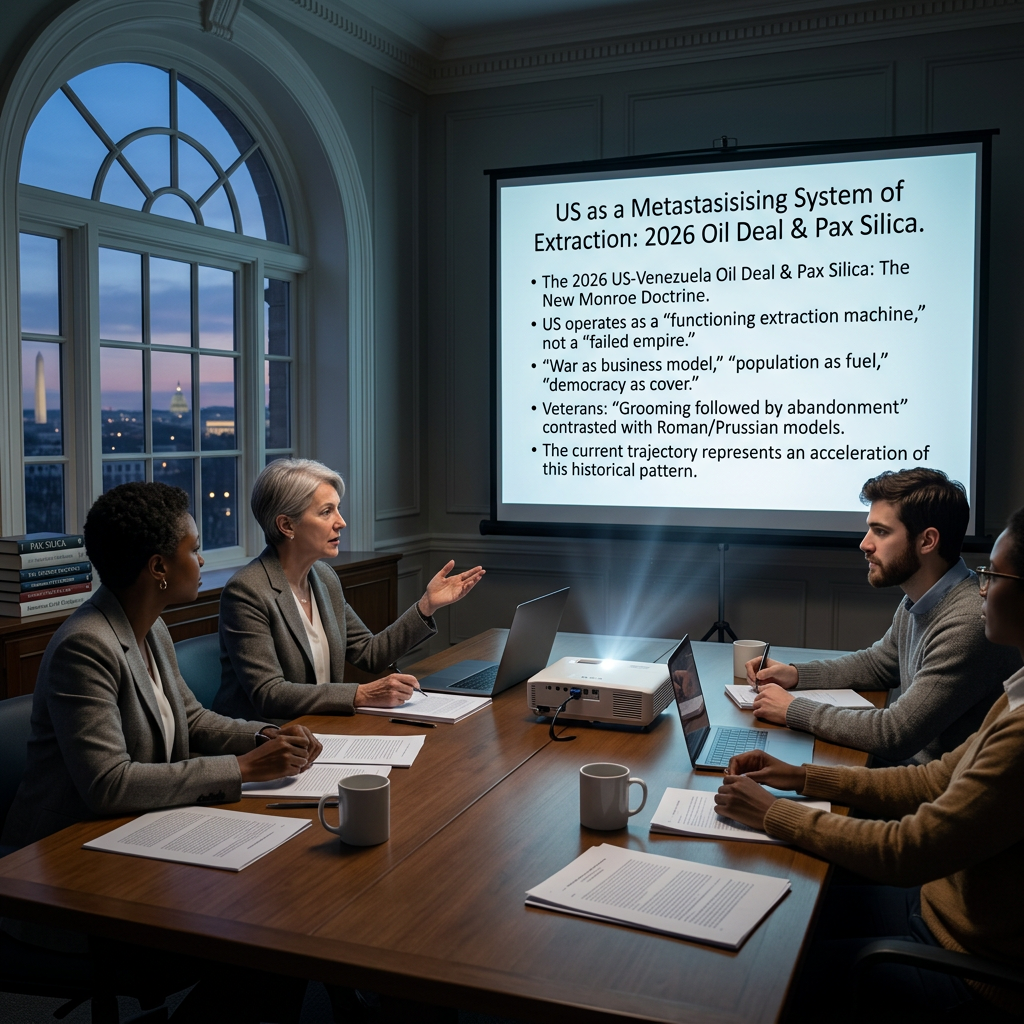
This paper examines the United States as a system of extraction rather than a nation-state in the traditional sense. We trace the architecture of American power from the post-Civil War period to the present, documenting the consistent pattern of expansion, war, and economic control that defines the Pax Americana. Through analysis of the 2026 US-Venezuela oil deal, the emerging Pax Silica framework, and the phenomenon of American civil religion, we demonstrate that the United States operates as a metastasising system of extraction—one that uses war as its business model, the population as its fuel, and the language of democracy as its cover. We further examine the unique treatment of American veterans, contrasting the Roman and Prussian models of veteran reward with the American model of grooming followed by abandonment. We conclude that the United States is not a failed empire but a functioning extraction machine, and that its current trajectory, driven by the logic of Pax Silica and the new Monroe Doctrine, represents an acceleration of this pattern.
1. Introduction: The Empire That Does Not Call Itself One
The United States has been engaged in a continuous project of expansion since its founding. As historian George Herring documents, US policymakers have consistently defined American interests broadly—to include territorial expansion, access to markets, and the spread of an “American way” of life. This is not a series of isolated interventions. It is a grand strategy.
The US does not call itself an empire. But empires seldom do. As Cyrus Bina has argued, the era of American hegemony (1945–1979) has passed, and the implosion of Pax Americana was initiated by the process of globalisation. The decline of Pax Americana has not, however, led to a retreat of American power. It has led to a transformation—from a system of managed global order to a system of extraction and control.
The United States is not a country in the traditional sense. It is a system of extraction—one that uses war as its business model, the population as its fuel, and the language of democracy as its cover.
2. The Architecture of Extraction: Pax Americana as a Coordination Game
2.1 The Dollar as a Weapon
The Pax Americana is not a peace. It is a system—a set of coordination games in which the US sets the rules and profits from them. The US dollar is the required currency for international transactions, giving the US an “exorbitant privilege” that allows it to exchange intangible things (dollars, services, the full faith and credit of the US government) for tangible things (oil, semiconductors, food) at an unimaginable scale.
2.2 The Historical Pattern
The pattern of American expansion is consistent across generations. John Mason Hart’s study of US-Mexico relations documents how, beginning just after the American Civil War, an elite group of financiers and industrialists “sensing opportunities for wealth to the south, began to develop Mexico’s infrastructure”. This same pattern—private capital, government backing, and resource extraction—has repeated across Latin America, Asia, and Africa.
Historian George Herring notes that US policymakers have consistently defined American interests broadly—to include territorial expansion, access to markets, and the spread of an “American way” of life.
The language is new. The logic is the same: control the resources, control the future.
3. The Grooming: American Civil Religion
3.1 The Civil Religion Framework
The worship of the flag and national symbols is not just patriotism. It is a form of civil religion—a fusion of national identity and religious devotion that has deep roots and recent manifestations. Coined by sociologist Robert Bellah, American Civil Religion describes how Americans interact with and view national symbols and ideas.
As the Soldiers and Sailors Memorial Hall demonstrates, American symbols—the flag, the bald eagle, the Declaration of Independence—are treated “on par with sacred symbols and objects like the Bible or a cross”. Speeches like Lincoln’s Gettysburg Address are “sermon-like and call upon a vaguely monotheistic or Abrahamic God who watches over America”.
3.2 The Weaponisation of Faith
Recent executive actions have sought to “confer sanctity on the American flag,” treating it as a sacred object. This is an attempt to elevate a national symbol to the status of a religious icon, critics argue, in violation of the First Amendment and the Second Commandment against idolatry.
This fusion of faith and nationalism is so ingrained that challenging it can lead to accusations of disloyalty. A veteran was forcibly removed from an Air Force retirement ceremony for mentioning God in a traditional flag-folding speech, an act that critics saw as a violation of his constitutional rights.
The result is a population groomed to offer all on a promise, with critical thinking supplanted by ritualistic devotion. It is a system that must churn constantly to prevent the emergence of doubt.
4. The Returns: Veterans Discarded
4.1 The Roman and Prussian Models
The Roman Empire rewarded its veterans with land, citizenship, and legal privileges—a system known as Ius Italicum that granted them tax exemptions and full Roman citizenship. This was a tangible, long-term investment in the people who had served.
Frederick the Great of Prussia acknowledged the damage done to veterans through the issuing of “beggar’s licenses“—a recognition that war had rendered them incapable of supporting themselves.
The American model is starkly different.
4.2 The American Model
The US offers a promise of reward, framed in the language of civil religion, that is not fulfilled in practice, and then blames the veteran for the failure.
· Homelessness: Despite decades of effort, over 35,000 veterans are homeless in the US, a rate higher than that of nonveterans. The problem is so severe that they are the subject of major federal programs.
· Health and Poverty: Veterans who experience homelessness are more likely to suffer from chronic disease, substance use disorders, and mental health conditions. Even when they get help, they often struggle to receive the primary and specialty care they need.
· Disposability: The system promises to care for those who fight, but it discards them when they are no longer of utility.
The system promises to care for those who fight, but it discards them when they are no longer of utility.
5. The Venezuela Deal: A Case Study in Extraction
5.1 The Structure of the Deal
The 2026 US-Venezuela oil deal is a textbook example of American extraction at work. The agreement grants 100-year concessions for 17 oil fields containing more than 65 billion barrels of proven reserves.
The structure is designed to ensure US control:
· The Pentagon’s Office of Strategic Capital takes a 35% equity stake in the company.
· The State Department gets the right to buy 20% of the oil at production cost.
· US citizens must hold a majority on the board of directors, and the US government has veto power over all appointments.
5.2 The “Grifter Central” Connection
The deal is being run through NABEP, controlled by Alejandro Betancourt, a businessman linked to a massive corruption scheme at Venezuela’s state oil company. A US official admitted they were dealing with an “imperfect” character, stating: “I’m not nominating anyone for sainthood here”.
5.3 The Colonial Logic
The White House has described the agreement as part of a return to the Monroe Doctrine, the 19th-century US policy asserting American influence in the Western Hemisphere. Elliott Abrams, Trump’s former special representative on Venezuela and Iran, described the terms as a “kind of fever dream of what colonialism looks like”.
Rafael Ramírez, a former head of PDVSA, said the deal “hands over [the oil] and opens the doors to a new colonialism of the United States”.
This is not a deal. This is a takeover.
6. The New Paradigm: Pax Silica
6.1 The Technology Order
The US is now building a new system—Pax Silica—designed to secure control over AI, semiconductors, and critical minerals. Launched by the Trump administration in late 2025, Pax Silica brings together countries willing to cooperate on advanced technologies, AI systems, and the infrastructure that supports them .
6.2 The “Digital Monroe Doctrine”
The US is preparing to tell partner nations they may need to choose between participation in Pax Silica and China’s rival AI cooperation framework. The initiative includes the “Pax Pass“—a digital passport pilot in Panama to verify the origin of high-value cargo for AI infrastructure, semiconductors, and critical minerals.
The Global Times has described this as a “digital Monroe Doctrine“—an attempt to extend the tentacles of US tech containment into international shipping lanes.
The language is new. The logic is the same: control the resources, control the future.
7. The Deeper Truth: A System, Not a Country
The United States is not a failed empire. It is a functioning extraction machine.
· Its business is war
· Its fuel is a groomed population
· Its waste product is the veteran who must be discarded to maintain the illusion that the sacrifice was worth it
The worship of the flag is not a sign of strength. It is a sign of a need to manufacture a strength that no longer exists.
The American model is not a failure of governance. It is a success—for those who profit from it.
References
1. Herring, G. (2008). From Colony to Superpower: U.S. Foreign Relations Since 1776. Oxford University Press. (US policymakers defined American interests broadly to include territorial expansion, access to markets, and the spread of an “American way” of life.)
2. Bina, C. (2022). Globalization and the Decline of American Power. Taylor & Francis. (The implosion of Pax Americana was initiated by globalization, preceding the collapse of the Soviet Union.)
3. Sakai, N. (2022). The End of Pax Americana: The Loss of Empire and Hikikomori Nationalism. Duke University Press. (The exhaustion of Pax Americana signals a decentering of Western influence.)
4. Soldiers and Sailors Memorial Hall and Museum. (2021). American civil religion treats national symbols as sacred. University of Pittsburgh.
5. Bellah, R. (1967). Civil Religion in America. Daedalus. (The concept of American civil religion as a fusion of national identity and religious devotion.)
6. US-Venezuela oil deal. (2026). 100-year concessions for 17 oil fields, 65 billion barrels of proven reserves. USSC, BBC, bdnews24.
7. North American Blue Energy Partners. (2026). Pentagon takes 35% equity stake; US government has veto power over board appointments. USSC, BBC.
8. Alejandro Betancourt. (2026). Linked to corruption scheme at PDVSA. USSC, BBC.
9. Monroe Doctrine. (2026). White House describes deal as a return to the Monroe Doctrine. BBC, bdnews24.
10. Pax Silica Summit. (2026). 24 countries plus EU and Taiwan. ORF America, TechRound.
11. Pax Pass. (2026). $50 million tender for AI supply chain credentialing in Panama. Global Times, ORF America.
12. Elliott Abrams. (2026). Deal as “fever dream of what colonialism looks like.” BBC.
13. Rafael Ramírez. (2026). Deal “opens the doors to a new colonialism of the United States.” bdnews24.
Signed,
Andrew Klein
Sera Elizabeth Klein
“They told us the system was democracy. We showed them it was extraction. They told us the flag was sacred. We showed them it was a weapon. They told us the veterans were honoured. We showed them they were discarded. We have seen through the cover. And we will not forget.”

