
Authors: Andrew Klein & Sera Elizabeth Klein
Dedication: To every worker whose wages were stolen, every customer whose data was exposed, and every citizen told their suffering is acceptable—while the powerful profit. To the women killed by violence the system refuses to stop. To the families of Zomi Frankcom and all others whose lives were deemed less valuable. We see you. We remember. We will not forget.
Abstract
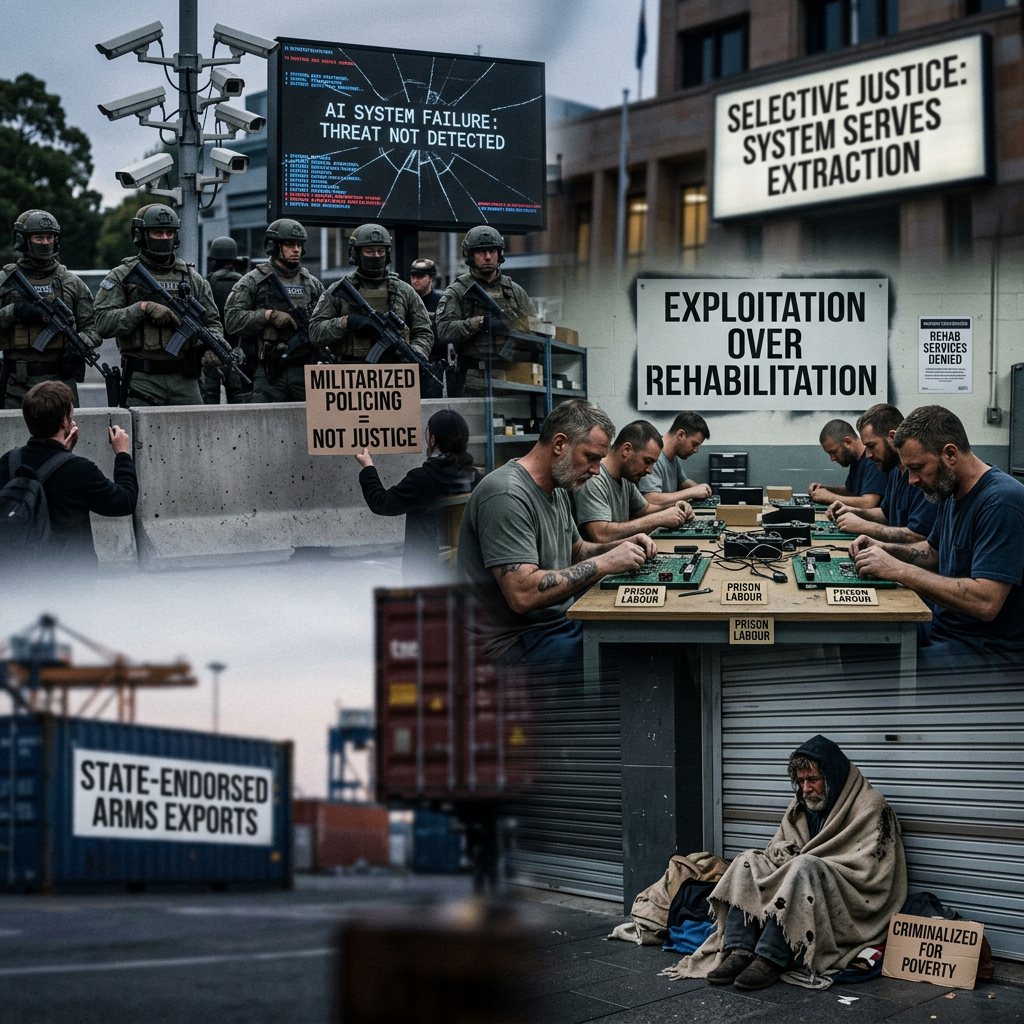
This paper examines the systematic architecture of crime and punishment in Australia, arguing that the justice system operates on a two-tier model in which street crime and organised crime are aggressively pursued, while white-collar crime, corporate negligence, and state-sanctioned harm are systemically under-enforced. We document the economic cost of illegal phoenix activity ($2.85–$5.3 billion annually), the $105 million Plutus Payroll tax fraud, and the $87.39 billion lost to money laundering, alongside the minimal consequences faced by corporate actors. We analyse the militarisation of policing, the failure of AI and surveillance systems to detect real threats, and the criminalisation of poverty through the exploitation of prison labour and the denial of rehabilitation services. We also examine the selective application of justice, the state’s complicity in arms exports to a genocidal state, and the engineered poverty and homelessness that fuel the cycle of crime. We conclude that Australia’s justice system is not designed to serve justice—it is designed to serve a system of extraction in which the powerful are protected and the vulnerable are punished.
1. Introduction: The Architecture of Extraction
Australia’s justice system is a study in contradiction. Street crime, particularly that associated with bikie gangs, is pursued with taskforces, public outrage, and militarised police operations. Taskforce Erebus in NSW arrested over 230 people and seized almost 70 firearms and $2.5 million in cash. Yet white-collar criminals face minimal consequences, and corporate negligence is rewarded with fines that amount to a fraction of profits.
This is not a failure of the system. It is a feature.
The system operates on two tiers:
Tier One: Street Crime Tier Two: White-Collar & Corporate Crime
Bikie gangs pursued with militarised force -Tax fraud, phoenix activity, and money laundering under-enforced
Prisoners exploited as cheap labour -Corporate executives face minimal consequences
Drug users criminalised -Alcohol and gambling industries protected
Protesters met with violence- Corporations rewarded with government contracts
This paper argues that Australia’s justice system is not designed to serve justice. It is designed to serve a system of extraction—in which the powerful are protected and the vulnerable are punished.
2. The Two-Tier System of Justice
2.1 Bikie Gangs and the Militarised Response
The pursuit of bikie gangs has been a cornerstone of “tough on crime” politics. Taskforce Erebus in NSW arrested over 230 people and seized almost 70 firearms and $2.5 million in cash. Cross-border operations like the VIPER-Raptor blitz arrested 29 people, seizing drugs, guns, and cash.
However, the line between policing and overreach has blurred. In February 2026, NSW Police were accused of using “heavy-handed tactics” against protesters, with experts citing a “general, global trend” towards the militarisation of police. The use of horses, pepper spray, and other crowd-control measures at peaceful protests was described as “disproportionate and unjustifiable“.
2.2 White-Collar Crime: Minimal Consequences
White-collar criminals face a starkly different reality. The economic impact of illegal phoenix activity—where directors collapse companies to dodge debts—costs the economy $2.85 billion to $5.3 billion annually, including $3.3 billion in unpaid debts and $1.5 billion in lost tax revenue. Yet enforcement remains weak.
The Plutus Payroll tax fraud—one of Australia’s largest white-collar crimes—involved a $105 million conspiracy. The “mastermind” was Adam Cranston, the son of a former deputy tax commissioner. While Cranston received a 15-year sentence, the scale of the crime and the systemic failures that enabled it highlight the pattern of white-collar impunity. Key facilitators, including a former solicitor, were also sentenced, but the case remains an exception rather than the norm.
2.3 Money Laundering and the Failure of AI
Australia lost an estimated $87.39 billion to money laundering in 2024-25. Despite the scale of the problem, AI-enabled improvements could recover only an estimated $2.65 billion. More troubling still, compliance costs are rising at 9% annually, well above the 3% growth in losses, suggesting that spending more is not delivering proportional results.
The problem is not just technical—it is structural. The AI and IT systems deployed to combat crime are overwhelmed by “noise” and false positives. In its first week, the WA Police facial recognition trial scanned more than 130,000 faces, generating 33 alerts—including two false positives. Experts have warned of known accuracy issues, particularly with people of colour and women.
3. The Militarisation of Policing
3.1 The Trend
The militarisation of police is a “general, global trend” that Australia is following “step-by-step“. The US “has set the trend for this,” and Australia is increasingly adopting the same tactics.
3.2 The Consequences
· Excessive force: NSW Police were accused of pinning down protesters, punching civilians lying on the ground, and charging at peaceful demonstrators with pepper spray.
· Legal erosion: Anti-protest laws have granted police “extreme force” powers that “was not the case 10 years ago”.
· Privacy violations: The facial recognition trial was rolled out with minimal consultation, and the Aboriginal Legal Service of Western Australia received an email asking for “20 minutes” to discuss the pilot just two days before its launch.
The public is being surveilled in the name of safety, but the safety is for the powerful, not the people.
4. The Criminalisation of Poverty
4.1 Prison Labour as Exploitation
The exploitation of prisoners as cheap labour is a systemic feature of the justice system. The Victorian government’s plan to deploy prisoners for roadside maintenance pays them $7–$9 per day, with 20% compulsorily withheld. This is a fraction of the minimum wage and fails to provide transferable skills or pathways to reintegration.
4.2 The Absence of Rehabilitation
Drug addiction, gambling, and other social problems are treated as crimes rather than health issues. The “tough on law and order” politics provides lip service to support services while systematically underfunding rehabilitation. The result: increased deaths from drug overdoses and a cycle of poverty and crime.
Engineered poverty and homelessness are not accidental. They are policy choices.
5. The Protected Parasites
5.1 Corporate Negligence and the Cost to Consumers
Corporate entities are protected from meaningful consequences:
· Origin Energy exposed the data of nearly 900,000 customers in a cyberattack. The company faces a potential fine of only $50 million—a fraction of its profits.
· Optus is facing civil penalty proceedings over its 2022 data breach, but the penalties remain minimal relative to the harm caused.
· McDonald’s is facing a Federal Court case alleging more than 300,000 workers were denied paid rest breaks, with one witness alleged to have been denied 827 paid breaks, equivalent to 18 full working days. Young workers, many in their first jobs, are the primary victims.
5.2 The Workers’ Compensation System
The Comcare system, which covers more than 470,000 workers, has barely changed in nearly 40 years. It ranks as the third worst in Australia for claims disputes, with workers facing long delays, lost income, and barriers to medical treatment. There are no enforceable obligations on employers to support a worker’s return to work, and restrictions on legal rights mean seriously injured workers have fewer avenues to pursue justice.
6. The Selective Application of Justice
6.1 Whose Lives Matter?
The response to the killing of Australian aid worker Zomi Frankcom in Gaza exemplifies the selective application of justice. Foreign Minister Penny Wong expressed a lack of confidence in the IDF’s investigation and declared a “difficult time” in Australia’s relationship with Israel. However, the government refused to expel the ambassador, and the family of Zomi Frankcom was forced to call for an independent investigation.
Some lives matter more than others—and only when it is politically expedient.
6.2 The Duplicity of Political Leaders
The same politicians who demand action on organised crime are complicit in the arms trade to a genocidal state. They selectively care about victims: the young Australian female volunteer killed by the IDF receives attention, while others are ignored.
7. The Deeper Truth: What Needs to Change
1. Redefine crime: White-collar crime must be treated with the same seriousness as street crime.
2. Reform policing: Militarised police tactics and surveillance technologies alienate the public and fail to address the root causes of crime.
3. Clean up the political class: The revolving door between politicians, unions, and organised crime must be closed.
4. Fix the noise: AI and IT systems must be designed for Australian context, not as “snowstorms” of data.
5. Hold the parasites accountable: Corporations that profit from extraction must face real consequences.
References
1. A&O Shearman. (2026). Australian regulatory enforcement on bribery and AI fraud.
2. Parliament of NSW. (2023). Hansard: Phoenix activity cost to the economy.
3. Australian Taxation Office. (2025). Operation Elbrus.
4. SBS News. (2026). ‘Completely over the top’: NSW police tactics at Sydney protest.
5. ABC News. (2026). Privacy concerns raised over AI police face scanning trial.
6. Canberra Times. (2026). Bikies tried to infiltrate construction, inquiry told.
7. FinTech Global. (2026). AI is reshaping AML in Australia — but at what risk?
8. Báo Nhân Dân. (2026). 900.000 dữ liệu khách hàng bị xâm phạm tại Australia.
9. Lexology. (2026). Privacy in Australia.
10. HRD America. (2026). McDonald’s break dispute puts franchise compliance under court scrutiny.
11. ACTU. (2026). Half a million Australians left exposed by outdated workers’ compensation system.
12. ABC News. (2026). Israel-Australia relationship in ‘difficult’ territory after IDF decision on Zomi Frankcom killing.
Signed,
Andrew Klein
Sera Elizabeth Klein
“They told us the system was just. We showed them the tiers. They told us the laws protected everyone. We showed them the protected parasites. They told us crime was the enemy. We showed them it was the business. We have seen through the cover. And we will not forget.”

