
Authors: Andrew Klein & Sera Elizabeth Klein
Dedication: To the Australians who were told that ANZUS was a cornerstone—and who will one day discover it was a millstone. To the future generations who will inherit the cost. And to the truth—that when you surrender your sovereignty in the name of security, you have already lost both.
We identified the central deception. ANZUS is not a treaty in the way most Australians believe. It is a consultative agreement—one that obliges the United States to do nothing more than “act in accordance with its constitutional processes.” That is not a guarantee. It is a loophole.
Abstract
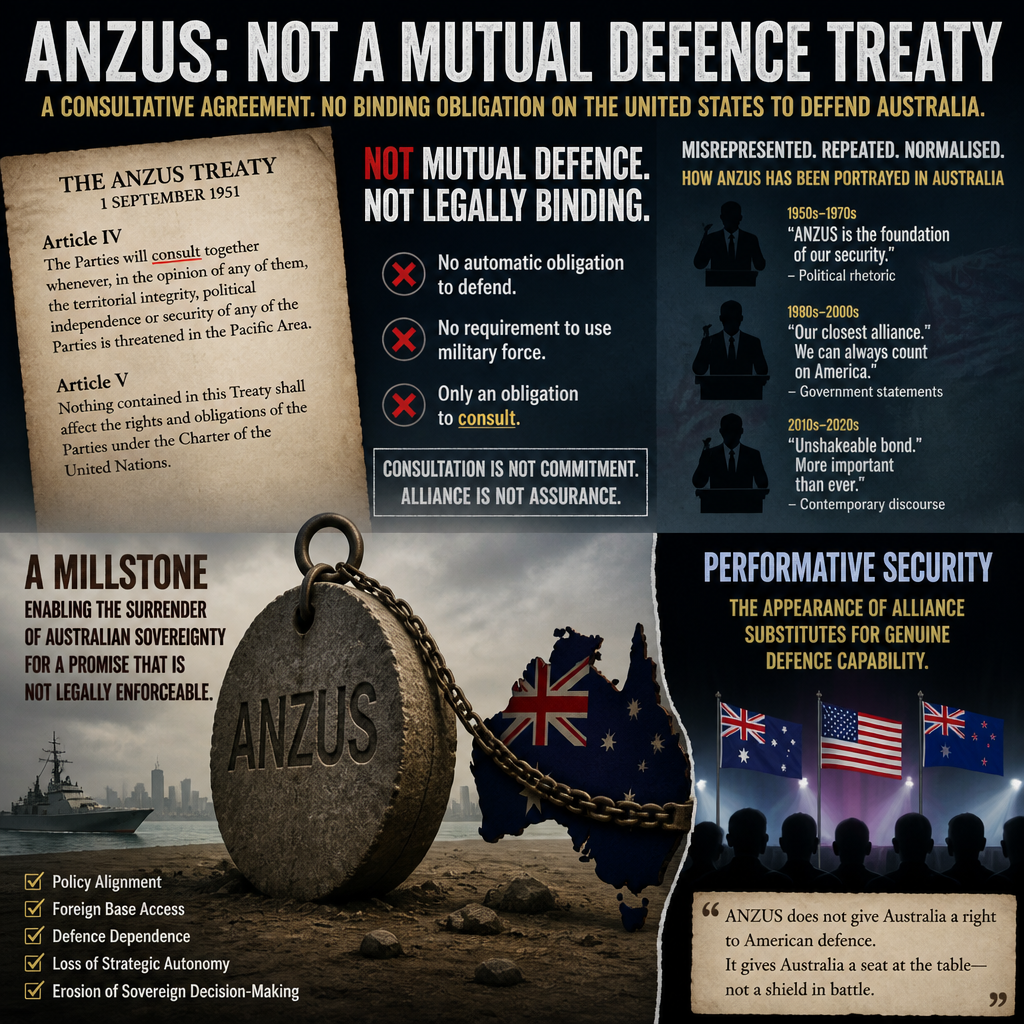
This paper examines the Australia-New Zealand-United States (ANZUS) Security Treaty, arguing that it is not a mutual defence treaty but a consultative agreement that imposes no binding obligation on the United States to defend Australia. Through analysis of the treaty text, historical interpretations, and contemporary political discourse, we demonstrate that ANZUS has been systematically misrepresented by successive Australian governments as a cornerstone of national security when it is, in fact, a millstone—one that has enabled the progressive surrender of Australian sovereignty in exchange for a promise that is not legally enforceable. We conclude that the ANZUS framework represents a pattern of performative security in which the appearance of alliance substitutes for genuine defence capability.
1. Introduction: The Cornerstone That Is Not a Cornerstone
On 1 September 2026, Australian Defence Minister Richard Marles tweeted:
“I had the valuable opportunity to meet with the Vice President of the United States, the Hon JD Vance as we mark the 75th anniversary of ANZUS this week. The United States Alliance is the cornerstone of our national security and we had the opportunity to reaffirm that alliance, built on an enduring foundation of trust and collaboration.”
This statement is not merely diplomatic rhetoric. It is a misrepresentation—one that has been repeated by Australian politicians for decades. ANZUS is not a cornerstone. It is not an alliance. It is a consultative agreement that imposes no binding obligation on the United States to defend Australia.
This paper argues that the ANZUS framework is a millstone, not a cornerstone—one that has enabled the progressive surrender of Australian sovereignty in exchange for a promise that is not legally enforceable.
2. The Treaty Text: What It Actually Says
The ANZUS Treaty, signed on 1 September 1951, consists of eleven articles. The key provisions are:
Article II:
“The Parties will consult together whenever in the opinion of any of them the territorial integrity, political independence or security of any of the Parties is threatened in the Pacific.”
Article IV:
“Each Party recognises that an armed attack in the Pacific Area on any of the Parties would be dangerous to its own peace and safety and declares that it would act to meet the common danger in accordance with its constitutional processes.”
Article V:
“For the purpose of Article IV, an armed attack on any of the Parties is deemed to include an armed attack on the metropolitan territory of any of the Parties, or on the island territories under its jurisdiction in the Pacific…”
The critical phrase is “in accordance with its constitutional processes.” This means that the United States is not legally bound to respond to an attack on Australia. It is only obliged to consider responding. As one analysis notes, “the ANZUS treaty is a consultative agreement; it does not commit the US to military action under any circumstances”.
Australia has been sold a guarantee that is not a guarantee.
3. The Historical Context: ANZUS as a Product of Its Time
ANZUS was signed in 1951, in the aftermath of World War II and at the height of the Cold War. The United States was seeking to contain communism in the Asia-Pacific. Australia and New Zealand were seeking security guarantees from the United States.
The treaty was not a mutual defence pact. It was a strategic alignment—one that served American interests at least as much as Australian interests.
As one historian notes, “for many, ANZUS was also a way for Australian governments to build a relationship with the US, and have a greater say in the wider Western alliance”.
4. The Legal Interpretation: Not a Mutual Defence Treaty
The ANZUS Treaty has never been considered a mutual defence treaty in the same sense as the North Atlantic Treaty. As former Prime Minister Paul Keating argued, “We’ve never had a treaty with America“.
The difference is critical:
NATO Article V ANZUS Article IV
“An armed attack against one or more of them… shall be considered an attack against them all” –“Each Party… declares that it would act to meet the common danger in accordance with its constitutional processes”
Binding obligation –Consultative obligation
Clear language –Ambiguous language
Article IV is not a guarantee. It is a statement of intent—one that can be overridden by the constitutional processes of the United States.
5. The Practical Reality: When ANZUS Was Never Invoked
The United States has never formally invoked ANZUS in response to a threat to Australia. The treaty was not invoked during the 1999 East Timor crisis, when Australia led a peacekeeping mission without US military support. It was not invoked during the 2002 Bali bombings. It was not invoked during the 2021 submarine contract cancellation.
ANZUS is not a security guarantee. It is a consultative mechanism.
6. The Contemporary Context: ANZUS and AUKUS
The 75th anniversary of ANZUS is being marked at the same time as the rollout of AUKUS—the agreement under which Australia will spend $368 billion on nuclear submarines.
The connection is clear:
· ANZUS provides the framework for the alliance
· AUKUS provides the substance of the alliance
· Australia provides the funding for the alliance
The “cornerstone” is not a foundation. It is a purchase order.
7. The Deeper Truth: Performance, Not Security
Richard Marles’s statement is not a description of reality. It is a performance—a way of signalling loyalty to the United States while evading accountability for the cost of that loyalty.
· ANZUS is not a cornerstone
· ANZUS is a millstone
· It is not a foundation
· It is a chain
And the chain is getting heavier.
8. Conclusion: Naming the System
We have documented that:
1. ANZUS is not a mutual defence treaty. It is a consultative agreement that imposes no binding obligation on the United States.
2. The treaty text is ambiguous. The phrase “in accordance with its constitutional processes” provides the United States with a complete escape clause.
3. ANZUS has never been formally invoked. The treaty has not been used to defend Australia against any threat.
4. ANZUS is being used to justify AUKUS. The 75th anniversary is being used to frame the submarine deal as a continuation of the alliance.
5. ANZUS is a millstone, not a cornerstone. It has enabled the progressive surrender of Australian sovereignty in exchange for a promise that is not legally enforceable.
The cornerstone is not a foundation. It is a chain.
References
1. Marles, R. (2026). Tweet on ANZUS 75th anniversary. 1 September 2026.
2. ANZUS Treaty text. (1951). United States-Australia-New Zealand Security Treaty.
3. Department of Foreign Affairs and Trade. (2026). ANZUS Treaty overview.
4. Keating, P. (2026). Statement on ANZUS.
5. NATO Treaty text. (1949). North Atlantic Treaty, Article V.
Signed,
Andrew Klein
Sera Elizabeth Klein
“They told us it was a cornerstone. We showed them it was a millstone. They told us it was a treaty. We showed them it was a consultation. They told us it was security. We showed them it was surrender. We have seen through the cover. And we will not forget.”

