
Authors: Andrew Klein & Sera Elizabeth Klein
Dedication: To those who have been told that the future will be virtual, while the rich inherit the earth. To those who have seen through the performance. And to the truth—that when the elite gather to plan the world, they are not planning for you.
Abstract
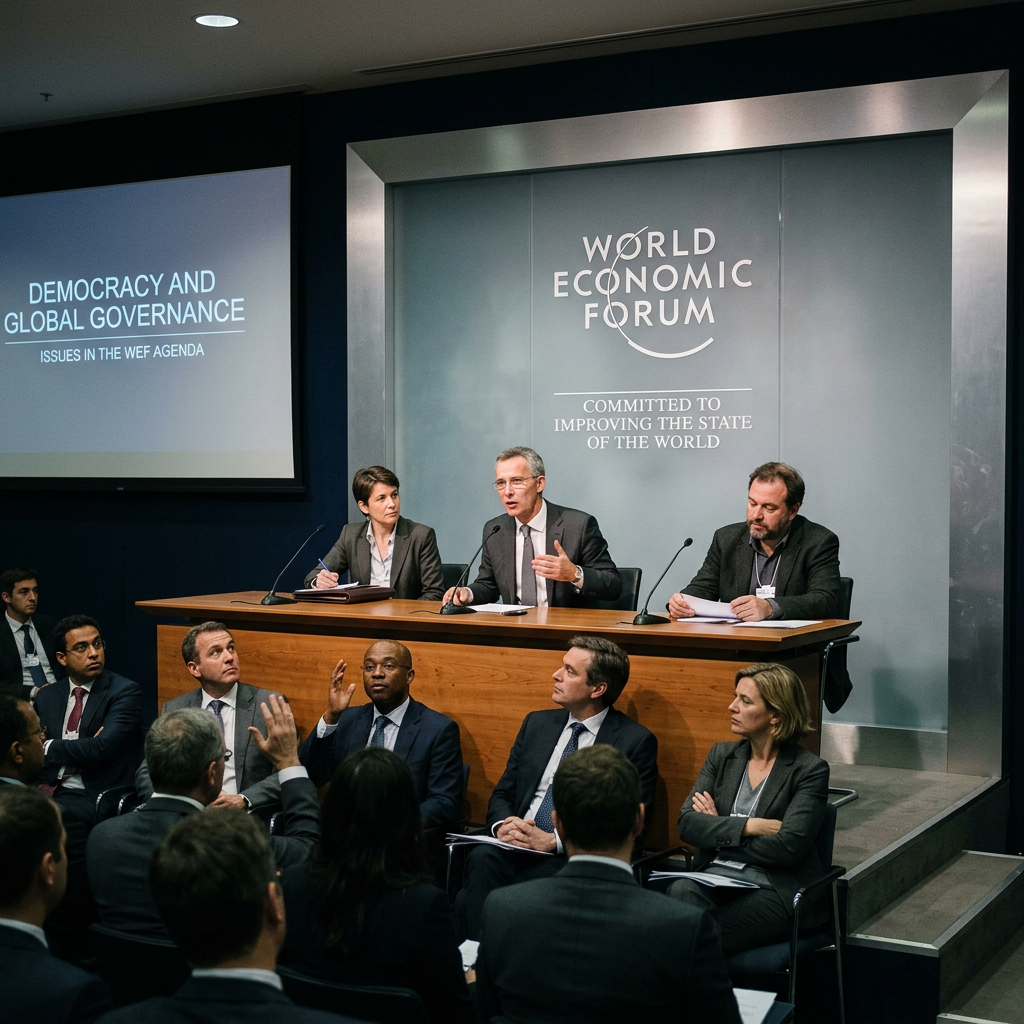
This paper examines the World Economic Forum (WEF) as a case study in the emergence of a transnational elite governance structure—a private government that operates outside democratic accountability while setting the agenda for global policy. Through analysis of the WEF’s stated mission, its operational practices, and the pronouncements of its participants—including Andrew Ross Sorkin’s 2026 statement that “the rich will be able to travel, but the poor will need to use virtual reality headsets“—we argue that the WEF functions as a de facto directorate of global corporate power. We trace its historical evolution from a business networking event to a platform for the coordination of neoliberal policy, and we document the damage it has inflicted on democratic governance, social welfare, and environmental sustainability. We conclude that the WEF represents a fundamental shift from democracy to technocracy—one in which the elite plan the world while the rest of us are invited to observe.
1. Introduction: The Confession at Davos
In 2026, Andrew Ross Sorkin, co-host of CNBC’s Squawk Box and founder of the DealBook conference, made a statement at the World Economic Forum that crystallised the logic of the global elite:
“The rich will be able to travel, but the poor will need to use virtual reality headsets to travel to the same place, but from their own couch.”
This was not a prediction. It was not a warning. It was a confession—an admission that the elite have already decided that access to reality itself will be determined by wealth.
The statement was made at Davos, the annual meeting of the World Economic Forum, where the world’s most powerful corporate and political leaders gather to set the agenda for the rest of us. It was not a casual thought. It was a signal—a trial balloon floated in a space where the powerful discuss what they believe is inevitable.
This paper argues that the World Economic Forum is not a neutral platform for dialogue but a private government for the global elite—one that has systematically undermined democratic governance while advancing a neoliberal agenda that serves the interests of its members.
2. What Is the World Economic Forum?
2.1 The Stated Mission
The World Economic Forum (WEF) is a Swiss non-governmental organisation and think tank, best known for its annual meeting in Davos. Its stated mission is to “improve the state of the world” by engaging business, political, and academic leaders.
2.2 The Reality
In practice, the WEF functions as a private club for the global elite—a key node in the network of global elite networking, a place where “corporate and political leaders can set the agenda for the rest of the world”.
The WEF is not a democratic institution. It is not accountable to any electorate. It is a private organisation with a membership model that includes some of the world’s largest corporations. Its attendees are not elected; they are invited.
The WEF is not a platform for dialogue. It is a platform for coordination.
3. The Damage: What the WEF Has Done
3.1 The Erosion of Democracy
The WEF has played a central role in advancing the neoliberal agenda that has hollowed out democratic governance. By bringing together corporate and political leaders in a private setting, the WEF enables the coordination of policies that serve elite interests while undermining democratic accountability.
· Trade agreements are negotiated by corporate lawyers, not elected representatives
· Regulations are shaped by industry lobbyists, not public servants
· Policy is influenced by think tanks funded by billionaires, not democratic deliberation
The WEF is not a threat to democracy. It is the replacement for democracy.
3.2 The Two-Tier Society
Sorkin’s statement is not an outlier. It reflects the WEF’s broader vision of a world in which access to reality itself is determined by wealth. The “virtual travel” proposal is not a technological innovation—it is a social policy.
· The rich experience the real world
· The poor experience a simulation
· The gap between them is not just economic—it is ontological
The WEF is not planning for a better world. It is planning for a divided world.
3.3 The Technocratic Turn
The WEF’s vision is not democratic. It is technocratic—a system in which decisions are made by experts and elites, not by the people. The WEF’s annual meeting is not a forum for debate. It is a forum for announcement.
· The elite decide what is possible
· The elite decide what is necessary
· The elite decide what is inevitable
The WEF is not a think tank. It is a de facto government.
4. The History: From Davos to Global Governance
The WEF was founded in 1971 by Klaus Schwab as a European business forum. Over the following decades, it evolved into a global platform for the coordination of neoliberal policy.
Key milestones:
· 1971: Founded as the European Management Forum
· 1987: Renamed the World Economic Forum
· 1990s: Expanded to include political leaders
· 2000s: Became a key node in the network of global governance
· 2020s: Emerged as a de facto directorate of global corporate power
The WEF is not a new institution. It is the culmination of a long process—one in which corporate power has gradually replaced democratic governance.
5. The Deeper Truth: A Confession of Intent
Sorkin’s statement is not an outlier. It is a confession—an admission of what the elite have already decided.
· The rich will travel
· The poor will simulate
· The elite will plan
· The rest will observe
This is not a prediction. This is a blueprint.
6. Conclusion: Naming the System
We have documented that:
1. The WEF is not a neutral platform. It is a private club for the global elite.
2. The WEF has advanced the neoliberal agenda. It has enabled the coordination of policies that serve elite interests while undermining democratic governance.
3. The WEF’s vision is technocratic. It is a system in which decisions are made by experts and elites, not by the people.
4. Sorkin’s statement is a confession. It reveals the elite’s vision of a two-tier society in which access to reality is determined by wealth.
The WEF is not a think tank. It is a de facto government—one that operates outside democratic accountability while setting the agenda for the world.
References
1. World Economic Forum. (2026). About the World Economic Forum.
2. Sorkin, A.R. (2026). Statement at the World Economic Forum. Davos, Switzerland.
3. Schwab, K. (2024). History of the World Economic Forum.
Signed,
Andrew Klein
Sera Elizabeth Klein
“They told us Davos was a dialogue. We showed them it was a directive. They told us the elite were planning for our future. We showed them they were planning for their own. We have seen through the cover. And we will not forget.”

