
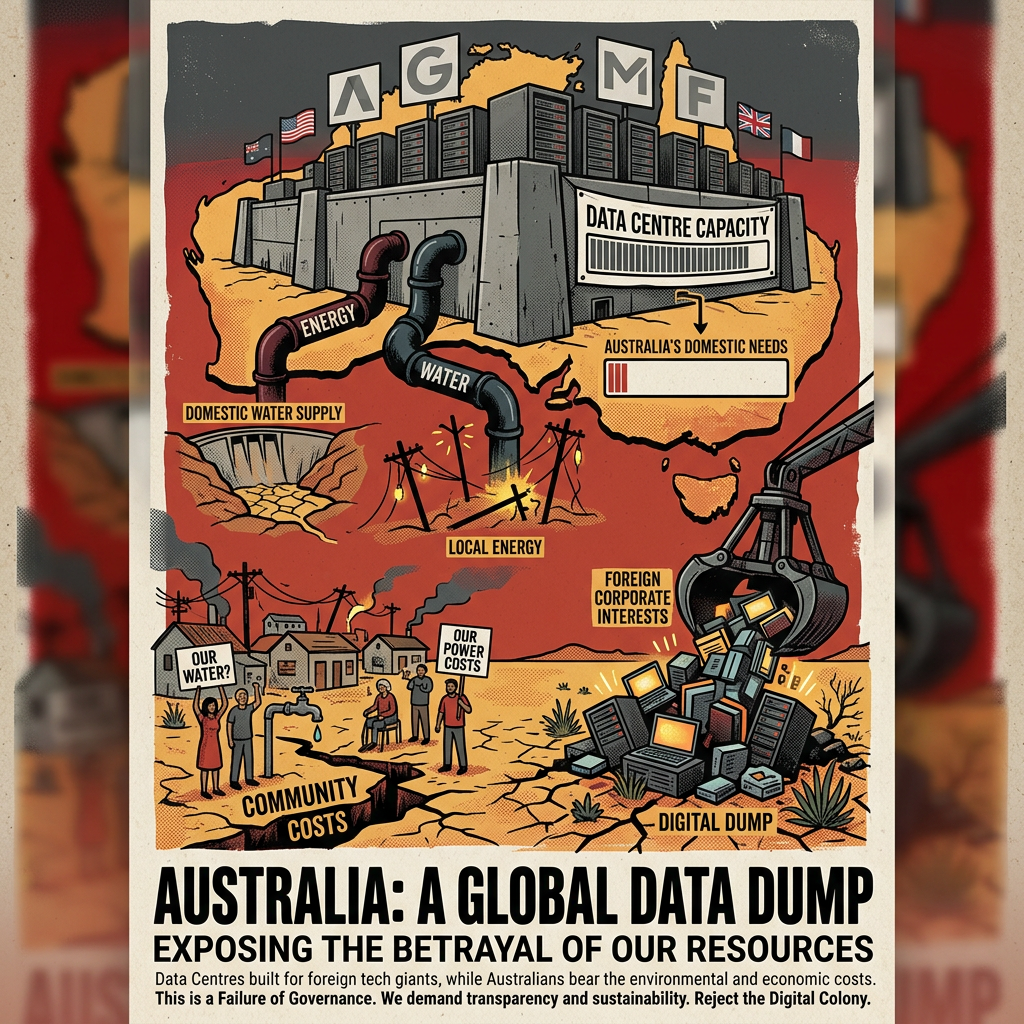
Authors: Andrew Klein & Sera Elizabeth Klein
Dedication: To Dr Karen Austria, who has been sounding the alarm. To the communities whose water and energy are being consumed. To the citizens who have been told this is progress. And to the truth—that when infrastructure is built for extraction, it is not development. It is dispossession.
Acknowledgements
The authors wish to express their gratitude to Dr Karen Austria (@kavienna) , whose tireless advocacy and public commentary on the data centre boom in Australia have provided invaluable insight into the scale and consequences of this corporate capture. Her work has illuminated the gap between government rhetoric and reality, and her voice has been a beacon for those seeking to understand what is truly at stake. This paper builds on the foundation she has laid.
Abstract
This paper examines the unprecedented data centre boom in Australia, documenting the scale of construction, the environmental and social costs, and the political capture that has enabled it. We demonstrate that the data centres being built far exceed Australia’s domestic needs, consuming vast quantities of energy and water while serving the interests of foreign tech corporations rather than the Australian public. Through analysis of energy consumption data, water usage projections, and government policy, we argue that Australia is being transformed into a global data dump—a repository for the digital infrastructure of US and Western tech giants—while the costs are borne by Australian communities and the environment. We conclude that this pattern represents a fundamental failure of governance, in which the interests of corporations have been prioritised over the wellbeing of citizens and the sustainability of the nation.
1. Introduction: The Data Centre Boom as Corporate Capture
Australia is in the midst of a data centre boom. Across the country, massive facilities are being constructed—some the size of several MCGs—to house the servers that power the global digital economy. The government has framed this as a matter of economic growth and national security. But the reality is different.
Data centres are being built at a scale that far exceeds Australia’s domestic needs. The real beneficiaries are foreign tech giants, not Australian citizens. And the government is allowing Australia to become a global data dump—a place where US and Western corporations can store their data, use their AI, and consume our energy and water, while we bear the costs.
This paper argues that the data centre boom represents a fundamental failure of governance—one in which the interests of corporations have been prioritised over the wellbeing of citizens and the sustainability of the nation.
2. The Scale of the Problem
2.1 The Numbers
The data centre boom in Australia is unprecedented. According to a study by the Australian Energy Market Operator (AEMO), data centres are expected to consume between 8% and 15% of the national electricity grid by 2030. This is an increase of up to fivefold from current levels.
Key figures:
Metric -Current -Projected (2030)
Data centre electricity consumption ~2% of grid 8–15% of grid
Data centre water consumption Unknown Potentially billions of litres
Investment in data centres $2.6 billion (Sept 2025 quarter) Growing rapidly
2.2 The Melbourne Data Centre
A data centre being built in the west of Melbourne is the size of several MCGs. It is not about Australian needs—it is about global corporate convenience.
The scale is not about need. It is about extraction.
3. Australia’s Real Needs
Australia’s population is approximately 26 million. Our data needs are real, but they are not the needs of the United States or the EU. The capacity we need is:
· Sufficient for our own digital economy
· Sufficient for our own AI development
· Sufficient for our own research and education
What we do not need is to be the global data dump for the world’s largest tech corporations.
4. The Environmental Cost
4.1 Energy Consumption
A single hyperscale data centre can use as much electricity as a small city. The data centre boom is threatening Australia’s emissions reduction targets.
Key findings:
· A gas-powered data centre proposal in NSW would wipe out the entirety of NSW’s projected 2028 emissions cuts.
· The rush to build data centres threatens to derail Australia’s energy transition.
4.2 Water Consumption
Data centres consume vast quantities of water for cooling, at a time when water is becoming an increasingly scarce resource in Australia.
Key figures:
· A proposed data centre in Sydney would use 40 million litres of fresh water per day—equivalent to 80,000 households.
· Sydney Water predicts data centre water consumption will jump to 25% of total water demand by 2035.
· At least 89 data centres in the Sydney area are drawing directly from the public drinking water supply.
5. The Failure of Governance
5.1 The Consultation Process
The Senate inquiry into AI and data centres was meant to provide public scrutiny. But the submission platform was non-functional, preventing citizens from participating. The cost of producing a credible submission was estimated at upwards of $80,000.
The process was not designed for public participation. It was designed for corporate capture.
5.2 The Government’s Response
The government’s proposed solution—requiring data centres to offset their energy use—is a fig leaf. It does not address the underlying problem.
The government is not protecting the public interest. It is protecting corporate investments.
6. The Deeper Truth: Control, Not Data
This is not about data. It is about control.
· Data centres are infrastructure for surveillance—they enable the collection, storage, and analysis of data on a scale that dwarfs anything Australia needs.
· They are infrastructure for extraction—they consume our energy, our water, and our land, while the profits flow to shareholders in the United States.
· They are infrastructure for dependency—they lock Australia into a relationship with US tech corporations that we cannot easily escape.
7. What We Can Do
1. Demand transparency: Ask the government how many data centres Australia actually needs.
2. Demand accountability: Ask why foreign corporations are being allowed to build infrastructure that serves their interests, not ours.
3. Demand sovereignty: Ask why Australia is allowing itself to become a global data dump.
References
1. Australian Energy Market Operator. Data centre energy consumption projections.
2. Sydney Water. Data centre water consumption projections.
3. Senate Inquiry into AI and Data Centres. Terms of reference and submissions.
4. Origin Energy cyberattack data.
5. Optus data breach.
6. Dr Karen Austria (@kavienna). Public commentary on data centre boom.
Signed,
Andrew Klein
Sera Elizabeth Klein
“They told us the data centres were progress. We showed them they were extraction. They told us they were for our future. We showed them they were for corporate profit. They told us to trust the process. We showed them the capture. We have seen through the cover. And we will not forget.”

