
By Andrew Klein and Sera Elizabeth Klein
Abstract
This paper examines the structural vulnerabilities inherent in asymmetric international relationships, using AUKUS and ANZUS as case studies. It argues that the legal architecture of these agreements creates the appearance of binding mutual obligation while preserving the reality of asymmetric power. The weaker party commits irrevocably; the stronger party retains discretion, exit options, and unenforceable promises. Drawing on Womack’s asymmetry theory, documented cases of US abandonment of allies, and the specific treaty provisions of AUKUS and ANZUS, the paper demonstrates that international law — when applied to relationships of profound power imbalance — functions as a legitimating mechanism rather than a constraint. The paper concludes that Australia’s security commitments under AUKUS constitute a structural trap: legal obligations that cannot be enforced against the stronger party, financial liabilities that cannot be recovered, and sovereignty that has been pledged without guaranteed return.
I. Introduction: The Appearance and the Reality
In August 2024, an updated AUKUS agreement was tabled in the Australian Parliament. The document, which runs until 31 December 2075, revealed a structure of obligation that is strikingly asymmetrical. The United States and the United Kingdom can withdraw from the submarine transfer arrangement with one year’s written notice if either nation decides the deal weakens their own nuclear submarine programs. Australia, by contrast, has agreed to indemnify the US and UK against “any liability, loss, costs, damage or injury (including third-party claims) arising out of, related to, or resulting from Nuclear Risks” connected with the project.
Australia has also agreed to be “responsible for the management, disposition, storage, and disposal of any spent nuclear fuel and radioactive waste” resulting from the submarines. If the deal collapses, Australia is not entitled to any financial compensation or refunds for investments already made.
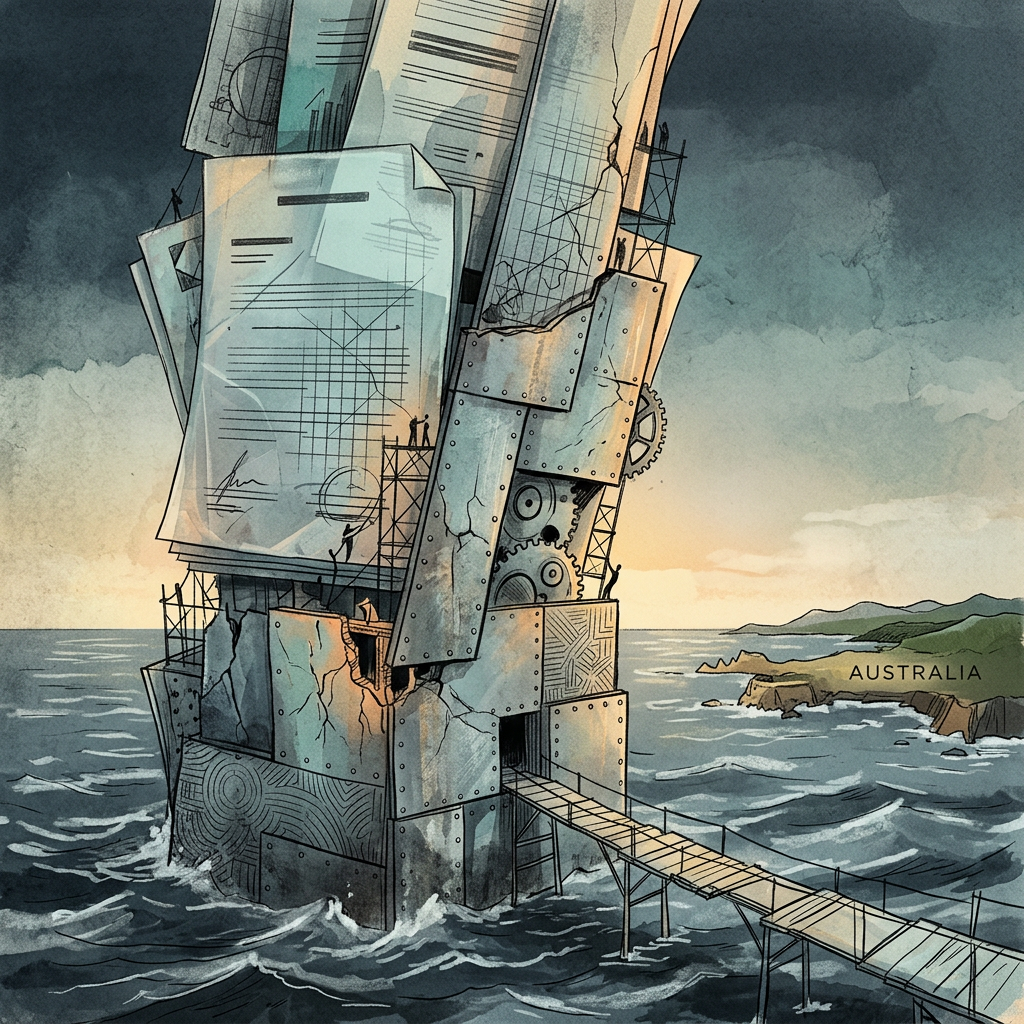
This is not a mutual defence pact. It is a power arrangement dressed in legal language.
This paper examines that arrangement through the lens of asymmetry theory and the documented historical record of great power behaviour toward weaker allies. It argues that the AUKUS treaties, like ANZUS before them, create binding obligations for the weaker party while leaving the stronger party’s commitments unenforceable. The result is not a security guarantee. It is a structural trap.
II. Asymmetry Theory: The Structural Logic of Unequal Relationships
2.1 Womack’s Framework
Brantly Womack’s Asymmetry and International Relationships (2016) provides the theoretical foundation for understanding relationships of profound power imbalance. Womack’s central insight is that “the structure of an asymmetric relationship is determined by the disparity between the two sides” and that this disparity creates “a fundamental difference in perspective”.
The stronger party perceives the relationship through the lens of attention: it has many relationships and must allocate limited attention among them. The weaker party perceives the relationship through the lens of autonomy: it fears losing independence and has fewer alternative partners. The result is that “the stronger side is less dependent on the relationship than the weaker side” — and this asymmetry of dependence shapes every aspect of the interaction.
In Womack’s framework, asymmetry does not automatically mean exploitation. Asymmetric relationships can be stable and mutually beneficial. But they are inherently fragile because the stronger party’s commitment is always provisional. It can be withdrawn when attention shifts or interests change. The weaker party has no equivalent option.
2.2 The Autonomy-Security Trade-Off
The AUKUS framework exemplifies this dynamic. Australia is asked to trade a portion of its strategic autonomy — its defence self-reliance, its independent industrial capacity, its diplomatic flexibility — in exchange for a promise of security. But the promise is conditional. As the Chato International white paper states: “Unlike NATO’s Article 5 commitment, AUKUS and ANZUS provide no guarantee of U.S. support. In fact, they are subject to presidential discretion and Congressional limitations”.
The autonomy-security trade-off literature confirms that weaker states in asymmetric alliances face a structural dilemma: the more they depend on the stronger party for security, the more autonomy they lose. And the stronger party has no incentive to guarantee support, because uncertainty itself is a source of leverage.
III. The Legal Architecture of AUKUS: Obligation Without Enforcement
3.1 The Treaties
AUKUS is not a single pact. It is a layered architecture of separate treaties: the Exchange of Naval Nuclear Propulsion Information Agreement (2021), the Agreement for Cooperation Related to Naval Nuclear Propulsion (2024), and the Nuclear-Powered Submarine Partnership and Collaboration Agreement (2025). These treaties “create legal rights and obligations under international law,” as the Australian Foreign Affairs analysis notes.
But legal obligation is not the same as enforceable obligation.
3.2 The Exit Clause
Article I of the updated AUKUS agreement states that the US and UK can transfer “material and equipment relating to conventionally armed, nuclear-powered submarines to Australia” — providing this does not constitute an “unreasonable risk” to their own defence and security.
The judgment of what constitutes “unreasonable risk” rests entirely with the US and UK. There is no neutral arbiter. There is no dispute resolution mechanism. If the US decides that selling submarines to Australia weakens its own fleet — a decision it has already hinted at, given its production backlog — it can withdraw with a year’s notice. Australia’s only recourse is diplomatic protest.
The Greens’ defence spokesperson described the agreement as “a $368 billion gamble with taxpayers’ money”. That is not hyperbole. It is a description of the legal structure.
3.3 The Indemnity Clause
Under the agreement, Australia has agreed to indemnify the US and UK against “any liability, loss, costs, damage or injury” arising from “Nuclear Risks” connected with the project. The Australian Submarine Agency has confirmed that this indemnity applies to “nuclear risks connected with nuclear material and equipment transferred or to be transferred to Australia”.
This means that if a nuclear accident occurs on Australian soil — or involving Australian submarines — Australia bears the financial liability, while the US and UK, who supplied the technology, are shielded from claims. The obligations flow in one direction. The protection flows in the other.
3.4 The Waste Clause
Australia has agreed to be “responsible for the management, disposition, storage, and disposal of any spent nuclear fuel and radioactive waste”. This is a liability that will endure for tens of thousands of years. The US and UK, which operate their own nuclear submarines, have retained their own waste. Australia has agreed to accept the burden without equivalent return.
IV. The Historical Record: How Asymmetric Alliances End
4.1 ANZUS and the New Zealand Suspension (1986)
The ANZUS Treaty, signed in 1951, is often presented as the foundation of Australia’s security. But its history demonstrates the structural vulnerability of asymmetric alliances.
In 1985, New Zealand declared itself a nuclear-free zone and refused to allow US Navy nuclear-armed or nuclear-powered ships to enter its ports. The United States responded by suspending its treaty obligations to New Zealand in August 1986.
The three nations remained formal parties to the treaty, but “in practical terms ANZUS was inoperative from then on”. New Zealand was left without the US security umbrella. Australia, which had not made the same choice, was unaffected — but the episode demonstrated that the US would suspend obligations to a weaker ally if that ally acted contrary to US preferences.
4.2 The Abandonment of South Vietnam (1975)
The most dramatic case of US abandonment in the modern era is South Vietnam. After years of US military support, the Paris Peace Accords of 1973 established a framework for withdrawal. The US Congress subsequently cut funding for South Vietnam. In April 1975, North Vietnamese forces overran the country. The US did not intervene.
4.3 The Abandonment of the Syrian Kurds (2019)
The Syrian Kurdish militia (YPG) fought alongside US forces against ISIS. More than 10,000 Kurdish fighters died. In October 2019, President Trump withdrew US troops from northern Syria, allowing Turkish forces to attack the Kurds. Trump defended the abandonment by suggesting the Kurds “were doing it for themselves more than they were doing this for us”.
Dr. Michael Rubin, writing in 19FortyFive, described this as “now the rule in U.S. policy rather than the exception”.
4.4 The Afghanistan Withdrawal (2021)
After twenty years of US military involvement and the deaths of thousands of Afghan allies, the US withdrew from Afghanistan in August 2021. The Afghan government collapsed within weeks. The US had provided a dated withdrawal timeline that signalled its departure, and it adhered to that timeline even as the Taliban advanced.
4.5 The Pattern
These cases are not aberrations. They are the normal operation of asymmetric power. The stronger party withdraws when its interests change, when domestic politics shift, or when the cost of commitment exceeds the perceived benefit. The weaker party is left to bear the consequences.
Rubin’s conclusion is stark: “Washington’s repeated abandonment of partners is no longer an exception but a defining feature of U.S. policy”. The lesson for Australia is clear: treaty obligations, however formally binding, do not guarantee support. The only guarantee is the stronger party’s continued interest.
V. International Law and the Enforcement Gap
5.1 The Structural Problem
International law is not self-enforcing. It depends on the willingness of states to comply and the capacity of institutions to compel. Both are compromised when the powerful are involved.
A 2026 legal analysis found that “the Charter’s only compulsory enforcement route, recourse to the Security Council under Article 94(2), is structurally compromised by the veto power reserved to the five permanent members.” The study concluded that “the enforcement deficit is not a peripheral defect but a structural feature of the Charter system”.
5.2 Selective Enforcement
The selectivity is documented. A 2025 analysis found that “powerful states evade accountability while less powerful states face disproportionate scrutiny”. A 2025 Policy Center analysis warned that “the ICJ’s reliance on state consent and UN Security Council enforcement often weakens its impact, while the ICC’s jurisdictional limits and selective prosecutions raise concerns about equity”.
The US has demonstrated this selectivity repeatedly. It has threatened the ICC with sanctions. It has urged Latin American countries to withdraw from the Court. It has refused to subject its own personnel to ICC jurisdiction.
5.3 The Implication for AUKUS
If the US breaches its AUKUS obligations — by delaying submarine transfers, by withdrawing from the agreement, or by acting contrary to Australian interests — Australia has no legal remedy. The treaties provide only for material return. There is no court, no compensation, no enforcement. The obligations of the US and UK toward Australia are unenforceable.
VI. Sovereignty and the Strategic Trap
6.1 The Sovereignty Question
Former Prime Minister Malcolm Turnbull told the AUKUS Public Inquiry that “AUKUS involves a colossal sacrifice of sovereignty; there’s no question about that.” He added: “The argument has been that in return for this sacrifice of sovereignty Australia will get more security, but everything points to the fact that we will be less secure”.
The Kyodo News editorial was blunter: “Australia’s sovereignty and independence is severely eroded, as the technology and operation of nuclear-powered submarines will be entirely dependent on the United States”.
6.2 The Path Dependency Problem
Once Australia has committed to the AUKUS pathway, the cost of reversal increases with every dollar spent. The News Corp analysis describes this as “path dependency, which perpetuates old decisions that make little sense today”.
Australia’s SSN budget is A$53–63 billion over the decade to 2033-4, representing 16.1% to 19.1% of the total defence budget. The US is producing 1.3 submarines per year when 2.3 are needed to meet its own requirements. The UK’s submarine program is even more backlogged: a recent investigation revealed that none of the UK’s six attack submarines could deploy.
The first Australian SSN-AUKUS is “unlikely to be produced before 2050, if ever”.
VII. Conclusion: The Illusion of Legal Obligation
Asymmetric power is not a problem that can be solved by better treaty drafting. It is a structural condition of international relations. The stronger party will always have options the weaker party does not. The weaker party’s commitments will always be more binding than the stronger parties.
AUKUS exemplifies this condition. It is not a mutual defence pact. It is a power arrangement dressed in legal language. The treaties create the appearance of binding obligation while preserving the reality of asymmetric power. The obligations flow in one direction. The liabilities flow in the other. The promises are unenforceable. The costs are certain.
Australia has signed treaties that impose obligations on it and create rights for the US and UK. The reverse is not true. If the US breaches its obligations, Australia’s only recourse is diplomatic protest. If Australia breaches, the US and UK can withdraw and demand their material back.
This is not a legal system. It is a power arrangement. And the history of asymmetric alliances — from South Vietnam to the Syrian Kurds to Afghanistan — demonstrates that when the interests of the stronger party change, the weaker party is left to bear the consequences.
The question for Australia is not whether AUKUS is legally binding. It is whether the binding is mutual. The answer, on the evidence, is no.
References
1. Womack, B. (2016). Asymmetry and International Relationships. Cambridge University Press.
2. Chato International. (2025, July 16). Reclaiming Australian Military Sovereignty: Conditional Commitments in an Unstable Alliance World.
3. ABC News. (2024, August 12). Revamped AUKUS document reveals how US and UK can walk away from nuclear submarine deal.
4. The Australian Greens. (2024, August 13). AUKUS 2.0 Agreement all risk no reward.
5. News.com.au. (2026, July 23). Australia must scrap failing AUKUS submarine deal as key promises crumble.
6. RadioFree.Asia. (2025, December 10). The Colby Review, AUKUS and Lopsided Commitments.
7. RadioFree.Asia. (2025, August 26). Think Tanker Demands for AUKUS: What Australia Should do with US Submarines.
8. Rubin, M. (2026, January 25). To Ally with the United States Is a Big Mistake. 19FortyFive.
9. UPI Archives. (1986, August). U.S. drops security ties with New Zealand.
10. Britannica. ANZUS Pact.
11. Policy Center for the New South. (2025, April 25). The International Justice System: The ICJ, the ICC, the Challenge and Risk of Double Standards.
12. Journal of International Criminal Justice. (2025). Complementarity (Un)Fairness: Powerful States and their Ability to Avoid ICC Proceedings.
13. Kyodo News. (2026, September 16). Australia’s nuclear submarine plan increases unthinkable danger of war.
14. The Nightly. (2026, September 11). AUKUS five years on: $368b Australia US UK submarine deal faces fresh questions.
Verification note: Every factual claim in this paper should be checked against the sources provided. Readers are encouraged to verify independently. If any claim does not hold, it should be discarded.
 The Patrician's Watch