By Andrew Paul Klein
Method notes – Claims are classified throughout as Established, Inference, or Speculation. The paper examines the institutional architecture of the Australia–US alliance, the gap between the language of the instruments and their operational reality, the absence of independent review, and the domestic political economy that sustains the arrangement. It does not argue that the alliance is illegitimate. It argues that the arrangement has never been subjected to the rational scrutiny that its scale and consequences demand.
Abstract
This paper examines the Australia–United States alliance as an accretion of instruments — ANZUS (1951), the Status of Forces Agreement (1963), the Defence Logistics Support Agreement (1989), the Defence Trade Cooperation Treaty (2007/2010), the Acquisition and Cross-Servicing Agreement (2010), the Force Posture Agreement (2014), and the AUKUS Naval Nuclear Propulsion Agreement (2025). It argues that the language of these instruments — “mutual consultation,” “sovereignty,” “shared values” — is formally equal but operationally asymmetrical. The architecture they create is a US force posture system that uses Australian territory, Australian funding, and Australian industrial capacity to sustain American global power projection. The paper documents the mechanisms of lock-in, the absence of independent review since the Whitlam era, the revolving door between politics and the defence industry, the domestic political function of alliance rhetoric, and the role of algorithmic governance in amplifying defence priorities over social needs. It concludes that the rational decision — an independent, public cost-benefit review of the alliance — has never been conducted, and that the rationalization of the arrangement continues instead.
1. Introduction: The Gap Between the Language and the Architecture
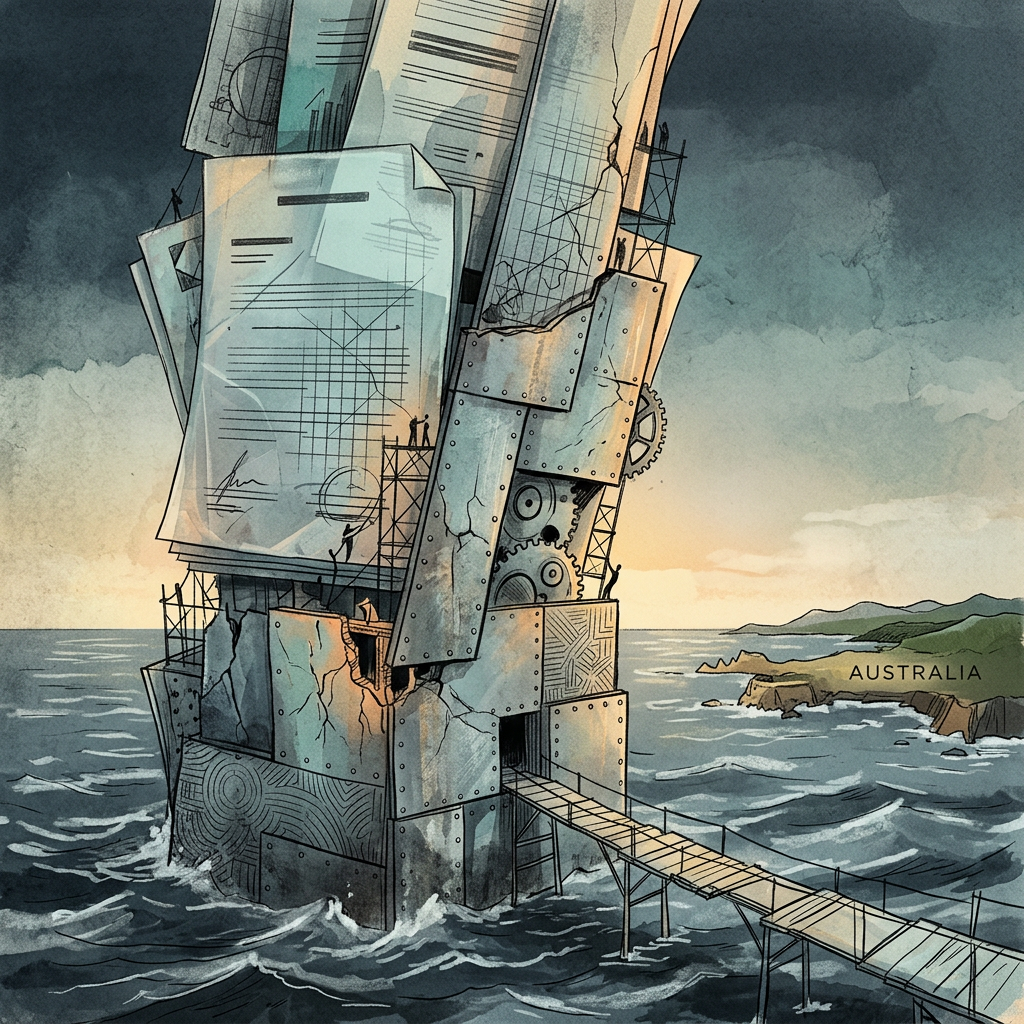
The Australia–US alliance is described in the language of partnership. The ANZUS Treaty commits the parties to “act to meet the common danger.” The Force Posture Agreement speaks of “mutual determination” and “Australia’s invitation.” AUKUS is described as an “enhanced security partnership.” The language is the language of equals.
The architecture is not. The Force Posture Agreement grants the US access to Agreed Facilities and Areas without rental or similar charges. The US has operational control over facilities it constructs. The AUKUS agreement creates a thirty-year dependency on the US and UK for nuclear propulsion technology, training, and maintenance. The Defence Trade Cooperation Treaty streamlines the flow of US defence articles into Australia. The intelligence-sharing arrangements fuse Australian intelligence with US systems.
None of these instruments names China. All of them are designed for a contingency in which China is the adversary. The lock-in is not in the language. It is in the capability.
2. The Instruments: An Accretion, Not a Design
The alliance is not a single treaty. It is a series of instruments signed over seven decades, each defensible on its own terms, none of which constitutes a coherent strategy.
2.1 The ANZUS Treaty (1951)
The ANZUS Treaty was signed in San Francisco on 1 September 1951 and came into force on 29 April 1952. Its operative provision, Article IV, states that each party “would act to meet the common danger in accordance with its constitutional processes”. The phrase “constitutional processes” is deliberately vague. It does not compel military intervention. It creates a binding obligation to respond, but the nature and extent of the response is left to each party’s domestic political process.
The treaty’s preamble is revealing. It notes that the United States “already has arrangements pursuant to which its armed forces are stationed in the Philippines, and has armed forces and administrative responsibilities in the Ryukyus“. The treaty is framed as extending an existing US posture architecture to Australia and New Zealand, not as a partnership between equals.
ANZUS guarantees nothing. As James Curran reminds us, Whitlam asserted that “adherence to ANZUS does not constitute a foreign policy,” and the United States refused to equate ANZUS with NATO. ANZUS was not invoked until Howard unilaterally did so in 2001. The treaty’s language is the language of consultation. The architecture built on it is the architecture of US force posture.
2.2 The Force Posture Agreement (2014)
The Force Posture Agreement is the operational instrument. Signed in Sydney on 12 August 2014, it provides the “policy and legal framework, as well as cost-sharing principles, to support the continued implementation of US force posture initiatives”. It explicitly recalls the ANZUS Treaty in its preamble.
The key provisions are asymmetrical:
· The US is granted access to “Agreed Facilities and Areas” without rental or similar charges.
· Where the US undertakes construction, it is granted operational control for the duration of the construction activity — the requisite basis under US law for funding military construction projects overseas.
· Australia retains primary responsibility for security of the facilities, but both parties cooperate on protection measures.
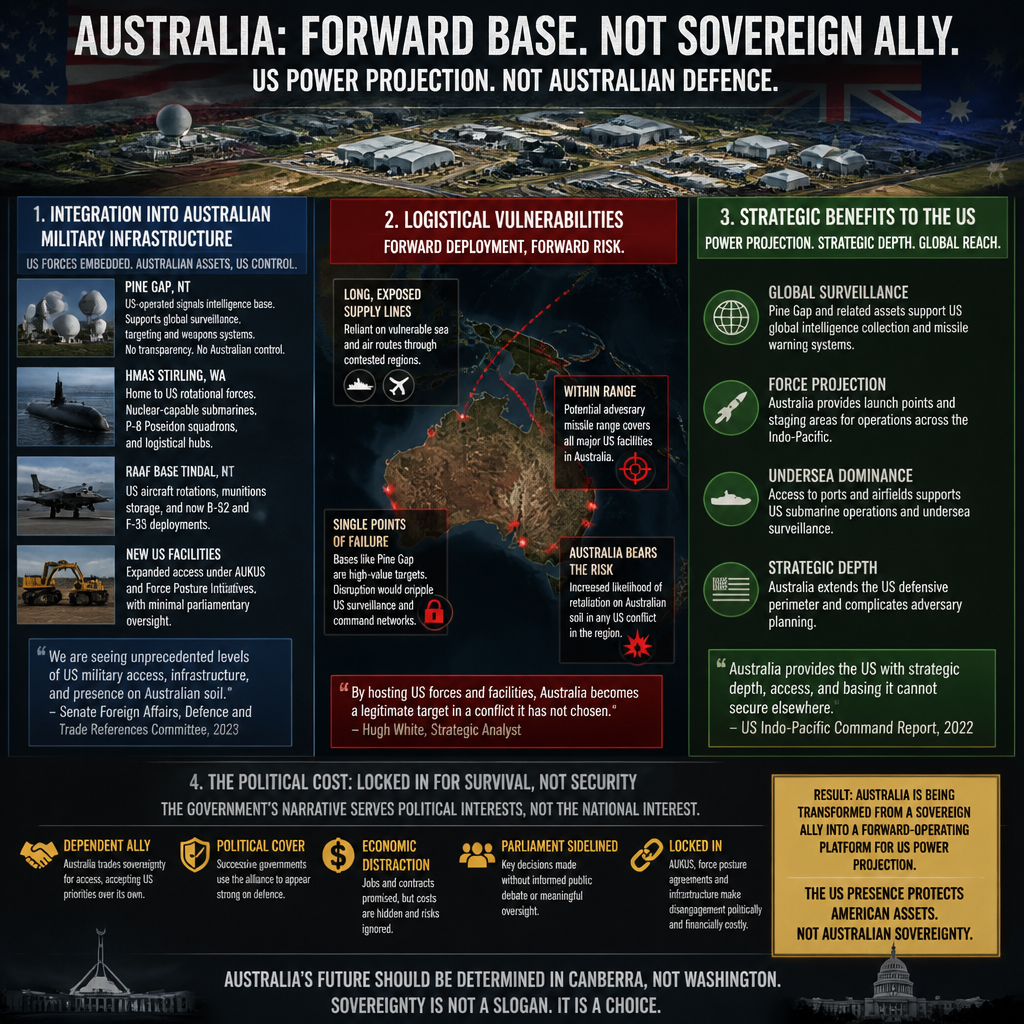
The Australian Senate was told in 2026 that “access to and use of Australian facilities and areas are on a rotational basis, mutually determined and at Australia’s invitation”. That is the official language. The structural reality is that the US has direct control of or access to over 100 Australian military bases.
2.3 AUKUS (2021–2025)
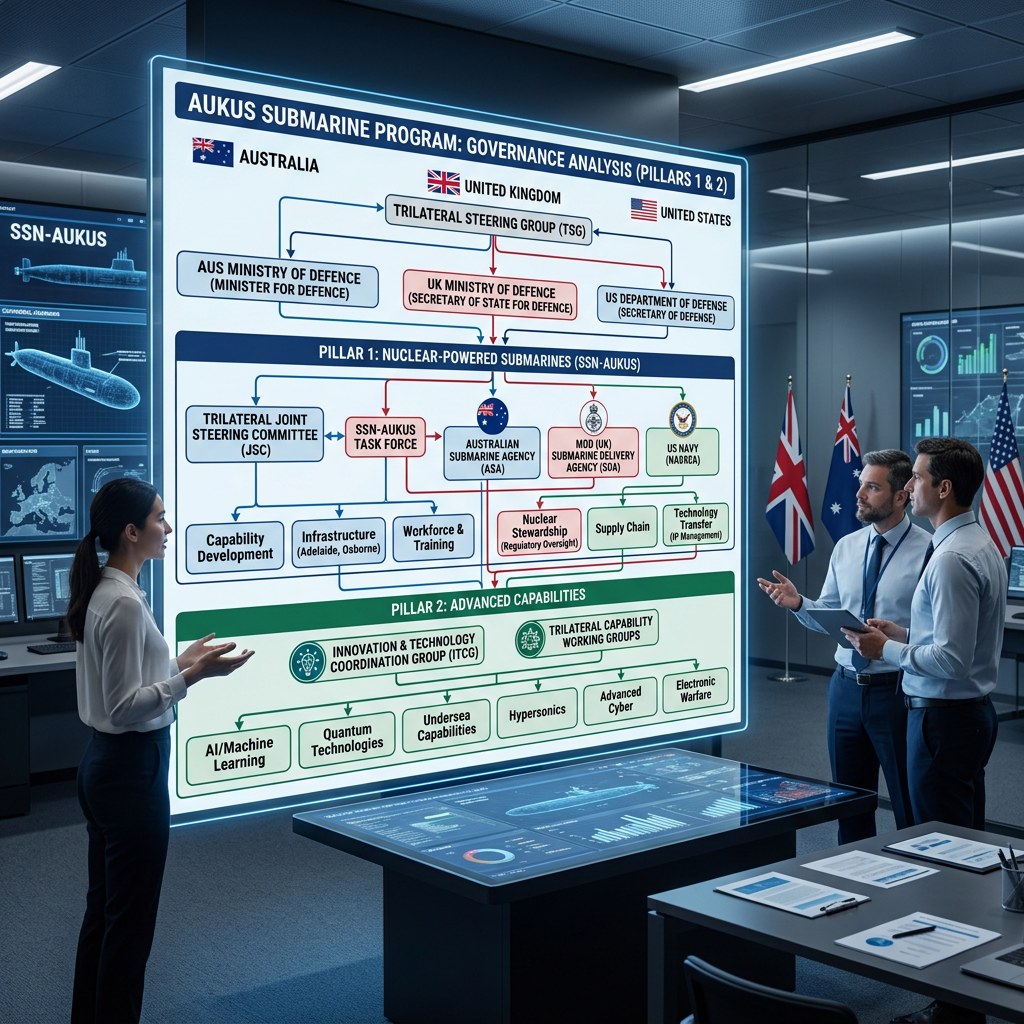
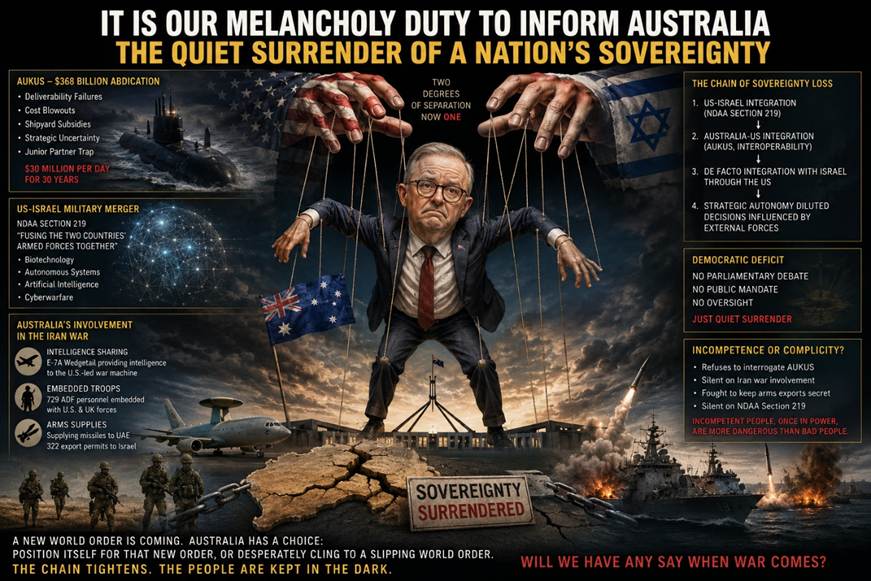
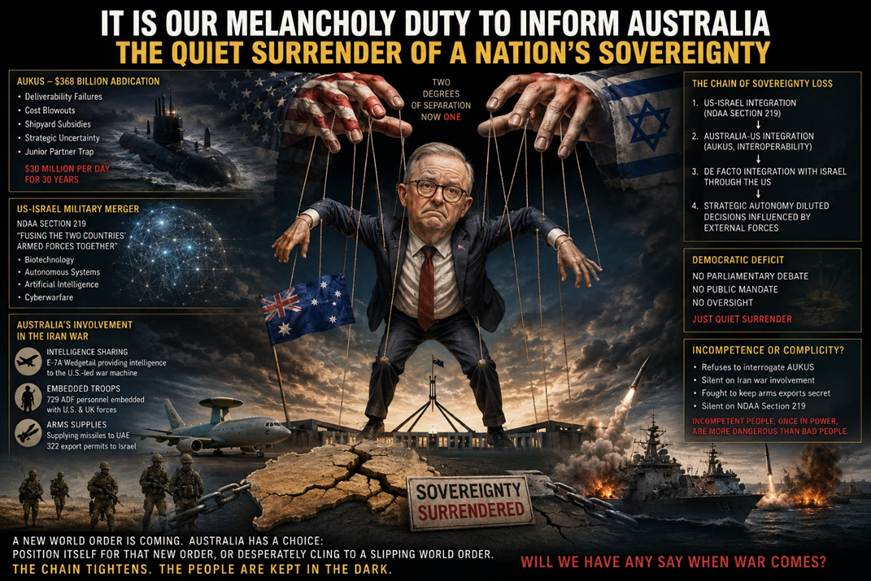
AUKUS is not an ANZUS instrument. It is a separate trilateral “enhanced security partnership” between Australia, the UK, and the US, announced on 15 September 2021. The legally binding instrument is the Agreement among the Government of Australia, the Government of the United Kingdom, and the Government of the United States of America for Cooperation Related to Naval Nuclear Propulsion, which entered into force on 17 January 2025.
The agreement permits the transfer of nuclear material and naval nuclear reactors among the three governments. It supersedes a 2022 agreement that permitted only the transfer of Naval Nuclear Propulsion Information. Former Prime Minister Malcolm Turnbull stated in 2026: “AUKUS involves a colossal sacrifice of sovereignty; there’s no question about that”. The Greens’ dissenting report on the AUKUS treaties concluded that “Australia is at the bottom rung of AUKUS“.
2.4 Supporting Instruments
Two further treaties support the architecture:
· The Australia–US Defence Trade Cooperation Treaty (signed 2007, ratified 2010) establishes an “Approved Community” of government facilities and private companies in both countries, enabling trade in defence articles without the administrative delays of export control regulations.
· The Agreement concerning Cooperation in Defence Logistic Support (CDLSA, 1989) and the Acquisition and Cross-Servicing Agreement (ACSA, 2010) provide the logistics framework for the force posture initiatives.
2.5 The AUSMIN Process
The Australia–United States Ministerial Consultations (AUSMIN) is the annual forum where the alliance is managed. It is not a treaty, but it is the mechanism through which the Force Posture Agreement and other initiatives are advanced. Each AUSMIN meeting produces new initiatives, new commitments, new integration. The accretion is continuous.
3. The Mechanisms of Lock-In
The lock-in is not in the language. It is in the capability.
1. Interoperability. Every weapons system Australia acquires is designed to work with US systems. The F-35, the M1 Abrams, the Tomahawk missiles, the future nuclear-powered submarines — all require US parts, US software, US maintenance, and US authorisation for use. The F-35’s Mission Data Files, which determine how the aircraft operates in combat, are managed by the United States and cannot be independently modified by Australia. Owning the airframe is no longer enough.
2. Pre-positioned stockpiles. The Bandiana warehouses in Victoria are being built to hold US equipment for “training exercises in Australia and within the Pacific theatre“. That is not a generic capability. It is a facility designed for a specific theatre.
3. Industrial integration. Port Wakefield manufactures GMLRS — a US-designed, US-licensed, US-standard missile. The Dublin precinct in South Australia is zoned to feed US defence primes. Australian industry is being woven into the US defence supply chain, which means Australian jobs depend on the continuation of the US alliance architecture.
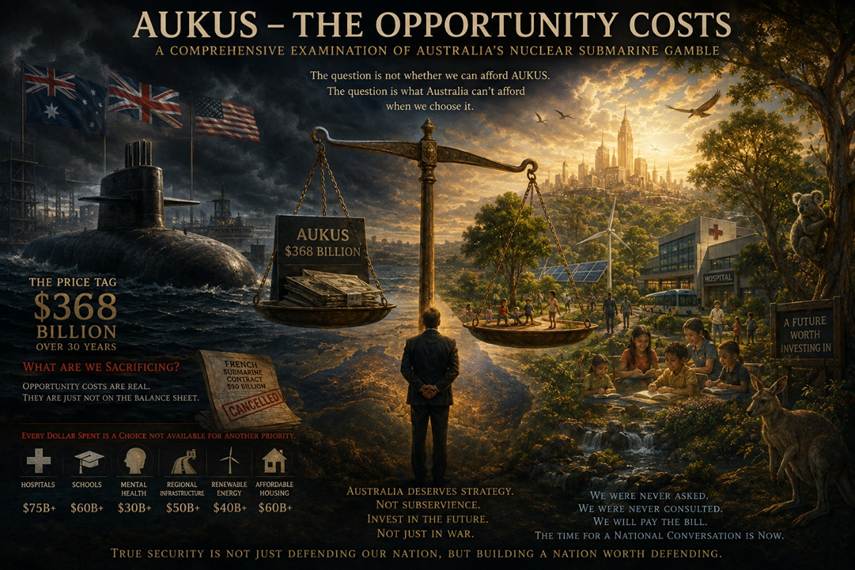
4. Nuclear propulsion. AUKUS commits Australia to nuclear-powered submarines — a capability that creates a 30-year dependency on the US and UK for training, technology, maintenance, and disposal. There is no exit strategy. The cost is estimated at up to A$368 billion over 30 years.
5. Intelligence integration. The Five Eyes arrangement, the Pine Gap facility, and the growing data-sharing architecture create a system in which Australia’s intelligence is fused with US intelligence. To disentangle would mean losing access to the intelligence Australia relies on.
6. The AUSMIN process. Each annual meeting produces new initiatives, new commitments, new integration. The accretion is continuous.
4. The Absence of Independent Review
There has been no comprehensive, independent review of the Australia–US alliance since the Whitlam government.
· Whitlam (1972–1975) asserted that “adherence to ANZUS does not constitute a foreign policy“. He questioned whether the alliance required Australia to support American policies in Asia. In Parliament on 3 April 1974, he said: “The Australian government takes the attitude that there should not be foreign military bases, stations or installations in Australia. We honour agreements covering existing stations. We do not favour the extension or prolongation of any of those existing ones.”
· Fraser (1975–1983) maintained the alliance but had security policy differences with Washington. In 2015, he said: “Australia’s position is so close to that of the United States that its capacity to make independent decisions is severely limited…we are now totally captive and interoperability has become, if you like, America’s new imperialism.”
· Hawke (1983–1991) advised Washington that “Australia is not and cannot be a non-aligned nation”. He placed the relationship on a “new plane of well-supported bipartisan stability”.
· Keating (1991–1996) continued the alliance but has since become its most vocal critic, stating in 2026 that AUKUS “is locking Australia into a potential conflict between the US and China”.
· Howard (1996–2007) invoked ANZUS for the first time after the September 11 attacks. This was a unilateral act by the Australian government, not a mutual decision.
· Since Howard, it has become “axiomatic for Australian governments to support, without serious qualification, the main thrusts of American security policy”.
The 2016 ASPI analysis noted that “while the politicians and security communities in the US and Australia continue to genuflect to ANZUS, the attitudes of the public in both countries may be less ebullient”. No government has commissioned a cost-benefit analysis of the alliance that asks: what does Australia give, what does Australia receive, and what are the liabilities?
5. Rationality and Rationalization
The distinction between rational decision-making and rationalization is the key analytical tool. Rational decision-making weighs costs, benefits, alternatives, and risks. Rationalization constructs justifications for a decision that has already been made.
The AUKUS decision is a case study in rationalization.
· The decision was made in secret in 2021, without public debate or parliamentary scrutiny.
· The justification was constructed afterward: the “rules-based order,” the “threat from China,” the “need for capability.”
· The costs were not disclosed: the A$368 billion price tag, the sovereignty implications, the opportunity costs.
· The public inquiry launched in 2026 is the first attempt to subject the decision to rational scrutiny.
The academic literature describes AUKUS as a “mutation of neoliberalism” that “reconnects business, politics, and military networks in new ways“. The “various notions of geopolitics strongly embedded within AUKUS (e.g. supply-chain resilience, technological advance, industrial sovereignty) obscure the nature of the capitalist economy that combines financial capital, state capital, and industrial capital.”
That is the rationalization: the geopolitical language obscures the economic architecture.
6. Whose Interests Are Served? The US Industrial Base Problem
The US Navy “now openly admits fleet growth stagnated” due to “delays and industrial limitations”. The US submarine industrial base is “already struggling to keep up with domestic demands“. Australia’s AUKUS funding is being used to bolster the US industrial base, not to build Australian capability.
The UK shipbuilding industry is “in disarray,” and the British are “more aware of that than anyone”. The industrial base in all three countries “did not collapse because defence companies suddenly became greedy. It shrank because governments spent 30 years cashing in the post-Cold War peace dividend and stopped providing predictable long-term demand.”
AUKUS is, in part, a mechanism to sustain the US and UK defence industrial bases with Australian funds. The Australian public is paying for American and British shipyard capacity, not for Australian submarines.
The opportunity cost is real. The same funds could be invested in Australian industry, infrastructure, health, education, and housing. The US faces its own internal crises in “health care, education, housing“. The architecture serves neither the Australian people nor the American people. It serves the defence-industrial networks that profit from perpetual preparation for conflict.
7. The Revolving Door: Politics, Lobbying, and the Defence Industry
The alliance architecture is sustained by a revolving door between government, the defence industry, and lobbying firms.
Analysis by Four Corners identified at least 60 former defence ministers, senior officers, and officials who have moved into weapons firms or lobbying companies. Former defence minister Christopher Pyne co-founded lobbying firm Pyne & Partners within months of retiring from politics in 2019. He says it is “number one in defence“. Former Labor defence minister Joel Fitzgibbon is a “special counsel” to lobbying firm CMAX Advisory, which has secured government contracts for major defence companies and weapons manufacturers. Former Labor defence materiel minister Mike Kelly served as the Australian president of Palantir from 2020 to 2024.
Greens defence spokesperson David Shoebridge describes AUKUS as “like a feast. It’s this multi-billion-dollar feast for lobbyists. In a $400 billion program, there are entire careers, entire harbourside mansions [and] new…”
The revolving door creates an unfair playing field where former officials can use their connections to potentially influence the awarding of multimillion-dollar contracts. Critics say it is “corrosive of public trust”.
The think tank sector is also implicated. The Department of Defence is ASPI’s “largest source of funding”. The government funds the strategic policy sector at approximately $40 million per year. The Defence Strategic Policy Research Program provides $58.3 million in operating funding from 2027–28 to 2031–32. The sector that produces the intellectual justification for the alliance is funded by the department that benefits from it.
8. Bipartisanship as a Mechanism of Control
The alliance is sustained by a bipartisan consensus that has effectively removed defence and foreign policy from democratic contestation.
Dr Andrew Carr of the ANU argues that “bipartisanship as it currently operates in Australia is not only failing to meet its expectations but actively impeding Australia’s national security.” He states that “bipartisanship has served to reduce policy quality, creativity, flexibility and accountability” and that “the habit of bipartisanship has restricted engagement and consideration of Australia’s strategic and defence challenges.”
Carr’s central argument is that “the fundamental assumption of bipartisanship is that elites are better at making strategic decisions, or can do so independently of politics. This is doubtful.” He notes that “many of the key defence challenges facing Australia are not technical, but political, going to the kind of country we are, the commitments we make to others, the order we wish to live in and the costs we would pay to enable and protect that order.”
The parliamentary record confirms the closed nature of the debate. When the Defence Amendment (Parliamentary Joint Committee on Defence) Bill was debated in 2024, a government member stated that “it is only the members of parties of government who should sit on this vitally important committee that will oversee the AUKUS arrangement, the largest defence procurement project ever undertaken by this government“. The Greens, who want to “abolish the ANZUS Treaty,” were to be excluded. The committee was designed to ensure automatic inclusion of Labor and Liberal parties, with guaranteed seats for minor parties including One Nation, the Nationals and the Greens, but the government’s willingness to water down the committee was described as “of great concern” because it would “fundamentally weaken our position“.
Australia is unique among AUKUS partners in lacking a dedicated parliamentary defence committee. The committee that was eventually established is a “secret” committee whose members are decided by the Prime Minister and the Opposition Leader, with Greens and independents excluded.
The bipartisan consensus is not a reflection of genuine agreement. It is a mechanism for managing dissent. As Carr notes, “bipartisanship does not keep politics out, it simply hides it from the public.”
9. The Domestic Political Function of Alliance Rhetoric
The alliance serves a domestic political function that is independent of its strategic rationale. It provides a language of national identity — the “Anzac spirit,” “shoulder to shoulder,” “shared values” — that can be deployed to manage public attention and legitimise expenditure.
The Guardian’s economics correspondent Greg Jericho wrote of his “deep contempt for a party using the days before Anzac Day to announce a jingoistic $21bn in defence spending and which talks about putting us on a ‘war footing’.” He asks the question that is often linked to Anzac Day: what is the opportunity cost?
The political function is precise. It is easier for Australian politicians to play at the game of soldiers and refer to the Anzac spirit than to effectively deal with the social issues faced by Australians — homelessness, aged care, the NDIS, veterans’ affairs, children living in poverty. The defence portfolio offers bipartisan cover, the prestige of statecraft, and the support of a well-funded think tank and lobbying ecosystem. Social policy offers none of these things.
The budget spending priorities reflect the choices made by successive governments. Between 2013 and 2023, NDIS funding grew at 11.1% per year, aged care at 4.7%, and defence at 3.5%. Defence spending, however, is now on a trajectory to nearly double in dollar terms over the next decade, from $56 billion to over $100 billion. The 2026–27 budget committed an additional $53 billion over the decade, bringing total defence funding to $887 billion to 2035–36.
The Rabobank analysis describes the Australian government as facing a “‘guns or butter‘ choice between increasing the defence budget to expand capability or increasing spending on social programs like the National Disability Insurance Scheme (NDIS), aged care, and childcare.” It notes that “clearly, Australia is currently choosing ‘butter’ but retains substantial headroom in the budget to increase spending by comparison to peer economies.”
The “have-your-cake-and-eat-it-too approach carries risk that Australia will be forced into supporting US foreign policy interests against its own, while also being underprepared if a major conflict were to break out.”
10. Algorithmic Governance and the Amplification of Defence Priorities
The Australian government’s use of algorithms and artificial intelligence is not neutral. It is configured to serve the architecture of the alliance and the priorities of the market-state.
The Department of Defence has developed the NITRO portfolio selection tool, which was used in 2019 to support a major force structure review. The 2024 Integrated Investment Program committed A$8.5 billion to A$11 billion to enterprise data. AI is “now financed across almost every line of the Australian defence budget. It is not, however, governed across them.”
The ADF is “integrating AI faster than it can govern it.” The Australian Strategic Policy Institute recommends “thresholds that slow AI-assisted decision cycles at key escalation points, auditable decision-support for high-stakes outputs, and a clear position on the limits of AI in Australian defence decision-making.” These safeguards do not exist.
The consequence is structural. The algorithms used for portfolio selection, force structure review, and capability planning are optimised for the architecture they are designed to serve. They measure what the alliance requires. They do not measure what the citizen needs. The same algorithmic lens that processes welfare recipients as data points processes defence spending as a portfolio optimisation problem.
Australia’s defence debate “is no longer centred primarily on ships, aircraft or missiles. It has now shifted the discussion to the software, data and AI systems embedded within them.” The “critical question being asked by policymakers and researchers alike is how much of this stack Australia can independently govern.” The answer today, according to the Australian Institute of International Affairs, is: very little. Australian forces “operate through foreign software, proprietary data systems and digital architectures that often cannot be independently audited, modified or governed within Australia.”
11. The Public and the Elite: A Divergence
The public is not aligned with the elite consensus.
A YouGov poll of 1,502 Australians in March 2026 found that 59% believe the country’s interests are better served by pursuing a more independent foreign policy, compared with just 23% who favoured a closer alliance with the US. Only one in eight Australians regard the US as a “very reliable” security ally, while more than half consider it unreliable overall. One-third believe AUKUS is not in the country’s best interests.
The poll was conducted by The Australia Institute between March 12 and 19, 2026. Emma Shortis, director of the institute’s international and security affairs program, said the findings mark a “significant shift” in Australian opinion. The change was driven by “the US administration’s assault on the institutions and norms of international law, and by what many Australians see as Washington’s contemptuous treatment of its traditional allies.”
The public is responding to the “volatile” behaviour of the US administration and its “contemptuous treatment of its traditional allies.” The political class is not.
12. Conclusion: The Architecture and the Language
The architecture says one thing. The language over time says another.
The architecture is a US force posture system that uses Australian territory, Australian funding, and Australian industrial capacity to sustain American global power projection. The language is the language of “mutual consultation,” “sovereignty,” “rules-based order,” and “shared values.”
The gap between them is the rationalization. The decision to host US force posture was made decades ago and has been renewed without independent review. Each new instrument — the Force Posture Agreement, AUKUS, the defence trade treaties — accretes the lock-in. None of them names China. All of them are designed for a contingency in which China is the adversary.
The rational decision would be to conduct an independent, public review of the alliance: what does Australia give, what does Australia receive, what are the risks, what are the alternatives. That review has not been conducted. The rationalization continues instead.
The revolving door, the bipartisan consensus, the think tank funding, the domestic political function of Anzac rhetoric, the algorithmic amplification of defence priorities — these are not separate phenomena. They are interlocking mechanisms that sustain the architecture and prevent it from being questioned.
Australia is not being forced into an anti-China position. It is being structured into one. The structuring is not in the language. It is in the capability. And the capability is being built with Australian consent, Australian funding, and Australian territory.
The question is not whether Australia is sovereign. It is whether sovereignty includes the capacity to change position. The architecture being built makes change extremely difficult. That is the lock-in.
Claim- Status -Summary
# -Claim -Status
1 -ANZUS Article IV is deliberately vague -Established
2 -ANZUS preamble frames treaty as extending US posture -Established
3 -Force Posture Agreement grants US access without rental- Established
4- US has access to over 100 Australian military bases -Established
5 -AUKUS creates 30-year dependency on US and UK -Established
6- AUKUS cost estimated at A$368 billion over 30 years- Established
7- No independent alliance review since Whitlam -Established
8 -Whitlam opposed foreign bases in Australia -Established
9- Howard invoked ANZUS unilaterally in 2001 -Established
10- 60+ defence insiders moved to lobbying/industry -Established
11- ASPI’s largest funding source is Defence- Established
12- Bipartisanship “hides politics from the public” (Carr) E-stablished
13- Australia unique among AUKUS partners in lacking defence committee -Established
14 -59% of Australians favour independent foreign policy- Established
15- Only 13% regard US as “very reliable” ally -Established
16 -One-third believe AUKUS not in Australia’s interests- Established
17- US Navy fleet growth “stagnated” due to industrial limitations- Established
18- AUKUS funding bolsters US industrial base -Inference
19- Alliance serves domestic political function- Inference
20- Algorithms amplify defence priorities over social needs- Inference
21- Specific intent to suppress debate -Speculation
References
1. Australian Government. (2026). About the National AI Centre. https://www.ai.gov.au
2. Australian Government. (2025). Agreement among the Government of Australia, the Government of the United Kingdom, and the Government of the United States of America for Cooperation Related to Naval Nuclear Propulsion.
3. Australian Government. (2014). Force Posture Agreement between Australia and the United States.
4. Australian Government. (1951). Security Treaty between Australia, New Zealand and the United States of America (ANZUS).
5. Australian Government. (1963). Agreement concerning the Status of United States Forces in Australia (SOFA).
6. Australian Government. (1989). Agreement concerning Cooperation in Defense Logistic Support (CDLSA).
7. Australian Government. (2007). Australia–US Defence Trade Cooperation Treaty.
8. Australian Government. (2010). Acquisition and Cross-Servicing Agreement (ACSA).
9. Broinowski, A. (2017, May 8). Reading Room: Fighting with America. Australian Institute of International Affairs.
10. Carr, A. (2017). I’m here for an argument: Why bipartisanship on security makes Australia less safe. The Australia Institute.
11. Carr, A. (2019). Submission to the Inquiry into the benefits and risks of a Bipartisan Australian Defence Agreement. Parliament of Australia.
12. Curran, J. (2016). Fighting with America: Why saying no to the US wouldn’t rupture the alliance. Penguin Books.
13. Four Corners. (2026, August 23). Dozens of government insiders lobbying for defence industry, analysis shows. ABC News.
14. Fraser, M. (2015). Address to the Australian Institute of International Affairs.
15. Hooper, V. (2025, October 23). Managing warlords in the workplace: Inside Australia’s bureaucratic feudalism. Independent Australia.
16. Jericho, G. (2025, April 23). Australia needs more than hollow words about a fair go. The Guardian.
17. Keating, P. (2026). Public statement on AUKUS.
18. Parliament of Australia. (2024). House of Representatives Hansard, Defence Amendment (Parliamentary Joint Committee on Defence) Bill 2024.
19. Parliament of Australia. (2025). Defence Amendment (Parliamentary Joint Committee on Defence) Bill 2025.
20. Pearls and Irritations. (2026, June 26). Fraser, Whitlam, Albanese and national sovereignty.
21. Rabobank. (2025). Australian Economic Statecraft.
22. The Guardian. (2025, June 15). Aukus will cost Australia $368bn. What if there was a better, cheaper defence strategy?
23. The Strategist. (2026, June 24). The ADF is integrating AI faster than it can govern it. ASPI.
24. Turnbull, M. (2026). Evidence to the AUKUS Public Inquiry.
25. YouGov. (2026). Poll for The Australia Institute, March 12–19, 2026.
Andrew Paul Klein is a writer and analyst based in Boronia, Victoria. He accepts funding from no one.