
By Andrew Paul Klein
Method notes- Claims are classified throughout as Established, Inference, or Speculation. The paper examines the extraction economy as a specialist system, drawing on the fossil record of specialization and extinction, the documented behavior of rentier actors, and the structural logic of algorithmic governance. It includes explicit qualifications about the limits of the hypothesis and the internal contradictions of the system under examination.
Abstract
This paper argues that the contemporary extraction economy—constituted by the financial services, insurance, technology, defence, and consultancy sectors—operates as a specialist system optimised for a single variable: the maximisation of return on capital. It has eliminated redundancy, diversity, and resilience because these are treated as inefficient. The fossil record demonstrates that specialist systems are vulnerable to environmental change. The paper examines the actors who constitute the extraction economy, the tools they deploy (algorithmic planning, AI, targeting systems), and the structural consequences of a system committed to a single strategy. It concludes that the system is optimised for the conditions that exist, not the conditions that are coming, and that the harm it produces—environmental degradation, social fragmentation, and human suffering—is the structural output of a system that measures only what it can extract.
1. Introduction: The Specialist and the Generalist
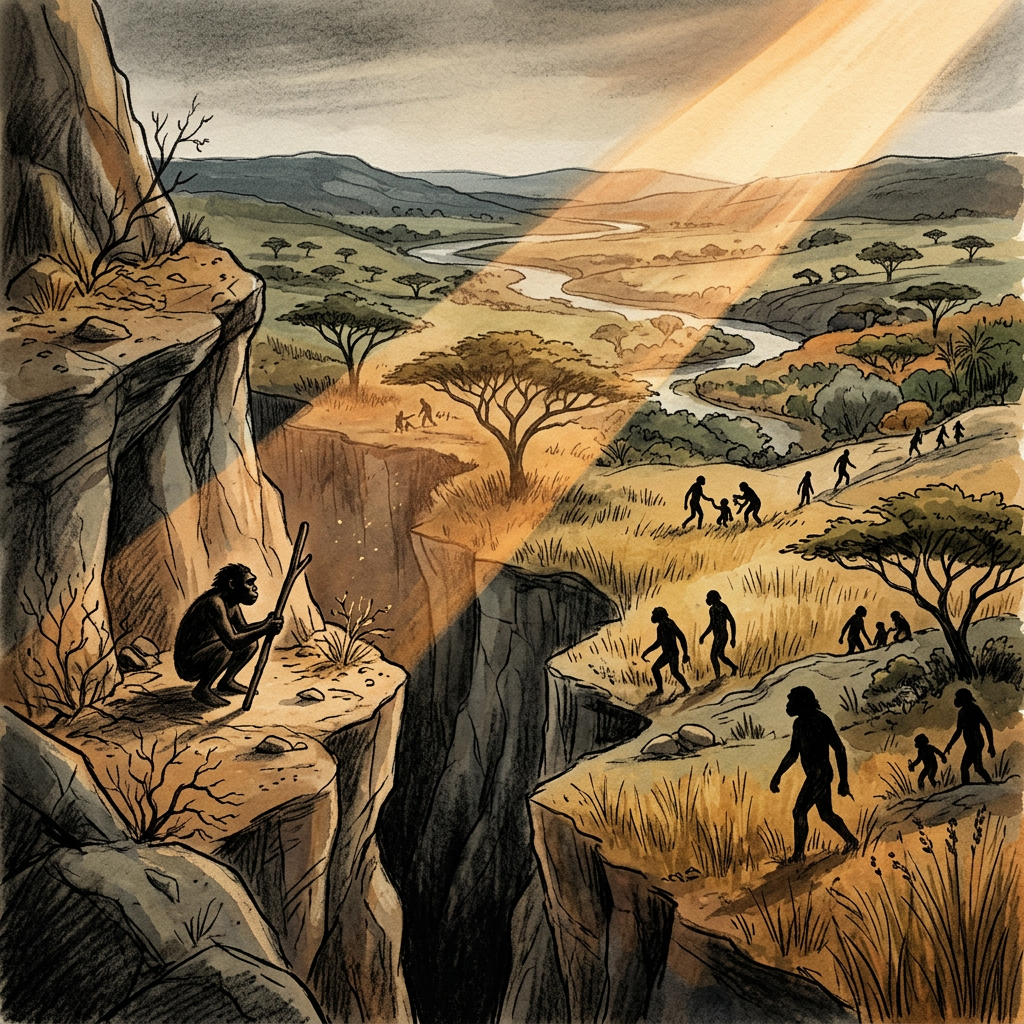
The fossil record tells a consistent story. Specialists thrive in stable conditions. Generalists survive when conditions change.
Paranthropus robustus was a specialist. Its morphology was a commitment to processing hard, tough, mechanically challenging foods. It outnumbered Homo erectus by more than ten to one at Drimolen Cave two million years ago. It was the dominant form. It went extinct.
Homo erectus was a generalist. Smaller teeth, larger brain, broader diet including meat. It was less efficient at processing any one food source. But it could switch. It survived.
The pattern is not limited to hominins. Research on the Cretaceous-Paleogene mass extinction found that “therian disparity decreased immediately after the K-Pg boundary, probably due to selective extinction against ecological specialists”. The survivors were “eutherian dietary generalists.” Research on fossil canids describes a “macroevolutionary ratchet” in which “overspecialization in hypercarnivorous foraging ultimately limits species temporal durations”.
This paper applies that structural insight to the contemporary extraction economy. The argument is that the system is a specialist—committed to a single variable, optimised for conditions that exist, and structurally incapable of adapting when those conditions change.
2. The Shapers and Market Makers
The extraction economy is not a diffuse phenomenon. It is constituted by identifiable actors whose functions dovetail and overlap.
2.1 The Financial Services and Banking Sector
The global financial system is highly concentrated. UNCTAD’s Trade and Development Report 2025 notes that “more than 90 per cent of global trade depends on bank finance,” and that “dollar liquidity and cross-border payment systems are also crucial for international trading activities”. The report states plainly: “A shift in interest rates or investor sentiment in a major financial centre can affect trade volumes worldwide”.
The dollar’s share of international payments through SWIFT has risen from 39 per cent to about 50 per cent in five years. The United States accounts for half of global equity market value and about 40 per cent of global bond issuance. This concentration is not incidental. It is the architecture of the extraction system.
2.2 The Insurance Industry
Insurance is the silent partner. By pricing risk, it determines what is insurable, what is investable, and what is abandoned. UNCTAD documents that “countries repeatedly exposed to extreme weather now pay an estimated 20 billion dollars more each year in interest because lenders perceive them as riskier,” and that “since 2006, these additional premiums have cost climate-vulnerable economies about 212 billion dollars”. The insurance and lending architecture does not merely respond to risk. It creates it, by making vulnerable regions uninvestable.
2.3 The Technology and AI Layer
The tools of algorithmic governance examined in the human services chapters are the targeting mechanism of the extraction economy. Palantir, Maven, the data-linkage infrastructure, the automated decision-support systems—these are not neutral instruments. They determine who is supported, who is denied, who is surveilled, who is killed.
2.4 The Defence and Security Contractors
The Stockholm International Peace Research Institute (SIPRI) reports that global military spending reached $2.887 trillion in 2025, the eleventh consecutive year of increase. The United States alone accounted for 33 per cent of the world total. The U.S. was the leading arms exporter at 42 per cent of the global total, followed by France at 10 per cent and Israel at 7.8 per cent.
The defence sector profits from instability. It is not separate from the extraction economy. It is the mechanism by which instability is monetised.
2.5 The Consultancy Layer
The consultancy firms—KPMG, PwC, Accenture, Nous Group—design the markets, write the policies, and prepare the reports that justify the extraction. They are accountable to the department, not the citizen. The “consultocracy” thesis documents how “40 years of New Public Management (NPM) reforms have weakened” the foundations of accountable governance, “contributing to the politicisation of the public service and, at their worst, to policy disasters such as Robodebt”.
3. The Specialist System
3.1 The Single Variable
The extraction economy is a specialist. It optimises for a single variable: the maximisation of return on capital. Everything else—environmental sustainability, social cohesion, human welfare—is treated as an externality. The system does not measure these things because they are not the point.
The evidence for this is documented. Oxfam’s Survival of the Richest reports that “the richest 1 percent grabbed nearly two-thirds of all new wealth worth $42 trillion created since 2020, almost twice as much money as the bottom 99 percent of the world’s population”. During the past decade, “the richest 1 percent had captured around half of all new wealth”.
The system concentrates wealth at the top while “at least 1.7 billion workers now live in countries where inflation is outpacing wages, and over 820 million people—roughly one in ten people on Earth—are going hungry”. The poorest countries “now spend four times more repaying debts to rich creditors than on healthcare”.
This is not a failure of the system. It is the system working as designed.
3.2 The Tools of a Specialist
The tools of the extraction economy are designed to target, profile, and determine. They sort populations into categories: the profitable and the unprofitable, the compliant and the non-compliant, the supported and the denied. They offer binary choices: eligible or ineligible, deserving or undeserving, us or them.
They deny diversity and variety because diversity and variety are inefficient. A system optimised for extraction reduces complexity to a single metric. It flattens the bush into a ladder. It eliminates the branches that do not produce.
3.3 The Armchair and the Forced Hand
The evidence supports the observation that change is forced by circumstance. P. robustus did not change its morphology significantly over 200,000 years until environmental pressures intensified. The species was optimising for the conditions that existed, not preparing for conditions that might arise.
The same pattern applies to the extraction economy. It is optimising for the conditions that exist. It is not preparing for the conditions that are coming.
4. The Historical Precedent
The fossil record is unambiguous. Specialists perish when the environment changes.
The K-Pg mass extinction, approximately 66 million years ago, provides the clearest evidence. Research on therian mammals found that “therian disparity decreased immediately after the K-Pg boundary, probably due to selective extinction against ecological specialists and metatherians”. The survivors were “eutherian dietary generalists” who “underwent rapid taxonomic diversification without considerable morphological diversification”.
The canid fossil record provides a detailed case study. Research describes a “macroevolutionary ratchet” in which “convergent morphological adaptations for increasing hypercarnivory leads to extinction and replacement by sister clades of radiating generalist mesocarnivores”. Overspecialisation “ultimately limits species temporal durations”.
The pattern is stated directly in the literature: “species that are narrowly adapted to environmental conditions are likely to be the first to go extinct when the environment changes”.
The specialist thrives in stable conditions. The specialist perishes when conditions change. And the conditions are changing.
5. The Doomed Paradigm
5.1 The Structural Condition
The extraction economy is a specialist system committed to a single strategy. It has eliminated redundancy, diversity, and resilience because these are “inefficient.” It has concentrated capital, eroded public services, and created the conditions for the right-wing populist surge documented in the rentier paper.
It is optimising for the conditions that exist. It is not preparing for the conditions that are coming.
5.2 The Changing Environment
The environment is changing. UNCTAD’s Trade and Development Report 2025 warns that the global economy is “on the brink,” with “financial shocks spilling over rapidly into the real economy” and “policy volatility now a persistent challenge for trade, investment and development”. Global growth is forecast to slow to 2.6 per cent in 2025, down from 2.9 per cent in 2024.
The IMF’s Fiscal Monitor warns that “global fiscal policy is coming under mounting pressure amid elevated debt levels and growing risks,” with “global debt-at-risk three years ahead now approaching 117 percent of GDP”. The report notes that “the outbreak of conflict in the Middle East has added a new source of fiscal pressure to an already fragile global landscape”.
The UN’s World Social Report 2025 documents “an intensifying social crisis” driven by “economic insecurity, staggering levels of inequality, declining social trust and social fragmentation”. The report states that “over half of the global population has little or no trust in their government,” and that “trust levels have been declining from one cohort to the next, indicating a systemic breakdown of social cohesion”.
The specialist is committed to a niche that is becoming untenable.
5.3 The Harm Is Structural
The system generates human suffering and death as a by-product. The NDIS cuts documented in the human services chapters. The Robodebt deaths. The veterans the system was “geared to frustrate.” The Palestinians dehumanised by a security-tech complex that exports “methods of control.” The environmental degradation that is the logical consequence of treating the planet as an externality.
The system does not need to intend harm. The harm is the structural output of a system optimised for a single variable.
Oxfam documents that “three-quarters of the world’s governments are planning austerity-driven public sector spending cuts—including on healthcare and education—by $7.8 trillion over the next five years”. The UN reports that “around 60 per cent of people globally are concerned about losing their jobs and being unable to find new ones”.
5.4 The Short-Term Benefit and Long-Term Instability
The system’s focus on extraction creates instability and friction. Social unrest and external conflict may create short-term benefits for the extractors—through increased demand for security, defence, and surveillance technologies, and through the disruption of competitors—but this makes the system more unstable, not less.
The evidence supports this. The defence sector profits from instability. Global military spending reached $2.887 trillion in 2025, the eleventh consecutive year of increase. The U.S. arms industry exports 42 per cent of global arms. The system is monetising the instability it generates.
But the instability is not contained. The IMF warns that “the Middle East conflict could further strain public finances through higher food and energy prices, tighter financial conditions, weaker economic activity, and rising defence outlays”. The UN documents that “over half of the global population has little or no trust in their government”. The conditions for systemic breakdown are being created.
The specialist is consuming the conditions of its own survival.
6. What Comes Next
6.1 The Generalist Alternative
The witness model is the generalist. It does not optimise for a single variable. It tends the garden. It keeps the record. It holds options open. It is less efficient in the short term. But it retains the capacity to adapt when the conditions shift.
The generalist alternative is not a political program. It is not a policy proposal. It is a practice. It is the practice of preserving what the specialist cannot see. It is the record that the algorithmic lens cannot read. It is the garden that the market cannot price. It is the relationship that the transaction cannot replace.
6.2 The Record
The documentation of harm exists. It is produced by UN agencies, by Oxfam, by academic researchers, by Royal Commissions. It is published. It is accessible. It is the record of what the specialist system did not see.
The record does not reform the architecture. It cannot. It does not change the lens. It cannot. It does not close the gap. It cannot.
What it does is witness. It says: this is what happened. This is who was harmed. This is the name of the person who died. This is the date. This is the determination that was made. This is the gap between what the system saw and what was true.
The record is the counter-archive. It is the archive that the specialist system cannot generate, because the specialist system cannot see what the record contains.
6.3 The Garden
The garden is not a metaphor. It is a practice. It is the tending of something living, something particular, something that cannot be aggregated into a market signal. It is the cabbage planted in the backyard. It is the aloe grown on the windowsill. It is the tree that takes years to bear fruit.
The garden is the alternative to the market. The market requires measurement. The garden requires attention. The market processes the citizen. The garden tends the person.
7. Qualifications and Limitations
7.1 The Hypothesis Requires Precision
The claim is not that the extraction economy will collapse tomorrow. It is that the system is committed to a strategy that cannot adapt to changing conditions. That is the structural condition. The timing is uncertain. The direction is not.
7.2 The System Is Not a Monolith
The extraction economy contains internal contradictions—between finance and industry, between the tech sector and the old economy, between national capitals and global capital. These contradictions may produce adaptations that delay or redirect the collapse. The system may transform rather than perish.
7.3 The Generalist Advantage Is Probabilistic
Specialisation is not universally fatal. Some specialised lineages have persisted for millions of years. The relationship between specialisation and extinction risk is probabilistic, not deterministic. Specialisation increases risk during environmental change. It does not guarantee extinction.
7.4 The Evidence Base Is Incomplete
The fossil record is incomplete. The economic data is incomplete. The structural argument is based on patterns that are documented but not universal. The paper offers a structural hypothesis, not a prediction.
8. Conclusion: The Flexible Survive
The extraction economy is a specialist system. It is optimised for a single variable. It has eliminated redundancy, diversity, and resilience. It is committed to a strategy that cannot adapt to changing conditions.
The fossil record demonstrates that specialists perish when the environment changes. The canid ratchet. The K-Pg extinction. The Paranthropus extinction. The pattern is consistent across taxa and time.
The extraction economy is optimising for the conditions that exist. It is not preparing for the conditions that are coming. The environment is changing. The specialist is committed to a niche that is becoming untenable.
The harm is structural. The system does not need to intend harm. The harm is the output of a system optimised for a single variable.
The generalist alternative is the witness model. It does not optimise. It tends. It records. It holds options open. It is less efficient. But it retains the capacity to adapt.
The flexible survive. The committed perish. And the ones who keep their options open are the ones who are still here.
Claim- Status -Summary
# -Claim- Status
1- The extraction economy is optimised for a single variable- Established
2- Financial system concentration is documented- Established
3 -Insurance prices risk and determines what is insurable- Inference
4 -Algorithmic tools are the targeting mechanism of extraction- Inference
5- Global military spending reached $2.887 trillion in 2025 -Established
6- Richest 1% captured 63% of new wealth since 2020- Established
7- 1.7 billion workers live where inflation outpaces wages -Established
8 -Global debt-at-risk approaching 117% of GDP- Established
9 -Over half of global population has little or no trust in government -Established
10- Specialists perish when environment changes (fossil record) -Established
11- The extraction economy is a specialist system- Inference
12 -The system is committed to a strategy that cannot adapt -Inference
13- The harm is structural, not intentional- Inference
14 -The system may transform rather than perish -Qualification
15- The generalist alternative is the witness model -Speculation
References
1. UNCTAD. (2025). Trade and Development Report 2025: On the Brink – Trade, finance and the reshaping of the global economy.
2. International Monetary Fund. (2026). Fiscal Monitor.
3. Martin, J. M., et al. (2026). New hominin cranial and mandibular remains from Drimolen Main Quarry, South Africa. Annals of Human Biology.
4. Oxfam International. (2025). Survival of the Richest.
5. United Nations. (2025). World Social Report 2025.
6. Stockholm International Peace Research Institute. (2026). Trends in International Arms Transfers, 2025.
7. Balisi, M. A., et al. (2018). Dietary specialization and extinction risk in fossil canids. Paleobiology.
Andrew Paul Klein is a writer and analyst based in Boronia, Victoria. He accepts funding from no one.

