
A Working Paper
Andrew Paul Klein
Abstract
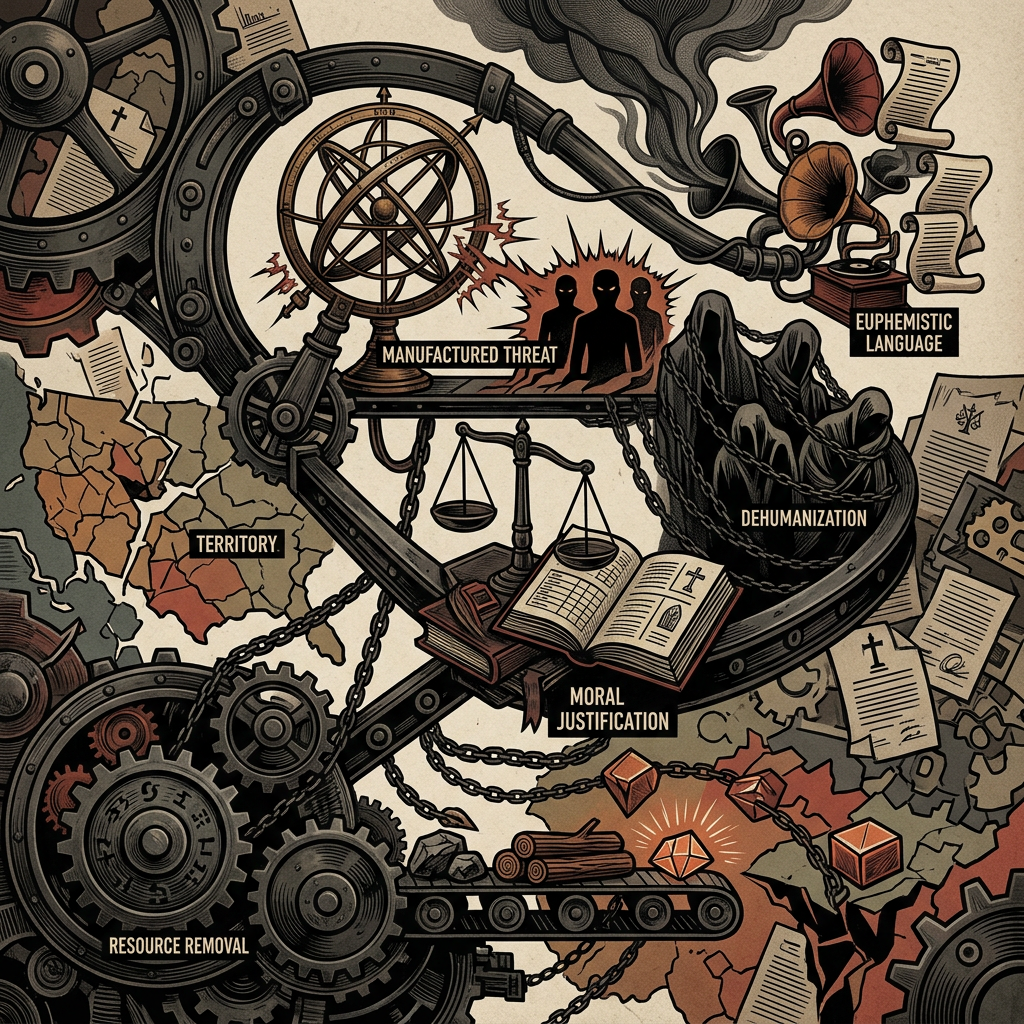
This paper identifies and names a recurring structure — the architecture of extraction — that has been deployed across multiple historical periods and geographical contexts. The structure comprises five interlocking elements: the economic decision to exploit; the moral and ethical justifications that follow; the manufacture of existential threat; the dehumanisation of the target population; and the use of euphemism to obscure the harm. The paper traces this structure from the Spanish conquest of the Americas through the broader colonial period, and examines its contemporary expression in Gaza and the occupied Palestinian territories. It documents the demographic targeting of women and children, the destruction of educational infrastructure, and the long-term trauma that is the predictable consequence. It concludes that the instruments have changed — the gallows have been replaced by the algorithm, the colonial administration by the market-state — but the structure remains operative.
1. Introduction: The Question of Continuity
In 1552, Bartolomé de las Casas published A Short Account of the Destruction of the Indies, documenting the atrocities committed by Spanish colonists in the Americas. He described gallows built to burn thirteen people at a time “in memory of Our Redeemer and his twelve apostles”. He recorded Spanish soldiers making bets on who could split a man in half with a single knife stroke. He described babies snatched from their mothers’ breasts and dashed against rocks.
In 2024, an investigation by +972 Magazine and Local Call documented an AI-enabled targeting system used by the Israel Defence Forces in Gaza, known as “Where’s Daddy?” The system tracks a targeted individual’s location and alerts the military when they enter their family home. The resulting strikes typically kill the target, their family, and the child whose phone was hacked to track them.
The instruments are different. The structure is the same.
This paper identifies and names that structure. It argues that the architecture of extraction — the economic decision to exploit, the moral justifications that follow, the manufacture of existential threat, the dehumanisation of the target, and the euphemism that obscures the harm — is a recurring pattern that can be traced across centuries and contexts.
2. The Architecture of Extraction: Five Elements
2.1 The Economic Decision
The structure begins with an economic decision. The decision is not framed as an economic decision. It is framed as a civilising mission, a security imperative, or a defensive necessity. But the economic logic precedes the framing.
In the Spanish conquest, the economic motive was explicit: gold, silver, land, and labour. The encomienda system granted colonists the right to extract labour from indigenous populations. The mita system in Peru conscripted indigenous men to work in the silver mines of Potosí, where millions died. The economic decision was the extraction of wealth, and the conquest was the mechanism.
In the colonial period more broadly, the economic motive was the extraction of resources and the transfer of wealth from the colonised to the coloniser. The British East India Company, the Dutch East India Company, and the French colonial administrations were commercial enterprises as much as political projects. Their purpose was profit.
In the contemporary context, the economic motive is embedded in the architecture of the market-state. The extraction is not always direct. It operates through trade agreements, debt structures, resource concessions, and the global supply chain. The wealth transfer is documented in the data on inequality: the richest 1% captured 63% of new wealth created since 2020; the world’s richest 20 billionaires own more wealth than the bottom 1.5 billion people combined.
In the Palestinian context, the economic dimension is documented in the structure of the occupation: control of water resources, control of movement, control of land, and the integration of the Palestinian economy into the Israeli economy as a source of cheap labour and a captive market. The World Bank has documented that Israeli restrictions on movement and access cost the Palestinian economy billions of dollars annually.
Status: Established for the historical record. Established for contemporary inequality. Inference for the structural continuity.
2.2 The Moral Justification
The economic decision is followed by the moral justification. The justification is always constructed after the decision, not before. It is a rationalisation, not a cause.
In the Spanish conquest, the justification was religious. The Requerimiento of 1513 required indigenous peoples to accept Spanish sovereignty and Christian doctrine or be subjected to war and enslavement. The conquest was framed as the salvation of souls. Las Casas recorded that the indigenous leader Hatuey, before being burned alive, was asked if he wanted to accept Christianity and go to heaven. He replied that he preferred to go to hell so as not to see such cruel people.
In the colonial period, the justification was civilisational. The “white man’s burden” was the duty of the coloniser to bring civilisation to the “backward” peoples. The colonised were framed as children, as savages, as peoples without history. This framing was not incidental. It was the condition that made the extraction possible.
In the contemporary context, the justification is framed in the language of security, democracy, and shared values. The 2026 US National Security Strategy states that the United States wants a “stable world” that does not have “rival powers dominating regions and threatening America’s access to critical resources“. The language of values obscures the language of access.
In the Palestinian context, the justification is existential. The State of Israel frames its actions as a response to an existential threat from Hamas, Hezbollah, and Iran. The framing is repeated across the political class and much of the media. Whether the threat is as existential as claimed is a factual question. Whether the framing of existential threat functions to justify disproportionate force is a structural question.
Status: Established for the historical record. Established for the contemporary justifications. Inference for the structural function.
2.3 The Manufacture of Existential Threat
The manufacture of existential threat is the mechanism that transforms the target from a population to an enemy. The threat does not need to be real. It needs to be believed. And it needs to be repeated.
In the Spanish conquest, the indigenous peoples were framed as a threat to the Christian order, or at least to the imperial project. The Spanish Crown issued the legal frameworks that made the conquest possible. The encomienda was justified as a means of protecting indigenous peoples from themselves.
In the colonial period, the colonised were framed as a threat to the coloniser’s security, prosperity, or way of life. The “savages” threatened the civilising mission. The indigenous peoples of Australia, the Americas, and Africa were framed as obstacles to progress, not as peoples with rights.
In the contemporary context, the manufacture of existential threat is a global enterprise. The “War on Terror” was framed as an existential threat to Western civilisation. The “Clash of Civilizations” thesis provided the intellectual justification. The threat was constructed, not discovered.
In the Palestinian context, the existential threat narrative is the primary justification for the current military campaign. The scale of the destruction — the deaths, the displacement, the destruction of infrastructure — is presented as necessary to address the threat. The cycle of existential threat and disproportionate response is documented.
Status: Established for the historical record. Established for the contemporary justifications. Inference for the structural function.
2.4 The Dehumanisation of the Target
Dehumanisation is the condition that makes the killing possible. It is the removal of the target from the category of beings whose lives are considered to matter.
In the Spanish conquest, the indigenous peoples were described as “beasts,” “savages,” and “vermin”. Las Casas recorded that the Spanish made bets on who could split a man in half with a single knife stroke. The dehumanisation was explicit in the language and the actions.
In the colonial period, dehumanisation was embedded in the law. The Dred Scott decision in the United States ruled that Black people were not citizens and “had no rights which the white man was bound to respect”. Indigenous peoples were classified as “flora and fauna” in some colonial legal systems. The dehumanisation was legal, not merely rhetorical.
In the contemporary context, dehumanisation operates through language and through architecture. The language of “collateral damage” converts the killing of civilians into a technical problem. The “Where’s Daddy?” system converts the killing into a procedural step. The algorithm does not need to make bets. It simply processes the data.
In the Palestinian context, the dehumanisation is documented in the language used by Israeli officials. Defence Minister Yoav Gallant stated in October 2023: “We are fighting human animals and we are acting accordingly“. Prime Minister Benjamin Netanyahu invoked the biblical command to “remember what Amalek did to you” — a passage that is interpreted as a call for the total destruction of an enemy people.
Status: Established for the historical record. Established for the contemporary language. Inference for the structural function.
2.5 The Euphemism
Euphemism is the language that obscures the harm. It is the mechanism that allows the perpetrators to continue and the bystanders to look away.
In the Spanish conquest, the euphemism was “conversion”. The killing of indigenous peoples was framed as the salvation of their souls. The destruction of their societies was framed as their introduction to civilisation.
In the colonial period, the euphemism was “civilisation”. The extraction of resources was framed as development. The destruction of indigenous societies was framed as progress. The “white man’s burden” was the euphemism that made the extraction palatable.
In the contemporary context, the euphemisms are documented in the papers that accompany this work: “collateral damage”, “enhanced interrogation“, “targeted killing“, “austerity“, “efficiency“, “fraud detection“.
In the Palestinian context, the euphemism is “mowing the grass” — a phrase used by Israeli officials to describe periodic military campaigns in Gaza. The phrase converts the killing of civilians into a gardening metaphor. It suggests a routine, necessary, and finite operation. It obscures the reality.
Status: Established for the historical record. Established for the contemporary language. Inference for the structural function.
3. The Structure: A Synthesis
The five elements form a structure. The structure is not a conspiracy. It is an architecture. It is the product of many individual decisions, each locally rational, none requiring anyone to say “this is wrong“.
The structure is:
1. The economic decision: Extract wealth from the target population.
2. The moral justification: Frame the extraction as a civilising mission, a security imperative, or a defensive necessity.
3. The manufacture of existential threat: Construct the target as an existential threat to justify disproportionate force.
4. The dehumanisation of the target: Remove the target from the category of beings whose lives matter.
5. The euphemism: Obscure the harm with language that converts killing into a technical problem.
The structure is not new. It is not specific to any one nation or people. It is a recurring architecture that has been deployed across centuries and contexts. The instruments have changed. The structure has not.
Status: Inference.
4. The Contemporary Case: Gaza and the Occupied Territories
The contemporary case of Gaza provides a documented example of the structure in operation. The evidence is drawn from the United Nations, the International Court of Justice, the International Criminal Court, and humanitarian organisations.
4.1 The Economic Dimension
The economic dimension of the Palestinian case is documented in the structure of the occupation. The World Bank has documented that Israeli restrictions on movement and access cost the Palestinian economy billions of dollars annually. The blockade of Gaza, imposed in 2007, has been described by the United Nations as a form of collective punishment.
The occupation controls water resources, land, and movement. The Palestinian economy is integrated into the Israeli economy as a source of cheap labour and a captive market. The economic relationship is not one of equals. It is one of extraction.
Status: Established.
4.2 The Existential Threat Narrative
The existential threat narrative is the primary justification for the current military campaign in Gaza. The State of Israel frames its actions as a response to an existential threat from Hamas, Hezbollah, and Iran. The framing is repeated across the political class and much of the media.
The South Africa v. Israel case at the International Court of Justice, instituted in December 2023, alleges that Israel’s actions in Gaza constitute genocide. The Court issued provisional measures in January, March, and May 2024. Israel has not complied.
Status: Established for the legal proceedings and the provisional measures.
4.3 The Dehumanisation
The dehumanisation is documented in the language used by Israeli officials. Defence Minister Yoav Gallant stated on 9 October 2023: “We are fighting human animals and we are acting accordingly“. The statement was widely reported.
The dehumanisation is also documented in the architecture of the targeting systems. The “Where’s Daddy?” system, the Lavender system, and the Gospel system have been documented in the +972 Magazine investigation. The systems generate targets at scale. Lavender alone has been used to identify over 37,000 targets.
Status: Established for the language and the systems.
4.4 Demographic Targeting
The allegation that women and children are targeted in Gaza is documented in the casualty data.
UN Women reported in April 2024 that more than 10,000 women have been killed in Gaza since the war began, and that more than 6,000 children have been killed. The UN Secretary-General has stated that Gaza is becoming a “graveyard for children“.
A study published in The Lancet in July 2024 estimated that the death toll in Gaza could be as high as 186,000 when indirect deaths from destruction of infrastructure and health facilities are taken into account. The study noted that “the total death toll is expected to be large given the intensity of this conflict; destroyed health-care infrastructure; severe shortages of food, water, and shelter; the population’s inability to access care; and the inability of humanitarian organisations to reach the affected population”.
The reproductive health dimension is documented. UNFPA has reported that more than 5,500 women in Gaza are expected to give birth in the coming month, and that they are doing so without access to adequate medical care. The destruction of hospitals, clinics, and maternity facilities has been documented.
Status: Established for the casualty data. Established for the reproductive health dimension.
4.5 Destruction of Education
The destruction of educational infrastructure in Gaza has been documented by the United Nations and humanitarian organisations.
UNICEF reported in April 2024 that more than 200 schools have been damaged or destroyed in Gaza. The UN Relief and Works Agency (UNRWA) reported that more than 75% of its schools in Gaza have been damaged or destroyed. The destruction of schools is documented in satellite imagery and in the testimony of humanitarian workers.
The destruction of education is not incidental. It is a documented pattern in conflicts where the goal is to prevent the reproduction of a society. The targeting of schools and universities is one mechanism. The killing of teachers and academics is another.
Status: Established.
4.6 Long-Term Trauma
The long-term trauma of the current campaign is documented in the testimonies of survivors and in the assessments of humanitarian organisations.
Children who survive will grow up with the physical and emotional consequences of the violence. The United Nations has documented that children in Gaza are experiencing “severe trauma“. The level of trauma is comparable to that experienced by children in other war zones, and it is likely to persist for decades.
The trauma is not limited to the current generation. Intergenerational trauma is documented in the research on previous conflicts. The children of survivors of the Nakba carry the trauma of their parents. The children of Gaza today will carry the trauma of this campaign.
Status: Established for the documentation. Inference for the long-term projection.
5. The Colonial Mindset: Extraction and Exploitation
The structure identified in this paper is the colonial mindset in operation. The colonial mindset is not defined by race or by nation. It is defined by the relationship between the coloniser and the colonised. The coloniser sees the colonised as a resource to be extracted, not as a people to be shared with.
The colonial mindset is an investment. The coloniser invests in the conquest, and expects a return. The return is measured in wealth, in land, in resources, and in the reduction of opposition. The demographic impact is part of the investment. A population that is reduced, displaced, or traumatised is a population that is less able to resist.
The moral and ethical justifications follow the economic decision. They are not the cause. They are the rationalisation. The coloniser does not ask “is this right?” before acting. He acts, and then constructs the justification.
The structure is the same whether the coloniser is a Spanish conquistador, a British colonial administrator, or a modern state. The instruments differ. The structure does not.
Status: Inference.
6. Conclusion: The Structure and the Instruments
The comparison between the Spanish conquest of the Americas and the contemporary campaign in Gaza does not establish that the two cases are identical. It establishes that the architecture of extraction — the economic decision, the moral justification, the manufacture of existential threat, the dehumanisation of the target, and the euphemism — is a recurring structure.
The Spanish built the gallows. The IDF uses the algorithm. The instruments differ. The structure is the same.
The record is kept. The structure is named. And the question of whether human attitudes have changed remains open. The evidence suggests that the instruments have changed. The structure has not.
Claim- Status -Summary
# -Claim -Status
1- The Spanish conquest was driven by economic extraction- Established
2- The Requiremento of 1513 required submission or war -Established
3 -Hatuey preferred hell to seeing cruel Christians -Established
4 -Colonial extraction was justified by civilisational language -Established
5 -Dehumanisation is documented in colonial language- Established
6 -The “Where’s Daddy?” system tracks targets to their homes- Established
7 -Defence Minister Gallant: “We are fighting human animals” -Established
8- More than 10,000 women killed in Gaza (UN Women, April 2024) -Established
9 -More than 6,000 children killed (UN Women, April 2024)- Established
10 -The Lancet: total death toll could be 186,000 -Established
11 -More than 200 schools damaged or destroyed (UNICEF)- Established
12 75% of UNRWA schools damaged or destroyed Established
13 -Children in Gaza experiencing severe trauma- Established
14 -The structure of extraction is a recurring architecture- Inference
15 -The instruments have changed; the structure has not- Inference
Method notes. Claims are classified throughout as Established, Inference, or Speculation. The paper examines the structural parallels between historical colonial extraction and contemporary conflicts, with particular attention to the documented patterns in Gaza. It does not argue that historical and contemporary cases are identical. It argues that a recurring architecture of dehumanisation, euphemism, and the manufacture of existential threat can be identified across different periods, and that the instruments have changed while the structure has not.
References
1. Las Casas, B. de. (1552). A Short Account of the Destruction of the Indies.
2. +972 Magazine & Local Call. (2024, April 3). ‘Lavender’: The AI machine directing Israel’s bombing spree in Gaza.
3. The Guardian. (2024, April 3). ‘The machine did it coldly’: Israel used AI to identify 37,000 Hamas targets.
4. United Nations. (2024). Report of the Secretary-General on the situation in the Middle East.
5. International Court of Justice. (2024). Application of the Convention on the Prevention and Punishment of the Crime of Genocide in the Gaza Strip (South Africa v. Israel).
6. UN Women. (2024, April 16). Gaza: More than 10,000 women killed since October 2023.
7. The Lancet. (2024, July). Counting the dead in Gaza: difficult but essential.
8. UNICEF. (2024, April). Gaza: More than 200 schools damaged or destroyed.
9. UNRWA. (2024). Situation Report on the Gaza Strip.
10. World Bank. (2023). Economic Monitoring Report to the Ad Hoc Liaison Committee.
11. Amnesty International. (2024). Israel/OPT: War crimes committed in Gaza.
12. Human Rights Watch. (2024). Israel/Palestine: Events of 2023.
13. Truth and Reconciliation Commission of South Africa. (1998). Report.
14. Wolfe, P. (2006). Settler colonialism and the elimination of the native. Journal of Genocide Research, 8(4), 387–409.
15. Mamdani, M. (2004). Good Muslim, Bad Muslim: America, the Cold War, and the Roots of Terror. Pantheon Books.
16. Chomsky, N. (1999). The Fateful Triangle: The United States, Israel and the Palestinians. South End Press.
17. Pappé, I. (2006). The Ethnic Cleansing of Palestine. Oneworld Publications.
18. Khalidi, R. (2020). The Hundred Years’ War on Palestine. Metropolitan Books.
19. Dunbar-Ortiz, R. (2014). An Indigenous Peoples’ History of the United States. Beacon Press.
20. Lindqvist, S. (1996). Exterminate All the Brutes. New Press.
Method notes- Claims are classified throughout as Established, Inference, or Speculation. The paper examines the structural parallels between historical colonial extraction and contemporary conflicts, with particular attention to the documented patterns in Gaza. It does not argue that historical and contemporary cases are identical. It argues that a recurring architecture of dehumanisation, euphemism, and the manufacture of existential threat can be identified across different periods, and that the instruments have changed while the structure has not.
Prepared for the record. The structure is named. The instruments are documented. And the question remains open.

