
Andrew Paul Klein
A Working Paper
Abstract
This paper examines the structural causes of the French Revolution of 1789 and compares them with contemporary conditions in the United States and Australia. It identifies six structural features present in both periods: (1) a fiscal crisis driven by war expenditure and debt service; (2) a regressive tax system that exempted the wealthy and burdened the poor; (3) extreme concentration of wealth and land; (4) a political system that excluded the majority from meaningful participation; (5) a legal system that operated differently for different classes; and (6) an ideological framework that justified the existing order. The paper documents the evidence for each feature in both periods and concludes that the instruments have changed but the structure has not.
1. Introduction: The Question of Comparison
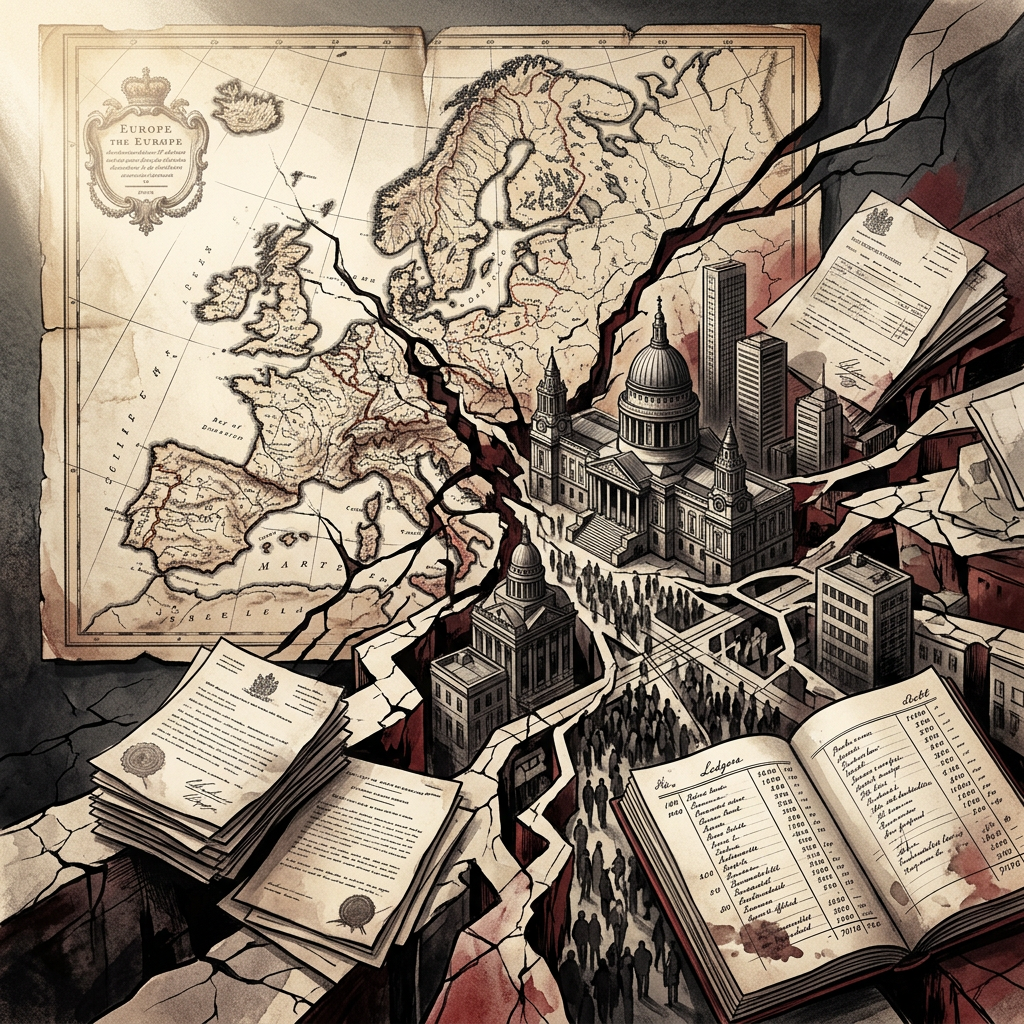
The French Revolution of 1789 was not caused by a single event. It was the product of a convergence of structural conditions: a fiscal crisis, a regressive tax system, extreme inequality, a closed political system, a legal order that privileged the few, and an ideology that justified the whole arrangement.
This paper asks a simple question: are those conditions present today?
The paper does not argue that a revolution is imminent in the United States or Australia. Revolutions are unpredictable. What the paper argues is that the structural features that preceded the French Revolution can be identified in the contemporary West, and that the differences between the two periods are differences of instrument, not of architecture.
2. The Fiscal Crisis
2.1 France, 1789
The immediate trigger of the French Revolution was a fiscal crisis. The French monarchy had accumulated a debt of approximately 3,400 million livres by the end of the American War of Independence, with an annual deficit of about 80 million livres and debt service consuming over half of national revenue in the 1780s.
The debt was not the product of domestic extravagance alone. It was the product of war. France’s participation in the American Revolutionary War cost approximately 1.3 billion livres. The monarchy had financed the war through loans rather than taxation, and the loans had to be serviced.
The fiscal crisis created a political crisis. The King, unable to raise new taxes without consent, was forced to summon the Estates General in May 1789 — the first meeting since 1614.
Status: Established.
2.2 United States, 2026
The United States faces a comparable fiscal structure. The national debt exceeds $36 trillion, with debt service consuming a growing share of federal revenue. The US spent an estimated $2 trillion on post-9/11 wars, financed through borrowing rather than taxation.
The structural parallel is precise. War expenditure, financed by debt, creates fiscal pressure that constrains state capacity and generates political conflict over taxation and spending priorities.
Status: Established.
2.3 Australia, 2026
Australia’s fiscal position is less acute than that of the United States, but the structural features are present. The government has committed to an additional $53 billion over the decade for defence, bringing total defence funding to $887 billion to 2035-36 — the largest peacetime increase in defence spending in Australian history.
The AUKUS submarine programme is officially costed at up to $368 billion over thirty years. These commitments are financed through borrowing, and the debt is serviced from general revenue.
Status: Established.
3. The Regressive Tax System
3.1 France, 1789
The French tax system was regressive. The nobility and clergy were exempt from the taille, the most burdensome direct tax. The nobility numbered approximately 400,000 (less than 2 per cent of the population), and the clergy approximately 130,000. Together, they controlled a disproportionate share of land and wealth while contributing far less to the royal treasury in proportion to their wealth than any other group.
The Church, which owned approximately 10 per cent of the land in the kingdom, was exempt from direct taxation. It collected the tithe — a 10 per cent tax on agricultural production — from the general population.
The Third Estate — everyone else, approximately 96 per cent of the population — bore the burden of taxation.
Status: Established.
3.2 United States, 2026
The contemporary US tax system exhibits structurally similar features. The top 1 per cent of households holds nearly 32 per cent of all wealth, while the bottom 50 per cent holds just 2.5 per cent. The Gini coefficient has reached a 60-year high.
The tax burden is regressive in its overall incidence. While the top 20 per cent pay a larger share of federal income taxes, the working class bears a disproportionate burden through payroll taxes, sales taxes, and tariffs. A 2026 analysis by the Joint Economic Committee found that middle-income workers lose hundreds of dollars annually from the combined effect of tax and tariff policies. A food preparation worker loses about $820, a security guard about $890, and a home health aide nearly $860.
The top 0.1 per cent, meanwhile, receives a net tax break of hundreds of thousands of dollars.
Status: Established.
3.3 Australia, 2026
Australia’s tax system is less regressive than that of the United States, but the structural features are present. The government spends more on property investor tax breaks — negative gearing and the capital gains tax discount — than on social housing, homelessness services, and rent assistance combined. The cost of these tax breaks exceeds $12 billion annually.
The benefits of these tax expenditures “overwhelmingly go to the top 10 per cent of income earners, with the gains concentrated at the top 1 per cent”.
Status: Established.
4. Extreme Concentration of Wealth and Land
4.1 France, 1789
The concentration of wealth and land in pre-revolutionary France was extreme. The nobility and clergy controlled a disproportionate share of the land, while the peasantry — the vast majority of the population — worked small plots or laboured on estates they did not own.
The Church owned between 1 per cent and 40 per cent of the land in different regions of France, and collected tithes from all the people.
Status: Established.
4.2 United States, 2026
Wealth concentration in the United States has reached levels comparable to the Gilded Age. The top 1 per cent holds nearly 32 per cent of all wealth; the top 0.1 per cent’s wealth has more than doubled since 2019, from $13.4 trillion to over $200 million average per household. Three men — Musk, Bezos, and Zuckerberg — own more wealth than the bottom half of all Americans.
A 2026 resolution in the House of Representatives expressed the sense that the United States must act “urgently to end the political and economic dominance of billionaire oligarchs” and “halt the corporate subsidies and tax advantages that fortify their power”.
Status: Established.
4.3 Australia, 2026
Australia’s wealth concentration is less extreme than that of the United States but is rising. The 20 richest Australians now hold more wealth than the bottom three million households. The wealth of Australia’s 200 richest people has tripled in the last 20 years.
A household net wealth of $12 million places a household in the top 1 per cent.
Status: Established.
5. The Closed Political System
5.1 France, 1789
The political system of the Ancien Régime excluded the vast majority of the population from meaningful participation. The Estates General had not met since 1614. Voting was by order, not by head, which meant that the First and Second Estates could always outvote the Third, regardless of the size of its representation.
The cahiers de doléances — the lists of grievances drawn up by each estate — documented the demands of the Third Estate for reform. They expressed “an ardent loyalism to the king and a profound desire for reform: egalitarian demand”.
The King’s attempts to raise taxes without consent triggered the political crisis that led to the Revolution.
Status: Established.
5.2 United States, 2026
The contemporary US political system is characterised by what scholars and legislators have described as oligarchy. A 2026 House resolution stated that “the United States was created to be a democracy… governed not by kings or corporate masters but by themselves as free citizens“, and that this principle is now threatened by the “political and economic dominance of billionaire oligarchs”.
Lobbying expenditure has reached record levels. Commodity trading firms spent $2.75 million on lobbying in the first half of 2026 alone — up from $320,000 in 2024. AI companies spent record sums: OpenAI nearly doubled its federal lobbying expenditure to $2.22 million, while Anthropic nearly tripled its spending to $3.53 million. The defence sector has donated nearly $5 million to members of Congress in 2026.
The system is not formally closed, as the Estates General was. But the influence of concentrated wealth on policy outcomes is documented and extreme.
Status: Established.
5.3 Australia, 2026
Australia’s political system is formally democratic, but corporate influence is documented. The Australian Greens have stated that “Labor and the Liberals do not answer to everyday Victorians, they answer to their corporate donors and the lobbyists and mates that run the companies”. The fossil fuel industry, including Chevron and Australian Energy Producers, has “contributed millions in political donations and ‘other receipts’ to Labor and the Coalition during the last election cycle”.
The “revolving door” between political office and the private sector is documented. “Almost every single resources minister in Australia in the last 10 years has gone on to work for the coal and gas industry”.
Status: Established.
6. The Two-Tier Legal System
6.1 France, 1789
The legal system of the Ancien Régime operated differently for different classes. The nobility and clergy enjoyed extensive legal privileges, including exemption from certain taxes and the right to be tried by their peers.
The lettres de cachet — sealed orders from the King — allowed for the imprisonment or exile of individuals without charge or trial. These were used disproportionately against the common people, though aristocratic families also used them against unruly relatives.
Status: Established.
6.2 United States, 2026
The contemporary US legal system exhibits structural disparities. The wealthy can afford legal representation that the poor cannot. Corporate defendants can negotiate settlements and deferred prosecution agreements, while individuals face the full weight of the criminal justice system.
The Robodebt scheme in Australia — which raised unlawful debts against welfare recipients using income averaging — provides a parallel in the Australian context. The scheme issued 866,857 debt notices and wrote off 470,000 unlawful debts amounting to $1.751 billion.
Status: Established.
6.3 Australia, 2026
The Australian Taxation Office operates a documented two-tier system. Large corporations negotiate settlements: in 2024–25, the ATO settled 18 cases with public and multinational businesses, securing $811 million — an average of 64 per cent of the original claim. The ATO conceded 36 per cent of what it initially asserted was owed.
For small businesses and individuals, the ATO operates an automated enforcement and debt recovery model. The ATO has aggressively reinstated 160,000 small business debts — many under $5,000, some under $100 — that were written off years ago. Interest at 10.78 per cent kicks in after six months.
The law is the same. The application is not.
Status: Established.
7. The Ideology of Legitimation
7.1 France, 1789
The Ancien Régime was justified by an ideology of divine right and natural hierarchy. The King ruled by the will of God. The nobility held their privileges by birth. The Church taught that the social order was ordained by Providence.
This ideology was not merely a set of beliefs. It was a legitimating narrative that made the existing order appear natural, necessary, and sacred.
The cahiers de doléances show that the Third Estate had largely accepted the legitimacy of the monarchy but demanded reform of its abuses. The Revolution began not as a rejection of the King but as a demand for reform that the system could not accommodate.
Status: Established.
7.2 United States and Australia, 2026
The contemporary legitimating ideology is neoliberalism — the doctrine that the market is the optimal allocator of resources, that individual choice is the highest good, and that state intervention is inherently inefficient.
As documented in the accompanying paper The Neoliberal Faith, this doctrine functions as a belief system. It is presented as natural, rational, and beyond political contestation. It naturalises the market, moralises market outcomes, individualises social problems, and sacralises the market as a beneficent force.
The trickle-down effect — the claim that wealth generated at the top of the economy benefits those at the bottom — is the central promise of the doctrine. A 2023 study in The Economic and Labour Relations Review found that “trickle-down effects did not reach many of those highly disadvantaged”, and that “the average proportionate gain for those in the top fifth of the income distribution was almost 50% greater than for those in the bottom fifth”. A parliamentary submission concluded that “the trickle-down economic theory continues to be alleged in support of current government policy but no longer works; there is only a trickle-up effect”.
Status: Established.
8. The Unrest and Its Aftermath
8.1 France, 1789–1799
The French Revolution began with the convocation of the Estates General in May 1789. The Third Estate declared itself the National Assembly on 17 June. The Bastille was stormed on 14 July. Feudalism was abolished on 4 August. The Declaration of the Rights of Man was adopted on 26 August.
What followed was not the peaceful reform that the cahiers had envisaged. It was a decade of upheaval: the Reign of Terror, the execution of the King and Queen, the rise of Napoleon, and the establishment of a new order that both realised and betrayed the revolutionary ideals.
The Revolution did not produce the liberty, equality, and fraternity that its slogans promised. It produced a new elite, a new hierarchy, and a new set of exclusions.
Status: Established.
8.2 The Contemporary Parallel
The question of what unrest might look like in the contemporary West is speculative. The paper does not predict a revolution. It notes that the structural features of the pre-revolutionary period — fiscal crisis, regressive taxation, extreme inequality, a closed political system, a two-tier legal order, and a legitimating ideology — are present.
What those features produce in the contemporary context is not yet known. What is known is that the instruments have changed. The gallows have been replaced by the algorithm. The Estates General by the polling booth. The divine right of kings by the invisible hand of the market.
The structure remains.
Status: Speculation.
9. Conclusion: The Structure and the Instruments
The French Revolution was not caused by a single event. It was the product of a convergence of structural conditions that made the existing order unsustainable. The King’s fiscal crisis was the trigger. The regressive tax system, the concentration of wealth, the closed political system, and the legitimating ideology were the conditions.
This paper has documented the presence of comparable conditions in the contemporary United States and Australia. The fiscal crisis is present, though less acute. The regressive tax system is present. The concentration of wealth is extreme. The political system is documented as oligarchic. The legal system operates differently for different classes. And the legitimating ideology — neoliberalism — functions as a belief system that resists disconfirming evidence.
The paper does not predict a revolution. Revolutions are unpredictable. What the paper argues is that the structural features that preceded the French Revolution can be identified in the contemporary West, and that the differences between the two periods are differences of instrument, not of architecture.
The record is kept. The structure is named. And the question remains open.
Claim – Status – Summary
# – Claim – Status
1 – France’s debt was 3,400 million livres by 1789- Established
2 – Debt service consumed over half of national revenue – Established
3 – Nobility and clergy were exempt from the taille – Established
4 – The Church owned 10% of land and collected tithes – Established
5 – The Third Estate was 96% of the population – Established
6 – Estates General had not met since 1614- Established
7 – Voting was by order, not by head- Established
8 – Lettres de cachet allowed imprisonment without trial – Established
9 – US debt exceeds $36 trillion – Established
10 – US top 1% holds 32% of wealth; bottom 50% holds 2.5% – Established
11 – US lobbying expenditure reached record levels in 2026- Established
12 – Australia’s 20 richest hold more than bottom 3 million – Established
13 – ATO settles multinationals at 64% of claim – Established
14 – ATO reinstated 160,000 small business debts – Established
15 – Australia spends more on property investor tax breaks than social housing- Established
16 – Trickle-down effects did not reach disadvantaged – Established
17 – Neoliberalism functions as a belief system- Inference
18 – Structural conditions of 1789 are present today – Inference
19 – Revolution is imminent – Not predicted
Method notes – The paper examines the structural causes of the French Revolution and compares them with contemporary conditions in the United States and Australia. It does not argue that a revolution is imminent. It argues that certain structural features — fiscal crisis, regressive taxation, extreme wealth concentration, closed political systems, and ideological legitimation — are present in both periods.
References
1. Rowen, H. H. (1960). A History of Early Modern Europe, 1500–1815. Bobbs-Merrill.
2. Cambridge University Press. (2010). The French Revolution and French economic history. In The Fruits of Revolution.
3. Taylor & Francis. (2020). Collapse of the Old Monarchy. In A History of Modern France.
4. Taylor & Francis. (2008). The Victory of the Aristocracy. In A Social History of the French Revolution.
5. American Progress. (2026, September 15). Wealth Inequality Has Grown During the Trump Administration.
6. Fortune. (2026, October 7). The new K-shaped economy splits the rich from the ultra-rich.
7. Xinhua. (2026, February 2). U.S. wealth inequality reaches new highs amid a “K-shaped” economy.
8. Australian Greens. (2026, February 5). Greens legislation would ban dirty donations.
9. Parliament of Victoria. (2026, March 3). Political donations.
10. Public Citizen. (2026, October 13). The Secretive Commodity Traders Profiting from Trump’s Critical Minerals Agenda.
11. Financial Times. (2026, July 27). AI companies spend record sums on Washington lobbying.
12. Military Times. (2026, May 12). Defense contractors have donated millions to members of Congress.
13. Parliament of Australia. (2026, May 7). Australian Greens’ Additional Comments.
14. The Point. (2026, June 11). Time is up on tax breaks that make Australia more unequal every day.
15. Daily Telegraph. (2026, April 16). Exactly how much you need to be rich in 2026.
16. ACOSS. (2026, January 29). Government spends more on property investor tax breaks than social housing.
17. HathiTrust. (n.d.). A History of Early Modern Europe.
18. Archive.org. (n.d.). L’ancien régime.
19. Taylor & Francis. (2020). The Church, The French Revolution and The Napoleonic Era.
20. National Library Board Singapore. (2011). French Revolution.
21. Taylor & Francis. (2016). Parish grievances.
22. Assemblée nationale. (n.d.). Cahiers de doléances.
23. Cambridge University Press. (2019). The Estates General Sitting as a National Assembly.
24. De Gruyter Brill. (n.d.). The Estates General.
25. House of Representatives. (2026). H. RES. 1028.
26. OpenAustralia.org. (2026, May 14). Senate debates.
27. Corrs Chambers Westgarth. (2026, April 7). Commonwealth electoral reforms.
28. Michael Berkman MP. (2026, February 12). Speech on Adani’s $600K donation.
Prepared for the record. The structure is named. The instruments are documented. And the question remains open.

