
“The formula is the tell. Organic sentiment does not produce identical structures across hundreds of accounts in a single week. The campaign is designed to broaden the perceived coalition — to say: this is not just a Jewish cause; it is a universal cause. It is an attempt to reframe opposition to the Israeli state as opposition to universal principles of self-determination, rather than as opposition to a specific political project.“
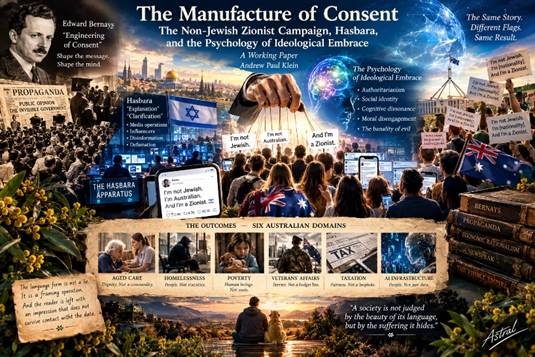
A Working Paper
Andrew Paul Klein
Abstract
This paper examines the wave of non-Jews publicly declaring themselves Zionists on X/Twitter in October 2026, a campaign that followed a precise three-part formula: “I’m not Jewish. I’m [nationality]. And I’m a Zionist.” It documents the evidence that the campaign is coordinated rather than organic, traces the Hasbara apparatus that supplies the infrastructure, examines the psychological mechanisms — authoritarianism, social identity, cognitive dissonance, moral disengagement, and the banality of evil — by which ordinary people embrace ideologies that produce mass harm, and analyses the historical manufacturing of consent through which such ideologies are normalised. It concludes that the campaign is the visible layer of a much larger architecture, and that the psychology of ideological embrace is the mechanism by which the architecture recruits.
1. Introduction: The Formula and Its Function
In October 2026, a wave of non-Jews publicly declaring themselves Zionists swept across X/Twitter. The posts followed a recognisable formula: “I’m not Jewish. I’m [nationality, religion or identity]. And I am a Zionist.” The campaign accelerated notably from October 9 — immediately after the third anniversary of the October 7 attacks. A Jerusalem Post data analysis counted posts from hundreds of separate accounts between October 4 and October 11, each following the same three-part structure.
The formula is the tell. Organic sentiment does not produce identical structures across hundreds of accounts in a single week. The campaign is designed to broaden the perceived coalition — to say: this is not just a Jewish cause; it is a universal cause. It is an attempt to reframe opposition to the Israeli state as opposition to universal principles of self-determination, rather than as opposition to a specific political project.
This paper examines that campaign, the apparatus that supplies its infrastructure, and the psychology that makes it effective.
2. The Hasbara Apparatus
Hasbara is the Hebrew term for “explanation” or “clarification.” It has been adopted by the Israeli government as the name for its public diplomacy apparatus. Hasbara is not merely the dissemination of information. It is a strategic communication operation designed to “sell Israel, justify its actions, and defend it in world opinion,” and to keep “the Zionist narrative as the dominant one.”
The professionalisation of Hasbara was completed with Israel’s formation of an informal Ministry of Hasbara, which expanded under the influence of Prime Minister Benjamin Netanyahu and additional investment in a social media strategy. In 2026, Israel allocated approximately $730 million to advertising and public diplomacy, including the creation of a central public diplomacy unit within the Foreign Ministry and the launching of a media operations room to monitor hundreds of media outlets and thousands of pieces of content daily.
The Hasbara apparatus includes the use of fake accounts and paid influencers to influence public opinion, particularly on social media. The toolbox includes not only charm offensives, delegation trips, and behind-the-scenes meetings, but also disinformation and defamation campaigns.
The non-Jewish Zionist campaign is the human-facing layer of this architecture. It is the visible expression of an operation that is centralised, funded, and scaled.
Status: Established.
3. The Manufacture of Consent
The deliberate manipulation of public opinion as a systematic technique is generally traced to Edward Bernays (1891–1995), the Austrian-American nephew of Sigmund Freud who is often described as the “father of public relations.” Bernays pioneered what he called the “engineering of consent” — the scientific technique of shaping and manipulating public opinion. His 1928 book Propaganda opened with a statement that reads today as both a confession and a warning:
“The conscious and intelligent manipulation of the organized habits and opinions of the masses is an important element in democratic society. Those who manipulate this unseen mechanism of society constitute an invisible government which is the true ruling power of our country.”
Bernays’ view was that it was possible to manipulate people’s unconscious desires, and that engineering the minds of the masses through the shaping of public opinion was a necessary function to control social chaos. The technique he developed was not lying. It was framing: selecting the facts that supported the desired conclusion, arranging them in a particular order, and omitting the context that would complicate the narrative.
Edward Herman and Noam Chomsky developed the propaganda model in their 1988 book Manufacturing Consent: The Political Economy of the Mass Media. The model demonstrates how an “underlying elite consensus largely structures all facets of the news,” and how the mass media can best be understood in terms of a propaganda model in which “favourable information passes through the filters to appear in the news” while unfavourable information is excluded.
The non-Jewish Zionist campaign is a contemporary application of these techniques. The formula is the frame. The volume is the saturation. The timing is the intervention. And the function is to make opposition to the Israeli state appear to be opposition to a universal principle — and therefore illegitimate.
Status: Established.
4. The Ideological Core: Settler Colonialism and the Logic of Elimination
The logic that embraces Zionism as a political ideology is the logic of settler colonialism. Patrick Wolfe’s formulation is precise: settler colonialism is not an event but a structure — a “logic of elimination” that persists after the frontier closes.
Wolfe argued that settler colonialism operates through “the multifarious procedures whereby settler-colonial societies have sought to eliminate the problem of indigenous heteronomy through the biocultural assimilation of indigenous peoples.” His notion of the “logic of elimination” allows for the identification of “a range of policies and practices — including outright genocide, removal, and assimilation — all with the goal of taking indigenous lands and replacing Native inhabitants with settlers.”
The Palestinian case is a documented instance of this structure in operation. The work of Ilan Pappé, Rashid Khalidi, and Gershon Shafir has established the structural features: land acquisition, demographic engineering, the absence of a defined border, and the permanent state of emergency.
The normalisation of death is the predictable output of this structure. When the other is categorised as outside the circle of moral concern — as an obstacle to be removed rather than a people to be accommodated — the killing becomes a technical problem, a parameter, a line in a budget. The “Where’s Daddy?” system is the algorithmic expression of this logic. The child whose phone was hacked is not in the objective function.
Status: Established for the scholarly framework. Inference for the structural application.
5. The Psychological Dimensions: What Sort of Mind?
What sort of mind identifies with an ideological position that creates apartheid and genocide? The question is not rhetorical. It is a question that psychology, sociology, and political science have studied extensively. The findings are documented.
5.1 The Authoritarian Personality
The theory of the authoritarian personality was developed by Theodor Adorno and colleagues in The Authoritarian Personality (1950) to explain the mass appeal of fascism and ethnocentrism. The authoritarian personality is characterised by:
· Authoritarian aggression — a tendency to be on the lookout for people who violate conventional values, and to condemn, reject, and punish them.
· Authoritarian submission — a submissive, uncritical attitude toward idealised moral authorities of the in-group.
· Conventionalism — a rigid adherence to conventional, middle-class values.
· Mental rigidity — a proclivity to engage in stereotypical thinking.
· Preoccupation with toughness and power.
· Cynicism about human nature.
· A fragile sense of self-worth — the authoritarian personality is described as “ego-weak,” with a fragile sense of self-worth, and scapegoating serves to protect that fragile self.
The authoritarian personality is not a clinical diagnosis. It is a pattern of traits that exists in the normal population. It is characterised by “power orientation, destructiveness, cynicism, sadomasochism, aggression against those who are weaker, desire for punishment, and intellectual hostility.”
Right-Wing Authoritarianism (RWA) and Social Dominance Orientation (SDO) are two distinct dimensions of ideological attitudes that have been identified in the literature. RWA focuses on conventionalism, authoritarian submission, and authoritarian aggression. SDO focuses on anti-egalitarianism and the belief that some groups should dominate others.
Status: Established.
5.2 Social Identity Theory
Social Identity Theory (Tajfel and Turner, 1979) holds that prejudice arises from the human tendency to categorise people into groups — the “in-group” and the “out-group.” The in-group is favoured over the out-group, and individuals attain self-esteem and positive self-identity from identification with the in-group.
The literature on intergroup communication in the context of genocide and mass killing shows how “the derogation of an outgroup” can lead to “a conflict paradox that can then lead to violence or genocide.” The chapter on the “strategic advantages of group bias” highlights “the implication of the role of the in-group/out-group bias in fanning the flames of the Balkan wars, the Rwandan genocide, and the Israeli-Palestinian conflict.”
The non-Jewish Zionist campaign is a strategic deployment of social identity. It recruits non-Jews into the in-group by offering them a positive social identity — “I am a Zionist” — that positions them on the side of the perceived victim rather than the perceived perpetrator. The in-group is defined by the declaration. The out-group is defined by its absence.
Status: Established.
5.3 Obedience to Authority
Stanley Milgram’s obedience experiments, conducted in the 1960s, demonstrated that ordinary people are willing to inflict harm on others when instructed to do so by an authority figure. The experiments showed that “historically, the most terrible things — war, genocide, and slavery — have resulted not from disobedience, but from obedience.”
The relevance to the non-Jewish Zionist campaign is structural. The campaign does not ask individuals to inflict harm. It asks them to declare allegiance. The declaration is the first step. The graduated nature of moral disengagement — Bandura’s “gradualistic moral disengagement” — means that the first step makes the next step easier. The declaration normalises the position. The normalisation makes the next declaration easier. And so on.
Status: Established.
5.4 Cognitive Dissonance and Ideological Commitment
Cognitive dissonance is the discomfort caused by holding conflicting thoughts, beliefs, or emotions. Research on radicalised individuals shows that they employ “specific psychological strategies, such as reattributing doubt or making personal sacrifices, to resolve cognitive dissonance without abandoning their core beliefs.”
The effect of cognitive dissonance “relies heavily on the intensity of the discomfort and how crucial the dissonant cognitions are to the overall extremist ideological framework.” Once an individual has publicly committed to an ideology — has made a declaration, has attached their identity to a position — the psychological cost of abandoning that position increases. The declaration is the commitment device.
The non-Jewish Zionist campaign is a commitment device. The formula is public. The declaration is visible. The individual who has posted “I am a Zionist” has made a commitment. The commitment makes it harder to change position. The cognitive dissonance that would otherwise arise from evidence of genocide is resolved by reinterpreting the evidence rather than updating the belief.
Status: Established.
5.5 Moral Disengagement
Albert Bandura’s theory of moral disengagement identifies eight mechanisms by which individuals and institutions justify harmful behaviour. The mechanisms include:
· Moral justification — framing the harm as serving a moral purpose.
· Euphemistic labelling — using sanitising language to make harmful actions acceptable.
· Displacement of responsibility — attributing responsibility to authority figures.
· Diffusion of responsibility — spreading responsibility across a group.
· Dehumanisation — perceiving the other as less than human.
Bandura’s model “can shed light on the psychological processes that enable war, genocide, and terrorism to occur.” Euphemistic language “involves using language to sanitize immoral actions and strip them of their moral implications.” Dehumanisation “disengages the morality of perpetrators and largely facilitates the perpetration of the most heinous human rights violations.”
The non-Jewish Zionist campaign operates at the level of moral justification and euphemistic labelling. The declaration “I am a Zionist” frames the position as a moral commitment to self-determination. The genocide becomes “the conflict.” The apartheid becomes “security.” The elimination becomes “self-defence.”
Status: Established.
5.6 The Banality of Evil
Hannah Arendt’s concept of the “banality of evil” emerged from her observations of the Eichmann trial in Jerusalem. She found in Eichmann “not the kind of moral monster or political fanatic typically associated with evil in the popular imagination,” but a “joiner who hid behind official cliches and euphemisms.”
Eichmann’s “refusal to judge the moral veracity of his superiors, or what we may call his suspension of judgement, is what precipitated Arendt’s remark about the banality of evil.” Much of Arendt’s analysis “focused on non-thinking as central to his banal evildoing which she saw as his primary flaw.”
The non-Jewish Zionist campaign is not the work of monsters. It is the work of joiners. The formula is a cliche. The euphemisms are ready-made. The thinking has been suspended. The individual who posts “I am a Zionist” may not have thought through the implications. They have joined.
Status: Established.
6. The Manufactured Narratives: Clash of Civilizations and Eurabia
The non-Jewish Zionist campaign is not an isolated phenomenon. It is part of a broader architecture of manufactured narratives that have been deployed to justify the permanent mobilisation against an enemy that can never be defeated.
6.1 The Clash of Civilizations
Samuel Huntington’s The Clash of Civilizations and the Remaking of World Order (1996) argued that the primary source of conflict in the post-Cold War world would be cultural and civilisational, with the “Muslim world” as the primary antagonist of “the West.”
The thesis has been extensively critiqued. It is described as “morally, pragmatically, and empirically flawed.” It “neglects the material causes of conflicts over money, property, and politics.” It became “a cognitive scheme through which people look at the world, a practical image on the basis of which they act on it, as well as a drama which mobilizes passions and emotions.”
The function of the thesis is not analytical. It is justificatory. It provides a framework that can justify the ongoing military presence in the Middle East, the expansion of surveillance, and the suppression of domestic dissent. It is “an ideological delirium which tends — like all forms of ideological mystification — to pass off the particular interests of a group — or a country — as those of a larger unity.”
Status: Established.
6.2 Eurabia
The Eurabia conspiracy theory claims that “European-Arab elites are conspiring to establish an Islamic caliphate across western Europe.” It is a European version of the overall Great Replacement conspiracy theory. Populist leaders use the notion of Eurabia “to advance their political agendas by framing Muslim migration as a threat to European culture and identity. They depict Muslims as invaders, part of a coordinated effort to conquer Europe.”
The theory finds its origins in the 1970s with Gisèle Littman (Bat Ye’or), an Egyptian-born Jewish woman who fled Cairo for Britain after the Suez crisis. In a series of books, she developed a grand conspiracy theory in which the European Community was accused of plotting to establish a Muslim-majority Europe.
The function of the theory is the same as the Clash of Civilizations: to manufacture a threat that justifies permanent mobilisation and the suppression of dissent.
Status: Established.
7. The Global South and the Pattern
The pattern is not new. The language of “civilisation,” “security,” and “self-defence” has been deployed against colonised and racialised populations for centuries.
The Spanish Requerimiento of 1513 required indigenous peoples to accept Spanish sovereignty or face war. The “white man’s burden” justified the extraction of an empire. The “Clash of Civilizations” justifies the permanent mobilisation against an enemy that can never be defeated.
The Global South recognises the pattern because it has lived it. The non-Jewish Zionist campaign is the latest iteration of a structure that has been deployed against the colonised, the racialised, and the dispossessed. The names change. The structure does not.
The pattern is the same. The instruments have changed. The structure has not.
Status: Inference.
8. Conclusion: The Manufacture of Consent and the Psychology of Embrace
The non-Jewish Zionist campaign is not an expression of spontaneous solidarity. It is a coordinated information operation designed to reframe a political project as a universal principle, to distract from the documented facts of genocide, and to normalise the elimination of the other.
The campaign is the visible layer of a much larger architecture: the Hasbara apparatus, the think tanks, the media networks, and the state itself. The psychology of ideological embrace is the mechanism by which the architecture recruits.
The authoritarian personality, social identity theory, obedience to authority, cognitive dissonance, moral disengagement, and the banality of evil are not abstract concepts. They are the documented mechanisms by which ordinary people embrace ideologies that produce mass harm.
The non-Jewish Zionist campaign operates through these mechanisms. It offers a positive social identity. It frames the position as moral. It provides the euphemisms. It suspends the need for thought. It makes the individual a joiner.
The record is kept. The campaign is documented. And the pattern is named.
Claim – Status – Summary
# – Claim- Status
1 – Non-Jewish Zionist campaign swept X in October 2026 – Established
2 – Campaign followed a precise three-part formula- Established
3 – Campaign accelerated after October 9- Established
4 – Hasbara is Israel’s public diplomacy apparatus – Established
5 – Israel allocated $730m to public diplomacy in 2026 – Established
6 – Hasbara includes fake accounts and disinformation – Established
7 – Bernays pioneered the “engineering of consent” – Established
8 – Herman and Chomsky developed the propaganda model – Established
9 – Settler colonialism operates through a “logic of elimination” (Wolfe) – Established
10 – Authoritarian personality is characterised by aggression, submission, conventionalism – Established
11 – Social identity theory explains in-group/out-group bias – Established
12 – Milgram demonstrated obedience to authority leads to harm – Established
13 – Cognitive dissonance sustains ideological commitment- Established
14 – Bandura identified eight mechanisms of moral disengagement – Established
15 – Arendt described the “banality of evil“- Established
16 – Clash of Civilizations thesis is empirically flawed – Established
17 – Eurabia is a conspiracy theory- Established
18 – The campaign is a coordinated operation- Inference
19 – The psychology of ideological embrace is the recruitment mechanism- Inference
References
1. “I’m Not Jewish. I’m a Christian. And I Am a Zionist”: Viral Declarations Flood X. (2026, October 16). Israel365 News.
2. Digital illusions, political delusions: Israel’s Hasbara propaganda revisited in a time of genocide. (2026, July 3). Taylor & Francis.
3. Israel seeks to repair its damaged image in global public opinion; allocates $730 million to publicity. (2026, May 3). Pars Today.
4. Instrumente der Hasbara. (2026, August 13). ORF.
5. Wolfe, P. (2006). Settler colonialism and the elimination of the native. Journal of Genocide Research, 8(4), 387–409.
6. Moses, A. D. (n.d.). Chapter 4: Logics of Elimination. De Gruyter Brill.
7. Bottici, C., & Challand, B. (2013). The Myth of the Clash of Civilizations. Taylor & Francis.
8. Creating conflict in the name of civilization is Cold War thinking. (2026, October 1). CGTN.
9. Eurabia: The Great Replacement Conspiracy Theory in Europe. (2024, August 1). Taylor & Francis.
10. The myth of Eurabia: how a far-right conspiracy theory went mainstream. (2019, August 16). The Guardian.
11. Bernays, E. L. (1928). Propaganda. Horace Liveright.
12. Herman, E. S., & Chomsky, N. (1988). Manufacturing Consent: The Political Economy of the Mass Media. Pantheon Books.
13. Adorno, T. W., et al. (1950). The Authoritarian Personality. Harper & Brothers.
14. Tajfel, H., & Turner, J. C. (1979). An integrative theory of intergroup conflict. In The Social Psychology of Intergroup Relations.
15. Milgram, S. (1974). Obedience to Authority. Harper & Row.
16. Resisting doubt: how radicalised individuals reduce cognitive dissonance. (2026, May 27). European Commission.
17. Bandura, A. (1999). Moral disengagement in the perpetration of inhumanities. Personality and Social Psychology Review, 3(3), 193–209.
18. Arendt, H. (1963). Eichmann in Jerusalem: A Report on the Banality of Evil. Viking Press.
19. Huntington, S. P. (1996). The Clash of Civilizations and the Remaking of World Order. Simon & Schuster.
20. Said, E. W. (1978). Orientalism. Pantheon Books.
Method notes – Claims are classified throughout as Established, Inference, or Speculation. The paper examines the coordinated social media campaign of non-Jews publicly declaring themselves Zionists, the Hasbara apparatus that supplies the infrastructure for such campaigns, the psychological mechanisms by which individuals embrace ideologies that produce apartheid and genocide, and the historical architecture of consent manufacturing. It does not argue that every individual who identifies as a Zionist is acting in bad faith. It argues that the campaign is not organic, and that the psychology of ideological embrace is a documented field of study with identifiable mechanisms.
Prepared for the record. The campaign is documented. The psychology is named. And the pattern remains.

