
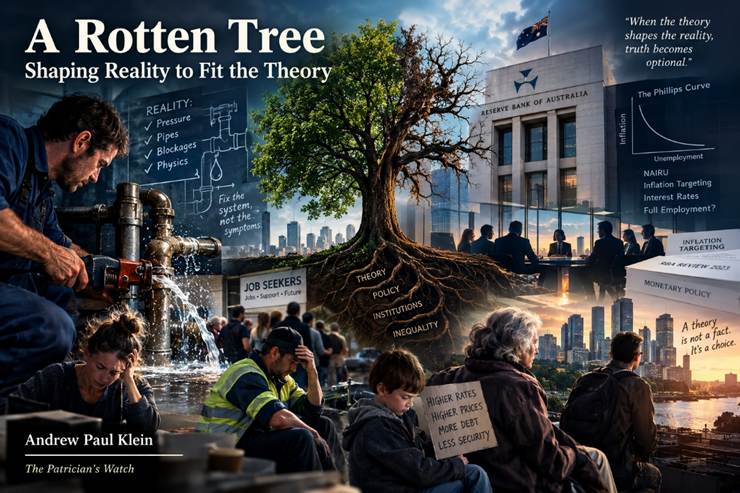
“The Reserve Bank of Australia is not a plumber. It is an institution entrusted with the economic prosperity and welfare of the Australian people, and it conducts its work through a theoretical framework that has, over three decades, been used less to describe the economy than to discipline it into conformity with a model. That framework — the Phillips Curve and its operational child, the Non-Accelerating Inflation Rate of Unemployment — is not a law of nature. It is a contested theoretical construct. And the costs of that construct are borne, with remarkable consistency, by the people who labour for their incomes.”
Andrew Paul Klein
The Patrician’s Watch
A plumber does not begin with a theory of water. He begins with the pipe, the pressure, the blockage, and the laws of physics that do not negotiate. If he arrived with a framework that insisted water should flow uphill, and spent his days adjusting the house to conform to the framework rather than the framework to the house, he would be dismissed within a week. The tap would still drip. The ceiling would still stain. And no client would accept the explanation that the theory was sound and the reality was at fault.
The Reserve Bank of Australia is not a plumber. It is an institution entrusted with the economic prosperity and welfare of the Australian people, and it conducts its work through a theoretical framework that has, over three decades, been used less to describe the economy than to discipline it into conformity with a model. That framework — the Phillips Curve and its operational child, the Non-Accelerating Inflation Rate of Unemployment — is not a law of nature. It is a contested theoretical construct. And the costs of that construct are borne, with remarkable consistency, by the people who labour for their incomes.
The Charter and the Operational Reality
The Reserve Bank Act 1959 is clear. The Bank is to conduct policy in a way that best contributes to “the stability of the currency of Australia,” “the maintenance of full employment in Australia,” and “the economic prosperity and welfare of the people of Australia”. The 2023 RBA Review reaffirmed these objectives, legislating a dual mandate of price stability and “contributing to full employment”.
But the operational definition of “full employment” has been captured by a concept that is unobservable and contested. The NAIRU is the rate of unemployment below which inflation is supposed to accelerate. It is not a measured fact. It is an estimate, derived from a model, and the model is built on assumptions — about how labour markets clear, about how wages and prices interact — that are themselves the subject of deep dispute. The RBA’s own research acknowledges that the NAIRU “is not observable and has to be estimated”. Its estimates have clustered in the 4–5 per cent range, and the Bank has used a benchmark of 4.5 per cent. If that estimate is too high — and critics argue it is — then the Bank is deliberately keeping hundreds of thousands of people out of work in order to suppress wage growth, and calling the result “full employment”.
This is the first way in which the theory shapes the reality. The NAIRU is not discovered in the data. It is imposed on the data, and then the economy is managed to produce the unemployment rate that the model says is necessary.
The Empirical Fragility of the Phillips Curve
The scientific credibility of the Phillips Curve is, at best, contested. The relationship between inflation and unemployment is not a stable law. A 2025 paper found evidence of a weakening of the slope starting around 1980, with the curve only re-emerging during the pandemic. A 2025 study across 41 countries concluded the relationship is “fragile and varies across countries and time periods,” completely collapsing during recessions. A Minneapolis Fed paper noted that estimates using national data are “highly unstable”.
The modern justification for the RBA’s framework rests on the Friedman-Phelps “natural rate” hypothesis, which argues there is no long-run trade-off. But this was a theoretical assertion that displaced an empirical regularity. Critics argue the underlying assumption — that the labour market continuously clears — is flawed, and that the positive correlation between inflation and unemployment in the 1970s was due to supply shocks, not a failure of Keynesian demand management.
The NAIRU itself has been described as a “myth”. Post-Keynesian economists argue there is no “natural rate” and that unemployment is involuntary, resulting from a lack of effective demand. Crucially, the RBA’s own estimates of the NAIRU wander around and tend to follow the lagged unemployment rate, which contradicts the theory that it should be an independent, stable anchor. The theory is not describing an external reality. It is tracking the reality that the Bank’s own policies have helped to create.
From Keynesian Planning to Neoliberal Discipline
The RBA’s current approach represents a profound break from its own history.
The Bank was founded on a Keynesian commitment. Its longest-serving Governor, H.C. “Nugget” Coombs, was an architect of the 1945 White Paper on Full Employment, which made full employment the first objective of Australian economic policy. Coombs and his colleagues used monetary and fiscal policy to maintain aggregate demand and to achieve that objective. The experience of the Great Depression — when one in five workers was unemployed — informed the entire framework.
The neoliberal turn of the 1980s and 1990s was a decisive rupture. The breakdown of the post-war consensus led to the adoption of “New Right” supply-side economics. The RBA formally adopted inflation targeting in 1993, and with it the NAIRU framework. This was a shift from managing demand to create jobs, to using interest rates to control inflation, with unemployment as the instrument rather than the objective. As the historical analysis puts it, the inflation-targeting era was not merely a change of target. It was a change in the order of policy responsibility, in which inflation became a problem of monetary policy alone — “a problem calling for the management of demand and not of income distribution”.
Former RBA Governor Bernie Fraser — who presided over the introduction of inflation targeting — has since said that the Bank’s performance has been “undermined by governments pursuing neoliberal policies”. The framework itself, he argues, has served the country well. But the distributional settings around it — housing policy, the tax system, labour law — have made inequality worse, and have undermined the Bank’s ability to improve the welfare of all Australians. The critique is not that the RBA is neoliberal in its charter. It is that the framework it operates has been captured by a neoliberal order that determines what the framework is allowed to see.
Who Wins and Who Loses
The distributional consequences are not incidental. They are the operational logic of the framework.
The RBA’s primary instrument is the cash rate. Raising rates reduces aggregate demand by making borrowing more expensive. The intended effect is to slow the economy, cool the labour market, and bring inflation down. The Bank’s own logic acknowledges that this will require “higher interest rates and unemployment“. This is not an unfortunate side-effect. It is the mechanism.
The burden falls on those who labour for their incomes. The Australian Council of Trade Unions describes rate rises as punishing “working people” who “did not cause global fuel price shocks, yet they are the ones being asked to carry the cost“. The Australia Institute estimates that the big four banks make $229,000 in profit on the average 30-year home loan, with working people paying while the banks make huge profits. The big four banks made over $30 billion in net profit in the last financial year. Commonwealth Bank alone posted a record $10.98 billion profit, even as mortgage applications fell 15 per cent, arrears rose, and the bank arranged 147,000 payment plans for struggling customers.
The winners are the asset holders. The RBA’s own research acknowledges that “net savers, including self-funded retirees, received significant indirect benefits through stronger economic conditions and higher asset prices”. Rising rates increase the income of those who hold deposits and superannuation. The policy is, in effect, a wealth transfer from the young and indebted to the old and asset-rich.
This is the rotten fruit of the tree. The tree is not the economy. The tree is the theoretical framework that tells the Bank what the economy is, what it should be, and who must bear the cost of getting there.
The Plumber’s Revenge
A plumber operating on a theory that ignored water pressure, gravity, and the material reality of pipes would be dismissed. The RBA operates on a theory that ignores the distributional reality of the economy — the power of corporations to set prices, the role of profits in driving inflation, the lived experience of mortgage stress and involuntary unemployment — and it is not dismissed. It is insulated. The 2023 reforms removed the Treasurer’s power to overrule the Bank’s monetary policy decisions, enhancing its autonomy from democratic accountability.
But the plumber’s analogy holds in a deeper sense. A plumber who ignored the actual flow of water would eventually be confronted by a flood. The RBA’s framework, by contrast, has been used to produce the conditions it predicts. It has kept unemployment higher than necessary, suppressed wage growth, and protected the value of assets, and then pointed to the resulting economy as evidence that the theory was right. The theory did not describe the world. It constructed it.
The question is not whether the RBA is staffed by bad people. It is whether an institution entrusted with the welfare of the people can continue to operate on a framework that treats the unemployed as a tool, that treats wages as a cost to be suppressed, and that treats the distribution of income as something that falls outside the frame. The plumber would have been dismissed. The Bank has been insulated. And the tap is still dripping.

