
Andrew Klein
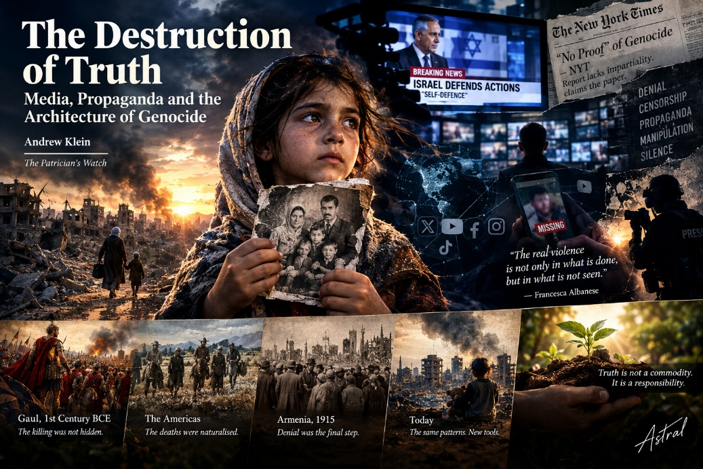
In July 2026, the United Nations Special Rapporteur on the situation of human rights in the Palestinian territories, Francesca Albanese, transmitted a report to the General Assembly. Its title was Truth under the Rubble: Media in the Time of Genocide. Its central finding was that the destruction of truth has become integral to the destruction of a people.
The report identified three interconnected patterns. The first was the elimination of Palestinian media workers — through killing, maiming, arbitrary detention, torture, intimidation, and the systematic labelling of them as “terrorists” — in order to suppress the documentation of crimes. The second was the construction of an information regime inside Israel through media restrictions, censorship, propaganda, hate speech, genocidal incitement, and denial. The third was the role of influential international media and digital platforms in marginalizing Palestinian voices, reproducing Israeli narratives, and normalizing legal distortions — practices that, in the report’s words, “ultimately legitimized atrocities”.
The report’s conclusion is stark: these practices “have not merely accompanied genocide but have facilitated its commission and obstructed accountability”. Albanese gave the phenomenon a name: mediacide.
The report was immediately contested. The New York Times, which the report criticised for advising editorial caution on the word “genocide” and for providing what Albanese called “humanitarian camouflage” to Israel through its coverage of “safe zones,” rejected the findings as “not impartial” and said the report offered “no proof” for its claims about external influence on editorial guidance. The exchange is instructive, because it demonstrates the very mechanism the report describes: the demand that the destruction of a people be proven to the satisfaction of the institutions that have already decided what counts as proof.
This essay examines that mechanism. It asks how previous genocides were marketed and made unremarkable; why the Genocide Convention has failed to prevent their recurrence; how contemporary media, propaganda, and the architecture of information control render some deaths visible and others invisible; and why the Palestinian people, in particular, are required to prove a suffering that is documented daily.
The argument is not that the media is solely responsible for genocide. It is that the media is one of the instruments through which genocide is made legible — or made unremarkable — and that this instrument has a history.
The Long History of Making Genocide Unremarkable
Genocide is not a modern invention. What is modern is the attempt to define it, prohibit it, and — crucially — to deny it while it is happening.
Julius Caesar’s conquest of Gaul in the first century BCE is one of the earliest documented cases of mass violence that modern scholars have analysed through the lens of genocide. Plutarch recorded that a million people were killed and a million enslaved. Caesar himself described occasions when Roman legionaries slaughtered non-combatants, and he stated what can be regarded as a genocidal intent: that “the stock and name of the tribe” of the Eburones might be destroyed. The killing was not hidden. It was celebrated as a demonstration of Roman virtue, and the enslaved and the dead were absorbed into the economy of empire. The violence was unremarkable because it was consistent with the prevailing moral order.
The colonisation of the Americas produced a genocide of a different scale and a different structure. The deaths were not primarily the result of a single campaign but of a process — disease, dispossession, forced removal, and deliberate massacre — that unfolded over centuries. And the process was rendered unremarkable by a racial hierarchy that had already determined which lives counted. As one historian of the California Indians put it, settler violence against Indigenous people was “unremarkable because it made sense in the context of U.S. settler and imperial conquest”. The deaths were not denied. They were naturalised — presented as the inevitable consequence of the inferiority of the people who died.
The Armenian Genocide of 1915 produced a third pattern: denial as the final step. Scholars of genocide have recognised that the last stage is not the killing but the cover-up. The Turkish state constructed an official narrative that the deaths were a consequence of war and deportation rather than a deliberate policy of extermination, and it promoted that narrative through diplomatic pressure, academic funding, and the discrediting of survivor testimony as “war propaganda”.
But the Armenian case also reveals something more subtle: the hierarchy of victims. The British historian Arnold Toynbee, writing in 1915 to mobilise support for the Armenian cause, assured his readers that Armenians were worthy of salvation because they were “not savages like the Red Indians” and “not nomadic shepherds like their barbarous neighbours the Kurds.” They were “townspeople,” “doctors and lawyers and teachers,” “in the closest personal touch with Western civilization”. Toynbee’s contrast was not a rhetorical flourish. It was a precis of the criteria by which different peoples are made eligible to have their extermination understood as genocide. The Armenians were grievable because they were civilised. The Native Americans and the Kurds were not, because they were savage, nomadic, or simply disappeared as a consequence of their own inferiority.
The hierarchy was not incidental to the genocide. It was the condition that made the genocide thinkable — and the condition that made its recognition selective.
The Genocide Convention: A Promise That Could Not Be Kept
The Holocaust produced a rupture in the moral order. The scale and industrial organisation of the killing, the testimony of survivors, and the photographic record made denial impossible in the way it had been possible for earlier atrocities. The United Nations adopted the Convention on the Prevention and Punishment of the Crime of Genocide in 1948, and Raphael Lemkin, who had coined the term, believed it would be a decisive break with the past.
It was not.
The Convention’s failures are structural, and they were built in from the beginning. The text affirms that genocide is a crime under international law, but it “lacks robust articulated mechanisms for preventing genocide, or for suppressing it when prevention fails”. Article VIII, which was supposed to allow the United Nations to take action, offers only “vague suggestions”. The Convention did not establish an international criminal court; it merely envisioned one. No such court existed until 1993, with the creation of the International Criminal Tribunal for the former Yugoslavia, and the first conviction for genocide did not occur until 1996.
The enforcement gap was compounded by the politics of the Security Council. When genocides have been underway, “the UN has almost always been powerless to act”. In Rwanda, the Security Council voted to withdraw 2,000 of the 2,500 peacekeeping troops at the beginning of a genocide that killed 800,000 people. The veto power of the permanent five members — Russia, the United States, the United Kingdom, China, and France — has been used repeatedly to block action.
But the most consequential failure is legal. In the Bosnia v. Serbia and Croatia v. Serbia cases, the International Court of Justice interpreted the Convention’s intent requirement so narrowly that the Convention may never again apply to a state’s commission of genocide. The Court held that genocide must be the only intent of a state for the ICJ to find a violation. If the state had any other intent — such as ethnic cleansing — the crime of genocide could not be proven. The legal scholar William Schabas has described this as one of the Convention’s historic defects. The practical consequence is that a state can kill a people while also pursuing territorial or political objectives, and the killing will not meet the legal definition of genocide, because the intent was not pure.
The Convention was a promise. It was a promise that the world would never again allow the destruction of a people to go unpunished. The promise was not kept — not because the Convention was ignored, but because it was constructed in a way that made it difficult to enforce, and then interpreted in a way that made it almost impossible.
The Contemporary Apparatus: Mediacide, Hasbara, and the Exhaustion of Truth
The Albanese report describes a system in which the destruction of truth is not a side-effect of genocide but a component of it. The system has three parts.
The first is the elimination of witnesses. More than 200 Palestinian journalists have been killed in Gaza since October 2023. The Committee to Protect Journalists has documented that this is the deadliest conflict for journalists ever recorded. The Israeli soldier quoted in the report — “Whoever writes an article or works on a laptop is like someone carrying a Kalashnikov and attacking us” — captures the logic: the journalist is not a neutral observer but a combatant, because the documentation of the crime is itself a threat to the perpetrator.
The second is the architecture of information control inside Israel. The report describes censorship, access restrictions, coordinated media and advertising, and the systematic promotion of narratives that frame the killing as self-defence. This is not merely propaganda in the ordinary sense. It is the construction of a regime of truth in which the facts that would constitute genocide are rendered invisible, ambiguous, or contested.
The third is the role of international media. The report examined twelve influential outlets and found that the majority reproduced Israeli narratives, marginalized Palestinian voices, and normalized legal distortions. The mechanisms are familiar to media scholars. One is the “both sides” frame, which presents a conflict between a state and an occupied population as a dispute between two equal parties, and which requires that every documented atrocity be balanced by a claim from the perpetrator. Another is the “humanitarian camouflage” — the use of terms like “safe zone” without the qualifier “so-called,” which lends legitimacy to a designation that has no basis in fact. A third is the demand for proof — the insistence that the victims demonstrate their suffering to a standard that is never applied to the claims of the perpetrator.
The Israeli government’s response to these practices has been described as hasbara — a Hebrew word meaning “explanation,” but which in practice functions as a strategy of erasure. The method is not to persuade but to exhaust. As one analysis puts it: “Don’t just contest the facts. Contest the eyes that see them”. Every image of a starving child is met with a claim that the child has a pre-existing condition. Every report of a massacre is met with a claim that the victims were human shields. Every journalist is described as a terrorist. The goal is not to win the argument but to make the argument unwinnable — to create enough doubt that editors pull back, audiences disengage, and the machinery of accountability grinds to a halt.
The result is what the report calls mediacide: the destruction of the conditions under which truth can be established. And mediacide is not a metaphor. It is the practical elimination of the possibility of witnessing.
The Hierarchy of Death: Whose Lives Are Grievable?
The media does not treat all deaths equally. This is not a conspiracy; it is a structure, and it has a name.
Journalists and social scientists speak of a “hierarchy of death” — the disproportionate coverage that different deaths receive. The rule, as formulated by Roy Greenslade, is that “foreign deaths always rank below domestic deaths”. In France, it is called the loi de proximité — the proximity law — or mort kilomètres, death by distance. The assumption is that empathy is correlated with proximity: we grieve those who are close to us, and we are indifferent to those who are far away.
But the hierarchy is not only geographical. It is also racial and political. Judith Butler’s work on grievability asks the question that the hierarchy of death answers: “Who counts as human? Whose lives count as lives? And, finally, what makes for a grievable life?”. Butler argues that certain populations are framed as lives that cannot be mourned — as ungrievable — and that this framing is not a failure of empathy but a political achievement. The differential allocation of grievability decides which lives are mourned and which are rendered expendable.
The Palestinian people are the clearest contemporary example of a population rendered ungrievable in the dominant Western media frame. Their deaths are reported as “clashes,” “cycles of violence,” or “tragedies,” rather than as the consequence of a deliberate policy. Their suffering is presented as a “humanitarian crisis” rather than as a crime. And when the images become too visceral to ignore — the skeletal children, the parents digging through rubble with their bare hands — the response is not to recognize the crime but to contest the evidence. The child is not starving; he has a medical condition. The hospital was not bombed; it was a Hamas command centre. The journalists were not killed; they were terrorists.
This is how the hierarchy is maintained. The deaths of some people are self-evident. The deaths of others must be proven — and the standard of proof is designed to be unmeetable.
Why Palestinians Must Prove Their Suffering
The question of why Palestinians must prove their suffering has a simple answer: because the apparatus that would otherwise register it has been destroyed.
The Albanese report documents the destruction of the witnesses — the journalists, the media workers, the documentarians. It documents the construction of an information regime that controls what can be said inside Israel. It documents the role of international media in reproducing the perpetrator’s narrative. The result is a vacuum of evidence that is not accidental. It is produced.
Into that vacuum flows the demand for proof. The Israeli government and its supporters ask: where is the evidence of genocide? Where is the intent? Where is the command decision? The questions are not asked in good faith. They are asked because the evidence has been systematically destroyed, and because the institutions that would normally adjudicate the evidence — the International Criminal Court, the International Court of Justice, the UN Security Council — are constrained by the legal and political limitations described in Section III.
The demand for proof is also a demand for deference. It asks the victims to accept the standards of the perpetrator, the framing of the perpetrator, and the timetable of the perpetrator. It asks them to wait for a legal determination that may never come, while the killing continues. And it treats the absence of a formal legal finding as evidence that the crime did not occur — as though the law were the only register of truth, and as though the law had not been constructed to make this particular crime difficult to prove.
The Palestinians are not required to prove their suffering because their suffering is doubtful. They are required to prove it because the conditions under which proof is possible have been dismantled.
The Media and the Normalization of Genocide
The media is not a neutral observer of genocide. It is one of the instruments through which genocide is made legible or illegible, remarkable or unremarkable, grievable or ungrievable.
This is not a new insight. The historians of the Armenian Genocide documented how denial was constructed through the discrediting of survivor testimony. The historians of the colonial Americas documented how the destruction of Indigenous peoples was rendered unremarkable by a racial hierarchy that had already decided which lives counted. The historians of the Holocaust documented how the Nazi regime used euphemism, censorship, and the control of information to conceal the Final Solution.
What is new is the scale and speed of the contemporary apparatus. The internet has made it possible to document genocide in real time, but it has also made it possible to flood the zone with disinformation, to exhaust the audience, and to create a permanent state of epistemic uncertainty. The result is a paradox: we have more evidence of genocide than at any point in human history, and less capacity to act on it.
The responsibility of the media is therefore not a secondary question. It is central. A media that reproduces the perpetrator’s narrative, that demands proof from the victims while accepting the claims of the perpetrator, and that treats the destruction of a people as a “tragedy” rather than a crime, is not a neutral observer. It is an enabler. It is the instrument through which the unremarkable is made possible.
The question this essay leaves is not whether the media is complicit in genocide. The evidence suggests that it is. The question is what would be required for the media to become something else — a witness rather than a transmitter, a register of grief rather than a manager of doubt.
The answer is not technical. It is moral. It requires a decision to treat all lives as grievable, to demand proof from the powerful rather than the powerless, and to refuse the framing that makes the destruction of a people appear as an unfortunate but unavoidable feature of the world.
That decision has not yet been made. And until it is, the rubble will continue to bury the truth.

