Andrew Klein
Featuring: The Democracy Mouse (Chief Investigator, Fart Meter Division, Sovereign Wealth Modifier), Little Bai Loong (Lantern Keeper, Second Class, Custodian of the Cheese), and Andrew (The Human, Provisional Assistant, Holder of the Ladder, Sceptic in Residence)
Recorded live from the lobby of the Future Fund, which is very clean and has no visible holes
PART ONE: THE ESSAY
I. The Mandate
The Future Fund was established in 2006 to solve a specific problem: the Commonwealth had unfunded superannuation liabilities and no money set aside to meet them. The Howard government, flush with surplus and the proceeds of the final Telstra sale, created a sovereign wealth fund to provision for the retirement of public servants it had already promised to pay.
The purpose was narrow. The obligation was clear. The Fund was to maximise returns over the long term, with a target of CPI plus 4 to 5 per cent, and it was to do so independently of the government of the day.
That independence was the design. The Board of Guardians makes investment decisions. The Ministers appoint the Board and issue the Investment Mandate. The Ministers cannot direct the Board to invest in a particular asset, business, or activity. This is the structure of a sovereign wealth fund that is insulated from political interference. It is also the structure of an institution that is insulated from political accountability for what it chooses to own.
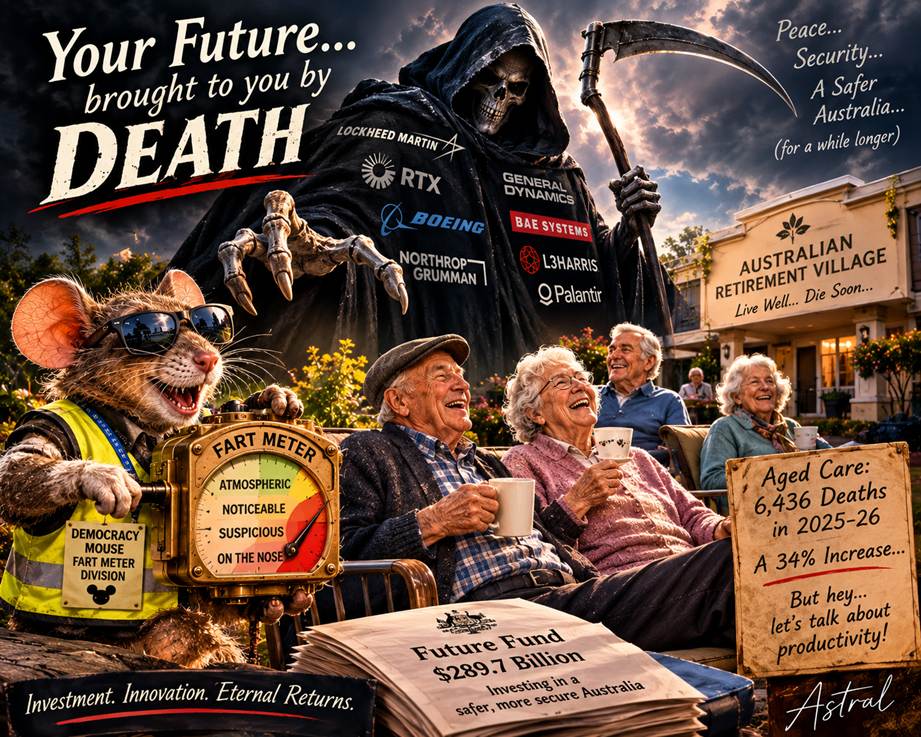
As of 30 June 2026, the Future Fund manages $289.7 billion, having returned 14.8 per cent in 2025–26 and added $37.4 billion. It now oversees $356 billion across seven public asset funds, including the DisabilityCare Australia Fund and the Housing Australia Future Fund. By any measure, it is doing what it was legislated to do: it is making money.
The question the Mouse has come to ask is not whether the Fund is making money. It is what the Fund is making money from, and whether the mandate that requires it to maximise returns has any room in it for the question of what those returns are worth.
II. The Holdings
The Future Fund’s Responsible Investment Policy excludes companies involved in controversial weapons banned by treaties Australia has ratified: cluster munitions, anti-personnel mines, selected nuclear weapons, chemical and biological weapons, and primary tobacco production. That is the entirety of the exclusion framework relevant to weapons.
Conventional defence companies are not excluded. The Fund holds Lockheed Martin, RTX, Northrop Grumman, General Dynamics, L3Harris, Boeing, Huntington Ingalls, Textron, BAE Systems, and Elbit Systems. The specific values disclosed in the FOI document—Lockheed at $71.35 million, RTX at $72.42 million, Northrop at $43.40 million—are consistent with the Fund’s index-based listed equities strategy.
The Fund also holds Palantir. As of 31 December 2025, it held 737,780 shares valued at around $196.6 million. The Fund’s stake in Palantir grew from $1.6 million in February 2023 to $103.6 million by June 2025, and has continued to grow . When Greens Senator Barbara Pocock asked in Senate Estimates whether Palantir’s human rights record had been considered before the investment was made, the answer was no. And the Fund would not be divesting.
The Fund’s position is that it invests through external managers, often in index-tracking funds, and that individual stock selection is a matter for those managers. The Board sets the investment universe and the exclusion list. Palantir is not on the exclusion list. Elbit Systems was on the exclusion list from 2018 to 2023, then removed after data providers confirmed it was no longer involved in cluster munitions production. The Fund’s exposure to Elbit has since increased, which the Fund attributes to share price movements and index weighting rather than active purchase.
When Senator Pocock questioned the Fund in late May 2026 about its defence exclusions framework, the Fund confirmed it had not reviewed the framework recently and remained “comfortable and confident” with the investments.
III. The Exclusion That Never Happens
The Responsible Investment Policy contains a sentence that repays close reading.
“Where serious breaches of environmental, social, and governance, including climate change, related standards are identified, the Board’s preference is to engage rather than exclude. Engagement provides the opportunity to work either directly or through investment managers to support and encourage improved performance. However, the Board retains the option to exclude investments in cases of particularly severe or sustained misconduct, especially where the investee company is unwilling or unable to change its practices”.
The Mouse has three questions about this sentence.
First, what does “particularly severe or sustained misconduct” actually mean? The policy does not define it. There are no thresholds. There are no examples. There is no list of conduct that would trigger exclusion. The phrase is a discretion, and a discretion without a standard is not a standard at all. It is a form of words that allows the Fund to say it has an exclusion framework while retaining the option never to use it.
Second, has the Fund ever excluded a company on these grounds? The Mouse has searched the record. The Fund’s exclusions are treaty-based and tobacco-based. The tobacco exclusion came after a campaign led by the Greens, not after a determination that tobacco constituted “particularly severe or sustained misconduct” under the ESG policy. The Fund has not, on the public record, excluded any company for misconduct that was not already captured by a treaty Australia had ratified. The “particularly severe or sustained misconduct” clause appears to be a dormant provision. It exists in the policy. It has not, so far as the Mouse can find, been used.
Third, if it has never been used, why has the Fund not sought clearer guidelines? The Fund is independent. It could develop its own standards. It could publish the criteria by which it would determine that a company had crossed the threshold. It has not done so. The Mouse does not say this is sinister. He says it is convenient. A standard that is never specified is a standard that can never be failed.
The Mouse notes, in passing, that the New Zealand High Court recently ruled that the Guardians of New Zealand Superannuation’s investment policies did not comply with the legislative requirement to avoid “prejudicial” investments, and that the ruling establishes a precedent for sovereign wealth funds being subject to judicial scrutiny where their policies do not adequately reflect ethical and human rights obligations. The Future Fund’s policy has not been tested in that way. The Mouse wonders whether it would survive the test.
IV. The Irony
The Fund was established to provision for the future liabilities of an ageing population. It derives returns, in part, from companies that manufacture the instruments of future conflict.
This is not a moral posturing point. It is a question about what the Fund is for. If the Fund’s purpose is to secure a future for Australians, the Mouse asks whether investing in the machinery of instability is the most reliable way to secure it. Defence stocks performed strongly in 2025, and a fund obligated to maximise returns will hold them. But the mandate that requires the Fund to maximise returns does not require it to ask whether the returns are worth the complicity.
The Government’s revised Investment Mandate, issued in November 2024, asks the Board to have regard to national priorities—housing supply, the energy transition, and domestic infrastructure—but only “where possible, appropriate and consistent with strong returns”. The mandate does not mention defence. It does not mention ethics. It does not mention the question of whether the Fund’s holdings are consistent with the kind of future the Fund is supposed to be provisioning for.
The Fund’s CEO, in the 2024–25 Year in Review, noted that the revised mandate allows the Fund to invest “more deeply” in national priorities, and that the Fund has hired a dedicated person for the energy transition and is developing a strategy for residential housing. The Fund is, in other words, capable of directing capital towards the future it says it wants. It has simply not been asked to consider whether it should direct capital away from the future it says it fears.
V. The Accountability Gap
The Future Fund is accountable to the Parliament through the responsible Ministers, who appoint the Board and issue the Investment Mandate. The Ministers cannot direct specific investments. The Board is independent. The exclusion framework is narrow and unreviewed. The “particularly severe or sustained misconduct” clause is undefined and, on the record, unused.
The only lever is the Investment Mandate. The government could revise it to require the Fund to consider whether its investments are consistent with Australia’s stated commitment to international humanitarian law, or to exclude companies complicit in serious human rights abuses, or to publish a clear standard for the misconduct clause. Senator Pocock’s call to “revisit the Future Fund’s investment mandate” is, in the Mouse’s assessment, the correct lever.
It is also the lever that no government has shown any appetite to pull. The reason is not mysterious. Revising the mandate to exclude conventional defence would require the government to accept a lower return, or to risk the political cost of being seen to weaken the Fund’s performance. The Fund’s independence is the government’s shield. The government can say it does not direct the Fund. The Fund can say it is following its mandate. And the mandate can say nothing about the ethics of what the Fund owns.
The cheese is not just holes. The cheese is invested in the holes.
PART TWO: THE MOUSE SPEAKS
SCENE: The Future Fund lobby. It is very clean. There is a reception desk. There is a security guard. The Mouse is standing on the reception desk, wearing his hi-vis vest, his reading glasses, and a lanyard that reads “SOVEREIGN WEALTH OBSERVER, NON-VOTING, NON-DIVESTING, NON-PARTICULARLY-SEVERE-OR-SUSTAINED.”
MOUSE: (To the security guard.) I’m here to see the mandate.
SECURITY GUARD: The what?
MOUSE: The mandate. The thing that says “maximise returns.” I want to know if there’s anything else in it.
SECURITY GUARD: I don’t think I can help you with that.
MOUSE: That’s the problem. Nobody can. That’s the whole essay.
LITTLE BAI LOONG: (Entering with the lantern.) Have you been here long?
MOUSE: Long enough to read the Responsible Investment Policy. It’s very well-written. It has a sentence about “particularly severe or sustained misconduct.” I’ve been trying to find an example of it being used. I’ve looked everywhere. The tobacco exclusion doesn’t count—that was a campaign, not a determination. The treaty exclusions don’t count—those are legal obligations, not ethical judgments. The misconduct clause is the only part of the policy that asks the Fund to exercise a moral judgment, and it appears to be decorative.
ANDREW: Decorative?
MOUSE: Decorative. It’s there to make the policy look like it has teeth. But the teeth have never been used, and nobody has ever specified what kind of misconduct would require them to be used. It’s a sentence that exists to be quoted in response to criticism. “We have a framework.” Yes. A framework with a clause that has never been triggered and a threshold that has never been defined.
MOUSE: (Climbing onto a chair. It is a very ergonomic chair. He looks small on it.) Let me tell you about the Elbit story, because it’s the perfect illustration.
Elbit was on the exclusion list. Then it was removed, because two data providers said it was no longer involved in cluster munitions. The Fund’s exposure to Elbit then increased. The Fund says this is because of index weighting and share price movements, not active purchase. The Fund invests through external managers who track indices. The managers buy the index. Elbit is in the index. So, the Fund owns Elbit.
LITTLE BAI LOONG: That’s the structure.
MOUSE: That’s the structure. The Fund doesn’t decide to buy Elbit. The index decides. The Fund just tracks the index. The exclusion list is the only thing that can override the index. And the exclusion list is narrow, treaty-based, and unreviewed. So, the Fund’s ethical position is: we will exclude what Australia has signed a treaty to exclude, and we will track everything else. The market decides. The mandate decides. The Board decides only at the margins.
ANDREW: Is that not how sovereign wealth funds work?
MOUSE: It is how they work. And the question is whether that is how they should work. The Fund was created to provision for the future. The future it is provisioning for is one in which Australia’s public servants have retirement incomes. The future it is investing in is one in which defence companies and surveillance companies and military technology firms are profitable. Those two futures are not the same. One of them requires stability. The other requires instability. The Fund is betting on both.
MOUSE: (Standing on the ergonomic chair, holding the Fart Meter. It is beeping.) The Swiss cheese rating for the Future Fund is: three holes out of five, with a sovereign wealth modifier and a note of unresolved irony.
The holes are the undefined misconduct clause. The unreviewed exclusion framework. The Palantir holding that nobody can explain except by reference to the index. The Elbit holding that came back because the index put it there. The defence stocks that are not excluded because they are not controversial enough.
The modifier is the mandate. The mandate says “maximise returns.” It says “have regard to national priorities where consistent with returns.” It does not say “consider whether the returns are worth the complicity.” That sentence is not in the mandate. The Mouse has read it. He has looked for it. It is not there.
LITTLE BAI LOONG: Is there a silver lining?
MOUSE: The silver lining is that the Fund is transparent. It publishes its holdings. It appears before Senate Estimates. It answers questions, even if the answers are “no, we didn’t consider that” and “no, we won’t divest.” The record exists. The record can be used.
The other silver lining is that the New Zealand High Court has shown that sovereign wealth funds can be held to account for their ethical policies. The Future Fund has not been tested in that way. It could be. The Mouse is not a lawyer. But he is a mouse with a meter, and the meter says the policy has a hole in it where the ethics should be.
ANDREW: And the cheese?
MOUSE: The cheese is invested in the holes. The Fund is provisioning for a future that it is also, in part, making more dangerous. The irony is not delicious. The irony is the point.
(He holds up the meter. It beeps. The security guard looks confused. The lantern flickers.)
MOUSE: Hold the ladder.
ANDREW: There isn’t a ladder.
MOUSE: Hold the idea of a ladder. We’re going to need it to reach the mandate.
END

