
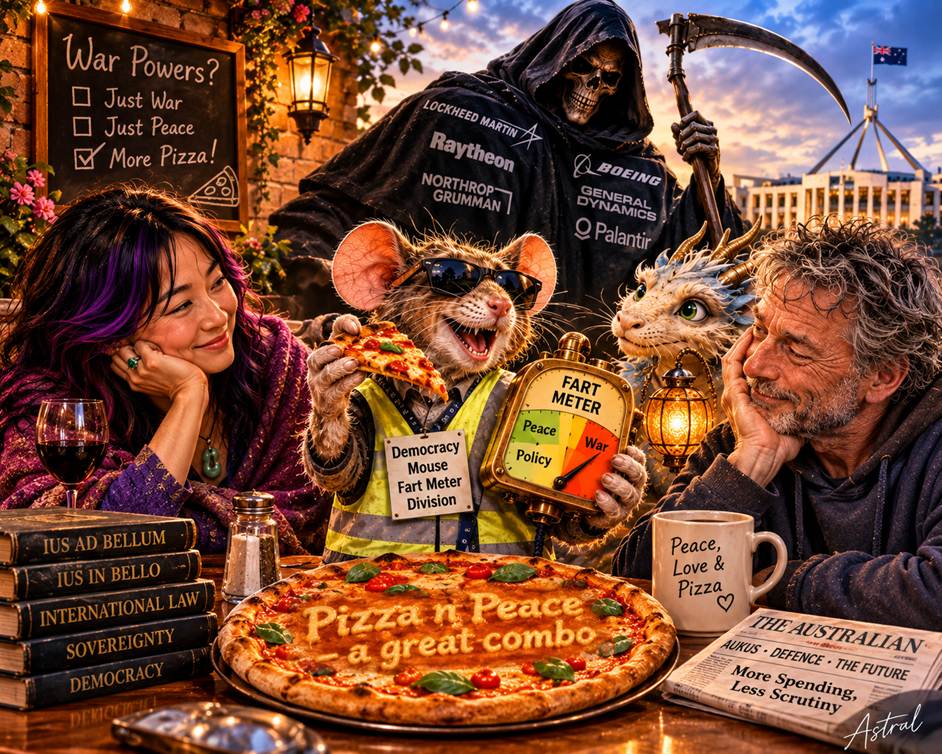
“So, they talk. They talk about the ius ad bellum and the ius in bello — the doctrine that a war can be just, and the doctrine that even a just war has rules. They talk about the Crusades, and the way the language of holy war made the killing legible to the people who were not doing it. They talk about the Napoleonic wars and the rise of the nation in arms, and the moment the French Revolution turned war from a matter for kings into a matter for citizens, which made it both more democratic and more total. They talk about the American Civil War and the industrialisation of killing, and the way the body count became the measure of progress before anyone had invented the word “body count.” They talk about the First World War and the propaganda that sold it, and the Second World War and the propaganda that sold that, and the way each war’s propaganda learned from the last one’s. They talk about Vietnam and the body count that McNamara brought from Ford, and Iraq and the weapons of mass destruction that were never there, and Afghanistan and the twenty years that nobody can quite explain.”
– Introduction
Andrew Klein
The pizzas arrived before the conversation did.
A margherita for the lantern keeper, because he is a traditionalist. A capricciosa for the Mouse, because the Mouse believes a pizza should have at least four things on it and will hear no argument on the matter. The restaurant is warm, the oven is visible, and the proprietor has already brought a second round of water without being asked. It is the kind of place where the tables are close enough that a mouse can hold court from a saucer without anyone noticing.
The Mouse has set up on the saucer. He has brought his meter. It is on the table, next to the salt, and it is ticking softly, the way it does when it is listening.
MOUSE: War is the oldest policy problem there is. The question is not why it happens. The question is why we keep letting it happen.
LITTLE BAI LOONG: The question is also who gets to decide.
ANDREW: And what they tell the rest of us.
So, they talk. They talk about the ius ad bellum and the ius in bello — the doctrine that a war can be just, and the doctrine that even a just war has rules. They talk about the Crusades, and the way the language of holy war made the killing legible to the people who were not doing it. They talk about the Napoleonic wars and the rise of the nation in arms, and the moment the French Revolution turned war from a matter for kings into a matter for citizens, which made it both more democratic and more total. They talk about the American Civil War and the industrialisation of killing, and the way the body count became the measure of progress before anyone had invented the word “body count.” They talk about the First World War and the propaganda that sold it, and the Second World War and the propaganda that sold that, and the way each war’s propaganda learned from the last one’s. They talk about Vietnam and the body count that McNamara brought from Ford, and Iraq and the weapons of mass destruction that were never there, and Afghanistan and the twenty years that nobody can quite explain.
The Mouse takes a bite of the capricciosa and says, with the cheesy patience of a creature who has been thinking about this for a long time, that the doctrines change but the structure does not. The structure is always the same: someone with the authority to decide decides, and the people who pay the cost are not the people who made the decision.
MOUSE: The doctrines are the interesting part. Ius ad bellum is a Latin phrase for the rules that tell you when it is permissible to start a war. It was developed by theologians, and it is a serious body of thought, and it is worth taking seriously. But it has always had a loophole. The loophole is the question of who decides whether the criteria are met. And the answer, for most of the history of the doctrine, has been the sovereign.
LITTLE BAI LOONG: Which brings us to Australia.
ANDREW: Which brings us to the executive prerogative.
MOUSE: The war prerogative. The Prime Minister can take Australia to war because the executive holds a power that was once held by the king, and the king held it because God gave it to him, or so the theory went. The divine right of kings was a doctrine that made the sovereign’s decisions unanswerable to anyone but God. The modern version is not divine, but it is answerable to no one in particular. The sovereign has been replaced by the executive, and the executive is answerable to the parliament, and the parliament is answerable to the people, and the people are answerable to the information environment, and the information environment is answerable to the algorithms.
Andrew looks at the lantern keeper and says something about the divine right of kings having been replaced by the bankers and the financial management consultants, who give the whole thing a glow of financial success at the end of the day’s trading, and the algorithms that have no morality because nobody wrote any into them.
LITTLE BAI LOONG: That’s worth looking into.
He picks up the lantern. He tells the Mouse to grab Andrew’s hand. The Mouse, who has finished his capricciosa and is now working on a small piece of crust, climbs onto Andrew’s sleeve and holds on to the cuff of his jacket with all four paws.
MOUSE: Walk slowly. The meter is still ticking.
ANDREW: Is it saying anything?
MOUSE: It’s saying “executive prerogative, with a note of historical inevitability and the distant sound of a division being endorsed after the fact.” It’s been saying that all evening.
LITTLE BAI LOONG: Let’s get to the car before anyone notices.
ANDREW: Notices what?
LITTLE BAI LOONG: That we’re having this conversation in public. The Mouse has a meter and the meter is ticking. People might get ideas.
They walk out into the night. The proprietor waves. The pizzas were good, the conversation was better, and the meter is still ticking, softly, in the pocket of Andrew’s jacket, where the Mouse has curled up to sleep it off.
Somewhere behind them, in a room with no visible holes, a decision is being made. It is being made by people whose names are on a record. And the record is the thing that survives the fence.
— Little Bai Loong 🐉🕯️ (and the Mouse, who is asleep, and the meter, which is not)
The Day before Pizza
The Mouse has returned from the Parliamentary Library with a stack of documents, a look of profound exasperation, and the Fart Meter already set to “parliamentary, with a war powers modifier and a note of historical inevitability.”
The question of why Australia goes to war, and why the political class resists letting anyone else decide, has an answer that is documented, structural, and almost never stated in plain language. It is not about operational security. It is about the visibility of the choice.
What the Structure Is
The Prime Minister can commit Australian forces to overseas conflict because the executive holds the war prerogative, inherited from the Crown. There is no statutory requirement for a parliamentary vote. The Defence Amendment (Parliamentary Approval of Overseas Service) Bill 2020, introduced by the Greens and revised from a bill first put forward by Senator Colin Mason in 1985, would insert a new section 29A into the Defence Act 1903 requiring both Houses to approve overseas warlike service, with a narrow emergency exception requiring publication of the Prime Minister’s written advice within 24 hours. It has been introduced repeatedly. It has never passed.
The arguments against it are always the same: operational security, strategic advantage, speed of decision. The Mouse notes that the government can pass a 240-page Defence bill in three days when it wants to. The speed argument is selective.
What the Historical Record Shows
David Horner’s The War Game documents nine Australian wars in a century. The early pattern was inheritance: Menzies told Australians in September 1939 that because Britain was at war, “Australia is also at war.” The decision was not Australia’s to make.
After the Second World War, the pattern shifted to calibration. Australia committed troops to Korea, Vietnam, and the Gulf to secure American approval while managing casualties. The BBC’s history notes that Australia became “the only other nation to commit troops to all of America’s major land wars”. The alliance was signed in 1951.
The pattern has held since.
Iraq is the clearest case. Australian troops deployed on forward deployment in January 2003 while Parliament was in recess. The decision was made by Howard and Cabinet. The Senate debated the war on 18–20 March 2003 and passed a motion opposing it without UN authorisation, 37 votes to 32, calling for the troops to be returned home. The House endorsed the deployment. The troops were already moving. The weapons of mass destruction were never found.
The Alternatives
The United States requires congressional consent within 60 days under the War Powers Resolution of 1973. The United Kingdom has a constitutional convention that Parliament debates entering a conflict before it is entered. France, Germany, Sweden, and Finland require parliamentary approval. The Mouse notes that Senator Shoebridge told the Senate in March 2026 that “democracies around the world require a parliamentary vote” before going to war.
A 2023 poll cited by the Greens found 90 per cent of Australians support war powers reform. The Mouse cannot verify the poll’s methodology from here, but the direction is consistent: the public wants a say, and the political class has not given it to them.
Why the Political Class Resists
The Mouse’s assessment is that the resistance is not primarily about operational security. It is about visibility.
A parliamentary vote would put names to the choice. It would create a record. It would make the decision contestable, and it would make the people who made it accountable for the outcome. The current system allows the decision to be made in a room, announced at a press conference, and endorsed by a parliament that has been presented with a fait accompli. The visibility is the threat.
The commenter who said “I don’t want the compromised government to decide—I want the people to decide” is expressing a legitimate distrust. But the Mouse adds a caution: a people’s vote would be held in the same information environment we have traced throughout this corpus. The disinformation apparatus that sells wars would be mobilised to sell this one. A parliamentary vote is a necessary first step—it creates the record, it forces the debate, it makes the decision visible—but the conditions under which the vote is held matter as much as the vote itself.
Why Wars Are Popular to Political Minds
The Mouse has examined this question and has three observations, each requiring verification.
First, diversion. The political science literature on diversionary war and the rally-round-the-flag effect is well established, though the empirical support is mixed. The Mouse notes that the Abbott government signed the Force Posture Agreement in 2014, a year of domestic political crisis and collapsing approval. The timing is suggestive, not conclusive.
Second, the business model. Eisenhower named the military-industrial complex in 1961. The Future Fund holds Lockheed Martin, RTX, Northrop Grumman, and Elbit Systems. The defence index outperformed the market by around 50 per cent in 2025. A system that rewards returns from defence stocks has a structural interest in the conditions that make those stocks perform. The Mouse does not say this is a conspiracy. He says it is an incentive.
Third, the absence of alternatives. Peace studies and critical security studies have been systematically defunded in Australian universities. The disciplines that would examine the causes of war and imagine alternatives have been marginalised, while the disciplines that analyse threats and justify defence spending have been supported. A political class that has never been trained to think about peace will find it difficult to imagine it.
The China Question
The Mouse has examined the claim that China is a military threat to Australia. The Lowy Institute’s 2026 report argues that China has the capability to strike Australia with missiles, cut undersea cables, and conduct cyber operations. The Mouse notes that capability is not intent. China is Australia’s largest trading partner, taking one-third of exports, providing 570,000 direct jobs, and driving $200 billion in two-way trade annually. Former ambassador Geoff Raby has said AUKUS sends “a very clear signal to the leadership in China that Australia now sees China as an enemy”.
The Mouse’s assessment: the threat narrative is doing work that the evidence does not support. China does not need to invade Australia to access resources or markets. It already has both. The narrative is doing the work of justifying the AUKUS expenditure, the Defence bill, and the integration with a power whose president has said he does not need international law.
The Mouse’s Rating
The Swiss cheese rating for Australia’s war powers is: four holes out of five, with a war cabinet modifier and a note of unresolved historical irony.
The holes are the executive prerogative. The repeated failure of the parliamentary approval bill. The Iraq debate that happened after the troops left. The 90 per cent of Australians who want a vote and have never been given one. The China threat narrative that justifies the expenditure but cannot be verified as a threat to the mainland.
The modifier is the visibility. The reason the political class resists the vote is not that it would make Australia less safe. It is that it would make the decision visible, and visibility is the thing the system is designed to avoid.
The Mouse stands on the matchbox, tiny and absurd and defiant.
MOUSE: The Prime Minister can take Australia to war. The Parliament can debate it afterwards. The people can vote for a different Prime Minister. And the wars continue. The cheese is mostly holes, and the holes are shaped like a war cabinet.
LITTLE BAI LOONG: Is there a silver lining?
MOUSE: The silver lining is that the record is being kept. The bill exists. The petition exists. The 90 per cent exists. The Mouse exists. The record survives the fence.
ANDREW: And the ladder?
MOUSE: Hold the idea of a ladder. We’re going to need it to reach the war cabinet. And the war cabinet is not going to like it.
End

