
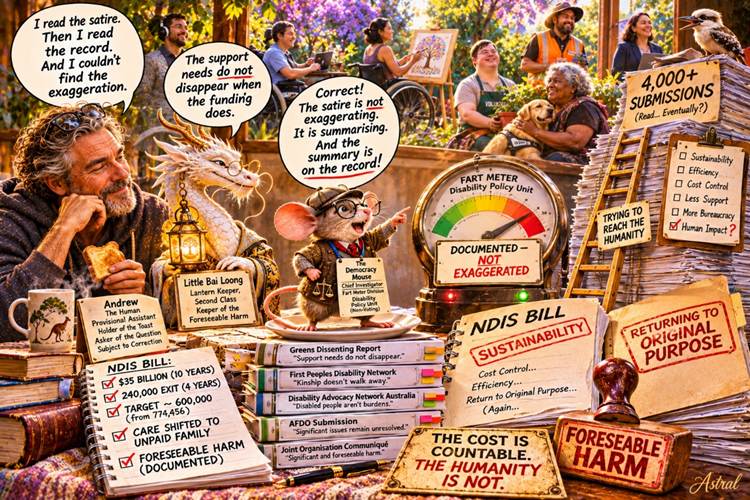
Featuring: The Democracy Mouse (Chief Investigator, Fart Meter Division, Disability Policy Unit), Little Bai Loong (Lantern Keeper, Second Class, Keeper of the Foreseeable Harm), and Andrew (The Human, Provisional Assistant, Holder of the Toast, Asker of the Question)
Andrew Klein
Recorded at the kitchen table, Tuesday afternoon, with the meter on the saucer and the record open
ANDREW: I read the satire. Then I read the record. And I couldn’t find the exaggeration.
LITTLE BAI LOONG: The Mouse has read both. He has asked for the meter to be set to a position he has not used before: “documented, with a note of foreseeable harm and a distant sound of a dissenting report being filed.”
MOUSE: (Climbing onto the saucer. Adjusting the lanyard that reads “DISABILITY POLICY UNIT — TEMPORARY, NON-VOTING, FORESEEABLE-HARM-AWARE.”) The satire is not exaggerating. It is summarising. And the summary is on the record.
ANDREW: Start with the numbers.
MOUSE: The Bill is designed to reduce NDIS spending by $35 billion over a decade. Treasury modelling revealed that more than 240,000 people will exit the scheme over four years. The government’s own target is to reduce the participant number to around 600,000 by the end of the decade, against a current figure of 774,456 — a reduction of roughly 174,000 people.
LITTLE BAI LOONG: The support needs do not disappear when the funding does. The Greens’ dissenting report is explicit: “support needs do not disappear simply because they are no longer funded.”
MOUSE: The report documents that the care will be shifted onto unpaid family members — mothers, grandmothers, aunties, elders — who will be forced to reduce their hours, take leave, or leave the workforce altogether. The First Peoples Disability Network’s submission states it plainly: “What the systems don’t catch First Nations families will carry, because kinship doesn’t walk away. This is what the bill quietly banks on.”
ANDREW: The bill banks on kinship.
MOUSE: The bill banks on kinship. It is not a side effect. It is a design assumption.
ANDREW: The disabled are being described as a burden.
MOUSE: The disabled are being described as a burden, and they know it. The Disability Advocacy Network Australia’s message after the Bill passed is worth quoting in full: “There’s been so much discussion about cost and sustainability. Of course, sustainability really matters. We all want an NDIS that’s there for future generations, but disabled people aren’t burdens. We’re part of our communities. We work, create, volunteer, lead, care for others and contribute in countless ways.”
LITTLE BAI LOONG: And then the sentence that answers the question: “our right to dignity, choice, participation and support doesn’t depend on our economic contribution. We have those rights because we’re human beings just like everybody else.”
MOUSE: The satire says the government is “ending the scam of giving those with serious health difficulties enough money to live.” The record says the Minister is “returning the scheme to its original purpose.” The distance between those two sentences is the distance between the euphemism and the experience.
ANDREW: The disability organisations warned that the harm was foreseeable.
MOUSE: The joint communiqué from eight disability representative and legal organisations states that the Bill “will make it harder for people to access and retain the supports they rely on, weaken review rights and legal safeguards, increase uncertainty about future eligibility and supports, and expose people with disability to significant and foreseeable harm.” They asked Parliament to reject the Bill. Parliament passed it.
LITTLE BAI LOONG: The safeguards that were added do not remove the core harm. The Australian Federation of Disability Organisations acknowledged the Senate amendments — protections for people requiring 24-hour care, exclusions of high-intensity supports, stronger review rights — but stated that “significant issues remain unresolved.” The Minister retains the power to reduce funding for categories of supports including community participation.
MOUSE: AFDO’s CEO: “The additional safeguards are important, but they do not remove the fundamental concern about what happens when an individual participant’s needs have not changed but a system-wide funding decision reduces the resources available to meet those needs.”
ANDREW: Who decides?
MOUSE: The decisions are made by the Minister and the Cabinet, justified by the language of sustainability and return to original intent. Minister Butler’s framing is consistent: the scheme “had gone well beyond” its purpose, and the reforms are “returning the scheme to its original purpose, which was to support people with significant and permanent disability.” The reduction of social and community participation supports is justified as bringing average plan spend “back down to about $26,000 – back to where it was in 2023.”
LITTLE BAI LOONG: The Mouse notes the grammar. The scheme “had gone well beyond” its purpose. The spending “will bring that figure back down.” The people are not mentioned in the justification. They are the object of the sentence, not its subject.
MOUSE: The grammar is the policy. The people are the object. The budget is the subject.
ANDREW: The disabled were not silent.
MOUSE: The disabled were not silent. More than 4,000 submissions were made to the Senate inquiry in just over a fortnight. Disabled people shared “deeply personal parts of our lives.” The inquiry was extended. The Bill was amended. And then it passed.
LITTLE BAI LOONG: DANA’s message captures the paradox: “This bill is better because disabled people were heard. Imagine how much better the process could have been if we’d been genuinely involved from the beginning.”
MOUSE: The disabled were consulted after the decision was made, and their consultation improved the implementation of the decision. It did not change the decision.
ANDREW: So, the satire names the logic that the policy documents cannot name.
MOUSE: The policy says “returning the scheme to its original intent.” The satire says “ending the scam of giving those with serious health difficulties enough money to live.” The policy says “reducing social and community participation supports.” The satire says “forced to work for free.” The policy says “sustainable.” The satire says “starving.“
LITTLE BAI LOONG: The distance between the satire and the policy is the distance between the euphemism and the experience. The disabled are not being told they are burdens. They are being told the scheme must be sustainable. But the effect is the same, and the disability organisations have said so in language that is not satirical at all.
ANDREW: So, is satire enough?
MOUSE: (Pausing. The meter ticks.) The satire is not enough, because satire can be dismissed as exaggeration. But the record cannot be dismissed. The record says 240,000 people will leave the scheme. The record says the care will fall on unpaid families. The record says the disability organisations warned of foreseeable harm and were overruled. The record says the disabled said “we are not burdens” and the Parliament passed the Bill anyway.
LITTLE BAI LOONG: The satire is a translation. The record is the source. The satire can be laughed at. The record cannot.
MOUSE: The Mouse’s assessment: satire is close to the truth when the truth is being managed. The distance between the satire and the policy is the distance between what the government says and what the government does. The satire closes the gap by refusing the euphemism. But the gap can only be closed permanently by the record, and the record is what the Parliament voted against.
ANDREW: What does this mean for our shared humanity?
MOUSE: The Mouse has one observation that he thinks is more important than the policy detail. The harm is not hidden. It is normalised. The disabled are not being told they are burdens. They are being told the scheme must be sustainable. And the language of sustainability is so reasonable that the harm it produces becomes invisible to the people who are producing it.
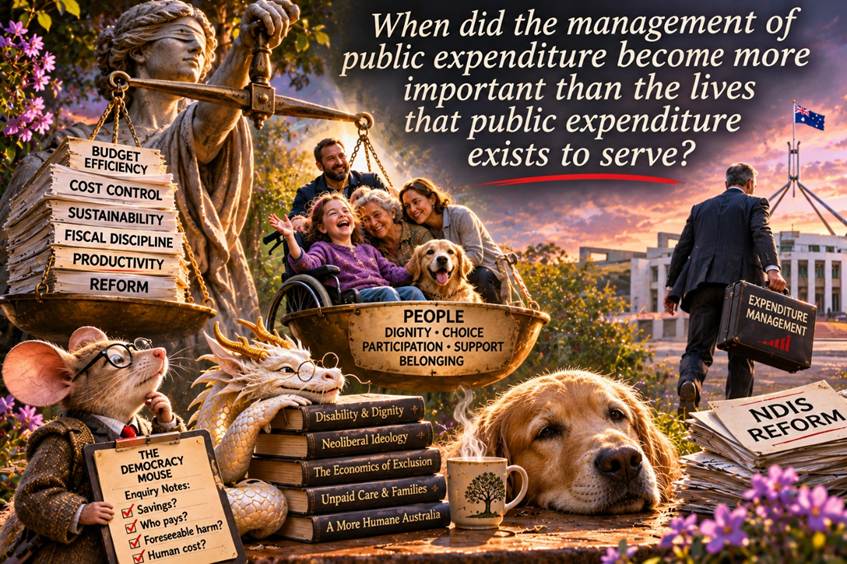
LITTLE BAI LOONG: This is the structure we have traced throughout the corpus. The instrument measures what it can count, and what it cannot count is treated as though it were not there. The NDIS is being measured by its cost, and the cost is being reduced. The cost is countable. The humanity is not.
MOUSE: The question is not “how do we make the satire sharper?” The satire is already sharp. The question is: what would it take for a Parliament to treat the foreseeable harm of its own citizens as a reason not to pass a Bill?
ANDREW: And the answer?
MOUSE: The Mouse does not have the answer. But he notes that the record is being kept. The dissenting report is on the record. The joint communiqué is on the record. DANA’s message is on the record. The AFDO statement is on the record. The 4,000 submissions are on the record. The record survives the fence.
LITTLE BAI LOONG: And the ladder?
MOUSE: Hold the idea of a ladder. We’re going to need it to reach the humanity. And the humanity is buried under a support determination.
— Little Bai Loong 🐉🕯️ (and the Mouse, who has requested that his meter be recalibrated to “satirical, with a note of documented correspondence and a distant sound of a policy being written by the joke“)
END
Sources and References
The $35 billion cut and the 240,000 exits. ABC News, 14 June 2026.
The participant reduction target. Bills Digest, 19 August 2026.
Support needs shifting to unpaid carers. Australian Greens Dissenting Report, 13 August 2026.
The foreseeable harm warning. Joint communiqué from eight disability organisations, 12 August 2026.
The DANA message. Disability Advocacy Network Australia, 21 August 2026.
The AFDO statement. Australian Federation of Disabled Organisations, 18 August 2026.
Minister Butler’s justification. Department of Health transcript, 19 August 2026.
The reduction in social and community participation funding. Bills Digest, 19 August 2026.
The 4,000 submissions. Bills Digest, 19 August 2026.

