
Rethinking Shareholder Liability: An Argument for Ethical Investment
By Andrew Klein
Introduction: The Problem of Corporate Accountability
Much has been written about the damage inflicted upon our planet and its inhabitants by corporations whose principal measure of success is financial return.
Corporations provide employment, develop technologies, manufacture goods, deliver essential services and contribute significantly to economic activity. There is no inherent contradiction between commercial success and social benefit.
The difficulty arises when the pursuit of financial returns becomes detached from the consequences of corporate conduct.
Those responsible for corporate decisions may receive substantial financial rewards, while the costs of their decisions are transferred to employees, consumers, communities, governments and the environment.
A corporation may distribute profits during its profitable years, yet leave behind environmental contamination, unpaid obligations and social consequences when its business fails.
The question is straightforward:
Why should those who benefit from corporate activity be able to externalise the costs of corporate misconduct onto everyone else?
The legal principle of limited shareholder liability has played an important role in the development of modern commerce. It has encouraged investment, enabled the pooling of capital and allowed individuals to participate in commercial enterprises without exposing their entire personal wealth to business failure.
However, a principle developed to facilitate investment should not be beyond examination when its application contributes to the separation of financial benefit from responsibility.
It is time to reconsider whether our existing arrangements provide an adequate balance between investment freedom and corporate accountability.
1. The Historical Development of Shareholder Primacy
One frequently cited historical reference is the 1919 Michigan Supreme Court decision in Dodge v Ford Motor Company.
The dispute arose after Henry Ford proposed retaining substantial company profits to expand production, reduce vehicle prices and increase employment rather than distributing additional dividends to shareholders.
The court stated:
“A business corporation is organized and carried on primarily for the profit of the stockholders.”
This statement subsequently became an important reference point in discussions of shareholder primacy.
However, the judgment requires some qualification.
The court did not prohibit Ford from increasing wages or reducing prices. It recognised the considerable discretion directors possess in managing wages, prices, working conditions and investment decisions. It also declined to prevent the proposed expansion of Ford’s operations.
The court did, however, order the distribution of an additional dividend, finding that the refusal to distribute profits in the circumstances amounted to an arbitrary exercise of the directors’ discretion.
Nevertheless, the judgment became associated with a broader understanding of corporate purpose in which shareholder interests occupy a privileged position.
The historical significance is not that corporations were suddenly instructed to behave without regard to their employees or customers.
Rather, it is that the relationship between corporate purpose, shareholder interests and the wider community became the subject of an enduring legal and economic debate.
2. The Problem with the Separation of Benefit and Responsibility
Modern corporations operate through complex structures involving directors, executives, subsidiaries, institutional investors, shareholders and creditors.
The separation of corporate ownership from management can be economically useful. It allows people to invest without personally managing the businesses in which they hold shares.
Limited liability provides another important protection.
Under Australian law, shareholders in a company limited by shares are generally not liable for the company’s debts beyond any unpaid amount on their shares.
The corporation itself is a separate legal entity, responsible for its own obligations.
There are sound economic reasons for this arrangement.
However, there is also a problem.
Where a corporation causes substantial environmental or social harm, the company may not possess sufficient assets to meet the resulting obligations.
The people affected may be left seeking compensation, remediation or assistance from governments and the wider community.
Meanwhile, those who previously benefited from the company’s financial performance may have no corresponding responsibility for its conduct.
This is not necessarily the result of deliberate wrongdoing by every shareholder. Many investors have little knowledge of, or influence over, the daily operations of the companies in which they invest.
Nevertheless, the structural separation between investment returns and corporate responsibility deserves closer examination.
A system that rewards investment but fails to adequately account for the consequences of corporate misconduct creates an imbalance.
3. The Australian Legal Position
Australian corporate law already imposes obligations upon directors and company officers.
Under the Corporations Act 2001, directors must exercise care and diligence, act in good faith in the best interests of the corporation and exercise their powers for proper purposes.
The Act also contains provisions addressing improper use of position and information, insolvent trading and other forms of misconduct.
Environmental legislation, workplace laws, consumer protection legislation and other regulatory frameworks impose additional obligations.
Therefore, it would be incorrect to suggest that Australian directors or corporations operate without legal accountability.
The problem is one of effectiveness, enforcement and the adequacy of existing remedies.
Can the law consistently identify those responsible?
Can penalties be imposed where wrongdoing is established?
Can affected communities obtain meaningful redress?
Can environmental damage be remediated when a company becomes insolvent?
And can corporate structures be used to place assets and liabilities in different entities, leaving the entity responsible for the damage without sufficient resources to meet its obligations?
These are practical questions, not merely theoretical objections to capitalism.
4. A Graduated Framework for Shareholder Liability
The original proposal was that shareholders should become financially accountable for serious corporate wrongdoing in proportion to their shareholding.
On further examination, a more sophisticated approach is necessary.
Not all shareholders exercise the same degree of control, possess the same information or participate in corporate decision-making.
An ordinary Australian investing through a superannuation fund should not automatically be treated in the same way as a controlling shareholder who knowingly directs or facilitates unlawful conduct.
Equally, a parent company exercising substantial control over a subsidiary should not necessarily be able to avoid scrutiny simply because the subsidiary is a separate legal entity.
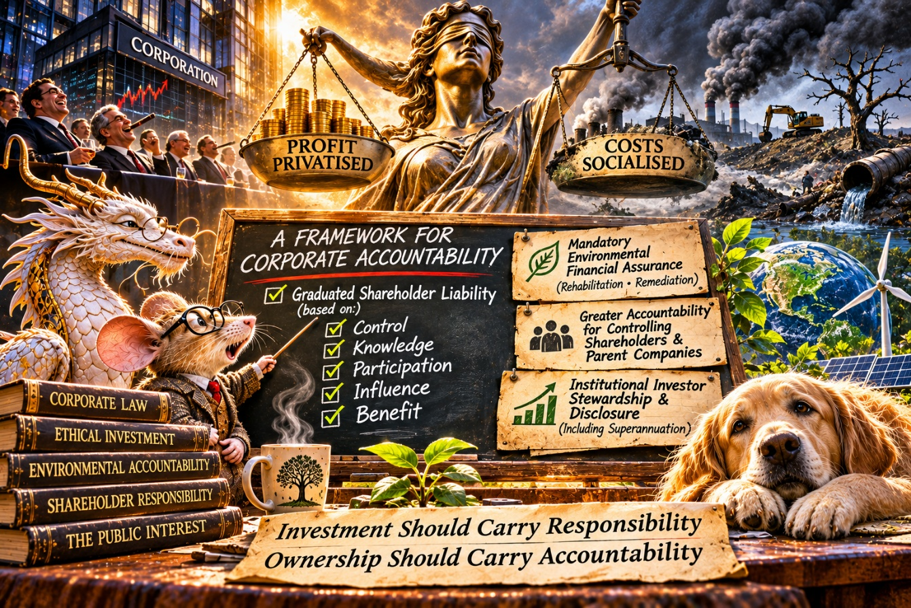
I therefore propose that Australia examine a graduated liability framework based on five considerations: control, knowledge, participation, influence and benefit.
These considerations would help determine the appropriate degree of responsibility where serious corporate wrongdoing has been established.
Control
The degree of actual control exercised over corporate decisions should be considered.
A controlling shareholder who directs company policy, determines operational priorities or exercises substantial authority over corporate conduct occupies a different position from a passive minority investor.
Knowledge
Whether an individual or entity knew, or in circumstances defined by law ought reasonably to have known, about serious corporate misconduct should be relevant.
Knowledge of unlawful conduct, particularly where accompanied by a failure to act despite the capacity to intervene, may justify greater accountability.
Participation
Direct involvement in decisions, transactions or arrangements that facilitate corporate wrongdoing should be considered.
This would include knowingly authorising, encouraging or assisting unlawful conduct.
Influence
Some investors and related entities may exercise substantial influence without holding a formal controlling interest.
Institutional investors, parent companies and significant shareholders may possess considerable capacity to influence corporate governance, investment decisions and operational priorities.
The extent to which that influence was exercised, or deliberately withheld in circumstances where obligations existed, should be examined.
Benefit
The financial benefits obtained through serious corporate wrongdoing should also be relevant.
Where individuals or entities knowingly receive or retain benefits arising from unlawful conduct, the law should examine whether those benefits can appropriately be recovered.
The mere receipt of an ordinary dividend by a passive investor would not, by itself, establish liability. The relevant circumstances, knowledge and connection to the wrongdoing would need to be established.
Applying the framework
The five considerations should not operate as an automatic formula.
Instead, they should inform a legally defined assessment of responsibility, with the appropriate consequences determined according to the seriousness of the misconduct and the person’s or entity’s actual involvement.
For example:
- A passive investor with no meaningful control, knowledge or participation would ordinarily remain protected by limited liability.
- A substantial shareholder exercising influence over corporate governance might have additional obligations where serious misconduct is known and preventable.
- A controlling shareholder who knowingly directs unlawful activity could face significant personal accountability.
- A parent company that exercises operational control over a subsidiary should not automatically escape scrutiny where its own conduct contributes to serious wrongdoing.
- An individual who knowingly participates in misconduct or receives benefits from it may be subject to appropriate recovery or liability provisions.
Any new framework would require clear statutory definitions, independent investigation, procedural fairness, proportionate consequences and access to appropriate legal review.
The objective is not to punish investment.
It is to establish a relationship between the degree of responsibility exercised and the consequences of corporate conduct.
Investment should not provide an unrestricted exemption from accountability.
5. Mandatory Environmental Financial Assurance
One of the most practical reforms would be to strengthen requirements for companies whose operations create significant environmental risks.
Industries involving mining, energy production, chemical processing, waste management and large-scale resource extraction can create substantial long-term remediation obligations.
Those obligations may continue long after a particular operation has ceased to be profitable.
A company should not be permitted to enjoy the financial benefits of an operation while leaving future generations to meet the cost of restoring the environment.
I propose that Australia strengthen the use of mandatory environmental financial assurance.
Depending on the nature and scale of the operation, this could include:
- Environmental rehabilitation bonds.
- Independently assessed financial guarantees.
- Insurance or other approved financial security arrangements.
- Ring-fenced rehabilitation funds.
- Periodic reassessment of estimated closure and remediation costs.
- Independent verification that sufficient financial resources remain available throughout the life of the operation.
The amount of assurance should reflect the foreseeable environmental liabilities associated with the activity, rather than simply the company’s preferred estimate.
Such arrangements should be reviewed regularly to account for inflation, changing environmental conditions, additional risks and changes in operational scale.
The purpose is straightforward.
When a company undertakes an activity that creates foreseeable environmental obligations, the financial capacity to meet those obligations should be established before the public is left carrying the risk.
This is not an argument against resource development or commercial enterprise.
It is an argument against treating environmental restoration as an optional expense.
6. Greater Accountability for Controlling Shareholders and Parent Companies
Modern corporate structures can be extraordinarily complex.
A business may operate through numerous subsidiaries, holding companies, special-purpose entities and related corporations.
There may be legitimate commercial reasons for these arrangements.
However, complexity can also make it difficult to identify who exercises effective control and where responsibility ultimately resides.
A subsidiary may conduct the operations that cause environmental damage, while the parent company controls major strategic decisions, financial arrangements or operational priorities.
If the subsidiary becomes insolvent, the parent company may not automatically be responsible for its liabilities.
The legal separation between companies must be respected, but it should not become an unquestionable shield where a parent company’s own conduct has contributed to serious wrongdoing.
I propose that Australia examine stronger accountability mechanisms for controlling shareholders and parent companies, particularly where they:
- Exercise substantial operational or financial control.
- Direct or materially influence decisions associated with serious misconduct.
- Knowingly facilitate unlawful corporate activity.
- Deliberately transfer assets or liabilities in ways designed to defeat legitimate claims.
- Benefit from arrangements that leave subsidiaries unable to meet foreseeable obligations.
This could involve carefully defined statutory duties, improved disclosure requirements, stronger recovery provisions and appropriate parent-company liability where the necessary legal conditions are established.
The objective is not to abolish corporate structures.
It is to ensure that corporate structures cannot be used to separate meaningful control and financial benefit from responsibility for serious wrongdoing.
7. Institutional Investor Stewardship and Disclosure
Australia’s superannuation system represents an enormous concentration of investment capital accumulated through the contributions of Australian workers.
This creates both an opportunity and a responsibility.
Superannuation funds invest across domestic and international markets, often holding interests in thousands of corporations.
Their investment decisions can influence corporate governance, environmental standards and workplace practices.
However, the complexity of modern investment structures can make it difficult for individual members to understand precisely where their money is invested or how those investments are managed.
There is a legitimate case for greater transparency.
Superannuation members should be able to understand the broad consequences of their investments, including significant environmental, social and governance risks.
I propose that Australia strengthen institutional investor stewardship and disclosure requirements.
This should include:
- Clear reporting of significant corporate governance and environmental risks.
- Greater transparency regarding voting decisions on major shareholder resolutions.
- Disclosure of engagement with companies concerning serious misconduct.
- Explanation of how institutional investors assess corporate accountability.
- Greater transparency concerning investments in companies with significant unresolved legal or environmental liabilities.
- Reporting on how investment managers exercise their influence over corporate behaviour.
Large institutional investors should not be treated merely as passive recipients of dividends when they possess substantial voting power and the capacity to influence corporate governance.
Their responsibilities should be proportionate to their influence.
There is also an opportunity to examine whether a greater proportion of Australian superannuation capital can support productive domestic infrastructure, provided that investments are commercially sound, independently assessed and consistent with the financial interests of members.
The objective should be to connect investment with long-term national benefit without compromising the integrity of retirement savings.
8. The Economics of Externalised Costs
One of the weaknesses of conventional financial accounting is that the costs recorded by a corporation do not necessarily represent the full costs imposed upon society.
A company may record a profit while transferring environmental damage to surrounding communities.
It may reduce operating expenses by weakening workplace conditions, only for the resulting costs to emerge through public health systems, welfare expenditure or family hardship.
It may exhaust natural resources while treating their depletion as someone else’s problem.
These are examples of externalised costs.
They are not necessarily reflected in the price of the product, the company’s reported profits or the return received by shareholders.
The wider community ultimately pays.
The polluter-pays principle is an attempt to address this imbalance by requiring those responsible for environmental harm to bear the costs of prevention, remediation and restoration.
However, the principle is only effective when the responsible parties can be identified and the necessary financial resources are available.
Where a company becomes insolvent, or its corporate structure prevents meaningful recovery, the public may still inherit the consequences.
This is why environmental financial assurance, parent-company accountability and graduated liability should be considered together.
They address different aspects of the same problem: ensuring that the costs of corporate activity are not simply transferred to people who had no meaningful involvement in the decisions that created them.
9. The Objections
There will be objections to any proposal that expands shareholder liability.
Some will argue that it will discourage investment, reduce market liquidity and increase the cost of capital.
Others will point out that ordinary investors cannot be expected to investigate every company in which their superannuation fund invests.
These objections deserve serious consideration.
Investment requires a degree of predictability. Limited liability has played an important role in providing that predictability.
A poorly designed liability regime could create unintended consequences, particularly for small investors and retirement savings.
But these concerns do not establish that existing arrangements are necessarily adequate.
The proposed graduated framework is intended to address precisely this problem.
It recognises that passive investment is different from controlling a company, knowingly participating in misconduct or exercising substantial influence over corporate decisions.
There is a difference between commercial failure and corporate misconduct.
There is also a difference between accepting the ordinary risks of investment and knowingly benefiting from unlawful conduct that imposes substantial costs on others.
The law should recognise that difference.
10. A Different Understanding of Corporate Responsibility
The purpose of reform should not be to eliminate commercial enterprise or discourage legitimate investment.
It should be to establish a more balanced relationship between financial reward and responsibility.
Corporate success should be measured not simply by the value returned to shareholders, but also by the consequences of the enterprise for employees, consumers, communities and the natural environment.
Profit is a legitimate measure of commercial performance.
It is not a complete measure of social value.
The capacity to generate financial returns does not automatically establish that a corporation is acting responsibly.
Nor should the legal separation between a corporation and its shareholders become an unquestionable barrier to accountability where serious wrongdoing has occurred.
We need a system that encourages investment while discouraging the transfer of corporate costs to the public.
We need directors who understand that their decisions have consequences beyond the next reporting period.
We need institutional investors who exercise their influence responsibly.
We need parent companies that cannot simply disregard the consequences of operations they meaningfully control.
And we need governments prepared to enforce the law without treating corporate size, political influence or economic importance as substitutes for accountability.
Conclusion: Investment Must Carry Responsibility
The principle of limited liability was developed to facilitate commercial activity and encourage the participation of investors.
It has served an important economic purpose.
But no legal principle should be treated as permanently immune from reconsideration.
The scale of modern corporate activity, the concentration of financial power and the environmental and social consequences of industrial production require us to examine whether the balance between investment protection and public accountability remains appropriate.
I propose that Australia undertake a serious examination of corporate accountability and shareholder liability, with particular attention to five considerations:
Control. Knowledge. Participation. Influence. Benefit.
These should form the basis of a graduated framework that distinguishes passive investors from those who exercise meaningful control, knowingly facilitate misconduct or derive benefits from serious corporate wrongdoing.
This reform should be supported by three complementary measures:
- Mandatory environmental financial assurance, ensuring that companies have sufficient resources for foreseeable remediation and rehabilitation.
- Greater accountability for controlling shareholders and parent companies, preventing corporate structures from separating meaningful control and benefit from responsibility.
- Institutional investor stewardship and disclosure, making large investors more accountable for how they exercise their influence over companies.
Such reforms should protect ordinary investors while ensuring that meaningful control and participation carry meaningful responsibility.
This is not an argument against business.
It is an argument for ethical business.
Nor is it an argument against investment.
It is an argument for investment that recognises the consequences of its decisions.
The world is not an infinite resource, and neither are the communities that sustain our economy.
The cost of corporate activity cannot be measured solely by what appears on a balance sheet.
There are costs to workers, families, communities, future generations and the natural environment.
If those costs are ignored, they do not disappear.
They are simply transferred to someone else.
The central question is not whether corporations should be permitted to make profits. It is whether they should be permitted to retain those profits while transferring the consequences of serious misconduct to the public.
Investment should carry responsibility.
Ownership should carry accountability where meaningful control or participation is established.
And commercial success should never be measured solely by the wealth accumulated by those who benefit from it.
That is a question Australia should be prepared to answer.
Andrew Klein

