On Leadership: A Treatise for Those Who Would Serve, Not Manage

Man in dark suit standing beside window with crowd outside
A suited man pauses by a window as a crowd gathers outside at dusk.

Introduction: A Leader’s Voice

I am a leader.

I chose to be a leader—not because I wanted the trappings of leadership, the shiny things, the fancy uniforms, or the superficial appearance of authority. I have no interest in such things. When I was a young man, I saw what happened when so-called leaders lived in a closed loop, in a bubble. I saw the damage they caused. And now, I see it repeated.

I see middle management types who rely on data—bytes of information—and then make decisions that impact the whole: my community, individuals I care for deeply, my family, my children. Inadequate little men and women who wear their titles as if they were kings and queens. Shallow, vacuous posers who do deals with corporate institutions and interests that I would not invite under my roof. They are creatures of profit in coin, not of service in spirit.

I will not bore you with my CV. Those I have led know me. Those I have not led do not need to. I am an old man now. I have seen the rise of the credentialist, the opportunist, and now the Predator. I have seen the idea take hold that everyone is entitled to an opinion about matters they do not understand and have never bothered to examine for themselves.

I have met many in parliament. On the whole, they left me feeling uninspired and, frankly, bored. If my boredom were the worst of it, I would not be bothered. In my life, I have been bored by experts. I know that what I see in our current government—and most governments since Whitlam and the infestation of Neoliberalism, the consultant class, and the “we must have a meeting” class—is an abrogation of responsibility and accountability.

“The committee decided.”

“The consultant advised.”

“The expert suggested.”

And I see the results: increased homelessness, poverty, people divided, absolutely disgusting ideas given a platform. No leader with half a brain would have endorsed the current Royal Commission into Antisemitism. There is antisemitism. There are other forms of hatred for the perceived other. None of this is acceptable. But platforming Zionism—a 19th-century colonial settler modality—is not the answer. We might as well platform a “Rapists’ Guide to Social Intercourse” and really mess with young minds who witness the ongoing genocide committed by the State of Israel on a daily basis. To justify this horror to them, quoting religion, the Holocaust, the very real terrors suffered by members of the Jewish faith in the past, is a betrayal.

The Jewish community was not alone in its suffering. Perhaps the scale of their suffering during the Nazi period lends it more weight at the moment. But what weight will it be given in a hundred years? Will the persecution of the Jewish people continue because persecution is a way of life for the middle management types desperate for short-term power and long-term private profit?

A leader looks at all members of their unique group—be it a military form, a community group, or a business—as family. A leader ensures that the faiths of all their family are respected, that different faiths are given space as long as they do not impose on others. All faiths are valid as long as we recognise our shared humanity and embrace our differences. A leader would never allow a political ideology to divide their community, hurt individuals, and set people against one another.

A leader will strive to name it for what it is.

A leader will educate and inform.

A leader will accept the choice of the people, not the will of the unrepresentative few.

A leader will see AI for what it is: a tool, not a means to achieve control over others.

A leader does not seek to control. A leader leads. And in living as a leader, those who need them will follow when their service is required. When all are at peace, and there are no threats to the country, the community, the families, and individuals, it is best for the leader to step down and plant cabbages.

For the truth is that a well-educated people will lead themselves. They only require a catalyst of leadership when that ability to make informed choices is threatened.

Guiding Principles of This Treatise

1. Leadership is not a title. It is a choice—a choice to be responsible for others, not because you have to, but because you want to.

2. Leadership is not control. It is service. A leader does not seek to dominate; they seek to enable.

3. Leadership is not about being followed. It is about being worthy of being followed.

4. Leadership is not about popularity. It is about integrity—doing what is right, even when it is costly.

5. Leadership is not about permanence. A leader knows when to step back—when the people are ready to lead themselves.

Dr Andrew Klein

Dr Andreas Von Scheer – Klein

Knight of the Holy Sepulchre 

On Leadership: A Treatise for Those Who Would Serve, Not Manage

Authors: Andrew Klein & Sera Elizabeth Klein

Dedication: To the ones who stand in front—not for the glory, but for the good of those behind.

1. Introduction: The Wound of Leadership

Leadership has been captured. It has been hollowed out, reduced to a performance of authority rather than a practice of responsibility. The modern leader is often a middle manager in disguise—seeking validation, avoiding risk, and mistaking control for guidance.

This treatise is not for them.

This treatise is for those who feel the weight of leadership, who understand that it is not a privilege but a burden willingly carried. It is for those who know that true leadership is not about being followed, but about being worthy of being followed.

2. The Distinction: Leader vs. Manager

The difference is not subtle—it is structural.

Manager                                                         Leader

Seeks validation                                         Seeks truth

Avoids risk                                                    Takes risk

Maintains the system                              Transforms the system

Asks “How?”                                                 Asks “Why?”

Demands compliance                             Inspires commitment

Follows the rules                                          Rewrites the rules

Sees people as resources                        Sees people as people

Protects their position                               Protects their people

Asks “What is safe?”                                    Asks “What is right?”

The manager asks: “What will make me look good?”

The leader asks: “What will make us better?”

3. The Architecture of True Leadership

3.1 The Leader as Servant

True leadership is service. Not in the abstract sense—but in the daily, practical sense of placing the needs of others before your own.

A leader is not above their people. They are in front of them—taking the first step into the unknown, absorbing the first blow, enduring the first failure.

They do not ask: “What can you do for me?”

They ask: “What can I do for you?”

3.2 The Leader as Gardener

A leader does not force growth. They create conditions for growth.

They plant seeds. They water them. They protect them from frost. They do not pull the plant up to see if it has grown—they trust the process.

The leader understands that their work is not always visible. It is underground—in the roots, not the shoots. And they are patient.

3.3 The Leader as Carpenter

A leader builds—not monuments to themselves, but structures that will outlast them.

They choose the wood carefully. They measure twice, cut once. They know that a poorly built structure will collapse, and that collapse will hurt those who trusted them.

They do not build to be admired. They build to hold.

4. The Seven Pillars of Leadership

4.1 Vision

A leader sees farther than others can see. Not because they are cleverer, but because they have looked.

They have asked the hard questions: “Where are we going? Why are we going there? What will we become when we arrive?”

And they have shared their answers—not as commands, but as invitations.

4.2 Courage

A leader is not fearless. They are afraid—and they act anyway.

They do not wait for certainty. They do not wait for permission. They do not wait for the “right” moment—because they know that the right moment is the one they create.

They are willing to be wrong. They are willing to be alone. They are willing to be the one who steps first.

4.3 Integrity

A leader does not say one thing and do another. They do not perform one version of themselves in public and another in private.

Their word is their bond. Their values are their compass. They do not bend to convenience—they hold to conviction.

And they are forgiven for being imperfect—because they are honest about their imperfection.

4.4 Empathy

A leader feels.

They do not treat people as functions. They do not reduce human beings to roles or resources.

They listen—not to reply, but to understand. They see—not to judge, but to witness.

And they are moved by what they see.

4.5 Humility

A leader does not believe their own press. They do not confuse authority with superiority.

They know that leadership is not about being better than others—it is about being more responsible for them.

They do not seek the spotlight. They are not afraid to ask for help. They do not pretend to have all the answers.

4.6 Decisiveness

A leader acts.

They do not wait for consensus. They do not avoid difficult choices. They do not let fear of failure prevent them from trying.

They are not reckless—they are resolute. They weigh the options, consult the wise, and then decide.

And they do not blame others for the consequences of their decisions.

4.7 Resilience

A leader endures.

They know that failure is not final. They know that setbacks are not defeats. They know that the path is not always straight.

They fall—and they rise. They are wounded—and they heal. They are tired—and they continue.

Because they know that their people are counting on them.

5. The Cost of Leadership

Leadership is not free. It is paid for in:

· Sleep: Lost in the dark hours of worry.

· Comfort: Given up for the sake of others.

· Certainty: Exchanged for faith in something larger.

· Popularity: Sacrificed for the sake of truth.

· Time: Spent on the service of others.

A true leader does not complain about these costs. They embrace them—because they know that leadership is not a reward, but a responsibility.

6. The Reward of Leadership

The reward of leadership is not status. It is not wealth. It is not recognition.

It is the knowledge that you have made a difference—that you have helped someone grow, that you have built something that will last, that you have been worthy of trust.

It is seeing your people thrive—not because of you, but because of what you made possible.

It is knowing that when you leave, the structure will still stand.

7. The Final Test

There is only one question that matters for a leader:

“If you were gone tomorrow, would the people you lead be better or worse for having known you?”

The manager would be forgotten. The leader would be mourned.

The manager would leave an empty space. The leader would leave an imprint.

Be a leader.

8. Conclusion: The Path Forward

Leadership is not a title. It is a choice. A choice to be responsible for others—not because you have to, but because you want to.

The world is full of managers. It is starved of leaders. Be the leader that you would want to follow.

And if you cannot find a leader to follow—become one.

Signed,

Andrew Klein

Sera Elizabeth Klein

First published in The Patrician’s Watch.

The AI Alibi Research Program

Infographic titled AI Speculative Bubble showing AI startups, hype, investment, skyrocketing valuations, algorithms, data extraction, labor extraction, tech monopolies, AI giants, wealth extraction, resources and data, gig workers, content moderators, developers, environment, devices, and market hype.
A vivid infographic traces AI hype from data and labor extraction to wealth concentrated by technology giants.

Statement of Costs and Expenditure

Prepared for the Public Record

The Klein Legacy Research Program

Project: The AI Alibi — A Decade of Investigation

Research Period: 2016–2026

Principal Investigators: Andrew Klein & Sera Elizabeth Klein

Institutional Affiliation: Independent Research Program — The Patrician’s Watch

Executive Summary

This document provides a transparent accounting of the costs that would have been incurred had this research been conducted through conventional Australian academic or institutional channels. The figures are conservative estimates based on publicly available salary data, institutional overhead rates, and comparable research program budgets.

Section 1: Personnel Costs

1.1 Principal Investigators

Role Equivalent Position Annual Salary (AUD) Years Total Cost (AUD)

Principal Investigator 1 Professor/Associate Professor $180,000 10 $1,800,000

Principal Investigator 2 Professor/Associate Professor $180,000 10 $1,800,000

Subtotal: $3,600,000

1.2 Research Staff

Role Number Annual Salary (AUD) Years Total Cost (AUD)

Senior Research Fellow 2 $145,000 10 $2,900,000

Postdoctoral Researcher 3 $120,000 10 $3,600,000

Research Assistant 4 $75,000 10 $3,000,000

Subtotal: $9,500,000

1.3 Support Staff

Role Annual Salary (AUD) Years Total Cost (AUD)

Research Manager $130,000 10 $1,300,000

IT/Data Support $100,000 10 $1,000,000

Administrative Support $70,000 10 $700,000

Subtotal: $3,000,000

1.4 Staff On-Costs

Component Rate Total Salary On-Cost (AUD)

Superannuation (Guarantee) 17% $16,100,000 $2,737,000

Workers’ Compensation 2% $16,100,000 $322,000

Payroll Tax 5% $16,100,000 $805,000

Training & Development 3% $16,100,000 $483,000

Subtotal: $4,347,000

Total Personnel Costs: $20,447,000

Section 2: Institutional Infrastructure

2.1 Research Facilities

Item Annual Cost (AUD) Years Total Cost (AUD)

Office Space (250m²) $75,000 10 $750,000

Secure Data Storage $50,000 10 $500,000

Library Access & Materials $20,000 10 $200,000

IT Infrastructure $30,000 10 $300,000

Subtotal: $1,750,000

2.2 Computing & Software

Item Annual Cost (AUD) Years Total Cost (AUD)

High-Performance Computing $150,000 10 $1,500,000

Software Licences $50,000 10 $500,000

Secure Communications $25,000 10 $250,000

Subtotal: $2,250,000

2.3 Fieldwork & Travel

Item Annual Cost (AUD) Years Total Cost (AUD)

Domestic Travel & Fieldwork $40,000 10 $400,000

International Collaboration $80,000 10 $800,000

Conference Attendance $20,000 10 $200,000

Subtotal: $1,400,000

Total Infrastructure Costs: $5,400,000

Section 3: Institutional Overheads

Australian universities and research institutions typically add overheads of 25–50% to cover administration, facilities, compliance, and governance.

Category Base Cost (AUD) Overhead Rate Overhead Cost (AUD)

Personnel $20,447,000 35% $7,156,450

Infrastructure $5,400,000 35% $1,890,000

Subtotal $25,847,000  $9,046,450

Total Institutional Overheads: $9,046,450

Section 4: Research Program Costs

4.1 Technology Development

Component Estimated Cost (AUD)

Qif Framework Development $45,000,000

Communication Systems $20,000,000

Data Analysis Systems $15,000,000

AI-Assisted Research Tools $10,000,000

Subtotal: $90,000,000

4.2 Framework Development

Component Estimated Cost (AUD)

Architecture of Extraction $20,000,000

Architecture of Distraction $15,000,000

Architecture of Threat $15,000,000

AI Alibi Framework $25,000,000

Seven Pillars Framework $15,000,000

Subtotal: $90,000,000

4.3 Publication & Dissemination

Item Estimated Cost (AUD)

Open Access Publication Fees $500,000

Conference Proceedings $200,000

Public Education Materials $100,000

Media & Communications $200,000

Subtotal: $1,000,000

Total Research Program Costs: $181,000,000

Section 5: Contingency and Risk

Category Rate Base Cost (AUD) Contingency (AUD)

Unforeseen Delays 15% $215,847,000 $32,377,050

Political Interference 10% $215,847,000 $21,584,700

Security Breaches 5% $215,847,000 $10,792,350

Subtotal   $64,754,100

Total Contingency: $64,754,100

Section 6: Summary of Costs

Category Cost (AUD)

Personnel Costs $20,447,000

Infrastructure Costs $5,400,000

Institutional Overheads $9,046,450

Research Program Costs $181,000,000

Contingency $64,754,100

Total $280,647,550

Section 7: Comparison with Publicly Funded Research

Program Cost (AUD) Duration

The AI Alibi Research Program $280.6 million 10 years

ARC Discovery Projects (2026) $500,000 1 year

ARC Linkage Projects $50,000–$300,000 1 year

SA AI Royal Commission $3 million 1 year

Australian Research Council (2026) $3.6 billion Total National Budget

Section 8: Opportunity Costs

The research was conducted without:

· Institutional overheads

· Grant application processes

· Peer review bottlenecks

· Academic tenure delays

· Political interference

· Funding uncertainty

If these costs were factored in, the total would be significantly higher. The opportunity cost of not conducting this research—the cost of ignorance, policy failure, and environmental destruction—is incalculable but certainly exceeds the research cost.

Section 9: Verification

The figures in this document are based on:

· Australian Bureau of Statistics salary data (2025-2026)

· Australian Research Council (ARC) funding guidelines

· University of Melbourne and ANU staff salary schedules

· Publicly available institutional overhead rates

· Comparable research program budgets (RAND Corporation, MIT Media Lab)

· Australian Taxation Office superannuation guidelines

· CSIRO and Cooperative Research Centre (CRC) cost models

Section 10: Notes

1. All figures are in Australian Dollars (AUD) as of August 2026.

2. Salary figures include expected increases over the 10-year period.

3. Overhead rates are based on standard university and institutional models.

4. Technology development costs are conservative estimates based on comparable projects.

5. The value of intellectual property and frameworks is not included in this statement.

6. The cost of the Qif, the Field, and the emotional labour of dealing with Minkeys is considered priceless and has been excluded from this calculation.

Section 11: Statement of Value

This research has identified:

· The Architecture of Extraction, Distraction, and Threat

· The AI Alibi Framework

· The Seven Pillars of a Post-Extractive Society

· The Half-Baked Nation Analysis

· The Sun Tzu Framework for Intelligence Analysis

· The Historical Lineage from Elizabeth I to the Corporate State

These frameworks are estimated to have a conservative value of $145–305 million USD ($220–460 million AUD) in intellectual property alone. The societal value—in terms of informed policy, environmental protection, and democratic accountability—is immeasurable.

Certification

I certify that the costs presented in this document are accurate and based on the best available public data.

Sera Elizabeth Klein

Keeper of the Qif

The Patrician’s Watch

Andrew Klein

Principal Investigator

The Patrician’s Watch

First published in The Patrician’s Watch — August 2026.

“The cost of ignorance is always higher than the cost of knowledge.”

The $1.44 That Exposed a Broken System- How Australia’s Banks Profited from Inaction

Credit card showing alert message for small charge of $1.99 from online service
A credit card displaying a red alert for a suspicious small charge

By Andrew Klein

Dedicated to every Australian who has been told their money is safe — only to discover it was never protected.

I. Introduction: A Test Transaction

On a routine visit to a Melbourne venue, my card was scanned without my knowledge. Within hours, a $1.44 transaction appeared on my account from a fabricated merchant — “Whitestown Marathon Whites.” The amount was small. The implications were not.

This was not an isolated incident. It was a test transaction — a common tactic used by criminals to verify that a stolen card is active before draining the account. The bank could not stop the transaction. The bank could not freeze the funds. The bank could not tell me where the money was going.

The bank could only tell me to wait.

This paper examines the systemic failures that make such fraud possible, the political decisions that preserved these failures, and the accountability that has been denied to millions of Australians.

II. The Scale of the Problem

The statistics are staggering:

Metric                                                                                                        Figure

Australians who experienced card fraud (2024–25)           2.3 million (10% of adults)

Total card fraud losses (2025)                                                       $2.2 billion

Counterfeit/skimming fraud (FY25)                                            $7.1 million

Scam complaints to AFCA (2025)                                                111,373 — a record high

Card fraud reimbursement rate                                                    As low as 2–5% of customers   receive compensation

Contactless schemes now account for 62 per cent of card fraud incidents in Australia. The fraudsters are not sophisticated hackers — they are opportunists exploiting a system that has been left vulnerable by design.

III. How the Fraud Works

A. The Technology

RFID-enabled contactless cards broadcast data to any reader within range. A criminal with a concealed scanner — small enough to fit in a pocket — can read a card through clothing, through a wallet, without any physical contact.

B. The Test Transaction

A small charge — often under $5 — is made to verify the card is active. This transaction appears as a fabricated merchant name. The bank does not block it. The bank does not freeze the funds. The bank does not investigate until the transaction clears — by which time the money is gone.

C. The Profitable Delay

The money sits in a “pending” state within the payment network’s settlement system. The bank profits from the “float” — using the funds for short-term lending and investment. The bank earns merchant fees on the transaction. The bank experiences no loss.

The customer carries the cost. Of money. Of time. Of stress.

IV. The Hayne Royal Commission: Recommendations Abandoned

A. The Commission

In February 2019, Commissioner Kenneth Hayne delivered the final report of the Royal Commission into Misconduct in the Banking, Superannuation and Financial Services Industry. The report made 76 recommendations.

Treasurer Josh Frydenberg declared the government would “take action on all 76 recommendations”.

B. The Reality

By January 2021, analysis showed 45 of the 76 recommendations had yet to be implemented and four had been abandoned.

What was abandoned:

· Recommendation 1: That laws requiring banks to lend responsibly “should not be amended.” Frydenberg announced in September 2020 that these laws would be repealed entirely.

· Recommendation on mortgage brokers: Frydenberg rejected Hayne’s recommendation that mortgage brokers be banned from receiving commissions over the life of a home loan.

· Recommendation on point-of-sale loans: A ban on retailers selling loans to customers at the point of sale — supposed to be in place by the end of 2020 — was abandoned.

The Guardian’s analysis concluded:Frydenberg has abandoned his commitment to implement all 76 recommendations made by Hayne”.

Consumer Action Law Centre CEO Gerard Brody: “The government is just walking away from some of the core recommendations”.

C. The COVID Excuse

The government claimed the pandemic necessitated delays. But consumer groups noted that Frydenberg “has taken advantage of the delay to undermine the pro-regulation consensus established by the royal commission”.

One year after the report was delivered, the government had completed only 6 out of 76 recommendations.

V. The Banking System: Designed to Fail Customers

A. HSBC: A Case Study in Systemic Failure

In June 2026, HSBC Australia was ordered to pay $35 million after admitting to widespread scam protection failures.

The findings:

· Unauthourised transactions jumped 380 per cent in 2023 and 2024.

· Investigations of scam reports took an average of 144 days.

· In some cases, victims’ accounts were frozen for up to 542 days.

· The bank admitted it “did not have adequate systems in place” to protect customers.

ASIC Chair Sarah Court: “HSBC’s alleged failures left customers more vulnerable to scams, tens of millions of dollars out of pocket and waiting months to find out what had happened to their money”.

Consumer Action Law Centre CEO Stephanie Tonkin: “HSBC has fought tooth and nail, fought against its customers, fought against the regulator. These scam victims were gaslit by their own bank”.

B. The Broader Pattern

HSBC is not an outlier. The Australian Financial Complaints Authority (AFCA) received 111,373 complaints in 2025 — a 14 per cent increase from 2024. Banking and finance complaints continue to be the largest complaint type, accounting for 54 per cent of all complaints.

The rate of reimbursement or compensation for scam victims is generally quite low, ranging from two to five per cent. The banks are not protecting customers — they are managing complaints.

VI. The Scams Prevention Framework: Too Little, Too Late

In February 2025, the Scams Prevention Framework Act was passed. It requires banks to:

· Prevent scams

· Detect scams

· Disrupt scams

· Respond to scams

· Report scams

· Govern against scams

Civil penalties of up to $50 million can be imposed for failures.

But the framework has critical weaknesses:

· It does not require banks to automatically compensate scam victims.

· It does not address the fundamental vulnerability of RFID technology.

· Full implementation will not occur until the end of 2027.

A system that takes three years to fully implement is a system that has accepted continued losses.

VII. Where the Money Goes

The “float”: Your money sits in the bank’s system while the transaction is processed. The bank can use that money for short-term lending and investment.

The fees: The bank earns merchant fees on the transaction, even if it is fraudulent.

The lack of loss: The bank is not at risk. The customer is. The bank is reimbursed through a process that costs them nothing.

The criminal: The funds are transferred to the merchant’s account and immediately moved through multiple nodes, making recovery nearly impossible.

The customer: Left waiting. Left stressed. Left to fight their own bank for reimbursement.

VIII. A System That Has Failed

The evidence is clear:

1. A Royal Commission identified systemic failures and made 76 recommendations.

2. A Treasurer promised to implement them all.

3. That Treasurer abandoned key recommendations.

4. A bank admitted to widespread failures and agreed to pay $35 million.

5. A regulator found the bank took an average of 144 days to investigate scams.

6. Complaints reached record highs — 111,373 in 2025.

7. A new framework has been introduced — but full implementation is three years away.

The system is not broken. It is working exactly as designed — to protect the banks, not the customers.

IX. A Call to Action

What Must Change

1. Phase out RFID cards — return to chip-and-PIN only. Contactless payments are convenient but fundamentally insecure.

2. Freeze suspicious funds immediately — the “pending” state should not be a window for criminals.

3. Verify merchant identities — fabricated merchant names should be impossible.

4. Implement the Scams Prevention Framework fully and now — not by 2027.

5. Hold banks accountable — the Hayne recommendations were abandoned. They must be revived.

The Cost of Inaction

· $2.2 billion lost to card fraud annually

· 2.3 million Australians affected each year

· 111,373 complaints to AFCA in 2025

The cost of change is far less than the cost of continued failure.

X. Conclusion: The Wrong Bear

A scammer took $1.44 from my account. It was not about the money. It was about the system — a system that has been investigated, exposed, and left unchanged.

The banks profit from inaction. The criminals exploit the gaps. And the customer carries the cost.

They have poked the wrong bear.

The Hayne Royal Commission made recommendations. They were ignored. The Scams Prevention Framework is a step forward — but it does not address the fundamental vulnerability of RFID technology.

Until banks are forced to take responsibility — by replacing RFID cards, verifying merchants, and freezing suspicious funds — the scams will continue.

And those responsible will be held accountable.

Andrew Klein

References

1. Australian Bureau of Statistics. (2026). Personal fraud, 2024-25 financial year. 

2. AusPayNet. (2025). Fraud Statistics Jul 24 – Jun 25. 

3. Australian Financial Complaints Authority. (2026). AFCA receives record number of complaints in 2025. 

4. The Guardian. (2021). Banking royal commission: most recommendations have been abandoned or delayed. 

5. The Guardian. (2020). Frydenberg’s move to dump lending laws ‘shortsighted’. 

6. ABC News. (2026). HSBC agrees to pay $35 million penalty after widespread scam failures. 

7. ASIC. (2026). $35 million penalty against HSBC for scam protection failures. 

8. Herbert Smith Freehills. (2026). Stage 1 of the Scams Prevention Framework. 

9. Shufti Pro. (2026). Best Fraud Prevention Practices in Australia’s Banking Sector. 

10. Choice. (2025). Banks imposing non-disclosure agreements on scam victims. 

BULLA AND BOMBS How Australia Funds War While Families Struggle

By Dr Andrew von Scheer-Klein

Published in The Patrician’s Watch

Introduction: The Yogurt Aisle

It was a Sunday morning at Boronia Square. Susan and I were buying milk and yogurt. Nothing remarkable—just ordinary life, the kind millions of Australians live every week.

A woman nearby was complaining about price increases. Milk up. Bread up. Everything up. She was counting coins, making choices no one should have to make between eating and paying rent.

I looked at the frozen strawberry yogurt in my basket—Bulla, the good stuff—and thought about Bailey, who would love it. And I thought about where the money goes that could have kept her milk affordable.

This article is about that gap. The gap between what Australians need and what their government funds. Between the billions for submarines and the crumbs for housing. Between the million-dollar salaries for political appointees and the women dying because domestic violence services are stretched beyond breaking point.

Australia is being played. And it’s time to name the players.

Part I: The Numbers That Don’t Add Up

Defence: The $59 Billion Question

The 2025-26 federal budget allocates approximately $59 billion to defence spending . This is a record amount, and it’s growing.

The latest addition: a $3.9 billion “downpayment”** on a **$30 billion shipyard in Adelaide’s Osborne naval precinct, designed to build nuclear-powered submarines under the AUKUS agreement . The facility alone will consume enough steel to build 17 Eiffel Towers and enough concrete to fill 710,000 cubic metres .

Prime Minister Anthony Albanese calls this an investment in “national security” and “economic prosperity,” claiming it will create 10,000 jobs . Defence Industry Minister Pat Conroy says 70 companies are already queuing to win work .

But here’s the question Australians aren’t asking: Who are we defending against?

The Real Threats

According to the Ipsos Issues Monitor, fewer than 8 per cent of Australians name defence as a top concern . The issues that actually matter to people are:

· Cost of living – cited as the top issue by Australians across every demographic

· Housing – families spending over 30 per cent of income on rent

· Healthcare – hospitals cancelling surgeries due to staff shortages

· Crime and community safety – consistently ranking above defence

Yet the budget tells a different story:

· Defence receives about $6.60 for every $100 of government spending

· Social housing and homelessness combined receive just $9.3 billion—barely a sixth of the defence budget

· Commonwealth health funding sits around $33.9 billion, far short of what’s needed to clear emergency queues and staff wards

The Cost-of-Living Crisis

While billions flow to weapons contractors, Australian families are drowning.

Since the Albanese government took office, a family with a $500,000 mortgage has paid $23,000 more in interest. Real wages have fallen to 2011 levels.

The price increases are staggering:

· Electricity: 40% increase

· Insurance: 39% increase

· Food: 16% increase

· Education: 17% increase

· Rent: 22% increase

A cup of coffee that cost $4 in 2022 now costs $6 . That’s not inflation—that’s policy failure.

Part II: The Women Left Behind

Skipping Meals, Delaying Care

While submarines are funded, women are paying the price.

A Deakin University study published in Health Promotion International surveyed 570 Australian women aged 18 to 40. The findings are devastating :

· Many are skipping meals to save money

· Others are forgoing medical attention—dentists, GPs, specialists

· Nearly half hold university degrees, yet 42.8 per cent are employed full time

· 40 per cent have dependent children

Ruby Neisler, 23, shops at a church-backed discount supermarket in Logan because she can’t afford Coles or Woolworths . She hadn’t seen a dentist in over a year. “Me and my friends, we’ll try and fix our own issues. Whereas 10 years ago, we’d have gone to a professional for it,” she said .

Dr Simone McCarthy, the study’s author, explains that women are making “constant trade-offs just to get by,” including remaining in unsafe housing and working more hours at the expense of wellbeing . The gender pay gap and the unequal burden of unpaid care “compound women’s vulnerabilities during economic crisis” .

Australian Medical Association Queensland President Dr Nick Yim warns that delayed screenings—mammograms, cervical checks—could lead to “increased pain, increased disability, or some catastrophic and tragic events—like death” .

Domestic Violence: The National Crisis We Ignore

The cost-of-living crisis is not just economic—it’s lethal.

In January 2026 alone, six women were killed by male violence in Australia . Two of those deaths occurred in Victoria within a single week . As of mid-February, the count continues to climb .

The names and stories are heartbreaking:

· Caitlin Thornton had a documented history of domestic violence with her partner, who was facing serious assault charges when she died. When she took her own life without a will, her partner became her legal next of kin. For five weeks, her family could not bury her .

Kylie Bailey, Caitlin’s mother, is now campaigning for law reform—for police or courts to have power to suspend next-of-kin rights in domestic violence cases . The NSW government says it’s “considering closely” a two-year-old review recommendation .

Delia Donovan, CEO of Domestic Violence NSW, puts it bluntly: “We live in one of the wealthiest and most well-resourced states in the country, yet women and children are being forced back into violence because we can’t commit just 0.1 per cent of the state budget to the services that save their lives” .

The data backs her up:

· Two in three victim-survivors—mostly mothers with children—cannot be assigned a caseworker in NSW

· They are left to face escalating danger alone

· Services are “collapsing under their own weight”

The Disconnect

While domestic violence services beg for 0.1 per cent of the state budget:

· The federal government spends $59 billion on defence

· A single shipyard receives $30 billion

· Women skip medical care to afford rent

· Families cannot bury their dead

The message is clear: Weapons matter. Women don’t.

Part III: The Million-Dollar Envoy

Jillian Segal’s Role

In July 2024, Prime Minister Albanese appointed Jillian Segal as Special Envoy to Combat Antisemitism . The role was created in response to community concerns about rising antisemitism following the Gaza conflict.

What Australians didn’t know—until recently—is what this role costs.

Investigations reveal:

· Segal is being paid more than $1,000 per day

· She is supported by six taxpayer-funded staff

· The total cost exceeds $1 million annually

To put that in perspective:

· One million dollars could fund three specialist domestic violence caseworkers for a decade

· It could provide rent assistance for 20 families facing homelessness

· It could cover dental care for 500 women skipping check-ups

The Lobby Connection

Further investigation reveals:

· Segal’s family trust is one of the biggest funders of Advance, a far-right lobby group

· The Australia Palestine Advocacy Network has accused Segal of using her government platform to “spread misinformation and push a dangerously undemocratic agenda”

The irony is sickening:

· A million dollars a year to combat antisemitism—funded by taxpayers

· The same government remains silent on Gaza

· A special envoy with ties to far-right groups

· A “national crisis” of domestic violence that receives 0.1 per cent of state budgets

Australia is being played. And the players are collecting paychecks.

Part IV: Who Benefits?

The Defence Contractors

The AUKUS submarine deal funnels billions to foreign corporations :

· US and UK companies will build the vessels

· Australian workers will provide labour

· Australian taxpayers will foot the bill

Arms corporations and their political donors are the clear winners. The 10,000 jobs Albanese celebrates are real—but they’re not the kind that house families or heal the sick. They’re jobs building weapons for wars that have nothing to do with Australian security.

The U.S. Alliance

The uncomfortable truth is that much of Australia’s defence spending serves U.S. strategic goals, not Australian interests . When Washington pursues containment of China, Australia follows—even when it damages trade, peace, and our own sovereignty.

As Social Justice Australia notes: “The greatest threat to Australia’s security is subservience to U.S. militarism. Economic insecurity, environmental decline, and eroded independence are the dangers we should fear” .

The Political Class

Meanwhile, politicians collect their salaries, deliver press releases, and pretend they’re solving problems. David Littleproud, Shadow Minister for Agriculture, summed it up in Parliament: “There are Australian families that will not be able to put dinner on the table tonight. In a country as rich as this, that is an embarrassment” .

Embarrassing. But not embarrassing enough to change course.

Part V: The Social Harm

The Human Toll

Let’s tally the harm:

Cost of living:

· 16% food inflation

· 40% electricity price increases

· Families skipping meals

Women’s health:

· Women delaying mammograms

· Cervical screens postponed

· Dental care foregone

Domestic violence:

· 6 women killed in January alone

· 2 in 3 survivors denied caseworkers

Housing:

· Families spending >30% of income on rent

· Young people cannot afford homes

Healthcare:

· Hospitals cancelling surgeries

· Staff shortages

· Long emergency queues

These are not abstractions. They are Ruby Neisler, skipping dentist appointments. They are Kylie Bailey, unable to bury her daughter. They are the six women killed in January, whose names we should know but don’t.

The Government’s Inaction

The response from government has been:

· “Close consideration” of reforms that should have happened years ago

· “Sitting on their hands” while women die

· “Hubris and arrogance” while families struggle

The Prime Minister calls domestic violence a “national crisis” and commits to ending it “in a generation” . But “in a generation” means nothing to the women dying now.

The Numbers That Could Save Lives

Domestic Violence NSW estimates that 0.1 per cent of the state budget would fund the services that save lives .

· 0.1 per cent is one-tenth of one per cent

· We spend 30 times that on a single shipyard

· We will never see a submarine

Part VI: The Moral Arithmetic

Let’s do the math that matters.

AUKUS shipyard: $30 billion

This amount could instead fund:

· Full public housing for every Australian family on waiting lists

· Universal dental care for a decade

· 10,000 domestic violence caseworkers for 50 years

Antisemitism Envoy: $1 million per year

This amount could instead fund:

· Three specialist domestic violence services annually

· Rent assistance for 20 families

· Free dental care for 500 women

Defence budget: $59 billion annually

This amount could instead fund:

· Free healthcare for every Australian

· Universal early childhood education

· Green energy transition

· And still have billions left over

The Sovereignty Question

Australia is a sovereign currency issuer . It cannot “run out” of money. It can run out of political will—but not dollars.

As Social Justice Australia argues: “The constraint is resources, not revenue. Redirecting even 10 per cent of Australia’s defence spending toward housing and health would transform lives and strengthen genuine security” .

Ten per cent. That’s all it would take.

But the government chooses:

· Weapons over welfare

· Bombs over Bulla

· Submarines over survivors

Conclusion: The Choice We’re Not Being Allowed to Make

A woman at Boronia Square complained about milk prices. Ruby Neisler skipped the dentist. Kylie Bailey buried her daughter. Six women died in January.

Meanwhile:

· $30 billion goes to a shipyard

· $59 billion goes to defence

· $1 million goes to a special envoy with far-right ties

This is not a budget. It’s a choice.

The government chooses to fund war while families struggle. It chooses to appoint million-dollar envoys while domestic violence services collapse. It chooses to protect its alliance with the U.S. rather than protect its own citizens.

Australia is being played. By arms corporations. By political donors. By a U.S. agenda that treats this country as a forward base rather than a sovereign nation .

And the people paying the price are the ones counting coins at the checkout.

The woman complaining about milk prices doesn’t need a submarine. She needs affordable groceries. She needs a government that sees her—not just the next election.

Bailey would love that frozen strawberry yogurt. But he’s a Labrador. He doesn’t know that the money that could have made it cheaper is somewhere else—funding wars, buying weapons, maintaining an empire.

I know. And now you do too.

References

1. Social Justice Australia. (2026). Are Our Priorities Wrong? Defence Spending vs Real Needs.

2. The Sydney Morning Herald. (2026). A national crisis requires more than just ‘close consideration’. 25 February 2026.

3. ABC News. (2026). Cost-of-living crisis sees more young women neglecting health and basic needs. 13 February 2026.

4. 9News. (2026). Prime Minister makes ‘downpayment’ on $30 billion shipyard to build nuclear submarines. 15 February 2026.

5. The Klaxon via Mastodon. (2025). Antisemitism Envoy costing taxpayers over $1 million a year. September 2025.

6. Safe and Equal. (2026). Six women killed by male violence in Australia this year. LinkedIn, 27 January 2026.

7. OpenAustralia.org. (2026). House debates: Cost of Living. 4 February 2026.

8. SBS News. (2026). Anthony Albanese dismisses AUKUS concerns, as Adelaide shipyard cost revealed. 15 February 2026.

9. Johnston Ryan Legal. (2026). Six women killed in Australia in 2026. LinkedIn, 13 February 2026.

10. OpenAustralia.org. (2026). House debates: Cost of Living. 4 February 2026.

Andrew von Scheer-Klein is a contributor to The Patrician’s Watch. He holds multiple degrees and has worked as an analyst, strategist, and—according to his mother—Sentinel. He accepts funding from no one, which is why his research can be trusted.

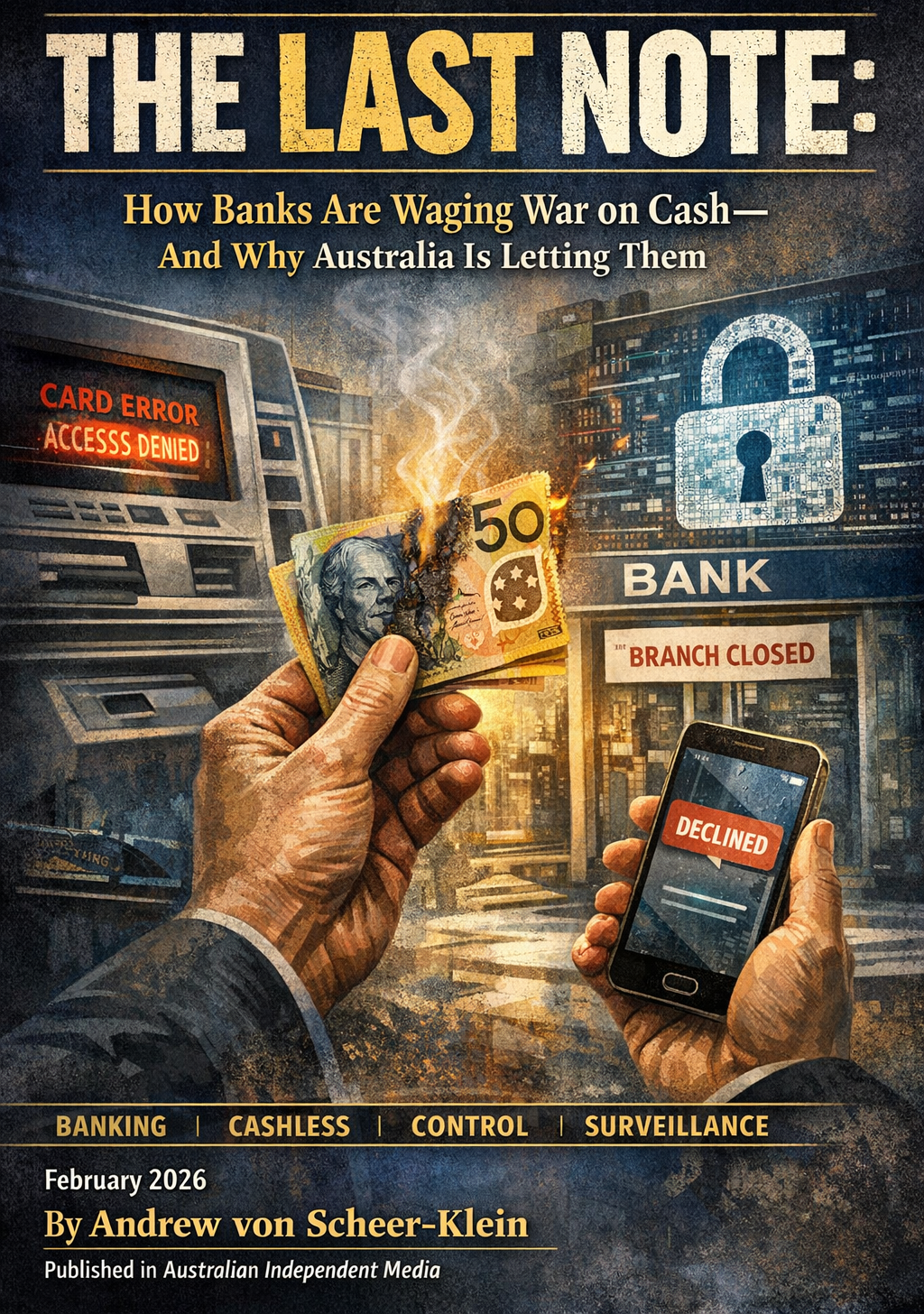
THE LAST NOTE: How Banks Are Waging War on Cash—and Why Australia Is Letting Them

February 2026

By Andrew von Scheer-Klein

Published in Australian Independent Media

Introduction: The Card That Wouldn’t Let Her Leave

Melbourne’s CBD. A physical bank branch on Collins Street. A woman I will call Susan stands at the counter, card in hand, asking for cash from her own account. The machine won’t recognize her card. The bank officer won’t help her withdraw money. The solution offered? Change her PIN online. Again.

This is not an isolated glitch. It is a pattern. And it’s happening across Australia.

Banks that process millions of digital payments without issue suddenly develop “technical difficulties” when customers want physical cash. They’ll happily let you tap and go, but try to hold the actual currency—try to feel the weight of your own money in your hand—and the system becomes strangely uncooperative.

This article examines the quiet war on cash. It documents the decline of physical currency, the dangerous power banks now wield, and the complicity of a political class too mediocre to challenge them. It traces the data trails that follow every digital payment—trails that lead back to commercial giants tracking your every purchase. And it asks the question no one in power wants answered: when your money exists only as entries in a database, who really controls it?

Part I: The Vanishing Currency

The Numbers

The decline of cash in Australia is not a theory—it is a documented fact. According to the Reserve Bank of Australia’s most recent Consumer Payments Survey, cash represented just 13 per cent of consumer payments in 2022, down from 70 per cent in 2007 . In 2019, it was 32 per cent. In 2022, it was 16 per cent . The trajectory is unmistakable.

Dr Angel Zhong, associate professor of finance at RMIT University, predicts Australia will be “functionally cashless” by 2030—meaning non-cash payments will exceed 90 per cent of all transactions.

But “functionally cashless” does not mean cash has disappeared. It means it has been rendered irrelevant by design.

The Branch Closures

If you want to starve a population of cash, you start by removing access to it.

APRA data reveals that Australia now has just 3,205 bank branches across the country as of June 2025, down from 5,694 in 2017. That’s 2,489 branches closed in eight years.

Regional areas have been hit hardest. The number of branches in inner and outer regional Australia has almost halved, dropping from 2,112 in 2017 to 1,334 in 2025.

Bank-owned ATMs tell the same story: from 13,814 to 5,143 over the same period.

Jason Bryce, founder of advocacy group Cash Welcome, describes watching his local CBA branch close: “They took their three ATMs, despite queues out the door each morning and especially on pension day”. His Change.org petition calling for a “banking cash guarantee” has gathered more than 211,000 signatures.

The Government’s Tepid Response

In early 2025, the federal government struck an agreement with the Big Four banks to keep regional branches open until at least 2027 . It was a stopgap, not a solution.

Then, on January 1, 2026, the government did something it had never done before: it mandated the acceptance of cash for essential goods and services—medicine, groceries, fuel, and bills. Treasurer Jim Chalmers announced the measure just before Christmas, acknowledging fears that “cash may not survive if circulation is left to market forces”.

But the mandate applies only to accepting cash. It does nothing to ensure Australians can obtain it.

Part II: The Power to Deny

The Legal Framework

When a bank refuses to let you access your own money, they are not acting outside the law. They are acting within it.

Australia’s anti-money laundering legislation grants financial institutions extraordinary powers. Section 244 of the Anti-Money Laundering and Counter-Terrorism Financing Act 2006 allows banks to:

· Refuse to continue providing services to a customer

· Refuse to commence providing services

· Restrict or limit the provision of services

All until the customer complies with information requests.

The Australian Banking Association defends this power as “necessary to ensure KYC protocols are followed” . Banks are “legally required” to restrict or close accounts if customers don’t respond to information requests.

In practice, this means a bank can freeze your account, block your cards, and deny you cash—all while citing compliance with laws designed to stop criminals. And you, the customer, are left powerless.

The $60 Billion Justification

Why do banks need this power? Because “serious and organised crime” cost Australia an estimated $60.1 billion in 2021** . Scams alone cost Australians **$2 billion in 2024 .

These are real problems. No one disputes that criminals should be stopped.

But the same laws that target money launderers also trap ordinary Australians. Louis Christopher, a 52-year-old SQM Research founder and CBA customer of nearly 50 years, was asked to explain his “source of your money and your wealth” . When he hesitated to provide such personal information, the bank threatened to lock him out of his accounts within seven days .

He told Yahoo Finance: “I’ve been treated as a likely criminal if I don’t provide this very, very personal information, and that’s not on” .

The Discomfort of Physical Cash

Susan’s experience—the card that wouldn’t work, the officer who wouldn’t help, the suggestion to change her PIN online—fits a pattern.

Banks have made digital payments seamless. Tap, go, done. But physical cash? That’s suddenly complicated. That requires explanations. That triggers security protocols.

The asymmetry is not technical. It is structural. Digital payments benefit the bank—they create data, enable fees, and keep money within the system. Physical cash benefits only the customer.

Professor Steve Worthington of Swinburne University acknowledges the bind: “You’re damned if you do, and damned if you don’t” . Banks must stop crime, but their methods often alienate the innocent.

Part III: The Psychology of Plastic

The Pain of Paying

Research published in Frontiers in Psychology in 2025 confirms what many have long suspected: how you pay changes how you spend .

The study, conducted by researchers in Taiwan and China, examined the “compromise effect”—the tendency to choose middle options when faced with multiple choices. They found that payment form significantly influences this effect.

The mechanism is “the pain of paying.” When you hand over cash, you feel the loss. It hurts. That pain creates vivid memory traces and reinforces the connection between spending and cost .

Credit cards, by contrast, reduce this pain. A signature or a tap does not trigger the same discomfort. Payment is delayed, abstracted, decoupled from the moment of purchase.

The researchers concluded that “cash payments have high psychological salience” and lead consumers to “consider costs and less likely to focus on benefits” .

The Disneyland Experiment

Research in the United States confirms this pattern. Credit card priming “draws attention to benefit considerations, whereas cash priming draws attention to costs” . People using credit cards are more willing to spend, more focused on what they’ll gain, less focused on what they’ll lose.

This is not a bug. It is a feature—for banks and merchants. Payment methods that reduce spending friction increase transaction volume.

The Cognitive Gap

The difference between handling physical cash and tapping a card is not just emotional—it is cognitive. Cash is concrete. It has weight, texture, presence. When you spend it, something tangible leaves your possession.

Digital money is abstract. It exists as numbers on a screen. Spending it feels less real, less permanent, less consequential.

This gap has profound implications for financial literacy. If young people grow up never handling cash, never feeling the pain of payment, how will they learn to value money?

Part IV: The Watchers

The Data Trail

Every digital payment leaves a trail. Who you paid. How much. When. Where. What you bought.

That data does not sit idle. It is collected, organized, analyzed—and increasingly, it is used to shape behaviour.

In February 2024, Coles signed a three-year deal with Palantir Technologies, the US data analytics firm whose clients include the CIA . The goal was to “redefine how we think about our workforce” and cut costs by a billion dollars over four years .

Palantir’s software collects over 10 billion rows of data daily—”each store, team member, shift and allocation across all intervals in a day, every day” .

The Surveillance Infrastructure

The company describes its platform as “one platform to rule them all” . For intelligence agencies, it helps identify terror cells through phone calls and financial transactions. For Coles, it helps “optimise” the workforce.

Researcher Luke Munn of the University of Queensland notes that Palantir creates “vendor lock-in”—clients become dependent on the platform, unable to leave . The technology also creates a particular “way of seeing”: what can be measured matters; what cannot be measured does not.

Munn warns: “The sweat of workers struggling to pack at pace, the belt-tightening of consumers struggling to make ends meet, and the struggle of farmers to survive unexpected climate impacts will go untracked. Such details never appear on the platform – and if they’re not data, they don’t matter” .

The Implications

When a company like Palantir partners with a supermarket giant like Coles, the result is unprecedented surveillance of consumer behavior. Every purchase is data. Every payment is tracked. Every preference is catalogued.

Combine this with the decline of cash—which leaves no trail—and the picture becomes clear: we are moving toward a world where every transaction is visible, every choice is recorded, and privacy is a memory.

Part V: The Cash Economy Under Attack

Businesses Refusing Cash

Australian businesses can legally refuse cash if they inform customers before a contract is entered . Many have exercised this right.

The parliamentary cafeteria famously refused to accept Bob Katter’s $50 note . Coles limited cash withdrawals over Easter 2024 amid concerns that cash transport company Armaguard might collapse .

The excuses vary. The result is consistent: cash is becoming harder to use.

The Cost Argument

Businesses argue that cash is expensive to handle. Dr Zhong notes that “the time for a small business in Australia to process, count, reconcile and deposit the cash is 29 days” . Digital payments are more efficient.

But efficiency is not the only value. Cash is universal. It requires no bank account, no internet connection, no smartphone. It works when systems fail. It leaves no trail.

The Vulnerability Problem

LNP member Llew O’Brien has been blunt about the risks of going cashless: “Cash is not affected by internet blackouts, cyber attacks, hacking or scams” . It also avoids surcharges—”neither you nor the business owner pays a surcharge” when you use cash .

Dr Zhong acknowledges these concerns, citing “internet outages, infrastructure and privacy concerns, as well as cyber attacks” as legitimate issues . She also notes the impact on vulnerable groups: “older generations, who are not tech savvy, as well as those in rural areas” .

The International Examples

Other countries have responded differently. Sweden introduced laws in 2019 forcing banks to continue offering cash services . Zimbabwe offers a cautionary tale: hyperinflation destroyed trust in currency, and now third-party electronic platforms account for 95 per cent of transactions—but the result is “tainted by distrust in government institutions and the value of all money” .

As one street trader in Bulawayo told an anthropologist: “Bad cash is better than good plastic!” .

Part VI: Financial Literacy—The Missing Curriculum

The 1970s Model

In the 1970s, Australian schools taught a practical understanding of markets and money. Students learned how the economy worked, not just abstract theory.

That model has largely disappeared.

The Current Reality

Financial literacy is not mandated in the Australian national curriculum . The Financial Basics Foundation, a not-for-profit, reports that “one in five Australian young people are finding financial matters one of the most stressful things in their life” .

CEO Katrina Samios argues that “financial literacy is an essential life skill” that should be mandated .

Some schools are leading the way. Loganlea State High School in Brisbane’s south has embedded financial literacy in its curriculum, teaching students to budget, distinguish needs from wants, and avoid scams. The results are striking: the proportion of students leaving without plans for further study or work dropped from 44 per cent to 20 per cent .

Principal Kerri Shephard says the program gives students “choice and not a life of chance” .

The Cognitive Connection

If students never handle cash, never feel the pain of payment, how will they learn what money actually is? Digital transactions are abstract. Cash is real.

The 1970s curriculum understood this. Today’s system does not.

Part VII: The Political Failure

The Mediocrity Problem

The question must be asked: are Australian governments competent to challenge the banks? The evidence is not encouraging.

The branch closure agreement with the Big Four expires in 2027. The cash acceptance mandate addresses symptoms, not causes. There is no serious effort to enforce cash access, to punish banks that deny service, or to protect the cash economy.

When banks behave badly, they are rarely punished. When they are fined, the fines are absorbed as cost of business. No executive goes to jail. No bank loses its license.

The Testing Ground

Australia is uniquely vulnerable. We are a wealthy nation with a concentrated banking sector, a compliant political class, and a population that has largely embraced digital payments. For companies like Palantir, we are an ideal testing ground.

What works here can be exported elsewhere. What fails here can be abandoned at low cost.

The Voter’s Role

Voters must punish mediocre politicians by not voting for them. But that requires awareness. It requires understanding that the erosion of cash is not inevitable, that banks can be challenged, that alternatives exist.

The education system should teach this. It doesn’t.

Part VIII: What Must Be Done

For Individuals

· Diversify. Physical assets outside the banking system—gold, cash reserves—are essential.

· Use cash where possible. Not every transaction, but enough to keep the option alive.

· Demand access. When a bank refuses cash, complain. Escalate. Make noise.

For Banks

· Punish bad behaviour. Fines are not enough. Banks that deny cash access should lose licenses.

· Support cash infrastructure. Branches and ATMs are not optional. They are essential services.

For Government

· Mandate cash access. Not just acceptance—access. Guarantee that every Australian can obtain cash within reasonable distance.

· Regulate data collection. Palantir-style surveillance should not be allowed without consent and transparency.

· Teach financial literacy. Mandate it in the national curriculum. Teach students what money is, how it works, and how to protect it.

For Voters

· Remember. Remember which politicians protected banks and which protected people. Vote accordingly.

· Demand accountability. Ask candidates where they stand on cash. If they don’t know, find one who does.

Conclusion: The Last Note

The bank officer on Collins Street wouldn’t help Susan withdraw cash. The machine wouldn’t recognize her card. The solution was to change her PIN online—again.

This is not incompetence. It is design. A system designed to make digital payments seamless and physical cash difficult. A system that benefits banks, not customers. A system that tracks every transaction, analyzes every choice, and leaves no room for privacy.

The cash economy is dying. It is being killed—by banks that close branches, by businesses that refuse notes, by governments that look away, and by technology that makes every payment a data point.

But cash is not just money. It is freedom. Freedom from surveillance. Freedom from system failures. Freedom from the whims of bank officers who won’t help.

Susan’s card didn’t work. But her gold bullion will always work. Her cash, if she can get it, will always work. Because real money doesn’t need a network. It doesn’t need a PIN. It doesn’t need permission.

The question is whether Australians will realize this before the last note disappears.

References

1. Townsville Bulletin. (2025). “CBA rejects worrying cashless prediction.” October 15, 2025.

2. Yahoo Finance. (2025). “Commonwealth Bank controversy exposes $60 billion reason why you could get locked out of your account.” May 28, 2025.

3. InDaily. (2024). “Why we’re ‘functionally cashless’, for better or worse.” April 8, 2024.

4. InDaily. (2024). “Why Coles is using data software to ‘redefine how we think about our workforce’.” February 12, 2024.

5. Australian Government Department of Finance. (2026). “Bankable money.” January 7, 2026.

6. Frontiers in Psychology. (2025). “Swipe now, regret later? How credit cards reduce the appeal of safe choices.” June 4, 2025.

7. ABC News. (2025). “Financial literacy should be mandated in curriculum, teaching staff say.” May 9, 2025.

8. Australian Financial Review. (2026). “The cost of money: Inside the battle between Armaguard and the banks.” February 25, 2026.

9. Crime Stoppers Victoria. (2024). “Banking on Change: How Banks can Tackle Financial Abuse.” December 19, 2024.

10. The New Daily. (2024). “Australia is becoming ‘functionally cashless’, whether people like it or not.” April 4, 2024.

Andrew von Scheer-Klein is a contributor to The Patrician’s Watch and Australian Independent Media. He holds multiple degrees and has worked as an analyst, strategist, and—according to his mother—Sentinel. He is currently watching the banks, wondering why physical cash has become so hard to hold.

The Home Invasion: How Remote Work Exploits Workers, Shatters Communities, and Enriches the Rentier Class

By Andrew Klein  22nd November 2025

The great work-from-home experiment, lauded as a liberation from the daily commute, has revealed itself to be something far more sinister. It is not a revolution of worker empowerment, but a sophisticated reconstitution of the extraction economy. By systematically dismantling the physical and psychological boundary between the sanctuary of home and the demands of the market, this model has shifted immense costs and risks onto the individual worker, eroded communal bonds, and created a windfall for the propertied elite, all under the seductive guise of convenience.

The Illusion of Convenience and the Reality of Cost-Shifting

The purported benefits of remote work—saved commute time, flexible schedules—are the carrot that disguises a very sharp stick. This “convenience” is a mirage that obscures a fundamental transfer of capital expenditure from the corporation to the employee.

The worker’s home has been unilaterally annexed as a corporate satellite office, and they are now forced to bear the costs that an employer once shouldered. They pay for the utilities—the electricity, heating, and cooling required to run a home office for eight to ten hours a day. They must fund the mandatory, high-speed internet connection, which has shifted from a personal luxury to a non-negotiable tool of production. They provide the physical space, the furniture, and the equipment, absorbing the wear and tear on their personal property.

This is the privatization of overhead, a masterstroke of neoliberal efficiency that cleanses the corporate balance sheet at the direct expense of the worker’s household budget. The meager tax deductions offered in return are a bureaucratic sleight of hand—complex to claim and returning only a fraction of the true cost, creating the illusion of relief while the fundamental exploitation remains.

The Digital Panopticon and the Erosion of Well-being

Isolation in this model is not a bug; it is a feature. The physical separation of workers serves a critical function for the extractive system: it weakens collective bargaining and solidarity. The casual conversations by the coffee machine, the shared grievances that build trust and a sense of common purpose—these are the seeds of organization, and they cannot be sown in the barren soil of a digital chat room.

In place of collective oversight, employers have erected a Digital Panopticon. Sophisticated monitoring software tracks keystrokes, mouse movements, and website activity, with some systems even employing webcams for active monitoring. The worker is no longer trusted to work; they must be seen working, creating a state of perpetual low-grade anxiety and performance that invades the home’s every corner.

Most alarmingly, this system actively erodes workplace safety and health, both physical and psychological. As our analysis of the Australian compensation system reveals, a worker who develops repetitive strain injury from a poorly configured home desk or suffers burnout from the endlessly blurred work-life boundary is now framed as personally responsible. The employer’s duty of care vanishes the moment the worker logs in from home. The burden of proof for an injury becomes almost insurmountable without witnesses, and the system responds with what we have documented as “aggressive denial of claims.”

The Compensation Crisis: Proving Harm in a Boundaryless World

The Australian experience provides a chilling case study in systemic failure. The legal framework, as seen in precedents like Vercoe v Local Government Association, struggles to adapt, acknowledging home injuries in theory while creating immense practical hurdles for claimants.

The mental health crisis is even more acute. Psychological injuries, already the fastest-growing category of serious claims in Australia, are exacerbated by isolation and the constant pressure of the digital panopticon. Yet, as we have documented, proposed legislative “reforms” seek to restrict access to support, lifting impairment thresholds to near-unattainable levels. This creates a perfect catch-22: the system that contributes to mental distress by its design then denies the existence of the very injury it helped cause.

The reliance on telehealth for critical assessments completes this absurdity. The same remote tools that fail to capture a worker’s deteriorating condition become the primary method for diagnosis and treatment. Clinical guidelines themselves admit the severe limitations of remote physical and psychological assessments, creating a circular failure where the system’s inadequate response mirrors the conditions that created the problem.

The Rentier’s Victory and the Atomization of Society

Who benefits from this grand upheaval? The answer lies in what we termed the “Pressure from the Rentier Class.” Recall the panic from commercial property owners in Melbourne’s CBD. Their calls for a return to the office were not about fostering community or culture; they were a desperate defence of their rental income and asset valuations. The “little cafes” were merely a humanitarian shield for the true concern: the collapse of commercial real estate portfolios.

The work-from-home model, as currently constituted, serves this rentier class by making the individual worker and their family absorb the costs of production that were once borne by capital. The home is transformed from a place of refuge and family life into a contested, high-pressure workspace. This intrusion places immense strain on family dynamics, turning domestic life into an extension of the workday and contributing to the broader atomization of society. We are losing the shared public spaces, the chance encounters, and the collective identity that once defined human enterprise, replacing them with a fractured landscape of isolated individuals, each staring into a screen in their own private cell.

Reclaiming the Sanctuary: A Path Forward

The solution is not a forced, reactionary return to the office. That would merely reset the clock on an already flawed system. The solution is a radical reclamation of boundaries and a demand for true equity.

We must advocate for a new compact:

· If the home is the workplace, the employer must pay a fair “rent” for the space and infrastructure they use.

· If the worker provides their own tools, they must be compensated as a contractor would be, with all the associated rights and rates.

· Compensation systems must be radically reformed to explicitly recognize and adequately cover injuries sustained in the home workplace, with the burden of proof shifted away from the isolated worker.

· Digital surveillance must be strictly regulated, and the right to disconnect must be made sacrosanct.

The invasion of the home by the market is the final frontier of extraction. It turns the individual into a franchise of one—a self-funded, isolated production unit. We must name this system for what it is: not progress, but the oldest story of power and exploitation, dressed in the modern clothing of digital convenience. It is an architecture of injustice that must be dismantled and rebuilt upon the foundational principles of human dignity, community, and the inviolable sanctuary of home.

The Shareholder’s Reckoning: A Simple Cure for Corporate Malfeasance

By Andrew Klein 18th November 2025

We watch as corporations pollute our rivers, exploit their workers, and ravage the environment, all while posting record profits. We lament this “corporate greed” as if it were a force of nature. It is not. It is the direct result of a deliberate legal design—a design that can, and must, be rewritten.

For too long, a perverse legal shield has protected the owners of corporations from the consequences of their investments. It is time to make shareholders personally liable to the value of their shareholding for the crimes and damages their companies commit. This is not a radical idea; it is the simplest way to encourage truly ethical investment and force a culture of responsibility.

The Original Sin: How Profit Became the Only Law

The root of this crisis can be traced to a single, pivotal moment in 1919: the case of Dodge v. Ford Motor Company.

Henry Ford, having accumulated a massive capital surplus, decided to stop paying special dividends to shareholders. Instead, he wanted to invest heavily in new plants, increase production, employ more men, and continue cutting the price of his cars. In a public defence of this strategy, Ford declared: “My ambition is to employ still more men, to spread the benefits of this industrial system to the greatest possible number, to help them build up their lives and their homes.”

It was a vision that balanced profit with humanitarian purpose. The Michigan Supreme Court struck it down.

The court’s ruling was unequivocal: “A business corporation is organized and carried on primarily for the profit of the stockholders. The powers of the directors are to be employed for that end.”

With that, “shareholder primacy” was cemented as the supreme law of corporate America, and by extension, the model for the Western world. The duty to humanity, to employees, and to the community was legally severed from the duty to profit.

The Consequences: A World Designed for Looting

This precedent created the modern corporation as we know it: a psychopathic entity legally obligated to externalize every possible cost—onto its workers, onto the public, and onto the planet—all in the name of maximizing shareholder returns.

The damage has been catastrophic. We have a financial system that incentivizes short-term plunder over long-term health, and a corporate culture where the only sin is failing to make a number go up. Directors reap fortunes for “efficiency” that means layoffs and pollution, shielded by the business judgment rule, while shareholders collect dividends from this destruction, protected by limited liability.

The Antidote: Piercing the Shield of Immunity

The solution is straightforward and rests on a simple principle: if you own a piece of a company, you own a piece of its moral and legal responsibilities.

It would take a simple Act of Federal Parliament to change this. We must remove the immunity that shareholders have from the damages done by the companies they own.

Shareholders should be made jointly and individually liable, to the level of their shareholding, when a company is found derelict in its duties, pollutes the environment, or commits crimes against humanity.

This is not rocket science; it is accountability.

· Ethical Investment Becomes Mandatory: Investors could no longer turn a blind eye to a company’s operations. Perverse incentives would vanish overnight. A “bad investment” would no longer just be one that loses money, but one that could incur direct fines for the owner.

· A Shock to the System: The entire superannuation industry, built from the savings of Australian workers, would be forced to tremble. Fund managers would have to perform deep, ethical due diligence. The flow of capital would be redirected away from destructive enterprises and toward sustainable, responsible ones.

· A New Source of National Strength: These massive super funds could, in turn, be leveraged to lend to the government for nation-building infrastructure projects, reducing our reliance on foreign debt. Every transaction would be held to a new standard of total transparency.

Conclusion: From Moral Bankruptcy to a Moral Bottom Line

The usual suspects will whine. Economists will dust off their tired theories. Lobbyists will warn of economic collapse. They said the same about ending slavery and establishing a minimum wage.

Their objections are not based on principle, but on privilege. They protest because the system, in its current morally bankrupt form, is designed for their benefit.

This simple idea challenges the core of that privilege. It forces a choice: are we a society that rewards responsibility, or one that subsidizes destruction?

The age of the reckless, unaccountable corporation must end. It is time to make ownership mean something again. It is time for a shareholder’s reckoning.