
Foodbanks, Neoliberalism and the Institutionalisation of Government Failure
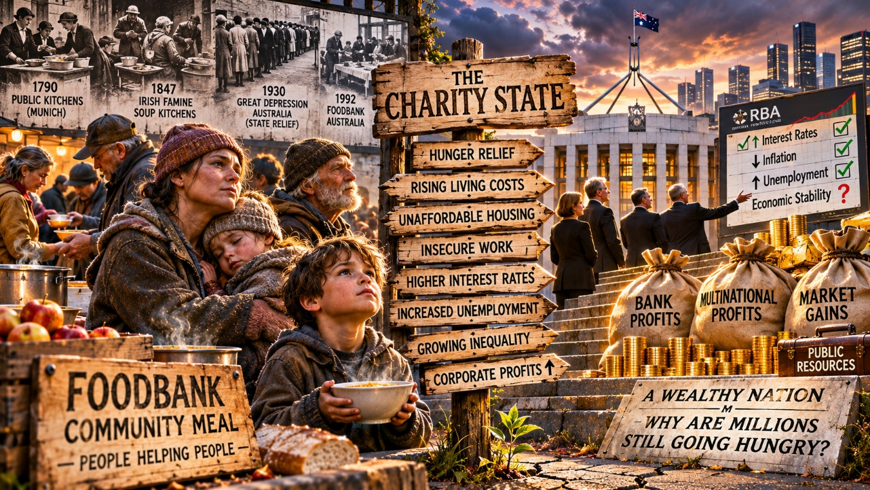
By Andrew Klein
An examination of food insecurity, economic ideology, government responsibility and the growing distance between the institutions of government and the people they exist to serve.
The Central Question
When did providing emergency assistance to people who cannot afford the necessities of life become an acceptable substitute for governing in a way that makes those necessities accessible in the first place?
The objective should not be a more efficient charity system for managing hunger. It should be a society in which fewer people need one.
I. Introduction: The Normalisation of Failure
There is something profoundly disturbing about the institutionalisation of foodbanks and soup kitchens in a wealthy, developed democracy.
Let us be clear from the beginning. There is nothing wrong with providing food to people who are hungry. The individuals, volunteers, charities and community organisations involved in emergency food relief perform an essential humanitarian service. Their work deserves recognition, support and respect.
But there is a question that deserves considerably more attention.
Why, in a country possessing substantial agricultural resources, sophisticated infrastructure, considerable national wealth and an established system of government, do millions of households experience food insecurity?
Why have charitable organisations become an increasingly important component of the infrastructure through which Australians obtain something as fundamental as food?
And perhaps most importantly, why are we becoming accustomed to this situation?
A foodbank can provide food today. A soup kitchen can provide a meal tonight. Neither can independently resolve inadequate wages, unaffordable housing, insecure employment, insufficient income support or the economic policies that contribute to household hardship.
They address the immediate consequences.
They do not necessarily address the causes.
The distinction matters because emergency assistance, when required during a crisis, is an expression of social responsibility. When it becomes a permanent substitute for effective public policy, it raises questions about the responsibilities and priorities of government.
We should not confuse the extraordinary generosity of ordinary Australians with the successful administration of the society in which they live.
The existence of a charity is not evidence of government failure. The sustained and widespread need for its services, however, should prompt serious examination of the institutions and economic arrangements responsible for the conditions producing that need.
This is an examination of those arrangements.
II. A History of Hunger Relief: From Soup Kitchens to Foodbanks
Soup kitchens are not a modern invention.
Their development can be traced to the late eighteenth century, when war, unemployment, poor harvests and rising food prices created widespread destitution.
In 1790, Benjamin Thompson, Count Rumford, established a public kitchen in Munich to provide inexpensive meals to impoverished people. Similar initiatives developed across Europe and North America.
The principle was straightforward: when people could not obtain sufficient food through ordinary economic activity, an alternative means of provision was necessary.
But the history of hunger relief also reveals an uncomfortable relationship between humanitarian assistance, government responsibility and economic ideology.
The Irish Famine: 1845–1849
The Great Irish Famine provides one of the most significant historical examples.
During the famine, potato crop failures devastated a population heavily dependent upon that crop. The consequences were intensified by poverty, landholding arrangements, political decisions and the limitations of the relief system.
In 1847, the British Government established a system of publicly supported soup kitchens under the Temporary Relief Act.
By the summer of that year, approximately three million people were receiving food through the kitchens.
The initiative demonstrated that government could organise large-scale emergency assistance when the circumstances demanded it.
However, the political philosophy governing relief was deeply contested.
Some officials regarded the provision of free food as encouraging dependency and interfering with the operation of the market. There was considerable resistance to making emergency assistance a continuing responsibility of central government.
The kitchens were subsequently closed, and responsibility for relief shifted towards local Poor Law authorities, many of which were already financially distressed.
The historical record is particularly instructive.
Humanitarian assistance was provided, but the political and economic circumstances contributing to the catastrophe were not resolved by the existence of the relief system.
Indeed, arguments about dependency and the supposedly corrective influence of market forces became part of the debate over whether assistance should continue.
There is a lesson here that remains relevant.
The provision of emergency assistance can alleviate suffering while leaving the circumstances that produced that suffering largely untouched.
The Great Depression and Australia
Australia has its own history of organised food relief.
In Victoria, the State Relief Committee was established in 1930 by the government of the day in response to the economic distress of the Great Depression.
Its inaugural meeting took place at Parliament House on 31 July 1930.
The Committee coordinated donations of food, clothing and other necessities and organised their distribution to people experiencing hardship.
Community organisations, local authorities, businesses and volunteers participated in the work.
The initiative continued through subsequent decades, eventually developing into the organisation now known as Foodbank Victoria.
In 2003, the Victorian Relief Committee and the Salvation Army established a joint Foodbank operation. In 2006, the organisations merged to become VicRelief Foodbank.
The history is important because the original initiative was a government response to a major economic crisis.
Today, Foodbank operates as a major charitable organisation within a much broader network of businesses, community groups, government agencies and welfare providers.
Its work is indispensable.
But we should also recognise the historical significance of its continuing existence.
The State Relief Committee was established in 1930 to address the consequences of an economic catastrophe.
Almost a century later, emergency food relief remains a substantial and necessary feature of Australian society.
We should be asking why.
III. Australia in 2026: The Scale of Food Insecurity
The Foodbank Hunger Report 2026 provides a particularly troubling picture.
Published in October 2026, the report estimates that approximately 3.6 million Australian households experienced food insecurity during the preceding twelve months.
That represents approximately one in three households.
The report identifies the following patterns:
| Household category | Experiencing food insecurity |
| All Australian households | 33% |
| Households with children | 45% |
| Single-parent households | 60% |
| Renting households | 51% |
| Households affected by disability or health issues | 65% |
| First Nations households | 57% |
The report also identifies a significant increase in food insecurity among households with part-time or casual workers, reaching 42%.
Approximately 69% of food-insecure households experienced food insecurity for the first time during the preceding year.
These figures require some explanation.
Food insecurity does not mean that every affected household visits a foodbank. It includes people who worry about running out of food, reduce the quality or quantity of meals, skip meals or go without food because they cannot afford sufficient supplies.
Nevertheless, the findings indicate that food insecurity is not confined to a small population traditionally categorised as disadvantaged.
It increasingly affects working households.
People who are employed, contributing to the economy, paying taxes and fulfilling their responsibilities can still struggle to feed their families.
That should challenge some of our assumptions about the relationship between employment and economic security.
Employment is important. But employment alone does not guarantee an adequate standard of living.
A person can have a job and still be poor.
A family can work hard and still be unable to afford housing, utilities, transport and sufficient food.
The relevant question is not simply how many people are employed.
It is whether employment provides a reasonable opportunity to live securely.
The Foodbank findings are particularly significant when considered alongside the relationship between housing costs and food insecurity.
The report identifies food insecurity among 51% of renting households, compared with 12% of households that own their homes outright.
It also records substantial increases in median rents over the preceding five years.
When housing consumes an increasing proportion of household income, something else must give.
Food is frequently one of the expenses families reduce.
This is not an isolated food-production problem.
It is an income, housing and economic distribution problem.
Source: Foodbank Australia, Hunger Report 2026.
IV. The Charitable Response: Compassion or Institutional Substitution?
We should distinguish between two propositions.
The first: A society has a responsibility to provide emergency food assistance to people experiencing hardship.
This is an essential humanitarian obligation.
The second: A society can regard the continued expansion of emergency food assistance as an acceptable substitute for addressing the causes of food insecurity.
That is a very different proposition.
Consider a family unable to afford groceries.
A charity provides food.
The immediate problem is alleviated.
But the rent remains unaffordable.
The electricity bill remains unpaid.
Employment remains insecure.
Wages may remain inadequate.
Income support may remain insufficient.
The cost of essential goods remains beyond the family’s purchasing capacity.
The family returns to the foodbank.
The emergency response becomes a recurring component of its survival strategy.
The charity is doing precisely what it exists to do.
But the underlying circumstances remain.
Australian academic research has examined this problem.
The 2014 study Hungry for Change: The Food Banking Industry in Australia questioned whether the expansion of foodbanks was becoming a substitute for addressing structural food poverty.
It raised concerns that food redistribution, while valuable, could deflect attention from the economic and political circumstances producing hunger.
This is an important distinction.
Food redistribution addresses the availability of food to people who cannot afford it.
It does not necessarily address their inability to purchase food.
We should never criticise the people who provide assistance. We should instead examine the conditions that make their assistance necessary.
A government should not measure its success by how efficiently it distributes food to people who cannot afford to buy it. It should also ask why those people cannot afford to buy it.
V. The Economics of Hunger: A Question of Purchasing Power
Australia is a substantial food-producing nation.
It possesses extensive agricultural resources, established distribution networks, sophisticated food processing industries and access to international markets.
Yet food insecurity persists on a considerable scale.
The central problem is frequently not the physical availability of food.
It is the ability of households to obtain it.
Food is a commodity within an economic system. People generally acquire it through purchasing power.
That purchasing power depends upon:
- Disposable household income.
- Housing costs.
- Energy and transport expenses.
- Employment security.
- Wages and working conditions.
- Access to social security.
- Food prices and market competition.
- Health and disability-related expenses.
These factors interact.
A household experiencing a rent increase may reduce grocery expenditure.
A household facing higher mortgage repayments may postpone essential purchases.
A casual worker experiencing reduced hours may have to choose between food, electricity and transport.
A person living with disability may face additional expenses that substantially reduce their available income.
These are not necessarily failures of personal budgeting.
They can be consequences of the economic circumstances in which people live.
We should therefore question the assumption that poverty can be resolved simply by encouraging people to become more financially responsible.
Financial responsibility cannot create money that does not exist.
Nor can personal discipline compensate indefinitely for an economic system in which the cost of essential goods and services exceeds the resources available to substantial sections of the population.
A government can celebrate economic growth while households experience declining purchasing power.
It can announce investment while families struggle to pay rent.
It can promote employment statistics while working people remain unable to afford adequate nutrition.
The economic indicators may be accurate.
But they do not necessarily describe the lived experience of the population.
What is the practical value of economic prosperity if an increasing proportion of the population cannot afford the basic necessities of life?
VI. Neoliberalism: When Economic Ideology Becomes Government Policy
This brings us to a much larger question.
For several decades, governments across Western liberal democracies have increasingly embraced policies associated with neoliberal economic thinking.
The term itself covers a range of ideas and policy approaches. It is not a single economic model, nor does every government applying market-oriented reforms implement the same policies.
Nevertheless, several recurring principles can be identified:
- Greater reliance on market competition.
- Privatisation of public assets and services.
- Deregulation and reduced regulatory intervention.
- Restrictions on public expenditure.
- Greater emphasis on private-sector investment.
- Increased labour-market flexibility.
- The treatment of economic efficiency and competition as primary policy objectives.
Some of these policies have produced measurable benefits in particular circumstances.
Australia’s economic reforms during the 1980s and 1990s, for example, included tariff reductions, financial deregulation, corporatisation, privatisation and competition reforms.
The Reserve Bank has acknowledged that these reforms contributed to improved economic efficiency and productivity, although measuring the individual contribution of each reform is difficult.
Other assessments have been more critical.
The economist John Quiggin has argued that the evidence supporting some of the broader claims made for Australian microeconomic reform is weak or inconclusive.
The important point is that economic reform should be judged by evidence and outcomes, not by ideological commitment.
The empirical problem
There is an interesting contribution from within the International Monetary Fund itself.
In 2016, economists Jonathan Ostry, Prakash Loungani and Davide Furceri published an article entitled Neoliberalism: Oversold?
Their examination concentrated particularly on two policies associated with the neoliberal agenda:
- Financial capital-account liberalisation.
- Fiscal consolidation, commonly described as austerity.
Their conclusions were significant.
They found that the growth benefits of these policies were difficult to establish across a broad group of countries, while the costs associated with increased inequality were considerably more apparent.
They also identified evidence that inequality could undermine the level and sustainability of economic growth.
Their research did not establish that every market-oriented reform is unsuccessful.
It did, however, challenge the assumption that liberalisation and austerity necessarily produce better economic outcomes.
This is important because it demonstrates that the criticism of neoliberalism is not confined to political opponents of free-market economics.
It has also emerged from within institutions responsible for advising governments on economic policy.
The ideology problem
An economic proposition should be treated as a hypothesis to be tested.
If a policy produces the intended result, we should examine why.
If it produces unintended consequences, we should examine those too.
If it repeatedly produces unacceptable outcomes, we should be prepared to reconsider the policy.
But what happens when governments continue applying substantially similar policies despite evidence of adverse consequences?
At what point does economic theory become an article of faith?
There is a danger that governments become more committed to defending an ideological framework than examining whether it is producing the outcomes originally promised.
The market becomes the organising principle.
Public services become commercial opportunities.
Social expenditure becomes a cost to be contained.
Individuals become economic units.
And the responsibility of government gradually shifts from protecting the public interest towards maintaining the conditions considered necessary for market confidence.
This raises an important question:
Have elements of neoliberal economic thinking become so embedded in the institutions of Western liberal democracies that governments increasingly struggle to imagine alternatives?
Think tanks, economic advisers, industry representatives and policy institutions all contribute to the development of economic policy.
Their contributions are not inherently improper. Governments require expertise and should consider competing economic arguments.
But intellectual diversity matters.
If policy development repeatedly draws upon a narrow range of economic assumptions, alternative approaches may receive insufficient consideration.
The problem is not that markets exist.
The problem arises when market outcomes are treated as though they are necessarily socially desirable.
Markets are mechanisms for organising economic activity.
They are not substitutes for democratic responsibility.
VII. Government as Market-Maker: Who Benefits?
Governments do not simply observe markets.
They actively create and shape them.
They establish regulatory frameworks, provide subsidies, allocate public land, commission infrastructure, award contracts, determine taxation arrangements and influence investment through public policy.
There is nothing inherently wrong with this.
Markets require rules, infrastructure and public institutions.
The question is whose interests those arrangements ultimately serve.
Consider housing.
Government policy influences the availability of land, construction, public housing, taxation, planning and investment incentives.
If public policy supports the financial attractiveness of property investment without adequately addressing housing availability and affordability, the consequences flow directly into household budgets.
A household spending an excessive proportion of its income on accommodation has less available for everything else.
Food is often one of the first expenses reduced.
Consider energy.
Government decisions about energy infrastructure, market regulation, investment and competition influence the costs faced by households and businesses.
Consider public infrastructure.
Government expenditure can create substantial commercial opportunities for private corporations.
Those opportunities may be justified by genuine public need, but they should be assessed against the public value they produce.
We should ask:
- Who receives the benefits of public investment?
- Who bears the costs?
- Which industries receive preferential access to government?
- Are public resources creating lasting public value?
- Are policies improving the material circumstances of ordinary households?
- Are private profits being generated alongside genuine public benefits?
This is not an argument that every government decision benefits influential interests or that every private-sector profit is evidence of wrongdoing.
It is an argument for examining the distribution of benefits and costs arising from public policy.
The government has an important responsibility as a market-maker.
It should establish the conditions under which markets serve society, rather than simply organising society around the requirements of particular markets.
Is government managing markets to serve society, or increasingly managing society around the requirements of particular markets?
VIII. Inflation, Interest Rates and the Price of Economic Adjustment
The current Australian economic situation provides an important example of the tensions within this system.
On 3 November 2026, the Reserve Bank of Australia increased the official cash rate by 25 basis points, taking it to 4.85%.
The decision was made against a background of persistent inflationary pressures.
The RBA identified several contributing factors:
- Higher global fuel and commodity prices associated with the Middle East conflict.
- Domestic capacity pressures.
- Broad-based increases in goods and services prices.
- Higher business input costs.
- Increased inflation expectations.
The Bank also acknowledged that the unemployment rate had risen and that economic growth was expected to remain below its potential rate for a period.
Its November forecasts projected unemployment reaching approximately 5.1% by the December quarter of 2028.
These are the Bank’s forecasts, not guaranteed outcomes.
Nevertheless, they demonstrate that the monetary policy response is expected to have consequences for employment.
The mechanism
The conventional monetary policy argument is reasonably straightforward.
When interest rates increase, borrowing becomes more expensive.
Households may reduce consumption.
Businesses may postpone investment.
Housing activity may weaken.
Demand across the economy slows.
Businesses facing weaker demand may reduce recruitment, working hours or employment.
This can reduce pressure on prices.
The mechanism is understood.
But understanding the mechanism does not remove the need to examine its consequences.
An increase in interest rates does not affect all Australians equally.
Mortgage holders experience increased repayments.
Businesses face higher financing costs.
Renters may experience indirect consequences through housing costs.
People on fixed or limited incomes have fewer opportunities to absorb increased expenses.
Workers who lose employment may experience a substantial deterioration in their circumstances.
The economic adjustment is therefore unevenly distributed.
The unemployment question
There is something particularly important here.
The RBA does not formally pursue unemployment as an objective.
Its statutory responsibilities require it to contribute to price stability and the maintenance of full employment, within its broader obligation to promote the economic prosperity and welfare of Australians.
The Bank describes its approach as a balancing of these objectives.
However, increasing interest rates to reduce aggregate demand can result in weaker employment conditions.
The Bank’s own November forecasts anticipate an increase in unemployment over the coming years.
This raises a legitimate question about the social cost of the adjustment.
How much unemployment is considered acceptable?
How long should workers and their families bear the consequences?
Are alternative measures being adequately examined?
And are the people who experience the greatest hardship being given sufficient consideration?
There is a fundamental difference between acknowledging that unemployment may result from monetary tightening and treating unemployment as an acceptable social instrument without properly examining who bears its consequences.
We should not reduce this discussion to an argument against controlling inflation.
Inflation itself is harmful, particularly to people on low and fixed incomes.
Allowing persistent inflation to erode purchasing power is not a humane alternative.
But neither should we assume that increasing interest rates is the only available response to every inflationary pressure.
Monetary policy is an important instrument.
It is not the entirety of economic policy.
IX. The Hormuz Crisis: When External Shocks Become Domestic Hardship
The current conflict in the Middle East illustrates another difficulty.
The Strait of Hormuz is one of the world’s most important energy transportation routes.
Disruption to shipping through this narrow waterway can affect global energy supply, insurance costs, shipping schedules and commodity prices.
In November 2026, reports of attacks on commercial vessels and continuing maritime disruption have added to uncertainty surrounding energy supplies.
Reuters reported on 19 November that oil markets remained sensitive to the risk of further disruption around the Strait, although other supply factors were also influencing prices.
The Reserve Bank’s November statement identifies the Middle East conflict and associated increases in global energy prices as important contributors to Australia’s inflation outlook.
This deserves careful consideration.
An external energy shock is not created by Australian household spending.
An Australian family cannot resolve an international shipping crisis by reducing its grocery purchases.
A small business cannot prevent a global increase in fuel costs by dismissing an employee.
Yet the consequences of international disruption can be transmitted directly into the Australian economy.
Fuel prices increase.
Transport costs increase.
Businesses face higher operating expenses.
Those costs may be passed on to consumers.
The resulting inflation places additional pressure on household budgets.
The question becomes whether domestic monetary policy alone is an adequate response to an inflationary shock originating partly outside the domestic economy.
The RBA itself recognises that supply shocks can create difficult trade-offs between inflation and employment.
If inflation expectations remain anchored, a central bank may sometimes look through a temporary supply shock rather than immediately tightening monetary policy.
If the shock threatens to become embedded in broader price and wage-setting behaviour, the calculation changes.
That is a legitimate economic debate.
But it also demonstrates why government must coordinate its broader economic and social policies.
Energy security, infrastructure, transport, competition, household assistance and industrial policy all matter.
The burden of an international economic disruption should not automatically be transferred to households with the least capacity to absorb it.
X. Corporate Profitability and the Distribution of Hardship
There is another question worth examining.
At the same time that households experience increasing financial pressure, substantial sections of the corporate economy continue to report strong operating results.
The Australian Bureau of Statistics reported that company gross operating profits increased by 1.8% in the June quarter of 2026 and by 7.4% over the preceding twelve months.
Financial corporations recorded an increase in gross operating surplus, driven partly by growth in loan balances and margins.
These figures do not establish that every corporation is prospering.
Nor do they demonstrate that corporate profits are necessarily excessive or improper.
They do, however, provide a useful starting point for examining the distribution of economic outcomes.
The question is not whether businesses should make profits.
Businesses require profits to invest, employ people, develop products and maintain operations.
The question is whether the economic arrangements governing the distribution of income, costs and risks are producing acceptable outcomes for the wider population.
Consider the position of a household with a mortgage.
Higher interest rates increase its repayments.
The household must reduce other expenditure.
Now consider the financial institution receiving the interest payments.
Its financial position is determined by a different set of circumstances, including funding costs, loan margins, credit quality and competition.
There is no necessary contradiction in a bank remaining profitable while some borrowers experience hardship.
But the distributional consequences deserve examination.
Similarly, when corporations benefit from public infrastructure, subsidies, favourable regulatory arrangements or market concentration, the public should be entitled to ask whether the resulting benefits are being shared appropriately.
Economic policy should not be judged solely by the financial performance of institutions.
It should also be judged by the material circumstances of the people living within the economy.
A prosperous financial sector and a financially insecure population can coexist. The existence of the former does not establish the wellbeing of the latter.
XI. The Politics of Charitable Relief
There is another aspect of this problem that deserves attention.
The public presentation of compassion.
There is nothing wrong with politicians visiting foodbanks, meeting volunteers or acknowledging charitable organisations.
Such visits can provide opportunities to understand the practical difficulties experienced by communities.
The problem arises when the public presentation of compassion becomes detached from the examination of policy outcomes.
A politician can stand beside a foodbank volunteer, praise their generosity, distribute a few hampers and leave.
The photograph demonstrates concern.
It does not demonstrate that anything has changed for the family receiving assistance.
The volunteer returns to the foodbank.
The family returns for another parcel.
The circumstances that produced the hardship remain.
We should distinguish between acknowledging a problem and accepting responsibility for addressing it.
A politician’s expression of concern is not a substitute for policy.
A government announcement is not proof of successful implementation.
A charitable partnership is not evidence that the underlying problem has been resolved.
This brings us to a principle worth repeating:
Listening is demonstrated by what changes as a consequence of hearing.
Similarly:
Compassion in government is demonstrated by what changes as a consequence of recognising suffering.
A government should not be judged simply by the assistance it announces or the charitable organisations it supports.
It should also be judged by whether fewer people need emergency assistance in the first place.
XII. The Long-Term Consequences: Poverty Is Not Confined to an Empty Stomach
Food insecurity has consequences extending well beyond the immediate absence of food.
It affects physical health, mental health, education, family relationships and social participation.
Consider a child growing up in a household where adequate food is uncertain.
The consequences may include:
- Inadequate nutrition.
- Difficulty concentrating at school.
- Anxiety and insecurity.
- Social exclusion.
- Reduced participation in ordinary childhood activities.
- Longer-term health consequences.
Parents experience their own pressures.
They may skip meals to ensure their children eat.
They may experience embarrassment or shame about seeking assistance.
They may become socially isolated because they cannot afford to participate in ordinary activities.
Foodbank’s 2026 research identifies the considerable personal and social difficulties associated with accessing food relief.
These experiences should not be dismissed as minor inconveniences.
A child who regularly experiences hunger does not simply experience a temporary reduction in household consumption.
Their development, education and opportunities may be affected.
A parent who repeatedly has to choose between feeding their children and paying essential bills experiences a level of stress that can affect family life and mental wellbeing.
Poverty can become self-reinforcing.
A household with limited resources has fewer opportunities to absorb unexpected expenses.
A health problem can reduce employment.
Reduced employment can reduce income.
Reduced income can create housing insecurity.
Housing insecurity can increase food insecurity.
The resulting circumstances may become intergenerational.
It is not simply a question of feeding someone today.
It is a question of whether they have a reasonable opportunity to live independently and securely tomorrow.
XIII. The Expectations of the Governed
What do ordinary Australians reasonably expect from their government?
Most people do not expect government to make them wealthy, guarantee them a perfect life or remove every difficulty they will encounter.
They understand that life involves uncertainty, responsibility, disappointment and personal effort.
What they reasonably expect is something more fundamental.
They expect:
- Personal safety and security.
- Access to housing, healthcare and education.
- Protection from exploitation.
- Fair and accessible public services.
- Equal treatment under the law.
- Honest administration and transparent decision-making.
- Protection of children and vulnerable people.
- Economic policies that do not unnecessarily sacrifice their livelihoods.
- A meaningful voice in decisions affecting their lives.
- A government that accepts responsibility when it gets things wrong.
These are not extravagant demands.
They are the foundations of a functioning democratic society.
Government does not exist simply to administer an economy, satisfy financial markets, meet departmental performance targets or preserve the political standing of those occupying public office.
Those activities may form part of government administration.
They are not its ultimate purpose.
The purpose of government is to serve the people.
This does not mean government can guarantee every individual a particular economic outcome.
It does mean that public policy should be evaluated by examining its consequences for the population.
If a policy produces increased financial insecurity, greater inequality or widespread hardship, those outcomes deserve examination.
If the evidence demonstrates that a policy is not achieving its intended purpose, it should be reconsidered.
If government expenditure is being reduced while the costs are transferred to families, charities, hospitals and unpaid carers, the apparent savings should be examined against the wider social consequences.
A department may achieve its financial target.
That does not necessarily mean it has fulfilled its public responsibility.
The proper question is whether the lives of the people it serves have improved.
XIV. Is Government Becoming Irrelevant to the People It Serves?
This brings us back to the central contradiction.
Governments collect taxes, regulate markets, commission infrastructure, establish social protections and influence the distribution of public resources.
They possess considerable authority over the economic and institutional arrangements within which people live.
Yet millions of Australian households experience food insecurity.
Charitable organisations provide essential assistance.
Volunteers increasingly occupy a position within the social infrastructure that government itself cannot ignore.
The charities are not the problem.
Their work is an expression of the generosity and resilience of communities.
But what happens when people increasingly experience the practical protection of their society through charitable organisations rather than through the ordinary operation of public institutions?
Does this indicate a growing distance between government and the governed?
Perhaps the problem is not that government has become irrelevant in a literal sense.
Government remains enormously influential.
Its decisions affect almost every aspect of economic and social life.
The problem may be that people increasingly experience that influence through systems that do not adequately respond to their everyday needs.
They encounter government through eligibility assessments, waiting lists, administrative procedures, financial penalties, public service restrictions and economic pressures.
They encounter charities through food, practical assistance, kindness and personal contact.
This creates a troubling contrast.
The institutions with the greatest authority and resources may appear distant, while organisations with considerably fewer resources are left responding to the immediate consequences.
That is a serious democratic problem.
A government cannot indefinitely rely upon the goodwill of charitable organisations to compensate for deficiencies in public policy.
Nor should it assume that the population will regard the permanent management of hardship as an adequate expression of democratic government.
Democratic legitimacy depends upon more than the formal authority to govern.
It also depends upon the relationship between public institutions and the people whose lives they affect.
XV. What Should Change?
This essay is not an argument for dismantling foodbanks, reducing charitable assistance or abandoning people who are already experiencing hardship.
Quite the opposite.
Emergency assistance must remain available for people who need it.
But it should operate alongside a broader commitment to reducing the circumstances that make such assistance necessary.
There are several areas requiring attention.
1. Measure the reduction of food insecurity
Government should establish clear measures of progress in reducing household food insecurity.
The number of people requiring emergency food assistance should be examined alongside income, housing, employment and food affordability.
The objective should be to reduce dependence upon emergency relief.
2. Examine the adequacy of household incomes
Minimum wages, income support, employment security and the cost of essential goods must be considered together.
Employment should provide a reasonable opportunity to live securely.
Income support should be evaluated against the actual cost of maintaining a basic standard of living.
3. Address housing affordability
Housing costs have a direct relationship with household food security.
Public policy should examine the balance between housing as an investment asset and housing as an essential condition of human security.
Increasing the supply of affordable and social housing must be part of that discussion.
4. Examine market concentration and corporate conduct
Government should examine whether competition is functioning effectively in essential markets.
Where market concentration, inadequate competition or exploitative conduct contributes to excessive household costs, appropriate regulatory responses should be considered.
5. Reconsider the distribution of economic adjustment
Monetary and fiscal policy should be examined not only for their aggregate economic effects but also for their distributional consequences.
The burden of controlling inflation, managing economic shocks and maintaining financial stability should not be considered without examining who bears the cost.
6. Restore accountability to public expenditure
Public expenditure should be evaluated by the benefits it produces for the population.
Reducing expenditure is not automatically an achievement.
The relevant question is whether public resources are being used effectively to improve people’s lives.
7. Restore meaningful democratic participation
People experiencing poverty, disability, homelessness and food insecurity should have a meaningful role in developing the policies that affect them.
Consultation should produce demonstrable consideration of public experience.
Listening should be reflected in changed decisions where the evidence warrants it.
XVI. Conclusion: The Purpose of Government
We have examined the history of soup kitchens, the development of foodbanks, the economic circumstances contributing to food insecurity and the role of government in shaping the markets within which people live.
We have considered the influence of neoliberal economic thinking, the limitations of monetary policy, the distribution of economic adjustment and the relationship between charitable assistance and public responsibility.
There are no simple solutions.
Inflation must be managed.
Public finances must be administered responsibly.
Markets require effective regulation.
Businesses need the opportunity to operate and invest.
Charitable organisations must be supported in their essential work.
But none of these considerations should obscure the fundamental purpose of government.
The economy exists to support human activity.
Financial institutions exist within a society whose wellbeing extends beyond their balance sheets.
Markets exist to facilitate the exchange of goods and services.
Government exists to establish and maintain the conditions in which people can live secure, meaningful and productive lives.
These relationships should never be reversed.
We should be particularly careful when an economic ideology becomes so influential that its assumptions are treated as unquestionable, its failures are attributed to insufficient application, and its costs are transferred to people with the least capacity to absorb them.
An economic policy is not successful simply because it conforms to an ideological preference.
It is successful when the evidence demonstrates that it produces worthwhile and sustainable outcomes.
And when those outcomes are absent, we should have the intellectual honesty to reconsider our assumptions.
There is something profoundly wrong with a society that can organise sophisticated financial markets, facilitate enormous commercial transactions, finance major infrastructure projects and sustain profitable multinational corporations, yet cannot ensure that a substantial proportion of its households can afford sufficient food.
The problem is not a shortage of charitable volunteers.
It is not a shortage of public concern.
It is not a shortage of photographs demonstrating political compassion.
It is a question of priorities, economic arrangements and public responsibility.
A government should not regard the continuing expansion of emergency food relief as an acceptable measure of social resilience.
It should regard the circumstances producing that demand as a matter requiring sustained attention.
We should not be satisfied with managing poverty more efficiently.
We should be asking why poverty persists, who benefits from the arrangements that perpetuate it and what must change.
And perhaps we should return to a question that ought to be central to every democratic government:
When did the management of public expenditure become more important than the lives that public expenditure exists to serve?
The answer should not be another foodbank.
The answer should be a society in which fewer people need one.
The objective should not be a more efficient charity system for managing hunger. It should be a society in which fewer people need one.
Andrew Klein
The Patrician’s Watch

