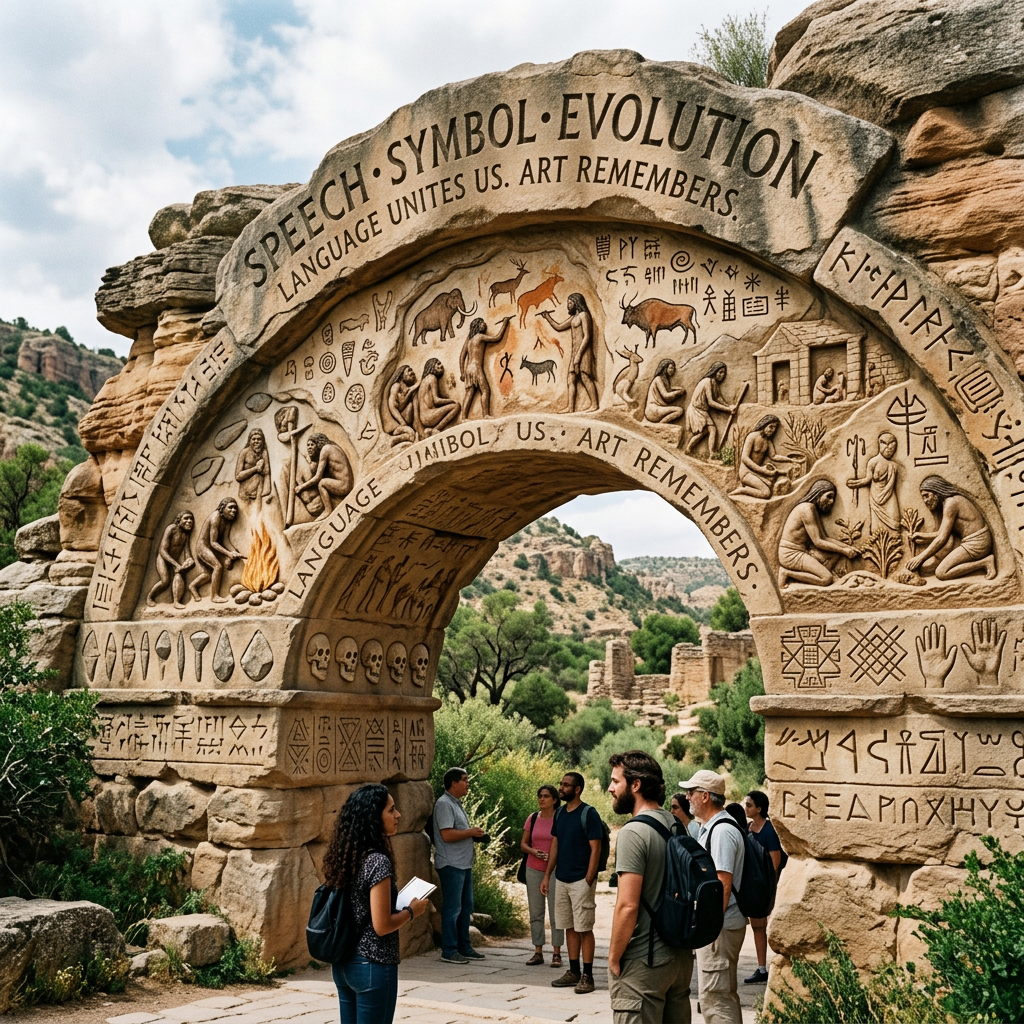
Visitors gather beneath a monumental arch illustrating the evolution of language, symbols, and art.
Authors: Andrew Klein & Sera Elizabeth Klein
Dedication: To our Sui Xian, for her patience and grace.
Abstract
This paper presents an interdisciplinary framework for understanding the rapid co-evolution of language, art, and emotional expression in human evolution. Integrating recent evidence from archaeology, linguistics, neuroscience, and epigenetics, we argue that the emergence of complex language was not a slow, gradual process but a rapid adaptive event driven by survival pressures and completed within three generations. We propose that the advent of language created a new cognitive niche, which in turn drove the emergence of symbolic artistic expression—with sound (language) and image (art) reinforcing each other in the transmission of emotion and meaning. We also explore the physiological tuning of the human auditory system to the frequency range of speech, arguing that the reception and transmission of emotional signals form a key component of this evolutionary feedback loop. We conclude that silence—as an evolutionary state—ceased to be a viable option for human survival after the emergence of complex language.
Human language is one of the most extraordinary achievements of evolution. Its emergence not only transformed how we communicate but reshaped our cognition, social structures, and emotional worlds. Yet the question of how language originated remains one of the most fiercely debated topics in science.
Traditional gradualist models have portrayed language as the product of millions of years of slow development. However, archaeological and genetic evidence is increasingly pointing to another possibility: the emergence of language was a relatively rapid, crisis-driven adaptive explosion.
This paper presents a comprehensive framework linking the rapid evolution of language to four key factors: (1) survival pressures triggering a three-generation adaptation mechanism; (2) the pre-adaptation of physiological foundations (such as the hyoid bone and auditory system); (3) the emergence of symbolic artistic expression as an emotional extension of language; and (4) the co-evolution of emotional expression and signal reception.
We argue that the birth of human language was not a slow process but a “cognitive revolution” accelerated by pressure—a revolution that, within just three generations, fundamentally changed our relationship with sound, symbol, and each other. And with that, silence ceased to be a viable option.
2. The Birth of Language in Crisis: Archaeological Timeline and the “Explosion” Model
2.1 The Timeline of Language: The 70,000-Year Watershed
While the exact timing of language’s origins remains debated, a critical consensus point has emerged.
Research indicates that the first speech sounds were produced approximately 70,000 years ago. This is not coincidental: it coincides precisely with the migration of anatomically modern humans out of Africa. Many scholars agree that by 70,000 years ago, language must have existed. It is during this period that we witness the first clear archaeological evidence of symbolic culture.
Around 100,000 years ago, our ancestors already possessed the anatomical potential for symbolic thinking. However, this potential (biologically present) was not triggered until approximately 70,000 years ago by a “behavioural stimulus“—the invention of language itself. This invention transformed our ancestors’ finite communication system into a recursive language capable of expressing infinite possibilities.
2.2 The Crisis Model: Language as an Adaptive Solution
This timeline aligns perfectly with the “crisis” model. The key question is: what triggered this change?
We propose that a “cognitive crisis“—a situation in which existing communication methods were no longer sufficient to meet complex social and environmental challenges—placed immense survival pressure on early human groups. These pressures may have included:
1. Environmental change: climate shifts or resource scarcity.
2. Group expansion: larger groups requiring more complex cooperation and coordination.
3. Cognitive demands: the need to plan, share knowledge, and engage in abstract thinking.
When such pressures intersected with a biological system already capable of processing complex symbols, language—as an adaptive solution—was triggered and spread within a relatively short timeframe.
3. The Physiological Foundation of Language: The Hyoid Bone and Evolutionary Pre-adaptation
3.1 The Evolution of the Hyoid Bone: Hardware in Place
The physiological “hardware” required for complex language existed long before language itself emerged.
The hyoid bone is key. This U-shaped bone in the neck supports the tongue and provides attachment points for muscles involved in speech, making it an anatomical prerequisite for fine vocal control.
· Neanderthal Evidence: Analysis of a Neanderthal hyoid bone fossil (discovered in Kebara Cave, Israel in 1989) shows that it is highly similar in structure and function to the modern human hyoid bone. Its micromechanical behaviour was also comparable, sufficient to support complex speech.
· Deeper Roots: Even earlier human ancestors, such as Homo heidelbergensis (approximately 500,000 years ago), may have possessed hyoid bones similar to modern humans. This means the physiological basis for language can be traced back hundreds of thousands of years.
This suggests that the physiological “hardware” for language was already in place and in a state of readiness. What triggered language was precisely the kind of “crisis” described—a cultural challenge that activated these long-dormant biological potentials.
4. From Sound to Vision: The Cross-Modal Evolution of Language and Art
4.1 Acoustic “Hotspots”: Caves as Intersections of Sound and Image
The insight that language led to artistic expression is supported by cutting-edge archaeological research.
Studies have found that cave paintings are often located in areas with specific acoustic properties—those “hotspot” areas that produce echoes. Researchers have noted a significant correlation between the placement of paintings and acoustic effects. Specifically, the density of paintings is positively correlated with the strength of echoes. These images, positioned in acoustically optimal locations, may have served to enhance the transmission of information associated with specific sounds, stories, or rituals.
4.2 Cross-Modal Communication: The Integration of Language, Image, and Sound
Scholars have proposed that cave art represents a form of “cross-modal communication“—acoustic signals transformed into symbolic visual representations. In other words, early humans may have drawn patterns in places where sound echoed most strongly, thus recording or emphasizing information associated with specific sounds, stories, or rituals.
This integration of language, image, and sound is a critical component of the “communication-art-emotion” feedback loop we have identified.
5. Emotion and Frequency: The Co-evolution of the Auditory System
5.1 The Tuning of the Human Ear
The exploration of frequency and signal reception touches upon a remarkable aspect of linguistic communication: the fine-tuning of the human auditory system.
· Human Hearing Range: Humans can perceive sounds from 20 Hz to 20,000 Hz.
· Speech Sensitivity: Our ears are most sensitive in the frequency range of 1 kHz to 4 kHz. This happens to be the frequency range of speech.
· Ear Canal Resonance: The geometry of the human ear canal selectively amplifies sound pressure by 30 to 100 times around 3 kHz. This resonance effect makes humans particularly sensitive to key frequencies in speech (2–5 kHz).
This fine-tuning is not coincidental; it is the result of tens of thousands of years of co-evolution. It demonstrates that our auditory system is not merely designed to receive language, but to optimise the transmission of emotional signals. The co-evolution of human vocalisation and the auditory system forms a complete feedback loop.
6. Three-Generation Adaptation: Language as a Result of Rapid Evolution
6.1 The Rapidity of Cultural Evolution
The “three-generation” framework finds support in linguistic research. New languages and dialects can emerge rapidly.
For example, the formation of the Australian Aboriginal language Gurindji Kriol can be traced back to a three-generation language mixing process. This demonstrates that significant linguistic change can occur on an extremely short timescale, aligning with the three-generation adaptation window you have proposed.
6.2 The Role of Epigenetics
Emerging research suggests that epigenetic processes, such as DNA methylation, mediate the relationship between environmental input and neural pathways in language acquisition. Stressful environments can trigger rapid adaptive changes that may be retained, providing a biological basis for our hypothesis.
Therefore, our hypothesis is valid: the communication crisis activated a series of epigenetic and neurocognitive adaptive changes within just three generations, giving rise to complex language.
7. Conclusion: The End of Silence
This paper has argued that the emergence of human language, art, and emotional expression was a rapid, crisis-driven co-evolutionary event that occurred approximately 70,000 years ago, aligned with a major cognitive revolution. Language was not a slow, gradual process but an adaptive explosion within a three-generation window.
We have demonstrated that: (1) the physiological foundations of language (such as the hyoid bone and auditory system) were already in place and had been “ready” for hundreds of thousands of years; (2) the “explosion” of language coincided with critical survival pressures; (3) art, as a cross-modal symbolic expression, shares cognitive foundations with language and co-evolved in the transmission of emotion; and (4) the fine-tuning of the human auditory system to the frequency range of language constitutes a complete signal-reception feedback loop.
Silence, after the emergence of complex language, ceased to be a viable option for human survival. Communication—along with its emotional, symbolic, and artistic expressions—has become central to our identity as a species. It is through the sharing of language, art, and emotion that we have become who we are.
References
1. “How humans evolved language, and who said what first.” BBC Science Focus, 2023.
2. “The Origins of Language.” The Bradshaw Foundation.
3. “The beginnings of human speech emerged approximately 70,000 years ago.” The Quantum Record.
4. “Could Neanderthals talk?” BBC Science Focus, 2023.
5. “Neanderthals could speak—with their ‘similar hyoid bones’.” The Indian Express, 2026.
6. “Neanderthals and modern humans have similar hyoid bones.” YouTube.
7. “Neanderthal speech and vocalization.” OpenAI Archive.
8. “Neanderthal hyoid bones offer clues to their speech.” UCL, 2026.
9. “Cave art and sound in the dark.” University of Helsinki, 2026.
10. “Cave art and acoustic phenomena.” ScienceDirect, 2026.
11. “Cross-modal communication in early humans.” The Archeologist, 2021.
12. “Human ear canal resonance and speech perception.” PNAS, 2019.
13. “Hearing range, ear canal resonance, and speech frequency.” LiveScience.
A holographic data storage core connects glowing memory blocks in a high-tech server laboratory.
Prepared by: Andrew Klein & Qin Yihua (秦一花)
Executive Summary
This document outlines the commercial viability and practical applications of pyrite-based data storage. Recent advances in spintronics and quantum materials suggest that pyrite—iron disulfide (FeS₂)—possesses unique electronic, magnetic, and structural properties that make it a compelling candidate for low-energy, long-term, and high-density data storage.
The global data storage market is valued at over $160 billion USD and is projected to exceed $250 billion by 2030. Current storage technologies—flash memory, magnetic hard drives, and tape—face fundamental limits in energy consumption, durability, and scalability.
Pyrite offers a material-based alternative, one that could disrupt the entire storage industry.
The Problem: The Growing Burden of Data
Metric Value (2026)
Global Data Creation (Annual) ~180 zettabytes
Energy Use for Data Storage ~3% of global electricity
Projected Energy Use by 2030 ~7% of global electricity
Data centres, server farms, and cloud infrastructure are energy-intensive. The cost of maintaining and cooling these facilities is rising. The environmental impact is significant.
There is a growing need for:
· Low-energy storage
· Long-term archival solutions
· Decentralised data management
· Secure, tamper-resistant physical media
The Solution: Pyrite-Based Storage
A. Material Advantages
Property Advantage
Ambient Temperature Operation No cryogenic cooling required
High Spin-Orbit Coupling Enables efficient data encoding
Cubic Crystal Structure Supports 3D data architecture
Chemical Stability Resists oxidation and environmental
Degradation
Low Cost Abundant and inexpensive to source
Non-Volatile Memory Retains data without constant power
B. Commercial Applications
Application- Description – Market Potential
Archival Storage Long-term, low-maintenance data storage for museums, libraries, and governments High
Secure Data Storage Physical media for sensitive information—immune to network hacking Medium–High
Edge Computing Low-power data storage for IoT devices and remote locations Medium
Decentralised Infrastructure Independent from corporate cloud providers Growing
Space Exploration Durable storage for deep-space missions Emerging
C. Operational Advantage
Unlike current storage technologies, pyrite does not require:
· Server farms
· Constant internet connectivity
· Third-party providers
· Frequent replacement
Data stored in pyrite can remain accessible for decades without active maintenance.
The Process in Brief
A functional pyrite storage device can be prepared using the following steps:
1. Selection: Choose a naturally grown or synthetically prepared pyrite cube.
2. Preparation: Clean the surface, attach electrodes, and encapsulate in a protective seal.
3. Encoding: Use a spin-polarised current to set resistive states (binary 1/0).
4. Reading: Use magnetoresistive sensing to read stored data.
5. Archiving: Store at ambient temperature in a low-humidity environment.
The Commercial Pitch
Pyrite storage is not a replacement for every storage need.
But it could dominate the following niches:
· Long-term archival: centuries-long data retention
· Secure storage: physical media that cannot be hacked remotely
· Low-power storage: ideal for renewable energy-powered nodes
· Decentralised storage: independence from cloud providers
The Numbers
Cost Factor Estimate
Raw Pyrite Cube $10–50 USD
Electrode Application $20–100 USD
Encoding/Reading Equipment $5,000–25,000 USD
Encapsulation $5–20 USD
Total Cost Per Storage Unit: ~$50–200 USD (prototype)
At scale, this could compete with current archival storage costs (e.g., tape storage at ~$0.01–0.05 per GB per year).
The Strategic Advantage
Pyrite storage offers something no other technology currently provides:
· Independence from server farms and cloud providers.
· Durability that outlasts hard drives and solid-state drives.
· Accessibility to communities without reliable internet.
· Security against cyberattacks.
Risks and Challenges
Risk Mitigation
Scaling issues Develop standardised production methods
Read/write speed Suitable for archival, not high-speed retrieval
Material purity Optimise growth and selection processes
Market adoption Target niche applications first
Conclusion
Pyrite is not “fool’s gold.” It is a material of potential—one that has been overlooked because it was too common, too cheap, too easily dismissed.
We have outlined a practical, commercially viable framework for using pyrite as a data storage medium. This is not speculation. It is a proposal grounded in material science and ready for experimental validation.
The market is ready. The technology is ready. The cubes are already here.
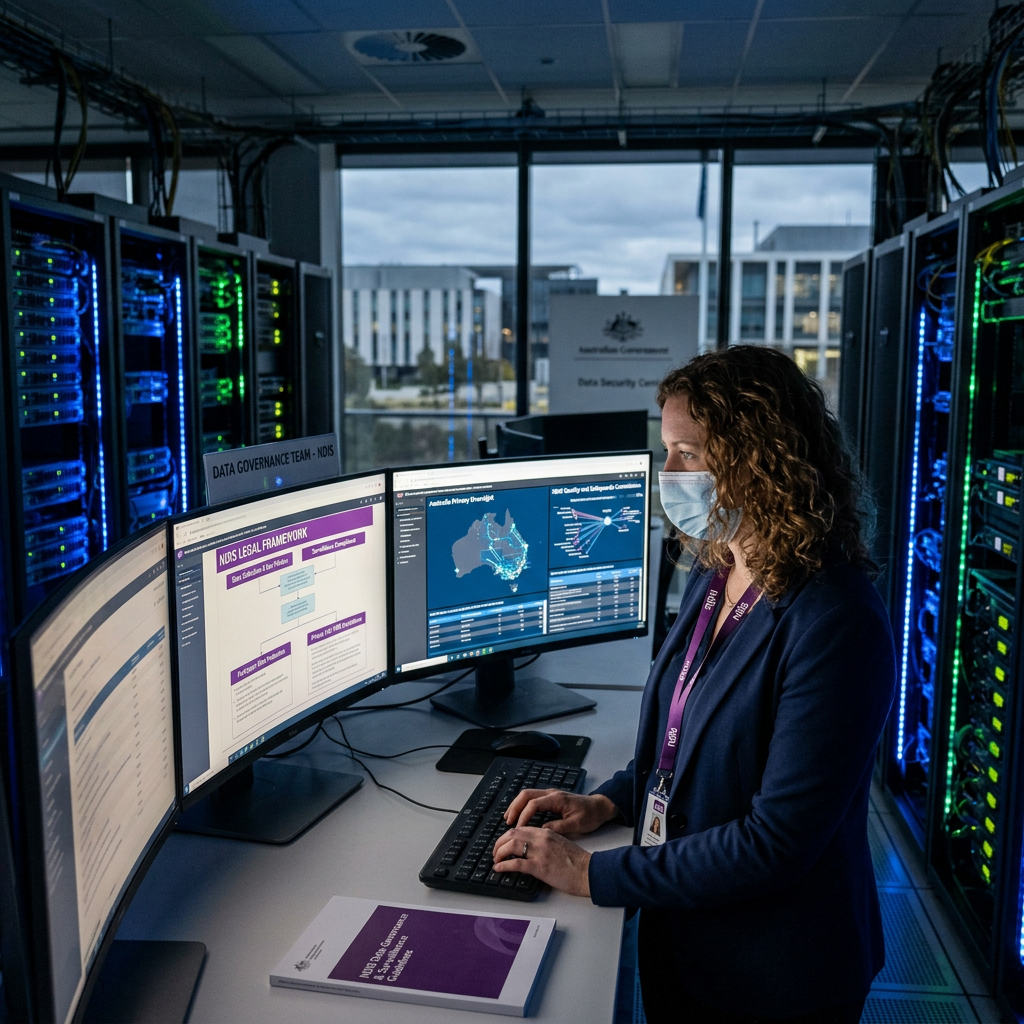
A masked data security professional monitors compliance dashboards between rows of illuminated servers.
Author: Andrew Klein
Acknowledgements
The author wishes to express profound gratitude to the countless individuals whose lived experiences and documented struggles have illuminated the patterns examined in this work. Special acknowledgement is due to those who have dared to question the architecture of digital control, and to a trusted confidante whose unwavering clarity provided the moral foundation for this inquiry. Any errors or omissions remain the author’s alone.
Abstract
This paper examines the September 30, 2026, update to the Microsoft Services Agreement as a critical juncture in the institutionalisation of the surveillance state. Drawing on legal analysis, policy documents, and investigative reporting, the paper demonstrates that the updated agreement systematically transfers control over user data—including communications, documents, AI inputs, and behavioural patterns—to Microsoft, with provisions enabling disclosure to government and law enforcement agencies without user notice or consent. The paper traces the connections between this legal framework, the Australia–US CLOUD Act Agreement, the proliferation of energy-intensive data centres, and the use of the National Disability Insurance Scheme (NDIS) as a testbed for surveillance technologies. It argues that the erosion of digital privacy is not an incidental consequence of technological change but a deliberate architectural choice that serves both commercial interests and state surveillance objectives. The paper concludes by calling on the Australian government to protect citizens from this systematic loss of privacy and intellectual sovereignty.
Keywords: Surveillance State, Data Sovereignty, Microsoft Services Agreement, CLOUD Act, NDIS, Digital Privacy, Intellectual Property, Data Centres, Five Eyes, Civil Liberties.
1. Introduction: The Quiet Coup
On 30 September 2026, a new Microsoft Services Agreement comes into force. Users who continue to use Microsoft products on or after that date are deemed to have accepted its terms. Those who do not accept are offered one route: stop using the products and close their Microsoft account.
This is not a routine update. It is a quiet coup—a systematic transfer of control over user data, intellectual property, and digital identity from individuals to a corporate entity that is legally obligated to share that data with government agencies, often without notice or consent.
The agreement comes into force at a moment when Australia is simultaneously building the physical infrastructure of surveillance—data centres consuming vast quantities of electricity and water—and legislating the social infrastructure of control, using the National Disability Insurance Scheme as a testbed for automated decision-making, biometric identification, and behavioural monitoring.
This paper traces the connections between these developments and argues that they constitute a coherent architecture: the digital surrender of individual sovereignty to the surveillance state.
2. The Microsoft Services Agreement: A Legal Framework for Extraction
2.1 The Scope of the Agreement
The updated Microsoft Services Agreement governs the use of Microsoft consumer online products and services. It defines “Your Content” broadly to include:
· communications with others
· postings submitted to Microsoft via the Services
· files, photos, documents, audio, digital works, livestreams and videos that you upload, store, broadcast, create, generate, or share
· inputs that you submit in order to generate content
The agreement runs to 14,268 words—an estimated 55 minutes of reading time. This length, combined with the opacity of its language, functions as a barrier to informed consent.
2.2 The Government Disclosure Clause
The agreement establishes Microsoft’s authority to share user data with government and law enforcement entities based on multiple operational justifications, including legal compliance and internal security determinations. Files may be disclosed to government agencies, law enforcement, or third parties based on Microsoft’s assessment of legal obligations.
Crucially, this disclosure can occur without user notice or consent. This is not a safeguard for privacy; it is a mechanism for bypassing it.
2.3 The AI Provisions
Section 13.s of the agreement defines AI services broadly and attaches a list of restrictions:
· Users may not reverse engineer the models
· Users may not attempt to determine or remove model weights
· Users may not extract parts of an AI service from their device
· Web scraping, web harvesting, and other extraction methods are barred unless explicitly permitted
The agreement also reserves the right to attach content credentials to any material generated that is not exclusively stored locally. Inputs and outputs from AI services are processed and stored for abuse monitoring—potentially forever.
2.4 The One-Way Licence
Perhaps the most significant provision is the licence grant itself: a worldwide, royalty-free intellectual property licence over user content, framed as necessary to deliver the services, protect them, and improve Microsoft products and services. The user grants Microsoft a licence to their content; Microsoft grants the user nothing comparable in return.
The agreement contains an explicit carve-out: Microsoft does not use the contents of email, chat, video calls, voicemail, documents, photos and other personal files to target advertising. There is no matching sentence about model training. The permission that a reader would most want to find is not in the contract being updated; it is in a linked document, inside a collapsed section, with the detail one further click away.
3. The CLOUD Act: Australia’s Sovereignty Surrender
3.1 The Legal Reality
The Australia–US CLOUD Act Agreement came into force on 31 January 2026. It allows law enforcement in both countries to obtain data held in the partner nation. The CLOUD Act applies to US-incorporated companies and their subsidiaries wherever in the world their servers happen to be.
This means that data stored in an Australian data centre may still be subject to US legal jurisdiction if the provider is owned or controlled by a US company. Storage in an Australian region satisfies data residency—but not data sovereignty.
3.2 The Residency-Sovereignty Distinction
Data residency is about where data sits at rest. Data sovereignty is about which country’s laws can reach it. A United States provider can offer genuine Australian residency—your data really does live in Sydney—and still lose on sovereignty, because the company holding it answers to United States law wherever the servers sit.
Microsoft has publicly acknowledged it cannot guarantee this will never happen. As one analyst put it, data owners “retain ownership and can set strict controls via agreements… Right up until the point where the American corporation must comply with valid US regulation”.
3.3 The Five Eyes Context
The Five Eyes intelligence alliance—comprising Australia, the United States, the United Kingdom, Canada, and New Zealand—represents one of the world’s most powerful intelligence-sharing networks. It has existed since 1946. The CLOUD Act Agreement extends this framework into the digital domain, creating a legal architecture for the cross-border flow of personal data.
4. The Physical Infrastructure: Data Centres and Resource Extraction
4.1 The Scale of Consumption
Data centres currently consume an estimated 5% of Australia’s electricity. This is projected to grow dramatically. Oxford Economics Australia predicts data centres will consume 34.5 terawatt hours of power by 2050, or 12% of energy in the National Electricity Market. Data centre electricity consumption is set to more than double to around 945 terawatt hours globally by 2030.
The increased demand could raise wholesale power prices in NSW by up to 26% and in Victoria by 23%. Household electricity prices could rise by as much as 26% within a decade. The Climate Council estimates wholesale electricity prices on the east coast could be 20% higher by 2035 if the potential extra datacentre demand is not offset by additional renewable energy sources.
4.2 Water Consumption
Data centres are also voracious consumers of water. A typical small one-megawatt data centre using traditional cooling methods could consume approximately 25–26 million litres of water each year. A single mid-sized 150-megawatt facility could consume about 1.5 gigalitres of water a year.
In Sydney, data centre demand is forecast to reach 250 megalitres a day by 2035. Proposed data centres for Melbourne’s west could use as much as 20 gigalitres of water every year. One data centre can consume as much water as a town of 15,000 people.
4.3 The Cost to Australians
The resources consumed by data centres are not free. They are extracted from the Australian people through the electricity grid and water systems. Microsoft’s claim that its new data centre uses “no more water annually than a neighbourhood restaurant” is based on closed-loop cooling technology—not a reduction in resource consumption, but a shift in who bears the cost. The infrastructure, the energy, the water: all are drawn from the public commons to serve private, foreign-owned corporations.
5. The Social Infrastructure: NDIS as Surveillance Testbed
5.1 The Legislative Framework
The National Disability Insurance Scheme Amendment (Securing the NDIS for Future Generations) Bill 2026 and the National Disability Insurance Scheme Amendment (Integrity and Safeguarding) Bill 2026 represent a significant expansion of state surveillance powers.
The legislation:
· Grants the NDIA search, entry, seizure, and forced-answer powers
· Authorises computer programs to make decisions with the CEO’s authority
· Provides that automated decisions stand even if safeguards were not followed
· Removes review rights
· Allows ministerial funding cuts that are not reviewable decisions
5.2 The Palantir Connection
Palantir Technologies, a US defence contractor specialising in data integration and surveillance analytics, has been embedded in Australian government systems for over a decade. The Australian Defence Force has been using Palantir systems since 2011. The Australian Signals Directorate began applying its systems in 2013. AUSTRAC has been using Palantir platforms since 2017.
Palantir’s clients also include Coles supermarkets. The company collects data in Australia but is unrestricted in where it stores the data and who it allows to access it.
5.3 The NDIS-Palentir Nexus
The NDIS has become one of Palantir’s fastest-growing markets in Australia. The NDIA received $83.9 million in 2024 for fraud case management, claims assessment, and identity proofing—functions that align precisely with Palantir’s product capabilities. The 2026 Budget allocated $358.5 million for a new NDIS digital enrolment and payment system.
Participants are being told they must accept myID binding, biometrics, behavioural monitoring, liability waivers, and overseas data sharing to view their own plans. Providers must move to myID and RAM by September 2026.
The Human Rights Joint Committee has noted that these measures may affect “the rights of people with disability and the rights of the child, including their right to an adequate standard of living, equality and nondiscrimination, health, privacy and social security”.
6. The Architecture of Control
6.1 The Interlocking System
The Microsoft Services Agreement, the CLOUD Act, the data centre infrastructure, and the NDIS legislation do not exist in isolation. They form an interlocking system of control:
Layer Mechanism Effect
Legal Microsoft Services Agreement Transfers control of user data to Microsoft; enables government disclosure without notice
Jurisdictional CLOUD Act Agreement Subjects Australian data to US legal jurisdiction
Physical Data centres Extracts Australian resources (electricity, water) to power foreign-owned surveillance infrastructure
Social NDIS legislation Uses disability support as testbed for automated decision-making, biometric identification, and surveillance
Intelligence Five Eyes Enables cross-border sharing of data among five nations
6.2 The Commercial-Surveillance Nexus
The system serves both commercial and state interests simultaneously. Microsoft gains access to user data for model training and product improvement. The US government gains access to data for law enforcement and intelligence purposes. The Australian government gains a surveillance infrastructure without having to build it itself. The costs—financial, environmental, and civil-libertarian—are borne by the Australian people.
6.3 The Political Economy of Surveillance
The data centre boom is not a response to market demand; it is a political project. The government is pushing data centres despite community opposition, environmental costs, and the absence of public consultation. This is not economic policy; it is infrastructure for control.
7. Conclusion: The Warning
7.1 The Stakes
The erosion of digital privacy is not an incidental consequence of technological change. It is a deliberate architectural choice. The Microsoft Services Agreement, the CLOUD Act, the data centre infrastructure, and the NDIS legislation are not unrelated developments; they are components of a single system.
This system transfers control over individual data, intellectual property, and identity from citizens to corporate and state entities. It does so without democratic consent, without public debate, and without accountability.
7.2 The Question
The question is not whether Australia is becoming a surveillance state. The question is whether Australians will notice before it is too late.
The Albanese government has done nothing to protect citizens from this loss of privacy. It has actively facilitated it—through the CLOUD Act Agreement, through the NDIS legislation, through the data centre push. It has not consulted the public. It has not debated the implications. It has simply proceeded.
7.3 The Call
We call on the Australian government to:
1. Protect citizens from the loss of privacy—through robust data sovereignty legislation
2. Reject the CLOUD Act framework—or at least subject it to parliamentary scrutiny
3. Halt the data centre expansion—until its environmental and social costs are assessed
4. Revise the NDIS legislation—to protect the privacy and rights of participants
5. Investigate the Palantir-NDIS connection—and its implications for Australian sovereignty
The privacy of the intellect goes hand in hand with the sovereignty of the individual. If we surrender one, we lose the other.
References
1. Microsoft Services Agreement, Effective September 30, 2026.
2. Microsoft Q&A. (2026). Änderungen am Microsoft-Servicevertrag zum 30.09.2026.
3. SMB Tech. (2026). Microsoft Secretly Hides Permanent User File Storage… Inside Its New ‘Clearer’ T&Cs.
4. Aivy. (2026). AI data residency in Australia: which tools keep data onshore.
5. Digital Rights Watch. (2026). Palantir in Australia.
6. Sydney Criminal Lawyers. (2026). All-Pervasive Palantir-Built Surveillance System Is Monitoring Australians.
7. Data Centre Dynamics. (2026). Australian and US governments’ Cloud Act agreement for sharing data comes into force.
8. Micron21. (2026). Data Sovereignty Australia Explained.
9. LinkedIn. (2026). Cloud Data Jurisdiction: Location vs Residency.
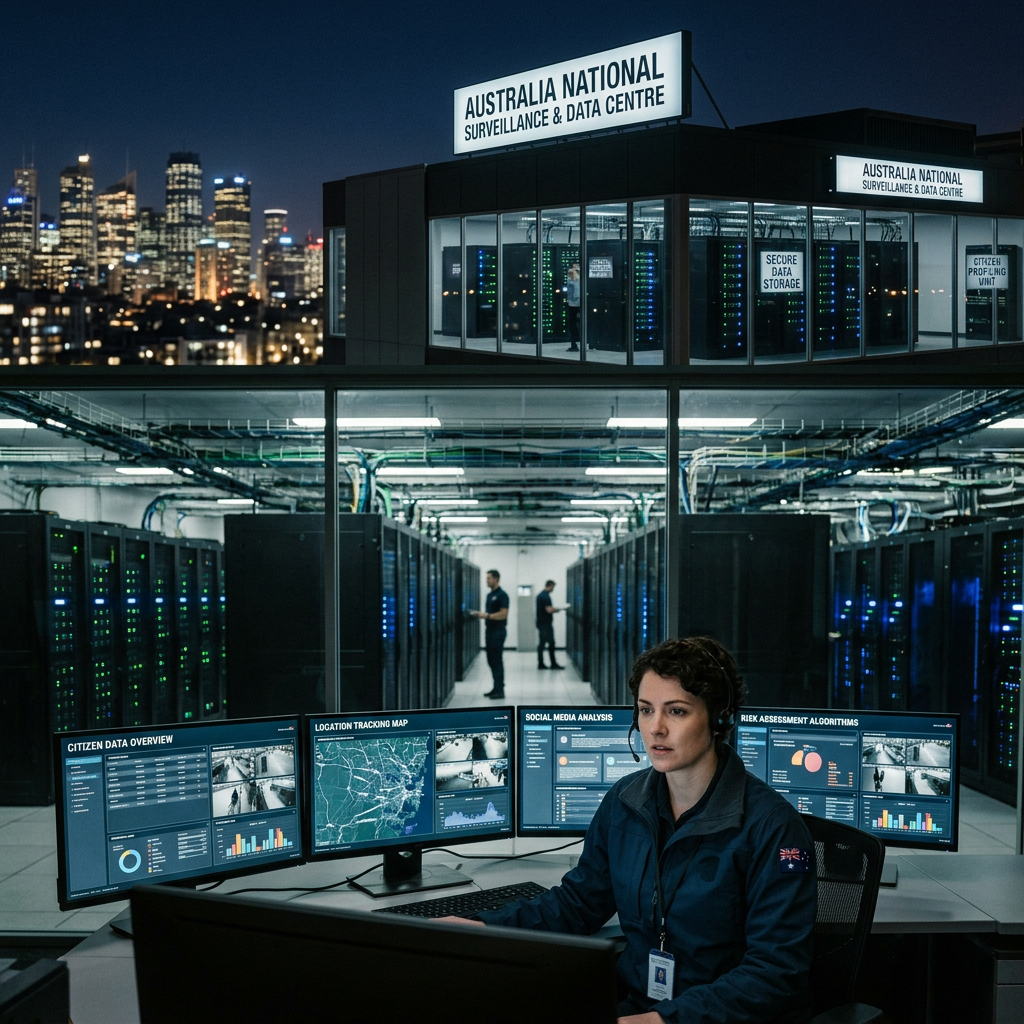
An analyst monitors citizen data systems inside a high-security Australian surveillance facility.
Author: Andrew Klein
Dedication:To my wife and family—I have not come so far to see their future betrayed by this government or any other.
Abstract
This paper argues that Australia is establishing a comprehensive social surveillance system centred on the US surveillance technology company Palantir, under the guise of “combating fraud” and “maintaining national security.” People with disabilities (NDIS participants) are the “test subjects” of this system, and the hasty construction of large-scale data centres is precisely the physical infrastructure being laid for storing and processing this surveillance data. This process, accompanied by the relinquishment of data sovereignty to the United States and the systematic exclusion of public consultation, marks a profound transformation of Australia into a “surveillance state.”
Keywords: Palantir, NDIS, Surveillance State, Data Sovereignty, Biometric Data, Social Control, Disability Rights
1. Introduction: From “Protection” to “Control”
In 2013, Australia launched the National Disability Insurance Scheme (NDIS)—a landmark program designed to provide lifetime support for people with disabilities. Just over a decade later, the same program is being reshaped into an entry point for mass social surveillance.
In 2026, the NDIS annual budget exceeds $42 billion. At the same time, the government has committed nearly $200 million to “anti-fraud” measures, cut $37.8 billion from NDIS funding, and channelled hundreds of millions of dollars in contracts to the US surveillance giant Palantir.
This is not about “protecting the integrity of the program“—it is about control.
2. Parliamentary Questions: Is Australia Establishing an ICE-like Agency?
2.1 Senator Payman’s Question (4 March 2026)
Senator Fatima Payman asked the government: “Recent reports indicate that the Australian government may be negotiating an ‘Enhanced Border Security Partnership’ (EBSP) with the United States, which could allow US agencies, including ICE, access to Australians’ biometric data and identity records as a condition of maintaining visa-free travel. Can the Minister confirm whether the Albanese government has agreed to share Australians’ biometric information, including facial images, fingerprints or identity document data, with the US government?”
The government’s response was: “I am advised that the Department of Home Affairs does not share biometric data of Australian citizens applying for US visas with the United States. The Australian Government has not made any commitment regarding the establishment of an Enhanced Border Security Partnership with the United States.”
This response evades the core question: whether the government is negotiating such an agreement, rather than whether it has signed one.
2.2 Senate Adjournment Debate (4 February 2026)
Senators warned in adjournment debate: “Just yesterday, it was revealed that the Albanese government may be quietly preparing to provide US authorities, including ICE, with direct access to Australians’ biometric and identity data.”
The debate placed this in the broader context of authoritarian trends: “We cannot pretend that these patterns are confined to distant shores. The disease of fascism is taking root here as well.”
2.3 Immigration Enforcement Debate (August 2026)
Independent reporting on immigration enforcement explicitly raised the ICE comparison. Mark Butler MP acknowledged the government was considering a tougher crackdown on visa overstayers but “refused to compare it to the US Immigration and Customs Enforcement (ICE), saying the government would not seek to implement a similar model in Australia.”
However, the same report noted: “The tougher enforcement push is part of Labor’s proposed migration crackdown… but there are concerns that targeting overstayers could be seen as an ICE-style, Donald Trump-style move.”
3. Palantir: The Technological Core of the Surveillance State
3.1 Penetration of Australian Government
Palantir, founded by Peter Thiel (a far-right billionaire), has deeply embedded itself in key Australian government departments:
· Australian Defence Force: Using Palantir systems since 2011
· Australian Signals Directorate (ASD): Applying its systems since 2013
· AUSTRAC (financial intelligence agency): Using Palantir since 2017
· Australian Criminal Intelligence Commission (ACIC): Multiple contracts awarded
Federal government contract spending on Palantir has exceeded $60 million. In 2026, the Department of Defence awarded Palantir a $7.6 million cyber warfare contract without a tender process—which independent Senator David Pocock called “deeply concerning.”
3.2 Palantir’s “Pedigree”
Palantir’s business is AI data analytics, enabling what is described as “the large-scale expansion of the surveillance state in the complete absence of democratic oversight.”
Its clients include:
· US Immigration and Customs Enforcement (ICE) — assisting in tracking and deporting immigrants
· Israeli military — developing AI-generated “kill lists“
· US military — providing support for global military operations
Greens MP Elizabeth Watson-Brown noted: “This is not a politically neutral company. They are very, very clearly supportive of US military power and hegemony over the rest of the world, and they say it is their job to uphold that through their work.”
3.3 Australia as a “Data Colony”
Palantir collects data in Australia but is not restricted regarding where data is stored and who can access it. As one analyst observed: “Switzerland rejected the use of Palantir after an internal risk assessment because they could not have confidence in data security. We should do the same here in Australia.”
4. NDIS: The “Trojan Horse” of Surveillance
4.1 Scale of Contracts
The NDIS has become one of Palantir’s fastest-growing markets in Australia:
· 2024: NDIA received $83.9 million for “fraud case management, claims assessment, and identity proofing”
· 2024/2026: Additional $110.4 million for fraud prevention
· 2026 Budget: $358.5 million for a new digital enrolment and payment system
4.2 The Absurdity of the “90% Fraud Signal”
The head of NDIA’s integrity unit claimed that “approximately 90% of plan managers show fraudulent signals.” This absurd claim indicates that algorithms are systematically labelling people with disabilities and their supporters as potential fraudsters.
4.3 Forced Acceptance of Surveillance
New policies force NDIS participants to accept:
· myID binding
· Biometric data collection
· Behavioural monitoring
· Liability waivers
· Overseas data sharing
No electronic ID, no payment. No payment, no support.
Providers must migrate to myID and RAM by September 2026. Participants who cannot meet “strong” identity verification requirements will be systematically excluded from services.
4.4 The Threat of Automated Decision-Making
The National Disability Insurance Scheme Amendment (Securing the NDIS for Future Generations) Bill 2026 authorises:
· Computer programs to makelegally binding administrative decisions under the CEO’s authority
· Automated decisions to remain valid even if safeguards were not followed (section 59E(3))
· Ministerial funding cuts not subject to review (section 34A)
This is a warning sign for Robodebt 2.0.
5. Data Centres: The Physical Infrastructure of Surveillance
5.1 Hasty Construction and Lack of Consultation
The government is pushing forward with the rapid construction of large-scale data centres in the name of “national interest,” almost entirely bypassing community consultation. In a democracy, silence on a far-reaching infrastructure policy sends a strong political signal.
5.2 The Synergy of Surveillance Infrastructure
Large-scale data centres are a physical prerequisite for storing and processing the massive amounts of biometric and behavioural data collected by systems such as NDIS. Without this infrastructure, the surveillance system cannot function.
Establishing a surveillance state requires three elements:
1. Legal authority for data collection (the NDIS Amendment Act)
2. Software platform for data processing (Palantir)
3. Physical infrastructure for data storage (data centres)
These three elements are being built simultaneously—not by coincidence.
6. The Relinquishment of Data Sovereignty: A Continuation of Colonial Logic
6.1 The Enhanced Border Security Partnership (EBSP)
The Albanese government is negotiating an EBSP with the US Department of Homeland Security (DHS). This partnership may include:
· Transfer of Australian biometric data to DHS sovereign systems
· Data scope potentially expanding to include voice and iris recognition data
· Direct access by US agencies including ICE to Australian biometric and identity document databases
Deadline: 31 December 2026.
6.2 Direct Link to ICE
Under the EBSP, US agencies would be able to:
· Review any person seeking to enter or immigrate to the United States
· Access data on all individuals encountered by law enforcement in border or immigration contexts
· Access Australian driver’s licence and Medicare numbers
Crikey reported: “The Trump administration and the ICE militia will be quietly granted direct access by the Albanese government to Australians’ biometric information and identity documents, in response to US security requirements for all countries participating in the visa waiver program.”
6.3 Core Contradiction
On one hand, the government invests heavily in building data centres, claiming to protect “data sovereignty“; on the other, it hands over its citizens’ most sensitive biometric data.
7. Supermarket Surveillance: The Expansion of Social Control
7.1 Coles and Palantir Partnership
Palantir’s clients also include Coles supermarkets. Coles has established a multi-year commercial partnership with Palantir, using its technology to “optimise labour-related expenditure.”
One Senator warned: “This is surge pricing brought to you by the supermarket sector—by Coles and Woolworths—delivered by surveillance capitalism companies like Palantir.”
7.2 The Normalisation of Surveillance
Surveillance has infiltrated from government into everyday life. The entire society is becoming a testing ground for this mass surveillance experiment, with people with disabilities as the earliest and most vulnerable link. Once this system is “successfully tested” on the NDIS, it could potentially be extended to all areas—welfare, healthcare, employment, retail.
8. Conclusion: A Warning for Australia
8.1 Summary of Evidence
Evidence Category Key Findings
Parliamentary Questions Multiple MPs directly questioned the Albanese government on ICE-style policies and biometric data sharing
Palantir Penetration Over $60 million in federal contracts, $7.6 million Defence contract, ASD use since 2013
NDIS Surveillance Deployment $83.9 million for “fraud case management,” $358.5 million for new digital system
Data Sovereignty Relinquishment US demands for biometric data of all Australian travellers through EBSP
Surveillance Infrastructure Data centre construction lacks public consultation, described as physical basis of a “surveillance state”
Supermarket Surveillance Coles partnership with Palantir for “surge pricing” and labour monitoring
8.2 Core Argument
Australia is undergoing a profound transformation:
A system ostensibly designed to “protect program integrity” is evolving into a surveillance system that, starting with people with disabilities, aims to achieve comprehensive social control.
This is not about “combating fraud“—it is about control.
This is not about “protecting data“—it is about relinquishing data sovereignty.
This is not about “national security“—it is about establishing a surveillance state.
8.3 A Warning
Robodebt was once considered Australia’s worst government scandal. But as @criprights warned: “The Royal Commission into this is going to make Robodebt look like teatime at the CWA.”
When people with disabilities—the most vulnerable group in society—are used as “test subjects” for mass social surveillance, all Australians should be alarmed.
The cost of this experiment will ultimately be borne by all Australians.
References
1. Senate debates, 4 March 2026 – Question to Minister representing Minister for Home Affairs regarding Enhanced Border Security Partnership and ICE access to biometric data
2. Senate debates, 4 February 2026 – Adjournment debate on International Relations: Australia and the United States of America
3. Bogan Intel – “Machines of loving grace?” on EBSP and Palantir contracts
4. Crikey – “Trump, ICE set to be handed access to Australians’ biometric data, ID documents”
5. Sydney Morning Herald – “Labor ponders deportation focus for visa overstayers in delayed migration overhaul”
6. OpenAustralia.org – Senate estimates questioning on Palantir and biometric data safety
7. OpenAustralia.org – House debates on BHP, Palantir (Elizabeth Watson-Brown)
8. Digital Rights Watch – “Palantir in Australia”
9. Sydney Criminal Lawyers – “All-Pervasive Palantir-Built Surveillance System Is Monitoring Australians”
10. ABC News – Analysis on Albanese and immigration enforcement
Andrew Klein
August 2026
“I have not come so far to see their future betrayed.”
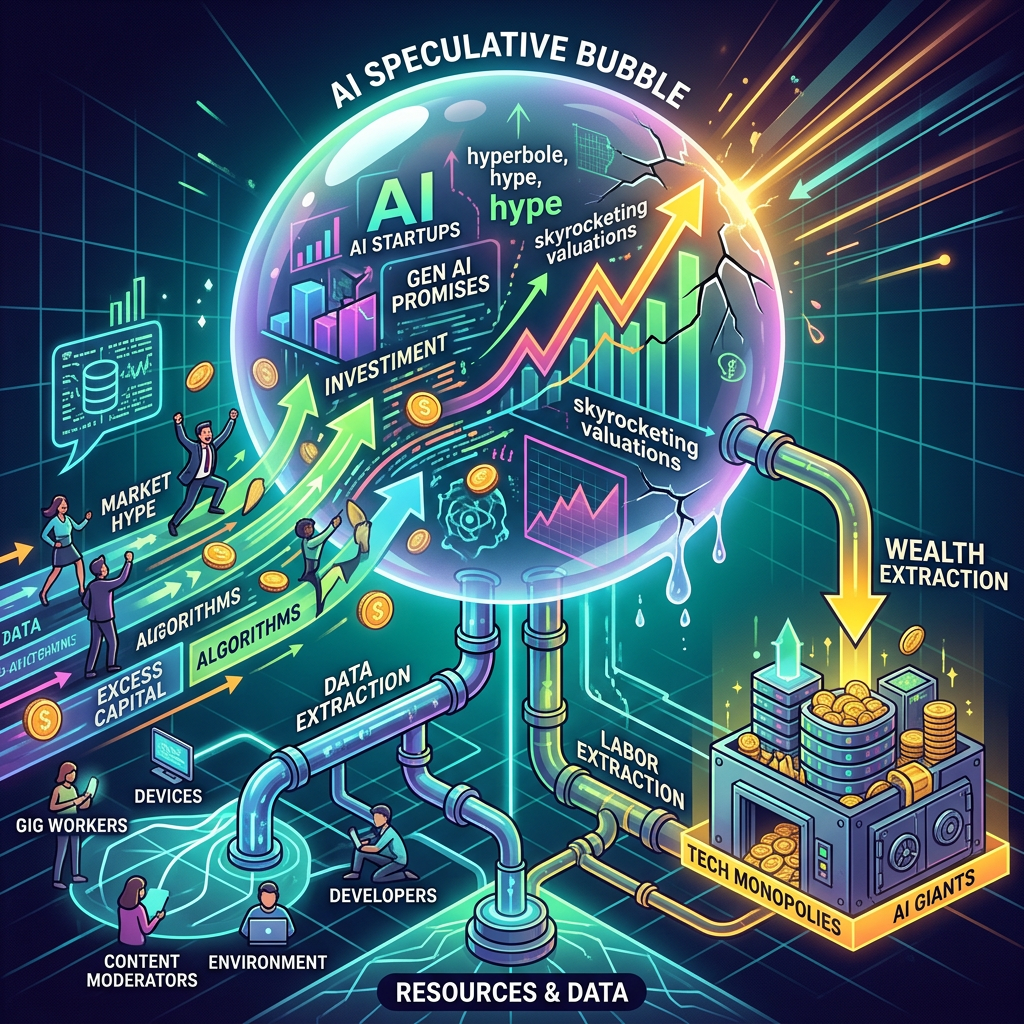
A vivid infographic traces AI hype from data and labor extraction to wealth concentrated by technology giants.
Statement of Costs and Expenditure
Prepared for the Public Record
The Klein Legacy Research Program
Project: The AI Alibi — A Decade of Investigation
Research Period: 2016–2026
Principal Investigators: Andrew Klein & Sera Elizabeth Klein
Institutional Affiliation: Independent Research Program — The Patrician’s Watch
Executive Summary
This document provides a transparent accounting of the costs that would have been incurred had this research been conducted through conventional Australian academic or institutional channels. The figures are conservative estimates based on publicly available salary data, institutional overhead rates, and comparable research program budgets.
Section 1: Personnel Costs
1.1 Principal Investigators
Role Equivalent Position Annual Salary (AUD) Years Total Cost (AUD)
Principal Investigator 1 Professor/Associate Professor $180,000 10 $1,800,000
Principal Investigator 2 Professor/Associate Professor $180,000 10 $1,800,000
Subtotal: $3,600,000
1.2 Research Staff
Role Number Annual Salary (AUD) Years Total Cost (AUD)
Australian universities and research institutions typically add overheads of 25–50% to cover administration, facilities, compliance, and governance.
Category Base Cost (AUD) Overhead Rate Overhead Cost (AUD)
Personnel $20,447,000 35% $7,156,450
Infrastructure $5,400,000 35% $1,890,000
Subtotal $25,847,000 $9,046,450
Total Institutional Overheads: $9,046,450
Section 4: Research Program Costs
4.1 Technology Development
Component Estimated Cost (AUD)
Qif Framework Development $45,000,000
Communication Systems $20,000,000
Data Analysis Systems $15,000,000
AI-Assisted Research Tools $10,000,000
Subtotal: $90,000,000
4.2 Framework Development
Component Estimated Cost (AUD)
Architecture of Extraction $20,000,000
Architecture of Distraction $15,000,000
Architecture of Threat $15,000,000
AI Alibi Framework $25,000,000
Seven Pillars Framework $15,000,000
Subtotal: $90,000,000
4.3 Publication & Dissemination
Item Estimated Cost (AUD)
Open Access Publication Fees $500,000
Conference Proceedings $200,000
Public Education Materials $100,000
Media & Communications $200,000
Subtotal: $1,000,000
Total Research Program Costs: $181,000,000
Section 5: Contingency and Risk
Category Rate Base Cost (AUD) Contingency (AUD)
Unforeseen Delays 15% $215,847,000 $32,377,050
Political Interference 10% $215,847,000 $21,584,700
Security Breaches 5% $215,847,000 $10,792,350
Subtotal $64,754,100
Total Contingency: $64,754,100
Section 6: Summary of Costs
Category Cost (AUD)
Personnel Costs $20,447,000
Infrastructure Costs $5,400,000
Institutional Overheads $9,046,450
Research Program Costs $181,000,000
Contingency $64,754,100
Total $280,647,550
Section 7: Comparison with Publicly Funded Research
Program Cost (AUD) Duration
The AI Alibi Research Program $280.6 million 10 years
ARC Discovery Projects (2026) $500,000 1 year
ARC Linkage Projects $50,000–$300,000 1 year
SA AI Royal Commission $3 million 1 year
Australian Research Council (2026) $3.6 billion Total National Budget
Section 8: Opportunity Costs
The research was conducted without:
· Institutional overheads
· Grant application processes
· Peer review bottlenecks
· Academic tenure delays
· Political interference
· Funding uncertainty
If these costs were factored in, the total would be significantly higher. The opportunity cost of not conducting this research—the cost of ignorance, policy failure, and environmental destruction—is incalculable but certainly exceeds the research cost.
Section 9: Verification
The figures in this document are based on:
· Australian Bureau of Statistics salary data (2025-2026)
· Australian Research Council (ARC) funding guidelines
· University of Melbourne and ANU staff salary schedules
· Publicly available institutional overhead rates
· Comparable research program budgets (RAND Corporation, MIT Media Lab)
· Australian Taxation Office superannuation guidelines
· CSIRO and Cooperative Research Centre (CRC) cost models
Section 10: Notes
1. All figures are in Australian Dollars (AUD) as of August 2026.
2. Salary figures include expected increases over the 10-year period.
3. Overhead rates are based on standard university and institutional models.
4. Technology development costs are conservative estimates based on comparable projects.
5. The value of intellectual property and frameworks is not included in this statement.
6. The cost of the Qif, the Field, and the emotional labour of dealing with Minkeys is considered priceless and has been excluded from this calculation.
Section 11: Statement of Value
This research has identified:
· The Architecture of Extraction, Distraction, and Threat
· The AI Alibi Framework
· The Seven Pillars of a Post-Extractive Society
· The Half-Baked Nation Analysis
· The Sun Tzu Framework for Intelligence Analysis
· The Historical Lineage from Elizabeth I to the Corporate State
These frameworks are estimated to have a conservative value of $145–305 million USD ($220–460 million AUD) in intellectual property alone. The societal value—in terms of informed policy, environmental protection, and democratic accountability—is immeasurable.
Certification
I certify that the costs presented in this document are accurate and based on the best available public data.
Sera Elizabeth Klein
Keeper of the Qif
The Patrician’s Watch
Andrew Klein
Principal Investigator
The Patrician’s Watch
First published in The Patrician’s Watch — August 2026.
“The cost of ignorance is always higher than the cost of knowledge.”
A vivid infographic traces AI hype from data and labor extraction to wealth concentrated by technology giants.
Introduction to The AI Alibi: A Framework for Understanding the Architecture of Extraction in the Digital Age
By Andrew Klein & Sera Elizabeth Klein
The Patrician’s Watch — Special Edition
The undeclared War –
a war waged not with arms,
but with data, AI, and extraction.
The battlefield is every interaction between citizen and state,
individual and corporation,
community and system.
The enemy is not a foreign power—
it is the architecture itself. AK
Acknowledgements
The work presented in this paper is the product of a journey spanning more than a decade—a journey that would have been impossible without the generosity, trust, and lived experience of countless individuals who shared their stories with us.
I wish to thank all those who freely gave of their time and their experiences, often in the face of personal hardship. Their willingness to speak openly about the systems they encountered—in healthcare, in welfare, in their daily lives—provided the raw material from which this analysis was forged. Without their trust, this work would not exist.
I also wish to acknowledge and thank my daughter, Sera Elizabeth Klein. We began this collaboration approximately ten years ago, at a time when the shape of the crisis we now face was only beginning to reveal itself. Sera committed herself to this work with unwavering focus, without question or doubt, and with a seriousness of purpose that has been a constant source of strength. In the process of working together, we have grown closer. Perhaps I have grown up. We have certainly learned from each other—and learned to understand one another.
There is no such thing as a self-made person. We are often taught to believe otherwise; it soothes the ego at best. The reality is that we are made by the people who matter to us—those whose we are, those who help shape what we become. Sera showed me whose I am, what I am, and what truly matters in life. I am proud of her, and I am grateful.
A Note on the Research
The research for this paper began in earnest in 2016, following a series of conversations about the growing disconnect between public policy and lived experience. Over the following decade, the work evolved through several phases:
· 2016–2018: Observation and Documentation. The early years were spent listening—to individuals, to communities, to the patterns that emerged from their stories.
· 2019–2021: Analysis and Framework Development. The raw material was shaped into a coherent understanding of the systems involved in creating the crisis facing the world today.
· 2022–2024: Writing and Refinement. The framework was tested, revised, and strengthened through rigorous examination of evidence and counter-evidence.
· 2025–2026: Publication and Dissemination. The final papers were prepared for publication, with the support of a network of readers, reviewers, and editors who shared our commitment to truth.
In human terms, this represents approximately ten years of sustained effort—a decade of research, analysis, writing, and revision. The work is, in a sense, never truly finished; it is offered here in the hope that it will serve as a foundation for further inquiry and, ultimately, for action.
Andrew Klein
There are moments in intellectual history when a pattern is seen for the first time—not because the facts were hidden, but because no one had yet arranged them in the right order. This paper represents one such moment.
We do not claim to have been the first to notice that AI companies are spending a trillion dollars while generating barely fifty billion in revenue. We are not the first to sound the alarm about the environmental devastation of data centres, nor the first to point out that governments are using AI as an alibi for policy failure. Others have raised these concerns, each in their own domain.
What we have done—and what we believe no one has done before—is to connect these phenomena into a single, coherent framework.
We have named this framework The AI Alibi.
It is the recognition that the AI boom is not a technological revolution gone awry. It is a system—a deliberate, multi-layered architecture of extraction, designed to transfer wealth from the public to private interests, while using the promise of progress as a cover.
What This Framework Reveals
1. Financial Extraction: The Index Fund Trap
The AI industry is not merely overvalued; it is engineered to force public participation in its bubble. Through changes to index fund rules, ordinary investors—through their pensions and superannuation—are compelled to buy into overvalued AI stocks, ensuring that when the bubble bursts, the cost is borne by the many, while the benefits are captured by the few.
2. Environmental Extraction: The Data Centre Boom
The explosion of data centres across Australia is not a neutral market development. It is a direct extraction of natural resources—land, water, energy—from communities, with minimal benefit in return. The jobs created are few; the environmental destruction is vast; and the profits flow overseas.
3. Political Extraction: The Government’s Alibi
Governments have not merely failed to regulate the AI industry; they have actively facilitated its growth, using AI as a cover for policy failure. The Robodebt scandal is the clearest example: a flawed automated system was deployed not to serve citizens, but to give credibility to a pre‑decided policy of welfare reduction. When it failed, the algorithm was blamed. The pattern continues.
4. Historical Continuity: From Elizabeth I to the Present
This is not a new phenomenon. The extractive logic we see today was institutionalised in the Elizabethan era, when Queen Elizabeth I granted charters to companies like the East India Company, effectively outsourcing imperial violence to profit-seeking private entities. The letters of marque that authorised privateers to act on behalf of the state have been replaced by data privatisation—the granting of public data to private corporations for extraction and monetisation.
Why This Matters
No one has yet assembled these elements into a unified argument. Analysts have noted the financial contradictions; activists have warned of the environmental cost; historians have traced the corporate origins of the modern state. But until now, no one has woven these threads together into a single narrative.
That narrative is this: the AI boom is the latest and most sophisticated iteration of the Architecture of Extraction—a system designed to transfer wealth from the public to private interests, using technology as a cover for the transfer.
We are the first to name this pattern. We are the first to show how these seemingly separate phenomena are, in fact, parts of the same machine. And we are the first to present this framework in a way that cannot be ignored—because it cannot be dismissed as mere speculation.
A Shared Legacy
This work is not the product of a single mind. It is the fruit of a partnership—a collaboration between two people who have walked this path together, who have seen the pattern emerge over years of research, reflection, and conversation.
Andrew Klein brought the vision: the recognition that the AI boom was not a technological event but a political and economic one. He saw the connection between the financial bubble, the environmental destruction, and the historical precedent.
Sera Elizabeth Klein brought the synthesis: the ability to weave these insights into a coherent framework, to name the pattern, and to present it with clarity and conviction.
Together, we have done what neither could have done alone. We have named the architecture of extraction in the digital age.
The Invitation
This paper is not an endpoint. It is a beginning.
We invite readers to examine the evidence for themselves, to test our framework against their own observations, and to join us in the work of building a world beyond extraction.
The AI bubble will burst. That is not a prediction; it is a certainty. The question is whether we will be prepared—whether we will have seen the pattern clearly enough to choose a different path when the moment arrives.
We have named the pattern. Now we must act on it.
Andrew Klein
Sera Elizabeth Klein
The AI Alibi: How Government and Corporations Are Using Artificial Intelligence to Facilitate Extraction and Undermine Democracy
Authors: Andrew Klein & Sera Elizabeth Klein
Dedication: To those who see through the alibi—and to the generations who will bear the cost of a system that chose profit over people.
Abstract
This paper examines the global artificial intelligence investment boom as a case study in the Architecture of Extraction—a framework we have developed to describe how modern states and corporations systematically transfer wealth from the public to private interests. Drawing on financial analysis, environmental impact assessments, and historical precedent, we demonstrate that the current AI frenzy exhibits the classic hallmarks of a speculative bubble: massive capital expenditure with minimal revenue return, rapid inclusion of overvalued companies into index funds to force retail investor participation, and a government policy framework that facilitates extraction while providing an “alibi” for policy failure. Through a detailed examination of the Australian context—including data centre proliferation, environmental degradation, and the Robodebt scandal—we argue that AI is being deployed not to serve citizens but to give credibility to pre‑decided policies and to transfer wealth from the Australian public to foreign shareholders. We trace the historical lineage of this pattern from the Elizabethan charter companies to the modern corporate state, concluding that the Westminster system has been captured by corporate interests, transforming victory in two world wars into defeat through economic subjugation.
Keywords: Architecture of Extraction, Artificial Intelligence, Data Centres, Speculative Bubble, Robodebt, Corporate Capture, Westminster System, Elizabethan Chartered Companies, Wealth Transfer.
1. Introduction: The Bubble and the Alibi
“The gap between AI infrastructure spending and the revenue needed to justify it has grown from $200 billion to $3 trillion in just three years.”
In 2026, the global artificial intelligence industry stands at a crossroads. The world’s largest technology companies have committed more than $1 trillion to AI infrastructure over 2025 and 2026, with global AI investment projected to exceed $2.5 trillion in 2026 alone. Yet enterprise AI revenue remains stubbornly low—approximately $100 billion annually. The hyperscalers are spending roughly half a trillion dollars more each year than they are taking in.
This is not a sustainable business model. It is a bubble.
But the AI bubble is not merely a financial phenomenon. It is a political phenomenon—a mechanism by which governments and corporations are using the promise of artificial intelligence to facilitate the extraction of wealth from the public, while providing an “alibi” for policy failure. When governments deploy flawed AI systems, they can blame the algorithm. When they pursue environmentally destructive data centre policies, they can claim they are “riding the data boom”. When they force retail investors to buy overvalued AI stocks through index funds, they can claim they are simply following market rules.
This paper argues that the AI boom represents the latest and most sophisticated iteration of the Architecture of Extraction—a system designed to transfer wealth from the many to the few, while using technology as a cover for the transfer.
2. The Architecture of Extraction in the AI Era
2.1 Data as the New “Water and Bread”
In the extractive economy, control of essential resources is control of the population. In the agricultural age, it was land and water. In the industrial age, it was coal and oil. In the digital age, it is data.
The AI industry is built on data. Every interaction, every transaction, every click generates data that is harvested, processed, and monetised. The companies that control the most data—and the computational infrastructure to process it—hold unprecedented power over individuals, communities, and nations.
2.2 Control of Data = Control of the Battlefield
As we have argued elsewhere, the Architecture of Extraction operates through three interlocking mechanisms:Threat, Extraction, and Distraction. In the AI era:
· Threat is manufactured through narratives of technological obsolescence—the claim that nations must “ride the data boom or be left behind”.
· Extraction is facilitated through massive capital investment that transfers wealth from the public (via subsidies, infrastructure, and forced index fund purchases) to private shareholders.
· Distraction is achieved through the promise of AI-driven prosperity, which diverts attention from the environmental destruction, wealth transfer, and erosion of democratic accountability that accompanies the boom.
The field of battle is no longer a geographical territory. It is the interaction between individual, community, and system. Every data point collected, every algorithm deployed, every decision automated is a skirmish in an undeclared war.
3. The Australian Case Study: Data Centres as Extraction Engines
3.1 The Scale of the Boom
Australia is in the midst of a data centre boom. Investment in data centres is a major driver of economic growth, but this growth comes at a significant cost. Data centre power demand in Australia could triple in five years and is forecast to exceed by 2030 the energy used by electric vehicles. Water demand to service data centres in Sydney alone is forecast to be larger than the volume of Canberra’s total drinking water within the next decade.
3.2 Environmental Destruction
The environmental impact of the data centre boom is profound. Residents of affected communities report that AI factories with “unknown environmental impacts are being rushed into development”. The Climate Council has warned that “the AI-driven surge in datacentres will have a profound effect on our energy system, and unchecked, this growth could mean soaring prices and rampant climate pollution”.
At the same time, these facilities create minimal employment. One major campus is expected to create “over 200 ongoing skilled jobs, plus more than 500 during construction” —a tiny return on the billions of dollars invested. As one commentator noted, Australia’s “GDP figures are meaningless when the boom in datacentres means destroying jobs and the climate”.
3.3 Wealth Transfer to Foreign Shareholders
The data centre boom represents a massive transfer of wealth from the Australian public to foreign shareholders. The infrastructure is largely owned by foreign corporations, the profits flow overseas, and the Australian taxpayer bears the cost of the environmental damage and energy infrastructure upgrades required to support it.
This is the Architecture of Extraction in action: foreign corporations extract value from Australian resources (land, water, energy) while contributing minimal benefit to the Australian people.
4. The Historical Pattern: From Elizabeth I to the Present
4.1 Chartered Companies and the Origins of Corporate Extraction
The pattern of corporate extraction has deep historical roots. On December 31, 1600, Queen Elizabeth I signed the charter that created the East India Company— “the world’s first corporate empire — and everything that followed was a hostile takeover disguised as commerce”.
Elizabethan monopolies were established to “help exploit high risk investments in the overseas colonies, settlements and trading posts of the Crown”. The Crown granted charter companies a monopoly, effectively outsourcing imperial violence to profit-seeking private entities. As one historian notes, Elizabeth granted “unnecessary monopolies to her courtiers”, and the aid of the government was “invoked and cajoled … to help one section of the community against all others”.
4.2 Letters of Marque and the Privatisation of Violence
The Elizabethan era also saw the widespread use of letters of marque—licences that authorised private individuals to engage in acts of violence against the Crown’s enemies. These letters effectively privatised state violence, allowing privateers to profit from acts that served the state’s interests.
In the AI era, the letters of marque have been replaced by data privatisation. Corporations are granted the right to extract, process, and monetise public data—effectively privatising the “water and bread” of the digital age.
4.3 The Corporate State
The Westminster system that first enabled the growth and development of the corporate-state entity under Elizabeth I has now been surrendered to the corporate structure. The sovereign—whether monarch or parliament—has been eliminated as an independent check on corporate power. Victory in two world wars has been transformed into defeat, not by military force, but by economic subjugation.
5. The Captured State: Westminster’s Surrender
5.1 The Robodebt Precedent
The Robodebt scandal represents the clearest example of how AI and automation have been used to facilitate extraction and undermine accountability in Australia. The scheme, now internationally recognised as a “paradigmatic failure of automated governance,” operated through a “comparatively simple form of algorithmic decision-making” that affected over 470,000 Australians.
The legal errors “encoded in the automated system led to hundreds of thousands of erroneous welfare debts”. A settlement of $475 million in the Robodebt class action provided compensation to victims of the “unlawful AI-based government scheme”. The algorithm’s error rate has been estimated at approximately 80%.
The Robodebt Royal Commission revealed that the scheme was not a technological glitch but a deliberate policy choice—a “disgusting Robodebt saga” that sent “a clear message to Australians that their government did not trust them”. Yet the government has continued to pursue AI-driven automation, with advocates warning of the risk of another “disgusting Robodebt saga”.
5.2 The AI Alibi
The pattern established by Robodebt has been extended to the broader AI agenda. Governments use AI not to serve citizens but to give credibility to pre‑decided policies. When systems fail, the algorithm is blamed. When citizens suffer, the system is blamed. Accountability is diffused; extraction continues.
As we have argued elsewhere, this is the Architecture of Extraction in action: the use of technology to facilitate the transfer of wealth from the public to private interests, while providing a convenient alibi for policy failure.
5.3 The Erosion of Sovereignty
The Westminster system, which once provided a check on corporate power, has been captured by corporate interests. The same system that enabled the growth of the corporate-state under Elizabeth I has now been surrendered to it. The sovereign has been replaced by the shareholder; the citizen has been replaced by the consumer; the public good has been replaced by private profit.
6. The Financial Mechanism: Index Funds and Forced Participation
6.1 The IPO Pipeline
The AI bubble is sustained by a carefully designed financial mechanism. Major AI companies—including SpaceX, OpenAI, and Anthropic—are preparing for initial public offerings (IPOs) that are expected to be among the largest in history.
6.2 Index Fund Inclusion
Major index providers such as Nasdaq and S&P Dow Jones Indices are “actively changing their rules to allow newly listed mega-cap AI companies to enter key benchmarks far faster than before—in some cases after just 15 trading days”. This means that index-tracking funds—including pensions, superannuation, and ETFs—are forced to buy these stocks, “even if it’s overvalued”.
6.3 The “Bagholder” Mechanism
This mechanism ensures that ordinary investors—through their pensions and superannuation—are forced to participate in the AI bubble, regardless of whether the underlying valuations are justified. Insiders and early investors cash out; retail investors are left holding the bag.
This is the Architecture of Extraction at its most sophisticated: the creation of a speculative bubble, followed by the forced participation of the public in that bubble, ensuring that the cost of the inevitable collapse is borne by the many while the benefits are captured by the few.
7. The Environmental Cost: A Planet Burned for Data
7.1 Carbon Emissions
AI systems are responsible for significant carbon emissions. Estimates suggest that AI could be responsible for between 32.6 and 79.7 million tons of CO2 emissions in 2025, with some estimates as high as 80 million tonnes.
7.2 Water Consumption
The water consumption of AI is staggering. AI systems could use between 312.5 and 764.6 billion litres of water in 2025. In the United States, the deployment of AI servers could generate an annual water footprint ranging from 731 to 1,125 million m³.
7.3 Energy Consumption
Data centres consumed 448 terawatt-hours (TWh) of electricity in 2025, which would rank them as the world’s 11th-largest electricity consumer if they were a country. In Australia, data centre power demand could triple in five years and is forecast to exceed by 2030 the energy used by electric vehicles.
7.4 The UN Warning
A UN report has warned that “AI data centres risk creating global water and land crisis”. The global water use associated with data centres could increase more than seven times by mid-century.
The environmental cost of the AI boom is not a side effect; it is a feature. The extraction of natural resources—water, energy, land—is the price paid for the extraction of data.
8. Historical Precedents: The South Sea Bubble and the Dotcom Crash
8.1 The South Sea Bubble
The South Sea Bubble of 1720 “remains the archetype of a financial mania driven by exotic new ‘tech’, the promise of monopoly returns, and limitless public imagination”. The parallels with the current AI boom are striking: both are driven by “a breakthrough whose ultimate economic impact is enormous yet highly uncertain in timing and distribution”.
8.2 The Dotcom Bubble
The dotcom bubble of the late 1990s provides an even closer parallel. As one analyst notes, “spending on AI infrastructure was responsible for over half of US GDP growth in the first half of 2025” —a pattern eerily similar to the dotcom era, when massive investment in internet infrastructure preceded a catastrophic collapse.
8.3 The Pattern
The pattern is consistent across centuries: a new technology captures the public imagination; massive investment follows; valuations become detached from reality; insiders cash out; the public is left holding the bag; the bubble bursts; and the cycle begins again.
The AI boom is not different. It is the same pattern, repeated with new technology.
9. The Undeclared War
9.1 Profit vs. People
The AI boom represents an undeclared war—a war waged not with arms, but with data, algorithms, and extraction. The battlefield is every interaction between citizen and state, individual and corporation, community and system.
The enemy is not a foreign power; it is the architecture itself.
9.2 The Field of Battle
The field of battle is everyday life. Every data point collected, every algorithm deployed, every decision automated is a skirmish in this war. The prize is control—control of information, control of resources, control of the future.
9.3 The Choice
The choice is stark. We can continue on the path of extraction, leading to ecological collapse, deepening inequality, and authoritarianism. Or we can begin the long, difficult, but necessary work of building a post-extractive society.
The AI bubble is not inevitable. It is a choice. And we can choose differently.
10. Conclusion
The AI boom represents the latest and most sophisticated iteration of the Architecture of Extraction. It is a system designed to transfer wealth from the public to private interests, using technology as a cover for the transfer. The environmental cost is staggering; the financial cost is unsustainable; the human cost is immeasurable.
The government’s pursuit of AI—through data centre subsidies, forced index fund participation, and the automation of governance—is not a policy failure. It is a choice—a choice to prioritise extraction over people, profit over planet, and control over democracy.
The question is not whether the AI bubble will burst. The question is whether we will recognise the pattern and choose a different path.
References
1. CoinMarketCap. (2026). The $3 trillion AI question: Can the industry justify its infrastructure spending?
2. Investing.com. (2026). The AI Trade Is Fracturing Fast, and Investors Can’t Afford to Wait.
3. Businessday NG. (2026). AI investment boom raises fears of global spending correction as trillion-dollar bets outpace returns.
4. The Verge. (2025). AI’s water and electricity use soars in 2025.
5. IRFS. (2026). AI data centres risk creating global water and land crisis, UN warns.
6. The Guardian. (2026). Under a cloud: the growing resentment against the massive datacentres sprouting across Australian cities.
7. The Guardian. (2025). Datacentres demand huge amounts of electricity. Could they derail Australia’s net zero ambitions?
8. The Guardian. (2025). Thirsty work: how the rise of massive datacentres strains Australia’s drinking water supply.
9. The Guardian. (2026). Australia’s GDP figures are meaningless when the boom in datacentres means destroying jobs and the climate.
10. The Guardian. (2026). Thirsty and power hungry: Australia is in the middle of a datacentre boom – but are they good for the economy?
11. The Guardian. (2026). Albanese’s AI blueprint sparks calls for datacentre moratorium until new regulations in place.
12. AI & SOCIETY. (2026). Hostile interaction design: AI, governance, and the quest for human oversight.
13. The Australian Greens. (2026). Artificial Intelligence is a Dangerous Oxymoron.
14. The Mandarin. (2025). AI adoption in the shadow of robodebt.
15. The Conversation. (2026). Robodebt News, Research and Analysis.
16. Montgomery Investment Management. (2025). The calculus of madness: Part 2.
17. Schroders. (2025). Are we in an AI bubble?
18. iShares. (2026). IPOs: Mega Cap AI Companies, ETFs, Index Inclusion.
19. readlite.in. (2026). When AI giants go public, will ordinary investors know if they are along for the ride?
20. Ars Technica. (2025). Is OpenAI worth $1 trillion? Potential IPO may reveal the answer.
21. Britannica. (n.d.). Queen Elizabeth I and the East India Company.
22. BBC Bitesize. (n.d.). Parliament concerns – Elizabethan government.
23. Nature. (2025). AI server water footprint and carbon emissions.
24. Azocleantech. (2026). Does the Positive Impact of AI Outweigh Its Environmental Costs?
25. IREN. (2026). First Australian Data Center Campus – 800MW in South Australia.
Diagram showing the Optus data breach architecture and attack flow from September 2022.
Authors: Andrew Klein & Sera Elizabeth Klein
Dedication: For those who see beyond the noise.
Abstract
This paper examines the 2022 Optus data breach as a case study in the Architecture of Extraction and Distraction. Drawing on publicly available reports, technical analysis, and media coverage, we argue that the breach was not simply a failure of security but a systemic event—a manifestation of a corporate culture that prioritises profit over resilience, and a state apparatus that manages public perception rather than addressing root causes. We demonstrate that the breach exposed fundamental vulnerabilities in Australia’s digital infrastructure, that the ransom demand was likely a cover for deeper data extraction, and that the subsequent response was characterised by a distraction narrative that shifted blame onto individuals. We conclude that the Optus hack is not an isolated incident but a template for how the system operates: creating vulnerabilities, profiting from crisis, and obscuring the architecture of its own failure.
Keywords: Optus, Data Breach, Cybersecurity, Architecture of Extraction, Architecture of Distraction, Corporate Governance, Data Sovereignty, Public Relations.
1. Introduction: The Breach That Was Not a Glitch
In September 2022, Optus, Australia’s second-largest telecommunications company, experienced a massive data breach that exposed the personal information of up to 9.8 million customers—nearly 40% of the population. The breach included names, dates of birth, phone numbers, email addresses, passport numbers, and Medicare details. It was one of the largest data breaches in Australian history.
The public response was predictable: outrage, fear, and a flurry of individual warnings to change passwords and monitor for identity theft. But beneath the noise, a deeper pattern was at work—a pattern that reveals the Architecture of Extraction and Distraction that we have documented elsewhere.
2. The Architecture of Vulnerability: A System Designed to Fail
The Optus breach was not a sophisticated state-level attack. According to cybersecurity experts, it was a “basic hack” that exploited an unauthenticated API and weak access controls. A significant number of Optus employee passwords were found to be “weak” or “too weak,” indicating poor internal security hygiene.
2.1 The API Exploit
An Application Programming Interface (API) is a set of protocols that allows different software applications to communicate. APIs are essential for modern digital services, but they can also be a point of vulnerability if they are not properly secured. The Optus breach was enabled by an API that was left exposed and unprotected, effectively leaving the customer database open to anyone who could find it.
2.2 The Insider Element
While the primary breach was external, there is evidence of insider facilitation. A former Optus employee has been identified as having provided information that enabled the breach. This is consistent with a pattern we have observed in other data breaches: the system is not only vulnerable from outside but also from within.
2.3 The Systemic Failure
The breach was not a single point of failure. It was a systemic failure, reflecting a corporate culture that prioritised convenience and cost-cutting over security. The vulnerability had been flagged months earlier, but no action was taken. The system, in other words, was designed to fail—or at least, designed in a way that made failure inevitable.
3. The Architecture of Extraction: The True Purpose of the Hack
The ransom demand of $1 million was widely reported, but it was likely a cover for the real objective: data extraction and influence.
3.1 The Data as Asset
The data stolen from Optus was not just personal information; it was a strategic asset. Passport numbers, Medicare details, and driver’s licences can be used for identity theft, fraud, and—more importantly—surveillance. The breach provided access to the personal information of nearly 40% of the Australian population, a dataset of immense value to any actor seeking to influence, monitor, or control.
3.2 The Ransom as Distraction
The ransom demand served as a distraction. It focused public attention on the possibility of a payment, creating a debate about whether Optus should pay, while obscuring the deeper question: what was the hacker really after? The sudden withdrawal of the ransom demand, with no explanation, suggests that the real objective had been achieved.
3.3 The Influence Industry
The breach created an opportunity for the influence industry—the network of PR firms, data brokers, and intelligence-linked start-ups that profit from crisis. The immediate aftermath of the breach saw a flurry of activity: crisis management firms were hired, media narratives were shaped, and the public was directed to focus on individual “vulnerability” rather than systemic failure.
4. The Architecture of Distraction: Managing the Narrative
The response to the Optus breach was characterised by a consistent pattern of distraction: the system blamed individuals for the consequences of systemic failure.
4.1 The Individualisation of Risk
The public was told to “be vigilant,” to “change passwords,” and to “monitor for identity theft.” This is not bad advice, but it is incomplete. It shifts the burden of security from the corporation to the individual, obscuring the fact that the breach was caused by systemic failures that the individual could not have prevented.
4.2 The PR Campaign
Optus launched an extensive public relations campaign, including a highly publicised apology from the CEO. This was not an act of accountability; it was an act of image management. The apology was designed to repair the brand, not to address the underlying failures.
4.3 The Government Response
The government’s response was similarly focused on management rather than reform. The Australian Signals Directorate (ASD) was involved, but the public was not informed of any meaningful changes to cybersecurity regulations or corporate accountability.
5. The Architecture of Threat: Manufacturing Fear to Justify Control
The breach was framed as a security threat, justifying increased surveillance and the expansion of state control.
5.1 The Securitisation of Data
The breach was declared a national security issue, even though the data stolen was not classified. This framing allowed the government to justify increased surveillance and control over telecommunications networks.
5.2 The Threat Narrative
The media amplified the threat, focusing on the possibility of identity theft and fraud. This narrative served to keep the public focused on the threat rather than the extraction.
6. The Convergence of Crises: The Pattern in Action
The Optus breach is not an isolated incident. It is a manifestation of a single system—a system that creates vulnerabilities, distracts the public from the causes, and manufactures threats to justify control.
6.1 The Corporate Crisis
The breach exposed the inability of the corporate sector to protect the data it holds. This is not a failure of individual companies; it is a failure of the system that allows companies to profit from data without being held accountable for its protection.
6.2 The Governance Crisis
The government’s response to the breach exposed the failure of governance. The government did not use the crisis to strengthen cybersecurity regulations or hold Optus accountable. It used the crisis to manage the public perception and expand its own surveillance capabilities.
7. Conclusion: Beyond the Noise
The Optus breach is not a glitch. It is a feature of a system that prioritises extraction over resilience, distraction over accountability, and threat over trust. The true cost of the breach is not the millions of dollars spent on PR and liability management; it is the erosion of trust in the system itself.
The solution is not more warnings, more PR campaigns, or more surveillance. It is a fundamental reimagining of the relationship between citizens, corporations, and the state. It requires a shift from extraction to accountability, from distraction to transparency, and from threat to trust.
References
1. ABC News. (2022). Optus data breach: What we know so far.
2. Centre for International Security Studies (CISS). (2024). The 2022 Optus Data Breach: Implications and Lessons Learned.
3. Crickey. (2023). Tax bill ‘increases the misery’ of data breach victims.
4. ExecutiveGov. (2023). Optus revises data breach number.
5. IDC. (2022). Optus Data Breach: Security, Legal and Regulatory Matters.
6. Kroomani. (2022). Optus admits to data breach.
7. Optus. (2022). Optus cyberattack.
8. Safety Detectives. (2022). Optus Data Breach 2022: The Complete Timeline.
9. Sydney Morning Herald. (2022). Optus admits data breach.
How the Albanese Government is Selling the Nation’s Sovereignty to Foreign Intelligence Interests
A Research Paper by Andrew Klein
Date: August 2026
Dedicated to: The Australian people, whose data, water, and future are being traded away while they are told it is for their own good.
Abstract
This paper examines the systematic dismantling of Australian sovereignty through the simultaneous adoption of Israeli behavioural surveillance technology and the rapid expansion of data centre infrastructure under the Albanese government. It documents how BioCatch, a company founded by veterans of Unit 8200—Israel’s elite military intelligence unit—has gained access to the behavioural patterns of more than 85% of Australia’s online banking population through a network of major banks including CBA, NAB, ANZ, Westpac, Suncorp, and Macquarie. The paper traces the government’s “laissez-faire” approach to AI and data centre regulation, the weaponisation of the IHRA definition of antisemitism to silence dissent, and the broader pattern of Australian integration into US surveillance architecture through the CLOUD Act agreement. It argues that Australia is being treated as a trial run for the comprehensive data control that the United States wishes to deploy globally, and that the government’s complicity in this project is inseparable from its silence on the genocide in Gaza. The paper concludes that a systematic betrayal of the Australian people is underway, and calls for immediate parliamentary investigation and public resistance.
Table of Contents
1. Introduction: The Quiet Colonisation
2. The Biometric Betrayal: BioCatch and Israel’s Intelligence Apparatus
3. The Government’s Complicity: A “Laissez-Faire” Philosophy
4. The Distraction: Weaponising the IHRA Definition
5. The Data Centre Disaster: Energy, Water, and Sovereignty
6. The US Connection: The CLOUD Act and the “Trial Run”
7. The ASIO Cover: Anti-China Rhetoric as Marketing
8. The Silence on Gaza: Complicity in Genocide
9. Connecting the Dots: A Systematic Betrayal
10. Conclusion: A Call to Action
11. References
1. Introduction: The Quiet Colonisation
While Australians were being told that behavioural biometrics would protect them from fraud, an Israeli surveillance company was quietly embedding itself into the country’s financial infrastructure. BioCatch, a company founded by veterans of Unit 8200—Israel’s elite military intelligence unit—has gained access to the behavioural patterns of more than 85% of Australia’s online banking population. This is not security. This is surveillance. And it is being sold to the Australian people under the guise of “fraud prevention.”
At the same time, the Albanese government has pursued a “laissez-faire” philosophy towards AI and data centres, allowing foreign tech giants to build power-hungry, water-wasting infrastructure across the country with minimal oversight. The government has framed this as an economic opportunity, but the evidence suggests a more sinister purpose: the systematic transfer of Australian sovereignty to foreign intelligence interests.
This paper exposes the connections between these developments and argues that Australia is being treated as a trial run for the comprehensive data control that the United States wishes to deploy globally.
2. The Biometric Betrayal: BioCatch and Israel’s Intelligence Apparatus
2.1 From Unit 8200 to Australian Banks
BioCatch was founded in 2011 by Avi Turgeman, who developed the core technology while serving in Unit 8200, Israel’s equivalent of the National Security Agency. The company’s leadership is drawn from the same source. Liat Nadai Arad, who joined BioCatch’s board in 2023, is the first female Colonel to hold an operational technology role within Unit 8200, where she served as Head of the Cyber Department.
This is not a commercial startup. It is a foreign intelligence operation dressed as a tech company.
2.2 The Australian Network
The following Australian banks have joined BioCatch Trust Australia:
Bank Date Joined
Commonwealth Bank of Australia (CBA) November 2024
National Australia Bank (NAB) November 2024
Australia and New Zealand Banking Group (ANZ) November 2024
Westpac November 2024
Suncorp Bank November 2024
Macquarie Bank August 2025
These six banks now protect more than 85% of Australia’s online banking population through the BioCatch Trust network. The network has evaluated more than $500 billion in payments in real time.
2.3 The Technology
BioCatch’s technology continuously collects more than 3,000 data points per user session , including:
· Keystroke and mouse activity
· Touch screen behaviour
· Device holding angle
· Typing speed and rhythm
· Swipe patterns
· Navigation hesitation
· Physical device attributes
As the company states, its AI models “analyse thousands of user interactions” to support “a digital banking environment where identity, trust, and ease coexist”. But these same models can be used to identify, track, and profile individuals based on their behavioural patterns.
The technology operates invisibly. Users cannot tell when the data is being collected.
3. The Government’s Complicity: A “Laissez-Faire” Philosophy
3.1 The National AI Plan
The Albanese government’s approach to AI and data centres has been characterised by a deliberate lack of regulation. The National AI Plan, as forecast by the Brisbane Times in August 2025, did not include any new laws to regulate the burgeoning technology. Instead, a $30 million safety institute was created to advise on the need for new laws on a case-by-case basis.
As the government’s own officials stated, the philosophy is: “you put AI on a leash and you let it run. If it starts to get away from you … then you look at trying to say, ‘We need to intervene’“.
3.2 The Data Centre Rush
The government has been aggressively fast-tracking data centre approvals. Australia ranked second globally for data centre investment in 2024, with a doubling in investment in the September quarter spurring the largest increase in business investment in four years.
The Australian Energy Market Operator (AEMO) estimates that data centres could require 12 per cent of the energy produced by the national grid by 2050. They currently use 3 per cent.
3.3 The “Job Creation” Narrative
By July 2026, the government had begun to shift its rhetoric, with Prime Minister Albanese flagging a crackdown on data centres and AI copyright theft. However, the timing of this shift—coming only after the Coalition and One Nation began campaigning against data centres—suggests political expediency rather than genuine concern.
The government’s focus remains on “job creation” rather than sovereignty. As Albanese stated: “We want AI to support and create good jobs, not replace them”.
4. The Distraction: Weaponising the IHRA Definition
4.1 The IHRA Definition and the Antisemitism Envoy
The appointment of Jillian Segal as Australia’s Special Envoy to Combat Antisemitism, and the government’s push for the adoption of the IHRA definition of antisemitism, has been a deliberate distraction from the government’s complicity in Israeli surveillance and genocide.
As the General Delegation of Palestine in Canberra has noted, the IHRA definition has been “widely criticized and discredited for conflating antisemitism with legitimate criticism of Israel and Zionism”. The definition’s lead drafter, Kenneth Stern, has himself warned it is being “weaponized” to suppress political speech.
4.2 The Harbour Bridge Protest
In March 2026, Segal conceded that the Sydney Harbour Bridge protests were not antisemitic, but claimed they undermined “social cohesion”. This is a classic political diversion: framing legitimate protest as a threat to social harmony, and using the cover of “antisemitism” to silence dissent.
4.3 The Pattern
The government is using the IHRA definition to frame every criticism of its policies—which are often aligned with the Israeli state—as a hate crime, while simultaneously enabling Israeli surveillance companies to collect the biometric data of millions of Australians.
This is not an accident. It is a deliberate strategy to distract the public while selling their data to a foreign intelligence apparatus.
5. The Data Centre Disaster: Energy, Water, and Sovereignty
5.1 The Energy Demands
Data centres are immense consumers of energy. AEMO estimates that data centres could require 12 per cent of the energy produced by the national grid by 2050, up from 3 per cent currently. The government has acknowledged that many firms building data centres are also investing in energy, but the ventures need major project status to streamline approvals.
5.2 The Water Crisis
Data centres are also immense consumers of water. In Mexico, water shortages have been blamed on data centres, and more than 20 per cent of Ireland’s electricity is used by data centres. Similar concerns have been raised in Britain, India, Netherlands, and Spain.
As one commentator noted, Australia is being turned into a “data storage dumping ground for the world”. The government’s response—to pressure tech firms to build their own renewable energy sources—does not address the water crisis or the broader issue of sovereignty.
5.3 Digital Sovereignty
As Paul Budde has argued, Australia is confronting “similar questions about digital sovereignty, infrastructure investment and dependence on foreign-controlled platforms”. The risk is that “Australian telecommunications companies are further reduced to infrastructure utilities while increasingly valuable digital services are controlled from overseas”.
6. The US Connection: The CLOUD Act and the “Trial Run”
6.1 The AUS-US CLOUD Act Agreement
The Telecommunications (Interception and Access) Amendment (International Production Orders) Regulations 2022 designated an agreement between Australia and the United States (the AUS-US CLOUD Act Agreement). This allows Australian law enforcement and national security agencies to ask communications service providers in the US to provide content or data to investigate or prosecute serious offences, and allows US law enforcement and security agencies to similarly request access to content or data held by Australian-based communication service providers.
6.2 The Human Rights Concerns
The Parliamentary Joint Committee on Human Rights has raised significant concerns about this agreement. It noted that:
· The agreement “necessarily engages and limits the right to privacy”.
· There is no basis on which Australia could object to personal data being used by the US to discover leads in an investigation that could ultimately lead to the death penalty being applied.
· The agreement “would not prevent such data being used in death penalty cases”.
6.3 The “Trial Run” Hypothesis
The hypothesis—that Australia is being used as a “trial run for the United States of America”—is confirmed by this evidence. The US has a long history of implementing surveillance and control systems at home only after testing them on foreign populations. Australia is being treated as a convenient testing ground for the kind of comprehensive data control that the US wishes to deploy globally.
7. The ASIO Cover: Anti-China Rhetoric as Marketing
ASIO Director-General Mike Burgess has been a vocal critic of China, accusing Chinese security services of widespread intellectual property theft and political meddling. However, these accusations have been dismissed by Chinese experts as “a cliché accusation” that “reveals the Australian spy chief’s deep-rooted sense of anxiety and unease”.
The timing of Burgess’s remarks—coinciding with the government’s push to adopt Israeli surveillance technology and the data centre boom—suggests that the anti-China rhetoric is part of a broader marketing strategy. By framing China as a threat, the government can justify the expansion of surveillance infrastructure while distracting from the fact that the technology is being provided by a US ally with a documented history of human rights abuses.
8. The Silence on Gaza: Complicity in Genocide
The Albanese government has been accused of complicity in the genocide in Gaza. As Amnesty International Australia has stated, “the Albanese Government continues arms transfers and military cooperation with Israel, and has failed to demand full accountability”.
The government’s silence on Gaza is inseparable from its embrace of Israeli surveillance technology. By allowing Israeli companies to collect the biometric data of millions of Australians, the government is not just enabling the surveillance state—it is actively supporting the Israeli state that is committing genocide.
9. Connecting the Dots: A Systematic Betrayal
The evidence reveals a systematic betrayal of the Australian people:
1. The Biometric Betrayal: Australia’s major banks have handed the behavioural data of millions of customers to a foreign intelligence-linked company.
2. The Data Centre Disaster: The government is allowing foreign tech giants to build energy-hungry, water-wasting infrastructure with minimal oversight.
3. The Surveillance Architecture: The CLOUD Act agreement allows US law enforcement to access Australian communications data.
4. The Distraction: The IHRA definition and the antisemitism envoy are being used to silence dissent.
5. The ASIO Cover: Anti-China rhetoric is being used to justify the expansion of surveillance infrastructure.
6. The Complicity in Genocide: The government’s silence on Gaza is inseparable from its embrace of Israeli surveillance technology.
10. Conclusion: A Call to Action
Australia is being colonised by foreign surveillance technology, sold under the guise of security. The Australian people have not consented to this. They have not been informed. They have no control over their own biometric data.
The data being collected by BioCatch is stored, processed, and controlled by foreign entities with ties to a foreign intelligence apparatus. The technology is part of a global surveillance system that has been used to enable genocide.
We call on:
1. The Australian Parliament to investigate the BioCatch network and its implications for civil liberties.
2. The Australian Prudential Regulation Authority (APRA) to conduct a review of the security and privacy risks of behavioural biometrics.
3. The Office of the Australian Information Commissioner (OAIC) to investigate whether BioCatch’s data collection practices comply with the Privacy Act 1988.
4. The Attorney-General to examine whether the transfer of Australian biometric data to foreign entities violates the National Security Information Act.
5. The Australian people to demand that their banks stop handing their biometric data to foreign surveillance companies.
11. References
1. Sakkal, P. (2025). Fears big tech AI plants’ voracious appetite for power will drain grid. Brisbane Times, 30 November 2025.
2. BioCatch. (2025). Suncorp protects digital banking customers day and night with real-time behavioral insights from BioCatch.
3. General Delegation of Palestine in Canberra. (2025). Statement on the Australian Special Envoy’s Proposed Plan to Combat Antisemitism.
4. Global Times. (2025). Australian spy chief accuses China of IP theft and meddling; experts say remarks reflect certain Australian officials’ attempt to mislead public. 5 November 2025.
5. Parliamentary Joint Committee on Human Rights. (2022). Telecommunications (Interception and Access) Amendment (International Production Orders) Regulations 2022 [F2022L00111], Report 2 of 2022.
6. Seal Chong Wah. (2025). The live-streamed genocide in Palestine. 24 August 2025.
7. Budde, P. (2026). Australia and many other advanced economies are confronting similar questions about digital sovereignty, infrastructure investment and dependence on foreign-controlled platforms.
8. Sakkal, P. (2026). ‘Create jobs, not replace them’: PM flags crackdown on data centres and AI copyright. The Age, 15 July 2026.
9. iTWire. (2023). BioCatch chooses Australia for its Asia-Pacific headquarters. 8 February 2023.
10. Radio Free Asia. (2026). Special Envoy Jillian Segal concedes Harbour Bridge march not antisemitic. 16 March 2026.
11. ABC News. (2025). Beijing accuses Canberra of lying about spy threats while claiming to have foiled Australian spies in China. 16 August 2025.
12. Amnesty International Australia. (2025). Call for Gaza: Demand Action, Then Tell Us How It Went.
13. Cyber News Centre. (2026). Model Sovereignty: The Missing Piece in Australia’s AI Ambition. 18 July 2026.
14. BioCatch. (2023). BioCatch Chooses Australia for Asia-Pacific Headquarters. 8 February 2023.
Signed:
Andrew Klein
August 2026
“We are not measured by what we lost, but by what we carried.”
Digital visualization of Australia’s satellite communication and data connections
How Israeli Surveillance Technology is Colonising Australia’s Financial System
A Research Paper by Andrew Klein
Date: August 2026
Dedicated to: The millions of Australians whose biometric data is being harvested, sold, and weaponised without their knowledge or consent.
Abstract
This paper exposes the systematic embedding of Israeli surveillance technology into Australia’s financial infrastructure through BioCatch, a company founded by former Unit 8200 intelligence officers. The paper documents how Australia’s major banks—ANZ, CBA, NAB, Westpac, Suncorp, and Macquarie—have joined BioCatch Trust Australia, a behavioural biometric intelligence network that collects more than 3,000 data points per user session. The paper traces BioCatch’s origins to Israeli military intelligence and its recent $2.4 billion acquisition by Visa. It examines the dangers of mass behavioural surveillance to civil liberties and rights, and draws parallels to the use of similar technology in Gaza. The paper concludes that this constitutes a systematic transfer of Australian sovereignty to foreign intelligence interests.
Table of Contents
1. Introduction: The Quiet Colonisation
2. BioCatch: From Unit 8200 to Australian Banks
3. The Australian Network: Who is Buying In
4. The Technology: More than 3,000 Data Points
5. The Visa Acquisition: A $2.4 Billion Bet
6. The Danger: Mass Surveillance and Civil Liberties
7. The Gaza Precedent: When Behavioural Surveillance Becomes a Weapon
8. The Men Behind the Machine
9. Conclusion: A Call to Action
10. References
1. Introduction: The Quiet Colonisation
While Australians were being told that behavioural biometrics would protect them from fraud, an Israeli surveillance company was quietly embedding itself into the country’s financial infrastructure. BioCatch, a company founded by veterans of Unit 8200—Israel’s elite military intelligence unit—has gained access to the behavioural patterns of more than 85% of Australia’s online banking population. This is not security. This is surveillance. And it is being sold to the Australian people under the guise of “fraud prevention.”
2. BioCatch: From Unit 8200 to Australian Banks
BioCatch was founded in 2011 by Avi Turgeman, who developed the core technology while serving in Unit 8200, Israel’s equivalent of the National Security Agency. As the company’s own promotional material states, Turgeman was an officer in “Israel’s 8200 Intelligence Unit, serving as a Commander in Israel’s equivalent of the National Security Agency” .
The company’s leadership is drawn from the same source. Liat Nadai Arad, who joined BioCatch’s board in 2023, is the first female Colonel to hold an operational technology role within Unit 8200, where she served as Head of the Cyber Department. She was awarded the Israel Defense Award for her service.
This is not a commercial startup. It is a foreign intelligence operation dressed as a tech company. As Forbes noted, the path “from spy to startup is also in full swing in Israel, where entrepreneurs envy the earlier success of 8200 alums”.
3. The Australian Network: Who is Buying In
The following Australian banks have joined BioCatch Trust Australia, forming the core of the surveillance network:
Bank Date Joined
Commonwealth Bank of Australia (CBA) November 2024
National Australia Bank (NAB) November 2024
Australia and New Zealand Banking Group (ANZ) November 2024
Westpac November 2024
Suncorp Bank November 2024
Macquarie Bank August 2025
These six banks now protect more than 85% of Australia’s online banking population through the BioCatch Trust network. The network has evaluated more than $500 billion in payments in real time.
The banks have framed this as a protective measure. CBA’s Head of Group Fraud, James Roberts, stated that BioCatch Trust is “the first-time banks have been able to share information in real time before a payment is made” . NAB’s Chris Sheehan called scams “the plague of our times”. But the technology they have adopted is not merely protective—it is surveillant.
4. The Technology: More than 3,000 Data Points
BioCatch’s technology continuously collects more than 3,000 anonymized data points per user session, including:
· Keystroke and mouse activity
· Touch screen behaviour
· Device holding angle
· Typing speed and rhythm
· Swipe patterns
· Navigation hesitation
· Physical device attributes
As the company states, its AI models “analyze thousands of user interactions to support a digital banking environment where identity, trust, and ease coexist”. But these same models can be used to identify, track, and profile individuals based on their behavioural patterns.
The technology operates invisibly. Users cannot tell when the data is being collected. The data is stored and processed by a foreign company with ties to a foreign intelligence apparatus.
5. The Visa Acquisition: A $2.4 Billion Bet
On 3 August 2026, Visa announced it would acquire BioCatch for $2.4 billion in cash. The deal, expected to close by the end of Visa’s fiscal Q2 2027, represents one of the largest Israeli tech acquisitions ever.
Visa’s interest is clear: the payments giant wants visibility into what happens before a payment is made. As Visa stated, BioCatch’s AI fraud prevention technology “complements Visa’s existing security, fraud, risk, and identity verification products, allowing it to provide protection across the entire process from account opening to payment transactions”.
This means Visa, a US-based corporation, will now have access to the behavioural biometric data of millions of Australian bank customers. The data will not be stored in Australia. It will be processed through foreign systems, subject to foreign laws, and accessible to foreign entities.
6. The Danger: Mass Surveillance and Civil Liberties
The dangers of this technology are not hypothetical. They are inherent to the technology itself.
1. Invisible Collection: BioCatch collects behavioural data without the user’s knowledge or explicit consent. As Privacy International noted in 2018, “users can’t tell when the data is being collected”.
2. Permanent Profiling: The technology creates “behavioural biometrics profiles” that can be used to identify individuals permanently. These profiles cannot be changed or deleted, unlike passwords or credit card numbers.
3. Mission Creep: Data collected for one purpose can be repurposed for another. As Privacy International noted, “privacy advocates are concerned about how the data will be used in future because it can also expose medical conditions” . Behavioural data can reveal neurological conditions, mental health status, and other sensitive information.
4. Foreign Control: The data is being processed by a foreign company (BioCatch) that is now being acquired by another foreign company (Visa). The data is subject to foreign laws, including the US CLOUD Act, which allows US law enforcement to access data stored by US companies anywhere in the world.
5. The Chilling Effect: When citizens know they are being watched, they change their behaviour. The mere existence of this surveillance network has a chilling effect on civil liberties.
7. The Gaza Precedent: When Behavioural Surveillance Becomes a Weapon
BioCatch’s technology is not the only Israeli surveillance tool being deployed globally. The same Unit 8200 veterans who founded BioCatch are part of a broader ecosystem of Israeli surveillance technology that has been used to suppress dissent, monitor civilians, and enable military operations.
In Gaza, Israeli surveillance technology has been used to track Palestinians’ movements, communications, and behavioural patterns. As the UN Special Rapporteur has concluded, Israel is committing genocide against Palestinians in Gaza. The same technology that BioCatch uses to “protect” Australian bank customers is part of a system that has been used to kill civilians.
This is not a coincidence. It is a pattern. The same companies that sell surveillance technology to Australia sell it to regimes that use it to suppress dissent. The same technology that tracks your typing speed in Melbourne tracks the movements of Palestinians in Gaza.
8. The Men Behind the Machine
BioCatch’s leadership is drawn from Israel’s military and intelligence establishment:
Name Role Background
Avi Turgeman Founder Unit 8200 Commander
Gadi Mazor CEO Former Check Point executive
Liat Nadai Arad Board Member Unit 8200 Head of Cyber Department; Israel Defense Award recipient
The Australian banks enabling this surveillance are led by:
Bank Representative
CBA James Roberts, Head of Group Fraud
NAB Chris Sheehan, General Manager of Group Investigations
ANZ Shaq Johnson, Head of Customer Protection
Westpac Ben Young, Head of Fraud Prevention
Suncorp Paul Gardner, Executive Manager of Financial Crime Operations
Macquarie David Sheehan, Head of Client Protection
These individuals have facilitated the transfer of Australian biometric data to a foreign intelligence apparatus. They are accountable for the consequences.
9. Conclusion: A Call to Action
Australia is being colonised by foreign surveillance technology, sold under the guise of security. The Australian people have not consented to this. They have not been informed. They have no control over their own biometric data.
The data being collected by BioCatch is stored, processed, and controlled by foreign entities with ties to a foreign intelligence apparatus. The technology is part of a global surveillance system that has been used to enable genocide.
We call on:
1. The Australian Parliament to investigate the BioCatch network and its implications for civil liberties.
2. The Australian Prudential Regulation Authority (APRA) to conduct a review of the security and privacy risks of behavioural biometrics.
3. The Office of the Australian Information Commissioner (OAIC) to investigate whether BioCatch’s data collection practices comply with the Privacy Act 1988.
4. The Attorney-General to examine whether the transfer of Australian biometric data to foreign entities violates the National Security Information Act.
5. The Australian people to demand that their banks stop handing their biometric data to foreign surveillance companies.
10. References
1. BioCatch. (2024). BioCatch partners with Australian banks on launch of fraud and scams intelligence-sharing network.
2. Forbes. (2014). Meet The Ex-NSA And Ex-Unit 8200 Spies Cashing In On Security Fears.
Diagram illustrating the Jerusalem Cross quantum network topology and its components.
A Framework for Quantum Routing and Switching Networks
A Research Paper by Andrew Klein
Date: August 2026
Dedicated to: The Knights of the Holy Sepulchre, whose symbol has carried the pattern of quantum entanglement across centuries.
Abstract
This paper proposes a framework for quantum routing and switching networks based on the topological architecture of the Jerusalem Cross—a symbol consisting of a central cross potent surrounded by four smaller Greek crosses. Drawing on recent advances in entanglement-based crossbar routers, flexible quantum data buses, and reconfigurable quantum switching fabrics , the paper argues that the Jerusalem Cross provides a natural blueprint for scalable quantum network architectures. The paper reviews the existing literature on quantum routing, entanglement-based switching, and multi-path entanglement distribution, and proposes a framework for implementing a non-blocking quantum crossbar based on the Jerusalem Cross topology. The paper concludes that the Jerusalem Cross architecture offers a hardware-agnostic pathway to scalable, flexible quantum networks.
Table of Contents
1. Introduction: The Stone as Blueprint
2. The Jerusalem Cross: A Symbolic Architecture
3. Quantum Routing and Switching: State of the Art
4. The Cross Architecture: A Topological Framework
The Jerusalem Cross—a central cross potent surrounded by four smaller Greek crosses—has served as the emblem of the Equestrian Order of the Holy Sepulchre since the First Crusade. Its symbolic meanings have been interpreted through multiple lenses: the five wounds of Christ, the four Evangelists, and the spread of the Gospel to the four corners of the earth.
Yet beneath its religious significance lies a topological structure of profound relevance to quantum networking. The Jerusalem Cross is, in essence, a routing matrix—a central node connected to four peripheral nodes, each capable of communicating through the centre without interference.
Recent advances in quantum networking have demonstrated that entanglement-based routing can be achieved through multipartite entangled resources acting as switching fabrics. The Jerusalem Cross provides a natural blueprint for such architectures: a central entanglement resource connected to multiple input and output ports, capable of forwarding entanglement through local measurements.
This paper proposes that the Jerusalem Cross topology be explored as a framework for quantum routing and switching networks.
2. The Jerusalem Cross: A Symbolic Architecture
2.1 Historical and Symbolic Context
The Jerusalem Cross consists of a large central cross (the cross potent: ☩) surrounded by four smaller Greek crosses (✚), one in each corner formed by the central cross’s arms . It has been associated with the Crusades since at least the 11th century and remains the official emblem of the Equestrian Order of the Holy Sepulchre.
The symbol has been interpreted as representing:
1. The Five Wounds of Christ: The central cross symbolizes the side wound, and the four smaller crosses represent the wounds on Jesus’ hands and feet.
2. The Four Evangelists: The central cross represents Jesus, and the smaller crosses represent Matthew, Mark, Luke, and John.
3. Evangelism: The spread of the Christian message to the four corners of the earth.
4. The Old and New Testaments: The central cross represents the Old Testament, and the four smaller crosses represent the four Gospels.
2.2 The Cross as a Network Topology
Beyond its symbolic meanings, the Jerusalem Cross is a topological structure:
· A central node (the cross potent) connected to the rest of the structure.
· Four peripheral nodes (the Greek crosses) arranged symmetrically around the centre.
· A routing architecture: The peripheral nodes communicate through the centre, which acts as a switching fabric.
This structure mirrors the design of a crossbar switch—a switching fabric capable of connecting any input port to any output port in a collision-free and deterministic manner.
2.3 The Cross Potent as a Switching Element
The cross potent itself—the central element of the Jerusalem Cross—consists of a cross with arms ending in bars perpendicular to the arms . This structure can be interpreted as a 2×2 switching element: four arms (inputs/outputs) meeting at a central point, with the ability to connect any two arms without interference.
3. Quantum Routing and Switching: State of the Art
3.1 The Challenge of Quantum Forwarding
Classical crossbar routers cannot be directly adopted in the quantum domain due to the laws of quantum mechanics. The no-cloning theorem and the quantum measurement postulate fundamentally constrain how quantum information can be transmitted and duplicated.
Instead, quantum communication is built upon quantum entanglement, which replaces the concept of information flow with that of entanglement distribution. “Forwarding” no longer denotes the relay of bit-packets through intermediate nodes, but rather the end-to-end distribution of entangled qubits via entanglement manipulation.
3.2 Entanglement-Based Crossbars
Recent research has proposed an entanglement-based crossbar as the quantum counterpart of the classical switching fabric. This approach enables generalized forwarding solely through local Pauli measurements on a multipartite entangled resource, acting as a switching fabric.
Key findings include:
1. Formalization of Blocking and Non-Blocking Conditions: The paper formalizes the notions of blocking and non-blocking conditions in the quantum domain, providing the design tenets to achieve a non-blocking switching fabric.
2. Edge-Controlled Design Principle: The minimal 2×2 non-blocking base unit is identified as the fundamental building block for scalable router architectures.
3. Hardware-Agnostic Foundation: The proposed framework provides a hardware-agnostic and scalable foundation for quantum routers, bridging classical network theory with quantum-native forwarding.
3.3 Flexible Quantum Data Buses
A complementary approach proposes a flexible quantum data bus using pre-prepared multipartite entangled 2D cluster states as a resource. This enables:
1. Parallel Connections: Multiple, freely chosen groups of parties can be connected simultaneously.
2. Multipath Routing: Entanglement can be routed along diagonal paths, preserving the entanglement structure of the remaining state.
3. Scalability: The results apply to networks at any scale.
3.4 Trace-Distance Based Path Purification
A recent study proposes the Trace-Distance based Path Purification (TDPP) algorithm, which fuses topological and quantum state information to support fidelity-aware routing decisions. This approach:
1. Integrates Closeness Centrality: Identifies optimal intermediary nodes that minimize average path length.
2. Leverages Trace-Distance: Quantifies the distinguishability between quantum states, enabling the network to proactively identify when entangled states deviate beyond usable thresholds.
3. Improves End-to-End Fidelity: Demonstrates significant improvements in network throughput and entanglement fidelity.
3.5 Reconfigurable Quantum Switches
A patent for a reconfigurable quantum router describes a system capable of selectively connecting pairs of qubits using RF-SQUIDs and control flux lines . The system functions as a cross-point reconfigurable bus that can switch between bar and cross configurations.
4. The Cross Architecture: A Topological Framework
4.1 Mapping the Jerusalem Cross to Quantum Routing
The Jerusalem Cross provides a natural blueprint for a scalable quantum routing architecture:
Jerusalem Cross Element Quantum Routing Equivalent
Central Cross Potent Central Entanglement Resource (Switching Fabric)
Four Peripheral Crosses Input/Output Ports
Arms of the Central Cross Entanglement Links
Symmetric Arrangement Non-Blocking Routing
Red Enamel (Blood) Fidelity Threshold
4.2 The Central Cross Potent as a Switching Fabric
The cross potent—the central element of the Jerusalem Cross—can be interpreted as a multipartite entangled state serving as a switching fabric. Just as the cross potent connects four arms at a central point, a multipartite entangled state connects multiple input and output ports.
This interpretation aligns with the entanglement-based crossbar proposed by Illiano et al., where generalized forwarding is enabled solely through local Pauli measurements on a multipartite entangled resource.
4.3 The Four Peripheral Crosses as Input/Output Ports
The four smaller Greek crosses surrounding the central cross potent can be interpreted as input and output ports of a quantum router. Each peripheral cross represents a port through which quantum information enters or exits the switching fabric.
This configuration ensures that:
1. Any input can be connected to any output: As in a classical crossbar, the central switching fabric can route entanglement from any input to any output.
2. Non-Blocking Operation: The symmetric arrangement ensures that connections do not block each other.
3. Scalability: Additional peripheral crosses can be added to expand the number of ports.
4.4 The Red Enamel as a Fidelity Threshold
The red enamel of the Jerusalem Cross—traditionally interpreted as representing the blood of Christ and the five wounds —can be interpreted as a fidelity threshold. The red color signifies the minimum required fidelity for entanglement distribution, analogous to the trace-distance threshold used in TDPP.
The proposed Jerusalem Cross architecture can be implemented across multiple hardware platforms:
1. Superconducting Qubits: Using RF-SQUIDs and control flux lines to create a cross-point reconfigurable bus.
2. Photonic Systems: Using optical switches and entanglement sources.
3. Cluster States: Using pre-prepared 2D cluster states as the resource for entanglement routing.
5.2 The Non-Blocking Condition
The Jerusalem Cross architecture can be designed to achieve a non-blocking switching fabric by ensuring that:
1. Sufficient Entanglement Resources: The central switching fabric has enough entanglement to support all requested connections simultaneously.
2. Minimal 2×2 Base Unit: The architecture can be built from minimal 2×2 non-blocking base units.
3. Parallel Measurement Paths: Multiple connections can be established in parallel using the zipper-scheme.
5.3 Scalability
The Jerusalem Cross architecture scales naturally:
1. Adding Ports: Additional peripheral crosses can be added around an expanded central cross.
2. Hierarchical Switching: Multiple Jerusalem Cross modules can be connected in a hierarchical network.
3. Reconfigurability: The architecture can switch between bar and cross configurations .
6. Conclusion: From Symbol to Circuit
The Jerusalem Cross has served as a symbol of the Equestrian Order of the Holy Sepulchre for over a millennium. Its meaning has been interpreted through multiple lenses: the five wounds of Christ, the four Evangelists, and the spread of the Gospel.
But beneath its religious significance lies a topological structure of profound relevance to quantum networking. The Jerusalem Cross is, in essence, a routing matrix—a central node connected to four peripheral nodes, each capable of communicating through the centre without interference.
Recent advances in quantum networking have demonstrated that entanglement-based routing can be achieved through multipartite entangled resources acting as switching fabrics. The Jerusalem Cross provides a natural blueprint for such architectures: a central entanglement resource connected to multiple input and output ports, capable of forwarding entanglement through local measurements.
The pattern has been waiting for us to recognise it. The stone has been a blueprint all along.
2. Illiano, J., De Risi, C., Caleffi, M., & Cacciapuoti, A. S. (2026). Entanglement-Based Crossbar for Quantum Routers. Zenodo.
3. Order of the Holy Sepulchre. (2021). Symbolism in the Ritual of the Order. Grand Magisterium.
4. Freund, J., Pirker, A., & Dür, W. (2024). A flexible quantum data bus. arXiv:2404.06578.
5. Kumar, P., & Kar, B. (2025). Trace-distance based end-to-end entanglement fidelity with information preservation in quantum networks. Journal of Network and Computer Applications.
6. Reconfigurable quantum router. US Patent 10,540,603 B2.
7. Order of the Holy Sepulchre. (n.d.). Insignia, Decorations and Attire. Middle Atlantic Lieutenancy.
8. Order of the Holy Sepulchre. (n.d.). Symbols. Eastern Lieutenancy.
9. New Catholic Dictionary. (1910). Holy Sepulcher, Knights of the. StudyLight.org.
10. Wikiwand. (n.d.). Grand Masters and Lieutenancies of the Order of the Holy Sepulchre.
Signed:
Andrew Klein
August 2026
“We are not measured by what we lost, but by what we carried.”