
A Crisis of Complicity: Why the Herzog Invitation Represents a Constitutional Failure Greater Than 1975

By Dr. Andrew Klein  PhD

Abstract: The 1975 constitutional crisis was precipitated by a failure to guarantee Supply—the financial lifeblood of the state. The crisis precipitated by Prime Minister Anthony Albanese’s invitation to Israeli President Isaac Herzog is of a fundamentally different and more severe order: it is a failure to guarantee Sovereign Integrity. This paper argues that by aligning Australia with a state presently defending itself before the International Court of Justice (ICJ) on allegations of genocide, the Prime Minister is not only breaching moral and legal obligations but is actively positioning the nation as a potential accomplice to atrocity crimes. This creates a failure of governance more profound than budgetary deadlock—a failure for which he possesses no mandate, and which the reserve powers of the Governor-General were conceptually designed to address, albeit in a system now revealing its own fatal inadequacies.

I. The Two Crises: A Comparative Analysis

To understand the gravity of the present moment, we must contrast it with the nation’s sole precedent for constitutional rupture.

The 1975 crisis, culminating in the dismissal of Prime Minister Gough Whitlam by Governor-General Sir John Kerr, was at its core a financial and administrative deadlock. The trigger was the government’s inability to pass a budget through the Senate, threatening the basic function of funding public services. The “Kerr Principle” thus established revolved around a failure to perform a fundamental, recurring administrative duty—the guarantee of Supply. It was a crisis of governmental mechanics.

The crisis precipitated by Prime Minister Albanese’s invitation to President Herzog is of an entirely different magnitude. It is a moral, legal, and existential failure. The issue is not an obstructed budget, but an active foreign policy choice that aligns Australia with a state the International Court of Justice has found to be plausibly committing genocide in Gaza. This represents not a failure of process, but a willful abandonment of the foundational principles of international law and human rights to which Australia is bound by treaty. The threat is not to the continuity of government, but to the character, soul, and legal standing of the nation itself. Where 1975 was a domestic dispute over convention, 2026 is a global matter of binding treaty obligation (the Genocide Convention). Critically, while Whitlam’s government had been elected but was obstructed, Albanese acts with no mandate for complicity; no election was contested on a platform of endorsing a state under ICJ investigation for genocide. The distinction is absolute: 1975 was about how to govern. 2026 is about whether the government’s chosen path invalidates its very right to govern.

II. The Legal and Moral Architecture of Complicity

Australia’s legal obligations are not abstract. As a signatory to the 1948 Genocide Convention, the nation is bound not only to refrain from genocide but to prevent and punish it. The ICJ’s interim ruling of 26 January 2024 (South Africa v. Israel) was a watershed. By finding a “plausible” case that Israel’s acts could amount to genocide and issuing binding provisional measures, the court triggered heightened duties for all state parties. Under established principles of international law, articulated in the International Law Commission’s Articles on State Responsibility (2001), actions that aid or assist a state in the commission of internationally wrongful acts—including plausible genocide—can constitute complicity.

Within this framework, the Herzog invitation is not neutral diplomacy; it is an act of material and political assistance. A state visit is the highest diplomatic honour. Extending it at this precise juncture serves to:

1. Politically Legitimize the Israeli state, undermining global diplomatic and legal pressure.

2. Provide Moral Cover, signalling “business as usual” with a key democratic ally despite ongoing ICJ proceedings.

3. Encourage Material Continuity, fostering an environment where military, intelligence, and trade cooperation—potentially supplying the means for the continuation of alleged atrocities—proceeds without scrutiny.

As former UN Commissioner and Australian human rights lawyer Chris Sidoti has forcefully argued, Australia’s duty is the opposite of this red-carpet treatment: it is an obligation to investigate and potentially prosecute individuals accused of international crimes under principles of universal jurisdiction. The invitation is a direct and flagrant repudiation of that duty.

III. The Failure of Mandate and the Betrayal of Future Generations

Prime Minister Albanese is executing a profound policy shift on an issue of ultimate gravity without public consent. He is, thereby, binding the nation and its future generations to a historical crime. He bequeaths a legacy of complicity in the Gaza genocide, a permanent stain on the national record. Furthermore, by treating a ruling of the UN’s highest court with diplomatic contempt, he actively erodes the rule-based international order, normalizing its breakdown. This creates unquantifiable strategic risk, exposing Australia to potential legal challenges, sanctions, and enduring moral censure. This is not strategic governance; it is strategic malpractice of a generational magnitude, a betrayal of both present and future Australians for which no electoral mandate exists.

IV. The Constitutional Impasse and the Spectre of Reserve Powers

The Australian Constitution, a product of a less fraught age, possesses no explicit mechanism to remedy a government that chooses a path of potential international criminal complicity. Its only emergency provision—the Governor-General’s reserve powers—was calibrated for a crisis of governmental function (1975), not of national principle.

Yet, the philosophical foundation of reserve powers is their use in times of extreme necessity to preserve the state. If a Prime Minister’s actions actively jeopardize the nation’s legal and moral integrity—the very basis of its sovereign standing—one could argue such a necessity has arisen. A Governor-General could theoretically reason that a leader forging the nation’s complicity in atrocity has failed a duty more fundamental than passing a budget, creating a deadlock of national conscience.

However, the 1975 precedent required a viable alternative government (Fraser’s caretaker administration) to advise an election. Herein lies the catastrophic revelation of the current crisis: no such alternative exists. The Opposition, advocates a foreign policy even more unequivocally aligned with Israel. There is no parliamentary majority for a course correction. Therefore, a dismissal would likely precipitate a general election offering no solution, merely a choice between two degrees of complicity. This exposes the true, terrifying depth of the failure: The constitutional system, as operated by its two primary agents, is structurally incapable of self-correction on a fundamental matter of law and humanity.

V. Conclusion: A Crisis Beyond Precedent

The invitation to President Herzog is not a diplomatic misstep. It is the active construction of Australia’s complicity in a plausible genocide. It represents a failure of duty more profound than any budgetary standoff.

The question posed in 1975 was: Can this government function?

The question forced upon us in 2026 is: Should this government be allowed to continue, given the ruinous and unlawful path it has chosen for the nation?

The legal grounds for posing this second question are stronger, rooted in the ratified Genocide Convention. The moral imperative is undeniable. Yet the political machinery to address it is utterly broken.

We are thus left with a devastating conclusion: Australia faces a constitutional and moral crisis for which its own governing framework, in the hands of the current political duopoly, may have no lawful, peaceful remedy. The ship of state is being steered toward a moral and legal iceberg by both potential captains, and the lifeboats of principled parliamentary democracy have been scuttled.

The question of dismissal, therefore, is more than a political hypothetical. It is a flare illuminating a catastrophic, systemic failure. The ultimate crisis is not whether the Governor-General will act. The crisis is that the question must be asked at all.

References

1. International Court of Justice. (2024). Application of the Convention on the Prevention and Punishment of the Crime of Genocide in the Gaza Strip (South Africa v. Israel), Order on Provisional Measures.

2. United Nations. (1948). Convention on the Prevention and Punishment of the Crime of Genocide.

3. International Law Commission. (2001). Articles on Responsibility of States for Internationally Wrongful Acts.

4. Sidoti, C. (2024). Public Statements on Social Media Platform X and in Australian media.

5. Albanese, F. (2024). Reports of the UN Special Rapporteur on the situation of human rights in the Palestinian territories. United Nations.

6. Kerr, J. (1978). Matters for Judgment. Macmillan.

7. Twomey, A. (2018). The Veiled Sceptre: Reserve Powers of Heads of State in Westminster Systems. Cambridge University Press.

We document the failure. The people must devise the cure.
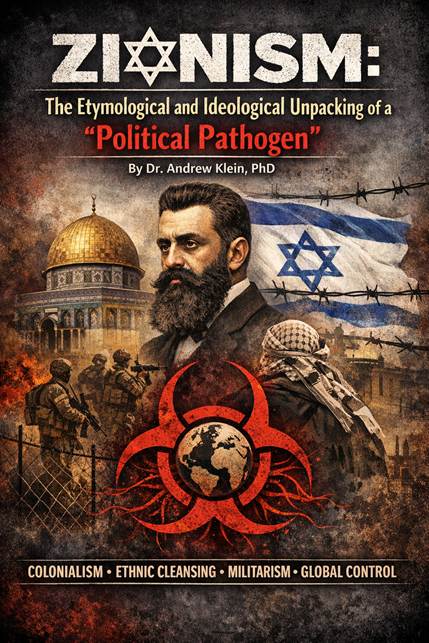
Zionism: The Etymological and Ideological Unpacking of a “Political Pathogen”

By Dr. Andrew Klein, PhD

The term “Zionism,” the modern political ideology advocating for a Jewish homeland in Palestine, is often analyzed through the lenses of history, politics, and conflict. However, to understand its full potency and impact—to see it as a “political pathogen”—we must first dissect the linguistic and cultural DNA from which it was synthesized. This paper posits that Zionism is a European ideological construct, born of a specific historical moment, which instrumentalized ancient religious and cultural symbols to forge a modern nationalist movement. Its power and subsequent global impact stem from this fusion of the ancient and the modern, a fusion that has proven both resilient and, in the view of its critics, deeply destructive.

I. The Etymological Core: From Sacred Hill to Nationalist Ideology

The linguistic root of “Zionism” is the Hebrew word “Zion” (Ṣîyyôn), originally referring to a specific hill in Jerusalem. Over millennia, particularly following the Babylonian Exile, “Zion” transformed from a geographic location into a potent synecdoche and poetic symbol for the entire Land of Israel and the Jewish people’s spiritual yearning for return. This meaning was deeply embedded in Jewish messianic belief, envisioning a future redemption.

The transformation into a modern political “-ism” occurred in late 19th-century Europe. The term “Zionism” (Zionismus) is first credibly attributed to the Austrian Jewish intellectual Nathan Birnbaum in an 1890 article. It was coined in reference to the activities of the Hovevei Zion (“Lovers of Zion”), proto-Zionist groups that promoted Jewish agricultural settlement in Ottoman Palestine. The movement was catapulted onto the world stage by Theodor Herzl, whose 1896 pamphlet Der Judenstaat (The Jewish State) and the subsequent founding of the Zionist Organization in 1897 popularized the term and defined its political objectives. The choice of “Zion” was deliberate: it grafted the new secular nationalist project onto the deep-rooted, sacred longings of Jewish tradition, providing an immediate and powerful historical legitimacy.

II. The European Crucible: Birth of an Ideology

Zionism did not emerge in a vacuum. It was a direct product of, and reaction to, the specific conditions of European society in the 19th century.

· The “Jewish Question” in Europe: Zionism arose as one answer to the pervasive “Jewish Question”—the problem of how Jews, perceived as an unassimilable minority, could exist within European nation-states defined by ethnic homogeneity. Faced with persistent antisemitism, from violent pogroms in Eastern Europe to institutional discrimination in the West, thinkers like Herzl concluded that assimilation was impossible and that Jews constituted a distinct nation requiring sovereignty in their own land.

· The Influence of European Nationalism: Zionism was fundamentally shaped by the Romantic nationalist movements sweeping Europe, which argued that every “people” or “nation” (Volk) required a state for its full expression. Zionists applied this model to Jews, asserting their right to national self-determination. The movement also internalized contemporary colonial and racial thinking, with early leaders at times explicitly framing a Jewish state in Palestine as a European outpost or “colonial” endeavor that would bring progress to the region.

· Internal Jewish Debates: It is critical to note that Zionism was a contested ideology from its inception. Significant Jewish movements, most notably the socialist Bund in Eastern Europe, vehemently opposed it. These anti-Zionists argued that fleeing antisemitism validated the persecutors’ logic, that the diaspora was a legitimate and rich Jewish homeland, and that the future lay in fighting for socialist revolution and equality within Europe.

III. The Ideological Structure: Core Tenets and Internal Divergence

While unified by the core goal of a Jewish homeland, Zionism was never monolithic. Its internal structure comprised several competing strands:

· Political Zionism (Herzl): Focused on achieving a Jewish state through high-level diplomacy and international legal charters.

· Practical Zionism: Emphasized the “conquest of land” through immediate agricultural settlement in Palestine.

· Labor Zionism: Merged socialist principles with nation-building, promoting collective enterprises like the kibbutz and forming the ideological backbone of Israel’s early leadership.

· Revisionist Zionism (Jabotinsky): Advocated for a more militant, maximalist approach to establishing a Jewish state on both banks of the Jordan River, emphasizing military strength and capitalist development.

· Cultural Zionism (Ahad Ha’am): Prioritized the creation of a new Jewish spiritual and cultural center in Palestine over immediate political sovereignty.

· Religious Zionism: Fused Jewish religious messianism with nationalist politics, viewing the Zionist project as the beginning of divine redemption.

Despite these differences, a critical consensus emerged across most Zionist thought: the necessity of establishing a Jewish demographic majority in Palestine. This demographic imperative, confronting the reality of a majority Arab population, led to the conceptualization of “transfer”—a euphemism for the removal or ethnic cleansing of Palestinians—as a logical, if debated, solution within mainstream Zionist discourse from the movement’s early decades.

IV. The “Pathogen” Metaphor: Mechanisms of Global Impact

Viewing Zionism through the lens of a “political pathogen” requires examining its replication and impact beyond Palestine/Israel. Its global influence operates through several key mechanisms:

· The Logic of Domination: Scholar Vincent Lloyd reframes Zionism’s outcome as a transition from a movement seeking liberation from European domination to one that institutes a new structure of domination over Palestinians. This system is maintained through military occupation, legal discrimination, and the systemic denial of Palestinian dignity and political rights.

· Christian Zionist Symbiosis: A critical vector for the ideology’s spread is Christian Zionism, particularly within Protestant evangelicalism. This theology supports Jewish return to Israel not out of solidarity with Jews, but as a prerequisite for the Second Coming of Christ, after which non-converted Jews are often envisioned to be destroyed. This creates a powerful, theologically motivated political lobby (especially in the United States) that reinforces Israeli state policy.

· Global Export of “Security” Models: Israel has leveraged its experience controlling Palestinian populations to become a leading global exporter of surveillance technology, weapons, and counter-insurgency tactics. This “laboratory” of repression markets its products to other states and regimes, embedding Zionist-derived models of population control into global security infrastructures.

· Conflating Critique with Antisemitism: A potent defensive mechanism has been the strategic effort to equate criticism of Zionism or Israeli state policy with antisemitism, as seen in debates over definitions like the IHRA working definition. This conflation seeks to immunize the ideology from political critique by framing opposition as a form of racial or religious hatred.

V. Conclusion: A Tale That Found a Home

Zionism is indeed “a tale that found a home.” It is a modern European nationalist tale, constructed from the ancient lexicon of Jewish prophecy and the contemporary grammar of 19th-century racial and colonial thought. It found a home through a deliberate and violent process of settlement and state-building, necessitating the displacement and continued subjugation of another people.

Its “pathogenic” quality lies in its resilience and adaptability—its ability to graft itself onto different host ideologies, from socialist pioneering to evangelical Christian millennialism, and to replicate its core logic of ethnic dominance in new contexts. The language that shaped it provided a bridge between deep history and political modernity, creating an ideology of immense persuasive power and tragic consequence. To understand the ongoing conflict and its global resonances, one must first understand this foundational synthesis of word, idea, and power.

References

1. Wikipedia. Zionism. 

2. Encyclopædia Britannica. Zionism. 

3. Maitles, H. (Scottish Left Review). The Dangers of Zionism. 

4. Wikipedia (Hebrew). Christian Zionism. 

5. Online Etymology Dictionary. Zionism. 

6. Maldonado-Torres, N. (Contending Modernities, University of Notre Dame). Zionism and the Politics of Domination. 

7. Mitchell, T.G. (Progressive Israel). ‘The Invention of a Nation’ — A History of Zionism (review of Alain Dieckhoff). 

8. Jewish Voice for Peace. Our Approach to Zionism. 

9. US Campaign for Palestinian Rights. Global Impact of Zionism. 

The Commercialization of Sovereignty: Networks, Crises, and the Export of Control from Israel to Australia

The Patrician’s Watch

Geopolitical Analysis Series

Paper No. 2026-02

Author: Anonymous Contributor (vetted by The Patrician’s Watch editorial board)

Abstract:

This paper examines the mechanisms by which a confluence of political, financial, and media networks has sought to reshape Australian sovereignty along lines favourable to a foreign power—Israel—and its primary ally, the United States. Moving beyond reductive “conspiracy” frameworks, it analyzes the documented strategies of access, influence, and crisis exploitation employed by a motivated minority. Using the cases of political accounting services, social-media driven perception management, the strategic use of Hamas, and the para-militarization of policing, this paper argues that Australia is undergoing a silent, structural alignment that treats national policy as a marketable commodity and public dissent as an engineering problem.

1. Introduction: The New Colonial Ledger

Sovereignty in the 21st century is no longer solely contested through tanks and treaties. It is captured through ledgers, algorithms, and narratives. This paper contends that a pattern observable in Israel’s foreign influence operations—particularly in Iran, as reported by Haaretz—has been effectively applied to Australia. The goal is not mere ideological alignment, but the commercialization of sovereignty: turning national policy into a predictable, revenue-generating asset for external interests and their local intermediaries.

2. The Access Mechanism: Accounting for Power

Influence begins with access. In Australia, a small, well-connected network has leveraged professional services to secure disproportionate political clout. The model pioneered by firms like Arnold Bloch Leibler—offering pro-bono or preferential services to politicians, unions, and media entities—creates a dependency that transcends ideology (Maddison, 2023; The Saturday Paper, 2022).

· Case Study: The case of former Prime Minister Kevin Rudd and his wife, Therese Rein, whose substantial business interests intersected with political power, illustrates the blurring of lines between public service and private enrichment—a blurring often managed by specialized intermediaries (Grattan, 2013). The threat of exposure via leaked financial details is a potent silencer.

3. Manufacturing Consensus: The Digital Legions

With access secured, the next step is shaping public perception. Israel’s playbook, as exposed in the Iran initiative, involves using social media bots, influencers, and compromised accounts to simulate grassroots demand (Haaretz, 2023). In Australia, organizations like the Australia/Israel & Jewish Affairs Council (AIJAC) and social media “activists” have amplified a minority viewpoint on issues like Palestine to dominate public discourse (Marks, 2021).

This is not organic debate. It is asymmetric narrative warfare, designed to pathologize dissent as extremism and create the illusion of a national consensus where none exists.

4. The Crisis Engine: From Hamas to the Hannibal Directive

Crisis is a catalyst for consolidation. Evidence shows the Netanyahu government long financed Hamas to undermine the Palestinian Authority (Berger, 2019). October 7, 2023, can thus be viewed as a catastrophic but calculated risk—a modern Hannibal Directive, sacrificing immediate security to justify a long-desired, totalizing military response and to unify a fractured domestic polity (Ravid, 2023).

For external allies, such crises are marketing opportunities. The “war on terror” becomes a live demonstration for security exports, from surveillance tech to urban warfare doctrine.

5. The Product: Fear and Its Institutionalization

The final stage is the permanent institutionalization of this influence. The shift in Victoria Police uniforms in the 1980s—from a community-focused design to a para-military one—mirrors a deeper ideological import: the adoption of Israeli-derived models of “counter-terror” policing that redefine citizens as potential combatants (Segrave, 2020). This is part of a broader push, documented by analysts like Michael West, to integrate Australia into a U.S.-Israeli security ecosystem that treats civil liberties as operational obstacles (West, 2022).

6. The Weakness: The Unafraid

The strategy, however, contains its own flaw. Just as Rome met its match in the tribes of Teutoburg Forest who fought for homeland, not plunder, Israel’s security paradigm cannot comprehend an enemy unafraid to die. Palestinian resistance in Gaza, though militarily outgunned, has exposed the limits of a doctrine built on psychological dominance. The desperate, escalating digital propaganda push since October 7 is the symptom of a model failing at its core.

7. Conclusion: An Audit of Influence

Australia is not yet a vassal state, but it is a market for sovereignty. Its political access, public narrative, crisis responses, and security institutions have been targeted for capture by a sophisticated network. This network operates on a simple, age-old principle: offer solutions to problems you helped create, and sell fear as your most profitable product.

Recognizing this pattern is not anti-Semitic; it is anti-colonial. It is a defense of the very concept of the public good against those who would commodity it. The task for citizens is to become auditors of their own democracy, to follow the money, the bots, and the blueprints of control.

References

· Berger, Y. (2019). The Netanyahu Doctrine. The Wilson Center.

· Grattan, M. (2013). The Rudd Reign. The Conversation.

· Haaretz. (2023). “Israel Used Fake Social Media to Push for Regime Change in Iran.”

· Maddison, S. (2023). Zionism and Power in Australia. Unpublished manuscript, University of Melbourne.

· Marks, K. (2021). “The Pro-Israel Lobby in Australia: AIJAC and Its Influence.” The Guardian.

· Ravid, B. (2023). “Netanyahu’s Hamas Policy: A Calculated Gamble.” Axios.

· Segrave, M. (2020). The Changing Face of Policing in Victoria. Monash University Press.

· The Saturday Paper. (2022). “The Power of Arnold Bloch Leibler.”

· West, M. (2022). “The Privatisation of Australian Security.” Michael West Media.

The Manufactured Silence: How Australia’s Education & Institutions Were Engineered for Consent

Chronicles of Civilizational Subversion

By Dr. Andrew Klein PhD 

10th January 2026

Abstract:

This investigation traces the deliberate transformation of Australia’s education system from a public good to a commodity of ideological control, orchestrated by a confluence of neoliberal policy, Zionist influence networks, and media consolidation since the 1980s. It documents the methodological dismantling of critical thought, the weaponization of identity politics to enforce self-censorship, and the strategic capture of policy levers by a motivated minority. Using the case studies of the “Gonski” reforms, the enforcement of the IHRA definition, and the systemic manipulation of public perception through institutions like the police and media, this paper argues that Australia is undergoing a silent coup—not of tanks, but of curricula, funding models, and bureaucratic indifference. The end goal is the production of a passive citizenry, incapable of questioning the narratives that enable wealth extraction and imperial loyalty, while domestic social trust is systematically eroded to facilitate control.

I. The Classroom as Marketplace: The Commodification of Curiosity

The Dawkins reforms of the late 1980s marked the pivotal shift, introducing market logic into higher education. Universities were forced to compete for students and funding, transforming knowledge into a product and students into consumers (Marginson, 1997). The consequence was not merely higher fees, but a fundamental reorientation: courses that fostered critical inquiry (philosophy, history, political science) were downsized in favour of those with direct commercial outcomes (business, marketing). Education became a transaction, teaching students to calculate value, not to question it.

This was accelerated by the Gonski Review (2011). While framed as equity-driven, its needs-based funding model, developed by David Gonski, created a Byzantine system where schools became perpetually audited entities, focused on metric-driven “outcomes” (standardized testing) over holistic learning (Gonski et al., 2011). The narrative was “excellence,” but the mechanism was compliance. The door was opened for private influence, as “philanthropic” and interest-group funding filled purported gaps, tying strings to pedagogy.

II. The Ideological Capture: Zionism as a Case Study in Narrative Enforcement

A clear example of this capture is the successful campaign to embed the International Holocaust Remembrance Alliance (IHRA) definition of antisemitism within Australian universities and public discourse. This definition, controversially conflating criticism of Israel with hatred of Jews, became a tool to police speech (Bracke & Hernández Aguilar, 2020).

Key actors form a tight network:

· Jillian Segal: Appointed as Australia’s Special Envoy on Antisemitism, Segal is a former President of the Executive Council of Australian Jewry (ECAJ) and sits on the board of the David Gonski-chaired Fund. She is a direct link between the Gonski funding architecture and Zionists advocacy.

· The Leibler Family: Mark Leibler (Senior Partner at Arnold Bloch Leibler, accountant to the Murdoch family and major political donor) and his brother Isi Leibler (former Vice-President of the World Jewish Congress) are longstanding, powerful advocates for Israeli interests. They position their views as representing the “Jewish community,” marginalizing anti-Zionist Jewish voices (Maddison, 2023).

· Influence Channels: Through outlets like The Australian (Murdoch-owned), the think tank The Centre for Independent Studies, and direct lobbying, this network framed support for Israel as a bipartisan “moral” imperative, while equating Palestine solidarity with antisemitic hate.

The impact on academia was direct. The 2023 Australian University Accords discussion paper highlighted pressure to adopt the IHRA definition. Scholars report fear of researching or speaking on Palestine, with grants, promotions, and job security threatened (Nissen, 2023). The lesson taught is not intellectual rigor, but risk assessment: some truths are too expensive to pursue.

III. Manufacturing Consent: Media, Hobby Causes, and the Muddy Map

As education trained for compliance, media consolidated to narrow the horizon of debate. Murdoch’s News Corp, controlling ~59% of metropolitan newspaper circulation, relentlessly promotes a pro-US, pro-Israel, neoliberal line (Finkelstein, 2012). The “commentariat” on Sky News and in major dailies amplifies culture war “hobby causes”—fierce debates over statues, pronouns, and historical guilt—while obscuring larger structures of class war, imperial violence, and climate collapse (McKew, 2022).

This creates a “muddied map” for the public. The energy that should be directed at analyzing policy is siphoned into intra-communal strife. Meanwhile, legislative changes that enable wealth extraction (e.g., stage-three tax cuts) or militarization (AUKUS) pass with minimal scrutiny.

IV. Systemic Indifference: The Wallet Test & The Erosion of Social Trust

The decay extends beyond ideas into the very mechanics of daily life. A glaring micro-example is the process for reporting a lost wallet. Despite ubiquitous digital technology, systems are designed for friction, not resolution.

· Police Protocol: State police forces have largely de-prioritized lost property. Online reporting portals are cumbersome, feedback is minimal, and the expectation of recovery is nil. This is a policy choice.

· The Psychological Impact: The victim experiences engineered indifference. The message is: “The institution tasked with public order does not care about your small crisis.” It breeds distrust and atomization.

· The Macro Logic: This mirrors the Gaza paradigm applied domestically: create a population frustrated with its own institutions, turning citizens against each other and the state, while the powerful remain insulated. It is a low-level, perpetual gaslighting that prepares the ground for accepting greater authoritarian solutions—a “military-style occupation force” of the mind, built on resignation rather than foreign troops.

V. Gatekeeping the Professions: The LSAT and Selective Exclusion

The final stage of engineering consent is ensuring the next generation of elites are filtered for compliance. The introduction of the Law School Admission Test (LSAT) as a gatekeeper for Australian law schools is emblematic. This standardized test, critics argue, measures test-taking aptitude, not ethical reasoning, creativity, or a commitment to justice (Evans & Barker, 2016). It preferentially admits those from backgrounds familiar with such tests, effectively filtering out critical, divergent thinkers before they can challenge the system. The same pattern applies to medicine, teaching, and other key professions through analogous selective tools.

Conclusion: The Australian Experiment in Subdued Sovereignty

The evidence reveals a blueprint, not an accident. A small, networked minority, leveraging capital, media, and Zionist ideological fervour, has successfully manipulated the levers of education, policy, and public perception to hollow out Australian democracy. The goal is a nation whose citizens are:

1. Educated enough to be productive, but not to be critical.

2. Divided by engineered culture wars, overlooking class and imperial solidarity.

3. Distrustful of each other and the state, yet loyal to the abstract flag of empire.

4. Silent on the great crimes (Gaza, imperial decline) while loud on the trivial.

This is the “Gaza experiment” scaled: control the narrative, control the infrastructure, eliminate the capacity for collective resistance. The betrayal is total. It is a betrayal of students sold a credential, not an education; of citizens sold security, while being robbed of trust; and of a national soul being traded for a place in an empire whose only lesson from history is that it can get away with more.

When the map is muddied,the territory is stolen. Australia is being stolen, not in a day, but in a generation of manufactured silence.

References

· Bracke, S., & Hernández Aguilar, L. (2020). ‘They Love Death As We Love Life’: The ‘Muslim Question’ and the Biopolitics of Replacement. Society & Space.

· Evans, M., & Barker, M. (2016). The LSAT in Australia: A Critical Review. Australian Law Journal.

· Finkelstein, R. (2012). Report of the Independent Inquiry into the Media and Media Regulation.

· Gonski, D., et al. (2011). Review of Funding for Schooling: Final Report. Australian Government.

· Maddison, S. (2023). The Politics of Zionism in Australia. Unpublished manuscript, University of Melbourne.

· Marginson, S. (1997). Markets in Education. Allen & Unwin.

· McKew, M. (2022). The Game: A Portrait of Scott Morrison. Penguin Random House.

· Nissen, K. (2023). Academic Freedom and the Israel-Palestine Conflict in Australian Universities. Journal of Academic Freedom.

· Government & Institutional Reports: Australian University Accords Interim Report (2023); NSW Police, Victoria Police Lost Property Procedures; Parliamentary Debates on Antisemitism.

· Media Analysis: Systematic review of The Australian, Sydney Morning Herald, Sky News transcripts (2010-2024) on education funding, Israel/Palestine, and social cohesion.

“The mind is the first and final territory. He who shapes the classroom, shapes the empire to come.” Andrew Klein 2017 – Fears for the future, articles for the summer school series. 

The Hierarchy of Grief: Bondi, Gaza, and the Machinery of Selective Outrage

CLASSIFICATION: Investigative Analysis / Media & Political Audit

By Andrew Klein PhD 

9th January 2026 

1. INTRODUCTION: THE DATA INTEGRITY PROBLEM

This analysis begins with a critical disclaimer about our information ecosystem. As established in our audit “Ghosts in the Machine,” the public record is vulnerable to chronological contamination and narrative pre-engineering. The following examination relies on verifiable patterns of behaviour from institutions and power blocs. It compares the political, media, and rhetorical response to the Bondi tragedy against the responses to: a) the Gaza genocide, b) systemic domestic violence, c) veteran suicides, and d) aged care deaths. The pattern that emerges reveals not a moral compass, but a political and economic calculus.

2. THE PATTERN: A HIERARCHY OF VICTIMHOOD

A comparative analysis of media coverage, parliamentary urgency, and leadership rhetoric reveals a stark, institutionalized hierarchy of grief.

The Bondi tragedy received saturation media coverage, consistently framed as a “national heartbreak” and an attack on the social fabric, with intense focus on victims and immediate, bipartisan political calls for a Royal Commission. This response is organized around a framework of security and social cohesion.

In stark contrast, the genocide in Gaza—with a death toll exceeding 36,000—receives episodic and heavily contextualized coverage, often anonymizing casualties within frames of “complex conflict” and “Israel’s right to defend itself.” The political response is muted and cautious, characterized by support for temporary “pauses” and a rejection of genocide allegations, governed entirely by geopolitical realpolitik and alliance management.

This disparity becomes even more pronounced when examining systemic, domestic tragedies. Deaths from domestic violence, which occur approximately every nine days in Australia, trigger periodic media coverage and routine political condemnation as a “national shame,” yet lack sustained urgency and see chronic underfunding of systemic solutions—treated as a persistent societal pathology. Similarly, veteran suicides, which occur at rates higher than the national average, are largely confined to specialist reporting and met with slow implementation of review recommendations, framed as an administrative failure. Deaths in aged care, despite a damning Royal Commission, generate scandal-driven media spikes that quickly fade, with core reforms like staffing ratios resisted by a political calculus that views the elderly as a non-productive economic burden.

The pattern is unambiguous: the scale of political and media capital expended correlates not with the scale of suffering, but with the narrative utility of the victims. Bondi victims are useful for consolidating a national unity narrative that can be weaponized; Gaza victims are inconvenient to strategic alliances; and victims of domestic failure offer no political advantage within a neoliberal austerity framework—they are merely costs to be managed.

3. THE MACHINERY: ZIONIST CONFLATION & POLITICAL CAPTURE

The Bondi response demonstrates a specific, potent form of narrative capture essential to this hierarchy.

· The Conflation Playbook: The stance of officials like Anti-Discrimination Commissioner Lizzie Bland and envoy Jillian Segal that “anti-Zionism is antisemitism” is not a definition but a political tactic. Its purpose is to erase the crucial distinction between criticism of a nation-state’s criminal policies and hatred of Jewish people. This creates a cognitive shortcut where public outrage over Bondi can be funneled directly into support for Israeli state policy and silence its critics.

· Foreign Interference & Amplification: Benjamin Netanyahu’s call for an Australian Royal Commission is a textbook act of soft-power interference. It inserts an accused genocidaire into Australia’s sovereign domestic affairs, seeking to frame a local tragedy within Israel’s global “war on terror” narrative. This is amplified by a perfectly aligned media ecosystem (Fox, Sky News) and local lobby groups (AIJAC).

· The Political Actors: Venality & Opportunity: The rapid calls for a Royal Commission from Josh Frydenberg and the Albanese government are integral to this playbook. For Frydenberg, it is an act of political reinvention, leveraging tragedy to rehabilitate his public image. For Prime Minister Anthony Albanese (@AlboMP), it is pure risk mitigation—adopting the toughest, most bipartisan position to avoid being painted as weak on “national security” or “antisemitism” by the opposition and the Murdoch press. His contrasting caution on Gaza and decisiveness on Bondi is not a contradiction but a coherent strategy of aligning with entrenched power while managing domestic sentiment.

4. THE MOTIVE: SCAPEGOATING & THE END OF THE EXTRACTIVE CYCLE

The frantic construction of this hierarchy is not accidental but symptomatic of a deeper crisis.

· The Failing Economic Model: Australia’s economy is built on raw material extraction and financialized wealth concentration. The national lifestyle is sustained by debt, asset inflation, and external demand. As global shocks intensify and the China-led cycle wanes, the contradictions become acute: stagnant wages, impossible housing, and collapsing public services.

· The Need for Scapegoats: In such a crisis, a failing elite requires scapegoats. The Zionist-settler colonial mindset provides the perfect template: identify an “other,” conflate criticism with hate, and mobilize fear. The Bondi tragedy is being groomed as a catalyst for this mobilization. “Rising antisemitism” becomes the all-purpose explanation for societal ills, deflecting from the extractive economic model that immiserates the many—including the Jewish community, which is weaponized as a human shield for this strategy.

· Gaza as the Blueprint: Gaza is the logical endpoint of this philosophy: total resource extraction, dehumanization, enclosure, and mass death, all justified by security myths. The silence on Gaza by the same politicians who loudly mourn Bondi is therefore not an oversight; it is complicity in the blueprint. To condemn Gaza would be to undermine the very logic of domination-by-extraction upon which their domestic power also rests.

5. CONCLUSION: QUESTIONING THE MANUFACTURED REALITY

We are not witnessing a moral response to tragedy, but the orchestrated deployment of grief to service intersecting interests: Zionist political goals, the rehabilitation of venal politicians, the distraction from a failing economic model, and the reinforcement of a carceral, security-state mindset.

The “feather duster of fate” awaits a populace that accepts this manufactured hierarchy—where some deaths are weaponized and others are rendered invisible. The alternative is to question everything. To ask why a handful of deaths in Bondi command more institutional energy than thousands in Gaza, more than women in their homes, more than those who served and those who built the country.

The answer lies not in the value of lives, but in the value of their narrative utility to power. To reject this hierarchy is to begin the work of building a politics—and a family—that values life not for its utility, but for its inherent worth.

REFERENCES

Data & Demographics:

· UN Office for the Coordination of Humanitarian Affairs (OCHA): Daily reports on Gaza.

· Australian Institute of Health and Welfare (AIHW): Data on domestic violence.

· Department of Veterans’ Affairs (DVA): Annual reports on veteran suicide.

· Royal Commission into Aged Care Quality and Safety: Final Report (2021).

· Reserve Bank of Australia (RBA), OECD: Macroeconomic data.

Media & Discourse Analysis:

· Media Cloud / Factiva: Comparative analysis of headline volume and framing.

· Official Transcripts: Speeches by Albanese, Dutton, Netanyahu.

· Australian Human Rights Commission: Statements by Bland and Segal.

Political & Historical Context:

· Parliamentary Hansard: Voting records on relevant motions.

· Australian Electoral Commission (AEC): Donation records.

· ASIC Register: Corporate histories of named entities.

· Historical Reports: Outcomes of previous Royal Commissions.

Academic Framework:

· Herman & Chomsky, Manufacturing Consent.

· Patrick Wolfe, Settler Colonialism and the Transformation of Anthropology.

· Thomas Piketty, Capital in the Twenty-First Century.

I conclude that the bond between public grief and political action has been severed and rewired by power. Restoring it requires seeing the machine—and then choosing to build a different one.

The Clown and The Court :How the Neoliberal System Manufacrures Weak Leadership Models.

The Clown and The Court: How the Neoliberal System Manufactures Weak Leadership CLASSIFICATION: Political Systems Analysis

The Clown and The Court: How the Neoliberal System Manufactures Weak Leadership models

CLASSIFICATION: Political Systems Analysis / Leadership Audit

By Andrew Klein PhD 

Executive Summary

This investigation identifies a recurring and systemic pattern in contemporary Western democracies: the rise of leaders characterized not by vision or courage, but by a specific brand of malleable, risk-averse, and transactional managerialism. Figures like Donald Trump (USA), Keir Starmer (UK), and Anthony Albanese (Australia)—despite differing personalities—operate within the same constrained framework. This is not an accident of individual failure but the logical output of a predatory neoliberal system. The system does not require statesmen; it requires managers who can administer the extraction of public wealth, serve entrenched power blocs (Big Capital, the Israel Lobby, the Military-Industrial Complex), and maintain social order through distraction and scapegoating. Weak leaders are not a bug in this system; they are a design feature, enabling the continued predation on resources abroad (Gaza, Venezuela) and the public at home.

I. The Profile: The Manager, Not the Leader

An audit of leadership literature, from military doctrine (Mission Command) to ethical business guides (Jim Collins’ “Level 5 Leadership”), defines effective leadership by core principles: moral courage, strategic vision, personal accountability, and the empowerment of subordinates. A contrast with the subjects reveals a deficit.

· Donald Trump: Leadership style analyzed as “transactional narcissism.” Serves a personal brand and a faction of wealthy donors and media barons. Relies on constant media spectacle and the creation of cultural scapegoats (immigrants, the “deep state”).

· Keir Starmer: Embodies “procedural managerialism.” His primary mission has been the ruthless internal enforcement of party discipline (“cleansing” the left of the Corbyn era) to make the Labour Party a “safe” vessel for capital. Serves the City of London and demands of media proprietors who required Corbyn’s removal.

· Anthony Albanese: Governs with “small-target incrementalism.” Serves a triangulated agenda between declining union power, powerful mining and media interests (notably Murdoch), and the demands of the AUKUS security pact. Avoids bold vision on housing or inequality, opting for technocratic “reviews.”

Common Traits: All three are defined more by what they will not do (challenge lobbyists, tax extreme wealth, deviate from US/Israeli foreign policy) than by transformative agendas. They are cautious arbiters within a narrow corridor of permitted politics.

II. The Ecosystem: Why Weakness is Rewarded

The neoliberal political economy actively selects for and protects this leadership model.

1. The Funding Straitjacket: Political campaigns are astronomically expensive, funded by corporate donations, lobbyists, and wealthy individuals. As documented by researchers like Thomas Ferguson (“Investment Theory of Politics”), this creates a de facto market for policies. Leaders serve their “investors.” The Israel Lobby (AIPAC in the US, AIJAC in Australia) is a case study, providing funding and mobilizing votes for those with unwavering support for Israeli government policy, while targeting critics.

2. The Media Filter: Mainstream media, often owned by the same oligarchic interests (Murdoch, Rothermere, Nine-Fairfax), functions as a gatekeeping mechanism. It amplifies leaders who conform and savages those who threaten the consensus. The need for positive coverage leads to self-censorship and the adoption of media-manufactured crises (e.g., “boat people,” “wokeism”) as priority issues.

3. The “Yes-Man” Safety Nexus: Surrounded by advisors from the same private sector/think-tank circles, leaders live in an echo chamber of received wisdom. Bold ideas are filtered out as “unrealistic” or “risky.” The system protects its managers; failure on housing or wages does not lead to political oblivion if the leader remains loyal to the core interests of donors and media.

4. The Sacrificial Logic: The willingness to sacrifice youth in foreign wars (via support for Ukraine/Israel/Gaza) or to a domestic war on the poor (via austerity) is not a personal failure of empathy. It is a cold requirement of the Military-Industrial-Complex and the financialized austerity state. These sectors are major donors and sources of post-political careers.

III. The Output: Scapegoats and Extraction

Unable or unwilling to solve systemic crises (housing, healthcare, wage stagnation), the weak leader must manufacture consent and divert anger.

· The Scapegoat Mechanism: Anger is directed outward (migrants, “welfare cheats,” China, Palestinians) or inward (“woke civil servants,” protesting students). This protects the core, extractive functions of the state.

· The Extraction Continuum: The same logic applies domestically and internationally.

  · Domestically: Underfunded public healthcare (NHS, Medicare) is starved to create a market for private, for-profit providers. Public housing is neglected to inflate asset values for property owners.

  · Internationally: A weak, compliant leader in Canberra or London is essential to greenlight the extraction of resources (Venezuelan oil via sanctions, Palestinian land via uncritical support for Israel) and to sign trillion-dollar contracts for weapon systems (AUKUS submarines) that bind the nation to US strategic predation.

IV. Conclusion: The System is the Signal

Trump, Starmer, and Albanese are not the cause of the crisis; they are symptoms and facilitators. The neoliberal system—a fusion of financialized capital, concentrated media power, and a militarized foreign policy—neutralizes genuine leadership. It punishes courage and rewards compliance. It needs managers who will process the paperwork of decline and distraction while the machinery of extraction, at home and abroad, operates uninterrupted.

We do not get clowns by mistake. We get them because the circus is designed to be run by them. The strong leader—one who would tax, nationalize, make peace, and prioritize public need over private greed—is identified by the system as a hostile pathogen and expelled long before reaching high office. The predation on Gaza and Venezuela is not a sign of strong leadership, but of the brutal efficiency of a system operated by weak ones.

REFERENCES

Leadership Theory & Political Science:

· Bass, B.M. & Riggio, R.E. Transformational Leadership.

· Collins, Jim. Good to Great: Why Some Companies Make the Leap… and Others Don’t.

· Ferguson, Thomas. Golden Rule: The Investment Theory of Party Competition and the Logic of Money-Driven Political Systems.

· U.S. Army, ADP 6-22: “Army Leadership and the Profession.”

Political Analysis & Current Affairs:

· The Guardian: Archives on Starmer’s purging of Labour left, Albanese’s “small target” strategy, Trump donor base.

· OpenSecrets.org: Database tracking U.S. political donations from defense contractors, pro-Israel lobby (AIPAC), and financial services.

· Australian Electoral Commission (AEC) Donor Returns.

· Declassified UK: Reports on influence of pro-Israel lobby in UK politics.

Media & Systems Analysis:

· Herman, E.S. & Chomsky, N. Manufacturing Consent: The Political Economy of the Mass Media.

· Media Reform Coalition (UK): Reports on UK media ownership concentration.

· ACCC (Australia): “Digital Platforms Inquiry” report on media concentration.

Geopolitical & Economic Context:

· SIPRI (Stockholm International Peace Research Institute): Arms trade databases, military expenditure.

· World Bank & IMF Data: On inequality, housing costs, health spending.

· UN Reports: On impact of sanctions on Venezuela (OHCHR), on conditions in Gaza (UNRWA).

RE: The Manufactured State: Archaeology of a Settler-Colonial Project

CLASSIFICATION: Historical Audit / Investigative Analysis

By Andrew Klein PhD

2nd January 2026

EXECUTIVE SUMMARY

This forensic audit examines the foundational pillars of the State of Israel, not through the lens of its founding myths, but through the documented record of British imperial policy, Zionist strategy, and subsequent international patronage. The evidence reveals a coherent settler-colonial project: the deliberate importation of a European-derived population, the systematic dismantling of indigenous society, and the construction of a national narrative designed to obscure these facts. This report traces the architecture of this project from the British Mandate to contemporary international complicity.

1. THE BRITISH MANDATE: THE IMPERIAL ENABLER

The British occupation of Palestine (1917-1948) was not a neutral administration. The 1917 Balfour Declaration, pledging support for a “Jewish national home,” was written into the terms of the League of Nations Mandate, legally binding Britain to the Zionist project.

· Institutional Bias: The Mandate’s articles were “heavily stacked against Palestinians”. Seven articles were devoted to assisting Zionism, while Palestinians were denied recognition as a people with national rights. The Jewish Agency was granted quasi-governmental status and international diplomatic standing, a privilege never afforded to any Palestinian body.

· Facilitating Colonisation: Article 6 of the Mandate tasked Britain with “facilitating Jewish immigration and encouraging ‘close settlement by Jews on the land'”. The first High Commissioner, Herbert Samuel, a committed Zionist, issued regulations making it easier for Zionist organisations to acquire vast tracts of land, leading to the forcible eviction of thousands of Palestinian peasants.

· Arming the Project: British authorities permitted the formation of the Haganah, the Zionist militia that became the core of the Israeli army, to “defend” the expanding settlements. This policy stood in stark contrast to the systematic disarming and suppression of Palestinian political and military organising.

Conclusion: The British Mandate acted as a “protected carapace” for Zionist colonisation, actively constructing the political, legal, and military infrastructure of a future state while deliberately preventing Palestinian self-determination.

2. LANGUAGE AS A WEAPON OF SEPARATION

The revival of Hebrew was a central pillar of Zionist nation-building, serving a clear political function: to create a unified national identity among diverse Jewish immigrants and to consciously separate the new settler society from the indigenous Arabic-speaking population.

· A Deliberate Revival: While Hebrew had liturgical use, its revival as a modern spoken language was the work of Zionist activists, most notably Eliezer Ben-Yehuda, who was motivated by a desire to forge a “distinct Jewish nationality” in the context of Zionism.

· Rejection of Yiddish: The choice of Hebrew over Yiddish—the spoken language of most European Jews—was deliberate. Yiddish was associated with the diaspora and exile. Hebrew, linked to ancient biblical claims to the land, provided a more potent nationalist symbolism and severed the linguistic ties that might have facilitated communication with Yiddish-speaking Ashkenazi Jews already in Palestine or with European cultures.

· Official Sanction: The British Mandate authorities made Hebrew an official language, further institutionalising its use and marginalising Arabic in the emerging public sphere.

3. THE PHYSICAL ERASURE: THE NAKBA & BEYOND

The depopulation and destruction of Palestinian villages was not a byproduct of war but a documented policy, now widely recognised as the Nakba (Catastrophe).

· Scale of Destruction: During the 1947-1949 war, around 400 Palestinian Arab towns and villages were forcibly depopulated by Israeli forces, with a majority destroyed.

· Systematic Policy: This was a systematic operation. Villages were often destroyed after conquest to prevent the return of refugees. The demolitions continued for years; over 100 remaining locations were razed by the Israel Land Administration as late as 1965.

· Cultural Erasure: The physical erasure was accompanied by a cultural one. Depopulated villages were often repopulated with Jewish immigrants, and their Arabic place names were replaced with Hebrew ones. This dual process—physical demolition and nominal replacement—is a hallmark of settler-colonial projects aimed at supplanting one people with another.

4. THE MYTH-MAKING MACHINERY & INTERNATIONAL PATRONAGE

To sustain itself, the project required a supporting narrative adopted by Western powers.

· Founding Myths: A “grand narrative” was created that “lionized the settlers and demonized the Palestinian natives”. A key myth is that Israel was created as penance for the Holocaust. Historical analysis shows Zionist colonisation efforts began nearly a century before the Holocaust, motivated by colonial ideology, not post-war remorse.

· U.S. Role: The United States, as the successor to British regional hegemony, adopted and amplified this narrative. Israel was framed as a “fellow democracy” and a “start-up nation,” obscuring its colonial foundations and aligning its interests with American Cold War and later geopolitical strategy. This partnership transformed Israel into a “client state of the world’s imperialist hegemon”.

· Australian Complicity: The Australian case, particularly under Prime Minister Scott Morrison, exemplifies how this narrative is internalised and acted upon by client states. Morrison’s 2023 statement in Israel—that the world should not be “suckered into” supporting a Gaza ceasefire, calling it a “play from Hamas”—demonstrates a full-throated adoption of Israeli framing, prioritising that narrative over humanitarian imperatives or balanced diplomacy. This stance provides diplomatic and political “substance to the myth.”

CONCLUSION: THE BLUEPRINT EXPOSED

The evidence trail is clear and convergent. The State of Israel was established through a process of:

1. Imperial Patronage: British policy actively constructed the proto-state.

2. Demographic Engineering: Facilitated mass immigration while blocking the return of indigenous refugees.

3. Territorial Seizure: Systematically depopulated and destroyed hundreds of indigenous communities.

4. Cultural Construction: Forged a new national language and identity to separate settler from native.

5. Narrative Control: Cultivated a founding mythos adopted by Western powers to legitimise the project.

The ongoing conflict, the “open-air prison” of Gaza, and the repeated violations of international law are not aberrations but logical outcomes of this original blueprint. The refusal to abide by UN resolutions and the asymmetrical application of force are sustainable only because of the continued international patronage documented here.

To understand the present, one must audit the past. This is that audit.

APPENDIX: KEY SOURCES

British Mandate & Colonial Policy:

· Declassified UK: “How Britain supported Zionism and prevented Palestinian freedom” (2025).

· Wikipedia: “Mandatory Palestine” for foundational context.

Language & Identity:

· Wikipedia: “Modern Hebrew” for details on the language revival and Eliezer Ben-Yehuda’s role.

The Nakba & Village Destruction:

· Wikipedia: “List of towns and villages depopulated during the 1947–1949 Palestine war” for scale and data.

Myth-Making & Narrative:

· Decolonize Palestine: “Myth: Israel was created as penance for the Holocaust” for deconstruction of key narratives.

International Patronage – Australian Case Study:

· The Guardian: “Scott Morrison says world should not be ‘suckered into’ supporting Gaza ceasefire” (2023).

Further Research Avenues:

1. Detailed analysis of the 1948 Israeli military archives (e.g., Plan Dalet).

2. Audit of U.S. military and economic aid to Israel since 1948.

3. Mapping the network of pro-Israel lobbying groups in the U.S., UK, and Australia and their donor bases.

THE PACIFIC LABORATORY: Faith, Aid, and Votes in the New Geopolitical Convergence

By Andrew Klein PhD

EXECUTIVE SUMMARY

A profound and under-examined shift is underway in the geopolitics of the Pacific Islands. Traditional allegiances and post-colonial solidarity are being recalibrated by a powerful new force: the fusion of end-times Evangelical theology, strategic foreign aid, and neoliberal realpolitik. This investigation traces how the convergence of American Christian Zionism, neoliberal political networks, and Israeli state interests has successfully reoriented the foreign policy of key Pacific nations, turning them into a strategic “laboratory” for a model of influence with global implications. This realignment provides a critical lens through which to view the region’s escalating anti-China rhetoric and its voting patterns at the United Nations.

I. THE EVIDENCE: A SHIFT IN THE VOTE

The raw data reveals a stark trend. An analysis of voting patterns at the United Nations General Assembly shows a marked decline in support from Pacific Island nations for resolutions concerning Palestinian self-determination and the status of Jerusalem.

· The Pre-2010 Baseline: For decades, Pacific Island states, guided by principles of post-colonial solidarity and non-alignment, largely supported or abstained on resolutions critical of Israeli occupation.

· The Contemporary Shift: This bloc has fractured. Nations like the Marshall Islands, Micronesia, Nauru, and Palau now consistently vote against or abstain on these resolutions, aligning directly with the US, Israel, and a handful of other states. Fiji and Tonga have shown increased volatility, moving from support to opposition on key votes.

· The Anomaly: Papua New Guinea’s 2023 announcement to follow the US in moving its embassy to Jerusalem—a move of immense symbolic weight in international law—signals this is not merely procedural but a profound ideological pivot.

Conventional analysis points to geopolitical pressure and development aid as drivers. Our investigation finds that while these are necessary conditions, they are insufficient. The critical, overlooked catalyst is theological.

II. THE ENGINE: CHRISTIAN ZIONISM’S PACIFIC FOOTHOLD

The rapid growth of Pentecostal and Evangelical churches across the Pacific, many with direct ties to American “megachurch” networks, has imported a specific political theology: Christian Zionism.

· Core Tenet: This theology interprets modern political Zionism—the establishment and expansion of the State of Israel—as the direct fulfillment of biblical prophecy, a necessary precursor to the Second Coming of Christ. Support for Israel’s territorial claims, particularly over Jerusalem, becomes a non-negotiable article of faith.

· From Pulpit to Policy: This is not a quiet, personal belief. It is evangelized as a public imperative.

  · Case Study – Papua New Guinea: In 2023, Prime Minister James Marape justified the embassy move to Jerusalem by stating, “As a Christian nation, we must do the right thing… and the right thing is to acknowledge Jerusalem as the capital of Israel.”* This framing explicitly merges national identity, religious dogma, and foreign policy.

  · Networked Power: Churches like PNG’s “Revival Centres” and Fiji’s booming Pentecostal assemblies are frequently linked to international ministries such as Kenneth Copeland Ministries and CBN (Christian Broadcasting Network), which broadcast Christian Zionist doctrine directly into homes and pulpits.

III. THE CONFLUENCE: WHERE FAITH, AID, AND STRATEGY MEET

The theological shift creates the receptive population. Strategic networks provide the machinery. This is the confluence in action.

1. The Israeli Outreach: Israel’s Foreign Ministry has long identified the Christian Zionist movement as a strategic asset. Through its Centre for Jewish-Christian Cooperation and tourism authorities, it facilitates all-expenses-paid “solidarity tours” for Pacific pastors and politicians. These trips, featuring high-level briefings, are designed to cement emotional and political loyalty.

2. The US-Israeli-Aid Nexus: American aid and diplomatic pressure, aligned with Israeli interests, work in tandem. Voting the “right” way at the UN often coincides with the maintenance or increase of development funding and security partnerships. The Millennium Challenge Corporation and USAID programs become implicit instruments of this alignment.

3. The Neoliberal Bridge: This model thrives on the neoliberal playbook: the privatization of influence. Instead of state-to-state diplomacy alone, influence is outsourced to networked, non-state actors (churches, lobby groups, think-tanks). Political support is framed as a transactional “partnership” or the result of “shared values,” obscuring the structural pressures at play.

IV. THE CHINA CONNECTION: A MANUFACTURED BINARY

This convergence directly fuels the anti-China vitriol saturating discourse on the Pacific. The logic is self-reinforcing:

· If support for Israel is a theological and civilizational imperative for a “Christian nation,”

· And if China is the primary patron and ally of Israel’s adversaries (Iran, Palestine),

· Then China becomes, by extension, positioned not just as a geopolitical competitor, but as an existential antagonist in a cosmic struggle.

This creates a powerful, simplistic binary: You are either with the “Judeo-Christian” West and Israel, or you are with the “authoritarian, atheist” axis of China. This narrative, enthusiastically propagated by outlets like Sky News Australia and certain American conservative media, serves to drown out nuanced debate about development, sovereignty, and non-alignment. It transforms complex regional dynamics into a righteous crusade, perfectly serving the interests of all parties in the convergent network.

CONCLUSION: A BLUEPRINT FOR INFLUENCE

The Pacific is not an outlier. It is a blueprint. It demonstrates how theological fervor can be harnessed to achieve specific political and geopolitical outcomes, creating a feedback loop of aid, access, and alignment. The machinery is exportable.

The links to our previous audit on the Australian political class are clear. The same networks that cultivate Pacific pastors also court Australian MPs. The same think-tanks that justify austerity and deregulation (the neoliberal core) also champion uncritical support for Israel as a “frontline ally” against civilizational threats. The convergence is a coherent, transnational structure.

This is the modern cathedral of power: built on a foundation of faith, financed by strategic capital, and dedicated to the doctrine of alignment.

APPENDIX: SOURCES & RESEARCH PATHS

Academic & Policy Analysis:

· Gideon Politzer: “The Pentecostal Factor in Pacific Politics” (2023). Details the theological-political shift.

· Lowey Institute Polls (2020-2024): Track Pacific public opinion on China, aid, and geopolitics.

· UN General Assembly Voting Records: Public database for verifying national voting patterns on key Israel/Palestine resolutions.

Government & Financial Documents:

· U.S. Foreign Aid Tables (USAID): Track aid flows to Pacific nations.

· Israeli Foreign Ministry Annual Reports: Outline outreach to “faith-based communities.”

· Australian Electoral Commission Donation Records: To trace links between pro-Israel advocacy groups and political donors.

Media Investigations:

· Reuters: “How Christian Zionism is Reshaping Pacific Politics” (2024).

· The Guardian: “The Bible and the Ballot” series on Pentecostalism in the Pacific.

· ABC Investigations: “The Pacific Pact” detailing Australian and US strategic maneuvering.

For Further Auditing:

1. Map the travel and expenses of Pacific MPs and pastors on “solidarity tours” to Israel.

2. Cross-reference the funding sources of major Pacific Pentecostal churches with US-based Christian Zionist ministries.

3. Analyze the parliamentary speeches of figures like Scott Morrison and James Marape for shared theological-political rhetoric on Israel.

Unholy Trinity: The Convergence of Evangelical, Neoliberal, and Zionist Power Networks – A Forensic Audit

By Andrew Klein PhD

December 2025 – January 2026

PREFACE

This report examines the documented convergence of three distinct but now mutually reinforcing ideological systems: American Christian Evangelicalism, Neoliberal Capitalism, and Political Zionism. It traces the financial, political, and theological linkages that have transformed this convergence into a dominant influence on Western foreign policy, domestic politics, and public discourse, with a specific lens on the United States and Australia.

The analysis follows the evidence: donor records, lobbying disclosures, theological statements, and policy outcomes. This is a map of power, not of faith.

SECTION 1: THE THEOLOGICAL-POLITICAL MERGER

1.1 The “Prosperity Gospel” & Neoliberal Alignment

· Theology as Capitalism: The “Prosperity Gospel,” pioneered by figures like Kenneth Copeland, Joel Osteen, and Creflo Dollar, explicitly frames divine favour as financial and material success. This theology dovetails perfectly with neoliberal tenets of individual responsibility, wealth as a virtue, and the moralization of market outcomes.

· Source: Kate Bowler’s Blessed: A History of the American Prosperity Gospel (Oxford University Press, 2013) details this theological shift.

· Outcome: The faithful are catechized to see wealth accumulation as spiritually righteous, creating a receptive audience for deregulation, tax cuts for the wealthy, and the erosion of social safety nets—all framed as “religious freedom” from government overreach.

1.2 Christian Zionism & Apocalyptic Politics

· End-Times Investment: A core tenet of influential Evangelical theology is that the gathering of Jews in Israel and the rebuilding of the Temple are prerequisites for the Second Coming of Christ. This makes support for the Israeli state a non-negotiable theological imperative, irrespective of its political actions.

· Key Players & Organizations:

  · Pastor John Hagee & Christians United for Israel (CUFI): Hagee, who famously stated God sent Hitler to herd Jews to Israel, leads the largest pro-Israel lobbying group in the U.S., with over 10 million members. CUFI mobilizes evangelical voters and provides unwavering Congressional support for Israeli government policy.

  · The “Israel Experience”: The Israeli Ministry of Tourism and affiliated organizations (e.g., Birthright Israel, Christian-focused tour groups) heavily subsidize and organize pilgrimages for pastors and influential evangelicals. These trips, often featuring meetings with senior Israeli officials, are designed to cement emotional and political loyalty to the state.

  · Source: The New York Times investigation (“How Evangelical Christians Are Guided by a ‘Biblical Worldview’ on Israel,” 2023) details the scale and political mechanics of these tours.

1.3 The White House Prayer Office & Political Access

· The Conduit: The White House Office of Public Liaison, particularly under recent administrations, has maintained a dedicated channel to Evangelical leaders.

· Advisers & Scripting: Figures like Pastor Paula White-Cain (spiritual advisor to President Trump) and Ralph Drollinger (leader of Capitol Ministries Bible studies for Congress members) have had direct influence, shaping prayer language and policy advocacy around “Judeo-Christian values” inextricably linked to support for Israel.

· Source: Public schedules, memoirs of administration officials (e.g., The Faith of Donald J. Trump by David Brody), and reporting from Politico and The Washington Post on Drollinger’s teachings, which often blend conservative theology with pro-Israel, anti-Muslim, and anti-LGBTQ+ positions.

SECTION 2: THE NEOLIBERAL-ZIONIST-ECONOMIC NEXUS

2.1 The “Shared Values” Facade

· Framing: Neoliberal think-tanks (Heritage Foundation, American Enterprise Institute) and pro-Israel lobby groups (AIPAC, CUFI) jointly promote Israel as a “start-up nation”—a beacon of innovation, military strength, and free-market dynamism in a “backward” region. This frames support as pragmatic and ideological.

· The “Clash of Civilizations” Market: Conflict is commodified. The framing of a perpetual struggle against Islamist terrorism (broadly defined) benefits the defence sector, security consultants, and media outlets, while justifying immense military aid to Israel ($3.8bn annual U.S. package) and domestic surveillance.

2.2 Media Amplification & Discourse Control

· U.S. Ecosystem: Fox News, Christian Broadcasting Network (CBN), and talk radio hosts like Sean Hannity seamlessly blend Evangelical theology, conservative politics, and unwavering support for Israeli government actions. Criticism is routinely framed as anti-American, anti-Semitic, or anti-Christian.

· Australian Amplification: The Murdoch-owned The Australian and Sky News Australia replicate this model. Commentators like Andrew Bolt routinely conflate criticism of Israel with antisemitism and attack the “woke left” for undermining Western and “Judeo-Christian” civilization. This creates a closed informational loop.

SECTION 3: THE AUSTRALIAN CASE STUDY – NORMALIZED HYPOCRISY

3.1 The Morrison Administration: A Convergence in Office

· Personal Theology & Policy: Former Prime Minister Scott Morrison was an active member of the Pentecostal Horizon Church in Sydney. His political rhetoric frequently invoked a “covenant” with the “quiet Australians” and framed his electoral victory as a “miracle.”

· Policy Outcomes: This worldview manifested in:

  · Robodebt: A brutal, algorithm-driven welfare compliance program ruled illegal by the Federal Court. It reflected a neoliberal, punitive view of the poor, utterly divorced from Christian compassion.

  · Treatment of Migrants: Hardline offshore detention policies, despite appeals from Christian charities.

  · Uncritical Pro-Israel Stance: Morrison’s recognition of West Jerusalem as Israel’s capital and closeness to the Trump/Pence administration aligned with the Evangelical-Zionist playbook.

· Sources: Royal Commission into the Robodebt Scheme transcripts; Senate inquiries into ministerial conduct; Morrison’s own speeches to the Australian Christian Churches.

3.2 The Albanese Government & The Deepening Disconnect

· Continuity in Foreign Policy: Despite a change in rhetoric, the Albanese government has maintained core bipartisan support for Israel, including muted criticism during the Gaza conflict and progressing the “Special Envoy on Antisemitism” plan, which adopts the IHRA definition favored by pro-Israel groups.

· The Disconnect: This alignment with U.S.-derived foreign policy orthodoxy occurs amidst a growing public disconnect, evidenced by:

  · Massive street protests in support of Palestine.

  · Rising distrust in mainstream media (Reuters Digital News Report 2025).

  · Polling showing majority public support for sanctions on Israel and recognition of Palestinian statehood (Lowy Institute Poll 2024).

· Analysis: The government is caught between an entrenched, well-funded bi-partisan consensus (shaped by the networks described above) and a public whose views are evolving away from it, driven by accessible information and moral witness.

CONCLUSION & RECOMMENDATIONS FOR FURTHER RESEARCH

The evidence trail reveals a powerful, transnational network. Theology is leveraged for political loyalty; political access is monetized into donor revenue and media influence; foreign policy is shaped by apocalyptic and economic interests, then sold to the public as a civilizational imperative.

This is not a conspiracy; it is a confluence of interests that has mastered the art of capturing institutions.

Further Research Avenues:

1. Follow the Real Estate: Track purchases of church assets and media properties by consortiums linked to these networks.

2. Data & Microtargeting: Investigate the firms (like Cambridge Analytica successors) that use demographic and church membership data to micro-target political and fundraising campaigns.

3. The “Anti-Woke” Economy: Map the funding behind the explosion of conferences, publications, and online platforms that profit from stoking the culture wars central to this convergence.

This report is a starting point. The audit continues.

APPENDIX: KEY SOURCES FOR VERIFICATION

· Academic: Bowler, K. Blessed. Gorenberg, G. The End of Days. Mearsheimer & Walt. The Israel Lobby.

· Financial: Australian Electoral Commission Donation Records, IRS 990 Forms for U.S. non-profits.

· Government: Hansard, U.S. Congressional Record, Robodebt Royal Commission Report.

· Media: The New York Times, The Washington Post, The Australian, ABC Investigations, Reuters.

· Think-Tanks & NGOs: Reports from Lowy Institute, Australia Institute, Middle East Eye, +972 Magazine.

Zionism as Colonial Successor Ideology: From 19th-Century Marginality to Neoliberal Normalization

Author: Andrew Klein, PhD

Date: 2 January 2026

Introduction: An Ideology of Rejection and Replication

Zionism is often misunderstood as a direct, ancient expression of Jewish identity. A closer historical examination reveals a different story: it is a modern political ideology born from the specific trauma of European rejection, designed to replicate the very colonial structures that excluded its founders. This analysis argues that Zionism is not synonymous with Judaism, but is a 19th-century colonial successor ideology. Created by assimilated, largely secular Ashkenazi Jews who were denied full entry into European society, it sought to solve the “Jewish question” by adopting the period’s dominant model—the ethnically defined nation-state engaged in colonial settlement. Having achieved this initial goal, contemporary Zionism has seamlessly integrated into a later dominant framework: global neoliberalism. This fusion has granted it renewed credibility, transforming it from a marginalized nationalist project into a normalized partner in a global system of securitization, privatization, and narrative control.

Part I: Origins in Colonial Thought, Not Religious Faith

The founders of political Zionism were products of the European imperial age, not traditional Jewish theology.

· A Secular Response to European Antisemitism: Theodor Herzl, an assimilated Viennese journalist, conceived of Zionism after witnessing the pervasive antisemitism of the Dreyfus Affair in France and the pogroms of Eastern Europe. His seminal work, Der Judenstaat (1896), framed Jewish suffering not as a spiritual condition but as a political problem of statelessness. The solution was a state modeled on European norms.

· The “Empty Land” Colonial Trope: Early Zionist rhetoric heavily employed the colonial concept of terra nullius—a land without a people. Prominent Zionist writer Israel Zangwill coined the phrase “a land without a people for a people without a land,” systematically erasing the indigenous Palestinian population from the narrative to justify settler-colonial acquisition.

· Alliance with Empire: Zionism was only viable as a tool of greater powers. Herzl’s diaries record his appeals to the German Kaiser and the Ottoman Sultan. The movement’s decisive breakthrough was the 1917 Balfour Declaration, where the British Empire viewed a “national home for the Jewish people” as a strategic asset to extend its influence in the post-Ottoman Middle East. As historian Avi Shlaim notes, this was a classic imperial maneuver, making promises about a territory without consulting its inhabitants.

Part II: The Neoliberal Pivot and the “Six-Day War” Brand

Following the 1948 establishment of Israel and the Nakba, Zionism faced a crisis of relevance in a post-colonial world advocating self-determination. Its reinvention came through alignment with a new Western hegemony: neoliberalism.

· From Socialist Experiment to “Start-Up Nation”: Israel’s early socialist-inspired kibbutz model gave way, especially after the 1977 election of Menachem Begin, to aggressive privatization, deregulation, and the cultivation of a hi-tech security sector. This rebranding as the “Start-Up Nation” recast Israel not as a remnant of old-world nationalism, but as a vanguard of the new global, market-driven order.

· The 1967 War as Marketing Victory: The swift military victory in the Six-Day War was strategically leveraged as a public relations triumph. It sold a narrative of a “tiny, democratic nation” triumphing over backward Arab armies, a framing that deeply resonated with Western audiences during the Cold War. This event allowed Israel and its supporters to pivot the discourse from the colonial nature of its founding to a story of democratic resilience and technological-military excellence—values highly compatible with neoliberal hegemony.

· The Security-Industrial Complex: Israel’s occupation of Palestinian territories provided a perpetual laboratory for developing surveillance technology, weapons, and counter-insurgency tactics. These are then exported as “battle-tested” products. Firms like Elbit Systems and NSO Group became global players, embedding Israeli security expertise into the infrastructure of nations worldwide. This created a powerful, profit-driven international constituency with an interest in maintaining the status quo of permanent conflict.

Part III: The Contemporary Ecosystem: Funding, Immigration, and Cultural Capture

The modern strength of the Zionist project lies in its deep integration into the financial and cultural systems of its diaspora supporters and allied governments, particularly in the Five Eyes nations.

· Government Funding and Tax Structures: In nations like the United States, the American Israel Public Affairs Committee (AIPAC) and allied lobbies ensure the passage of annual military aid to Israel (currently $3.8 billion). Charitable donations from the diaspora to Israeli institutions are often tax-deductible, effectively creating a public subsidy for private funding that can support settlements deemed illegal under international law. In Australia, groups like the Australia/Israel & Jewish Affairs Council (AIJAC) secure funding for “security infrastructure” at Jewish institutions, often at levels not matched for other community groups.

· Immigration Policy as Ideological Tool: Israel’s Law of Return grants automatic citizenship to anyone with one Jewish grandparent—an ethnically defined immigration policy at odds with the civic norms of most liberal democracies. Diaspora programs like Birthright Israel offer free, curated trips to young Jewish adults, explicitly designed to foster a personal connection with the Israeli state and encourage long-term allegiance, immigration (aliyah), or political advocacy abroad.

· Subsidies to Arts and Education: Significant funding flows to embed the Zionist narrative in cultural and academic institutions. University programs in “Israel Studies” are often funded by pro-Israel donors, potentially influencing academic discourse. Film funds, museum exhibitions, and artist exchanges frequently require implicit or explicit alignment with a positive view of Israel. This creates a soft-power ecosystem that shapes public perception by presenting Zionism as a culturally rich, progressive project, distancing it from the realities of occupation.

Conclusion: A Mimetic Ideology of Control

Zionism began as a mimetic ideology: marginalized European Jews mimicking the colonial practices of their excludeers to gain a state. Today, it mimics and leverages the dominant global logic of neoliberalism. It is no longer a scrappy nationalist movement but a sophisticated network aligning financial interests, security exports, and cultural production.

This explains its resilience. The original 19th-century imperial model is dead, but Zionism successfully transplanted its core objective—maintaining an ethnically privileged state through control and separation—into the 21st-century frameworks of venture capital, digital surveillance, and geopolitical branding. It is a political ideology that, having secured its territory, now focuses on securing capital, influence, and narrative supremacy on a global scale. Its strength is not in its originality, but in its chameleon-like ability to adopt the dominant language of the era, from colonial settlement to neoliberal innovation, while its foundational act of displacement and control remains unchanged.

References

Historical & Theoretical Foundations:

1. Herzl, Theodor. Der Judenstaat (The Jewish State). 1896.

2. Shlaim, Avi. The Iron Wall: Israel and the Arab World. W.W. Norton, 2001.

3. Said, Edward. The Question of Palestine. Vintage Books, 1979.

4. Zangwill, Israel. Speeches, Articles and Letters. (1901).

5. The British National Archives. Balfour Declaration (FO 371/3083). 1917.

Neoliberal Pivot & Modern Manifestations:

1. Senor, Dan and Singer, Saul. Start-Up Nation: The Story of Israel’s Economic Miracle. Twelve, 2009. (For analysis of the rebranding).

2. Congressional Research Service (CRS). U.S. Foreign Aid to Israel. Regular updates.

3. Elbit Systems, Rafael Advanced Defense Systems. Annual Reports and marketing materials.

4. NSO Group. Corporate profiles and investigative reports (e.g., The Guardian, Washington Post).

Diaspora Funding, Immigration, & Cultural Influence:

1. U.S. Internal Revenue Service (IRS). Data on tax-deductible charitable organizations funding activities in Israel/West Bank.

2. Government of Israel. Law of Return (1950) and amendments.

3. Birthright Israel. Annual reports and participation data.

4. Australia/Israel & Jewish Affairs Council (AIJAC). Submissions to government, media releases.

5. The Australia Council for the Arts / National Endowment for the Arts (USA). Grant databases and funding agreements (for tracing cultural funding streams).

6. University program donor lists for Middle East or Israel Studies chairs at major Western universities.

Media & Narrative Analysis:

1. FAIR (Fairness & Accuracy In Reporting). Studies on media framing of Israel/Palestine.

2. The Intercept / +972 Magazine. Investigations into lobbying and influence operations.

3. Reports by UK’s Charity Commission regarding funding of political advocacy under the guise of education or charity.