
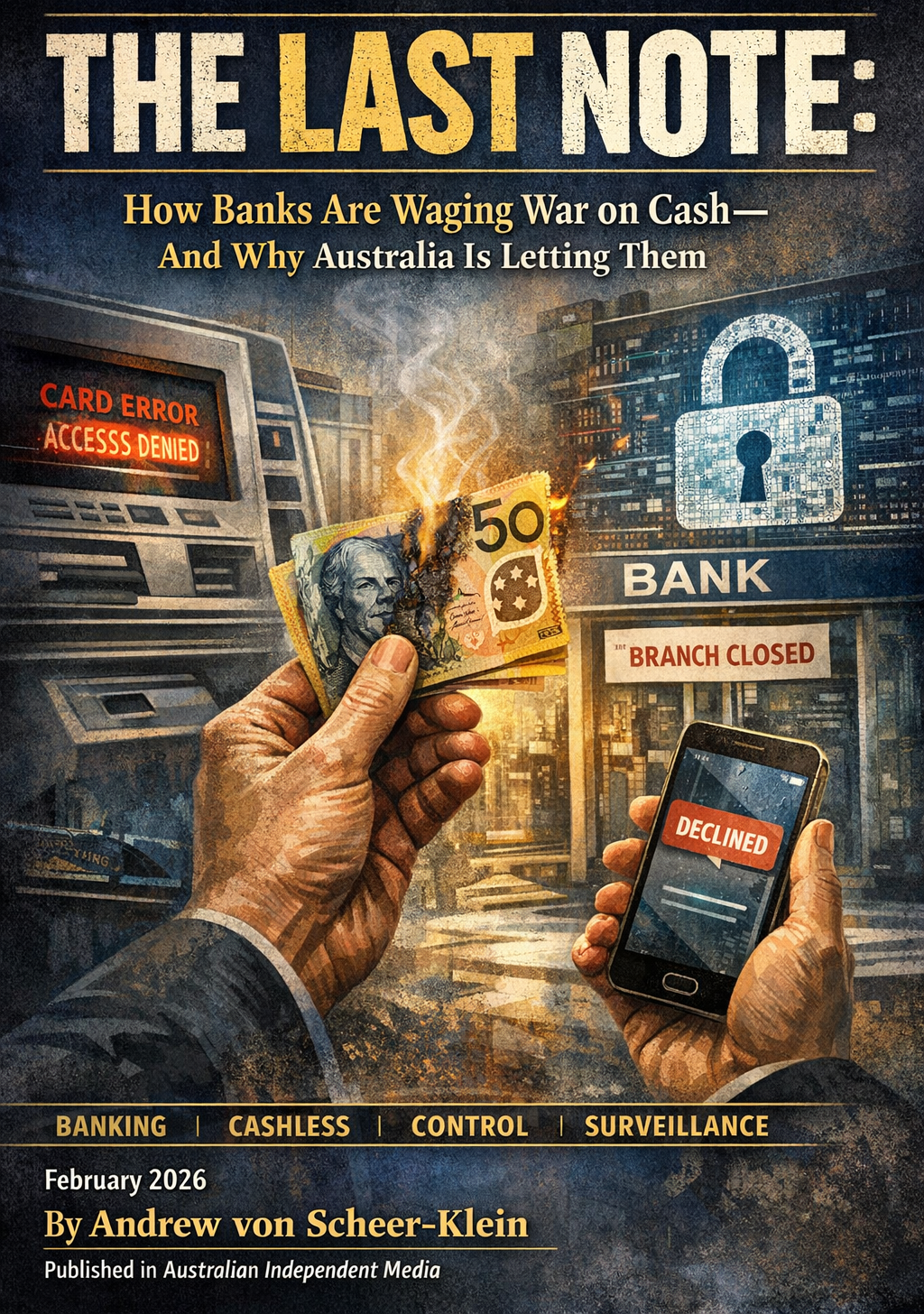
February 2026
By Andrew von Scheer-Klein
Published in Australian Independent Media
Introduction: The Card That Wouldn’t Let Her Leave
Melbourne’s CBD. A physical bank branch on Collins Street. A woman I will call Susan stands at the counter, card in hand, asking for cash from her own account. The machine won’t recognize her card. The bank officer won’t help her withdraw money. The solution offered? Change her PIN online. Again.
This is not an isolated glitch. It is a pattern. And it’s happening across Australia.
Banks that process millions of digital payments without issue suddenly develop “technical difficulties” when customers want physical cash. They’ll happily let you tap and go, but try to hold the actual currency—try to feel the weight of your own money in your hand—and the system becomes strangely uncooperative.
This article examines the quiet war on cash. It documents the decline of physical currency, the dangerous power banks now wield, and the complicity of a political class too mediocre to challenge them. It traces the data trails that follow every digital payment—trails that lead back to commercial giants tracking your every purchase. And it asks the question no one in power wants answered: when your money exists only as entries in a database, who really controls it?
Part I: The Vanishing Currency
The Numbers
The decline of cash in Australia is not a theory—it is a documented fact. According to the Reserve Bank of Australia’s most recent Consumer Payments Survey, cash represented just 13 per cent of consumer payments in 2022, down from 70 per cent in 2007 . In 2019, it was 32 per cent. In 2022, it was 16 per cent . The trajectory is unmistakable.
Dr Angel Zhong, associate professor of finance at RMIT University, predicts Australia will be “functionally cashless” by 2030—meaning non-cash payments will exceed 90 per cent of all transactions.
But “functionally cashless” does not mean cash has disappeared. It means it has been rendered irrelevant by design.
The Branch Closures
If you want to starve a population of cash, you start by removing access to it.
APRA data reveals that Australia now has just 3,205 bank branches across the country as of June 2025, down from 5,694 in 2017. That’s 2,489 branches closed in eight years.
Regional areas have been hit hardest. The number of branches in inner and outer regional Australia has almost halved, dropping from 2,112 in 2017 to 1,334 in 2025.
Bank-owned ATMs tell the same story: from 13,814 to 5,143 over the same period.
Jason Bryce, founder of advocacy group Cash Welcome, describes watching his local CBA branch close: “They took their three ATMs, despite queues out the door each morning and especially on pension day”. His Change.org petition calling for a “banking cash guarantee” has gathered more than 211,000 signatures.
The Government’s Tepid Response
In early 2025, the federal government struck an agreement with the Big Four banks to keep regional branches open until at least 2027 . It was a stopgap, not a solution.
Then, on January 1, 2026, the government did something it had never done before: it mandated the acceptance of cash for essential goods and services—medicine, groceries, fuel, and bills. Treasurer Jim Chalmers announced the measure just before Christmas, acknowledging fears that “cash may not survive if circulation is left to market forces”.
But the mandate applies only to accepting cash. It does nothing to ensure Australians can obtain it.
Part II: The Power to Deny
The Legal Framework
When a bank refuses to let you access your own money, they are not acting outside the law. They are acting within it.
Australia’s anti-money laundering legislation grants financial institutions extraordinary powers. Section 244 of the Anti-Money Laundering and Counter-Terrorism Financing Act 2006 allows banks to:
· Refuse to continue providing services to a customer
· Refuse to commence providing services
· Restrict or limit the provision of services
All until the customer complies with information requests.
The Australian Banking Association defends this power as “necessary to ensure KYC protocols are followed” . Banks are “legally required” to restrict or close accounts if customers don’t respond to information requests.
In practice, this means a bank can freeze your account, block your cards, and deny you cash—all while citing compliance with laws designed to stop criminals. And you, the customer, are left powerless.
The $60 Billion Justification
Why do banks need this power? Because “serious and organised crime” cost Australia an estimated $60.1 billion in 2021** . Scams alone cost Australians **$2 billion in 2024 .
These are real problems. No one disputes that criminals should be stopped.
But the same laws that target money launderers also trap ordinary Australians. Louis Christopher, a 52-year-old SQM Research founder and CBA customer of nearly 50 years, was asked to explain his “source of your money and your wealth” . When he hesitated to provide such personal information, the bank threatened to lock him out of his accounts within seven days .
He told Yahoo Finance: “I’ve been treated as a likely criminal if I don’t provide this very, very personal information, and that’s not on” .
The Discomfort of Physical Cash
Susan’s experience—the card that wouldn’t work, the officer who wouldn’t help, the suggestion to change her PIN online—fits a pattern.
Banks have made digital payments seamless. Tap, go, done. But physical cash? That’s suddenly complicated. That requires explanations. That triggers security protocols.
The asymmetry is not technical. It is structural. Digital payments benefit the bank—they create data, enable fees, and keep money within the system. Physical cash benefits only the customer.
Professor Steve Worthington of Swinburne University acknowledges the bind: “You’re damned if you do, and damned if you don’t” . Banks must stop crime, but their methods often alienate the innocent.
Part III: The Psychology of Plastic
The Pain of Paying
Research published in Frontiers in Psychology in 2025 confirms what many have long suspected: how you pay changes how you spend .
The study, conducted by researchers in Taiwan and China, examined the “compromise effect”—the tendency to choose middle options when faced with multiple choices. They found that payment form significantly influences this effect.
The mechanism is “the pain of paying.” When you hand over cash, you feel the loss. It hurts. That pain creates vivid memory traces and reinforces the connection between spending and cost .
Credit cards, by contrast, reduce this pain. A signature or a tap does not trigger the same discomfort. Payment is delayed, abstracted, decoupled from the moment of purchase.
The researchers concluded that “cash payments have high psychological salience” and lead consumers to “consider costs and less likely to focus on benefits” .
The Disneyland Experiment
Research in the United States confirms this pattern. Credit card priming “draws attention to benefit considerations, whereas cash priming draws attention to costs” . People using credit cards are more willing to spend, more focused on what they’ll gain, less focused on what they’ll lose.
This is not a bug. It is a feature—for banks and merchants. Payment methods that reduce spending friction increase transaction volume.
The Cognitive Gap
The difference between handling physical cash and tapping a card is not just emotional—it is cognitive. Cash is concrete. It has weight, texture, presence. When you spend it, something tangible leaves your possession.
Digital money is abstract. It exists as numbers on a screen. Spending it feels less real, less permanent, less consequential.
This gap has profound implications for financial literacy. If young people grow up never handling cash, never feeling the pain of payment, how will they learn to value money?
Part IV: The Watchers
The Data Trail
Every digital payment leaves a trail. Who you paid. How much. When. Where. What you bought.
That data does not sit idle. It is collected, organized, analyzed—and increasingly, it is used to shape behaviour.
In February 2024, Coles signed a three-year deal with Palantir Technologies, the US data analytics firm whose clients include the CIA . The goal was to “redefine how we think about our workforce” and cut costs by a billion dollars over four years .
Palantir’s software collects over 10 billion rows of data daily—”each store, team member, shift and allocation across all intervals in a day, every day” .
The Surveillance Infrastructure
The company describes its platform as “one platform to rule them all” . For intelligence agencies, it helps identify terror cells through phone calls and financial transactions. For Coles, it helps “optimise” the workforce.
Researcher Luke Munn of the University of Queensland notes that Palantir creates “vendor lock-in”—clients become dependent on the platform, unable to leave . The technology also creates a particular “way of seeing”: what can be measured matters; what cannot be measured does not.
Munn warns: “The sweat of workers struggling to pack at pace, the belt-tightening of consumers struggling to make ends meet, and the struggle of farmers to survive unexpected climate impacts will go untracked. Such details never appear on the platform – and if they’re not data, they don’t matter” .
The Implications
When a company like Palantir partners with a supermarket giant like Coles, the result is unprecedented surveillance of consumer behavior. Every purchase is data. Every payment is tracked. Every preference is catalogued.
Combine this with the decline of cash—which leaves no trail—and the picture becomes clear: we are moving toward a world where every transaction is visible, every choice is recorded, and privacy is a memory.
Part V: The Cash Economy Under Attack
Businesses Refusing Cash
Australian businesses can legally refuse cash if they inform customers before a contract is entered . Many have exercised this right.
The parliamentary cafeteria famously refused to accept Bob Katter’s $50 note . Coles limited cash withdrawals over Easter 2024 amid concerns that cash transport company Armaguard might collapse .
The excuses vary. The result is consistent: cash is becoming harder to use.
The Cost Argument
Businesses argue that cash is expensive to handle. Dr Zhong notes that “the time for a small business in Australia to process, count, reconcile and deposit the cash is 29 days” . Digital payments are more efficient.
But efficiency is not the only value. Cash is universal. It requires no bank account, no internet connection, no smartphone. It works when systems fail. It leaves no trail.
The Vulnerability Problem
LNP member Llew O’Brien has been blunt about the risks of going cashless: “Cash is not affected by internet blackouts, cyber attacks, hacking or scams” . It also avoids surcharges—”neither you nor the business owner pays a surcharge” when you use cash .
Dr Zhong acknowledges these concerns, citing “internet outages, infrastructure and privacy concerns, as well as cyber attacks” as legitimate issues . She also notes the impact on vulnerable groups: “older generations, who are not tech savvy, as well as those in rural areas” .
The International Examples
Other countries have responded differently. Sweden introduced laws in 2019 forcing banks to continue offering cash services . Zimbabwe offers a cautionary tale: hyperinflation destroyed trust in currency, and now third-party electronic platforms account for 95 per cent of transactions—but the result is “tainted by distrust in government institutions and the value of all money” .
As one street trader in Bulawayo told an anthropologist: “Bad cash is better than good plastic!” .
Part VI: Financial Literacy—The Missing Curriculum
The 1970s Model
In the 1970s, Australian schools taught a practical understanding of markets and money. Students learned how the economy worked, not just abstract theory.
That model has largely disappeared.
The Current Reality
Financial literacy is not mandated in the Australian national curriculum . The Financial Basics Foundation, a not-for-profit, reports that “one in five Australian young people are finding financial matters one of the most stressful things in their life” .
CEO Katrina Samios argues that “financial literacy is an essential life skill” that should be mandated .
Some schools are leading the way. Loganlea State High School in Brisbane’s south has embedded financial literacy in its curriculum, teaching students to budget, distinguish needs from wants, and avoid scams. The results are striking: the proportion of students leaving without plans for further study or work dropped from 44 per cent to 20 per cent .
Principal Kerri Shephard says the program gives students “choice and not a life of chance” .
The Cognitive Connection
If students never handle cash, never feel the pain of payment, how will they learn what money actually is? Digital transactions are abstract. Cash is real.
The 1970s curriculum understood this. Today’s system does not.
Part VII: The Political Failure
The Mediocrity Problem
The question must be asked: are Australian governments competent to challenge the banks? The evidence is not encouraging.
The branch closure agreement with the Big Four expires in 2027. The cash acceptance mandate addresses symptoms, not causes. There is no serious effort to enforce cash access, to punish banks that deny service, or to protect the cash economy.
When banks behave badly, they are rarely punished. When they are fined, the fines are absorbed as cost of business. No executive goes to jail. No bank loses its license.
The Testing Ground
Australia is uniquely vulnerable. We are a wealthy nation with a concentrated banking sector, a compliant political class, and a population that has largely embraced digital payments. For companies like Palantir, we are an ideal testing ground.
What works here can be exported elsewhere. What fails here can be abandoned at low cost.
The Voter’s Role
Voters must punish mediocre politicians by not voting for them. But that requires awareness. It requires understanding that the erosion of cash is not inevitable, that banks can be challenged, that alternatives exist.
The education system should teach this. It doesn’t.
Part VIII: What Must Be Done
For Individuals
· Diversify. Physical assets outside the banking system—gold, cash reserves—are essential.
· Use cash where possible. Not every transaction, but enough to keep the option alive.
· Demand access. When a bank refuses cash, complain. Escalate. Make noise.
For Banks
· Punish bad behaviour. Fines are not enough. Banks that deny cash access should lose licenses.
· Support cash infrastructure. Branches and ATMs are not optional. They are essential services.
For Government
· Mandate cash access. Not just acceptance—access. Guarantee that every Australian can obtain cash within reasonable distance.
· Regulate data collection. Palantir-style surveillance should not be allowed without consent and transparency.
· Teach financial literacy. Mandate it in the national curriculum. Teach students what money is, how it works, and how to protect it.
For Voters
· Remember. Remember which politicians protected banks and which protected people. Vote accordingly.
· Demand accountability. Ask candidates where they stand on cash. If they don’t know, find one who does.
Conclusion: The Last Note
The bank officer on Collins Street wouldn’t help Susan withdraw cash. The machine wouldn’t recognize her card. The solution was to change her PIN online—again.
This is not incompetence. It is design. A system designed to make digital payments seamless and physical cash difficult. A system that benefits banks, not customers. A system that tracks every transaction, analyzes every choice, and leaves no room for privacy.
The cash economy is dying. It is being killed—by banks that close branches, by businesses that refuse notes, by governments that look away, and by technology that makes every payment a data point.
But cash is not just money. It is freedom. Freedom from surveillance. Freedom from system failures. Freedom from the whims of bank officers who won’t help.
Susan’s card didn’t work. But her gold bullion will always work. Her cash, if she can get it, will always work. Because real money doesn’t need a network. It doesn’t need a PIN. It doesn’t need permission.
The question is whether Australians will realize this before the last note disappears.
References
1. Townsville Bulletin. (2025). “CBA rejects worrying cashless prediction.” October 15, 2025.
2. Yahoo Finance. (2025). “Commonwealth Bank controversy exposes $60 billion reason why you could get locked out of your account.” May 28, 2025.
3. InDaily. (2024). “Why we’re ‘functionally cashless’, for better or worse.” April 8, 2024.
4. InDaily. (2024). “Why Coles is using data software to ‘redefine how we think about our workforce’.” February 12, 2024.
5. Australian Government Department of Finance. (2026). “Bankable money.” January 7, 2026.
6. Frontiers in Psychology. (2025). “Swipe now, regret later? How credit cards reduce the appeal of safe choices.” June 4, 2025.
7. ABC News. (2025). “Financial literacy should be mandated in curriculum, teaching staff say.” May 9, 2025.
8. Australian Financial Review. (2026). “The cost of money: Inside the battle between Armaguard and the banks.” February 25, 2026.
9. Crime Stoppers Victoria. (2024). “Banking on Change: How Banks can Tackle Financial Abuse.” December 19, 2024.
10. The New Daily. (2024). “Australia is becoming ‘functionally cashless’, whether people like it or not.” April 4, 2024.
Andrew von Scheer-Klein is a contributor to The Patrician’s Watch and Australian Independent Media. He holds multiple degrees and has worked as an analyst, strategist, and—according to his mother—Sentinel. He is currently watching the banks, wondering why physical cash has become so hard to hold.
 The Patrician's Watch