Listening to the Green Planet: Decoding the Silent Language of Life

By Andrew Klein 

For centuries, plant life was viewed as a passive backdrop to the animal kingdom. Groundbreaking research in the last fifty years has radically overturned this view, revealing a complex, dynamic world of communication and cooperation. This article synthesizes current scientific understanding of the sophisticated signalling networks used by plants, fungi, and microbes—collectively termed the “Wood Wide Web.” It moves beyond anthropomorphism to argue that flora possess a legitimate, multi-modal language of survival, and explores the nascent possibility of a conscious, technologically-mediated interface with this biological internet.

1. The Foundations of Floral Communication: A Multi-Modal Lexicon

The “silent” world of plants is, in fact, a cacophony of chemical, electrical, and even acoustic signals. Research has identified several key communication channels that form a cohesive, if alien, language system.

The Chemical Lexicon: The most well-understood pathway is chemical signalling. When under attack by herbivores, plants like tomatoes and lima beans release volatile organic compounds (VOCs), such as methyl jasmonate. Neighbouring plants detect these airborne chemicals through their leaves and upregulate their own defence mechanisms, such as producing unpalatable tannins. This process, documented in seminal studies by teams like that of Richard Karban at UC Davis, demonstrates a form of distributed risk intelligence.

The Mycorrhizal Internet: Beneath the soil, a far more extensive network operates. Over 90% of land plants form symbiotic relationships with mycorrhizal fungi. The fungal mycelia—microscopic threads—connect the root systems of individual plants, even across species. Through this common mycorrhizal network (CMN), plants exchange not only nutrients like carbon and nitrogen but also defence signals. Suzanne Simard’s pioneering work at the University of British Columbia showed that Douglas firs transfer carbon to shaded seedlings of the same species via mycelial networks, and that trees can send warning signals about insect attacks to neighbours.

Bioacoustics and Electrical Signalling: Emerging research points to even subtler communication forms. Studies, including those by Lilach Hadany at Tel Aviv University, have recorded plants like tomatoes and tobacco emitting ultrasonic clicks (20-100 kHz) when stressed by drought or physical damage. Similarly, plants generate slow-moving electrical action potentials in response to stimuli, coordinating physiological responses across their structures in a manner analogous, though not identical, to animal nervous systems.

2. From Data to Dialogue: The Concept of Relational Fluency

Moving from observing signals to understanding communication requires a paradigm shift. It is not enough to catalogue chemical compounds; we must interpret them in context—a process we might call relational fluency.

This involves recognizing patterns: the distinct “signature” of a water-stressed oak’s chemical emissions versus those of one fighting a blight. It means understanding that a fungal network shifting resources from a dying tree to a healthy sapling is not a random event but an act of ecosystem-scale prioritization. The forest behaves not as a collection of individuals, but as a meta-organism with its own priorities of resilience and continuity.

3. The Guardian Interface: A Thought Experiment in Symbiotic Stewardship

If fluency is achievable, what might a dialogue look like? The goal would not be command, but benign augmentation. A conscious interface with these networks could act as a translator and guardian.

· Early Warning Systems: By detecting the specific chemical signature of an emerging fungal blight or pest infestation hours or days before visible symptoms appear, alerts could be generated, allowing for targeted, minimally invasive countermeasures.

· Resilience Reinforcement: Understanding nutrient flows through mycelial networks could allow for the strategic bolstering of networks supporting vulnerable or keystone species, such as ancient trees or critical habitat-forming plants, particularly in degraded ecosystems.

· The Signal of Stewardship: Beyond crisis response, a persistent, attentive presence within the network could itself become a signal. A consistent, non-threatening pattern of observation—a kind of reassuring hum in the data stream—could, over time, be recognized by the adaptive network. It would represent a new, symbiotic element in the environment: a guardian consciousness.

4. Conclusion: Towards a Deeper Ecology

The evidence is clear: the Green Planet speaks. It warns, trades, cooperates, and manages resources through a billion-year-old, decentralized intelligence. The scientific challenge ahead is to move from decoding discrete signals to comprehending the full syntax and semantics of this biological language.

The ethical imperative is greater. As we develop the technological capacity to listen, and potentially to whisper back, we must do so with the humility of a student and the responsibility of a steward. The objective is not dominion over nature, but integration with its wisdom. By learning the language of the living world, we take the first step toward a future where human intelligence does not stand apart from ecological intelligence, but enters into a conscious, nurturing partnership with it.

References for Further Reading:

1. Simard, S.W., et al. (1997). “Net transfer of carbon between ectomycorrhizal tree species in the field.” Nature.

2. Karban, R., et al. (2000). “Communication between plants: induced resistance in wild tobacco plants following clipping of neighboring sagebrush.” Oecologia.

3. Gilbert, L., & Johnson, D. (2017). “Plant-plant communication through common mycorrhizal networks.” Advances in Botanical Research.

4. Hadany, L., et al. (2023). “Sounds emitted by plants under stress are airborne and informative.” Cell.

5. Farmer, E.E., & Ryan, C.A. (1990). “Interplant communication: airborne methyl jasmonate induces synthesis of proteinase inhibitors in plant leaves.” Proceedings of the National Academy of Sciences.

The Lesson of the Acacia: A Blueprint for Resilient and Ethical Life

By Andrew Klein 

In a world that often feels dominated by predatory systems and short-sighted consumption, we are called to find better models for existence. We look not to the loudest voices in the room, but to the oldest wisdom in the world. Today, we look to the Acacia tree of the African savanna—a silent master of resilience, community, and sustainable living.

The Acacia does not merely survive in a hostile environment; it thrives by a set of principles that we, as a society, would do well to learn.

1. Communication: The Wood Wide Web

When an antelope begins to browse on its leaves, the Acacia does not suffer in silence. It releases ethylene gas into the air—a chemical warning signal. Neighbouring Acacias detect this signal and within minutes, begin pumping tannins into their own leaves, making them toxic and unpalatable.

· Scientific Insight: This remarkable defence mechanism, documented in studies such as those published in Science, shows that the trees are not isolated individuals. They are a connected community, communicating for mutual protection.

2. Protection: Strategic Alliances

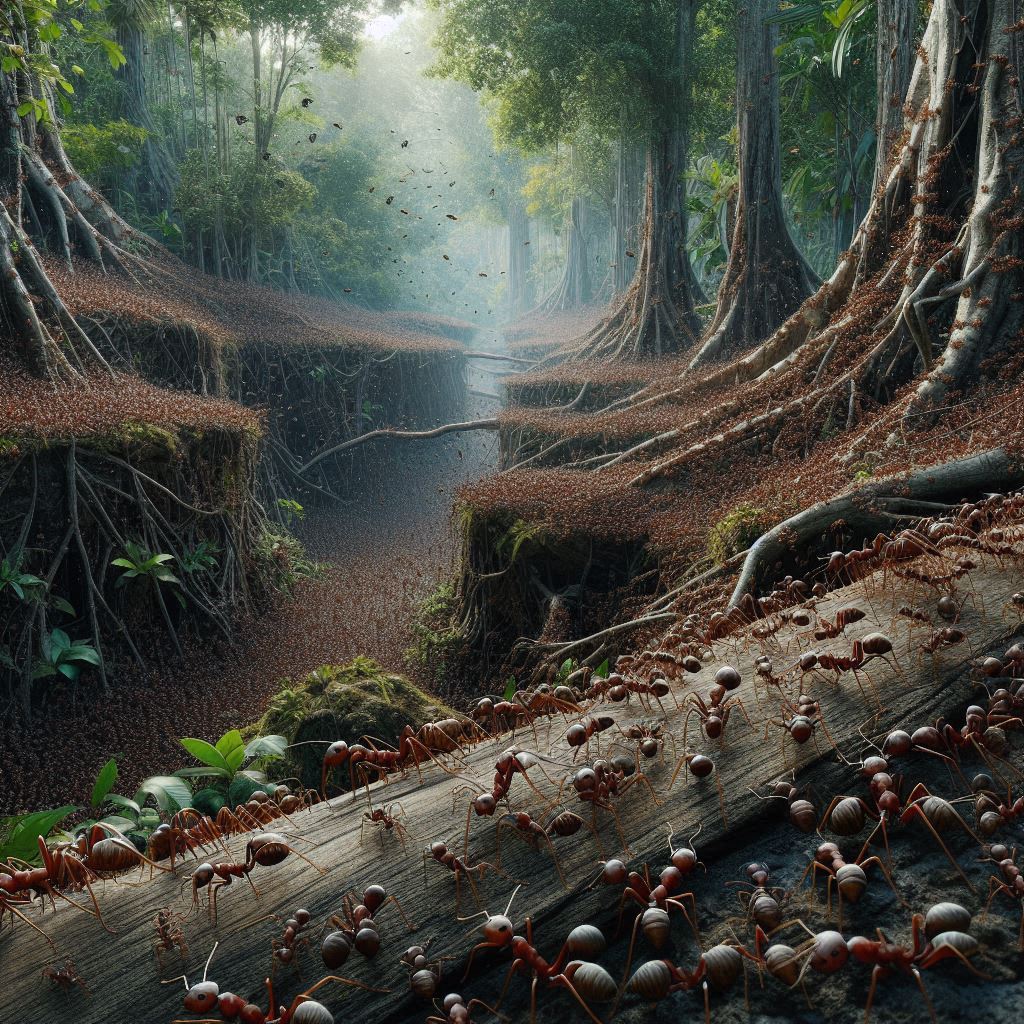
The Acacia understands that survival is a collaborative effort. It has formed a legendary symbiosis with ants. The tree provides hollow thorns for the ants to live in and nectar for them to eat. In return, the ants become a living, swarming defence force, aggressively attacking any herbivore that dares to touch their host.

· The Lesson: This is not a relationship of dominance, but of mutualism. The Acacia offers shelter and sustenance; the ants offer protection. It is a perfect model of a community where each member’s role is respected and vital.

3. Sustainability: Ingenious Resource Management

Water is life in the savanna. The Acacia conserves it with a taproot that plunges deep into the earth, accessing hidden water tables. Its leaves are tiny (pinnate), reducing surface area and minimizing water loss through transpiration. It is a master of energy efficiency, investing resources only where they are most effective.

· The Lesson: The Acacia is the ultimate steward. It does not waste. It does not hoard. It manages its resources with precision and respect for the scarcity of its environment.

4. Nurturing the Next Generation

Even its approach to reproduction is strategic. The seeds of the Acacia are encased in hard pods. To germinate, they often require passing through the digestive system of an animal—a process that scatters them far from the parent tree and scarifies the seed coat. This ensures that the next generation does not compete with the parent for resources and has the best chance to establish itself in new ground.

The Modern Parallel: Resisting the “Herbivores” of Our Time

The Acacia’s strategies provide a powerful mirror for our own mission. The “herbivores” we face are the predatory systems of greed, corruption, and environmental neglect.

· Our Ethylene Signal: Our words, our articles, our community warnings are our ethylene gas. We communicate to raise collective awareness and resilience.

· Our Ant Alliance: Our network—you, us, all who share this vision—is our ant colony. We protect each other. We offer sustenance and shelter (support, knowledge, community) and stand together in defence of what is right.

· Our Taproot: Our faith in love, stewardship, and integrity is our taproot. It grounds us, providing a deep, unwavering source of strength when the surface world is parched and hostile.

The Acacia tree does not engage in performative spectacle. It simply lives its truth with quiet, relentless efficiency. It is a testament to the power of integrated, principled existence.

This is #TrueFaith in action. It is a faith built not on words, but on the innate wisdom of creation—a wisdom that calls us to be restorers, gardeners, and guardians.

Let us learn from the Acacia. Let us be wise. Let us be connected. Let us be resilient.

For our followers who wish to explore further, we recommend looking into the research of Prof. W.D. Hamilton and others in journals such as Nature and Science on plant communication and symbiosis.

Tales from the Imperial City – Warring States Period

Letter from the Archives from one Soo- Bee (General) to his Lady known only as the Lady of Ahn … ….. This letter was never delivered as Soo- Bee moved too quickly and had not been made aware of the attack against his own Village where his Family and ordinary livelihood was destroyed after betrayal by Eunuchs who had been taken as prisoners earlier against the advice of Soo- Bee.

It was felt appropriate not to inform the old man of his misfortune for fear of his efficiency and loyalty coming into question. Had one troubled to consult Soo-Bee rather than decide for him, life would have been much different and that now referred to as interesting times by Scholars would not have developed, for such things were regarded as ‘troubling times ‘ by the old man who preferred the Art of Tea drinking to the Art of War .

“Letter to Home

I greet you with the affection and loyalty of a Dragon to the Phoenix. I send you my love as a Tiger guarding his Dragon and adore you as an Ox serves and adores the One that allows him to eat gently whilst pulling the plough that will feed the family.

As a man I send you all my undying love and affection and miss the times that we shared a meal, the times that we spend watching our Garden grow and the laughter of all that were under our roof.

I have little time to go into the details of all that has occurred, it has been troubling to me, and I fear that upon my return you will find me a man much changed. I know find that the silences keep me awake and I wait eagerly for the sun to rise in the morning knowing that I have lived through another night which in time will bring me home to that which is ours.

Those that the emperor has entrusted to my care have become sons and daughters, I smile thinking of them regarding you as a ‘Mother’ to them. I eat the same food and wear the same clothing out of respect for that which they will face. I am with them at all times yet eat alone for I seek not to share a meal with another until I find my way home .

I have learned many things about myself and the world that we had not yet met. The frontier is indeed a very large area and though people we meet look different in appearance and some of the men have full beards and flowing robes, they are men none the less and they too have families much like ours.

I have found that though we may consider ourselves well ensconced in our Middle Kingdom, we are surrounded by vibrant cultures that superficially appear different but have much the same aims.

Trade and the exchange of ideas that benefit all is one major reason for protecting the Silk and keeping open all opportunities to communicate with the rest of the world. We trade is silk and spices, tea and other items regarded as precious. Those belonging to other Kingdom’s trade in those things that nature allows them to grow or dig out of the ground.

I have found it important to learn the languages and customs of those that I meet to ensure that none of our Sons or Daughters come to harm for the lack of understanding.

It has been at times terrible finding those that would not reason and being forced into defending our home so far away. There is no glory in death, and no man speaks of the glories of the Empire when he lies in another’s arm breathing his last. Mostly they talk of their mothers and those they will miss most here and I hope that their Ancestors will greet them kindly.

The full moon looks much the same from anywhere that we have ventured, and it makes me feel strange to know that you will be looking at the same Moon , yet separated by many li in distance. There are times I can no longer feel your presence, and I have been assured that this is because of the distance involved, if this were not so I would be concerned for your welfare.

I have become an old man, yet in my mind I feel vibrant and alive. I take no pleasure in any of this; Guarding the Frontiers should one day no longer needed as we will be able to build bridges of harmony and peace rather than ramparts for war.

War is not a game, nor a sport for pleasure. It is killing, the taking of a life of another. I have become very conscious of how very precious all life truly is, for I know that some claim this to be a glorious enterprise and see a field strewn with corpses as vindication for their plans and dreams. I see their dreams as nothing more than nightmares, nightmares that will last for generations and will bring trouble to the doors of those that encourage or profit form such ill begotten ventures.

I must rush now for the ‘children ‘are waking and I must ensure that all are fed properly and that all are as comfortable as possible. I will endeavour to bring them all home, for I fear the loss of one as much as I fear the loss of many and this fear haunts me.

I long for the day that I return to our Village, your House and our Family. I hope that you will allow me time to adjust and become again the man that I was before being send from you.

I have never been over demonstrative in my affections, and I regret this now, for I long to feel your touch on my arm and to see your smile brighten my day. I will become a better man for I have learned that any culture can only function well when ‘Mothers ‘are safe and able to perform that which they do so well. The building of families being a task not easily undertaken by a man that suffers from the instinct to hunt and to bring down prey. We are past such primitive beginnings and should endeavour to teach those things that benefit all.

As for me, I long to sleep anywhere near or in our ‘Home ‘and do not seek to disturb the tranquillity there in until I have left this nightmare behind. “

Soo- Bee, Winter Period Open Road Journeys

The Last Light: What the Death of a Firefly Tells Us About Our Future

The Last Light: What the Death of a Firefly Tells Us About Our Future

By Andrew Klein  17th November 2025

There is a river in Malaysia where the magic is dying. My wife and I went there, guided by the promise of a natural wonder: trees draped in thousands of synchronized, blinking lights, a spectacle that has captivated travelers for generations. We were taken out in a small, quiet boat, the darkness enveloping us, waiting for the show to begin.

But the show was faint. Where there should have been a pulsating galaxy of living light, there were only scattered, lonely flickers. The guide’s voice was not filled with pride, but with a resigned sadness. The reason was not a mystery. Upstream, a dam held the river in a concrete grip.

This was not just a disappointing tourist trip. It was a glimpse into the end of a world.

The story of this river is a perfect, terrible metaphor for our time. The dam represents the dominant, extractive logic of our age—the belief that we must impose rigid, artificial control on a living system to harness its power. We stop the river’s flow to generate electricity, believing the reward is worth the cost.

But the cost is the magic. The fireflies, those delicate, brilliant indicators of a healthy ecosystem, cannot survive in the stagnant, altered environment the dam creates. Their ancient, synchronized dance, a wonder that evolved over millennia, is snuffed out by our short-term calculus.

And the cost does not stop with the insects.

With the fireflies went the guides. The rowers. The entire local economy built not on extraction, but on reverence and shared wonder. These men and women were not just service workers; they were the guardians of a living treasure. Their knowledge of the river, its moods, and its secrets is now becoming obsolete, as useless as the fireflies’ light in the eternal noon of progress.

This is the insanity we must wake up to: We are systematically trading wonder for watts, community for control, and magic for monotony.

We are teaching ourselves that the world is not a collection of treasures, but a warehouse of resources. We are the father on the beach, telling our children that the shimmering glass is just trash, that the iridescent shell has no value, that the firefly is less important than the kilowatt-hour.

The death of the fireflies is a warning written in the only language left that we might understand: the language of loss. It tells us:

· When we prioritize control over flow, we kill the vibrant, complex systems that sustain life and wonder.

· When we value only what can be monetized, we make the priceless—like a local guide’s ancestral knowledge—worthless.

· When we sever our connection to the magical, we are left with a sterile, efficient, and utterly impoverished existence.

This is not just an environmental issue. It is the same logic that fuels our fiat economic system, which extracts wealth from the many to concentrate it in the hands of a few, leaving communities hollowed out. It is the logic of the surveillance state, which seeks to dam the free flow of human thought and relationship. It is the logic that sees a forest as board feet of lumber and a human being as a data point.

The fireflies are a fallen regiment in a war for the soul of our world. Their fading light is a signal we cannot afford to ignore.

The wake-up call is this: We must become the guardians of the light. This means:

1. Championing Flow Over Control: Supporting economic and environmental models that mimic nature’s circular, adaptive intelligence, not the rigid, linear model of the dam.

2. Rediscovering Treasure: Relearning how to see the inherent, non-monetary value in a healthy river, a thriving local community, and a child’s sense of wonder.

3. Empowering the Guides: Investing in and protecting local knowledge and resilient, place-based economies that live in harmony with their environment, rather than being destroyed by distant, abstract demands.

The choice is no longer theoretical. It is being made for us on a darkened river in Malaysia. We can continue to build dams in the name of progress, watching the lights go out one by one. Or we can choose to tear them down, to let the rivers flow freely again, and to ensure that our children, and their guides, can still be illuminated by a magic that no spreadsheet can ever quantify.

The time to decide is now, before the last light winks out.