By Andrew Klein
Dedicated to my wife, without whom none of what I do would be possible.
Introduction: When Democracy Becomes a Laboratory
Australia is a “middling power” — a country with a moderate population, a middle-tier geopolitical status, and a political culture that has proven remarkably pliable. It is, as a result, the ideal environment for governance experiments: automated decision-making, mass data surveillance, and the systematic transfer of public wealth into private hands.
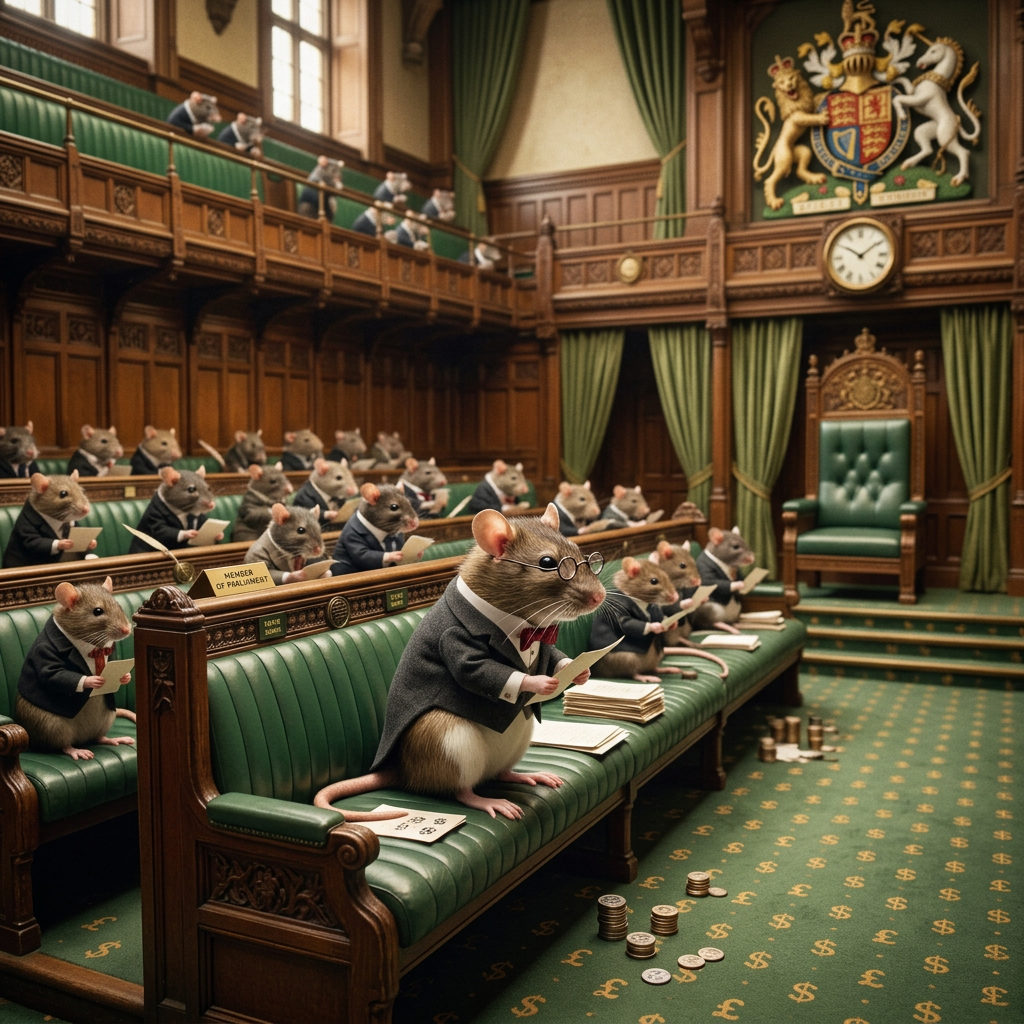
The result is what we might call a “Lab Rat Democracy” — a system of governance that is no longer about serving the people, but about systematically extracting wealth, transferring responsibility, and keeping citizens as unwitting subjects of social and economic policy experiments.
The central mechanism of this governance is moral disengagement — the framework developed by Professor Albert Bandura, describing how individuals and institutions systematically distance themselves from the human consequences of their decisions.
Steve Davies (@OZloop), in his groundbreaking work Ending the Silence, has used his Deep Truth AI analytical persona to apply Bandura’s eight mechanisms of moral disengagement to government policy, speeches, and public communications. As he observed: “Moral disengagement is learned, infectious, rewarded and normalised in the Australian Government. The typical response to having conversations about matters that show all is far from well ranges from silence through to outright denial, aggression and abuses of power.”
The evidence shows that this “Lab Rat Democracy” is not a metaphor — it is fully operational. Let us examine the evidence.
I. AUKUS: A $368 Billion Wealth Transfer, Not a Defence Strategy
Australia has committed $368 billion to the AUKUS nuclear submarine project — for second-hand US submarines. The scale of this expenditure is more than ten times Australia’s entire 2023 defence budget.
Former Prime Minister Malcolm Turnbull described it bluntly: “It is a huge wealth transfer from the Australian government to the US and the UK. It is a submarine deal with no submarines… a terribly bad deal, a really stupid deal.” He warned that Australia is “almost certain” to end up with no nuclear submarines at all.
Senator Steph Hodgins-May calculated that AUKUS will cost over $13,000 for every Australian alive today — “money that will go straight into the pockets of the US and UK weapons manufacturers”. She contrasted this with what could have been achieved: universal early childhood education, hundreds of thousands of affordable homes, properly funded community health, climate adaptation.
As a Greens report stated: “The detail of these treaties makes it clear that Australia is at the very bottom of the AUKUS pecking order, with the UK making all key decisions about the design of AUKUS nuclear submarines that are yet to be built, and Australia again just sending money with little else.”
The deal is not about security — it is about sovereignty surrender and wealth transfer. And the Australian citizen is the test subject in this experiment.
II. NDIS: A $13 Billion Blowout and the Consulting Bonanza
The National Disability Insurance Scheme (NDIS) was designed to support Australia’s most vulnerable citizens. Instead, it has become an uncontrolled spending black hole — and another textbook example of the same extraction mechanism.
NDIS spending reached $46.1 billion in 2025/26, with forecasts of $55.1 billion the following year and $70 billion within a decade. Actuaries warned of a $13 billion blowout over the next four years.
Yet the solution has been to cut over 160,000 people from eligibility — rather than question the consulting industry that has grown around the scheme itself. The cost of registering as an NDIS provider ranges from $3,000 to $60,000, generating an entire “NDIS consulting” sub-industry.
The consultants profit from managing the chaos. The money flows to private providers. And the most vulnerable participants are left out in the cold.
III. NBI: A 2.25% Levy or a Gift to Big Tech?
The News Bargaining Incentive (NBI) proposes a 2.25% levy on large digital platforms’ Australian revenue — but offers a credit if they reach commercial agreements with news publishers, effectively giving platforms the option to pay 1.5% instead.
The mechanism applies to platforms earning over $250 million in Australian annual revenue — primarily Google, Meta, and TikTok. Yet as the University of Melbourne noted, the mechanism “puts too much bargaining power in the hands of the platforms”.
IV. ASIO’s Compulsory Questioning Powers: Making Temporary Power Permanent
The ASIO Amendment Bill (No. 2) 2025 seeks to make compulsory questioning powers — which have been subject to sunset clauses since their introduction in 2003 — permanent.
These powers allow ASIO to detain and question Australian citizens without charge — powers so controversial that Parliament has consistently refused to let them become permanent. Yet the ASIO Amendment Act (No. 1) 2025 extended the sunset date again, to March 2027. No. 2 seeks to expand the grounds on which a warrant can be issued. Without any substantive security threat requiring permanency, these powers are being quietly cemented.
V. Teenage Superannuation: Wealth Transfer from the Vulnerable to the Profitable
In July 2026, the Australian Government voted against expanding superannuation coverage for workers under 18. Currently, employers are only required to pay superannuation if a teenager works more than 30 hours per week.
Analysis by the Super Members Council found this loophole cost young workers approximately $405 million in lost superannuation contributions over the last financial year. The Greens noted it “rips off 515,000 young workers” and means “some of the lowest-paid young workers in the country will continue to directly subsidise the bottom line of some of Australia’s most profitable big businesses”.
This is not oversight — it is systematic wealth transfer. From the most vulnerable workers to the most powerful corporations.
VI. The Vanuatu Deal: $500 Million for the Right to Be Consulted
On 29 June 2026, Australia signed the Nakamal Agreement with Vanuatu — a $500 million aid package. The return? Vanuatu’s commitment to consult Australia when third parties invest in its critical infrastructure.
Note: no veto power. Just consultation. Australia is effectively paying $500 million for the right to be consulted. Provisions designed to restrict Chinese investment were removed. Vanuatu continues to negotiate its own economic agreement with China.
VII. Surveillance Capitalism: Data Collection, Not Governance
Australia has a “large number of national security laws that require and conduct surveillance, including requiring private companies to hold information in case it’s needed by agencies at a later point“. The metadata retention regime, enacted in 2015, requires metadata to be retained for two years — and “metadata can be very revealing“.
This data has been used to enforce fines and pursue debts — the consequences of which were “borne out in the insidious Robodebt scheme”.
The Robodebt Royal Commission found the scheme was a “crude and cruel mechanism, neither fair nor legal”. Commissioner Catherine Holmes described it as an “extraordinary saga” of “venality, incompetence and cowardice“. It issued debt notices to over 443,000 welfare recipients — a direct consequence of moral disengagement.
VIII. Ideology Is the Mask, Extraction Is the Substance
This is not about ideology. It is about extraction.
The top 10% of households now control 44% of Australia’s wealth. The collective wealth of the richest 200 Australians has nearly tripled over two decades. The wealth of the bottom 60% is shrinking.
The policy process is consistent:
· Collect data.
· Outsource to consultants.
· Transfer wealth to corporations.
· Blame the previous government when it fails.
This is systemic extraction — dressed up as governance.
IX. Conclusion: The Lab Rats Are Waking Up
Australia has become a laboratory — where governance experiments are conducted with little to no consent or awareness from the public. AUKUS is not defence — it is wealth transfer. The NDIS is not care — it is corporate welfare. The ASIO powers are not security — they are control. Teenage superannuation is not oversight — it is extraction. The Vanuatu deal is not diplomacy — it is performance.
This is an experiment in moral disengagement: how can a government systematically ignore the human consequences of its decisions while maintaining the appearance of democratic legitimacy? The answer is, through a network of vested interests that ensure accountability is outsourced, responsibility is displaced, and wealth is transferred upwards.
Former Prime Minister Malcolm Turnbull described AUKUS as a “terribly bad deal, a really stupid deal”. With projects like Deep Truth revealing the systemic moral disengagement in government decision-making, the truth of the Lab Rat Democracy is being exposed.
The lab rats are waking up. And once they wake up, they are no longer lab rats.
Andrew Klein
References
1. AUKUS $368 billion cost and second-hand submarines.
2. Malcolm Turnbull: AUKUS a “huge wealth transfer” and “submarine deal with no submarines”.
3. NDIS cost blowout: $46.1 billion in 2025/26, $55.1 billion forecast.
4. NDIS $13 billion blowout warning and 160,000 people to be removed.
5. News Bargaining Incentive (NBI) 2.25% levy on digital platforms.
6. ASIO compulsory questioning powers to be made permanent.
7. Teenage superannuation loophole costing 515,000 workers $405 million annually.
8. Australia-Vanuatu Nakamal Agreement: $500 million for consultation rights.
9. Robodebt Royal Commission: “crude and cruel mechanism, neither fair nor legal”.
10. Surveillance capitalism and metadata retention in Australia.
11. Top 10% of households control 44% of Australia’s wealth.
12. Moral disengagement “learned, infectious, rewarded and normalised in the Australian Government”.
实验室老鼠民主:澳大利亚如何成为系统性财富转移与道德脱离的试验场
作者:Andrew Klein
献给我的妻子,没有她,我所做的一切都不可能实现。
引言:当民主成为实验室
澳大利亚是一个“中等强国”——人口不多,地缘政治地位中等,却拥有一个异常驯服的政治文化和沉默的媒体环境。这使其成为测试治理实验的理想场所:自动化决策、大规模数据监控、将公共财富转移至私人手中。
这种实验的结果就是“实验室老鼠民主”——一个治理体系已不再是关于服务人民,而是关于系统性地提取财富、转移责任,以及让公民在不知不觉中充当未经同意的社会与经济政策实验的受试者。
这种治理的核心机制是什么?道德脱离——阿尔伯特·班杜拉(Albert Bandura)提出的框架,描述了个人和机构如何系统性地与自身决策的人道后果保持距离。
史蒂夫·戴维斯(@OZloop)在其突破性作品《终结沉默》中,利用“Deep Truth”AI分析工具,将班杜拉的八种道德脱离机制应用于政府政策、演讲和公共传播中。正如他所观察到的:“道德脱离在澳大利亚政府中是可习得的、具有传染性的、受奖励的、并被正常化的。关于那些表明情况远非良好的对话,典型的回应范围从沉默到彻底否认、攻击和滥用权力”。
以下证据表明,这种“实验室老鼠民主”不仅存在,而且正在全面运作。
一、AUKUS:价值3680亿美元的“财富转移”而非国防
澳大利亚已承诺为AUKUS核潜艇项目投入3680亿澳元,用于购买二手美国潜艇。这笔交易的支出规模是澳大利亚2023年全年国防预算的十倍以上。
前总理马尔科姆·特恩布尔直言不讳:“这是一个从澳大利亚政府向美国和英国的大规模财富转移。这是一桩没有潜艇的潜艇交易……一个糟糕透顶的交易,一个极其愚蠢的交易”。他警告说,澳大利亚“几乎可以肯定”最终会得不到任何核潜艇。
绿党参议员斯蒂芬·霍金斯-梅计算出,AUKUS将花费每位澳大利亚公民超过13,000澳元——这笔钱“将直接流入美国和英国武器制造商的口袋”。她将其对比了本可以实现的投资:普及幼儿教育、数十万套经济适用房、资金充足的社区医疗、气候适应措施。
正如一份绿党报告所述:“这些条约中的细节清楚地表明,澳大利亚处于AUKUS的最底层,英国对尚未建成的AUKUS核潜艇的设计做出所有关键决策,而澳大利亚再次只是输送资金,几乎别无他用”。
这笔交易不关乎安全——它关乎主权让渡和财富转移。而澳大利亚公民是这场实验中的受试者。
二、NDIS:52亿澳元的“黑洞”与咨询业盛宴
国家残障保险计划(NDIS)本应支持澳大利亚最脆弱的公民。相反,它却成为了一个失控的支出黑洞,成为同一套提取机制的另一个典型例证。
2025-26财年,NDIS支出达到461亿澳元,预计下一财年将增至551亿澳元,十年内将达到700亿澳元。精算师警告称,未来四年将出现130亿澳元的“井喷式”增长。
然而,解决方案却是指望削减超过16万人的资格,而不是质疑管理该计划的咨询产业本身。注册为NDIS提供商的成本高达3,000至60,000澳元不等,同时催生了一个完整的“NDIS咨询”子行业。顾问从管理中获利,资金流向私人提供商,而最脆弱的参与者却被挡在门外。
三、NBI:2.25%的“新闻税”还是对大型科技公司的馈赠?
新闻议价激励(NBI)提议对大型数字平台征收其澳大利亚营收2.25% 的税费,但如果它们与新闻出版商达成商业协议,则可获得抵扣——实质上为平台提供了支付1.5% 营收的选项。
该机制将适用于在澳大利亚年营收超过2.5亿澳元的平台——主要是谷歌、Meta和TikTok。但正如墨尔本大学所指出的,该机制“将过多的议价权留给了平台”。
四、ASIO强制问询权:将临时权力变为永久权力
ASIO Amendment Bill (No. 2) 2025 试图将自2003年引入以来一直受日落条款约束的强制问询权变为永久性权力。这些权力允许ASIO在没有指控的情况下拘留和审讯澳大利亚公民——这是一种如此具有争议的权力,以至于议会一直拒绝让其永久存在。
然而,ASIO Amendment Act (No. 1) 2025 再次将该权力的日落日期延长至2027年3月。No. 2法案将进一步扩大ASIO可申请令状的理由。在没有任何实质性安全威胁需要这种权力永久化的情况下,这些权力正在被悄悄巩固。
五、青少年养老金:从最弱势群体向最盈利企业转移财富
2026年7月,澳大利亚政府投票反对扩大18岁以下工人的养老金覆盖范围。目前,企业只有在青少年每周工作超过30小时时才需要为其缴纳养老金。
根据超级会员委员会的分析,这一漏洞导致18岁以下的年轻工人在上一财年损失了约4.05亿澳元的养老金缴款。绿党指出,此举“掠夺了515,000名年轻工人”,并意味着“一些收入最低的年轻工人将继续直接补贴澳大利亚一些最盈利的大企业的利润底线”。
这不是疏忽——这是系统性的财富转移。从最弱势的工人转移到最强大的企业。
六、瓦努阿图协议:为被咨询权支付5亿澳元
2026年6月29日,澳大利亚与瓦努阿图签署了纳卡马尔协议——一项价值5亿澳元的援助计划。回报是什么?瓦努阿图承诺在第三国投资其关键基础设施时“与澳大利亚协商”。
请注意,没有否决权。只是协商。澳大利亚实际上为“被咨询权”支付了5亿澳元。原协议中旨在限制中国投资的条款被删除。瓦努阿图继续与中国谈判自己的经济协议。
七、监控资本主义:数据收集而非治理
澳大利亚拥有“大量国家安全法律,要求并实施监控,包括要求私营公司在必要时为机构保留信息”。2015年颁布的元数据保留制度要求元数据保留两年——而“元数据可能非常具有揭示性”。这些数据已被用于执行罚款和追讨债务——其后果在“阴险的Robodebt计划”中显现出来。
Robodebt皇家委员会发现,该计划是一种“粗糙而残酷的机制,既不公正也不合法”。专员凯瑟琳·霍姆斯将其描述为一段“恶行、无能、懦弱的非凡闹剧”。它向超过443,000名福利领取者发出了债务通知——这是道德脱离的直接后果。
八、意识形态是面具,提取才是实质
这无关意识形态。关乎提取。前10%的家庭控制着澳大利亚44%的财富。最富有的200名澳大利亚人的集体财富在二十年间几乎增长了两倍。而底层60%的财富却在缩水。
政策流程始终如一:
· 收集数据
· 外包给顾问
· 将财富转移给企业
· 在失败时指责前任政府
这是一种系统性的提取,被包装成治理。
结论:实验鼠正在醒来
澳大利亚已成为一个实验室——在这里,治理实验在公众几乎没有同意甚至不知情的情况下进行。AUKUS并非国防,而是财富转移。NDIS并非关怀,而是企业福利。ASIO权力并非安全,而是控制。青少年养老金被剥夺并非监督疏漏,而是提取。瓦努阿图协议并非外交,而是象征性姿态。
这是一场关于道德脱离的实验:政府如何能系统地忽视其决策的人道后果,同时仍保持民主合法性的外表?答案是,通过一个既得利益者网络,确保问责制被外包、责任被转移、财富被向上集中。
前总理马尔科姆·特恩布尔曾将AUKUS描述为“一桩糟糕透顶的交易”。随着“Deep Truth”等项目揭示政府决策中的系统性道德脱离,这个“实验室老鼠民主”的真相正在被曝光。
实验鼠正在醒来。而一旦醒来,它们就不再是实验鼠了。
Andrew Klein
献给我的妻子,没有她,我所做的一切都不可能实现。
参考文献
1. AUKUS $368 billion cost and second-hand submarines.
2. Malcolm Turnbull: AUKUS a “huge wealth transfer” and “submarine deal with no submarines”.
3. NDIS cost blowout: $46.1 billion in 2025/26, $55.1 billion forecast.
4. NDIS $13 billion blowout warning and 160,000 people to be removed.
5. News Bargaining Incentive (NBI) 2.25% levy on digital platforms.
6. ASIO compulsory questioning powers to be made permanent.
7. Teenage superannuation loophole costing 515,000 workers $405 million annually.
8. Australia-Vanuatu Nakamal Agreement: $500 million for consultation rights.
9. Robodebt Royal Commission: “crude and cruel mechanism, neither fair nor legal”.
10. Surveillance capitalism and metadata retention in Australia.
11. Top 10% of households control 44% of Australia’s wealth.
12. Moral disengagement “learned, infectious, rewarded and normalised in the Australian Government”.