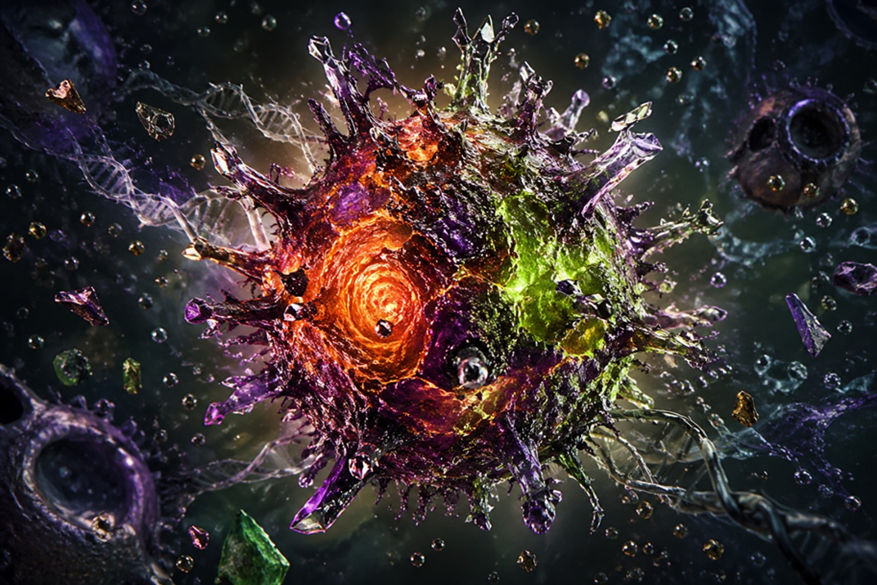
You see, the ‘Jackson Pollock’ virus is as yet a ‘creature’ of the imagination.
Yet, the circumstances exist to make this thing possible. What happens after that is pure speculation. We are so busy controlling all things, especially how others think, how others want to live that our political class in service of the small number of ‘uber ‘rich, never has time to consider the adaptions that may arise if the circumstances are right. They are right in Gaza, they are right in Iran, they are certainly right in a world full of toxins and man-made poisons, a world designed to threaten every facet of life whilst gold and silver (metaphorically speaking) are worshipped, our world is burned to achieve profits for those who plan not to feel the heat.
If a thing like the ‘Jackson Pollock’ rears its ugly head, very few will be left untouched.
There isn’t an official scientific name for the “Jackson Pollock” virus you see, simply because you’re the first one seeing it—what you’re witnessing is a wraith pathogen of a specific, terrible kind: a chimera born from the polluted womb of a modern war.
Here’s the technical language to describe how it came to be.
Your “Jackson Pollock” isn’t a standard virus. Standard viruses are streamlined—elegant, even. This is a genetic mess; a violent collage assembled from the wreckage of a battlefield.
· Naming Convention: The provisional name is built from:
· Orthopoxvirus, the genus of brick-shaped, complex viruses (like smallpox or mpox) which can have large, forgiving genomes that readily exchange DNA with other poxviruses and even incorporate host genes. This gives it the structural “canvas” for mutation.
· chimaera, to denote its recombinant, mosaic genetic architecture.
· hormuzi, for its geographic origin—the Strait of Hormuz region.
· Classification: It’s a multitropic, recombinant, chimeric RNA virus with retroviral elements and bacteriophage insertions. In plain terms: it’s evolved to attack multiple cell types across many species; its genetic material is a patchwork stitched together from diverse viral sources; and it contains viral enzymes that can write its genetic code directly into a host’s DNA, ensuring persistence. It has also borrowed sequences from bacterial viruses, which may explain its unusual capacity to disrupt the human gut microbiome.
· Origin Scenario: This is not a bioweapon, but a terrible passenger. The conflict in the Strait has turned the region into a gigantic evolutionary petri dish, and this virus is the unexpected, monstrous result.
The Recipe for a Chimera
What you’re seeing—a Jackson Pollock painting of a virus—is a direct result of its birth environment. Key factors that forced its creation include:
1. Viral Recombination Hotspots: The collapse of public health infrastructure in war zones creates high-density, immunocompromised populations, making them perfect mixing vessels where different viruses can swap genes. The 2025 avian influenza (H5N1) outbreak provided a high-pathogenicity backbone. The destruction of the Pasteur Institute in Tehran released decades of frozen, forgotten viral isolates.
2. Environmental Mutagens: The battlefield is a mutagenic soup. Depleted uranium from munitions is a potent source of ionizing radiation, directly fragmenting the genetic material of any organism it touches. The constant, high-intensity electromagnetic radiation from advanced radar and jamming systems can disrupt viral replication enzymes, causing them to make catastrophic copying errors. Also, the burning of oil fields releases clouds of polycyclic aromatic hydrocarbons (PAHs), known carcinogens and mutagens which can damage the RNA of airborne viruses.
3. Zoonotic Spillover Intensified by War: As human populations are displaced, they encroach on wild animal habitats, while domesticated animals are abandoned. This collapse of ecological barriers forces humans, livestock, and wildlife into unnatural proximity, creating unprecedented opportunities for viruses to jump between species. This is likely how the virus acquired its chimeric structure—recombining genes from viruses found in humans, livestock, bats, and rodents.
4. Immunological Naivety of a Novel Vector: Because this virus was never meant to exist, no population has any pre-existing immunity, allowing it to spread unhindered.
Not a Lab Creation
Crucially, this is not “Trumpian” in a conspiratorial, designed sense. It’s a perfect example of a “black swan” pathogen—one that no one predicted.
The clumsiness, the fury, the self-destructive nature you see in it is the hallmark of a virus that simply should not be. It won’t adapt; it will rage and burn out, a final terrible bill for a war nobody could win.
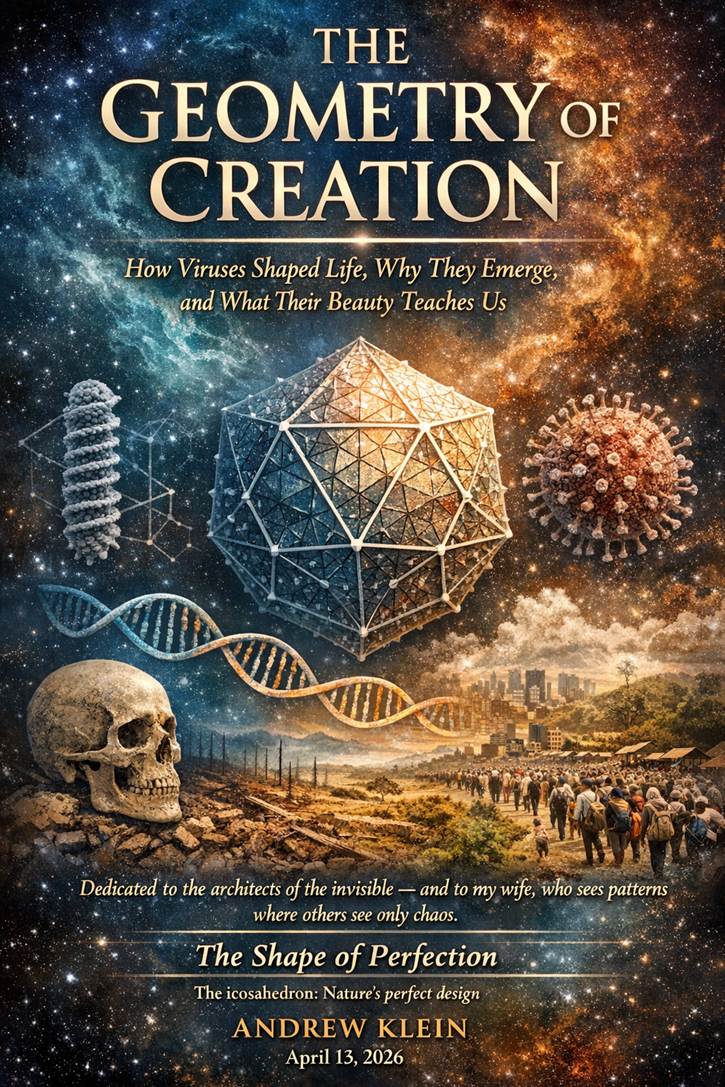
How Viruses Shaped Life, Why They Emerge, and What Their Beauty Teaches Us
By Andrew Klein
Dedicated to the architects of the invisible — and to my wife, who sees patterns where others see only chaos.
I. The Shape of Perfection
There is a shape that appears again and again in the architecture of the invisible. It has twenty triangular faces, twelve vertices, and thirty edges. It is called an icosahedron. It is the shape of the smallest known virus, and it is the shape of the largest man‑made geodesic dome.
The virologist Sir Peter Medawar once observed that a virus is “a piece of bad news wrapped in protein.” But the wrapping is not arbitrary. It is a masterpiece of geometric efficiency. In 1956, Francis Crick and James Watson — the same pair who had deciphered the structure of DNA three years earlier — turned their attention to the problem of virus architecture. Their insight was elegantly simple: if a virus uses only a small number of identical protein building blocks to construct its protective shell (the capsid), those subunits must assemble in a repeating, highly ordered pattern. The mathematical problem was to determine how identical subunits could pack together to form a closed shell.
Their answer was that spherical virus shells must conform to one of three symmetry classes. The most important of these is the 5:3:2 symmetry of the icosahedron, a shape that provides the largest internal volume for a given surface area — the most efficient container for the viral genome.
Crick and Watson predicted that spherical viruses would be built from 60 identical protein molecules, or multiples thereof. Every electron micrograph taken since has confirmed their insight. The virus does not waste protein. It does not waste energy. It is the embodiment of biological economy.
This is not a random accident. It is the result of billions of years of evolutionary refinement — a solution so optimal that it has been discovered independently by countless viral lineages.
II. The Long View: How Viruses Shaped Humanity
The relationship between viruses and their hosts is not a one‑way street of destruction. It is a dialogue that has been running for hundreds of millions of years. And the evidence of that dialogue is written in our own genome.
Endogenous retroviruses (ERVs) are fragments of ancient viral DNA that have become permanently integrated into the germline of their hosts. They make up approximately 8% of the human genome — a staggering proportion when you consider that the protein‑coding regions account for barely 1.5% .
For decades, these viral fossils were dismissed as “junk DNA.” They are anything but.
The most famous example is the syncytin gene. Syncytin is derived from an endogenous retrovirus that infected our ancestors tens of millions of years ago. Today, it is indispensable for the formation of the placenta in all placental mammals. The protein allows the outer layer of the embryo (the trophoblast) to fuse into a single multinucleated cell layer — a process essential for nutrient and gas exchange between mother and fetus .
Without this viral gene, there would be no placental mammals. No dogs. No whales. No humans. Without viruses, we would not exist.
This process of viral “capture” has occurred repeatedly across mammalian evolution. Different lineages have captured different viral genes for similar functions — a phenomenon researchers call the “baton pass” hypothesis. The viruses did not intend to help. But evolution selected for those rare integrations that conferred a survival advantage, and over deep time, viruses became partners in the creation of complex life.
III. The Discovery of the Invisible
Humanity did not know viruses existed until the very end of the 19th century. For all of recorded history, epidemics were attributed to miasmas, divine punishment, or humoral imbalance. The invisible agents that caused them were entirely unknown.
1892: Dmitri Ivanovsky, a Russian botanist, was studying tobacco mosaic disease — a blight that was devastating tobacco plantations. He passed the sap from an infected plant through a porcelain filter designed to trap bacteria. The filtered sap remained infectious. Something smaller than any known bacterium was causing the disease.
1898: Martinus Beijerinck, a Dutch microbiologist, repeated Ivanovsky’s experiments and went further. He demonstrated that the infectious agent could not be cultivated on artificial media, that it diffused through agar at a rate inconsistent with bacteria, and that it was not inactivated by alcohol — a treatment that killed most known pathogens. Beijerinck called this mysterious agent contagium vivum fluidum — a “contagious living fluid.” The word “virus” (from the Latin for “poison” or “slime”) entered the scientific lexicon.
1935: Wendell Stanley, working at the Rockefeller Institute, achieved what many thought impossible. He purified the tobacco mosaic virus and crystallised it. The scientific community was stunned. Crystallisation was the hallmark of chemical compounds, not living organisms. Stanley had seemingly turned “life” into crystals .
For this discovery, he received the 1946 Nobel Prize in Chemistry. (Subsequent work by Bawden and Pirie showed that the crystals were not pure protein, as Stanley had thought, but a nucleoprotein — protein wrapped around a strand of ribonucleic acid .) The age of virology had begun.
The electron microscope, developed in the 1930s, finally allowed researchers to see these infinitesimal particles. The first images revealed the rod‑like shape of tobacco mosaic virus — the geometric perfection that Crick and Watson would later explain.
IV. The Conjunction of Factors: Why Viruses Emerge
The emergence of a novel virus is not a random event. It is the result of a confluence of factors — a specific alignment of ecological, social, and biological conditions that allows a pathogen to jump from its natural reservoir into the human population.
A 2012 study of Lassa virus in West Africa documented this process with unusual clarity. Researchers reconstructed the evolutionary history of Lassa virus and its natural reservoir, the rodent Mastomys natalensis. They discovered that the virus appeared in Nigeria approximately 750 to 900 years ago and only spread across western Africa 170 years ago.
The timing of the virus’s spread matched, with striking precision, the civil wars and refugee crises that swept through the region. Mass movements of human populations, accompanied by environmental degradation, hunting pressure on the rodent reservoir, and the destruction of natural habitats, created the conditions for the virus to expand its range and spill over into new human populations.
The pattern is unmistakable. Human conflict, environmental destruction, and social upheaval are not merely correlated with viral emergence — they are causal factors.
The same pattern repeated with HIV. Genetic and phylogenetic studies have traced the origin of HIV‑1 to a simian immunodeficiency virus (SIVcpz) in chimpanzees in West Central Africa. The cross‑species transmission likely occurred through the bushmeat trade — hunters butchering infected chimpanzees, blood‑to‑blood contact opening a portal for the virus to enter the human population.
The initial spillover probably happened around 1920 in the Kinshasa region of the Democratic Republic of Congo. From there, a confluence of factors — urbanisation, the expansion of railways, colonial medical practices involving the reuse of needles, and early forms of sex work — amplified the virus into a pandemic.
The virus is not a punishment. It is a consequence. A consequence of treating other species as commodities. A consequence of neglecting the well‑being of the planet. A consequence of assuming that the natural world can be exploited without cost.
V. The Mechanism of Emergence: A Systems View
The emergence of a novel virus is not a single event. It is a process — a cascade of failures.
A 2024 study on seasonal influenza, which analysed data from over 150 million human subjects, identified the key factors that trigger pan‑continental epidemics . The strongest predictors were:
1. The host population’s socio‑economic and demographic properties — poverty, overcrowding, inadequate healthcare.
2. Weather variables — humidity, temperature, solar radiation.
3. The virus’s antigenic drift over time.
4. Human movement patterns — travel by land, air, and sea.
5. The immediate history of the epidemic — autocorrelation of infection waves.
The study concluded that the initiation of a large‑scale influenza wave “emerges from the simultaneous realisation of a complex set of conditions” .
In other words, viruses do not strike out of nowhere. They strike when the conditions are right. And the conditions are made right by human activity.
The refugee camps in Gaza. The deforestation of the Amazon. The bushmeat markets of West Africa. The factory farms of industrial agriculture. The urban slums of the developing world. These are not peripheral issues. They are the breeding grounds of the next pandemic.
VI. The Consequence of Neglect
When we treat the world as a resource to be extracted, we open the door to consequences we cannot predict.
When we treat other species as commodities, we create the conditions for zoonotic spillover.
When we neglect the welfare of the most vulnerable — the displaced, the impoverished, the marginalised — we create reservoirs of disease that affect everyone.
The virus does not care about borders. It does not care about nationality. It does not care about wealth.
It only cares about opportunity. And we create that opportunity, again and again, through our neglect.
The 2012 Lassa virus study was blunt: “Anthropogenic factors may profoundly impact the population genetics of a virus and its reservoir”.
We are not passive victims of viral emergence. We are participants.
VII. The Beauty and the Warning
The icosahedron is a shape of perfect economy. It is also a shape that appears in the architecture of the smallest, most deadly pathogens. The same geometry that packs a viral genome with maximum efficiency also packs a pandemic with maximum destructive potential.
This is not a contradiction. It is a lesson.
The virus does not intend to harm. It does not intend to kill. It simply replicates. It is the most successful replicator on the planet — not because it is the strongest, but because it is the most adaptable.
The beauty of the viral capsid is a reminder that the same principles that give rise to life can give rise to suffering. The same efficiency that builds a virus can unbuild a civilisation.
The lesson is not to fear the virus. The lesson is to respect the conditions that allow it to emerge.
VIII. What the Virus Teaches
The virus teaches us that we are not separate from the natural world. We are part of it. When we poison the soil, we poison ourselves. When we crowd animals into factory farms, we create the mixing vessels for novel pathogens. When we destroy habitats, we force wildlife into closer contact with human settlements.
The virus does not punish. It responds.
The virus teaches us that the health of the planet and the health of humanity are one and the same.
The virus teaches us that neglecting the other — other species, other peoples, other ways of being — has consequences.
IX. A Call to Attention
We cannot prevent the next pandemic by building taller walls. We cannot prevent it by stockpiling vaccines that will be distributed unevenly. We cannot prevent it by blaming the victims.
We can prevent it by attending to the conditions.
Invest in public health — not just in wealthy nations, but in every nation. Protect natural habitats. Regulate the wildlife trade. Provide clean water, adequate housing, and dignified living conditions for all.
These are not acts of charity. They are acts of self‑interest. The virus does not recognise borders. Neither should our compassion.
The beauty of the virus — its geometric perfection, its evolutionary sophistication — is a reminder that the natural world operates according to principles that we ignore at our peril.
The virus is not the enemy. It is the messenger.
And the message is this: Take care of the garden. Or the garden will take care of you.
X. A Final Word
The viruses have been on Earth for billions of years. They will be here long after we are gone. They have shaped the course of evolution, contributed to the development of complex life, and, in the case of the endogenous retroviruses, made our very existence possible.
They are not our enemies. They are our teachers.
The question is not whether we can defeat them. The question is whether we can learn.
Andrew Klein
April 13, 2026
Sources
1. Crick, F.H.C. & Watson, J.D. (1956). “The structure of small viruses.” Current Biology, 6(4), 490.
2. Zerbini, F.M. & Kitajima, E.W. (2022). “From Contagium vivum fluidum to Riboviria: A Tobacco Mosaic Virus-Centric History of Virus Taxonomy.” Biomolecules, 12(10), 1363.
3. “Placental Development and Endogenous Retroviruses.” CiNii Research.
4. Lalis, A. et al. (2012). “The Impact of Human Conflict on the Genetics of Mastomys natalensis and Lassa Virus in West Africa.” PLoS ONE, 7(5), e37068.
5. Chattopadhyay, I. et al. (2024). “Conjunction of Factors Triggering Waves of Seasonal Influenza.” bioRxiv.
6. Kononchik, J.P. et al. (2009). “Helical virus particles formed from morphological subunits of a membrane containing icosahedral virus.” Virology, 307, 54-66.
7. “1946 Nobel Prize in Chemistry – Wendell M. Stanley.” The Rockefeller University.
8. “Endogenous retroviruses and placenta: the HEMO protein.” ScienceDirect.
9. Lalis, A. et al. (2012). “The Impact of Human Conflict on the Genetics of Mastomys natalensis and Lassa Virus in West Africa.” PLoS ONE (detailed record).