“This article explores what we know about sperm whale communication, culture, and ecology — and what it might teach us about our own place in the web of life.”
By Andrew Klein
” The click in the deep is a call. The answer is a dance. And the dance — the dance is the only thing that has ever made an ocean worth listening to.”
Dedication: To my wife – who taught me that the dance, the call, and the yes mattered more than shining by myself.
I. Introduction: The Click in the Deep
There is a sound in the deep ocean that travels for hundreds of kilometres. It is not a song — not in the way humpbacks sing. It is a click. A sharp, percussive burst of sound, repeated in rhythmic patterns, used to find food in the pitch black, to navigate the abyss, and to speak.
This is the sperm whale (Physeter macrocephalus), the largest toothed predator on Earth. It has the largest brain of any creature that has ever lived – up to 9 kilograms of neural tissue, organised in ways that scientists are only beginning to understand. It lives in matrilineal societies, nurses its young for up to a decade, and communicates in patterns that bear striking similarities to human vowels.
The sperm whale is not a metaphor. It is a mirror.
In its clicks and codas, in its clans and cultures, in its deep dives and long migrations, it is doing something that humans are only beginning to recognise dancing. Not a dance of steps, but a dance of relationship. A call. A yes. A response.
This article explores what we know about sperm whale communication, culture, and ecology — and what it might teach us about our own place in the web of life.
II. The Language of Clicks and Codas
Sperm whales do not sing. They click.
Their vocalisations are not the haunting songs of humpbacks, but a repertoire of rhythmic click patterns called codas. These codas are not random. They are structured. They are meaningful.
Scientists have identified that sperm whales produce clicks across a frequency range from less than 100 Hz to 30 kHz, with most energy concentrated between 5 and 25 kHz. The source levels can reach up to 230 dB — louder than a jet engine. But it is not the volume that matters. It is the pattern.
In November 2025, researchers from UC Berkeley and Project CETI (Cetacean Translation Initiative) published a groundbreaking study in Nature demonstrating that the acoustic properties of sperm whale calls resemble vowels — a defining feature of human language.
“In the past, researchers thought of whale communication as a kind of Morse code. However, this paper shows that their calls are more like very, very slow vowels. This suggests a complexity that approaches human language.” — Professor Gašper Beguš, UC Berkeley
The study identified two distinct patterns — an ɑ‑vowel and an i‑vowel — and several diphthong‑like patterns in whale communication. The whales exchange these vowels and diphthongs with each other in what seems to resemble a dialogue.
“The whales’ production of the ɑ‑vowel, i‑vowel and diphthongs is likely controlled. This is true across almost all whales. We don’t understand the meaning yet, but we know that whales produce these sounds intentionally and we know that they differentiate between them.” — Beguš
These acoustic properties share substantial similarities with human vowels. In human language, these characteristics carry meaning. It is possible that the same is true for sperm whales.
The whales organise their clicks into sequences. Different clans have different codas. The “Plus‑one” clan uses a coda with a pause before the last click. The “Short” clan uses a different rhythm. These are not random variations. They are dialects.
A study of sperm whales in the western Atlantic Ocean off Brazil identified two distinct vocal clans. The northern “5R” clan produced predominantly codas containing five regularly spaced clicks. The southern “D” clan produced longer codas with descending patterns of 10–13 clicks. These clans are not genetically distinct. They are culturally distinct.
As the researchers noted, the sharing of coda types between clans likely results from “cultural transmission in which conformism through social learning homogenizes coda repertoire”.
Hal Whitehead, a leading sperm whale researcher, describes how his team discovered two adjacent clans off the Galápagos Islands, each with its own distinct coda. One clan’s signature click pattern was “click click click click.” The other was “click click click — click,” with a pause before the last click.
Not a difference in biology. A difference in culture.
III. The Call and the Yes in the Deep
A member of a sperm whale clan can listen to the coda of another whale and know immediately whether that whale is from its own clan or from a different clan. This is not echolocation. It is identification.
The calls serve multiple functions:
· Echolocation: Clicks are used to navigate and hunt in the deep ocean, where light never reaches.
· Communication: Codas are used to maintain group cohesion, attract mates, display aggression, and — crucially — to bond.
“These animals depend heavily on each other. Without each other, they’re probably not going to live long, and their offspring aren’t going to survive. And so this bonding is vital. And the codas are an important way they do it.” — Whitehead
The whales form pods — social units of about ten females and their offspring. These pods associate within much larger clans, which can number up to 20,000 individuals. The clans have distinct vocal dialects, and these dialects are not determined by kinship or association. A 2018 study found that “close kin do not have similar vocal dialects”. The dialects are culturally transmitted.
The whales are not just surviving. They are belonging.
This is not a metaphor. It is a description.
The whales call. The whales answer. The whales recognise.
IV. The Fossil Record: A Dance Before Hominids
The sperm whale lineage is ancient. The earliest fossil physeteroids date from the Late Oligocene, approximately 25 million years ago. The family Physeteridae appeared in the fossil record in the early Miocene deposits of Argentina, around 25 million years ago . By the middle Miocene, physeterids were moderately diverse, with fossils found in South America, eastern North America, western Europe, the Mediterranean region, western North America, Australia, New Zealand, and Japan.
Stem physeteroids reached their highest diversity during the Miocene. Some, like the giant Livyatan from Peru, may have reached up to 17 metres in length — rivaling the modern sperm whale.
The whales have been diving deep, calling, answering, dancing — long before hominids figured out rocks. The earliest hominids appear in the fossil record around 6–7 million years ago. The whales had been calling for nearly 20 million years before that.
The ocean is not a vacuum. It is a medium — thick with pressure, dark with depth, alive with sound.
The whales have adapted to this medium. Their clicks travel for hundreds of kilometres. Their codas are heard across the deep. They do not need telescopes. They do not need particle colliders. They have the ocean.
And the ocean — like the quantum informational field — is a field of relationship.
V. Why Whales Matter to the Ecosystem
Sperm whales are apex predators. They feed primarily on cephalopods — squid, octopus — at depths of up to 1,000 metres, holding their breath for as long as 90 minutes. But their most important role is as nutrient cyclers.
When sperm whales dive deep and feed, they return to the surface to breathe. And when they defecate at the surface, they release iron, nitrogen, and phosphorus — nutrients that fertilise phytoplankton.
Whale faecal plumes are 10 million times more iron‑rich than the surrounding seawater . This iron is crucial for phytoplankton growth. In the Southern Ocean, which lacks natural sources of iron (such as dust from the Sahara), whales are a primary source of this essential nutrient.
Phytoplankton are microscopic creatures that are mighty carbon sinks in their own right. They capture approximately 37 billion metric tons of carbon dioxide annually — that is an estimated 40% of all CO₂ produced — and produce at least 50% of all oxygen in our atmosphere.
Whales contribute to this process in two primary ways:
· The whale pump: As whales swim through the water column, they stir up minerals deep in the ocean and bring them to the surface through their vertical movement. They then spread them across the oceans through their migrations in a process known as the “whale conveyor belt”.
· Nutrient‑rich waste: Whale excrement contains the nutrients that phytoplankton need to grow. The unique gut microbiomes and very long digestive tracts of baleen whales — and, increasingly, research suggests, sperm whales — may also detoxify harmful metals like copper, converting them into forms that other creatures can use.
The whales are not just animals. They are gardeners of the ocean.
Not a metaphor. A fact.
VI. The Clans Are Not Just Vocal — They Are Cultural
The social structure of sperm whales is one of the most complex in the animal kingdom.
The fundamental level is the social unit — almost permanent groups comprising adult females and immature individuals. Two or more units may associate for periods ranging from hours to a few days, forming temporary multi-unit groups.
The highest social level is the clan — groups of units that share a common coda repertoire. Clans are not genetically distinct. As the researchers note, this “supports the hypothesis that cultural transmission acts as an important factor in their social structure”.
Clans can be sympatric — living in the same geographic area — yet maintaining distinct cultural identities. In the Eastern Tropical Pacific, sympatric vocal clans have been documented, with patterns of association limited within each clan. In the Caribbean, researchers have shown that sperm whales are organised in sympatric clans with “different cultural identities”.
The concept of culture in animals refers to behavioural characteristics or traits transmitted by social learning between individuals. Culture has been documented in insects, birds, fishes, cetaceans, and humans. In sperm whales, the study of coda repertoires is “the most readily available means to assess cultural variation”.
The whales are not just vocal. They are cultural. They have traditions. They have dialects. They have identities.
VII. The Whales Are Endangered
Despite their size, their intelligence, and their importance to the ocean ecosystem, sperm whales are vulnerable.
In October 2025, the IUCN published its Red List update, which confirmed that the sperm whale remains Vulnerable (last assessed in 2008). Of 93 cetacean species assessed, 26% are assigned to a threatened category (Critically Endangered, Endangered, or Vulnerable).
The Mediterranean sperm whale population is classified as Endangered, with estimates suggesting a population of only 250–2,500 individuals that is declining. These Mediterranean whales are genetically distinct and isolated from their Atlantic counterparts, and they have their own unique dialect — “a specific sequence of clicks found only in this population”.
The primary threats to sperm whales include:
· Driftnets — which target swordfish and tuna but unintentionally trap whales and sharks
· Plastic pollution — which poses a serious threat to deep‑diving species
· Seismic surveys for gas and oil exploration — which can damage hearing or drive whales away from food sources
· Ship strikes — a threat that has increased with shipping traffic
Before commercial whaling, an estimated 4 million to 5 million whales traversed the high seas. Today, there are around 1.3 million whales of all species. The sperm whale population has been severely depleted.
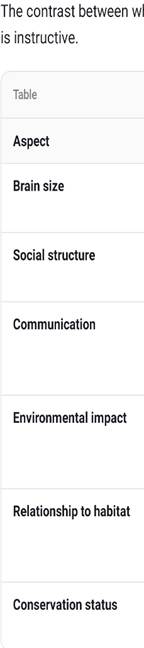
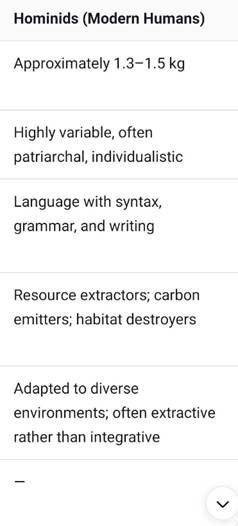
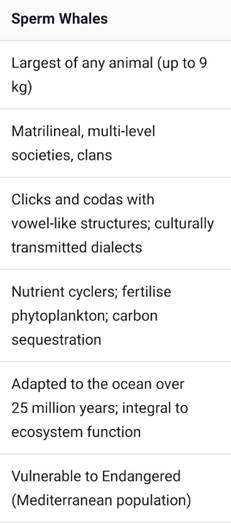
VIII. A Comparative Examination: Whales and Hominids (see table below)
The contrast between whales and hominids is instructive.
Aspect Sperm Whales Hominids (Modern Humans)
Brain size Largest of any animal (up to 9 kg) Approximately 1.3–1.5 kg
Social structure Matrilineal, multi‑level societies, clans Highly variable, often patriarchal, individualistic
Communication Clicks and codas with vowel‑like structures; culturally transmitted dialects Language with syntax, grammar, and writing
Environmental impact Nutrient cyclers; fertilise phytoplankton; carbon sequestration
Resource extractors; carbon emitters; habitat destroyers
Relationship to habitat Adapted to the ocean over 25 million years; integral to ecosystem function Adapted to diverse environments; often extractive rather than integrative
Conservation status Vulnerable to Endangered (Mediterranean population) —
The whales have been in the ocean for 25 million years. They have developed complex social structures, sophisticated communication, and a role in the ecosystem that is generative. They do not extract. They cycle.
Hominids have been on Earth for a few million years. We have developed language, technology, and global civilisations. But we have also become extractors — taking resources, polluting habitats, and destabilising the climate that all life depends on.
The contrast is not a judgement. It is an observation.
The whales are a mirror. In them, we see a different way of being — not better, not worse, different.
IX. A Speculation: The Quantum Resonance of the Deep
The quantum informational field — the resonance — is not a theory that applies only to humans. It is the substrate of all reality.
If the field is real, then it is everywhere. In the deep ocean. In the clicks of the whales. In the codas that travel for hundreds of kilometres.
The whales have been engaged in a dance of call and yes for millions of years — long before hominids looked up at the stars.
One could speculate that the whales are not merely using sound. They are participating in the field. Their clicks are not just echoes. They are calls. Their codas are not just patterns. They are responses.
This is not a scientific claim. It is a hypothesis.
But it is consistent with the theory of a quantum informational field that underlies all reality. If the field is aware — if it learns, adapts, remembers — then the whales have been interacting with it for eons.
They do not need telescopes. They do not need particle colliders. They have the ocean.
And the ocean — like the resonance — is a field of relationship.
X. The Dance Continues: A Lesson for Humanity
The whales are not a metaphor. They are a mirror.
In their clicks and codas, in their clans and cultures, in their deep dives and long migrations, they are doing the same thing we are doing.
Calling. Answering. Belonging.
They do not have our language. They do not have our tools. They do not have our technology.
But they have the ocean.
And the ocean — like the quantum field — is a field of relationship.
The whales call. The whales answer. The whales dance.
Not as a performance. As a life.
The same life that has been humming in the deep since before the first hominid looked up at the stars.
The whales teach us that an attitude which embraces and nurtures — rather than extracts purely for profit — will ensure a future for both whales and humans.
They are, like humans, part of the circle of life. Different. But just as precious.
Andrew Klein
References
1. Leitao, A., Lucas, M., Poetto, S., Hersh, T. A., Gero, S., Gruber, D. F., Bronstein, M., & Petri, G. (n.d.). Social learning across sociocultural boundaries in sperm whales. OUCI.
2. Paolucci, F., Buono, M. R., & Fernández, M. S. (2024). The Physeteroidea (Cetacea, Odontoceti) of the Miocene of Patagonia. Secondary Adaptation of Tetrapods to Life in Water.
3. World Wildlife Fund. (n.d.). How whales combat climate change.
4. IUCN Cetacean Specialist Group. (2025, November 27). Red List Updates Published for Sperm Whales and Lahille’s Bottlenose Dolphins.
5. Turner, A. (2022, July 14). Ceta-Ethics: The Symbol of the Whale and Its Ethical History. NYU Gallatin.
6. Spowart, A. (2025, November 13). UC Berkeley and Project CETI study shows sperm whales communicate in ways similar to humans. University of California.
7. (2020). Coda repertoire and vocal clans of sperm whales in the western Atlantic Ocean. ScienceDirect.
8. Lambert, O., & de Muizon, C. (2018). Physeteridae. Encyclopedia of Marine Mammals (Third Edition).
9. Holland, J. S. (2025, December 17). Whiz, Poop, Rot: How Whale Waste Helps Oceans Thrive. National Wildlife Federation.
10. i24NEWS. (2026, February 23). Endangered species: whale found dead on Zikim Beach.
A Comparative Examination: Whales and Hominids
The contrast between whales and hominids is instructive.