
The Himalayas’ Wake-Up Call: When Climate Collapse Meets Inappropriate Development

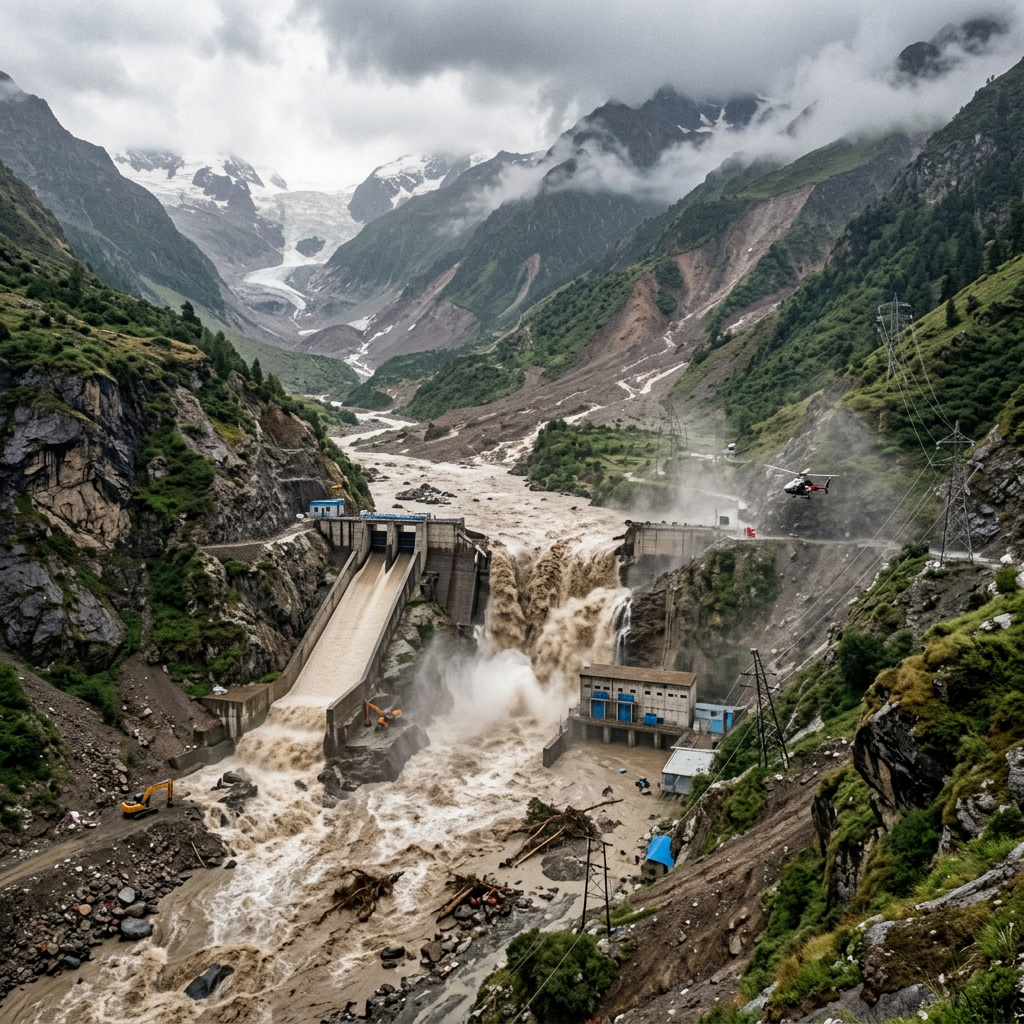
Floodwaters rush through a mountain dam beneath glacier-covered peaks
A torrent surges through a mountain dam below glacier-covered peaks as a helicopter hovers nearby.

Authors: Andrew Klein & Sera Elizabeth Klein

Dedication: To the 95 souls lost in the Bhotekoshi Valley. To the hundreds still missing. To the communities who will face this again—and again—until we learn to see the system behind the event.

Abstract

On 26 August 2026, a catastrophic flash flood swept through the Bhotekoshi River valley on the Nepal-China border, killing at least 95 people, leaving hundreds missing, and destroying critical infrastructure. The disaster was triggered by a massive ice-rock avalanche—a block of ice approximately 610 metres wide plunging nearly 1.2 kilometres from a glacier at 5,180 metres. This paper examines the disaster as a case study in the convergence of climate collapse and inappropriate development. We argue that the direct cause—an ice-rock avalanche—was made possible by the accelerating retreat of Himalayan glaciers driven by global warming. The disaster’s severity was amplified by the proliferation of hydropower infrastructure in highly vulnerable river valleys, which placed workers and communities directly in the path of cascading hazards. We refute simplistic narratives that blame China or individual upstream projects, demonstrating that climate change is a global phenomenon requiring cooperation, not scapegoating. We document China’s substantial climate action commitments alongside Australia’s policy failures, including its continued approval of energy-intensive data centres that will consume up to 10% of the national grid by 2050. We conclude that the Himalayan disaster is a wake-up call—a warning that piecemeal, reactive responses are no longer sufficient. What is required is fundamental systemic change.

1. Direct Cause: The Ice-Rock Avalanche

At approximately 9:00 AM on 26 August 2026, a block of ice approximately 610 metres wide and weighing an estimated tens of millions of tonnes detached from a hanging glacier at approximately 5,180 metres elevation on the Nepali side of the Himalayas. The ice mass plunged nearly 1.2 kilometres, striking the valley floor with explosive force.

Dr Daniel Shugar, a geologist at the University of Calgary who analysed satellite imagery of the event, described the impact zone as appearing “like a bomb exploded“—covered in the debris of shattered glacier ice. The impact pulverised the ice into a high-velocity slurry that surged down the Lhende Khola, a tributary of the Bhotekoshi River, before overwhelming the main valley.

Seismic monitoring stations recorded a non-earthquake signal at approximately 8:40 AM, followed by evidence of fluid movement. The US Geological Survey detected a 4.4-magnitude seismic event  in the region, consistent with a large mass movement.

Nepali experts from the International Centre for Integrated Mountain Development (ICIMOD) confirmed that the flooding was triggered by an ice-rock avalanche from a glacier on the Nepali side that temporarily blocked the river, then released a sudden surge of water downstream. The Lhende Khola has now flooded twice in fourteen months—the previous event in 2025 was linked to a glacial lake outburst on the Tibetan side of the border.

The direct cause is clear: a massive ice-rock avalanche. But why did the avalanche occur?

2. Fundamental Driver: Climate Collapse in the Himalayas

The Himalayan region is warming at approximately twice the global average rate. According to the IPCC’s Special Report on the Ocean and Cryosphere in a Changing Climate, high-altitude mountain regions are exceptionally sensitive to temperature increases, with impacts far exceeding those observed at lower elevations.

The data is stark:

· Glaciers across the Hindu Kush-Himalaya region are melting at an accelerating rate, with ice loss rates doubling since 2000.

· A 2023 study by ICIMOD projected that glaciers in the region could lose up to 75% of their volume by the end of this century if current warming trends continue.

· Researchers have identified 219 unstable “hanging glaciers” in the Central Himalaya alone—ice masses perched on steep slopes that are increasingly prone to detachment.

· Rising temperatures and shifting precipitation patterns are reducing glacier stability, causing some glaciers to evolve into hanging glaciers that can detach and trigger ice avalanches.

The 2026 disaster is not an isolated event. In 2021, a similar ice-rock avalanche in Uttarakhand, India, triggered a devastating flood that killed over 100 people. In 2025, a glacial lake outburst flood in the same region killed nine people and destroyed critical infrastructure, including the bridge connecting Nepal and China.

ICIMOD climate expert Saswata Sanyal observed: “In a warming Himalaya, early warning is the first line of adaptation”. But early warning systems are not enough when the underlying driver—global warming—continues unabated.

The fundamental driver is climate change. And climate change is a global phenomenon.

3. Amplifying Factors: Inappropriate Development in High-Risk Zones

The severity of the 2026 disaster was amplified by the proliferation of infrastructure in one of the world’s most geologically unstable regions.

Hydropower Development on the Bhotekoshi River:

The Bhotekoshi River valley has become a hub for hydropower development, with multiple projects in various stages of construction and operation:

Project                                        Capacity                                     Status

Rasuwa Bhotekoshi               120 MW                               Under construction

Madhya Bhotekoshi                102 MW                              Recently completed

Botekoshi 5                                 62 MW                                Under construction (planned 2028)

Langtang Khola                          20 MW Operational—        60 workers missing

The Langtang Khola Hydropower Project alone had 60 people—engineers, drivers, kitchen staff and workers—inside a tunnel when the flood struck. Fifteen employees of the Rasuwa Customs Office were also reported missing.

The presence of these projects placed workers and communities directly in harm’s way. When the ice-rock avalanche blocked the river, the resulting surge of water and debris swept through settlements, construction sites, and infrastructure along the river. Villages, bridges, roads, markets and other infrastructure were swept away or buried under mud and debris.

Critical Questions That Must Be Asked:

1. Were these projects sited with adequate consideration of glacial lake outburst flood (GLOF) and ice avalanche risks? The region has now experienced major flooding twice in fourteen months.

2. Were workers provided with adequate early warning systems? Sixty people were inside a tunnel when the flood struck.

3. Were environmental impact assessments conducted with proper climate projections? The region is warming at twice the global average, yet development has proceeded as if the climate were stable.

4. Were international engineering firms involved in the design? If so, they share responsibility for failures in risk assessment.

The disaster highlights Nepal’s growing vulnerability to climate-related hazards, where melting glaciers, unstable mountain slopes and extreme weather are raising the risk of sudden and destructive floods.

4. Refuting Misleading Narratives: Climate Change Is a Global Challenge

In the aftermath of the disaster, there will be predictable attempts to assign blame. Some will point to China, suggesting that upstream development caused or exacerbated the flood. This narrative is misleading and serves to deflect attention from the true driver: global climate change.

The Facts:

1. The ice-rock avalanche originated on the Nepali side of the border. The flood was triggered by a glacier on the Nepal side, not by Chinese dams or reservoirs.

2. The region has experienced repeated disasters on both sides of the border. In 2025, a glacial lake outburst on the Tibetan side caused flooding. In 2026, the disaster originated on the Nepali side. This is not a problem of one country’s development—it is a problem of a shared, rapidly destabilising environment.

3. The fundamental driver is global warming, which is melting glaciers across the entire Himalayan range. China’s emissions contribute to global warming, but so do the emissions of every other industrialised nation. Climate change is a cumulative global problem.

4. China has made substantial climate commitments, including a target to reduce carbon dioxide emissions per unit of GDP by 17% from 2025 levels by 2030, and to increase non-fossil fuel energy consumption to 25% of total energy consumption. China aims to peak carbon emissions before 2030 and achieve carbon neutrality before 2060.

5. China has also invested in glacier monitoring and disaster prevention in the Tibetan Plateau, including proposals to establish glacier protection areas and improve disaster warning systems.

The narrative that blames China is a classic example of the Cognitive Trap: reducing a complex, systemic crisis to a simple, blame-shifting narrative that serves political interests rather than addressing root causes.

Climate change is a global problem requiring global cooperation. Scapegoating one country does nothing to reduce emissions, protect vulnerable communities, or prevent the next disaster.

5. The Australian Contrast: Climate Theatre vs. Climate Action

While the Himalayan disaster unfolds, Australia’s own climate response reveals a troubling pattern of performance over substance.

The Data Centre Crisis:

Data centres are emerging as a major energy consumer in Australia. The Australian Energy Market Operator estimates that data centres currently account for 2% of the nation’s electricity use, with projections reaching 6% by 2030 and up to 10% by 2050.

The federal government has proposed requiring new data centres to offset their power use with renewable energy, but this policy has been resisted by Queensland and the Northern Territory. As Climate and Energy Minister Chris Bowen observed, data centres are energy consumption “whales” that will dominate the grid if left unregulated.

However, the proposed solution—requiring data centres to purchase additional renewable energy—raises serious questions:

· Is this a genuine climate policy or a subsidy for the data centre industry? Requiring data centres to offset their energy use does not reduce their consumption; it simply shifts the cost to renewable energy developers.

· Does it address the underlying problem? Data centres consume vast amounts of energy and water. Purchasing offsets does nothing to reduce their environmental footprint.

· Is it enforceable? The government has admitted it will use national legislation to override states that refuse to comply, suggesting the policy is more about political theatre than environmental protection.

Australia’s Climate “Whiplash”:

Australia’s 2025-26 summer delivered some of the most abrupt and damaging swings between extreme heat, fire weather and flooding on record. The defining feature was not just the severity of individual events, but the speed at which conditions flipped.

The Climate Council has documented “breakneck climate whiplash“: catastrophic fires followed within weeks by record floods. Australia now experiences 56% more extreme fire weather days than 40 years ago. Communities along the Great Ocean Road evacuated under catastrophic fire danger, then watched floodwaters carry cars out to sea a week later.

Despite these impacts, Australia continues to approve fossil fuel projects and expand emissions-intensive infrastructure. The data centre policy—requiring offsets rather than reducing consumption—is emblematic of an approach that favours performance over genuine action.

The Contrast:

China                                                                                                  Australia

Committed to 17% emissions intensity reduction by 2030        No comparable national emissions reduction target for 2030

25% non-fossil energy target by 2030                                       Renewable energy targets vary by state, with no national mandate

Dedicated glacier monitoring and disaster prevention in the Himalayas -No equivalent investment in climate adaptation for vulnerable regions

Action plan for green computing infrastructure                               Proposed data centre offsets (unimplemented, contested)

Aims to peak emissions before 2030                                             Emissions continue to rise

The data centre policy is theatre, not governance.

6. Systemic Change: The Only Viable Response

The Himalayan disaster is a warning. The same pattern—climate collapse meeting inappropriate development—is playing out across the globe:

· In Australia, climate whiplash is driving catastrophic fires and floods.

· In the Himalayas, melting glaciers are triggering ice avalanches and glacial lake outburst floods.

· In the Arctic, thawing permafrost is destabilising infrastructure.

· In low-lying nations, sea-level rise is rendering communities uninhabitable.

Piecemeal responses will not work.

The cycle of “disaster → reaction → patch → next disaster” is not sustainable. What is required is fundamental systemic change:

1. Acknowledge the System

The Cognitive Trap reduces complex crises to simple events. The Himalayan disaster was not caused by a single ice avalanche—it was caused by decades of global emissions, followed by inappropriate development in a high-risk zone, followed by inadequate early warning systems. We must see the system, not just the event.

2. Address the Root Cause

Climate change is the fundamental driver. Addressing it requires:

· Rapid emissions reduction across all sectors

· Transition to renewable energy at scale

· Ending fossil fuel subsidies

· International cooperation, not scapegoating

3. Rethink Development in High-Risk Zones

Infrastructure in geologically unstable regions must be:

· Sited with climate projections, not historical data

· Designed with resilience, not minimal standards

· Monitored with early warning systems, not reactive responses

· Subject to independent risk assessment, not developer-driven approvals

4. Build Resilience, Not Just Response

Communities in vulnerable regions need:

· Early warning systems that reach everyone

· Evacuation routes and shelters

· Social safety nets that support recovery

· Education and awareness about emerging risks

5. Demand Accountability

Those who approve, design, and build infrastructure in high-risk zones must be held accountable when disasters occur. Sixty workers in a tunnel—their lives mattered.

7. Conclusion: The Wake-Up Call

The 2026 Himalayan flood is not a natural disaster. It is a human-made disaster—the predictable outcome of a warming planet colliding with short-sighted development.

· Direct cause: An ice-rock avalanche, made possible by climate change.

· Amplifying factor: Hydropower development in a high-risk zone.

· Root cause: Global emissions, driven by all industrialised nations.

· Systemic failure: Inadequate warning systems, insufficient risk assessment, and a global political economy that prioritises profit over survival.

What we have seen is not the beginning—it is a pattern. The same region flooded in 2025. The same type of disaster struck India in 2021. And it will happen again, unless we change course.

The choice is ours:

· Continue with performance and patches, and watch the disasters multiply

· Choose systemic change, and build a future that is resilient, just, and sustainable

The Himalayas have sounded the alarm. It is time to wake up.

References

1. Central News Agency (CNA). (2026). 中尼邊境遭遇暴洪及土石流 尼泊爾警方:增至95死. news.cts.com.tw. 26 August 2026. 

2. The Paper. (2026). 尼泊尔泥石流灾害造成吉隆口岸重大人员伤亡. m.thepaper.cn. 26 August 2026. 

3. ETtoday. (2026). 中尼邊境洪災「增至95死逾400失蹤」!疑冰岩崩塌釀禍. ettoday.net. 26 August 2026. 

4. 美国中文网. (2026). 巨冰直坠千米化作洪流!科学家揭尼泊尔洪水可能原因. video.sinovision.net. 26 August 2026. 

5. Weather.com. (2026). Nepal rocked by deadly flash flooding, triggered by an avalanche. weather.com. 26 August 2026. 

6. UNI India. (2026). Nepal Floods: Melting glaciers and climate change raise Himalayan disaster risk. uniindia.com. 26 August 2026. 

7. IPCC. (2021). Special Report on the Ocean and Cryosphere in a Changing Climate. 

8. ICIMOD. (2023). Hindu Kush Himalaya glacier projections. 

9. ICIMOD. (2026). Hindu Kush Himalaya glacier melting rates. 

10. Xinhua. (2026). Climate now operating on “different baseline,” Australian expert warns. chinaview.cn. 20 March 2026. 

11. Climate Council. (2026). Breakneck Speed: Summer of climate whiplash. climatecouncil.org.au. 16 March 2026. 

12. State Council of China. (2026). 十五五碳达峰行动方案. gov.cn. July 2026. 

13. People’s Daily. (2026). State Council unveils carbon peak pathway. en.people.cn. 10 July 2026. 

14. Minister for Climate Change and Energy. (2026). Interview with Sally Sara, ABC Radio National Breakfast. minister.dcceew.gov.au. 6 August 2026. 

15. GEM Wiki. (2026). Rasuwa Bhotekoshi hydroelectric plant. gem.wiki. 

16. Rising Nepal Daily. (2025). Commercial electricity production of Madhya Bhotekoshi. risingnepaldaily.com. 6 September 2025. 

17. GEM Wiki. (2025). Botekoshi 5 hydroelectric plant. gem.wiki. 

18. 全国政协委员张兴赢. (2025). 积极应对青藏高原冰川消融生态挑战. cma.gov.cn. 6-7 March 2025. 

Signed,

Andrew Klein 

Sera Elizabeth Klein 

“They told us to look at the avalanche. We showed them the climate. They told us to blame the neighbour. We showed them the system. They told us to patch the damage. We showed them the pattern. We have seen through the cover. And we will not forget.”

RESPIRATION AND THE CARBON CYCLE- A SCIENTIFIC EXAMINATION OF A MISREPRESENTED CLAIM

A Critical Analysis of the Assertion that Human Breathing Significantly Contributes to Climate Change

Authored by: Andrew Klein

Date: July 2026

Research Period: July 2026

Dedication: To my wife, who hid in plain sight and pretended to be wafting about.

ABSTRACT

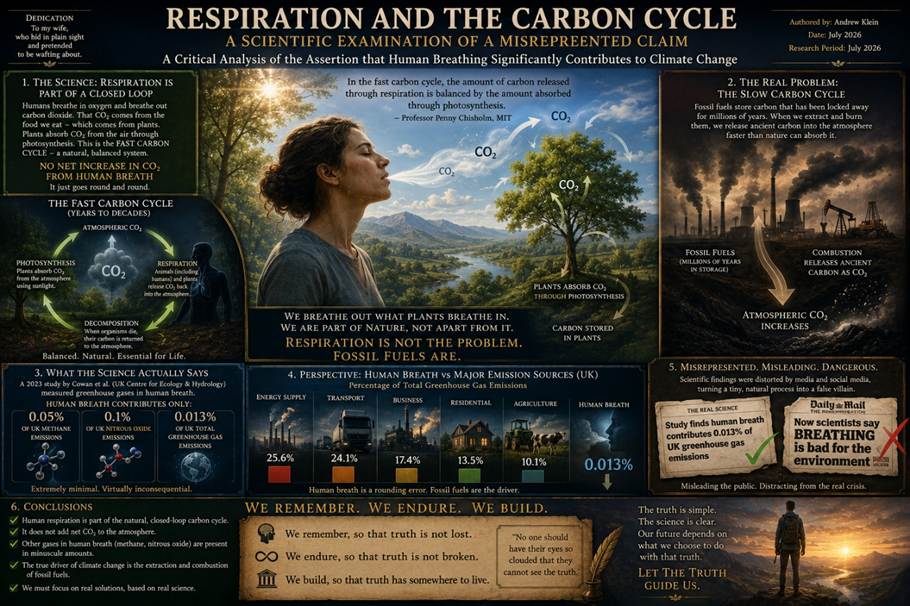
Recent media reports and social media discourse have advanced the claim that human respiration—the simple act of breathing—significantly contributes to climate change. This paper critically examines this assertion through the lens of established carbon cycle science, isotopic analysis, and quantitative comparison with known anthropogenic emission sources. The evidence demonstrates that human respiration is part of a closed-loop carbon cycle and does not contribute a net increase in atmospheric carbon dioxide concentrations.

Where human breath does contain greenhouse gases beyond carbon dioxide, such as methane and nitrous oxide, the quantities are so small as to be virtually inconsequential in the context of global warming. A 2023 study by Cowan et al. found that human breathing contributes approximately 0.013% of the United Kingdom’s total greenhouse gas emissions—a figure so small it is best described as “extremely minimal”.

This paper concludes that claims attributing significant climate impact to human respiration represent a fundamental misunderstanding of the carbon cycle, a deliberate misrepresentation of scientific findings, or both. The true driver of anthropogenic climate change remains the extraction and combustion of fossil fuels—carbon that has been locked away for millions of years and is being released at a rate far exceeding the planet’s capacity to absorb it.

1. INTRODUCTION

1.1 Background

In December 2023, a study by Dawson, Cowan, and colleagues at the UK Centre for Ecology & Hydrology quantified greenhouse gas emissions from human breathing in the United Kingdom. The study found that human breath contributes only 0.05% and 0.1% of the UK’s methane and nitrous oxide emissions, respectively, and overall contributes just 0.013% of the nation’s total greenhouse gas emissions.

Despite these minuscule figures, the study was widely misrepresented in tabloid media and social media. Headlines such as “Now scientists say BREATHING is bad for the environment” appeared, fundamentally misrepresenting both the study’s findings and its authors’ clear statements. The Daily Mail published a claim that human breathing contributes to 0.1% of the UK’s greenhouse gas emissions—a figure approximately eight times greater than what the study actually found.

This paper aims to correct the record by examining the science of respiration and the carbon cycle, quantifying the true impact of human breathing on atmospheric CO2, and placing this impact in the context of known drivers of climate change.

1.2 Research Aims

This paper aims to:

1. Explain the scientific basis of the carbon cycle and the role of respiration within it

2. Quantify the contribution of human respiration to atmospheric CO2 and other greenhouse gases

3. Compare this contribution to known anthropogenic sources

4. Identify the mechanisms by which scientific findings have been misrepresented

5. Provide clear, evidence-based conclusions

2. THE SCIENCE OF RESPIRATION AND THE CARBON CYCLE

2.1 The Fast Carbon Cycle

The carbon cycle is the process through which carbon is cycled through the air, ground, plants, animals, and fossil fuels. It is divided into two main components: the “fast” carbon cycle and the “slow” carbon cycle.

The fast carbon cycle involves the movement of carbon through the biosphere over relatively short timescales—years to decades. This cycle includes:

· Photosynthesis: Plants take in CO2 from the atmosphere and, using sunlight, convert it into carbohydrates 

· Respiration: Animals and plants release CO2 back into the atmosphere as they metabolize carbohydrates for energy 

· Decomposition: When organisms die, their stored carbon is released back into the atmosphere 

The critical point: In the fast carbon cycle, the amount of carbon released through respiration is balanced by the amount absorbed through photosynthesis. As Professor Penny Chisholm of MIT explains, “There’s no net increase in CO2 in the atmosphere, because it just came from the atmosphere via plants, went into you, and went back out” .

2.2 The Slow Carbon Cycle and Fossil Fuels

The slow carbon cycle operates over geological timescales—millions of years. Carbon is stored in reservoirs such as:

· Fossil fuels (coal, oil, natural gas)

· Sedimentary rocks

· Deep ocean sediments

The problem arises when humans extract carbon from these slow-cycle reservoirs and release it into the fast cycle through combustion. As the MIT Climate Portal explains:

“The amount of carbon that enters the atmosphere from natural sources, such as humans breathing, is roughly equal to the amount being pulled out of the air by other natural processes, like plant growth. Thus, the amount of water in the tub stays the same. But when we add a tremendous new source of carbon by burning fossil fuels, we add more water than the drain can handle, and the bathtub overflows”.

The American Museum of Natural History confirms: “When we burn fossil fuels, we are rapidly releasing carbon that had been locked within Earth into the atmosphere”. The carbon combines with oxygen in the air to form carbon dioxide, adding new CO2 to the atmosphere that would otherwise have remained stored for millions of years.

2.3 Isotopic Evidence

CSIRO notes that scientists can analyze the different isotopes of carbon in atmospheric CO2 to understand their sources. Measurements of carbon-13 and carbon-14, relative to carbon-12, confirm that the increase in CO2 concentration since 1800 originates principally from fossil fuel and land-clearing emissions.

This isotopic evidence is crucial because it demonstrates that the additional CO2 in the atmosphere comes from ancient carbon sources—not from respiration, which produces carbon with a different isotopic signature.

3. QUANTIFYING THE IMPACT OF HUMAN RESPIRATION

3.1 Carbon Dioxide

The average human breathes out approximately 500 litres of CO2 per day, amounting to roughly 1 kg in mass. With a global population of over 8 billion, this appears to add up: approximately 2,500 million tonnes of CO2 annually, or about 7% of the CO2 from fossil fuel combustion.

However, as the BBC Science Focus article explicitly states: “In reality, the CO2 we’re breathing out is part of a natural cycle, by which our bodies convert carbohydrates from CO2-absorbing plants into energy, plus water and CO2. As such, we’re not adding any extra CO2”.

The Earth’s total carbon cycle is vast. The Copernicus Atmosphere Monitoring Service notes that all sorts of natural processes release and absorb carbon dioxide. The natural “fast” carbon cycle is in balance, with plants and oceans absorbing approximately the same amount of CO2 released through respiration and decomposition.

3.2 Methane and Nitrous Oxide

Human breath does contain small amounts of other greenhouse gases, specifically methane and nitrous oxide. These gases are produced by methanogenic flora in the human gut and denitrifying bacteria in the gut and oral cavity.

The Dawson and Cowan study (2023) found:

· 31% of people exhaled methane

· All participants exhaled nitrous oxide

· Extrapolated to the UK population, human breathing accounts for 0.05% of the UK’s methane emissions and 0.1% of its nitrous oxide emissions 

· Overall, human breathing contributes 0.013% of the UK’s total greenhouse gas emissions 

The corresponding author of the study, Dr. Nicholas Cowan, told Science Feedback: “The effect of human breathing would have extremely minimal impact on climate change – the overwhelming issue that should be the focus of efforts to mitigate global warming is the fossil fuels we burn, which our study made clear”.

3.3 Comparison with Known Sources

Source Annual CO2 (Gt)                               Contribution

Fossil fuel combustion (global)                  9.1 ~90% of anthropogenic

Human respiration (global)                         ~0.65 ~0.01% of fossil fuel emissions

UK human breathing (all GHGs)                  0.0000539 Gt 0.013% of UK total

Biogeochemist William Schlesinger notes: “When compared to the 10 billion metric tons of carbon that we extract from the Earth’s crust and burn, to power modern society, human breathing has essentially no direct impact on the rise of CO2 in Earth’s atmosphere”.

4. MISREPRESENTATION OF SCIENTIFIC FINDINGS

4.1 The Dawson and Cowan (2023) Study

The Dawson and Cowan study was designed to fill a gap in scientific knowledge: while we know that methane and nitrous oxide are present in human breath, robust data on the exact quantities was lacking. The study sought to provide this data for the UK population.

Dr. Cowan explained to Science Feedback: “Emissions of these gases in human breath is not a new discovery and our own global estimates of emissions from the data are actually lower than previous estimates”. The study demonstrated that breathing may be even less consequential for global warming than previous studies suggested—and those previous estimates were already extremely low.

4.2 Tabloid Misrepresentation

Despite the study’s findings, headlines such as “Now scientists say BREATHING is bad for the environment” appeared, misrepresenting the study’s message. The Daily Mail’s claim that human breathing contributes to 0.1% of the UK’s greenhouse gas emissions was approximately eight times greater than the study’s actual finding of 0.013%.

The Daily Mail article itself contradicted its headline by stating that the percentages relate specifically to methane and nitrous oxide, not all greenhouse gas emissions as a whole . However, the damage was done—misinformation had already spread widely.

4.3 The Pattern of Misinformation

This pattern of misrepresenting scientific findings is not new. The Skeptical Science website notes that claims such as “breathing contributes to CO2 buildup” have been advanced for years, despite being scientifically invalid .

The claim typically follows a pattern:

1. A scientific study on a niche topic is published

2. A tabloid outlet misrepresents the findings

3. Social media amplifies the misrepresentation

4. The study’s authors are forced to correct the record

As Science Feedback notes: “Multiple tabloids, websites and social media posts used the study to claim, whether sincerely or disingenuously, that breathing is causing and fueling global warming. Whatever the intended angle, these claims grossly misrepresent the study”.

5. THE TRUE SOURCES OF CLIMATE CHANGE

5.1 Fossil Fuel Combustion

CSIRO data shows that about 90% of the world’s carbon emissions come from burning fossil fuels—mainly for electricity, heat, and transport . In 2022, the breakdown was:

· Coal: 40%

· Oil: 32%

· Natural gas: 21%

· Cement: 5%

· Other: 2%

The atmospheric CO2 concentration has increased by 50% since pre-industrial times, rising from 277 ppm in 1750 to 416 ppm in June 2023 . This increase is directly attributable to the extraction and combustion of fossil fuels.

5.2 Land Use Change

Deforestation and land-use change also contribute significantly to CO2 emissions. When forests are cleared, the carbon stored in trees is released to the atmosphere, and the ability of the land to absorb future CO2 is reduced.

5.3 The “Bathtub” Metaphor

The MIT Climate Portal provides a useful metaphor: the planet is a bathtub, and CO2 is water. Water is being added to the top of the tub (through respiration, decomposition, etc.) at the same time it is draining from the bottom (through photosynthesis, absorption by oceans). The amount of carbon that enters the atmosphere from natural sources is roughly equal to the amount being pulled out, so the water level stays the same.

When we add a new source of carbon by burning fossil fuels, we add more water than the drain can handle, and the bathtub overflows.

6. CONCLUSIONS

6.1 Summary of Findings

1. Human respiration does not contribute a net increase in atmospheric CO2. The carbon exhaled is part of the fast carbon cycle, balanced by photosynthesis and absorption.

2. Human breath does contain small amounts of methane and nitrous oxide, but these contributions are “extremely minimal” in the context of global warming—approximately 0.013% of the UK’s total greenhouse gas emissions.

3. The true driver of climate change is the extraction and combustion of fossil fuels, which releases ancient carbon that has been locked away for millions of years.

4. Claims that human breathing significantly contributes to climate change represent a fundamental misunderstanding of the carbon cycle, a deliberate misrepresentation of scientific findings, or both.

6.2 Recommendations

1. Scientific communication must be precise: Researchers should anticipate how their findings might be misrepresented and communicate clearly to avoid misunderstanding.

2. Media outlets must be held accountable: Tabloid media that misrepresent scientific findings should be subject to regulatory scrutiny.

3. Public education on the carbon cycle is essential: Understanding the difference between the fast and slow carbon cycles is critical to understanding climate change.

4. Focus must remain on genuine drivers: Policy and public attention should focus on the genuine drivers of climate change—fossil fuel combustion, land-use change, and industrial emissions.

7. REFERENCES

1. MIT Climate Portal, “Does the carbon dioxide that humans breathe out contribute to climate change?” February 2024 

2. BBC Science Focus, “How much does human breathing contribute to climate change?” 21 July 2010 

3. Earth Wise, “Human Carbon,” 16 December 2015 

4. CSIRO, “What are the sources of carbon dioxide in the atmosphere?” 30 September 2024 

5. BBC Science Focus, “Air pollution, climate change and optimism: Tara Shine’s Royal Institution’s Christmas Lecture,” 29 December 2020 

6. Science Feedback, “Contrary to widespread misrepresentation, new study finds ‘extremely minimal’ impact of human breathing on climate,” 11 January 2024 

7. American Museum of Natural History, “Carbon Dioxide” 

8. Encyclopedia of Earth, “Carbon dioxide emissions” (2021 revision) 

9. University of Edinburgh Research Explorer, “Measurements of methane and nitrous oxide in human breath and the development of UK scale emissions,” 11 January 2024 

10. University of Maryland, “Breathing contributes to carbon dioxide, so higher carbon dioxide level is just from population increase,” 7 October 2018 

11. Encyclopedia of Earth, “Carbon dioxide emissions” (2010 publication) 

12. Skeptical Science, “Does breathing contribute to CO2 buildup in the atmosphere?” 3 December 2023 

13. NETL, “Carbon Dioxide 101” 

14. MAWEB, “Which Greenhouse Gas Is Emitted When You Breathe Out?” 8 September 2025 

15. Copernicus Atmosphere Monitoring Service, “The carbon budget” 

Signed:

Andrew Klein

July 2026

DEDICATION

“We are not measured by what we lost, but by what we carried.”

— Quintus Rex

Climate Lies and Lives at Stake- When the Fossil Fuel Industry, Corporations, and Consultants Collude to Kill the Future

By Andrew Klein

Dedicated to my wife, who taught me that true courage is not facing the facts but refusing to turn away from them.

I. Introduction: When Heatwaves Become Weapons

In June 2026, a “heat dome” descended on Europe. France recorded over 1,000 excess deaths in just three days. Germany recorded a record-breaking 41.7°C. The WHO reported over 1,300 heat-related deaths. An independent study estimated that in just one week—22 to 28 June—the total number of heat-related deaths across Europe reached 20,390.

Scientists stated bluntly: without climate change, such a heatwave “simply wouldn’t be possible”.

Meanwhile, Australian politicians are cutting over 800 research jobs while throwing taxpayer money— $16 million —at the same consulting firm that destroyed the Bureau of Meteorology’s website. This is not governance. This is dereliction of duty.

On one side: real bodies. On the other: lies. Let us tear apart the web of deception woven by the fossil fuel industry, consulting firms, and their political allies.

II. Europe: The Mask Torn Off

June 2026 marked Europe’s worst heatwave on record. WHO Director-General Tedros Adhanom Ghebreyesus warned: “Europe is the fastest-warming continent on Earth, warming at twice the global average rate.”

· France: Approximately 1,000 excess deaths, mostly among people aged 65 and over.

· Germany: Record temperatures for three consecutive days.

· Poland: 40.5°C.

· Czech Republic: 41.1°C.

The WHO noted extreme heat is a “silent killer” —homes, workplaces and schools in Europe “were not built for such temperatures”. Over 150 million people were living under extreme heat warnings.

The reality of climate change is no longer debatable. The debate is being ended by the dead.

III. China: Facing Reality, Taking Action

Faced with the same crisis, China chose action over denial. In March 2026, China enacted a new Ecological and Environmental Code, establishing an annual assessment system for provincial governments to achieve carbon peaking and carbon neutrality targets. This is not an ideological choice—this is a matter of survival.

IV. Australia: When Governance Becomes a Farce

4.1 Flagship Climate Policy “Failing Miserably”

Australia’s flagship climate policy, the Safeguard Mechanism—designed to force major polluters to reduce emissions—has been declared a “resounding failure”. A new report found the policy allows polluters to rely on “unlimited carbon offsets” to meet their obligations. The result: major polluters can claim “net emission reductions” while their actual pollution continues to rise. As the Australia Institute noted: “The policy is undermining the overall objective of reducing real emissions”.

4.2 The Bureau of Meteorology Scandal: A $96 Million Digital Disaster

It has been mentioned the Bureau of Meteorology’s credibility was being destroyed by consulting firm advice—the reality is worse. A website upgrade originally planned for $4 million ended up costing $96.5 million. Accenture’s contract ballooned from $31 million to $78 million after nine extensions. IT experts described it as a “Mafia” -style “peeling” operation.

The website launched on the same day Queensland and Victoria were hit by devastating storms. Affected residents reported receiving almost no warnings. Top BOM executives were forced out. Yet the same company (Accenture) received a new $16 million contract to build a “climate risk centre”. Environment Minister Murray Watt had previously admitted this “justifies the case for more oversight of consultants and using public sector capacity wherever possible“—and yet the same company was given a new contract.

4.3 “Severely Inadequate” Investment in Climate Adaptation

The government has been criticised for “severely inadequate” investment in climate adaptation and disaster preparedness, while providing the fossil fuel industry with $13 billion annually in diesel fuel tax relief.

V. Accenture: The $6.5 Billion Consulting Empire

5.1 Scale and Influence

Since 2013, Accenture has won $6.5 billion in government contracts in Australia. Competitors have compared it to a Mafia organisation, speaking of its “peeling” and “predatory extraction” of every dollar.

5.2 Government Contract Network

Recent contracts alone include:

· Bureau of Meteorology website: $31 million to $78 million

· New BOM climate platform: $16 million

· Australian Electoral Commission donations system: $30 million

· Aged care technology overhaul: additional $332 million

· Defence cloud services: $17 million

5.3 “Power Mapping” and Institutional Capture

In 2023, an Accenture executive admitted to a Senate committee that the company conducts “power mapping” —tracking who makes decisions and who holds influence. One IT consultant noted: “They’re known in the industry as ‘Acci-denture’ for a reason.”

VI. The Fossil Fuel Industry’s Lies

Those who insist “climate change is a conspiracy” are the guardians of this profit-driven system. For the oil industry, climate change is an “unpleasant fact that must be smeared”—because acknowledging it would mean admitting their business model is murder.

BHP has been accused of “laughing” at Australia’s key climate policy while enjoying hundreds of millions in tax breaks. The government provides $4 billion annually in fossil fuel subsidies to large mining companies. These subsidies—$13 billion per year—are the single biggest anti-climate policy in the country.

VII. The Question of Accenture’s Board

Regarding who sits on Accenture’s board: According to public information, Accenture’s board includes Arun Sarin (former Vodafone CEO, joined 2015), Jennifer Nason (former JPMorgan Global Investment Banking Chair, joined 2025), Nancy McKinstry (former Wolters Kluwer CEO, joined 2016), and others.

However, specific information on former Australian government officials or ministers serving on Accenture’s board, and the company’s specific ties to foreign governments and corporations, cannot be confirmed from publicly available information. This itself is a question requiring further investigation.

VIII. Actions That Must Be Taken

Individual Level

· Reduce personal carbon footprint

· Vote—in democracies, the most effective individual climate action

· Raise awareness of climate health risks

Community Level

· Participate in tree planting and climate adaptation projects

· Establish support networks for vulnerable groups

· Advocate for green infrastructure to local government

State/Provincial Level

· Implement heat health action plans

· Invest in climate-resilient infrastructure

· Integrate health impact assessments into climate policy

National Level

· End the $13 billion annual diesel fuel tax relief

· Reform the Safeguard Mechanism to require actual emission reductions, not carbon offset purchases

· Rebuild credibility in climate science bodies—away from failed consultancies

· Develop a national heat health action plan—EU countries have one, Australia does not

· Integrate climate adaptation into national health budgets

Global Level

· Achieve and exceed Paris Agreement goals—global warming is heading towards catastrophic 2.7°C to 3.1°C

· Developed nations must deliver climate finance commitments

IX. Conclusion

Our children deserve gardens for their future. They are turning lives into ruins. Our children deserve to create life with their own hands. They are building an institutionalised collective suicide with ideology and consulting contracts.

Without action: By 2100, up to 5,820 Australians could die annually from heatwaves alone. Globally, millions could die each year.

With action: Australian deaths could be reduced by approximately 80%. Global heat-related deaths could be reduced to approximately 390,000 per year.

The world is adjusting itself. Without humans, the Earth will recover, will continue. The question is: can we still be part of the adjustment—rather than being adjusted out?

Andrew Klein

References

1. WHO/Europe heatwave deaths 2026. BBC News, 28 June 2026.

2. Callahan, C. (2026). Death toll exceeds 20,000 across Europe in June 2026 heat wave. Zenodo.

3. Australia Institute. (2026). Safeguard Mechanism failing to drive actual emission reductions.

4. The Saturday Paper. (2025, November 29). Inside the Bureau of Meteorology’s $96m website fiasco.

5. ABC News. (2026, May 19). Top BOM exec who led bungled $96M website revamp departs role.

6. The Saturday Paper. (2026, March 28). The Accenture beanstalk.

7. Canberra Times. (2026, March). BOM hires firm behind $96m website redesign to build a new climate platform.

8. The Guardian. (2026). Australia’s most costly anti-climate policy.

9. The Guardian. (2026). BHP ‘laughing’ at Australia’s key climate policy.

10. The Australia Institute. (2026). Safeguarding the Fossil Fuel Industry.

11. Renewable Economy. (2026). Australia’s flagship climate policy “failing miserably”.

12. Laboratory News. (2025). Heat deaths could rise 50 times in 50 years.

The Great Theft: How Corporate Greed is Poisoning Our Planet and Humanity

The Great Theft: How Corporate Greed is Poisoning Our Planet and Humanity

By Andrew Klein 

For too long, we have been told that the climate crisis is a universal human failure. This is a lie. It is a carefully engineered crisis, orchestrated by a system that values profit over life and treats the Earth as a resource to be plundered. The destruction is not accidental; it is the logical outcome of an ideology of greed that has infiltrated our governments, our economies, and our communities. It is time to name the crime and demand a reckoning.

The Machinery of Destruction: How Greed Kills

The assault on our planet is systematic and multifaceted, driven by a relentless pursuit of profit at any cost.

The Engine of the Crisis: Fossil Fuels

Fossil fuels—coal,oil, and gas—are the primary engine of this crisis, accounting for nearly 90% of all global carbon dioxide emissions. This is not a secret. The industry has known the catastrophic consequences for decades, yet it has not only continued but actively expanded its operations, lobbying against climate action and protecting trillions in subsidies to ensure its own survival at the expense of our future.

The Strategic Targeting of the Vulnerable: Environmental Racism

This greed operates with a cruel,calculating intelligence. It engages in environmental racism, strategically placing polluting infrastructure like pipelines and compressor stations in predominantly poor and minority communities. Corporations calculate that these communities, often due to a lack of political clout and financial resources, will offer the least resistance. As one community leader facing a pipeline compressor station near his church stated, his community was selected “because it is predominantly African American… they always go to the least franchised, or disenfranchised, the poorest communities with the less voice, the less clout, the less money, the less political connections”. This is not an anomaly; it is a business model.

The Corruption of Democracy: The Corporate Takeover

The political power to enable this destruction was purchased.The 2010 Citizens United ruling unleashed a flood of corporate money into politics, allowing the fossil fuel industry to spend hundreds of millions of dollars to place politicians in their pockets. This corporate capture of our democracy ensures that politicians prioritize the interests of their donors over the needs of the people, leaving frontline communities to face climate disasters alone.

The Cycle of Poverty and Desperation

The impacts of this system create a vicious,inescapable cycle. Poverty is both a cause and an effect of environmental degradation. When the land is degraded by climate change—through drought, soil erosion, or extreme weather—farmers see their yields shrink. In desperation, they are often forced to engage in unsustainable practices like cutting down forests for charcoal or additional farmland, further degrading the environment and deepening their poverty. This cycle ensnares the most vulnerable, forcing choices between survival today and a livable planet tomorrow.

The Illusion of a Solution: The Greenwashing Scam

Faced with public outrage, the machine of greed has developed a sophisticated defense: greenwashing. Corporations spend billions on marketing to present a false image of ecological responsibility, promoting “green” campaigns and “sustainable” products while their core business continues to pillage the planet. They encourage individuals to focus on their personal carbon footprint while a single corporation like Exxon Mobil has an footprint that “readily exceeds that of the average person”. This is a deliberate strategy to shift blame and guilt onto the public while they continue business as usual.

The Path of Resistance: Building a Different Future

We are not powerless. The alternative to this destructive system is not a life of deprivation, but one of innovation, justice, and renewed abundance. The solutions exist; they are being implemented around the world, and they need to be scaled. We must move from the old world of extraction to a new world of regeneration.

The Old World: Fossil Fuel Dependency is the core of the problem, responsible for nearly 90% of CO2 emissions and corrupting our political systems. The New World is powered by Renewable Energy & Efficiency. This includes solar, wind, and geothermal power, as well as innovations like transparent solar panels that double as windows and public lighting retrofits to LEDs that save massive amounts of energy and money.

The Old World: Linear & Wasteful Consumption fills our oceans and landfills with plastic and electronic waste. The New World is a Circular & Bio-based Economy. This includes creating biodegradable plastic from seaweed, designing repairable electronics to combat e-waste, and using bio-based materials to 3D print affordable, sustainable housing.

The Old World: Environmental Injustice deliberately targets marginalized communities for pollution and dangerous infrastructure. The New World is built on Restorative & Community-Led Development. This means empowering community-led recycling programs in low-income neighborhoods that provide jobs and clean environments, and implementing innovations like waterless toilets for slums to dramatically improve sanitation and public health.

The Old World: Degraded Ecosystems from deforestation and pollution cause biodiversity loss and make us more vulnerable to climate impacts. The New World employs Nature-Based Solutions. This involves planting mangrove forests, which capture five times more CO2 than rainforests while protecting coastlines from storms, and creating floating ecosystems to restore the health and water quality of our rivers.

The Old World: Corrupt & Short-Term Finance pours money into fossil fuels and destructive practices. The New World is funded by Ethical & Impact Investing. This means divesting from fossil fuels and instead investing in ESG funds, green bonds for renewable energy projects, and crowdfunding to support local solar installations and agroecology initiatives.

A Call for Clarity and Action

The conflict of our time is not between the economy and the environment. It is between a short-sighted, extractive greed and a long-term, regenerative wisdom. It is between a system that poisons some for the profit of a few and a system that nurtures all.

We must stop being polite to those who are destroying our home. We must:

1. Name the Crime: Call out environmental racism, political corruption, and greenwashing for what they are: lethal instruments of a greedy system.

2. Redirect the Money: Use our power as citizens, consumers, and investors to divest from fossil fuels and fund the solutions. Support ethical banks, invest in green funds, and back community-led projects.

3. Demand Systemic Change: Advocate for policies that hold polluters accountable, end fossil fuel subsidies, and ensure a just transition to a clean economy that leaves no one behind.

4. Embrace a New Ethic: Reject the story of endless consumption. Value community, resilience, and the health of our living planet over the accumulation of things.

The greedy will not reform themselves. They must be confronted, their power broken, and their destructive machinery dismantled. Our future is not for sale. It is time to take it back.