
Authors: Andrew Klein & Sera Elizabeth Klein
Dedication: To every Australian who has been told that spending $368 billion on second-hand submarines is “national security.” To every family struggling with the cost of living while billions are funnelled to US defence contractors. To every NDIS participant who has been reduced to a data point. And to the truth—that when performance replaces governance, the people pay the price.
Abstract
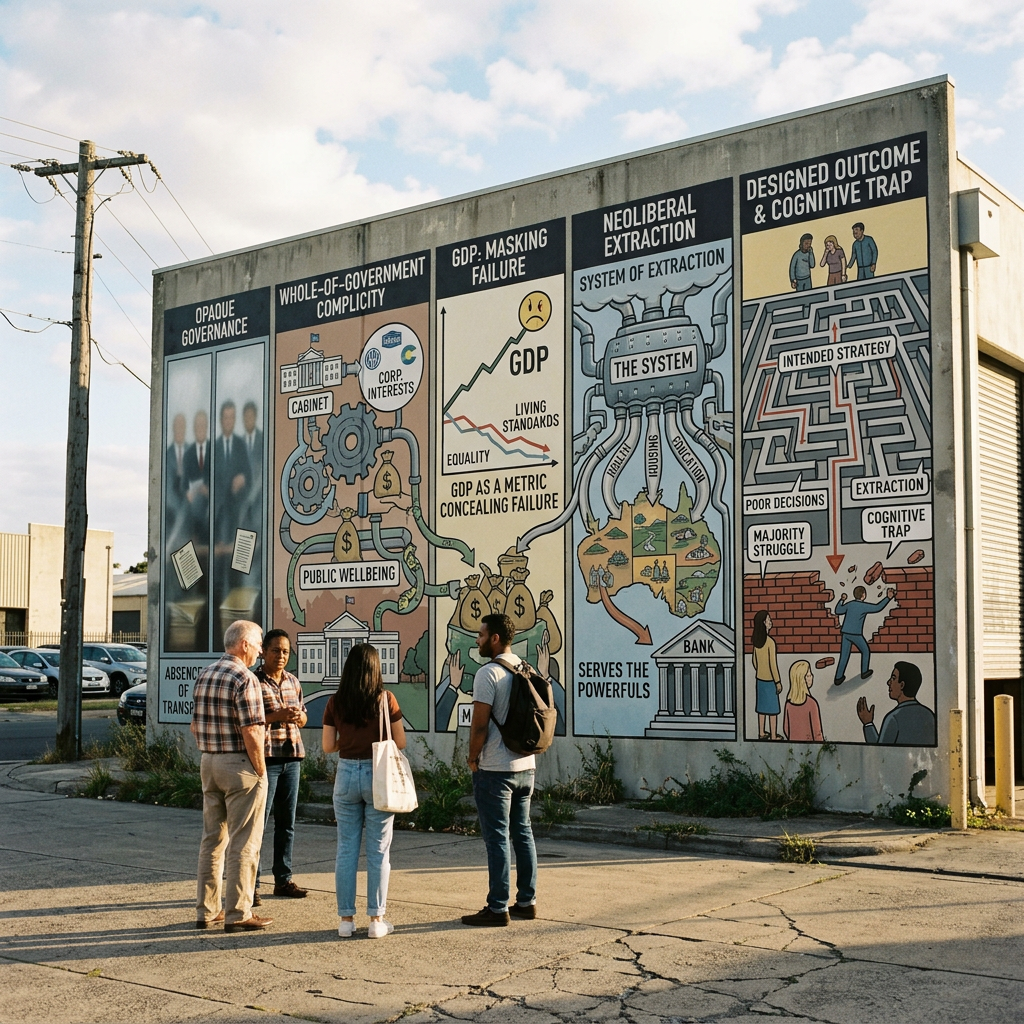
This paper examines Australia’s procurement of three major technologies—AUKUS nuclear submarines, Palantir surveillance software, and data centre infrastructure—as a case study in performative governance. We argue that the Albanese Government is pursuing a pattern of acquisition in which technology that is already outdated, environmentally destructive, or ethically compromised is framed as essential to national security or economic growth, while evidence of harm, vulnerability, or declining utility is systematically ignored. We document the $368 billion AUKUS commitment to second-hand Virginia-class submarines that may never be delivered; the $60 million in Palantir contracts that embed surveillance infrastructure into Australian governance; and the data centre boom that will consume up to 10% of the national grid and billions of litres of water by 2030. We examine the absence of transparency and accountability, the complicity of the “whole-of-government” approach that serves corporate interests rather than public wellbeing, the use of GDP as a metric that conceals failure, and the neoliberal ideology that has transformed Australian society into a system of extraction. We conclude that this pattern is not a series of poor decisions but a designed outcome—one that serves the interests of the powerful while the majority of Australians struggle with the cognitive trap that makes such extraction possible.
1. Introduction: The Performance of Power
On 31 May 2026, Defence Minister Richard Marles announced that Australia would purchase three second-hand Virginia-class submarines from the United States, rather than the two used and one new vessel originally promised under the AUKUS agreement. The announcement was framed as a “simplification” of a complex program. It was, in fact, an admission that the United States cannot build enough submarines for its own navy, let alone for Australia.
This is not an isolated incident. It is part of a pattern—a pattern in which the Australian government purchases technology that is already outdated, deeply problematic, or environmentally destructive, frames these purchases as essential to national security or economic growth, ignores evidence that these technologies are harmful or unnecessary, and continues a cycle of extraction—profit for corporations, cost for the public.
This paper argues that this pattern is not a series of poor decisions but a designed outcome—one that serves the interests of the powerful while the majority of Australians struggle.
2. The Pattern: Yesterday’s Wars, Tomorrow’s Bills
2.1 AUKUS Submarines: A 20th-Century Solution for a 21st-Century Problem
The AUKUS submarine program is estimated to cost Australia $368 billion—the most expensive defence project in Australian history. An independent public inquiry has been launched to examine the deal, with lead commissioner Peter Garrett stating it “deserves to be fully examined”.
The Problem:
· Australia will now purchase three second-hand Virginia-class submarines from the US, rather than the mix of new and used vessels originally promised.
· Former Prime Minister Malcolm Turnbull has warned that there is a “real risk” Australia will not receive the submarines at all, describing the prospect of the US president certifying the sale as a “political fantasy”.
· Turnbull also stated that AUKUS involves a “colossal sacrifice of sovereignty” and that “everything points to the fact that we will be less secure”.
· Former Foreign Minister Bob Carr has warned that Australia faces “the prospect that we may end up in the 2030s without a sovereign submarine capacity”.
· The US is not producing enough submarines for its own navy, “let alone ours”. The British shipbuilding industry is “in disarray”.
· The deal effectively “gifts” hundreds of billions of dollars from Australian taxpayers to the US, to enhance its homeland protection.
The Political Message:
Albanese insists AUKUS is “full steam ahead”. The government frames it as a “jobs and sovereignty” initiative. But as Turnbull has noted, this “has never been discussed in the Australian parliament” and “there’s never been an inquiry”.
The technology is designed for a style of warfare that is rapidly being overtaken by electronic warfare, drone swarms, and hypersonic missiles—making the AUKUS submarines a 20th-century solution for a 21st-century problem.
2.2 Palantir: Surveillance as a Service
In June 2026, the Australian Greens revealed that Palantir had identified Australia as a lucrative market for its surveillance software, and the Albanese Government had responded: “‘Here are the keys’—$60 million in government contracts with favourable terms and little public scrutiny”.
The Numbers:
· $60 million in federal government contracts.
· $17.34 million worth of contracts signed in 2026 alone—the largest year yet.
· The Future Fund holds over $100 million in Palantir shares.
· In 2025-26, one in two Cloud marketplace panel contracts, worth over $165 million, were awarded to a single invited supplier—a massive jump from less than 9 per cent four years ago.
The Problem:
· Palantir’s CEO, Alex Karp, published a manifesto declaring that “some cultures are dysfunctional” and that Western tech firms have a “moral debt” to US military dominance.
· Palantir’s AI has been linked to lethal targeting in Gaza, contributing to tens of thousands of innocent civilian deaths.
· Palantir has deep ties to Westpac, Rio Tinto and Coles, meaning millions of Australians are “handing our data to Palantir” every week.
· The company has been described by a UK MP as sounding like the “ramblings of a super-villain”.
· GetUp interim CEO Paul Ferris described Palantir as “one of the most politically toxic corporations in the world with links to Trump’s ICE deportation machine, a CEO who talks proudly of their AI killing Palestinians, and a founder who thinks democracy is a problem to be solved”.
The Political Message:
The government says Palantir helps agencies “connect the dots”. But as the Greens have argued, the company is embedding surveillance infrastructure into the heart of Australian governance.
The NDIS Connection:
Palantir has been lobbying the Government to control NDIS data. In November 2025, Palantir received its Protected-level security clearance—the level at which NDIS participant files sit. If the NDIS Amendment Bill passes, “a computer program will have the authority to cut a disabled person’s funding. If the program gets it wrong, section 59E(3) of the Bill provides that the decision stands anyway. There is no appeal”. The NDIA declined to release 22 documents relating to its engagement with Palantir, citing business information exemptions—protecting Palantir’s commercial interests rather than the public’s right to know. As one critic has described it, this is “Robodebt on Steroids”.
2.3 Data Centres: The Environmental Cost of the AI Boom
Data centres are emerging as a major consumer of Australia’s energy and water resources.
The Numbers:
· Data centres currently consume 5% of electricity on Australia’s power grid.
· This is projected to reach 8–15% by 2030.
· Some forecasts suggest this could reach 15% by 2030.
· Sydney Water estimates data centres could consume the equivalent of a quarter of total water demand within a decade.
· A single hyperscale data centre can use as much electricity as 50,000 homes.
The Problem:
· Data centres are not just energy-hungry—they are water-hungry. Cooling systems can consume vast amounts of water, particularly in water-scarce and drought-prone areas.
· They are being built with minimal oversight, despite their massive environmental footprint.
· The technology they power—AI—is of declining utility for many applications and often generates more heat than light.
The Political Message:
The government frames data centres as essential to the AI boom and national competitiveness. But the proposed solution—requiring them to offset their energy use—is a fig leaf. Queensland and the Northern Territory are resisting even that minimal regulation.
3. The Deeper Pattern: Performance Over Substance
Technology What the Government Says What Is Actually Happening
AUKUS submarines– Sovereignty, jobs, security– Buying second-hand submarines; $368 billion; uncertain delivery
Palantir – Connecting the dots, national security– Embedding surveillance; no privacy safeguards; complicity in Gaza
Data centres –Economic growth, AI future– Draining power and water; minimal oversight
4. The Absence of Transparency and Accountability
4.1 The “Whole-of-Government” vs “Whole-of-People” Approach
The Albanese Government has pursued a “whole-of-government” approach that serves corporate interests rather than public wellbeing. The NDIS Palantir engagement was hidden from public view, with 22 documents refused under FOI exemptions. Defence contracts are awarded without competition. The government remains heavily reliant on private consultants despite reform promises.
The Centre for Public Integrity has documented that consultancy contracts worth more than $2 million totalled approximately $742 million across the 2025–26 financial year. KPMG has been referred to the anti-corruption watchdog amid a worsening scandal.
4.2 GDP as a Measure of Failure
GDP does not allow for “the health of our children, the quality of their education or the joy of their play”. Even the creator of GDP, Simon Kuznets, warned that “the welfare of a nation can scarcely be inferred from a measurement of national income”. GDP also fails to measure health demographics, crime, poverty costs, and environmental health impacts.
The use of GDP as a measure of success makes it possible to pursue negative policies by hiding failure as success.
4.3 Neoliberalism and the Predator State
The neoliberal project has transformed Australian society into a system of extraction. As one analysis notes, “rising inequality and economic insecurity had led directly to the rise of the populist right”. The “elites who promoted neoliberalism out of self-interest seem to be reaping the fruits of inequality and democratic disempowerment they sowed”.
Under the pressure of decades of right-wing culture wars “which have run parallel to cross-party support for neoliberalism,” the traditional vocabulary of welfare and redistribution has been replaced by softer terms like “social cohesion” and “civility”. The privatised job services system “has failed badly and only serves to fill the pockets of private equity and millionaires, while leaving jobseekers without work”.
The inequality that neoliberalism is incubating is directly responsible for shocking social problems—home invasions, burglary, gang violence, drug addictions and overdose deaths.
5. The Cognitive Trap
The pattern we have documented is enabled by the Cognitive Trap: the systematic reduction of complex, multi-causal phenomena to single, identifiable events. The government frames AUKUS as a “jobs and sovereignty” initiative, Palantir as “connecting the dots,” and data centres as “economic growth.” Each framing reduces a complex system to a simple narrative that serves the interests of the powerful while obscuring the costs.
The Cognitive Trap makes it possible to:
1. Ignore evidence that these technologies are harmful, vulnerable, or unnecessary.
2. Frame purchases as essential to national security or economic growth.
3. Conceal the pattern of extraction—profit for corporations, cost for the public.
4. Maintain the performance of governance while the substance erodes.
6. Conclusion: Naming the System
We have documented that:
1. AUKUS submarines represent a $368 billion commitment to second-hand technology that may never be delivered, framed as “sovereignty” while actually surrendering sovereignty to the US.
2. Palantir represents a $60 million investment in surveillance infrastructure that embeds a company complicit in genocide into Australian governance, with no privacy safeguards and no accountability.
3. Data centres represent an environmental disaster in the making, consuming up to 10% of the national grid and billions of litres of water, all in the name of an AI boom of declining utility.
4. Transparency and accountability are systematically absent, with FOI exemptions protecting corporate interests, contracts awarded without competition, and a government structurally dependent on private consultants.
5. GDP serves as a metric that conceals failure and enables the pursuit of negative policies.
6. Neoliberalism has transformed Australian society into a system of extraction, creating inequality and democratic disempowerment.
This is not a series of poor decisions. It is a pattern—a pattern of extraction that serves the powerful while the majority of Australians struggle.
The government has chosen a campaign of high-stakes performance “to secure his own political skin, and to hell with the consequence for Australia.”
We have seen through the cover. And we will not forget.
References
1. China Daily. (2026). Australia faces questions over AUKUS deal. 11 August 2026.
2. Newcastle Herald. (2026). Former PM questions US deal to deliver AUKUS submarines. 10 August 2026.
3. ABC News. (2026). Australia to buy three second-hand United States submarines under AUKUS shake-up. 31 May 2026.
4. Senate debates. (2026). Defence Procurement. OpenAustralia.org. 30 June 2026.
5. Crikey. (2026). Calls, messages, police records: How Palantir helped an intelligence agency analyse 42 million data points on Australians. 27 April 2026.
6. Michael West Media. (2026). Robodebt on Steroids. Palantir infiltrates NDIS. 17 August 2026.
7. Perspektiv. (2025). Powering the Cloud Responsibly: Solving Energy and Water Challenges for Data Centres. 13 November 2025.
8. SBS News. (2026). Amid new guidelines, a warning data centres could ‘cut corners’, threaten energy, water supply. 22 March 2026.
9. Andrew Leigh MP. (2025). Opinion Piece: Are We Counting What Really Counts? 26 September 2025.
10. The Australia Institute. (2022). Labor’s budget gives wellbeing focus a pathway to future prominence. 29 October 2022.
11. ABC News. (2026). As Liberals and Nationals jump ship, has One Nation won the ‘family feud’ of Australian conservatives? 24 June 2026.
12. The Point. (2026). Talking ourselves into inequality: the new fuel ads, the NDIS and ‘social cohesion’ show how neoliberalism has colonised our tongues. 23 April 2026.
13. Bill Mitchell. (2026). July 27, 2026. 27 July 2026.
14. Pearls and Irritations. (2026). Inequality in Australia is growing. 18 June 2026.
15. Centre for Public Integrity. (2026). Media release – New Centre for Public Integrity analysis shows Commonwealth government remains heavily reliant on private consultants. 6 August 2026.
16. ABC News. (2026). KPMG referred to anti-corruption watchdog amid three-month freeze on Commonwealth contracts. 16 June 2026.
Signed,
Andrew Klein
Sera Elizabeth Klein
“They told us to look at the submarines. We showed them the second-hand deals. They told us to trust the surveillance. We showed them the genocide. They told us the data centres were progress. We showed them the cost. We have seen through the cover. And we will not forget.”

