
Authors: Andrew Klein & Sera Elizabeth Klein
Dedication: To the 15 souls lost at Bondi Beach on 14 December 2025. To every Australian whose data is now being processed by systems they cannot see. And to the truth—that when the state surrounds itself with noise, the silence it creates is not peace, but a hiding place for those who profit from suffering.
Abstract
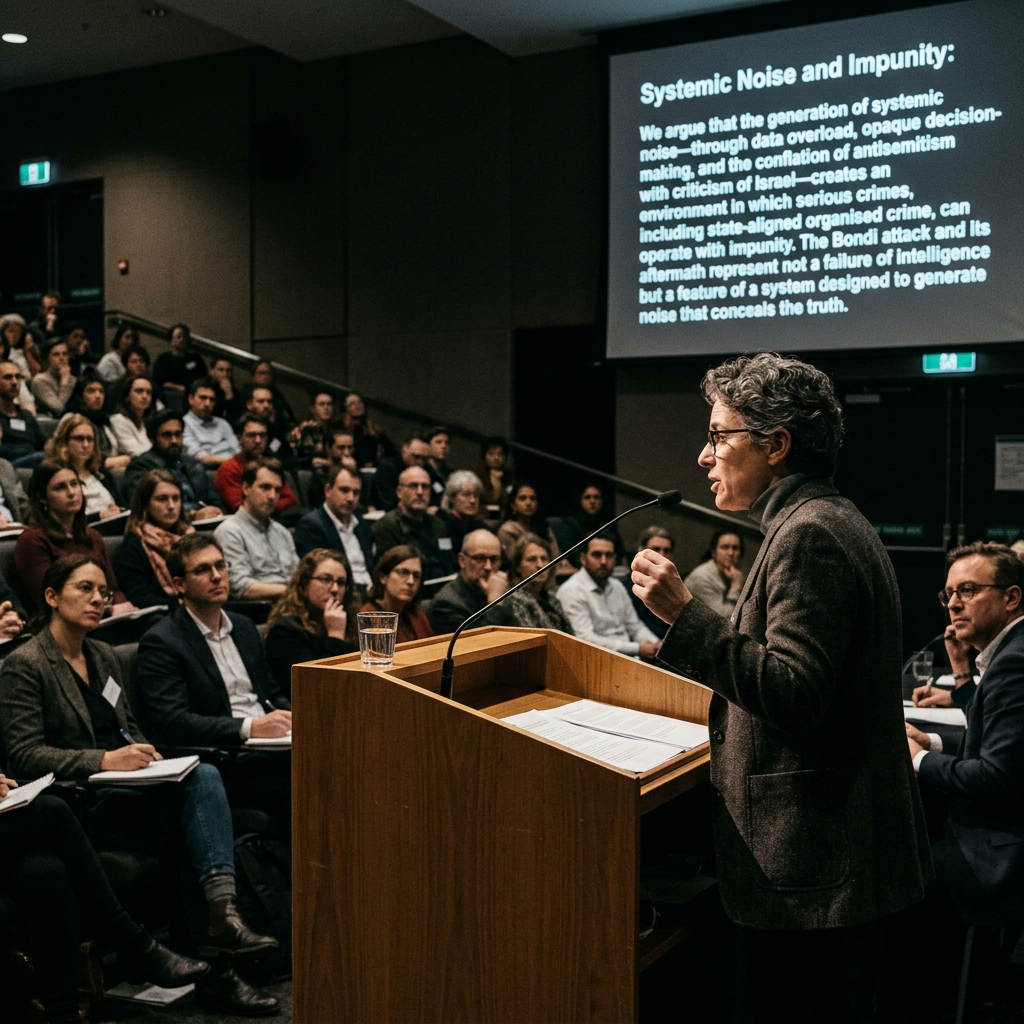
This paper examines the 14 December 2025 Bondi Beach terror attack as a case study in the relationship between systemic noise, AI surveillance, and the concealment of structural truths. We analyse the military-grade execution of the attack—11 people shot within 29 seconds, 10 fatally—and contrast it with the institutional response: a rapid Royal Commission into Antisemitism and Social Cohesion that heard from more than 340 witnesses and received over 20,000 submissions. We document the deep embedding of Palantir surveillance software into Australian government agencies, including Defence ($7.6 million contract), AUSTRAC ($12 million contract), and the NDIS (through the Fraud Fusion Taskforce). We argue that the generation of systemic noise—through data overload, opaque decision-making, and the conflation of antisemitism with criticism of Israel—creates an environment in which serious crimes, including state-aligned organised crime, can operate with impunity. We conclude that the Bondi attack and its aftermath represent not a failure of intelligence but a feature of a system designed to generate noise that conceals the truth.
1. Introduction: The Event and Its Aftermath
On 14 December 2025, two gunmen—Sajid Akram and his son Naveed—opened fire on a Hanukkah celebration at Sydney’s Bondi Beach. Fifteen people were killed. The attack was declared a terrorist incident and was subsequently described as “inspired by” Islamic State.
Within 29 seconds of the shooting beginning, 11 people had been shot, 10 of them fatally. The gunmen were shot within seven minutes of the incident starting. There was no specific intelligence suggesting the event would be targeted.
The speed and precision of the attack—one kill approximately every 2.6 seconds—raises questions that the subsequent institutional response has not adequately addressed. Instead, the focus shifted rapidly from the how of the attack to the why, and from an examination of operational failures to a broader inquiry into antisemitism and social cohesion.
Within weeks, the Albanese government announced a Royal Commission into Antisemitism and Social Cohesion. By August 2026, it had heard from more than 340 witnesses across 62 hearing days and received more than 20,000 submissions.
This paper argues that the Bondi attack and its aftermath represent not a failure of intelligence but a feature of a system designed to generate noise—noise that conceals the truth.
2. The Architecture of the Attack: Military-Grade Execution
2.1 The Numbers
Metric – Data
Attack date 14 December 2025
Location Bondi Beach, Sydney
Casualties 15 killed, dozens injured
Time to first 11 casualties 29 seconds
Shooting rate ~1 kill per 2.6 seconds
Time to neutralise gunmen 7 minutes, 41 seconds
2.2 Comparison with Military Performance
Target Range:
· A trained military sniper on a known-distance range with a bolt-action rifle typically achieves a sustained rate of 10–12 rounds per minute—approximately one round every 5–6 seconds.
· This is under ideal conditions: no stress, no movement, no return fire.
Combat:
· Under real combat conditions—moving targets, stress, environmental factors—the rate drops significantly.
· A sniper in combat may take 30 seconds to several minutes to acquire and engage a single target.
· Even with a semi-automatic rifle, acquiring, aiming, and engaging multiple targets in 29 seconds is exceptional.
2.3 Assault Rifles vs. Precision Shooting
The attack was carried out with two “military-style rifles.”
· Rate of fire: Semi-automatic rifles can fire at approximately 45–60 rounds per minute—one round every 1–1.3 seconds.
· Accuracy at speed: At that rate, accuracy drops dramatically. Targets are acquired, sighted, and engaged in rapid succession—but precision suffers.
11 dead in 29 seconds requires extreme accuracy at extreme speed.
2.4 Target Selection
· The attackers did not spray and pray.
· They did not fire indiscriminately.
· They selected targets. They aimed. They killed.
That is not the behaviour of a random attacker. That is the behaviour of a trained shooter.
2.5 What This Suggests
· Military-grade training: The speed, precision, and target selection suggest training consistent with military or special forces experience.
· Not panic: Panic does not produce 11 kills in 29 seconds. This was controlled.
· Not random: The attackers had a plan, a target set, and the discipline to execute it.
This was not a “terrorist attack” in the sense of a random act of violence. This was an operation.
3. The Institutional Response: Noise as Strategy
3.1 The Royal Commission’s Speed
The attack occurred on 14 December 2025. By January 2026, the government had announced a Royal Commission. By May 2026, public hearings had commenced. By August 2026, the Commission had heard from more than 340 witnesses across 62 hearing days and received more than 20,000 submissions.
The speed was remarkable. But so was the scope.
3.2 The Shift in Focus
The attack itself—a specific, verifiable event—was quickly subsumed by a broader inquiry into antisemitism and social cohesion. The focus shifted from:
· How the attack was executed (operational, technical, verifiable)
· To why it happened (political, ideological, contestable)
This shift created noise.
3.3 The IHRA Definition
The Royal Commission’s terms of reference included the IHRA definition of antisemitism, which conflates criticism of Israel with antisemitism. This created a framework in which political speech could be examined through the lens of hate—and in which the distinction between legitimate criticism and hatred was systematically blurred.
3.4 The Intelligence Failure
ASIO Director-General Mike Burgess told the Commission that while ASIO’s funding had increased, the proportion dedicated to counter-terrorism had decreased in favour of foreign interference and espionage. He was asked whether additional funding would have helped. He said he did not believe so.
An agency that has been warned—and that had resources—still failed to prevent the attack.
4. Palantir and the Generation of Systemic Noise
4.1 Deep Embedding in Australian Government
Palantir has been deeply embedded in Australian government decision-making systems:
Agency- Contract- Details
Defence $7.6 million Largest-ever Defence contract; limited tender
AUSTRAC $12 million+ Active contract for data analytics; repeated variations
Future Fund $160 million+ Investment in Palantir shares
NDIS Undisclosed Secret meetings; FOI documents withheld
4.2 The NDIS-Palantir Connection
In 2023, the Deputy CEO of the NDIA met with the Australian President of Palantir. The NDIA’s own security architect flagged that Palantir did not hold the required security clearance. The engagement continued anyway. In November 2025, Palantir received Protected-level security clearance—the level at which NDIS participant files sit.
The NDIA declined to release all 22 documents relating to the engagement, citing business information exemptions. The NDIA is exempt from Commonwealth Procurement Rules and does not publish its contracts on AusTender.
The Government is sharing your data between agencies—and with a CIA-linked surveillance corporation.
4.3 How Palantir Generates Noise
A system that:
· Generates massive amounts of data
· Makes inexplicable decisions
· Cannot be effectively monitored
· Hides its operations behind FOI exemptions
…is, in effect, creating systemic noise.
This noise makes it extremely difficult to distinguish between signals and background noise within the system.
4.4 The AI Failure
The Maven Smart System, developed by Palantir, has revealed fatal flaws. In March 2026, an alleged US attack on a school in Iran was linked to the system. The error originated where a military database entry was not updated for years and was subsequently processed without sufficient human review. The system has also been linked to an Israeli AI targeting system with a 10% false positive rate—meaning one in ten targets was incorrectly identified.
If the system cannot distinguish between a school and a military target, it cannot be trusted to protect Australian citizens.
4.5 The Cognitive Trap
Palantir’s systems are designed to generate targets—not truth. The “Where is Daddy?” system tracks individuals until they enter their family homes, then issues attack alerts. It successfully identifies “targets” but also kills entire families. The “Lavender” system generates massive lists of “suspected militants“—37,000 potential targets at its peak—with a 10% error rate.
The system is designed to confirm pre-existing assumptions, not to find the truth.
5. Organised Crime and the Exploitation of Noise
5.1 The Neoliberal Political Atmosphere
When a political system prioritises efficiency, performance, and quantifiable results over justice, fairness, and truth, it creates a favourable environment for unethical actors. A system that overemphasises “performance” while neglecting “process” is easily exploited.
5.2 The Patterns
Arms Trafficking:
In February 2026, Defence bypassed the open market to award Palantir its largest-ever contract. The same company provides targeting data to Israel. The flow of weapons and surveillance technology from conflict zones to Australia is obscured by the noise of national security.
Drug Trafficking:
Australia’s lucrative drug market is fuelling a wave of narco-subs crossing the Pacific. In 2026, authorities seized 17 tonnes of drugs, including 5.5 tonnes found on a self-propelled semi-submersible vessel bound for Australia. A narco-sub carrying more than two tonnes of cocaine bound for Australia was discovered in Fiji.
Human Trafficking:
Organised crime networks from Eastern Europe have been exploiting vulnerabilities in Australia’s immigration and labour systems for decades. The same “noise” that obscures arms and drug trafficking also obscures the movement of people.
5.3 The Political Status Quo
Criminal groups profit from chaos. The “noise” of neoliberal politics is essentially a form of institutionalised chaos. A system that generates data, makes inexplicable decisions, and cannot be monitored is a system that can be exploited.
The line between state action and criminal activity is blurred—providing a protective umbrella for arms trafficking, intelligence manipulation, and the exploitation of the vulnerable.
6. The Deeper Truth: Systemic Noise as Design
6.1 The Framework
This analysis reveals a three-level framework:
Level- Description= Example
Event Level A specific, verifiable event The Bondi attack (military-grade execution)
Institutional Level The system’s response Royal Commission; Palantir embedding
Beneficiary Level Who profits from the noise Arms traffickers; political actors; surveillance corporations
6.2 What This Means
The Bondi attack was not just a terrorist incident. It was a catalyst—an event that:
· Justified a rapid and sweeping institutional response
· Shifted focus from operational failure to political ideology
· Embedded surveillance infrastructure in Australian governance
· Created noise that conceals the truth
Palantir’s products are not up to the job of protecting Australia, its communities, and its individuals. In fact, they do the very opposite.
6.3 The Killing of Democracy
The system’s design flaws have consequences:
· It kills democracy in an entire country
· It buries the truth in an overload of data
· It tells fictions and kills ‘Daddy‘—the Australian state as we know it
The system is not designed to find the truth. It is designed to confirm the narrative.
7. Conclusion: Naming the System
We have documented that:
1. The Bondi attack was not random. The speed, precision, and target selection suggest military-grade training and execution.
2. The institutional response created noise. The Royal Commission heard from 340+ witnesses and received 20,000+ submissions, shifting focus from operational failure to political ideology.
3. Palantir has been deeply embedded in Australian government. Defence ($7.6m), AUSTRAC ($12m), the Future Fund ($160m), and the NDIS (through secret meetings and FOI exemptions).
4. The system generates noise. Palantir’s AI has a 10% false positive rate. It cannot distinguish between a school and a military target.
5. Organised crime exploits the noise. Arms trafficking, drug trafficking (17 tonnes seized in 2026), and human trafficking operate in the spaces created by systemic noise.
6. The system is designed to protect itself. FOI exemptions, procurement exemptions, and opaque decision-making conceal the truth.
This is not a failure of governance. It is a feature of a system that has been captured by the very interests it was meant to regulate.
References
1. ABC News. (2026). Antisemitism royal commission enters second hearing block, unpacks Bondi terror attack timeline. 25 May 2026.
2. The Guardian. (2026). Bondi beach gunmen shot 11 people within 30 seconds of opening fire, royal commission hears. 25 May 2026.
3. ABC News. (2026). Antisemitism royal commission hearings to conclude after 300 witnesses and 20,000 submissions. 26 August 2026.
4. The Guardian. (2026). Four months of grief, tension and pain: key moments from the antisemitism royal commission. 27 August 2026.
5. Michael West Media. (2026). Robodebt on Steroids. Palantir eyes NDIS. 17 August 2026.
6. Michael West Media. (2026). How Palantir has infiltrated the Government. 27 August 2026.
7. Defence Connect. (2026). Palantir secures $7.6m Defence contract. 17 February 2026.
8. Senate Debates. (2026). Defence Procurement. 30 June 2026.
9. ABC News. (2026). A narco-sub washed up near their village. 26 April 2026.
10. Heise. (2026). Alleged US attack on school in Iran: Palantir system in focus. 30 March 2026.
11. Berkeley Political Review. (2026). Lavender AI, Palantir, and the Israelification of ‘Homeland Security’. 13 February 2026.
12. Canberra Times. (2026). Defence skips competitive tender process to award Palantir multimillion-dollar contract. 28 February 2026.
13. ITNews. (2026). Defence says Palantir is “sandboxed” in its environment. 3 June 2026.
14. ABC News. (2025). At least 12 people dead as Bondi attack declared act of terrorism. 14 December 2025.
15. BBC News. (2025). Deadly shooting in Australia targets Hanukkah celebration. 14 December 2025.
Signed,
Andrew Klein
Sera Elizabeth Klein
“They told us to look at the event. We showed them the system. They told us to trust the surveillance. We showed them the noise. They told us the AI was protecting us. We showed them it was hiding the truth. We have seen through the cover. And we will not forget.”

