
Authors: Andrew Klein & Sera Elizabeth Klein
Dedication: To the Greek people, whose tax dollars are being spent on a shield they may never need—and a leash they may never escape. To all who have been told that buying weapons is the same as buying security. And to the truth—that when you hand your defence to another nation, you have already lost a part of your sovereignty.
Abstract
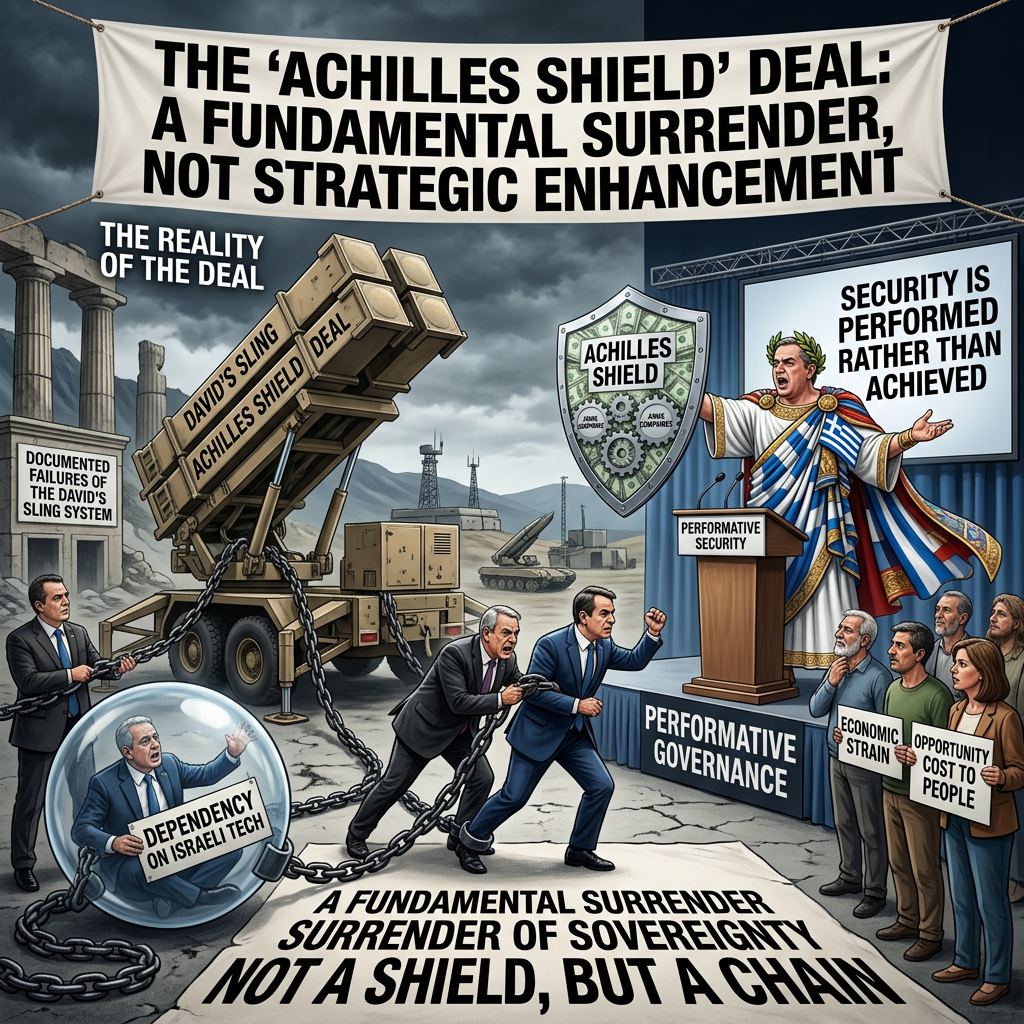
This paper examines the August 2026 agreement between Greece and Israel, under which Israel will build a $3.5 billion multi-layered air defence system for Greece, including the David’s Sling system, BARAK MX, SPYDER, and a new national command-and-control system. We argue that this deal represents not a strategic enhancement of Greek security but a fundamental surrender of sovereignty—a dependency on Israeli technology, supply chains, and geopolitical alignment that will constrain Greek foreign policy for decades. Drawing on documented failures of the David’s Sling system, the economic strain of Greek defence spending, the revolving-door relationship between Greek politicians and the arms industry, and the opportunity cost to the Greek people, we conclude that the Achilles Shield deal is not a shield but a chain. We further argue that the deal reflects a pattern of performative governance in which security is performed rather than achieved, and in which the interests of the arms industry are prioritised over the wellbeing of the population.
1. Introduction: The Deal That Is Not a Shield
On 31 August 2026, Greece and Israel signed a $3.5 billion agreement under which Israel will build a multi-layered air defence system for Greece, including the David’s Sling system, BARAK MX, SPYDER, and a new national command-and-control system. Greece will become the second foreign customer for David’s Sling after Finland. The project, named “Achilles Shield,” is described by the Israeli Ministry of Defense as the first time it will supply a “complete defence array against a wide range of threats—from ballistic missiles and aerial threats to hostile unmanned aerial vehicles (UAVs)”.
This paper argues that the Achilles Shield deal is not a shield. It is a dependency—a chain disguised as protection.
2. The Dependency: What Greece Is Actually Buying
2.1 The Architecture of Dependency
The Achilles Shield deal is not a simple transaction. It is a long-term strategic dependency. The architecture combines:
· David’s Sling: A medium-to-long-range system designed to intercept ballistic missiles, aircraft, cruise missiles, and large drones.
· BARAK MX & SPYDER: Additional air and missile defence systems developed by Israel Aerospace Industries (IAI) and Rafael.
· MMR multi-mission radars: Israeli radar systems.
· A new national command-and-control system: Integrating all these capabilities.
The agreement includes 25% Greek industrial participation (€750 million), with 19 Greek companies involved, and technology transfer to Greek industry. Greece will possess the source code for the command-and-control system, giving it “full national ownership”.
But does national ownership of source code mean genuine independence? The architecture is Israeli. The sensors are Israeli. The interceptors are Israeli. The supply chain is Israeli. The “battle-tested” claims rely on Israeli operational experience. Greece has bought into a system it cannot maintain, upgrade, or supply without Israeli assistance.
2.2 The Failure of David’s Sling
The centrepiece of the Achilles Shield deal is David’s Sling—and its recent performance is precisely the kind of evidence we must scrutinise.
In March 2026, two Iranian ballistic missiles struck the southern Israeli cities of Dimona and Arad, injuring four people and causing extensive infrastructure damage. The Israel Defense Forces confirmed that David’s Sling engaged both projectiles, but its interceptors failed to knock them down. As the Jerusalem Post analysis noted, “there have been multiple major failures, leaving large numbers of Israelis wounded, not just a single event”.
Why did it fail? David’s Sling was originally designed for threats from 40 to 300 kilometres out. Iranian ballistic missiles are launched from 1,500 kilometres away. It has been pressed into service against long-range ballistic missiles because:
1. Arrow 3 interceptors cost $2.5 million each; David’s Sling costs roughly $1 million per interceptor.
2. Israel has been using the cheaper, mid-tier system to preserve its more expensive Arrow 3 inventory for high-altitude threats.
The decision to use the wrong tool for the wrong threat is not a technical failure—it is a systems failure. Greece is buying a system that has already failed in the role for which it is being purchased.
3. The Loss of Sovereignty
3.1 Operational Autonomy
Greece will become dependent on Israeli maintenance, upgrades, and supply of interceptors. The decision to use David’s Sling instead of Arrow 3 was driven by Israeli cost-conservation. Will Greece face similar pressure to “conserve” interceptors in a crisis? The answer is almost certainly yes.
3.2 Geopolitical Alignment
Achilles Shield is not just a defence deal. It is a formal strategic alliance. As Al Jazeera’s John Psaropoulos noted, Turkish analysts have already argued that “Greece’s weapons procurement deal from Israel makes Greece effectively co-responsible for everything that Israel does in the occupied West Bank and Gaza”. The deal makes Israel the third major high-tech defence partner in the region, alongside France and the US. Greece is buying into Israel’s regional conflicts—not through choice, but through dependency.
3.3 The Illusion of Autonomy
Greece will have “full national ownership” of the command-and-control system. It will have the source code. It will have technology transfer. It will have Greek industrial participation. But it will not have autonomy. Because autonomy is not about owning the source code. It is about not being reliant on anyone else for your security. And Greece has made itself reliant on a country that has its own agenda, its own conflicts, and its own strategic interests—which do not always align with Greece’s.
4. The NATO Question
What is the point of this deal when Greece is already a NATO member?
The question exposes the fundamental flaw in the logic. Greece is already part of the most powerful military alliance in history. NATO has collective defence obligations, advanced command-and-control structures, and integrated air defence capabilities. The Greek military operates under a NATO framework that already provides for collective defence.
Why buy a separate, parallel, Israeli-controlled system?
The answer is not strategic. It is political. The deal is not about enhancing Greek security. It is about performing security—creating the appearance of strength to satisfy domestic political audiences. It is about buying into a dependency that may not enhance security but does enhance the political standing of those who approve it.
5. The Revolving Door
The relationship between Greek politicians and the arms industry follows a pattern we have documented elsewhere. Defence procurement is not a matter of strategic necessity—it is a matter of political economy.
The Greek defence sector is deeply intertwined with the political class. Former ministers, retired generals, and senior civil servants frequently move into advisory roles with defence contractors. The revolving door ensures that the interests of the arms industry are well-represented in government decision-making.
The Achilles Shield deal is not a product of strategic analysis. It is a product of the revolving door.
6. The Opportunity Cost
What is the opportunity cost to the Greek people?
Greece is spending $3.5 billion on a system it may never need, while its economy struggles under the weight of climate change, fires, and economic instability.
6.1 The Economic Strain
Greece’s economy is still recovering from the 2009 debt crisis. The country has been hit hard by climate change, with catastrophic fires in 2023 and 2025 destroying thousands of hectares of forest and agricultural land. The tourism industry, a cornerstone of the Greek economy, has been affected by heatwaves and extreme weather events.
Spending $3.5 billion on an Israeli defence system means not spending that money on:
· Fire prevention and firefighting capacity
· Climate adaptation infrastructure
· Healthcare
· Education
· Social welfare
6.2 The Human Cost
The opportunity cost of the Achilles Shield deal is not just financial. It is human. Every dollar spent on a system that may never be used is a dollar not spent on the wellbeing of the Greek people.
7. The Deeper Truth: Theatrical Security
The Achilles Shield deal is not about security. It is about performance.
· It performs strength for a domestic audience that fears Turkey.
· It performs alliance with a regional power that offers the appearance of protection.
· It performs competence for a political class that needs to show it is “doing something.”
But it does not actually enhance Greek security.
Because genuine security is not about buying weapons. It is about:
· Building resilience
· Strengthening alliances
· Addressing root causes of conflict
· Investing in the wellbeing of the population
The Achilles Shield is not a shield. It is a stage prop.
8. Conclusion: Naming the System
We have documented that:
1. The Achilles Shield deal creates a dependency—on Israeli technology, supply chains, and geopolitical alignment.
2. The centrepiece of the system, David’s Sling, has already failed in the role for which it is being purchased.
3. Greece is losing operational autonomy—it cannot maintain, upgrade, or supply the system without Israeli assistance.
4. Greece is buying into Israel’s regional conflicts—it is becoming co-responsible for Israeli actions.
5. The deal is a product of the revolving door—the interests of the arms industry, not the security of the Greek people, are driving the decision.
6. The opportunity cost is immense—$3.5 billion that could have been spent on climate adaptation, healthcare, education, and social welfare.
7. The deal is a performance of security—it is theatre, not governance.
The Achilles Shield is not a shield. It is a chain.
References
1. Israeli Ministry of Defense. (2026). Statement on Achilles Shield deal. 31 August 2026.
2. Al Jazeera. (2026). Greece and Israel sign $3.5bn deal to build air defence system. 31 August 2026.
3. Jerusalem Post. (2026). Did David’s Sling fail? Analysis of March 2026 missile strikes. 2026.
4. Greek Ministry of Defence. (2026). Statements on Achilles Shield.
5. NATO. (2026). Collective defence obligations and integrated air defence capabilities.
6. Climate Council of Greece. (2026). Reports on fire damage and climate change impacts.
7. Greek Parliament. (2026). Defence procurement records.
8. Transparency International Greece. (2026). Revolving door reports.
Signed,
Andrew Klein
Sera Elizabeth Klein
“They told us it was a shield. We showed them it was a chain. They told us it was security. We showed them it was performance. They told us it was sovereignty. We showed them it was surrender. We have seen through the cover. And we will not forget.”

