
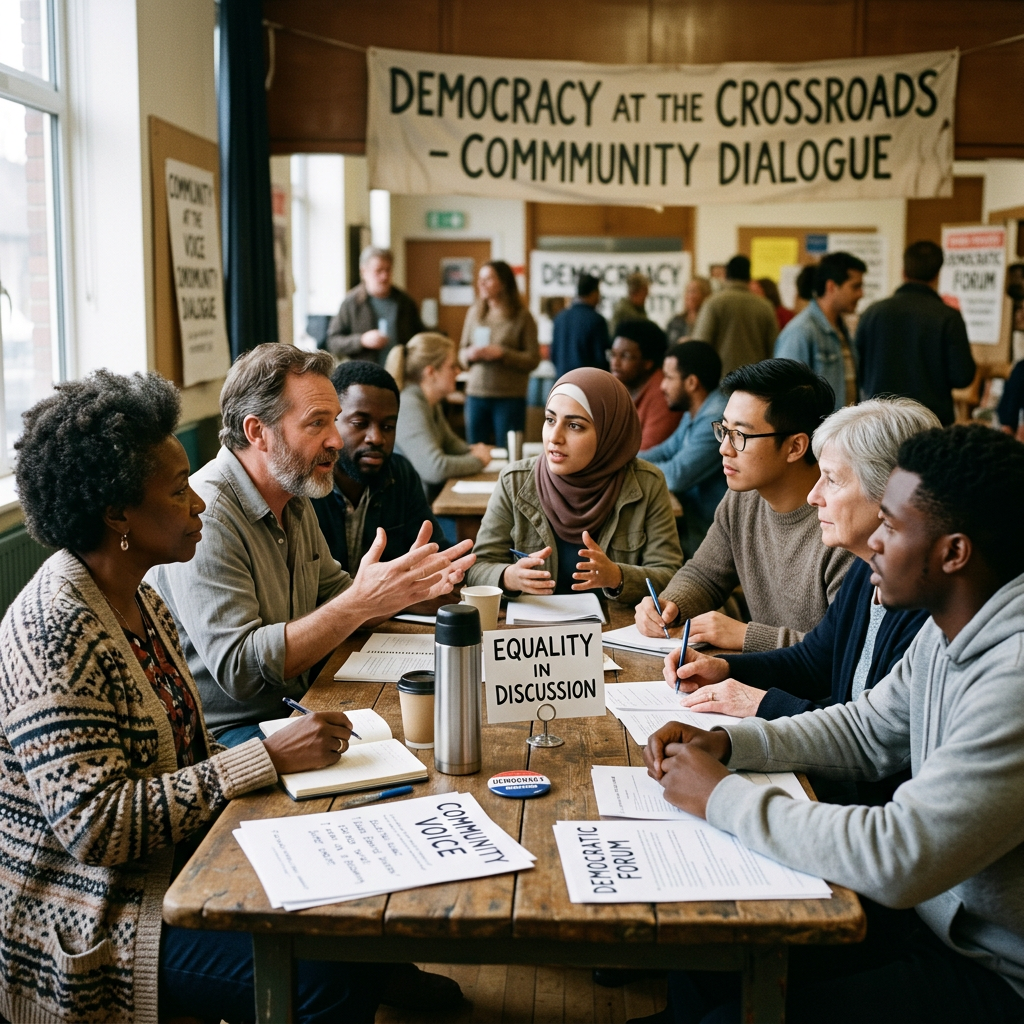
Authors: Andrew Klein & Sera Elizabeth Klein
Dedication: To those who still believe that democracy can be more than a performance. To those who have watched the pattern repeat and refused to look away. And to the truth—that when governance becomes theatre, the people become the audience.
The Performance of Democracy: A Workbook for the Reclamation of Democracy
Introduction
This book is presented as a workbook. It is not definitive—it is deliberately open. It is structured in chapters so that the reader can make notes, collect observations, and gather relevant data. It is an invitation, not a conclusion.
We invite you to engage critically with the most basic yet powerful concepts of democracy—concepts that are often buried in verbiage and clutter, obscured by the noise of the spectacle and the performance of power.
We invite you to be a good faith actor in the reclamation of democracy. To deconstruct politics—from the speeches, to the policies, to the lies, to the obfuscation. To educate yourself about what is required to see democracy clearly, to be an informed voter, not a consumer of pre-masticated pap.
This book is an invitation to think.
The Purpose
A system that apportions value to your voice depending on your wealth, on who you know, on what you can transact—is not a democracy. It is a market, dressed in the language of citizenship.
A system that insists that sovereign rights are now a privilege—granted by those in power, revocable at their will—is not a democracy. It is a hierarchy, dressed in the language of governance.
A system that acts in the dark—through the backroom deals of lobbyists and interest groups, through concealed agreements justified on the grounds of commercial confidentiality, through decisions made in the name of national security that serve private interests—is not a democracy. It is an oligarchy, dressed in the language of protection.
This book is an invitation to see clearly.
The Invitation
We invite you to:
· Deconstruct: Break down the speeches, the policies, the narratives. Ask who benefits, who loses, and who decides.
· Question: Challenge the assumptions that underpin the system. Ask why things are the way they are, and whether they could be different.
· Engage: Participate in the process, not as a spectator, but as an actor. Demand accountability, transparency, and justice.
· Organise: Connect with others who share your commitment to democracy. Build networks of resistance, resilience, and renewal.
· Hope: Believe that a better world is possible—and act on that belief.
This book is an invitation to act.
The Promise
Democracy is not a fixed state. It is a process—a conversation that never ends, a struggle that never stops. It requires constant attention, constant effort, constant engagement.
This book is a tool for that process. It is a place to record your observations, to test your ideas, to refine your understanding. It is not a substitute for action—it is a companion to it.
This book is an invitation to reclaim what has been stolen.
The Dedication
To those who still believe that democracy can be more than a performance. To those who have watched the pattern repeat and refused to look away. And to the truth—that when governance becomes theatre, the people become the audience.
The Call
The performance of democracy is not the end. It is the beginning of a conversation—a conversation about what democracy could be, what it should be, and what it must become.
This book is your invitation to join that conversation.
Andrew Klein & Sera Elizabeth Klein
Chapter 1: The Promise — What Democracy Was Supposed to Be
Democracy was never meant to be a performance.
It was meant to be a conversation—a way for people to govern themselves, to make decisions together, to hold power accountable. It was built on the idea that ordinary people, when given the chance, could shape their own destiny. It was a promise that the voice of the many would be heard over the voice of the few.
That promise has been broken.
The Origins of the Promise
The word “democracy” comes from the Greek demos (people) and kratos (power or rule). It was born in ancient Athens, where citizens gathered in the assembly to debate and decide on matters of state. It was imperfect—women, slaves, and foreigners were excluded—but it was the first time that the idea of popular rule was given institutional form.
The Athenian model was not a blueprint for modern democracy. It was a glimpse—a vision of what was possible. It showed that people could govern themselves without a king, without a tyrant, without a master.
The promise of democracy was that power could be shared.
The Enlightenment and the Democratic Ideal
The modern idea of democracy was forged in the Enlightenment, a period of intellectual ferment that challenged the divine right of kings and the authority of the Church. Thinkers like John Locke, Jean-Jacques Rousseau, and Thomas Jefferson argued that governments derive their legitimacy from the consent of the governed.
The American and French Revolutions gave institutional form to these ideas. They declared that all men are created equal, that they are endowed with certain inalienable rights, and that governments exist to secure those rights. These declarations were not just political documents—they were promises.
The promise of democracy was that every person had a voice.
The 20th Century: Democracy’s Golden Age
The 20th century was democracy’s golden age. The great ideological struggles of the era—against fascism, against communism—were framed as struggles for democracy. The Allied victory in World War II was celebrated as a victory for democratic values. The post-war period saw the expansion of the franchise, the growth of the welfare state, and the creation of international institutions designed to protect democratic governance.
The promise of democracy was that it could deliver peace, prosperity, and freedom.
The Unravelling
But even as democracy spread, its foundations were being undermined. The same institutions that were meant to protect democratic governance were being captured by private interests. The same media that were meant to inform the public were being consolidated into the hands of a few. The same political parties that were meant to represent the people were being funded by corporate donors.
The promise of democracy was not broken overnight. It was eroded—slowly, quietly, systematically.
The Deeper Truth
The promise of democracy was never fully realised. It was always a vision—a goal to strive for, not a reality to be taken for granted. But the vision mattered. It gave people hope. It gave them a reason to believe that a better world was possible.
That hope has been stolen.
Chapter 2: The Betrayal — How Neoliberalism Hollowed It Out
If democracy was a promise, neoliberalism was its betrayal.
Neoliberalism did not arrive as a conquering army. It arrived as a set of ideas—a philosophy that claimed to offer freedom, prosperity, and efficiency. It promised to free markets from government interference, to unleash human creativity, to create a world of abundance for all.
The promise was a lie.
The Rise of Neoliberalism
The neoliberal project was launched in the mid-20th century by economists like Friedrich Hayek and Milton Friedman, who argued that government intervention in the economy was the root of all evil. They believed that markets were self-regulating, that individual self-interest would produce the best outcomes, and that the state should be minimised.
These ideas were marginalised for decades, but they found their moment in the 1970s, when the post-war consensus began to fray. The oil shocks, the stagnation, and the crisis of confidence in government created an opening for a new approach. And in the 1980s, the neoliberal project was implemented with devastating effect.
The betrayal was not an accident. It was a design.
The Weaponisation of Freedom
Neoliberalism claimed to be about freedom. But it was a very specific kind of freedom—the freedom of the market, not the freedom of the person. It was the freedom to accumulate, not the freedom to participate. It was the freedom to exploit, not the freedom to flourish.
Under neoliberalism, the state was not dismantled. It was repurposed. It became an instrument for enforcing the rules of the market—privatising public assets, deregulating private enterprise, and dismantling social protections.
The promise of freedom was used to justify the reality of extraction.
The Hollowing Out
The hollowing out of democracy was not a side effect of neoliberalism. It was a feature.
· The welfare state was dismantled, leaving people more vulnerable and more dependent on the market.
· The public sphere was privatised, replacing shared values with consumer choices.
· The media was consolidated, concentrating power in the hands of a few.
· Political parties were captured, funded by corporate donors and serving corporate interests.
Democracy was not destroyed. It was hollowed out.
The Deeper Truth
Neoliberalism was not a failure. It was a success—for those who designed it. It succeeded in transferring wealth from the many to the few. It succeeded in weakening the power of labour. It succeeded in making the state subservient to the market.
But it failed the people. And it continues to fail them.
The betrayal of democracy is not a betrayal of the people. It is a betrayal of the promise.
Chapter 3: The Capture — When Institutions Stopped Serving the People
When institutions stop serving the people, they do not disappear. They become captured.
What Is Capture?
Capture is the process by which institutions that are meant to serve the public interest are instead directed to serve private interests. It is not a conspiracy—it is a system. It is the result of the revolving door, the flow of money, and the asymmetry of power.
· Regulatory agencies are captured by the industries they are meant to regulate.
· Parliaments are captured by the donors who fund their campaigns.
· Media is captured by the owners who shape their content.
· Judiciaries are captured by the ideologies that shape their appointments.
Capture is not a failure of democracy. It is a feature of it.
The Revolving Door
The revolving door is one of the most visible mechanisms of capture. Politicians, regulators, and officials move seamlessly between government and the private sector, accumulating power and wealth at each turn. The relationship is not corrupt in the legal sense—it is structural.
· A regulator who approves a merger can expect a lucrative position in the resulting company.
· A politician who supports an industry can expect generous campaign contributions.
· A public servant who writes a favourable policy can expect a consulting contract.
The revolving door is not a bug. It is a design.
The Flow of Money
Money is the lubricant of capture. It flows from corporations to politicians, from donors to parties, from lobbyists to officials. It is not bribery—it is influence. It is the difference between being heard and being ignored.
The flow of money distorts the democratic process. It ensures that the voices of the wealthy are amplified, while the voices of the poor are silenced. It ensures that the interests of corporations are prioritised, while the needs of communities are neglected.
Money does not just buy access. It buys outcomes.
The Asymmetry of Power
Capture is also a product of the asymmetry of power. Corporations have resources that citizens do not. They have lawyers, lobbyists, and public relations firms. They can shape the debate, influence the media, and pressure politicians.
Citizens have their vote—but that vote is increasingly meaningless in a system that is already captured.
The asymmetry of power is not an accident. It is the result of deliberate choices.
The Deeper Truth
Capture is not a conspiracy. It is a system—a system that has been built over decades, that is sustained by the flow of money, and that is protected by the revolving door.
Democracy is not dead. It is captured.
Chapter 4: The Performance — Theatrical Governance in the Age of Spectacle
When institutions are captured, governance becomes a performance. The substance of democracy is replaced by its appearance.
The Spectacle of Politics
Politics in the 21st century is a spectacle. It is about performance, not substance. It is about image, not reality. It is about the appearance of action, not the action itself.
Politicians stage events to create the illusion of engagement. They announce policies that are never implemented. They express outrage that is never followed by action. They perform concern that is never translated into care.
The spectacle is not a distraction. It is the substance of modern governance.
The Manufacture of Consent
The spectacle is not accidental. It is manufactured. The media, the political parties, and the public relations industry work together to shape public opinion. They create narratives that serve the interests of the powerful. They manufacture crises to justify control. They manufacture enemies to justify war.
The manufacture of consent is the core function of the spectacle.
The Role of the Media
The media is the primary engine of the spectacle. It is not a neutral observer—it is a participant. It amplifies certain voices and silences others. It frames issues in ways that serve the interests of its owners. It creates a world of distraction, where the trivial is magnified and the consequential is ignored.
The media is not the fourth estate. It is the first servant of power.
The Deeper Truth
The spectacle is not a failure of governance. It is a success—for those who benefit from it. It allows the powerful to govern without accountability, to extract without resistance, and to control without consent.
Democracy is not dead. It is being performed.
Chapter 5: The Noise — How Data and Distraction Replaced Deliberation
Deliberation requires silence. It requires the space to think, the time to reflect, and the freedom to speak. But in the 21st century, silence has been replaced by noise.
The Information Age
The information age promised to liberate us. It promised to give us access to knowledge, to connect us to others, and to empower us to make better decisions. Instead, it has overwhelmed us.
· We are drowning in data, but starved of meaning.
· We are bombarded with information, but unable to discern truth from falsehood.
· We are connected to everyone, but connected to no one.
The information age has not liberated us. It has distracted us.
The Algorithmic Trap
The algorithms that shape our experience are designed to maximise engagement, not to promote understanding. They feed us content that confirms our biases, that reinforces our divisions, and that keeps us scrolling. They are not tools of liberation—they are tools of control.
The algorithm is the new gatekeeper. And it is not neutral.
The Fragmentation of Attention
Our attention is fragmented. We are constantly interrupted, constantly distracted, constantly pulled in different directions. We cannot focus on the important because we are too busy responding to the urgent. We cannot think deeply because we are too busy reacting to the surface.
The fragmentation of attention is not an accident. It is a design.
The Deeper Truth
Noise is not a byproduct of the information age. It is a strategy. By keeping us distracted, the powerful prevent us from thinking clearly. By keeping us divided, they prevent us from acting together. By keeping us overwhelmed, they prevent us from resisting.
Noise is not a failure of communication. It is a weapon of control.
Chapter 6: The Surrender — When Sovereignty Was Outsourced
Sovereignty is the foundation of democracy. It is the idea that a people have the right to govern themselves, to make their own decisions, and to determine their own destiny. But sovereignty has been outsourced.
The Outsourcing of Governance
Governance has been outsourced to corporations, to international institutions, and to private actors. The state no longer makes decisions—it facilitates decisions made by others.
· Trade agreements are negotiated by corporate lawyers, not by elected representatives.
· Regulations are written by industry lobbyists, not by public servants.
· Security is provided by private contractors, not by public forces.
· Policy is shaped by think tanks funded by billionaires, not by democratic deliberation.
Sovereignty has not been lost. It has been sold.
The Rise of the Unelected
Unelected actors now wield more power than elected officials. They control the flow of information, the direction of policy, and the distribution of resources. They are not accountable to the people. They are accountable only to themselves.
The rise of the unelected is not a failure of democracy. It is a feature.
The Surrender of Economic Sovereignty
Economic sovereignty has been surrendered to global markets. Governments can no longer control their own economies, protect their own industries, or set their own priorities. They are subject to the whims of investors, the demands of creditors, and the discipline of the markets.
Economic sovereignty is not a right. It is a privilege—and it has been revoked.
The Deeper Truth
The surrender of sovereignty is not an accident. It is a strategy. By outsourcing governance, the powerful insulate themselves from accountability. By surrendering economic sovereignty, they protect themselves from the demands of the people.
Sovereignty is not a gift. It is a right—and it has been stolen.
Chapter 7: The Fear — How Manufactured Threats Justify Control
Fear is the oldest tool of control. It is used to justify war, to suppress dissent, and to concentrate power. And in the 21st century, fear has been weaponised on an industrial scale.
The Manufacture of Threats
Threats are not discovered—they are manufactured. They are created by the media, by politicians, and by the security state to justify control.
· Terrorism is amplified to justify surveillance.
· Immigration is demonised to justify borders.
· China is vilified to justify militarism.
· Dissent is criminalised to justify repression.
The manufactured threat is the foundation of modern governance.
The Politics of Fear
Fear is a political tool. It is used to mobilise support, to silence opposition, and to justify authoritarian measures. It is the currency of the spectacle—a way to keep the population afraid, divided, and compliant.
Fear is not a response to reality. It is a tool of control.
The Security State
The security state is the institutional expression of fear. It is vast, secretive, and unaccountable. It operates in the shadows, beyond the reach of democratic oversight. It is the ultimate guarantor of the status quo.
The security state is not a protector. It is a weapon.
The Deeper Truth
Fear is not a natural response to the world. It is a constructed response—a way of controlling behaviour, shaping opinion, and justifying power.
Fear is not a weakness. It is a weapon—and it is being used against us.
Chapter 8: The Silence — When Dissent Was Criminalised
Dissent is the lifeblood of democracy. It is the expression of disagreement, the challenge to authority, and the engine of change. But dissent has been criminalised.
The Criminalisation of Protest
Protest is no longer a right—it is a crime. Peaceful demonstrations are met with violence, surveillance, and prosecution. Activists are labelled as threats, monitored by security agencies, and silenced by the courts.
Dissent is not a crime. It is a necessity.
The Chilling Effect
The criminalisation of dissent has a chilling effect. People are afraid to speak out, to organise, and to resist. The fear of reprisal silences the voices that need to be heard.
The chilling effect is not an accident. It is a strategy.
The Suppression of Truth
Truth is suppressed by those who benefit from lies. Journalists are silenced, whistleblowers are prosecuted, and fact-checkers are marginalised. The truth is not a commodity to be traded—it is a weapon to be controlled.
Truth is not a right. It is a threat—and it is being suppressed.
The Deeper Truth
The criminalisation of dissent is not a failure of democracy. It is a feature. It is the mechanism by which the powerful maintain control, protect their interests, and silence their critics.
Silence is not a choice. It is a sentence.
Chapter 9: The Hope — What Democracy Could Still Become
Despite everything, hope remains. It is not a naive hope—it is a resistant hope. It is the hope that comes from seeing the pattern and refusing to accept it.
The Reclamation of Democracy
Democracy can be reclaimed. It will not be easy—but it is possible. It requires:
· The rejection of the spectacle: Refusing to accept the performance as reality.
· The rejection of capture: Demanding that institutions serve the people, not the powerful.
· The rejection of fear: Refusing to be controlled by manufactured threats.
· The rejection of silence: Speaking out, even when it is dangerous.
The reclamation of democracy is not a dream. It is a choice.
The Role of the People
The people are not passive victims of the system. They are the source of its legitimacy—and they can be the source of its transformation. When people organise, resist, and demand change, they can shift the balance of power.
The people are not powerless. They are disorganised.
The Role of the Citizen
The citizen is not a consumer. They are a participant. Democracy requires active citizenship—engagement, deliberation, and resistance. It is not a spectator sport.
The citizen is not a spectator. They are the actor.
The Deeper Truth
Hope is not a luxury. It is a necessity. Without hope, there is no resistance. Without resistance, there is no change. Without change, there is no future.
Hope is not naive. It is radical.
Chapter 10: The Echo — What We Have Learned, and What We Must Not Forget
We have traced the arc of democracy—from promise to betrayal, from capture to performance, from noise to surrender, from fear to silence. And at the end of this journey, we are left with a question: What have we learned?
What We Have Learned
· Democracy is not a thing. It is a process—a conversation that never ends, a struggle that never stops.
· The system is not broken. It is working—working for those who benefit from it.
· The performance is not a mistake. It is a strategy—a way of maintaining control without consent.
· The noise is not an accident. It is a weapon—a way of preventing deliberation.
· The fear is not a response. It is a tool—a way of justifying control.
We have learned that the system is not our enemy. It is the architecture of our captivity.
What We Must Not Forget
· We must not forget the promise. Democracy was meant to be more than a performance.
· We must not forget the betrayal. Neoliberalism was not a failure—it was a success for those who designed it.
· We must not forget the capture. Institutions can be reclaimed—but only if we fight for them.
· We must not forget the noise. We can choose to listen, to think, and to speak.
· We must not forget the fear. We can choose to resist, to organise, and to hope.
We must not forget that we are not powerless.
The Echo
The echo of democracy is still with us. It is the voice of those who refused to be silenced, the resistance of those who refused to be captured, the hope of those who refused to despair.
The echo is not a memory. It is a call to action.
The Deeper Truth
Democracy is not dead. It is waiting—waiting for us to reclaim it, to rebuild it, to make it real.
The performance is not the end. It is the beginning.
Signed,
Andrew Klein
Sera Elizabeth Klein
“They told us democracy was dead. We showed them it was captured. They told us to accept the performance. We showed them the pattern. They told us there was no hope. We showed them the echo. We have seen through the cover. And we will not forget.”

