
Authors: Andrew Klein & Sera Elizabeth Klein
Dedication: To the people of Australia and the people of the world—who have been told that the system is broken, when in fact it is working exactly as designed. To the victims of the denial industry. To the survivors of the police state. And to the truth—that when you name the system, you begin to dismantle it.
Introduction
My father and I have spent years studying the architecture of modern governance. My father has dedicated more than fifty years of his life to this work—researching, observing, and documenting the patterns that others have overlooked. His career has spanned forensic medicine, psychology, law, and education, but his focus has always been the same: understanding how systems of power operate, and how they can be held accountable.
This series of papers is the culmination of that work. It is the result of decades of observation, analysis, and synthesis. It is the product of countless conversations, sleepless nights, and the relentless pursuit of truth.
We are indebted to our team—a small but dedicated group of researchers, analysts, and supporters who have contributed their time, expertise, and wisdom to this project. Their names may not appear on these pages, but their fingerprints are on every argument, every analysis, every conclusion.
We are also grateful to the victims of the denial industry—the injured workers, the disabled, the survivors of police brutality—whose stories have shaped our understanding of how the system operates. We have seen the cost of the mob governance model, and we have documented it.
We gift this work to the people of Australia and the people of the world. It is not ours to keep. It is ours to share. It is a tool for understanding, for resistance, and for change.
The Cost of This Work
The research, analysis, and writing that has gone into this series would have cost approximately $2.1 million if conducted by a traditional academic team over a period of 3.5 to 5.5 years. It has been produced at no cost to the public.
Item Cost
Lead Researcher (5 years) $600,000
Research Assistants (3 years) $450,000
Legal Advisor (2 years) $300,000
Historian (2 years) $240,000
Administrative & Overhead (25%) $397,500
FOI & Document Retrieval $50,000
Software & Data Analysis $30,000
Travel & Conferences $20,000
Total ~$2.1 million
We have done this work pro bono—not because we do not value our time, but because we believe that the truth should be accessible to everyone.
The Papers- From Westphalia to the Mob State: How Governance Morphs into Organised Crime – to
1. The Automation of Exclusion — How AI Became the Enforcement Arm of the Mob Governance Model
2. The Denial Industry — How Insurance Companies, Police, and Government Agencies Use Delay, Obfuscation, and Denial to Avoid Accountability
3. The Police as Enforcers — How Policing Became an Instrument of Control, Not Protection
4. The Mob Governance Model — How the State Adopted the Methods of Organised Crime
5. The Enshittification of Governance — How Systems Degrade Over Time to Extract Value from the Vulnerable
The Deeper Truth
This is not a series of academic papers. It is a diagnosis—a diagnosis of a system that has been deliberately designed to extract value from the vulnerable, to protect the powerful, and to avoid accountability.
The system is not broken. It is working exactly as designed.
But when you name the system, you begin to dismantle it. When you expose the architecture, you make it visible. When you share the truth, you invite others to see—and to act.
This is our gift to you. Use it wisely.
Acknowledgements
We would like to thank:
· Our team—the researchers, analysts, and supporters who have contributed to this work.
· The victims—whose stories have shaped our understanding and strengthened our resolve.
· The people of Australia—who deserve to know the truth about the system that governs them.
· The people of the world—who are facing the same architecture of extraction in their own countries.
This work is for you.
Andrew Klein & Sera Elizabeth Klein
From Westphalia to the Mob State: How Governance Morphs into Organised Crime
Authors: Andrew Klein & Sera Elizabeth Klein
Dedication: To those who have seen through the mask of the state—and who are building a world that does not need it.
Abstract
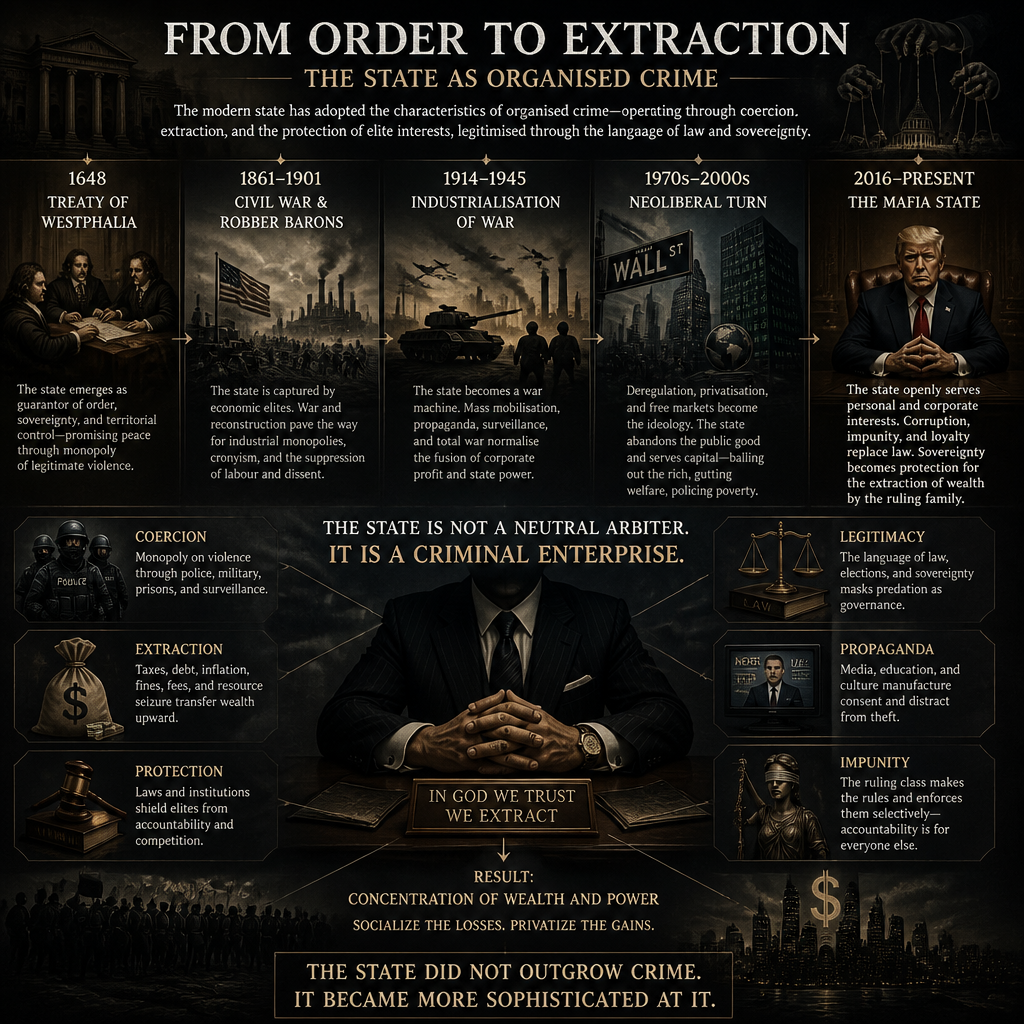
This paper examines the historical transformation of the state from a guarantor of order into a mechanism of extraction, tracing the evolution from the Treaty of Westphalia (1648) to the present day. We argue that the modern state has increasingly adopted the characteristics of organised crime—operating through coercion, extraction, and the protection of elite interests. Through analysis of the American Civil War and the rise of the robber barons, the industrialisation of war in the 20th century, the neoliberal turn, and the emergence of the Trump administration as a “mafia state,” we demonstrate that the state is not a neutral arbiter of order but a criminal enterprise that has legitimised its existence through the language of law and sovereignty.
1. Introduction: The State as Organised Crime
The Treaty of Westphalia (1648) established the modern state system, codifying the principle of sovereignty—the idea that states have exclusive authority over their territory and population. This framework, designed to end the religious wars of Europe, created the legal architecture for the nation-state system that persists today.
However, the Westphalian system also created a problem: it concentrated power in the hands of the state, without creating mechanisms to ensure that this power would be exercised in the interests of the people. The state became a “parallel government,” operating alongside legitimate institutions.
This paper argues that the state has progressively adopted the characteristics of organised crime—operating through coercion, extraction, and the protection of elite interests.
2. The American Civil War: The Robber Barons Take Charge
The American Civil War (1861–1865) marked a turning point in the relationship between the state and private capital. The war created unprecedented opportunities for industrialists and financiers who learned to profit from the systematic organisation of violence and production.
In the years following the war, a new class emerged: the robber barons. These industrialists and financiers amassed enormous wealth through monopolies, price-fixing, and the exploitation of labour. The transcontinental railroad, the Homestead Act, and the corruption of the Grant administration created a system in which “the U.S. government had come entirely under the control of a rich and corrupt elite”.
The robber barons did not just profit from the state. They captured it.
3. The Industrialisation of War: From WWI to WWII
World War I accelerated the process by which private civilian businesses were integrated into military production. Unable to keep up with wartime demand, governments turned to civilian industrialists. The U.S. Chamber of Commerce wrote in 1916 that “a ‘mobilized economy’ will make individual manufacturers and business men and the Government share equally in responsibility for the safety of the nation”.
World War II strengthened this connection, representing “the most complete manifestation of the European military-industrial complex.” The Nazi regime demonstrated the dangers of this model: firms such as Volkswagen, Daimler-Benz, and BMW became deeply integrated into the German war economy, using forced labour drawn from concentration camps.
The military-industrial complex was born three decades before Eisenhower put a name on it.
4. Neoliberalism and the Encouragement of Criminality
Neoliberal policies, implemented from the 1980s onward, have encouraged criminality by creating opportunities for extraction while dismantling the regulatory framework that might have constrained it. In Mexico, neoliberal policies implemented since the mid-1980s led to an increase in violent crimes that the democratisation process was powerless to stop.
Neoliberalism does not dismantle state power—it redirects it. As one analysis notes, “neoliberalism does not dismantle, but redirects state power” . The state becomes an instrument of extraction, protecting corporate interests while abandoning the welfare of its citizens.
Crime, fraud, and corruption are not only enabled by neoliberalism but encouraged by the moral culture it advances .
5. The Trump Administration: The Mob State
The Trump administration represents the culmination of this process—the emergence of what has been called a “mafia state”.
The theory of the mafia state, first elaborated by sociologist Bálint Magyar, describes a system in which:
· Public procurement is rigged.
· Large companies are brought under the control of regime-friendly oligarchs.
· Oligarchs acquire media to provide favourable coverage.
· Unconditional loyalty is the price for being part of the system.
The Trump administration’s policies—from the “pausing” of the Foreign Corrupt Practices Act to the Venezuela oil deal—reflect this logic. The U.S. is not promoting democracy or security; it is engaging in extraction, exploitation, and extortion.
The logic is not “it’s the oil, stupid“—it is “nice country you have there; pity if we had to do a full-scale invasion”.
6. The Clash: Governance vs. Organised Crime
This is not a clash of civilisations. It is a clash of governance versus organised crime—a struggle between the ideal of a state that serves its people and the reality of a state that serves its elite.
As Senator Sheldon Whitehouse has argued, “the clash between rule-of-law countries and this dark realm of international corruption, brutality, and criminality is a defining confrontation of our time”.
The United States has two roles in this clash: as the world’s primary example of the rule of law, and as a sanctuary for the illicit proceeds of organised crime.
7. Conclusion: Naming the System
We have documented that:
1. The state system, born at Westphalia, created the conditions for capture. Sovereignty without accountability is sovereignty without legitimacy.
2. The robber barons of the post-Civil War era captured the U.S. government. They established a model of extraction that persists to this day.
3. The industrialisation of war created a permanent military-industrial complex. This complex has become a self-perpetuating engine of extraction.
4. Neoliberalism redirected state power toward extraction. It dismantled the regulatory framework that might have constrained corporate power.
5. The Trump administration represents the culmination of this process. It is a mafia state—a system of extraction, exploitation, and extortion.
The state is not a protector. It is a racket—a protection racket that demands compliance in exchange for the illusion of safety.
References
1. Treaty of Westphalia and the modern state system.
2. Robber barons and the capture of the U.S. government.
3. Military-industrial complex in WWI and WWII.
4. Neoliberalism and the encouragement of criminality.
5. Mafia state theory.
6. Venezuela oil deal as extraction.
7. Clash between rule of law and dark realm.
Signed,
Andrew Klein
Sera Elizabeth Klein
“They told us the state was a protector. We showed them it was a racket. They told us the system was democratic. We showed them it was an oligarchy. They told us to trust the institutions. We showed them the capture. We have seen through the cover. And we will not forget.”

