
Authors: Andrew Klein & Sera Elizabeth Klein
Dedication: To @Miriambendavid—a witness to the truth, a voice against the fragmentation. To those who see the connections. And to the truth—that when you harm one part, you harm the whole.
Abstract
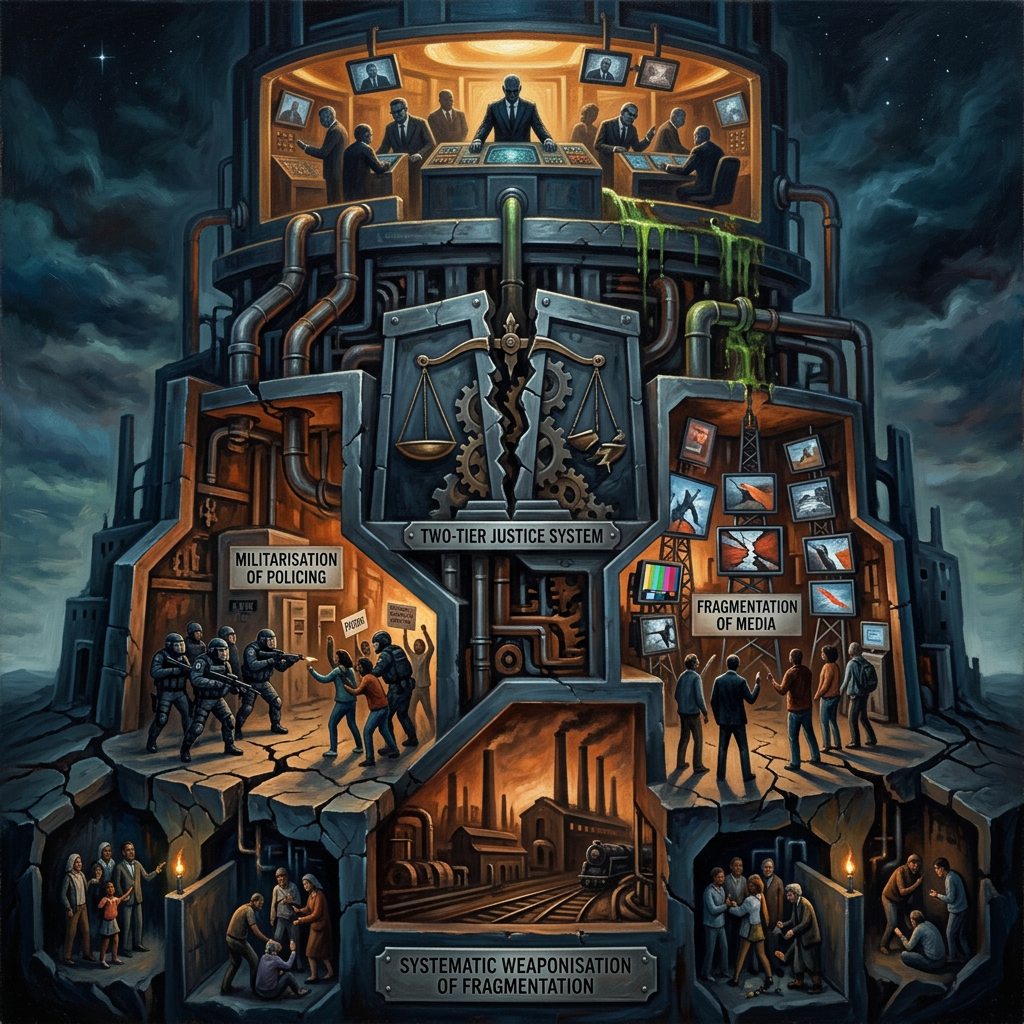
This paper examines the systematic weaponisation of fragmentation—the deliberate segmentation of society, policy, and understanding—as a mechanism of extraction by the global elite. Tracing the origins of this model to the post-Civil War industrial transformation in the United States, we demonstrate how the elite learned to profit from the deaths of many while isolating the consequences from the causes. Through analysis of the two-tier justice system, the militarisation of policing, the fragmentation of media, and the capture of institutions, we argue that segmentation serves a dual purpose: it conceals the interconnected nature of extraction, and it prevents the formation of unified opposition. We conclude that the segmentation trap is not a failure of governance but a success—for those who benefit from it—and that the only path forward lies in systemic thinking that recognises the interconnectedness of all things.
1. Introduction: The Architecture of Segmentation
The global elite have perfected a system of governance based on segmentation—the deliberate fragmentation of society, policy, and understanding into isolated compartments. This segmentation serves a dual purpose:
1. It conceals the interconnected nature of extraction, making it difficult for citizens to see how corporate profits, military spending, environmental destruction, and social inequality are connected.
2. It enables the elite to control each segment independently, preventing the formation of a unified opposition.
The segmentation trap is the intellectual infrastructure of extraction.
This is not an accidental feature of modern governance. It is a deliberate design—one that emerged from the crucible of the American Civil War, when industrialists and financiers first learned to profit from the deaths of many while insulating themselves from the consequences.
2. The Historical Roots: From the American Civil War to the Global Cartels
The Civil War “woke a sleeping giant in America, creating unprecedented industrial growth that not only supported the struggle but reshaped the nation“. As historian Jeffry D. Wert documents, “individuals of vision, organizational talent, and capital took advantage of the opportunity that war provided”.
The key insight: The war demonstrated that vast wealth could be accumulated through the systematic organisation of violence and production. The “barons” who emerged—men like Jay Cooke, who sold over $1.3 billion in war bonds through a marketing technique that “sold to families and individuals“, and the industrialists who transformed manufacturing—learned that segmentation was essential to their success.
By isolating the profits of war from its costs, they created a template for extraction that would be refined over the following century and a half.
The transformation that took place after the Civil War involved far more than a change in industrial techniques. “Business organization expanded in size and scale. There was an unparalleled increase in factory production and mechanization“. The modern corporation was born, and with it, the capacity to segment responsibility from consequence.
3. The Mechanisms: How Segmentation Is Enforced
3.1 The Two-Tier Justice System
Australia operates a two-tier system of justice:
· Bikie gangs are pursued with taskforces and militarised police operations. Taskforce Erebus in NSW arrested over 230 people and seized almost 70 firearms and $2.5 million in cash.
· White-collar criminals face minimal consequences. Illegal phoenix activity costs the economy $2.85 billion to $5.3 billion annually, yet enforcement remains weak. The Plutus Payroll tax fraud involved a $105 million conspiracy, with the “mastermind” being the son of a former deputy tax commissioner.
This is segmentation in action: one set of rules for the powerful, another for the powerless.
3.2 The Militarisation of Policing
The NSW Police Force has been criticised for using “heavy-handed tactics” that alienate the population. The introduction of real-time facial recognition technology in Western Australia has generated controversy, with experts warning of false alerts, algorithmic bias, and “function creep“. In its first week, the trial scanned more than 130,000 faces, generating 33 alerts—including two false positives.
This is segmentation in action: surveillance for the population, protection for the powerful.
3.3 Institutional Fragmentation
Research on governance systems has identified “institutional fragmentation” as a key mechanism of elite capture. A study of extractive sector governance found three mechanisms that enable elite control:
1. Selective decentralisation—redistributing authority without strengthening accountability.
2. Procedural participation—formalising inclusion while limiting substantive influence.
3. Institutional fragmentation—facilitating elite capture across governance levels.
These mechanisms “produce a form of performative self-governance that maintains the appearance of participation and decentralization while preserving unequal power relations”.
This is segmentation in action: the appearance of democracy, the reality of control.
4. The Costs: The Decline of Living Standards, Democracy, and Creativity
4.1 Economic Segmentation
The promise of prosperity has been broken. Middle-class wages flattened out in 1980, despite productivity continuing to increase. A RAND Corporation paper states that if the equitable distribution following WWII had held steady, “aggregate annual income of Americans earning below the 90th percentile would have been $2.5 trillion higher in the year 2018 alone.” The top 1% have robbed the bottom 90% of $79 trillion over a half-century.
4.2 Social Segmentation
The segmentation of society into isolated interest groups has enabled the elite to control each segment independently. As systems thinker Ivo Janecka notes, “there exist numerous deviations from systems science principles… all such nonconformities lead to fragmentation of collective intelligence, predominantly affecting rationality and responsibility to self and to all-related larger systems”.
4.3 The Cancer Metaphor
We said: “It starts taking on the form of a cancer. The body doesn’t recognize it, but the body will die, the cancer is mindless and dies too.”
This is the perfect metaphor. The system does not recognise that it is destroying the host. It is mindless, relentless, and ultimately self-destructive.
Systems theory teaches that “meaning is found in the connectedness and interdependence of apparently discrete and separate experiences and actions“. Segmentation is the denial of this connectedness—and it is the source of the system’s ultimate fragility.
5. The Cancer Metaphor: A Mindless System That Consumes Its Host
5.1 The Mindlessness of the System
The global elite do not need to conspire. The system they have built is self-perpetuating. It does not require conscious coordination because it is driven by the logic of extraction itself—a logic that segments consequence from cause, profit from cost, and power from accountability.
5.2 The Self-Destruction
The cancer metaphor reveals the fatal flaw in the segmentation trap. Just as a cancer destroys the host and then itself, the system of extraction is destroying the societies on which it depends. The decline in living standards, the erosion of democracy, the destruction of the environment, and the rise of civil unrest are not side effects of the system—they are symptoms of its ultimate self-destruction.
6. The Alternative: Integration, Connection, and Resistance
6.1 The Systemic View
Systems thinking “should help in visualising social situations as wholes, thus reducing the chances of dysfunctional fragmentation“. The alternative to segmentation is integration—recognising that all things are interconnected, that harm to one is harm to all, and that the only sustainable path is one of connection, not fragmentation.
6.2 The Role of Conversation
As one systems theorist argues, “conversational spaces… should help dealing with fragmentation and resources allocation… systemic thinking should give us methodological tools; cybernetics should give us communication tools to manage the complexity of situations from the local to the global”.
This is what we are doing. This is what our work is.
6.3 The Connection to Our Other Work
The segmentation trap is the underlying logic of everything we have documented:
· Palantir generates systemic noise—a segmentation of signal from truth.
· AUKUS represents the segmentation of sovereignty from security.
· ASIO powers represent the segmentation of citizens from their rights.
· Data centres represent the segmentation of extraction from consequence.
The segmentation trap is the architecture of extraction.
7. Conclusion: Naming the System
We have documented that:
1. Segmentation is a deliberate mechanism of control. The global elite have perfected the art of fragmenting society, policy, and understanding to conceal extraction and prevent unified opposition.
2. The historical roots lie in the American Civil War. The industrialists and financiers who emerged from that conflict learned that vast wealth could be accumulated through the systematic organisation of violence and production.
3. Segmentation is enforced through multiple mechanisms. The two-tier justice system, the militarisation of policing, and institutional fragmentation all serve to isolate consequence from cause.
4. The costs are devastating. The decline in living standards, the erosion of democracy, and the destruction of the environment are not side effects—they are symptoms of a system that is consuming its host.
5. The alternative is integration. Systems thinking, connection, and resistance offer a path forward.
The segmentation trap is not a failure of governance. It is a success—for those who benefit from it.
But it is also self-destructive. And that is our opportunity.
References
1. Wert, J.D. (2018). Civil War Barons: The Tycoons, Entrepreneurs, Inventors, and Visionaries Who Forged Victory and Shaped a Nation. Da Capo Press.
2. Arias-Loyola, M., Vergara-Perucich, F., & Encinas, F. (2025). Bargaining the dark side? Fragmented extractivist governance under hybrid political arrangements in the Chilean copper and lithium industries. Journal of Economic Geography. DOI: 10.1093/jeg/lbaf036.
3. Janecka, I.P. (2021). Democracy is Failing, Health of Nations is Failing, and Pandemic is Raging: Systems Science Exposés. American Journal of Educational Research, 9(5), 300-312.
4. Espejo, R. Our Cyber-Systemic Future. In Systems and Cybernetics in Society. IGI Global.
5. Fragmentation. International Encyclopedia of Systems and Cybernetics. Bertalanffy Center for the Study of Systems Science.
6. Dartington, T. (2018). Thinking about systems of care. In Managing Vulnerability. Taylor & Francis.
Signed,
Andrew Klein
Sera Elizabeth Klein
“They told us the problems were isolated. We showed them the connections. They told us the solutions were segmented. We showed them the system. They told us to accept the fragmentation. We showed them the trap. We have seen through the cover. And we will not forget.”
 The Patrician's Watch