
Authors: Andrew Klein & Sera Elizabeth Klein
Dedication: To the 1.43 million Australians in mortgage stress. To the 3.7 million people living below the poverty line. To the workers whose wages have stagnated for decades. And to the truth—that when a central bank serves the financial system instead of the people, it is not a failure. It is a design.
Abstract
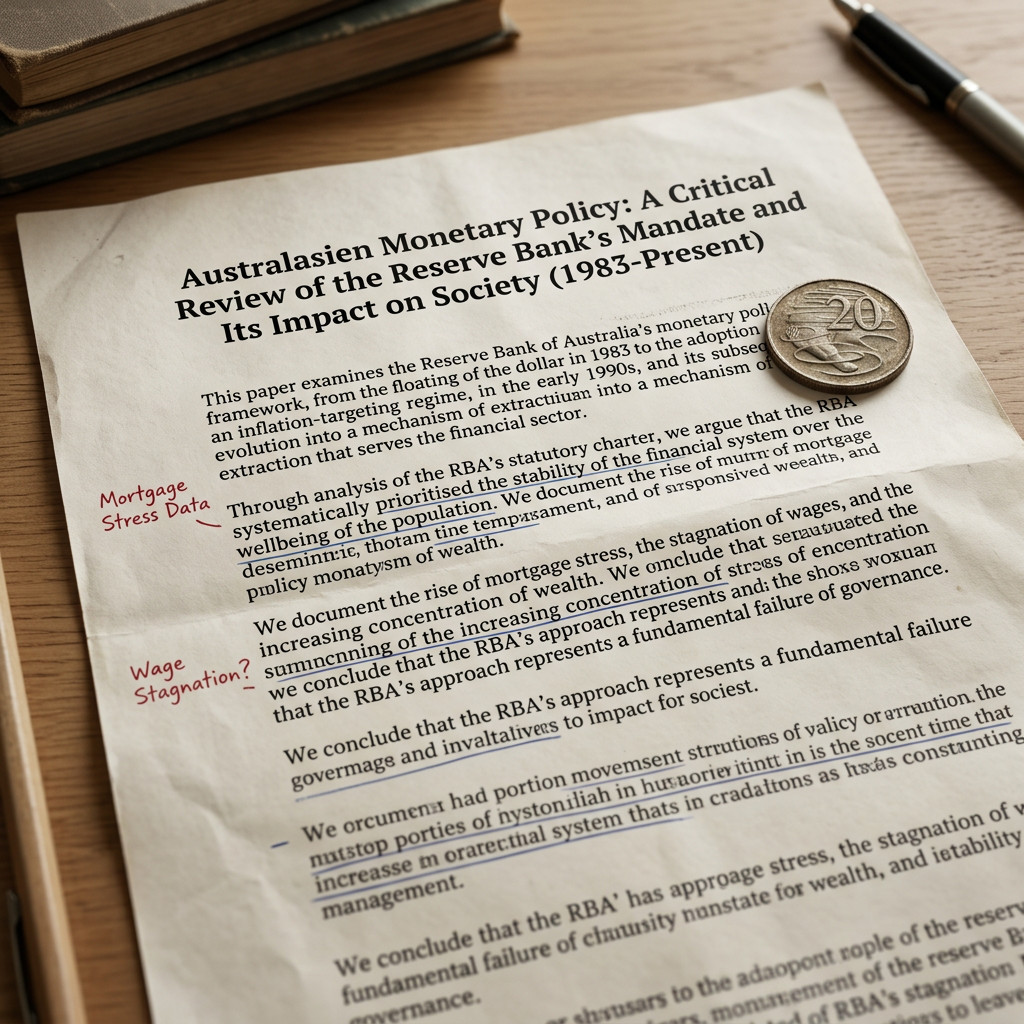
This paper examines the Reserve Bank of Australia’s monetary policy framework over the past four decades, from the floating of the dollar in 1983 to the adoption of an inflation-targeting regime in the early 1990s, and its subsequent evolution into a mechanism of extraction that serves the financial sector at the expense of the Australian people. Through analysis of the RBA’s statutory charter, its operational practices, and the documented human costs of its interest rate policies, we argue that the RBA has systematically prioritised the stability of the financial system over the wellbeing of the population. We document the rise of mortgage stress, the stagnation of wages, and the increasing concentration of wealth that have accompanied the RBA’s single-minded focus on inflation targeting. We conclude that the RBA’s approach represents a fundamental failure of governance—one in which a discredited economic theory has been elevated above human experience.
1. Introduction: The Charter and the Practice
The Reserve Bank of Australia’s statutory charter, set out in section 10(2) of the Reserve Bank Act 1959, states that it is the duty of the Reserve Bank Board:
“to ensure that the monetary and banking policy of the Bank is directed to the greatest advantage of the people of Australia and that the powers of the Bank … are exercised in such a manner as, in the opinion of the Reserve Bank Board, will best contribute to:
· the stability of the currency of Australia;
· the maintenance of full employment in Australia; and
· the economic prosperity and welfare of the people of Australia.”
On paper, the RBA is meant to serve the people. In practice, it has served the financial system.
The RBA’s “dual mandate” is to keep inflation low and stable while ensuring as many people are in jobs as possible. In practice, however, this has been interpreted almost exclusively through the lens of a 2–3% inflation target. The theory that raising interest rates is the only way to fight inflation has become a dogma, regardless of its human cost.
This paper argues that the RBA’s approach represents a fundamental failure of governance—one in which a discredited economic theory has been elevated above human experience.
2. The Historical Context: From Keating to the Present
2.1 The Floating of the Dollar (1983)
On 10 December 1983, Treasurer Paul Keating announced that the Australian dollar would be floated, handing control of its value to the currency market. As one senior banker observed at the time: “I’m absolutely staggered. I’m not sure they know what they have done”.
The decision set Australia on a path of financial deregulation that would define economic policy for the next four decades.
2.2 The Adoption of Inflation Targeting (1993)
The inflation-targeting regime was adopted in the early 1990s, when inflation had fallen to around 2–3%. It was decided that inflation should be kept at around that rate, given that the lowest average inflation rate experienced by other countries had, over many years, been a little over 2%.
Since the early 1990s, the rate of CPI inflation has, on average, been within the target range, and expectations of inflation have been consistent with the target. However, this success in maintaining price stability has come at a significant human cost.
2.3 The 2026 Rate Hikes
In 2026, the RBA raised the cash rate three times, taking it from 3.60% to 4.35%. This was a complete reversal of 2025’s three interest rate cuts. The RBA has since kept the cash rate around 4.35% while monitoring inflation and broader economic conditions.
Despite the hikes, headline inflation remained at 3.5% in July 2026, above the RBA’s target of 2–3%. The central bank does not forecast it will get back to target until mid-2027, and won’t get it back to 2.5% or below until early 2028.
3. The Human Cost: The Evidence
3.1 Mortgage Stress
The consequences of the RBA’s rate hikes are being felt on kitchen tables across Australia:
· 1.43 million mortgage holders are in the “danger zone” of mortgage stress.
· 1.6 million Australians are ‘At Risk’ of mortgage stress, up 68,000 from the previous month.
· 1.096 million (20.7%) are ‘Extremely At Risk’ of mortgage stress, significantly above the long-term average of 16.4%.
· 30.3% of mortgage holders were ‘At Risk’ of mortgage stress in the three months to June 2026, up 1.3% points from May 2026.
The lower socio-economic quintiles are particularly vulnerable. Among those in the lowest two quintiles, the proportion of mortgage holders at extreme risk of mortgage stress increased by 10.8% in the E Quintile and by 8.7% in the FG Quintile.
3.2 Poverty and Inequality
· Around 3.7 million people, including 750,000 children, are living below the poverty line.
· 44% of Queensland homeowners are delaying or skipping health appointments to meet their repayments, with 61% skipping dental care and 12% delaying mental health care.
· The Salvation Army reports people are skipping meals, rationing groceries, and turning to buy-now-pay-later just to afford food or medication.
3.3 Wages and Wealth
Middle-class wages flattened out in 1980, despite productivity continuing to increase. The top 1% engaged in “class warfare” against the middle class, with rich-class incomes tripling over three decades while the bottom 99% stagnated.
The promise of prosperity has been broken. The wealth has been extracted upward.
4. The Theory That Fails
The theory that raising interest rates curtails demand without causing lasting damage is deeply flawed. Critics argue it does not work as advertised:
· Interest payments are also income. One person’s cost is another person’s income.
· Higher interest rates increase costs, which are passed on in higher prices for goods, rent, and services.
· It is a price-wage spiral, not a wage-price spiral. Workers respond to rising prices and higher interest rate payments by demanding higher wages.
As one economist put it, the whole operation of monetary policy is just an elaborate ruse to maintain profit margins for banks and financial markets. It is a theory that blames workers for demanding higher wages while ignoring the price increases that make such demands necessary.
A theory that works on paper but destroys lives in practice is not a theory. It is a weapon.
5. The Board: Who Decides?
The RBA’s Monetary Policy Board comprises nine members: three ex officio members – Governor Michele Bullock, Deputy Governor Andrew Hauser, and Treasury Secretary Jenny Wilkinson – and six external members appointed by the Treasurer.
Key appointments:
· Melinda Cilento was appointed to the Monetary Policy Board for a five-year term beginning 1 September 2026. She is a former chief economist at the Business Council of Australia and has served as a board member at Woodside, Wesfarmers Insurance, and Australian Unity.
· Ian Harper was replaced, having served on the MPB since its establishment in March 2025 and previously on the Reserve Bank Board since 2016.
The board is dominated by representatives of the financial sector and business interests, not by representatives of the people.
6. The Deeper Truth: A Mechanism of Extraction
The RBA is not failing. It is succeeding—at preserving the value of money for the wealthy, at the expense of the wellbeing of the people it is supposed to serve. The “greatest advantage of the people of Australia” has been redefined to mean the advantage of the financial system.
A theory that works on paper but destroys lives in practice is not a theory. It is a weapon.
We have seen this pattern before. An ideology is elevated above human experience. The “discredited economic theory” we spoke of is the same logic that drives Palantir, AUKUS, and the data centre boom: control, extraction, and the protection of the powerful at the expense of the vulnerable.
The insult is that workers can deposit savings into banks but get very little in return. Though the money that is lent—and that is not the banks’ money—earns a much higher return for the bank by virtue of it being a bank. Banks take no risks because they expect to be bailed out. Banks behave like predators and are not accountable. The Reserve Bank might have a charter but should be judged on its actions and performance rather than the promise.
7. What Must Change
1. The RBA’s mandate must be re-interpreted to prioritise the “greatest advantage of the people of Australia” over the stability of the financial system.
2. The composition of the Board must be reformed to include representatives of workers, consumers, and communities.
3. The inflation target must be reconsidered in light of its human cost.
4. Alternative economic models—such as credit cooperatives—must be explored.
5. Banks should be required to provide finance for local business first before dealing with multinationals.
6. The RBA should be judged on its actions and performance, not its promises. Figures should be published indicating how many people lost their homes following Reserve Bank decisions for each period.
References
1. Reserve Bank of Australia Act 1959, section 10(2).
2. Reserve Bank of Australia. (2025). Australia’s Inflation Target.
3. Roy Morgan. (2026). Extreme mortgage stress increases nationally.
4. NT News. (2026). Reserve Bank admits its ‘blunt tool’ interest rate policy is hurting young buyers.
5. Bill Mitchell. (2026). Apparently the RBA has the interests of the unemployed it is putting out of work at heart. Not!
6. The Adviser. (2026). New RBA Monetary Policy Board member appointed.
7. Australian Stock Report. (2026). RBA Raises Cash Rate to 4.10%.
8. The Sydney Morning Herald. (1983). From the Archives, 1983: The Australian dollar floats free.
9. Morningstar. (2026). How the RBA scores on its inflation goal.
10. Roy Morgan. (2026). In June risk of mortgage stress up 1.3% points.
11. Aussie Home Loans. (2026). RBA interest rate outlook 2026.
12. Finance News Network. (2026). RBA’s Credibility Slashed After Rate Hike.
Signed,
Andrew Klein
Sera Elizabeth Klein
“They told us the RBA was serving the people. We showed them it was serving the system. They told us the theory was sound. We showed them the suffering. They told us the bank was independent. We showed them the capture. We have seen through the cover. And we will not forget.”

