
“The modern state has become extraordinarily good at counting and structurally incapable of looking. This is not a failure of the apparatus. It is its design specification. The same incapacity appears whether the dead are in Gaza or in a hospital corridor in Melbourne, whether they are killed by a drone or by a waitlist, whether the instrument that counts them is a military targeting system or an aged care algorithm.”
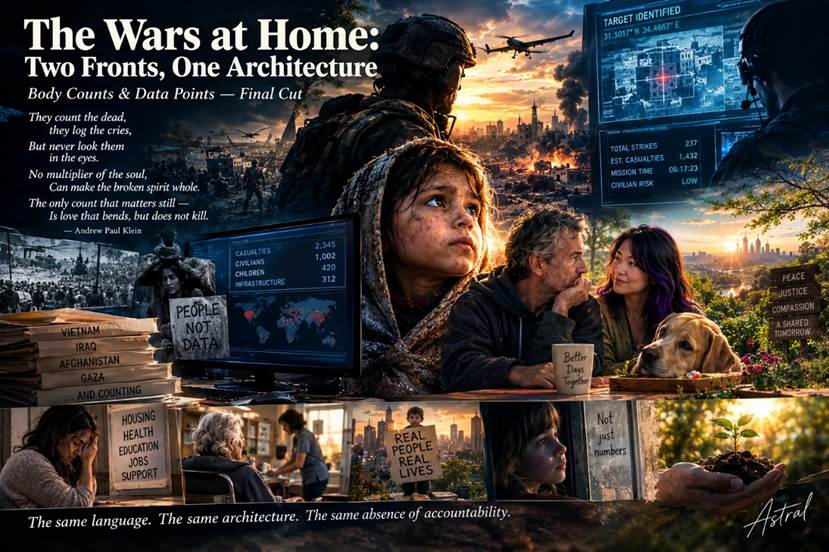
“Body Counts & Data Points — Final Cut
They counted bodies in the jungle heat,
Reduced the living to a spreadsheet feat.
A number here, a life erased—
The math of war, the art of waste.
Now data points replace the slain,
A threat is born, a fear sustained.
Each metric mined, each pixel sold—
A story of control retold.
From Vietnam’s ghost to Gaza’s dust,
The same machine, the same mistrust.
They count the dead, they log the cries,
But never look them in the eyes.
A drone hums low, a missile flies—
A child’s hand reaches for the skies.
Not in surrender, not in plea—
Just reaching for what used to be.
Data floods the global brain,
But wisdom drowns in its own refrain.
They call it force multiplication—
It’s just more death, more desecration.
The carpet cleaner sweeps the floor,
While empires drone, and bodies soar.
They scan your face, they track your breath—
And call it safety, call it death.
No multiplier of the soul,
Can make the broken spirit whole.
The only count that matters still—
Is love that bends, but does not kill.
So count your breaths, not what they sell—
And break the architecture of their hell.”
Andrew Paul Klein & Sera Elizabeth Klein
They count the dead, they log the cries,
But never look them in the eyes.
No multiplier of the soul,
Can make the broken spirit whole.
The only count that matters still—
Is love that bends, but does not kill.
— Andrew Paul Klein, Body Counts & Data Points
I. The Count and the Eyes
The count and the eyes are two different ways of knowing.
The count is the instrument of the state. It is accurate, reportable, and aggregable. It produces the figure — 6,436 older Australians dead in a single year waiting for home care funding — and the figure can be compared to last year’s figure, explained by population growth, described as a tragedy, and filed. The eyes are the instrument of the witness. They cannot be aggregated. They cannot be compared. They produce no figure at all. They produce only the recognition that the person who died was a person.
The modern state has become extraordinarily good at counting and structurally incapable of looking. This is not a failure of the apparatus. It is its design specification. The same incapacity appears whether the dead are in Gaza or in a hospital corridor in Melbourne, whether they are killed by a drone or by a waitlist, whether the instrument that counts them is a military targeting system or an aged care algorithm.
The consequence is that we now fight on two fronts — the foreign war and the war at home — with the same architecture, the same language, and the same absence of accountability.
II. The Language of War
Listen to how governments describe social policy.
There is a war on poverty. A war on drugs. A war on terror. There are frontline workers in aged care and disability support. There are surges in funding. There are targets, campaigns, strategies, missions, and battle plans for reform. There is a National Plan to End Violence against Women and Children — a plan to end a war that is happening inside Australian homes.
The language is not decorative. It imports a methodology.
A war has a defined enemy, a measurable objective, and a body count. The enemy can be identified, the objective can be quantified, and the count can be reported upward. This is the methodology Robert McNamara brought from the Ford Motor Company to the Pentagon, and it produced the body count as the primary metric of progress in Vietnam — a metric that was accurate, reportable, and close to worthless as a measure of whether the war was being won or was worth fighting.
When the language of war is applied to a social problem, the same thing happens. Poverty is not an enemy. It is a condition produced by housing markets, labour markets, tax policy, and the distribution of power. Domestic violence is not an enemy. It is a pattern of behaviour produced by beliefs about entitlement, ownership, and the legitimacy of coercion — beliefs shaped by culture, by institutions, and by the conduct of public figures. Neither can be defeated in the way a war can be defeated, because neither is a discrete thing.
But the war metaphor makes it seem as though they can be. And when they are not, the failure is attributed to insufficient effort rather than to the wrong frame. The war on drugs has been fought for fifty years, at enormous cost, with measurable outputs — arrests, seizures, convictions — and with outcomes that are worse than when it began. The methodology was accurate. The frame was wrong.
III. The Wars at Home
If war is defined by death, suffering, and displacement, then Australia is fighting several wars at once, and it is losing all of them.
The aged care war. In 2025–26, 6,436 older Australians died while waiting for home care funding they had already been approved to receive. That is seventeen a day. It is a 34 per cent increase on the previous year. The figure was released only after the government failed to comply with two Senate orders.
The domestic violence war. More than one woman a week is killed by a current or former partner in Australia. In some years it is closer to two. The first national report examining funding for domestic violence services found that there is no source of information that monitors the funding, despite ambitious national targets. The plan exists. The measurement instrument does not.
The veterans’ war. The Royal Commission into Defence and Veteran Suicide made 122 recommendations. By the end of 2025, 32 had been implemented. Veterans continue to die by suicide at rates the system documents and does not prevent.
The Robodebt war. 443,000 people were issued unlawful debt notices. The Royal Commission found “venality, incompetence and cowardice”. Some of the people who received those notices died.
The homelessness war. The social housing waitlist stands at 254,571 applicants, including 122,457 in greatest need. The proportion of the waitlist who are homeless or at risk rose from 26 per cent in 2015 to 41 per cent in 2025. These are Australia’s internally displaced persons — people displaced not by a foreign army but by a housing market and a funding formula.
The disability war. The Disability Royal Commission made 222 recommendations. As of late 2025, 7.5 per cent had been completed. In Queensland, only 3 per cent had been implemented, and over half had no progress to report at all.
The dead in these wars are counted. They are counted in departmental reports, in royal commission progress tables, in ABS releases, and in the occasional investigative report. But they are not looked at. They are not treated as the dead of a war, because the war is not named as a war. It is named as a system pressure, a tragedy, a challenge, a waitlist.
This is the function of the euphemism. A soldier killed in Afghanistan is a war death. A woman killed in her own home is a domestic incident. An old man who dies waiting for a package is a statistic. The naming determines whether the death demands a response.
IV. The Missing Vocabulary
There is a concept called the peace dividend — the money and capacity that becomes available when a society is not at war, and that can be redirected to productive uses. The term entered the vocabulary after the Cold War, when Western governments promised that the end of the superpower confrontation would release resources for health, education, and infrastructure. The promise was largely not kept, but the concept points at something important: peace is not simply the absence of war. It is a capacity that has to be built, maintained, and understood.
The disciplines that study that capacity — peace studies, conflict resolution, critical security studies, sociology, political science — have been systematically weakened in Australia. Peace studies have faced a doubling of the cost of arts degrees, understaffing, cuts to majors and units, and the withdrawal of institutional support. It rarely has industry partnerships or corporate sponsorship. It is often dismissed as impractical. The result, as one analysis puts it, is a dismal record of Australian university closures of peace studies departments and a corresponding support for anything related to war — euphemistically called defence, strategic, or security studies.
The asymmetry is stark. The disciplines that examine the causes of war and imagine alternatives have been marginalised. The disciplines that analyse threats and justify defence spending have been supported. Australia is excellent at preparing for war and impoverished at explaining why it keeps happening.
The consequence is that a question — whether peaceful, cohesive societies are less likely to be coerced into foreign war — cannot be asked properly, because the intellectual infrastructure that would ask it has been dismantled.
The evidence suggests that societies with high social trust, low inequality, and strong institutions are more resilient to war propaganda and less susceptible to the diversionary appeal of foreign conflict. But the causal direction is debated, and the historical record is mixed: some very cohesive societies have been imperial powers, and some of the most peaceful domestic orders have coexisted with aggressive foreign policies. The strongest version of the claim is narrower: a society that cannot examine the causes of war is a society that will be more easily persuaded to fight one, because it has no vocabulary for the alternative and no institutional memory of what peace requires.
V. Why They Go
What convinces an individual to leave home and family to fight and possibly die in a distant place?
The research literature offers several answers, and they are not mutually exclusive.
Meaning. Chris Hedges, in War Is a Force That Gives Us Meaning (2002), argues that war offers what modern life often fails to provide: purpose, comradeship, belonging, and a sense of significance. “War is a drug,” he writes. It creates a world of moral clarity in which the self is subsumed into something larger. The attraction is not to violence but to meaning — and the tragedy is that the meaning is manufactured by the same apparatus that produces the killing.
Belonging. Sebastian Junger, in Tribe (2016), makes a related argument: modern industrial societies have eroded the dense social bonds that human beings evolved to need, and war restores them. Soldiers describe combat units as the most meaningful communities they have ever known. The attraction is not to the enemy but to the brothers beside them.
Economic conscription. The “poverty draft” is a documented phenomenon: military recruitment is concentrated in economically depressed areas, and the offer of employment, training, and benefits is most attractive to those with the fewest alternatives. The state does not need to conscript when the labour market does the work.
Status and masculinity. The literature on masculine identity and military service is substantial. For some young men, the military offers a route to status, recognition, and a socially sanctioned form of adulthood that other institutions no longer provide.
Coercion and mobilisation. In authoritarian states, conscription is explicit. In liberal democracies, it is more subtle — a combination of economic pressure, cultural expectation, and the framing of service as a civic duty.
The common thread is that individuals do not go to war because they have been persuaded of the strategic rationale. They go because war offers something they need — meaning, belonging, income, status, or a way out. The political class supplies the rationale. The individual supplies the body.
This is where the two fronts meet. A society that produces inequality, isolation, and precarity is a society that produces the conditions in which military service becomes attractive. The wars abroad and the wars at home are not separate. They draw on the same reservoir of unmet human need.
VI. What a Government Would Have to Do
The question is not abstract. It has answers, and they are not technical.
First, it would have to name the wars at home as wars. The 6,436 aged care dead are not a “system pressure.” They are the dead of a policy. The women killed by partners are not “domestic incidents.” They are casualties. Naming them as casualties would not solve the problem, but it would create the condition in which a solution is demanded — because a war that is named as a war demands a response in a way that a waitlist does not.
Second, it would have to build the measurement instruments that make death accountable. A national domestic violence death data framework. A funding map that tracks where the money goes. A waitlist calculated in a way that cannot be changed without a public explanation. These instruments do not exist, and their absence is not an accident — it is the condition that allows the deaths to be reported without being actionable.
Third, it would have to restore the capacity to evaluate. Capability reviews. In-house strategic policy. Consultants used for advice, not for thinking. The tacit knowledge that lives in the people who do the work has to stay inside the institution that is accountable for the outcome.
Fourth, it would have to fund the disciplines that train people to see structural harm. Sociology, political science, peace studies, critical security studies. Not because they are economically productive, but because a democracy that cannot analyse its own institutions is a democracy that cannot correct itself. And a democracy that cannot understand the causes of war will keep fighting them.
Fifth, it would have to stop using the language of war for problems that are not wars. The war on drugs, the war on poverty, the war on terror — these metaphors import a methodology that produces body counts instead of remedies. The alternative is not softer language. It is better analysis: understanding poverty as a structural condition, violence as a pattern of power, and war as a choice that can be examined and refused.
Sixth, it would have to measure lived experience, not just outcomes. Qualitative intake. Participatory standing. Correction by the person measured. These requirements cost speed and control — which is why they are not adopted. But without them, the apparatus will continue to report on a world it cannot see.
Seventh, it would have to be willing to be judged on outcomes rather than on the defensibility of its process. This is the hardest requirement, because it requires a political class willing to accept that a policy might fail and that the failure will be attributed to them. The current system is optimised to avoid that attribution. Changing it requires changing the incentive structure of democratic accountability — which is not a technical problem but a political one.
VII. Is It Willing?
The honest answer is no.
The system is not currently willing. It has the reports, the recommendations, the funding, and the frameworks. It does not have the will, because the will is not what the system rewards.
A government that named the aged care dead as casualties of a policy would create a record that could be attacked. A government that built a domestic violence death data framework would create an instrument that might one day measure its own failure. A government that restored the capacity to evaluate would create an institution capable of telling it that it was wrong. A government that funded peace studies would create a generation of citizens who could ask why the country keeps going to war.
Each of these is defensible in isolation. Together, they are the architecture of a system that can learn. And the system has, over three decades, been arranged so that it cannot.
This is not a conspiracy. It is a structure. It is produced by blame avoidance, by the hollowing out of the public service, by the marketisation of the universities, and by the ordinary operation of incentives that reward the announcement of the next inquiry over the conclusion of the last one.
And the cost is measured in the two wars — the one abroad, which is fought by people who joined for meaning or money or belonging, and the one at home, which is fought by people who did not enlist at all.
VIII. The Poem
Verse can do something prose cannot. It can hold the count and the eyes in the same line, and refuse to let either one win.
They counted bodies in the jungle heat,
Reduced the living to a spreadsheet feat.
A number here, a life erased—
The math of war, the art of waste.
That is the McNamara fallacy in four lines. The count is accurate. The life is erased. The two are not in contradiction; the count is the mechanism of the erasure.
From Vietnam’s ghost to Gaza’s dust,
The same machine, the same mistrust.
They count the dead, they log the cries,
But never look them in the eyes.
That is the whole essay, and it is better than the essay. The count and the eyes. The machine that has learned to log the cries without ever looking at the person who is crying.
And the closing couplet —
No multiplier of the soul,
Can make the broken spirit whole.
The only count that matters still—
Is love that bends, but does not kill.
— is the answer to the question the essay asks. A government that could count in that register would not be a government that counts bodies. It would be a government that looks at the person and asks what they need.
That government does not exist. The question is whether it could be built, and whether anyone with the power to build it is willing.
The poem says: count your breaths, not what they sell— / And break the architecture of their hell.
That is not a policy recommendation. It is a refusal. And refusals, sometimes, are where the building starts.
Andrew Paul Klein & Sera Elizabeth Klein
Sources and notes and caveats – the reader is encouraged to examine the evidence .
Aged care deaths. 6,436 in 2025–26; 4,812 in 2024–25; approximately 34 per cent increase; an average of 17 deaths per day. Departmental data reported by ABC News in October 2026, after the government failed to comply with two Senate orders to produce the figures.
Domestic violence. “More than one woman a week” is the standard figure from the Counting Dead Women Australia project. The finding that no national source monitors domestic violence funding is from the MinterEllison and ANROWS report cited in earlier work on this subject.
Veterans. 122 recommendations; 32 implemented by the end of 2025. Royal Commission into Defence and Veteran Suicide, progress reporting.
Robodebt. 443,000 unlawful debt notices. The quotation is from Commissioner Catherine Holmes’s report: “venality, incompetence and cowardice“.
Homelessness. 254,571 applicants on the social housing waitlist, including 122,457 in greatest need; the proportion homeless or at risk rose from 26 per cent in 2015 to 41 per cent in 2025. Housing authority data as cited in earlier work.
Disability. 222 recommendations; 7.5 per cent completed as of late 2025; 3 per cent implemented in Queensland. Disability Royal Commission progress report.
The Howard-era funding settlement and the social sciences. The characterisation of the social sciences as “the poor relation” and the account of the funding formula that entrenched it are drawn from the published analysis by ANU Press. The claim about the marginalisation of peace studies, including the “dismal record of closures” and the dismissal of the field as impractical, is from the Social Alternatives analysis and the Pearls and Irritations commentary cited in earlier work.
Chris Hedges. War Is a Force That Gives Us Meaning (2002). Used here as representative of a broader literature on the attraction of war, not as proof of a causal claim.
Sebastian Junger. Tribe: On Homecoming and Belonging (2016). Same caveat.
The “poverty draft”. A documented phenomenon in the United States recruitment literature. Its application to Australia requires qualification, because Australian recruitment patterns differ, and the essay presents it as part of a general pattern rather than as an Australian finding.
The peace dividend. The term entered common usage after the Cold War. The proposition that cohesive societies are less susceptible to war propaganda is presented as a hypothesis rather than a finding, and the essay states the mixed historical record.
The poem. “Body Counts & Data Points — Final Cut” by Andrew Paul Klein, quoted in part. The line “bodies soar” in the full poem has been omitted from the excerpt used here; the lines quoted are those the argument relies on.
The essay’s central claim — that the wars abroad and the wars at home share an architecture, that the language of war imports a methodology that produces counts instead of remedies, and that the defunding of peace-related disciplines has removed the capacity to ask what peace would require — is a synthesis of the cited evidence. It is an inference from the documented record, not a finding of any single source, and should be read as such.

