
“The flag is not the enemy. The contract is not the enemy. The enemy is forgetting that both are human creations — and that we can create something better.” AK
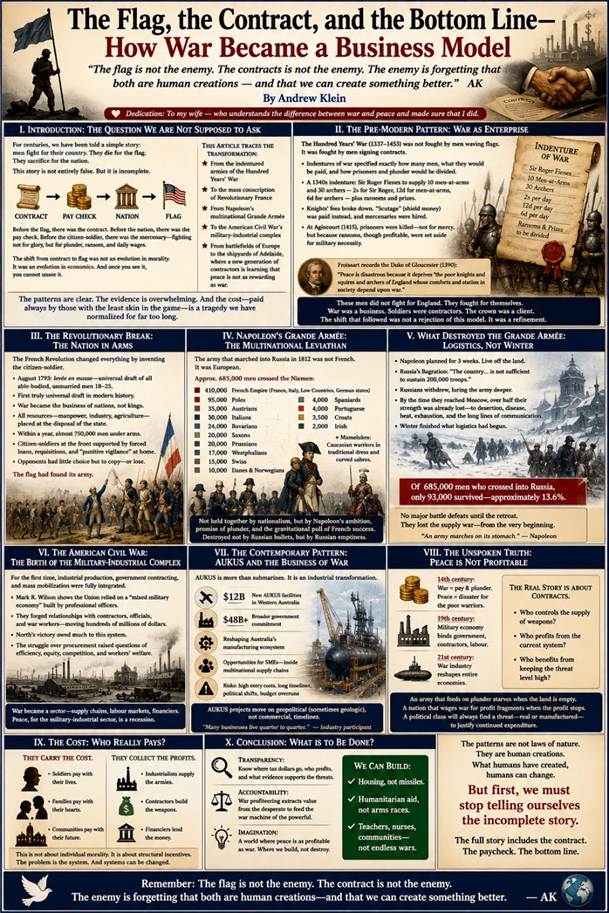
By Andrew Klein
Dedication: To my wife — who understands the difference between war and peace and made sure that I did.
I. Introduction: The Question We Are Not Supposed to Ask
For centuries, we have been told a simple story: men fight for their country. They die for the flag. They sacrifice for the nation.
This story is not entirely false. But it is incomplete.
Before the flag, there was the contract. Before the nation, there was the pay check. Before the citizen-soldier, there was the mercenary — fighting not for glory, but for plunder, ransom, and daily wages.
The shift from contract to flag was not an evolution in morality. It was an evolution in economics. And once you see it, you cannot unsee it.
The modern world runs on a different fuel: manufactured identity. The flag. The nation. The idea that you owe your life to a piece of cloth. This idea did not emerge organically. It was built — by revolutions, by conscription, by propaganda, and by the industrialists who discovered that war, properly managed, is extraordinarily profitable.
This article traces that transformation. From the indentured armies of the Hundred Years’ War to the mass conscription of Revolutionary France. From Napoleon’s multinational Grande Armée to the American Civil War’s military-industrial complex. From the battlefields of Europe to the shipyards of Adelaide, where a new generation of contractors is learning that peace is not as rewarding as war.
The patterns are clear. The evidence is overwhelming. And the cost — paid always by those with the least skin in the game — is a tragedy we have normalized for far too long.
II. The Pre-Modern Pattern: War as Enterprise
The Hundred Years’ War (1337–1453) was not fought by men waving flags. It was fought by men signing contracts.
These documents, called indentures of war, were agreements between the king and a captain specifying exactly how many men would be supplied, what they would be paid, and how prisoners and plunder would be divided. A typical indenture from the 1340s shows Sir Roger Fienes agreeing to supply 10 men-at-arms and 30 archers, with specified daily wages — 2 shillings for Sir Roger, 12 pence for the men-at-arms, and 6 pence for the archers — plus additional payment for ransoms and prizes.
The feudal system of obligatory service had broken down. Knights’ fees had been subdivided among heiresses, creating fractions of knights that could not realistically fight. Instead, scutage — “shield money” — was paid in lieu of service, and the crown used the funds to hire mercenaries.
At Agincourt (1415), prisoners taken during the battle were deemed an enormous threat — so they were killed. Ransoms, which could be enormously profitable, were set aside in the face of military necessity. The historian Froissart records the Duke of Gloucester complaining to Richard II in 1390 that peace was disastrous because it deprived “the poor knights and squires and archers of England whose comforts and station in society depend upon war.”
These men did not fight for England. They fought for themselves.
This system was not a moral failure. It was an economic reality. War was a business. Soldiers were contractors. And the crown was a client. The shift that followed — from contract to conscription, from paycheck to patriotism — was not a rejection of this model. It was a refinement.
III. The Revolutionary Break: The Nation in Arms
The French Revolution changed everything — not because it invented conscription, but because it invented the citizen-soldier.
In August 1793, the National Convention decreed the levée en masse — a “requisition” of all able-bodied, unmarried men between the ages of 18 and 25. This was the first truly universal draft in modern history. The revolution “opened the way for an era of mass armies and full national mobilization and set in motion the transformation of France from a royal kingdom to a modern nation-state”.
War was no longer the business of kings. It became the business of nations.
The entire resources of France — manpower, industry, agriculture — were placed at the disposal of the state. Casualties that would have been unthinkable in the 18th century became acceptable. War became more mobile, more destructive, and more total .
Within a year, almost three-quarters of a million men were under arms. The citizen-soldiers merging with line-army troops in new units called demi brigades . This huge popular mobilization reinforced the revolution’s militant spirit. The citizen-soldiers risking their lives at the front had to be supported by all means back home, including forced loans on the rich and punitive vigilance against those suspected of disloyalty.
The armies of France’s opponents had little choice but to copy the system or face defeat. With the exception of Britain, all the great powers adopted conscription and mass mobilization.
The flag had found its army.
IV. Napoleon’s Grande Armée: The Multinational Leviathan
The army that marched into Russia in 1812 was not French. It was European.
Of the approximately 685,000 men who crossed the Niemen River:
· 410,000 from the French Empire (present-day France, Italy, the Low Countries, and several German states)
· 95,000 Poles
· 35,000 Austrians
· 30,000 Italians
· 24,000 Bavarians
· 20,000 Saxons
· 20,000 Prussians
· 17,000 Westphalians
· 15,000 Swiss
· 10,000 Danes and Norwegians
· 4,000 Spaniards
· 4,000 Portuguese
· 3,500 Croats
· 2,000 Irish
The Grande Armée even included a unit of Mamelukes — Caucasian warriors recruited during Napoleon’s Egyptian campaign who retained their traditional costumes and curved sabres.
This was not a French army fighting for France. It was a coalition — held together not by nationalism, but by Napoleon’s ambition, his promise of plunder, and the gravitational pull of French military success.
And it was destroyed — not by Russian bullets, but by Russian emptiness.
V. What Destroyed the Grande Armée: Logistics, Not Winter
The common narrative blames the Russian winter. The evidence shows otherwise.
Napoleon intended the campaign to last a mere three weeks. His army was to live off the land, taking what it needed from Russia instead of relying on lumbering supply wagons.
The Russian command realized what Napoleon did not: the Russian land would not be able to sustain a force of 200,000, let alone half a million soldiers. Prince Petr Ivanovich Bagration noted: “The country on either side of the road is not sufficient to sustain 200,000 troops”.
The Russians feinted and withdrew, pulling the Grande Armée deeper into Russia. By the time the army reached Moscow, over half of its strength had already been lost to desertion, disease, heat, exhaustion, and the long lines of communication. The winter merely finished what the logistics had begun.
Of the 685,000 men who crossed into Russia, only 93,000 survived — approximately 13.6%.
The French did not lose a single major battle until the retreat. They lost the supply war — from the very beginning.
Napoleon famously said that “an army marches on its stomach”. He was right. And he ignored his own advice.
The lesson is not merely military. It is economic. An army that feeds on plunder starves when the land is empty. A system that depends on extraction collapses when the extracted resource runs out. And a nation that wages war for profit fragments when the profit stops flowing.
VI. The American Civil War: The Birth of the Military-Industrial Complex
The pattern we have been tracing reaches its mature form in the American Civil War (1861–1865). Here, for the first time, we see the full integration of industrial production, government contracting, and mass mobilization.
Mark R. Wilson’s study, The Business of Civil War: Military Mobilization and the State, 1861-1865, documents how the Union war effort was sustained by a “mixed military economy” — a complex contracting system that career army procurement officers pieced together to meet the demands of war.
The task of equipping and sustaining Union forces fell to professional military men who were “largely free from political partisanship or any formal free-market ideology”. They created relationships with contractors, public officials, and war workers that determined the flow of hundreds of millions of dollars.
Wilson argues that the North owed its victory to these professional military men and their finely tuned relationships with contractors. But this victory came at a cost. The struggle over procurement raised fundamental questions about the balance between efficiency and equity, the promotion of competition, and the protection of workers’ welfare.
The Civil War also illustrates a critical shift in the duration of warfare. The Hundred Years’ War was fought in campaigns, with armies disbanded between seasons. The Napoleonic Wars introduced the concept of sustained, year-round campaigning. The Civil War perfected the model of total war — the complete mobilization of society’s resources for an indefinite duration.
This is not merely a military development. It is an economic one. War became a sector — with its own supply chains, its own labour markets, its own financiers. And once a sector exists, it develops a vested interest in its own continuation.
Peace, for the military-industrial sector, is a recession.
VII. The Contemporary Pattern: AUKUS and the Business of War
The patterns we have traced — contract armies, mass conscription, multinational coalitions, logistics as the decisive factor — find their contemporary expression in Australia’s AUKUS agreement.
The AUKUS alliance, often discussed in terms of submarines and strategic power plays, is “beneath the geopolitics… a massive industrial story”. The Australian government has committed $12 billion to expand new AUKUS facilities in Western Australia, on top of a broader $48 billion pledge. This is not merely defence spending; it has “the potential to reshape the country’s manufacturing ecosystem”.
The government’s investment is described as “a vote of confidence in the strength of Australian advanced manufacturing”. But it also represents an industrial policy that funnels billions of taxpayer dollars into a specific sector — not because the market demands it, but because strategic considerations override market logic.
For Australian businesses, AUKUS presents “both an unprecedented opportunity and a complex challenge”. Small and medium enterprises that once dreamed of selling to US and UK companies are positioning themselves inside multinational supply chains. A “licence-free environment” under the Defence Trade Controls Amendment Act empowers manufacturers to pursue import/export opportunities without the hurdles of security-driven bureaucratic “red tape”.
But the risks are substantial. “Market fragmentation within the Defence sector, high entry costs and slow returns all complicate the picture, making AUKUS both a blessing and a curse”. The long-term scale of the projects complicates planning. Workforce growth must be sustained over decades. And “long development horizons also risk political shifts, budget overruns or changing US and UK priorities”.
The most striking observation comes from industry participants themselves: “AUKUS projects move on geopolitical (sometimes geologic), not commercial, timelines” . While “the pact is accelerating industry engagement, the reality is that many businesses live quarter to quarter. Defence contracts typically stretch into multi-year procurement cycles, a rhythm difficult for entrepreneurial businesses to sustain”.
This is not a criticism of AUKUS. It is an observation about the nature of the military-industrial sector. War — or the preparation for war — operates on a different economic logic than civilian industry. It is less responsive to market signals. It is more dependent on government spending. It is more resistant to the normal pressures of competition.
And once established, it is extraordinarily difficult to dismantle.
VIII. The Unspoken Truth: Peace Is Not Profitable
The pattern that emerges from this history is uncomfortable but undeniable.
In the 14th century, men fought for pay and plunder. Peace was disastrous for the “poor knights and squires and archers whose comforts and station in society depend upon war”.
In the 19th century, the American Civil War created a “mixed military economy” that tied government, contractors, and labor together in a web of mutual dependency. The system worked — too well. It did not disappear after Appomattox.
In the 21st century, AUKUS represents a “transformative industrial undertaking” that will “reshape the country’s manufacturing ecosystem”. The submarines are almost incidental. The industry is the point.
The modern world runs on manufactured identity. The flag. The nation. The idea that you owe your life to a piece of cloth. This idea is not false — but it is instrumental. It serves a purpose. It motivates sacrifice. It justifies expenditure. And it obscures the economic reality beneath.
The real story is not about patriotism. It is about contracts.
The same pattern appears wherever there is a choke point. Who controls the supply of weapons? Who profits from the current system? Who benefits from keeping the threat level high?
The questions answer themselves.
An army that feeds on plunder starves when the land is empty. A nation that wages war for profit fragments when the profit stops flowing. A political class that depends on military spending to sustain its industrial base will always find a threat — manufactured if necessary — to justify continued expenditure.
This is not a conspiracy. It is a system.
And systems do not need conspirators to perpetuate themselves. They need only inertia.
IX. The Cost: Who Really Pays?
The cost of war is not distributed evenly.
The soldiers who freeze at Valley Forge, who starve in Russia, who drown in the trenches of the Somme — they carry the physical cost. Their families carry the emotional cost. The communities that lose their young men carry the demographic cost.
The industrialists who supply the armies, the contractors who build the ships, the financiers who lend the money — they carry the profits.
This is not an argument about individual morality. It is an observation about structural incentives.
The soldier who fights for pay is not greedy. He is rational. The contractor who supplies both sides is not treacherous. He is diversified. The politician who approves military spending is not corrupt. He is responsive to powerful interests.
The problem is not the individuals. The problem is the system.
And the system is not inevitable. It was built. It can be rebuilt.
But first, it must be seen.
X. Conclusion: What Is to Be Done?
The patterns are clear. The evidence is overwhelming.
Men fought for pay and plunder — until nations learned to make them fight for flags. Nations fought for glory — until industrialists learned to make them fight for profit. And now, in the 21st century, we have reached the logical conclusion of this evolution: war as a sector.
A sector that requires constant threat to justify its budget. A sector that operates on geological timelines while demanding quarterly returns. A sector that shapes foreign policy, domestic politics, and the very identity of citizens.
The first step is transparency. Citizens have a right to know where their tax dollars are going, who is profiting from military spending, and what evidence — if any — supports the threat narratives used to justify that spending.
The second step is accountability. War profiteering is not a victimless crime. It is the extraction of value from the desperate to feed the war machine of the powerful.
The third step is imagination. We must imagine a world where peace is as profitable as war. Where the same industrial capacity that builds submarines builds housing. Where the same logistical expertise that supplies armies supplies humanitarian aid. Where the same patriotic energy that supports troops supports teachers, nurses, and the rebuilding of communities.
This is not naive. It is necessary.
The patterns we have traced are not laws of nature. They are human creations. And what humans have created, humans can change.
But first, we must stop telling ourselves the comfortable story. The story of the flag. The story of the nation. The story of the citizen-soldier who fights for love of country.
These stories are not false. But they are incomplete.
The full story includes the contract. The paycheck. The bottom line.
And until we tell the full story, we will never be free of it.
Andrew Klein
References
1. Cambridge University Press. (2016). Raising an Army: Recruitment and Composition. In Henry of Lancaster’s Expedition to Aquitaine, 1345-1346.
2. Britannica, T. Editors of Encyclopaedia. (2020, June 15). Levée en masse. Encyclopedia Britannica.
3. Stanford H4D Newsletter. (2024, July 16). Hacking for Defense and Lessons Learned from the French Invasion of Russia.
4. Wilson, M. R. (2006). The Business of Civil War: Military Mobilization and the State, 1861-1865. Johns Hopkins University Press.
5. Defence Connect. (2025, October 28). Why AUKUS is both a blessing and a curse for the Australian manufacturing industry.
6. Cambridge University Press. (2023). Accounting for Service at War: The Case of Sir James Audley of Heighley. In Journal of Medieval Military History.
7. Britannica, T. Editors of Encyclopaedia. (2024, May 14). France – Army, Republic, Revolution. Encyclopedia Britannica.
8. de Segur, P. (2021). History of the Expedition to Russia: Undertaken by the Emperor Napoleon in the Year 1812.
9. Library of Congress. (2006). Publisher description for The Business of Civil War.
10. Defence Connect. (2026, March 24). SPOTLIGHT: Inside Australia’s AUKUS industrial transformation.
 The Patrician's Watch