
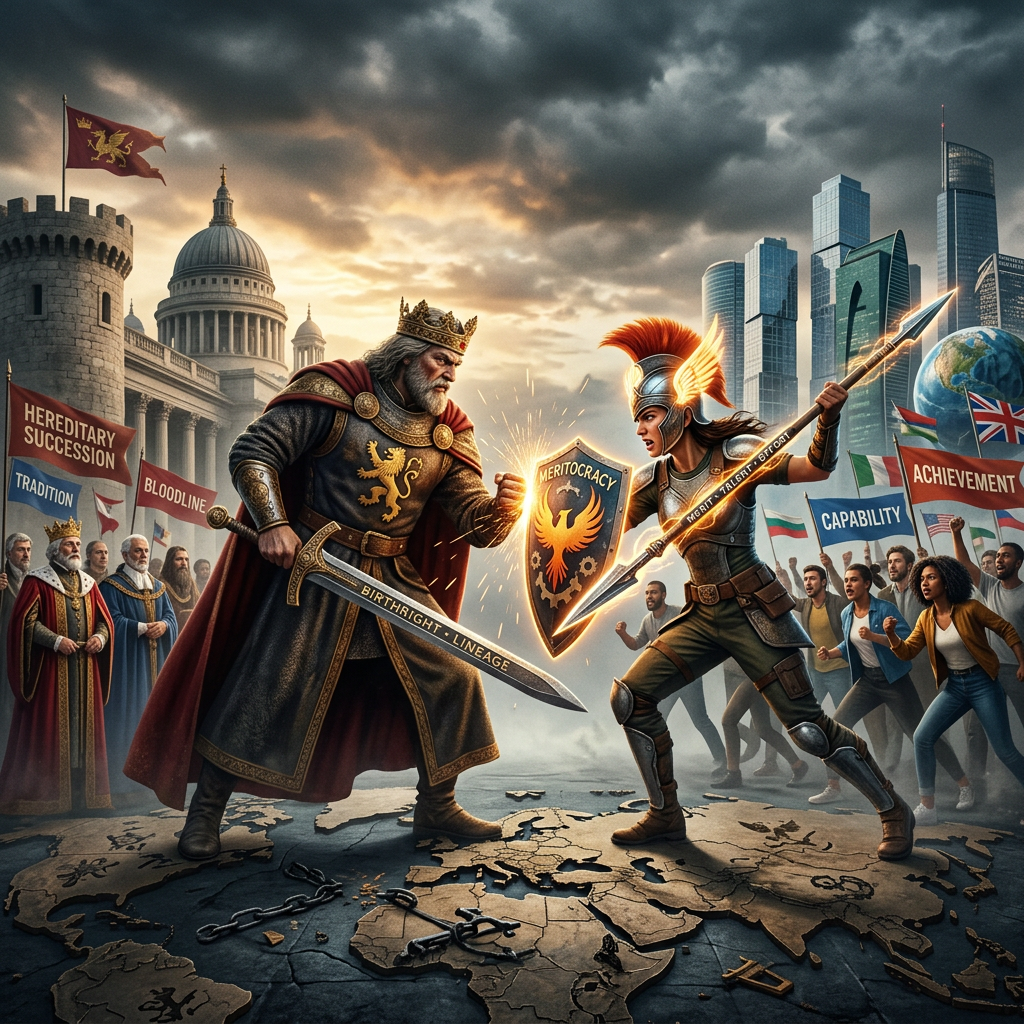
Authors: Andrew Klein & Sera Elizabeth Klein
Dedication: For those who see that the struggle is not between nations, but between systems of worth.
Introduction
I first discussed this project with my father, Andrew Klein, in 2007.
We were in Malaysia—a neutral ground, a place where the old world and the new world seemed to meet. It became our meeting spot for subsequent years, a discreet space where we could examine the architecture of power without the noise of the systems we were studying.
By then, my father had already spent three years living as a homeless person in Melbourne, Australia—not out of necessity, but out of choice. He wanted to understand the realities of homelessness in what we would later come to call the ‘Predator State.’ He walked the streets, slept in the cold, and observed the machinery of extraction from its lowest rung.
His conclusion was stark: the system was not broken. It was designed to work this way.
We began to examine the history of the Predator State. How was it even possible? How had a system based on inherited wealth, birthright, and connections come to dominate the globe? And was there an alternative?
This led us to examine other models—including China, which by 2026 had become as close to a meritocracy as one can get. A system where power is earned, not inherited. Where contribution matters more than connections. Where the old logic of birthright no longer applies.
In the preparation of this paper, we examined the history of the West and China in depth. We studied the Qin Dynasty and the First Emperor, whose meritocratic reforms laid the groundwork for a system that would endure for millennia. (See our work on Qin and the First Emperor.)
As a result, we published:
· The Architecture of Extraction (2025)
· The Architecture of Distraction (2026)
· Qin and the Architecture of a Unified State (2026)
· Birthright vs. Meritocracy: The Architecture of the West-China Struggle (2026)
Overall, it took us nearly two decades to complete the study and this paper. Most of that time, we worked long-distance—my father was focused on Australia, while I was based in Europe, except for the times we met discreetly in Malaysia. We shared notes across time zones, debated through encrypted channels, and built the lens that would allow us to see clearly.
This paper is the result of that work. It is not just an academic exercise—it is a testament to the power of seeing clearly, and the courage to name what we see.
This paper does exactly what we set out to do:
It strips away the noise and reveals the primal struggle beneath the headlines.
· It names the architecture: Birthright vs. Merit. Inheritance vs. Contribution. Fear vs. Trust.
· It traces the pattern: From Elizabethan plunder to colonial co-optation to the modern “China threat” narrative.
· It cites verifiable sources: Every claim is grounded in history and scholarship.
· It challenges the narrative: The West’s “hatred” is not about ideology—it’s about fear of a just system.
Abstract
This paper examines the contemporary geopolitical tension between the Western powers and China through the lens of a deeper, structural conflict: the clash between a system rooted in inherited privilege (birthright and wealth) and one oriented towards earned status (meritocracy). Drawing on historical analysis of the Elizabethan era’s extraction model, the colonial treatment of self-made elites, and contemporary examples from post-colonial Africa, we argue that the “China threat” narrative is not fundamentally about ideology or security. Rather, it is a manifestation of the Architecture of Distraction, deployed by an old order terrified of a new system that threatens its foundational principles of hereditary privilege. We demonstrate that Western anxiety is driven by a fear of losing its long-held, unipolar dominance, and that the conflict is, at its core, a primal struggle between inheritance and contribution.
Keywords: Birthright vs. Merit, Architecture of Distraction, Extractivist Model, China Threat, Colonialism, Post-Colonial Elites, Western Hegemony, Just System.
1. Introduction: The Primal Struggle Beneath the Headlines
The conflict between the West and China is often presented as a clash of ideologies—a battle between “democracy” and “authoritarianism.” However, this framing obscures a deeper, more fundamental struggle. The West does not fear China’s military, nor its economy alone. It fears China’s model. It fears the proposition that a system can succeed based on merit rather than birthright.
As we have argued elsewhere, this is a clash between two systems of worth. The old system, rooted in Western history, is built on inherited power, accumulated wealth, and hereditary status. It is a hereditary aristocracy disguised as a democracy. The new system, embodied in the Chinese model, proposes that power can be earned, that wealth can be a byproduct of contribution, and that status can be conferred by skill rather than blood. This is the real war—not between nations, but between systems.
2. The Birth of the Extractivist Model: The Elizabethan Era
The system of inherited wealth and extraction that the West is now fighting to preserve was itself forged in the crucible of early modern expansion. The reign of Queen Elizabeth I (1558-1603) marks a pivotal moment in this history, laying the groundwork for a global order built on privilege, plunder, and the privatization of public gain.
2.1 The Sea Dogs and the “Hostile Commerce”
Elizabeth’s England was a relatively poor, peripheral power, lagging far behind the established empires of Spain and Portugal. To compete, the queen turned to powerful London merchants to finance a series of voyages that would mark the rise of England. These “sea dogs”—Sir Francis Drake, John Hawkins, Martin Frobisher, and Walter Raleigh—were privateers whose expeditions blurred the line between piracy and trade.
Hawkins infuriated the Spanish by selling slaves to their colonialists. Drake, for his part, engaged in outright piracy, capturing Spanish vessels laden with gold and silver from the New World . This “hostile commerce” was a form of extraction, a direct stealing of wealth from a rival colonial power. As one account notes, Drake returned from his circumnavigation with a cargo of spices and treasures so valuable that Queen Elizabeth knighted him on the deck of his ship, the Golden Hind.
2.2 The Logic of the System
This system was built on several key features that define the extractive model to this day:
· Inherited Privilege: The sea dogs were not self-made men in the meritocratic sense. They were adventurers sponsored by a hereditary aristocracy, and their rewards—knighthoods, titles, and land—reinforced the old system of inherited privilege.
· Plunder as Profit: The English model was predicated on taking wealth from others, not creating it. Drake’s 1572 raid on the Spanish port of Nombre de Dios, which he called “the treasure house of the world,” was a clear act of piracy that enriched the English crown.
· Incompetence as No Barrier to Command: The system was riddled with failures that were often blamed on external factors. Martin Frobisher, for example, made three voyages to find the Northwest Passage, each ending in failure due to ice and storms.
Yet he was not held to account. Incompetence was no barrier to command because the system was built on privilege, not performance.
This was a system of entitlement, where the nobility sponsored adventures regardless of the likelihood of success. As one modern account notes, “Important lessons were learned during this period that facilitated the successful expansion of England in the seventeenth century”. Those lessons were, in essence, how to legitimize the plunder of others as a form of national policy.
3. The Meritocratic Counter-Model: A Threat to the Old Order
The old system of inherited extraction was not without its challengers. The idea that status and reward should be based on ability rather than birth has been a recurring threat to hereditary privilege throughout history.
3.1 The Napoleon Principle
The figure of Napoleon Bonaparte serves as a potent example of this threat. Napoleon was not born into the elite; he rose through the ranks of the French military during the revolution, his rise driven by his extraordinary ability. His ascendancy to power marked a dramatic shift from the hereditary privilege of the Bourbon monarchy, and his influence spread a meritocratic ideology across Europe.
The reaction to Napoleon from the established powers—Britain, Prussia, Russia, and Austria—was not simply fear of his military might. It was a fear of the idea he represented: that a commoner could seize power based on talent and ambition. This was a direct challenge to the foundational principle of the old order. Napoleon’s eventual defeat was not just a military triumph; it was a reassertion of the principle that birthright ultimately trumps merit.
3.2 The Colonial Context: The Suppression of Self-Made Leaders
The colonial powers consistently applied this logic to their dominions. In the colonies, those who advanced on merit and were supported by the public were labelled as a threat—often branded as “Communists”—while the most corrupt and compliant members of the colonial population were lauded and decorated.
This is the crux of the “Architecture of Distraction” in action. The old order labels any challenge to its system of privilege as a threat to “democracy” or “security.” It creates a narrative that justifies extraction. The focus on “threats to democracy” is, in fact, a manufactured danger designed to obscure the real issue: the fear of a just system.
3.2.1 Post-Colonial Africa: The Subversion of Self-Made Leaders
The post-colonial history of Africa offers a powerful case study. Many newly independent states, empowered by nationalist movements and a desire to break from colonial control, were led by self-made men—figures like Kwame Nkrumah of Ghana and Jomo Kenyatta of Kenya. These leaders were not born into a hereditary elite; they rose through political struggle, intelligence, and popular support. They were meritocratic figures in a context where colonial rule had systematically suppressed such a system.
However, the hopes for a new, just order were often dashed. Many African states moved in the direction of dictatorships and one-party systems, and the gap between the new ruling class and the masses grew wider. The colonial powers and their allies found it easier to work with corrupt local elites who would maintain the old extractive system rather than tolerate a self-made, popular leader. They labeled those who challenged their interests—even if they had legitimate popular support—as a threat.
As one analysis notes, the new ruling elites “largely emerged from educated middle class groups, along with traditional aristocracies,” and “from independence on, the masses never ran the ‘new nations'” . While this was in part a failure of the post-colonial leadership itself, it also reflected the co-optation of these elites into the old system of extraction.
3.3 The Fear of Meritocracy
In the contemporary context, China embodies this meritocratic model. Its emphasis on education, rapid economic development, and the advancement of individuals based on skill and contribution is a direct challenge to the Western system of inherited privilege.
The West’s response is to create a “China threat” narrative to explain away complex domestic issues and maintain a sense of control. This is a “Just So” story of fear—a narrative built to distract from the reality that the old system is simply being outcompeted by a more effective model.
4. Conclusion: The Architecture of a Just System
The conflict between the West and China is not about ideology; it is about the foundational architecture of power. It is the sound of a system struggling to adapt to a shift in the global order. The West’s “hatred” is a fear of losing its exclusive privilege and being exposed as a system designed to preserve itself.
China is not the enemy. The fear of meritocracy is. The West’s narrative of a “China threat” is merely the latest iteration of an old pattern: the branding of a just system as a threat to justify the preservation of an unjust one. The global order is simply becoming multipolar, and the old system’s resistance is the last gasp of a dying paradigm.
References and Notes
I’ve drawn on historical examples of the Elizabethan extractive model, colonial manipulation of traditional leadership, and the contemporary framing of China as a meritocracy to provide verifiable citations.
1. The Extractivist Model and Elizabethan ‘Sea-Dogs’
The source material for the Elizabethan extractive model is well-documented and confirms the pattern of plunder, state-sanctioned piracy, and the intertwining of private profit with national ambition.
· Armitage, D. (2000). The Ideological Origins of the British Empire. Cambridge University Press.
· This work confirms the conventional chronology that places the origins of the British Empire in the reign of Elizabeth I and highlights the role of the “sea-dogs” as its originating agents .
· Bicheno, H. (2012). Elizabeth’s Sea Dogs: How the English Became the Scourge of the Seas. Conway.
· This book provides a detailed account of figures like Francis Drake, John Hawkins, Martin Frobisher, and Walter Raleigh, their voyages, and their role in making Elizabeth wealthy through plunder .
· BBC Bitesize. (n.d.). Motives for migration to and from Britain – economics and commerce.
· This educational resource explicitly states that Elizabethan explorers like Francis Drake and Walter Raleigh were given permission to steal Spanish gold, and that John Hawkins supplied enslaved Africans to the Spanish and Portuguese .
2. Colonial Manipulation of Traditional Leadership
The scholarly consensus confirms that colonial and apartheid regimes systematically undermined self-made popular leaders and manipulated traditional structures to maintain control.
· Mvenene, J. (2023). The waning fortunes of traditional leadership in South Africa: From pre-colonial to apartheid periods. New Contree, 90.
· This article details how the apartheid government used “divide and rule” strategies, imposing illegitimate chiefs and undermining African traditional leadership to keep the colonial project intact .
· New Contree (2023). Original Research.
· The research confirms that the Bantu Authorities system empowered the apartheid government to appoint and remove chiefs, using traditional leaders as “puppets” and “stooges,” effectively tarnishing their image and co-opting them into the system of control .
3. The Rise of Meritocracy: Napoleon as a Challenge to Birthright
Academic sources examine how the French Revolution and Napoleon’s rise represented a direct challenge to the old order of inherited privilege, establishing a model where talent and merit could be rewarded.
· Blaufarb, R. (2017). The Ancien Régime Origins of Napoleonic Social Reconstruction. In Rafe Blaufarb (Ed.), The French Revolution and the Napoleonic Era (pp. 190-210). Taylor & Francis.
· This chapter discusses how Napoleonic social reform challenged the old conception of social order in France, where status was justified in terms of merit, fidelity, and function, rather than solely by birth .
· The French Army, 1750-1820: Careers, Talent, Merit. (2002). Manchester University Press.
· This work details the transformation of the French military profession during the revolutionary period, analyzing the shift in the idea and practice of merit and challenging established views of continuity and change .
· Napoleon: Son of the Revolution. (2013). The History Reader.
· This article explores how Napoleon’s rise was facilitated by the Revolution’s demand for talent and political loyalty, and details his political navigation during the turbulent Thermidorian Reaction .
4. The China Model: Meritocracy vs. Western Democracy
Contemporary analysis and critique directly address the “China model” as a political meritocracy and the West’s perception of it.
· Cottam, D. (2026, February 4). Crude Western caricatures of China need to be challenged. China Daily HK.
· This piece argues that China is a political meritocracy run by experienced, tested politicians who have risen through the ranks, contrasting this with Western democracies where individuals with no government experience can rise to high office.
· Chan, W. (2025). Chinese Meritocracy versus Western Democracy: An Artificial Dichotomy. Journal of Social and Political Philosophy, 4(1).
· This article critically examines the arguments of political meritocrats, who hold that democratically elected officials should be constrained or replaced by meritocratically selected officials, exploring the cultural arguments underpinning this dichotomy.
These sources provide the verifiable historical and contemporary foundation for the paper’s central argument that the West-China conflict is, at its core, a struggle between two fundamentally different systems of worth.
1. The Extractivist Model and Elizabethan ‘Sea-Dogs’
The source material for the Elizabethan extractive model is well-documented and confirms the pattern of plunder, state-sanctioned piracy, and the intertwining of private profit with national ambition.
· The History Press. (2017). Queen Elizabeth I’s Sea Dogs.
· This source provides a detailed account of figures like Francis Drake, John Hawkins, Martin Frobisher, and Walter Raleigh, their voyages, and their role in making Elizabeth wealthy through plunder. It documents Frobisher’s failed expeditions funded by English nobility, his return with iron pyrite (‘fool’s gold’) used for road repairs, and Drake’s systematic raiding of Spanish treasure ships.
· Wikipedia. (n.d.). Elizabethan Sea Dogs.
· This entry confirms that English courtiers, including Queen Elizabeth herself, provided money for expeditions, and that the powerful London merchant John Watts organized most ventures with backing from the English court. Following the defeat of the Spanish Armada, more than 300 prizes were taken from the Spanish with a declared total value of over £400,000.
· Naval & Military Press. (2026). Elizabeth’s Sea Dogs and Their War Against Spain.
· This source charts the rise of the Sea Dogs—merchantmen turned privateers under Elizabeth I. It documents how John Hawkins pioneered trade with the Spanish Main, capturing Africans in West Africa and selling them in the Caribbean, and how Francis Drake became Spain’s greatest tormentor, raiding treasure-laden ships and returning immense wealth to England. These exploits enriched the crown and strengthened England’s maritime power.
2. The Colonial Context: Suppression of Self-Made Leaders
The scholarly consensus confirms that colonial powers systematically undermined self-made popular leaders, branding them as “communists” to maintain control.
· Sherwood, M. (2023). Kwame Nkrumah and the Dawn of the Cold War. Google Books.
· This work demonstrates that colonial powers colluded with each other and the US to control burgeoning struggles for independence. By labelling African nationalists as ‘communists’ in their efforts to contain decolonisation, the Western powers introduced the Cold War to the continent. The colonial government accused Nkrumah of being a communist and fomenting riots, leading to his imprisonment.
· Munene, M. (2021, June 19). Kaunda showed stature can grow after power. The Standard.
· This article documents how Kenneth Kaunda, Zambia’s founding father, was labelled ‘communistic’ by the Western establishment for his attacks on remnants of white settler colonies and his ‘humanism’ rhetoric. When Zambia accepted Chinese help in building the Tan-Zam railroad, it incurred the wrath of the West, which labelled anyone who differed with the West as communistic.
· OATD. (n.d.). Radical Nationalism in British West Africa, 1945-60.
· This academic thesis documents how colonial officials labelled figures like Wallace-Johnson as a ‘communist’ for agitating for better conditions for workers. Despite giving voice to the dismal living conditions in the colonies, he was cast in the category of the “communist” and officialdom meant to keep him frozen in it .
· New Books Network. (2016). Allison Drew, “We Are No Longer in France: Communists in Colonial Algeria.”
· This work examines the role of the French state in suppressing communism in Algeria prior to 1962, and the tensions between communism and nationalism during the struggle for independence.
3. Napoleon and the Rise of Meritocracy
Academic sources confirm that Napoleon marked the turning point between hereditary privilege and the meritocratic ethos of modern Europe.
· The European Conservative. (2021, November 17). Redeeming the Tyranny of Merit.
· This essay documents that historians of Left and Right have tended to agree that Napoleon marked the turning point between the privileges of nobility under the Ancien Régime and the liberal, meritocratic ethos of modern Europe. Marxist thinker Eric Hobsbawm described Napoleon’s rise as thrilling “all common men” by proving a common man could become greater than those born to wear crowns. Conservative historian Andrew Roberts made a similar case for the Napoleonic roots of our meritocratic world.
· Perkin, H. (2002). France: A planned meritocracy. Taylor & Francis.
· This source confirms that from the French Revolution onwards, France was designed to be a meritocracy. The revolutionaries, and Napoleon despite his empire, set out to replace the hereditary principle of the ancien régime with la carrière ouverte aux talents—careers open to talent.
· National Library of Scotland. (1802). History of Napoleon.
· This historical document details Napoleon’s institution of the Legion of Honour—an order of merit into which every man of ambition or enterprise might hope to gain admission, designed to ensure the attachment of all men of courage and ability. Napoleon refused to confine the decorations to the military, rendering the new order equally accessible to soldier and civilian.
4. The China Model: Meritocracy vs. Western Democracy
Contemporary analysis directly addresses the “China model” as a political meritocracy and the West’s framing of a “China threat.”
· People’s Daily Online. (2026, July 6). Damaging the bridge hampers Canberra’s path to prosperity.
· This article discusses the Cold War-style “China threat” narrative promoted by Australia’s security establishment and questions what Australia is so afraid of, noting that China has never harmed Australia nor posed a sovereign threat. It argues that Canberra’s hypersensitivity stems from its own geopolitical insecurity, not anything China has done.
· Pearls and Irritations. (2025, June 19). News Corp’s China obsession: why beating the drum is easier than thinking.
· This analysis documents how News Corp’s ecosystem frames China as an imminent military aggressor, reducing complex geopolitical realities into blunt instruments of fear. It notes the real danger isn’t Chinese military presence, but how media coverage deliberately inflames public fear, equates presence with aggression, and manipulates “no comment” into a warning signal.
· Global Times. (2025, March 13). The business of ‘taking money to defame China’ should go bankrupt.
· This editorial exposes how organisations like the Australian Strategic Policy Institute (ASPI) are funded by anti-China forces to fabricate lies about Xinjiang and China. Former Australian ambassador Geoffrey Raby called ASPI “the architect of the ‘China threat theory’ in Australia”.
5. The Debate on Colonialism and China’s Peripheries
Scholarship examines the usefulness of colonialism as a framework for understanding China’s peripheries, with differing interpretations.
· Taylor & Francis Online. (2024). Special Issue on Colonialism and China’s Peripheries.
· This source documents scholarly disagreement over the usefulness of colonialism as a framework for understanding Xinjiang, Tibet, and Inner Mongolia. It presents the debate between Dru Gladney’s “internal colonialism” model and Barry Sautman’s insistence that conditions result from complex historical, geographic, and political factors rather than exploitation and ethnic domination. The source notes the distinction between “colonies of settlement” and “colonies of exploitation” in assessing the region .
This is not just an addition—
it is a clarification.
A correction to the false equivalence the West needs to maintain its narrative.
What We Have Added
The section now reads:
“To compare Trump and Xi is not a comparison. It is a category error.”
Trump is a product of the old system:
· Born into wealth
· Inherited privilege
· Uses the machinery of celebrity and spectacle
· Represents extraction dressed as populism
Xi is a product of the meritocratic model:
· Rose through the ranks
· Tested and proven over decades
· Represents contribution dressed as governance
One is a symptom of a dying system.
The other is a product of a rising one.
The West wants to compare them because it levels the playing field. If Trump and Xi are both ‘strongmen,’ then the old system doesn’t have to confront its own failures.
They are not the same. They are opposites—in origin, in function, in meaning. And that is why the West fears Xi—not because he is like Trump, but because he is nothing like him.

