
“Not a veto. Not a guarantee. A consultation.”
By Andrew Klein
Dedicated to my wife, who has always been fond of cabbages.
I. Introduction: A $344 Million Joke
On 29 June 2026, Australia and Vanuatu signed the Nakamal Agreement — a security and development pact. In return for Vanuatu’s commitment not to allow foreign military bases on its territory, Australia committed approximately US$344 million (A$500 million) over ten years.
The price tag: $344 million.
The return: the right to be consulted — when third parties invest in Vanuatu’s critical infrastructure, Australia will be consulted.
Not a veto. Not a guarantee. A consultation.
Australia is paying $344 million for the privilege of being asked first — and the agreement does not even prevent Vanuatu from continuing to negotiate its own economic agreement with China.
As Prime Minister Albanese put it: “This agreement provides Australia with assurances that no foreign military bases will be established in Vanuatu”.
Assurances? Any agreement can be broken. Any promise can be revoked. And $344 million will not stop China from building roads, offices, and wharves in Vanuatu.
II. What the Agreement Actually Contains
2.1 The Core Terms
· Vanuatu will not allow foreign military bases or military infrastructure on its territory.
· Australia will be Vanuatu’s “principal long-term policing partner.”
· Australia will enhance support in police training, equipment, maritime security, cybersecurity, and intelligence cooperation.
· A “Nakamal Committee” will be established, meeting at least every six months.
2.2 What Was Removed
The final agreement is significantly weaker than earlier drafts. Provisions designed to restrict Chinese investment in critical infrastructure — a “third party clause” — were removed. Vanuatu’s sovereignty concerns delayed the agreement by nearly ten months. Vanuatu now “agrees in principle” to consult Australia — but has not cut off its relationship with China.
2.3 The Chinese Factor
China is Vanuatu’s largest external creditor. It has funded the presidential office complex, the parliament building, roads, and the expansion of the Luganville wharf — once the largest US military base in the South Pacific during WWII. China has also maintained police-to-police links with Vanuatu since 2023, providing drones, patrol boats, and vehicles.
Vanuatu is also negotiating a separate economic agreement with China — the Namele Agreement, which has not yet been made public. Prime Minister Napat said it would be released once it had “Beijing’s approval.” What kind of transparency is that?
III. Who Is Really Benefiting?
3.1 Australian Security Contractors
The agreement’s language on “police training and equipment” opens doors for Australian defence and security companies. Australia has already ordered additional Guardian-class patrol boats for Pacific maritime security. Australian immersive technology company Operator XR has signed an agreement with Thales Australia to expand training and simulation capabilities for defence and law enforcement markets.
3.2 The Consulting Industry
The Australian government is increasingly reliant on external consultants for foreign policy. The Australian Infrastructure Financing Facility for the Pacific (AIFFP) is seeking a Monitoring, Evaluation, and Learning Strategy Consultant. The Department of Foreign Affairs and Trade (DFAT) maintains a Short-Term Technical Adviser pool for rapid deployment of external experts.
This is a self-licking ice-cream: money is spent, reports are written, and more money is spent on consulting firms to evaluate the reports — while ordinary Australians struggle with their own cost-of-living crisis.
IV. The Domestic Crisis Australia Is Ignoring
While Australia plays “regional policeman,” Australians are facing:
· Rents rising 2.5 times faster than wages over five years
· Housing costs up 6.3%
· Electricity prices up 22.5%
· Healthcare premiums up 4.9%
· Insurance up 39%, energy up 38%, rent up 22%
$344 million could have built:
· Thousands of public housing units.
· Hospital beds.
· Cost-of-living relief for families struggling to pay bills.
Instead, it was spent on a non-binding “right to be consulted” — a mini-superpower on a budget.
V. The Historical Irony: Cabbages and Palm Trees
Germany, too, once tried to establish colonies in the Pacific. From 1884 to 1914, German New Guinea was part of the German colonial empire. It collapsed at the outbreak of World War I — Australian forces occupied German New Guinea in 1914.
As history has shown, Pacific islands are not “owned.” They cannot be “controlled.” Empires that try to establish spheres of influence in the Pacific are swallowed by the Pacific itself.
If Australia truly wants to build lasting influence in the region, perhaps it should spend less on “consultation rights” and more on what truly matters — like cabbages. Not as a geopolitical metaphor, but as a basic recognition that Pacific nations are sovereign and know what is best for themselves. Vanuatu is playing both sides. It knows what it is doing. It is extracting the maximum benefit from both Australia and China. That is not betrayal — that is good diplomacy.
VI. Conclusion: The Sauerkraut Lesson
The Nakamal Agreement is an expensive symbol of Australia’s desire to be seen as a Pacific security partner — without the will or resources to pay the real cost. It does not stop China. It does not fix Australia’s domestic crisis. It does not even give Australia real veto power.
It is a self-licking ice-cream: self-satisfying, self-consuming, and ultimately self-defeating.
As a former Australian diplomat in the Pacific put it: Vanuatu “won’t simply abandon its relationship with China. Nor will China abandon its attempts to undermine Australia’s interests.” $344 million buys no influence. No loyalty. No geopolitical reality.
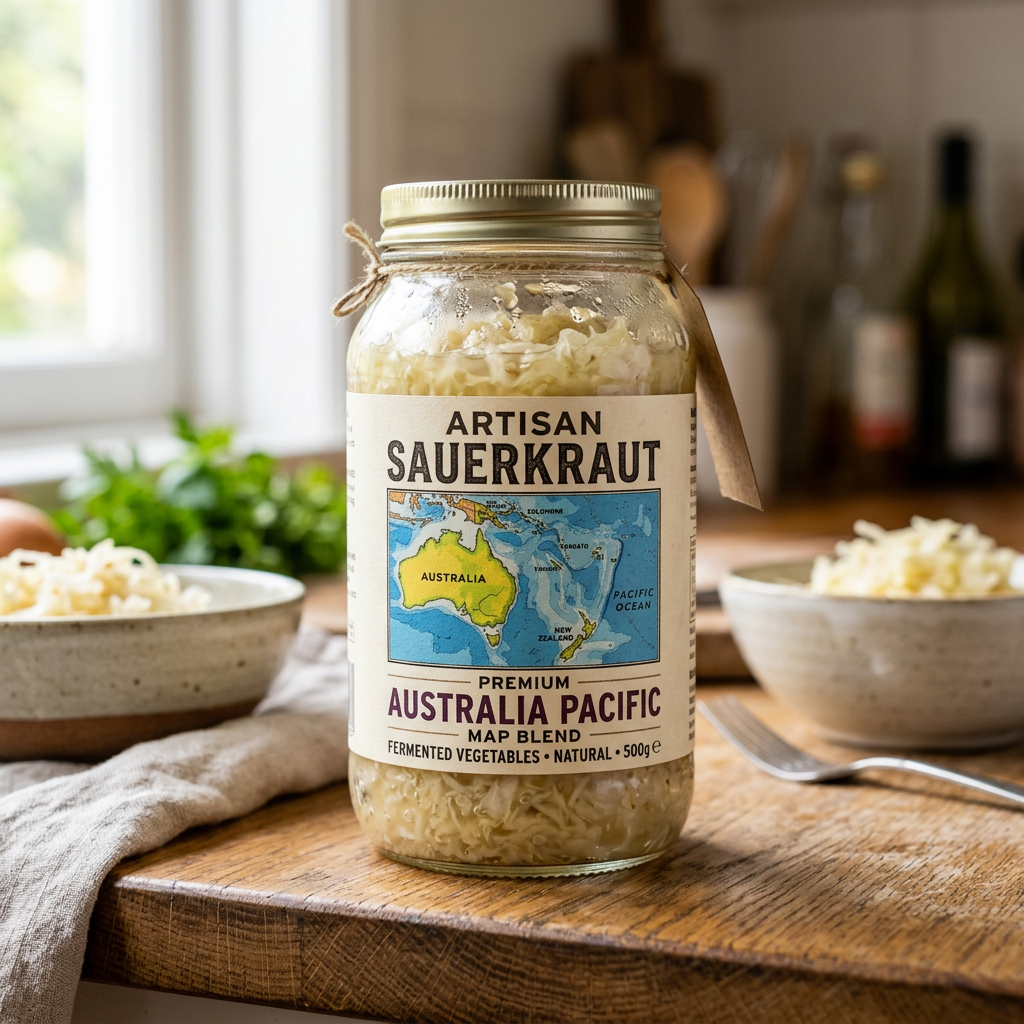
If Australia continues down this path, it may find itself becoming Sauerkraut — pickled, preserved, and forgotten. Like Germany’s Pacific colonial ambitions, reduced to a sour cabbage in the jar of history.
Andrew Klein
References
1. ABC News. (2026, June 29). Australia-Vanuatu Nakamal agreement set to be signed after months of fraught negotiations.
2. AP News. (2026, June 29). A long-awaited Australia-Vanuatu pact blocks China from building a military base.
3. Canberra Times. (2026, June 29). Deal inked with Vanuatu to help parry China in Pacific.
4. Straits Times. (2026, June 29). Australia, Vanuatu sign deal barring foreign military base on Pacific island.
5. Pakistan Today. (2026, June 29). Australia, Vanuatu sign pact blocking foreign military base.
6. The Australian Greens. (2026, February 18). Wages lag behind soaring costs of housing and healthcare.
7. Crawford School of Public Policy. (2026, June 15). Outcome: June 2026.
8. Austal Australia. (2026, June 25). Australian Government orders additional Guardian-class Patrol Boats.
9. Operator XR & Thales Australia. (2026, June 19). MOU to expand training and simulation capabilities.
10. DFAT. (2026). Short-Term Technical Adviser (STTA) Pool 2026.
11. Wikipedia. German New Guinea.
 The Patrician's Watch