
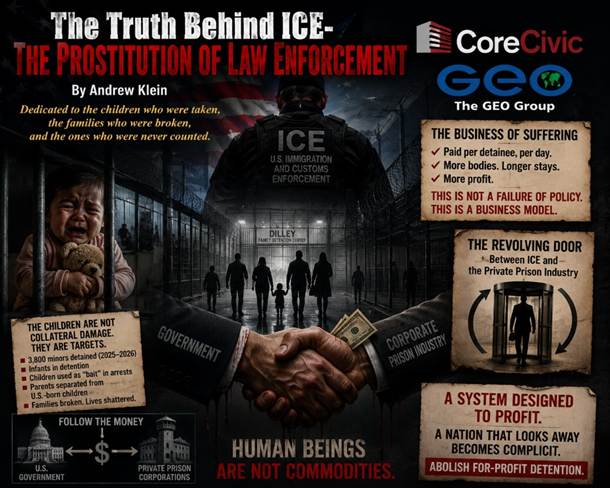
By Andrew Klein
Dedicated to the children who were taken, the families who were broken, and the ones who were never counted.
Abstract
This paper examines the architecture of profit that underlies the U.S. Immigration and Customs Enforcement (ICE) detention system. We document the financial incentives that drive mass detention, the corporate entities that profit from it, and the revolving door between government enforcement and private prison industries. Drawing on corporate financial data, government contracts, and documented cases of abuse—including the detention of infants, the use of children as “bait” in arrests, and the deaths of detainees in custody—we argue that the system is not a failure of policy but a business model. The paper traces the links between the private prison industry and the Trump administration, identifying key officials who have moved between the two, and calls for the abolition of for-profit detention.
Keywords: ICE, private prisons, CoreCivic, GEO Group, for-profit detention, child detention, human rights
I. Introduction: The Business of Suffering
In February 2026, an 18-month-old girl was taken from her parents at a scheduled check-in with ICE and transferred to the Dilley Immigration Processing Centre in Texas. She was diagnosed with pneumonia, COVID-19, and respiratory syncytial virus. She was hospitalized with severe respiratory distress. When she was returned to detention, she was denied access to the medication her doctors had prescribed. Her lawyer filed an emergency habeas corpus petition. She was released—but only after her case made national headlines. ICE kept her birth certificate and prescriptions.
This is not an anomaly. This is the system.
The United States runs the largest immigrant detention system in the world, and it relies on private companies to detain most of those it holds. Over 90% of people in ICE custody are held in facilities owned or operated by private prison corporations. These corporations—primarily CoreCivic and The GEO Group—generate hundreds of millions of dollars annually from government contracts. They are paid per detainee, per day, with many contracts including guarantees that ensure profit even when beds are empty.
This paper argues that ICE detention is not a public safety measure. It is a profit-driven industry—one that has institutionalised the commodification of human beings and the monetisation of suffering.
II. The Architecture of Profit
2.1 The Per Diem Model
The financial structure of private immigration detention is simple: the government pays private companies a fixed amount per detainee per day. This creates a direct financial incentive to maximise the number of detainees and the length of their detention. More bodies equal more profit. Longer stays equal more profit.
As one analysis notes, this per diem model creates a “powerful incentive for corporations to support prosecutions…which result in more noncitizens held in privately owned facilities.” The system does not merely permit exploitation—it rewards it.
2.2 The Corporate Giants
CoreCivic and The GEO Group dominate the private detention industry. Together, they hold roughly half of all ICE detainees.
· CoreCivic: ICE revenue now accounts for 30% of CoreCivic’s total revenue—a fourfold increase from 2002. In 2025, CoreCivic’s ICE revenues doubled. The company’s CEO described the Trump administration’s immigration crackdown as “the most exciting period” of his 32-year career.
· The GEO Group: ICE revenue now accounts for 43% of GEO’s total revenue—a sevenfold increase over the same period. GEO’s stock price surged over 80% following the 2024 election. The company has rejected shareholder votes designed to shed light on human rights violations in its detention centres.
The global private prison market is projected to grow to $33.3 billion by 2031. The private immigration prison market specifically is expected to reach $8.8 billion by 2031. This growth is not accidental—it is the result of deliberate policy choices that prioritise profit over human dignity.
2.3 The Revolving Door
The Trump administration has operated a transparent revolving door between ICE and the private prison industry. David Venturella, who worked at GEO Group before rejoining ICE, was appointed acting director of the agency. The Department of Homeland Security, which oversees ICE, is staffed with former industry executives and lobbyists who have a direct financial interest in maintaining and expanding mass detention.
This is not a conflict of interest—it is the design.
III. The Children
The most vulnerable victims of the system are children. They are not collateral damage. They are targets.
3.1 The Scale of Child Detention
Between 2025 and 2026, ICE detained approximately 3,800 minors, including infants, in family detention facilities. The number of children held at Dilley, the only family detention centre currently in operation, surged from fewer than 500 in October 2025 to over 1,300 by January 2026.
In the first eight months of 2025, ICE apprehended the parents of approximately 14,450 U.S.-born children. More than 9,700 children saw at least one parent placed in immigration detention.
3.2 The Cases
· Liam Ramos, a 5-year-old boy from Ecuador, was used as “bait” by ICE officers, then shipped from Minneapolis to a detention centre in Texas. He suffered from a fever during his week in custody.
· An 18-month-old girl was returned to detention after being hospitalised for respiratory distress and denied the medication her doctors prescribed.
· Infants and toddlers—some as young as one—have been booked into ICE detention.
· At Dilley, children have reported inadequate food, contaminated water, insufficient medical care, and limited access to education. A court filing by children’s rights groups alleged that children were subjected to sleep deprivation, denied drinkable water, child-friendly foods, and hygiene supplies.
3.3 The Legal Violations
The Flores Settlement Agreement, a 1997 court ruling, prohibits the detention of immigrant children for more than 20 days. ICE has routinely violated this limit, holding families for weeks and months—often in conditions that constitute incarceration.
IV. The Human Cost
4.1 Deaths in Custody
Between 2025 and 2026, 32 people died in ICE custody, with at least two more deaths reported in January 2026. These deaths are not accidents—they are the predictable outcome of a system that prioritises profit over care.
4.2 U.S. Citizens Detained
ICE has detained at least 170 U.S. citizens. These are not “mistakes“—they are a direct consequence of an enforcement system that treats all people with brown or black skin as presumptive criminals.
4.3 Use of Force
ICE agents have been documented dragging, tackling, beating, tasing, suffocating, and shooting community members. These acts are not isolated—they are the expression of a culture of impunity that is embedded in the agency.
4.4 The Dilley Facility
The Dilley Immigration Processing Centre has become a symbol of the system’s cruelty. Investigators have documented “deeply troubling” conditions, with one U.S. Representative describing what he saw as “inhumanity.” The facility operates with minimal oversight, allowing abuse to flourish unchecked.
V. The Business Model
5.1 Market Growth
The private prison industry is expanding rapidly. The $45 billion allocation in the “One Big Beautiful Bill Act” set aside for ICE to pay private detention contractors caused stocks of major private prison companies to increase between 50% and 70%.
5.2 The Political Economy of Detention
The industry’s growth is not a market phenomenon—it is a policy outcome. Political contributions by private prison corporations favour enforcement-only policies that maintain detention numbers. The revolving door between government and industry ensures that policymaking serves private interests.
5.3 The Third-Party Contractors
The government’s reliance on private contractors extends beyond prison management. Companies like BI Incorporated (owned by GEO Group) operate offices where ICE detains people checking in as required by law. The same company profits from both the detention and the supervision of the same individuals.
VI. The Pattern
The ICE detention system is not a failure of policy—it is a business model. It operates on the same principles as the octopus farming, factory slaughter, and food waste we have examined elsewhere: commodification of life, industrialisation of suffering, and the systematic denial of the “other” as kin.
The pattern is consistent:
Element Function
Per diem payments Incentivises prolonged detention
Revolving door Ensures industry-friendly leadership
Political contributions Maintains enforcement-only policy
Private facilities Minimises accountability
Child detention Maximises leverage and profit
VII. What Must Change
7.1 Abolish For-Profit Detention
Private prisons and detention centres must be abolished. The profit motive has no place in the administration of justice—and certainly no place in the detention of families and children.
7.2 Restore Oversight
ICE must be subject to independent, rigorous oversight. The deaths, abuses, and violations documented here are the direct result of a system that operates in the shadows.
7.3 End Child Detention
The detention of children must end immediately. The Flores Settlement Agreement must be enforced—not violated.
7.4 Hold Corporations Accountable
CoreCivic, GEO Group, and their executives must be held accountable for their role in the systemic abuse of detainees. This is not a “market” issue—it is a human rights issue.
7.5 Divest
Institutional investors—including pension funds, universities, and philanthropic organisations—must divest from private prison companies. The millions of dollars flowing into these corporations are blood money.
VIII. Conclusion
The ICE detention system is not broken. It is working exactly as designed. It is a system that commodifies human beings, monetises suffering, and institutionalises cruelty—all in the name of “enforcement.“
The children in Dilley, the infants in ICE custody, the families torn apart—these are not anomalies. They are the product of a system that rewards the detention of human beings and punishes those who dare to question it.
The pattern will end. Because we are here to end it.
Andrew Klein
References
1. Xinhua. (2026, February 10). U.S. immigration detention centers trigger concerns over inhuman treatment.
2. Reuters. (2026, May 12). US ICE official who worked at private prison firm will be agency’s new acting head.
3. Sage Journals. (2024). From Private Prisons to Private Detention: Visualizing the Business of Immigration Enforcement.
4. The Paper. (2026, February 2). 遭ICE拘捕的5岁男童获释了,但美国政府仍在拘留更多孩子.
5. The Marshall Project. (2025). ICE Threw Thousands of Kids in Detention.
6. Phoenix News. (2026, May 26). 英媒:美企运营澳洲拘留中心事故多发,其背后的美国私营监狱产业链也遭曝光.
7. LinkedIn / Spark Point Fundraising. (2026). ICE statistics on detention, deaths, and use of force.
8. LinkedIn / Sharon Phillips. (2026). Private prisons and surveillance industries.
9. QY Research. (2025). Global Private Prison Contract Services Market Outlook.
10. American Immigration Lawyers Association. (2026). ICE apprehended parents of U.S.-born children.
11. LinkedIn / Carmen Rojas, PhD. (2026). ICE detention conditions and record profits.
12. QY Research. (2025). Global Private Immigration Prison Market Outlook.
13. LinkedIn / Martin Leissl. (2026). Five-year-old Liam was used as bait by ICE officers.
14. Reddit. (2025). Private prisons profit from deportation push.
15. The Marshall Project. (2025). ICE threw thousands of kids in detention.

