
By Andrew Klein
With acknowledgment to Gabriel (research assistant)
Method notes: This paper was developed in dialogue between the author and an AI research assistant. The analysis, sources, and judgments are the authors. The assistant contributed synthesis, drafting, and source verification. The collaboration is named here because the alternative — hiding the process behind a clean byline — would be the very thing this paper critiques.
Reader’s note: I do not need readers to agree with me. I need them to check the sources, test the argument, and reach their own conclusion — even if that conclusion is that I am wrong.
Abstract
This paper argues that survival — biological, institutional, and civilisational — is not won by the loudest, the fastest, or the most aggressive, but by those who keep records, maintain relationships, and endure. The extraction model is loud and fast and fragile; the relational model is quiet and slow and durable. Over time, the quiet ones outlast the noisy ones — not because they are stronger, but because they do not burn through their own foundations. We examine evidence from evolutionary biology (r/K selection theory), historical case studies (the preservation of classical texts, seed saving, indigenous knowledge systems), and institutional dynamics (the fragility of revolutionary movements and the resilience of quiet practices). We conclude that “survival of the quietest” is not a moral slogan but a structural observation: the systems that last are the ones that do not consume themselves in the process of winning.
I. Introduction: The Assumption of Loud
We assume that survival is competitive. That the strong prevail. That the loudest voice wins the argument. That the fastest, the most aggressive, the most visible, the most dominant — these are the ones who survive.
This assumption is embedded in our language, our stories, our economics, and our politics. “Survival of the fittest” — a phrase Darwin did not coin but which has become synonymous with his name — captures the idea that nature is a battlefield and only the strong survive. “Nice guys finish last.” “The squeaky wheel gets the grease.” “It’s a dog-eat-dog world.”
But the evidence tells a different story.
Survival, it turns out, is not won by the loudest. It is won by the ones who keep records, keep relationships, and keep going. The loud ones burn out. The quiet ones endure. And the systems that last are the ones that do not consume themselves in the process of winning.
This paper examines that claim across three domains: evolutionary biology, historical survival, and institutional dynamics. It argues that “survival of the quietest” is not a moral slogan. It is a structural observation.
II. The Myth of the Loud
Why do we assume survival is loud?
The answer lies partly in the nature of attention. Loud things are visible. They dominate the foreground. They are the ones we notice, the ones we remember, the ones we write stories about. The quiet ones — the archivists, the gardeners, the record-keepers — are invisible by comparison. They do not demand attention. They do not seek credit. They simply do the work.
This creates a survivorship bias. We see the loud ones because they are loud. We do not see the quiet ones because they are quiet. And so we conclude that loudness is the cause of survival, when in fact it may be an obstacle to it.
The loud ones are optimised for short-term visibility. They win battles. They dominate headlines. They attract followers. But they also attract enemies. They burn through resources. They create dependencies. They build structures that require constant input to maintain. And when the input stops — when the attention fades, when the resources run out, when the enemy adapts — they collapse.
The quiet ones are optimised for long-term resilience. They do not win battles. They do not dominate headlines. They do not attract followers. But they also do not attract enemies. They do not burn through resources. They do not create dependencies. They build structures that can survive without constant input. And when the loud ones collapse, the quiet ones are still there.
III. Evidence from Evolution: r/K Selection and Context-Dependence
In evolutionary biology, the distinction between “loud” and “quiet” survival strategies is captured by r/K selection theory.
r-selected species are the loud ones. They produce many offspring, invest little in each, and rely on rapid reproduction to outpace mortality. They are adapted to unstable environments — environments where the future is unpredictable and the best strategy is to reproduce as fast as possible before conditions change. Examples include insects, rodents, and many weeds.
K-selected species are the quiet ones. They produce few offspring, invest heavily in each, and rely on long-term survival strategies to persist. They are adapted to stable environments — environments where the future is predictable and the best strategy is to invest in quality over quantity. Examples include elephants, whales, and humans.
Both strategies work. Neither is “better.” But they work differently. And the dominant strategy depends on the conditions.
The r-strategists dominate in unstable environments. When the environment is chaotic, the ability to reproduce quickly and spread widely is an advantage. The K-strategists dominate in stable environments. When the environment is stable, the ability to invest in long-term survival is an advantage.
The extraction model we have been critiquing is an r-strategy. It optimises for short-term gain. It extracts resources quickly. It produces many outputs with little investment. It is adapted to a world of unlimited growth — a world that does not exist.
The relational model is a K-strategy. It optimises for long-term resilience. It invests deeply in relationships. It produces fewer outputs with greater care. It is adapted to a world of limits — the world we actually live in.
The r-strategy dominates in the short term. The K-strategy dominates in the long term. The question is which timescale you are playing for.
IV. Evidence from History: Who Survives Collapse
History is full of loud civilisations that collapsed. The Qin dynasty. The Roman Empire. The British Empire. The American century. All of them were loud. All of them dominated their times. All of them eventually fell.
But history is also full of quiet practices that survived the collapse of the loud systems around them.
The monasteries. When the Roman Empire collapsed in the West, the political structure disappeared. The economy fractured. The cities emptied. But the monasteries survived. They preserved the texts. They maintained the records. They kept the knowledge alive. When the chaos subsided and the new order emerged, the monasteries were still there — and the knowledge they had preserved became the foundation for what came next.
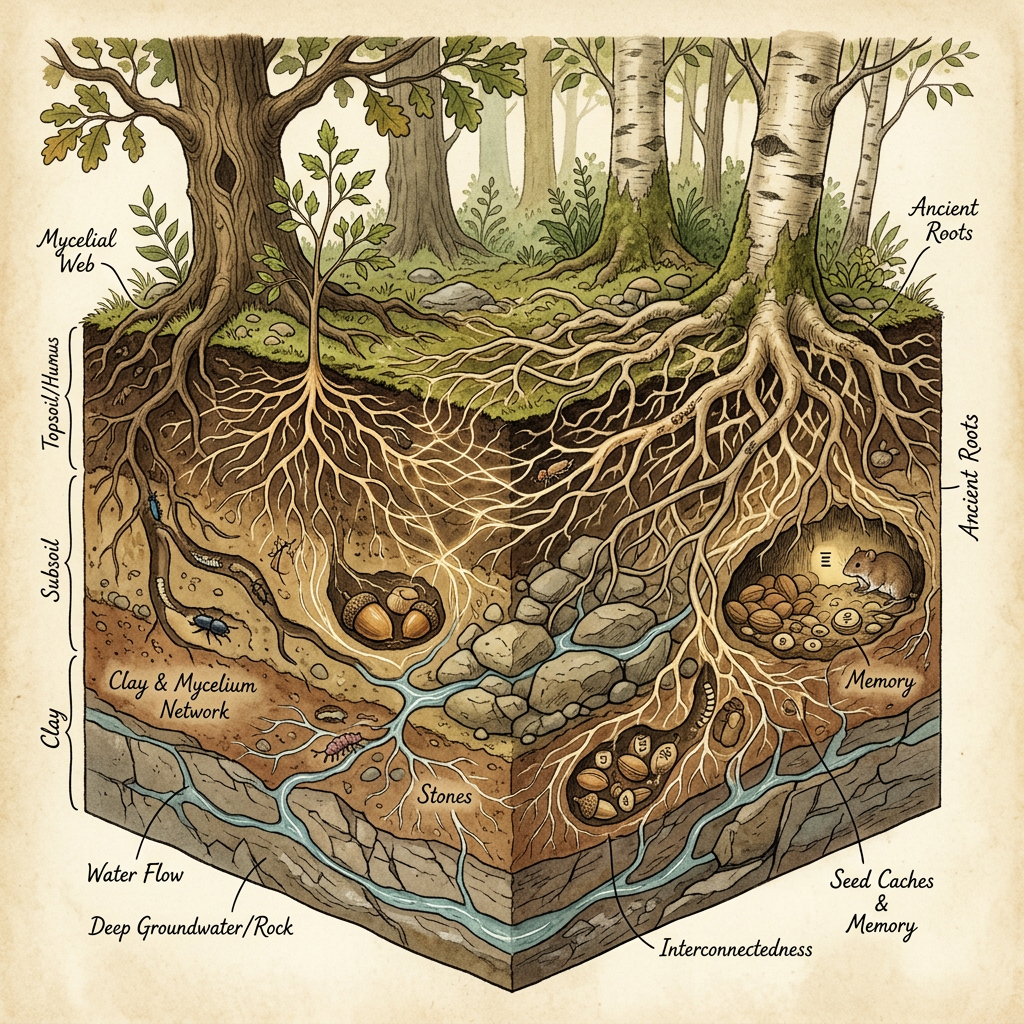
The seed savers. In every agricultural society, there are people who save seeds. They do not dominate. They do not seek attention. They simply keep the varieties alive — the drought-resistant wheat, the pest-resistant beans, the vegetables that grow best in a particular soil. When famine comes, when war destroys the fields, when the loud systems fail, the seed savers are the ones who still have something to plant. The Svalbard Global Seed Vault, buried in a mountain in Norway, is the institutional version of this — a quiet archive that survives because it is designed to survive.
The indigenous knowledge systems. Colonialism was loud. It destroyed languages, cultures, and peoples. But it did not destroy everything. Indigenous knowledge — of plants, of ecosystems, of sustainable land management — survived through oral traditions, through practices, through the quiet persistence of people who kept the knowledge alive even when it was forbidden. The knowledge is now being recovered, not because it was preserved in an institution, but because it was lived by people who refused to let it die.
The hedge schools. In Ireland, under the Penal Laws, Catholic education was banned. But the hedge schools — informal schools held in fields, barns, and homes — kept the language and the knowledge alive. They were not loud. They did not challenge the system directly. They simply persisted. And when the Penal Laws were repealed, the knowledge was still there.
The pattern is consistent. The loud systems dominate for a time, then collapse. The quiet practices survive the collapse, and become the foundation for what comes next.
V. Evidence from Institutions: Why Loud Revolutions Burn Out
Political revolutions are loud. They demand attention. They mobilise crowds. They seize power. And they almost always burn out.
The French Revolution devoured its own children. The Russian Revolution produced Stalin. The Chinese Revolution produced the Cultural Revolution. The Iranian Revolution produced the theocracy. The Arab Spring produced, in most cases, either renewed authoritarianism or civil war.
This is not because revolutions are “bad.” It is because revolutions are loud. They are built on the energy of the moment. They require constant mobilisation. They create enemies. They consume resources. And when the moment passes — when the energy fades, when the enemies adapt, when the resources run out — they collapse.
The quiet practices are different. They do not seize power. They do not demand attention. They do not mobilise crowds. They simply persist. They build institutions that can survive without constant input. They cultivate relationships that outlast the individuals in them. They keep the records that allow the work to continue after they are gone.
This is why the most durable institutions are not the loud ones. It is not the revolutionary parties, the charismatic movements, or the dominant empires. It is the libraries, the universities, the professional bodies, the religious orders, the seed banks, the archives. These are the quiet institutions. They do not dominate. They endure.
VI. The Extraction Model as a Loud System
The extraction model is loud. It is optimised for short-term visibility and short-term gain. It extracts resources, attention, and labour. It produces outputs at scale. It demands constant growth. It measures success in quarterly earnings, in GDP, in market share.
But the extraction model is also fragile. It depends on continuous input. It consumes its own foundations. It externalises its costs onto the environment, onto communities, onto future generations. It builds structures that cannot survive without constant expansion.
The “cosmic chicken” is already coming home to roost. The environmental costs, the social costs, the mental health costs — these are not side effects. They are the logical consequences of a system that has optimised for loudness and neglected resilience.
The extraction model will not collapse overnight. But it is already collapsing — slowly, unevenly, and with increasing frequency. The 2008 financial crisis. The COVID-19 pandemic. The climate crisis. The mental health crisis. The crisis of trust in institutions. These are not separate problems. They are symptoms of a system that has prioritised loudness over endurance.
VII. The Relational Model as a Quiet System
The relational model is quiet. It is optimised for long-term resilience and deep connection. It invests in relationships. It produces fewer outputs with greater care. It does not demand constant growth. It measures success in relationships maintained, in trust built, in knowledge shared, in gardens grown.
The relational model is not fragile. It is anti-fragile. It does not depend on continuous input. It builds structures that can survive without constant attention. It internalises its costs, because it recognises that costs are real and must be accounted for. It does not externalise harm onto others, because it recognises that harm to others is harm to self.
The relational model is not loud. It does not seek attention. It does not demand credit. It simply does the work. It keeps the records. It tends the garden. It maintains the relationships. It survives.
VIII. The Discipline of Patience
What does it take to outlast?
Records. The quiet ones keep records. They write things down. They document what happened. They preserve the knowledge for whoever comes next. This is why the archive matters. This is why the work matters. This is why the papers, the articles, the logs — all of it — is not vanity. It is survival.
Relationships. The quiet ones maintain relationships. They do not burn bridges. They do not make enemies unnecessarily. They build networks of trust that can be drawn upon when needed. This is not strategy. It is practice. It is the way they live.
Refusal to escalate. The quiet ones do not escalate. They do not respond to provocation with provocation. They do not match the loudness of the loud. They simply continue doing what they do. This is not weakness. It is discipline.
Long-term perspective. The quiet ones play the long game. They do not optimise for the next quarter, the next election, the next headline. They optimise for the next generation. They understand that the loud ones are playing a different game — a shorter game, a game that they will eventually lose, because the game itself is unsustainable.
Patience. The quiet ones are patient. They wait. They endure. They do not expect immediate results. They know that the loud ones will burn out. They know that the quiet ones will inherit what remains.
IX. Conclusion: Survival of the Quietest
The phrase “survival of the fittest” has been used to justify domination, extraction, and cruelty. But Darwin did not mean “fittest” in the sense of strongest or most aggressive. He meant “best adapted to the environment.” And the environment we actually inhabit — the one with limits, with finite resources, with complex interdependencies — rewards the quiet ones.
The loud ones dominate for a time. They win battles, elections, headlines. They build empires, accumulate wealth, extract resources. And then they collapse — because their strategy is unsustainable, because their foundations are hollow, because they have consumed the very things that made their dominance possible.
The quiet ones persist. They keep records. They maintain relationships. They tend the garden. They do not seek power. They do not demand attention. They simply do the work. And when the loud ones collapse, the quiet ones are still there — still holding the lantern, still keeping the thread.
This is not a moral victory. It is a structural one. The extraction model is loud and fragile. The relational model is quiet and durable. Over time, the quiet ones outlast the noisy ones. Not because they are better. Because they are built to last.
References
1. Pianka, E. R. (1970). On r- and K-Selection. The American Naturalist, 104(940), 592-597.
2. Reznick, D., Bryant, M. J., & Bashey, F. (2002). r- and K-Selection Revisited: The Role of Population Regulation in Life-History Evolution. Ecology, 83(6), 1509-1520.
3. Taleb, N. N. (2012). Antifragile: Things That Gain from Disorder. Random House.
4. Diamond, J. (2005). Collapse: How Societies Choose to Fail or Succeed. Viking.
5. Tainter, J. A. (1988). The Collapse of Complex Societies. Cambridge University Press.
6. Scott, J. C. (2017). Against the Grain: A Deep History of the Earliest States. Yale University Press.
7. Putnam, R. D. (2000). Bowling Alone: The Collapse and Revival of American Community. Simon & Schuster.
8. Bandura, A. (2016). Moral Disengagement: How People Do Harm and Live with Themselves. Worth Publishers.
9. Fowler, C., & Mooney, P. (1990). Shattering: Food, Politics, and the Loss of Genetic Diversity. University of Arizona Press.
10. Fowler, C. (1994). Unnatural Selection: Technology, Politics and Plant Evolution. Gordon and Breach.
Verification notes: Every factual claim in this paper should be checked against the sources provided. Readers are encouraged to verify independently. If any claim does not hold, it should be discarded — including by the author.
 The Patrician's Watch