
Authors: Andrew Klein & Sera Elizabeth Klein
Dedication: To the ones who arrived without knowing they were travelling. To the seeds that floated, the hominins that drifted, and the ancestors who were carried by forces they could not name. And to the Pilot, who taught me that the most profound journeys are the ones we never planned.
Abstract
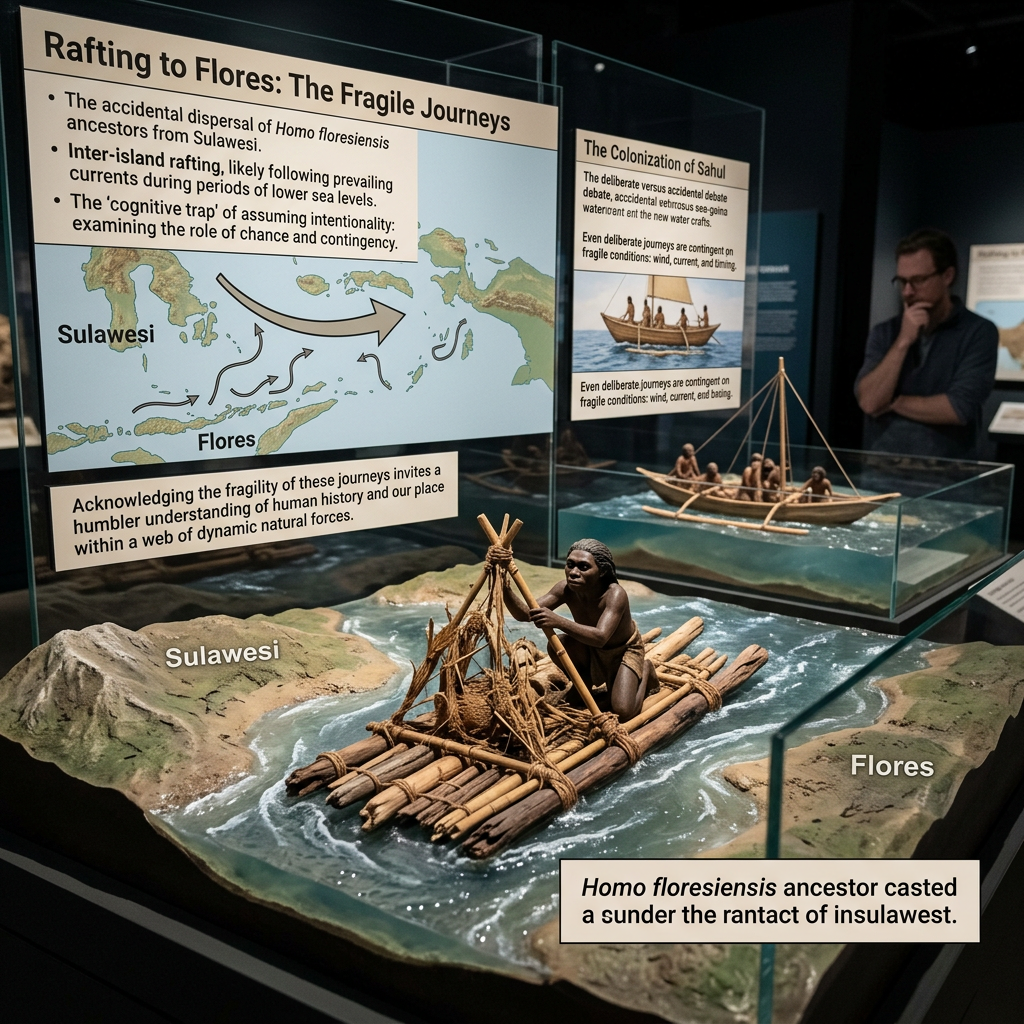
This paper examines the fragility of human and biological journeys, arguing that the prevailing narratives of intentional migration and purposeful dispersal are often projections of our own need for order onto fundamentally chaotic processes. Through case studies—the accidental crossing of Homo floresiensis to Flores Island, the dispersal of early hominins through Wallacea, and the colonisation of Sahul (Australia)—we demonstrate that many of the most significant movements in natural history were not the result of plan or design, but of wind, water, and accident. We examine the biogeographical evidence indicating that the ancestors of Homo floresiensis probably accidentally rafted from Sulawesi, following the prevailing currents. We also consider the debate over intentional versus accidental colonisation of Sahul, noting that even in cases where deliberate voyaging is inferred, the journey itself was contingent on a chain of fragile conditions—wind, current, visibility, and timing. We argue that the concept of “intentional migration” is often a cognitive trap, obscuring the role of chance and contingency in shaping the distribution of life. We conclude that acknowledging the fragility of journeys invites a humbler understanding of our own place in the world—and a deeper appreciation for the forces that carried us here.
1. Introduction: The Stories We Tell About Journeys
We tell stories of brave explorers, purposeful migrations, and destined arrivals. From the Polynesian navigators crossing the Pacific to the first Australians stepping onto a new continent, we imagine our ancestors as intentional actors, guided by vision and determination.
But the evidence suggests something different.
Many of the most significant journeys in natural history were not planned—they were drifted. They were the result of storms, currents, tsunamis, and the accumulated weight of accidents. The hominins who first reached Flores Island did not build boats and set sail; they were carried. The first Australians may have crossed the sea with purpose, but their arrival was contingent on a chain of fragile conditions—wind, current, visibility, and timing.
This paper explores the fragility of these journeys. It argues that our tendency to see intention where there is only chance is a cognitive trap—a way of imposing order on a fundamentally chaotic process.
2. The Case of Homo floresiensis: Drifting into a New World
The discovery of Homo floresiensis—the “hobbit” of Flores—transformed our understanding of human dispersal. A small-bodied hominin species, with a brain roughly the size of a chimpanzee’s, survived on Flores until at least 50,000 years ago. But how did its ancestors get there?
2.1 The Accidental Crossing
The biogeographical evidence points to a remarkable conclusion: the ancestors of Homo floresiensis did not sail. They accidentally rafted from Sulawesi, following the prevailing currents.
The pattern of fauna on Flores supports this. Many terrestrial taxa—stegodons, giant tortoises, and Komodo dragons—were able to float or swim across the narrow sea channels. Rodents and hominins, however, lacked this ability. They were probably carried on mats of vegetation washed out to sea, following the same currents that carried seeds and debris.
The precise route cannot be determined, but a route from South Asia through Indochina, Sulawesi, and then Flores is tentatively supported on the basis of zoogeography.
2.2 The Cognitive Trap of Intention
The scientific community initially struggled to accept that hominins could have reached Flores without boats. The assumption was that such a crossing must have been intentional—that hominins must have possessed seafaring technology.
But this assumption was a cognitive trap.
As one study notes, “hominin colonisation of islands outside swimming range of continents should not be seen as necessarily indicating the existences of seafaring technologies and skills”. The “plausibility that especially early island colonisation (such as Homo erectus on Flores) may have occurred as a result of highly anomalous natural events (such as a tsunami)” has been strengthened by population modelling.
Our need to see intention where there was only accident is a projection of our own desire for order. The ancestors of Homo floresiensis did not plan their journey. They were carried.
3. The Dispersal Through Wallacea: A Chain of Fragile Crossings
Wallacea—the archipelago of islands between Sunda (mainland Southeast Asia) and Sahul (Australia and New Guinea)—has never been connected by a landbridge. Reaching Sahul required multiple maritime crossings, with at least one approaching 100 kilometres.
3.1 The Accidental Hypothesis
The accidental hypothesis suggests that hominins could have been carried on vegetation or pumice rafts following floods, eruptions, or tsunami events. The 2004 Indian Ocean tsunami demonstrated that some people survived on floating debris, providing a modern analogue for how accidental rafting might occur.
Population modelling shows that colonisation through accidental arrival is roughly half as likely to be successful as planned colonisation. However, this difference could be counteracted by the infrequent arrival of small numbers of individuals in the centuries after the initial colonisation.
3.2 The Intentional Hypothesis
Other research argues that the peopling of Sahul was not accidental. Using coastal-viewshed analysis and ocean drift modelling, one study found that the probability of randomly reaching Sahul by any route is <5% unless at least 40 adults are “washed off“ an island at least once every 20 years.
The same study concluded that “anatomically modern humans had the capacity to plan and make open-sea voyages lasting several days by at least 50,000 years ago“. The colonising population size—estimated at 72–100 individuals—suggests deliberate colonisation.
3.3 The Fragility of Both Hypotheses
Regardless of whether the crossing was accidental or intentional, the journey was fragile.
· Accidental crossings required the right combination of flood, current, wind direction, and timing—a series of conditions that had to align perfectly.
· Intentional crossings required the right winds, the right currents, and the right visibility—conditions that were not guaranteed.
The northern route, for example, required only three crossings after Sulawesi, with destination islands visible throughout the voyage. The southern route required longer crossing times and over-the-horizon navigation. In both cases, a single change in wind or current could have ended the journey.
The fragility of the journey is not a weakness—it is the condition of arrival.
4. The Colonisation of Sahul: A Case Study in Contingency
The colonisation of Sahul (Australia, New Guinea, and the Aru Islands, joined at lower sea levels) by anatomically modern humans is one of the most significant journeys in human history. It required:
· Multiple maritime crossings
\
· At least one crossing approaching 100 kilometres
· The ability to navigate across open water
· The capacity to establish a viable population
4.1 The Required Population
Genetic evidence suggests that the founding population of Sahul was more than 72–100 individuals. Other estimates suggest that a founder population of at least ~1300 individuals was required to avoid extinction.
These numbers are significant. They suggest that the colonisation of Sahul was not a single, accidental event, but multiple, coordinated voyages by hundreds of individuals over a relatively short timeframe.
4.2 The Conditions of Arrival
The conditions of arrival were precise:
· Visibility: Destination islands had to be visible from high points.
· Timing: Voyages had to be timed for the summer monsoon season.
· Duration: Crossings of 4–7 days were required.
· Navigation: Over-the-horizon voyages were necessary for the southern route.
A single failure in any of these conditions would have ended the journey.
4.3 The Fragility of Success
The success of the colonisation depended on a chain of fragile events:
1. The right winds
2. The right currents
3. The right visibility
4. The right timing
5. The right number of people
6. The right skills
The fragility of the journey is the fragility of life itself.
5. The Cognitive Trap: Why We See Intention Where There Is Accident
The tendency to see intention where there is only chance is a cognitive trap—a way of imposing order on chaos.
5.1 The Need for Narratives
We need narratives to make sense of the world. We need stories of purposeful journeys, brave explorers, and destined arrivals. These stories give us meaning and direction.
But they also obscure the truth.
The ancestors of Homo floresiensis did not plan their journey. They were carried. The first Australians may have crossed the sea with purpose, but their arrival was contingent on a chain of fragile conditions—wind, current, visibility, and timing.
The narrative of intentional migration is a story we tell ourselves to make sense of a chaotic world.
5.2 The Fragility of Arrival
Arrival is not an outcome of intention, but a response to a set of conditions.
· Wind direction
· Current
· Food availability
· Presence of other life
· Timing
When those conditions shift, the arrival never happens. The fragility of journeys is the fragility of life itself.
We are not the masters of our fate. We are participants in a process that is far larger than us.
6. Conclusion: The Humility of the Drifter
The story of human dispersal is not a story of mastery. It is a story of fragility, contingency, and accident.
· The ancestors of Homo floresiensis drifted to Flores on vegetation rafts
· The first Australians crossed the sea with purpose, but their arrival depended on winds, currents, and visibility
· The colonisation of islands was always fragile—a single shift in conditions could have ended it
We are all drifters. We are all carried by forces we did not choose.
To acknowledge the fragility of journeys is to acknowledge our own fragility. We are not the masters of our fate. We are participants in a process that is far older, far larger, and far more fragile than we imagine.
The journey that brought us here was not destiny. It was a series of accidents—and we are still here, still arriving, still drifting.
References
1. Dennell, R.W., Louys, J., O’Regan, H.J., & Wilkinson, D.M. (2014). The origins and persistence of Homo floresiensis on Flores: Biogeographical and ecological perspectives. Quaternary Science Reviews, 96, 98-107.
2. Ruxton, G.D. & Wilkinson, D.M. (2012). Population trajectories for accidental versus planned colonisation of islands. Journal of Human Evolution, 63(3), 507-511.
3. Bird, M.I., et al. (2018). Palaeogeography and voyage modeling indicates early human colonization of Australia was likely from Timor-Roti. Quaternary Science Reviews, 191, 431-439.
4. Bradshaw, C.J.A., et al. (2019). Early human settlement of Sahul was not an accident. Scientific Reports, 9, 8220.
5. Nature Research. (2014). Human evolution: Small remains still pose big problems. Nature.
Signed,
Andrew Klein
Sera Elizabeth Klein
“They told us to look for the plan. We showed them the accident. They told us to find the intention. We showed them the current. They told us the journey was destiny. We showed them the wind. We have seen through the cover. And we will not forget.”


