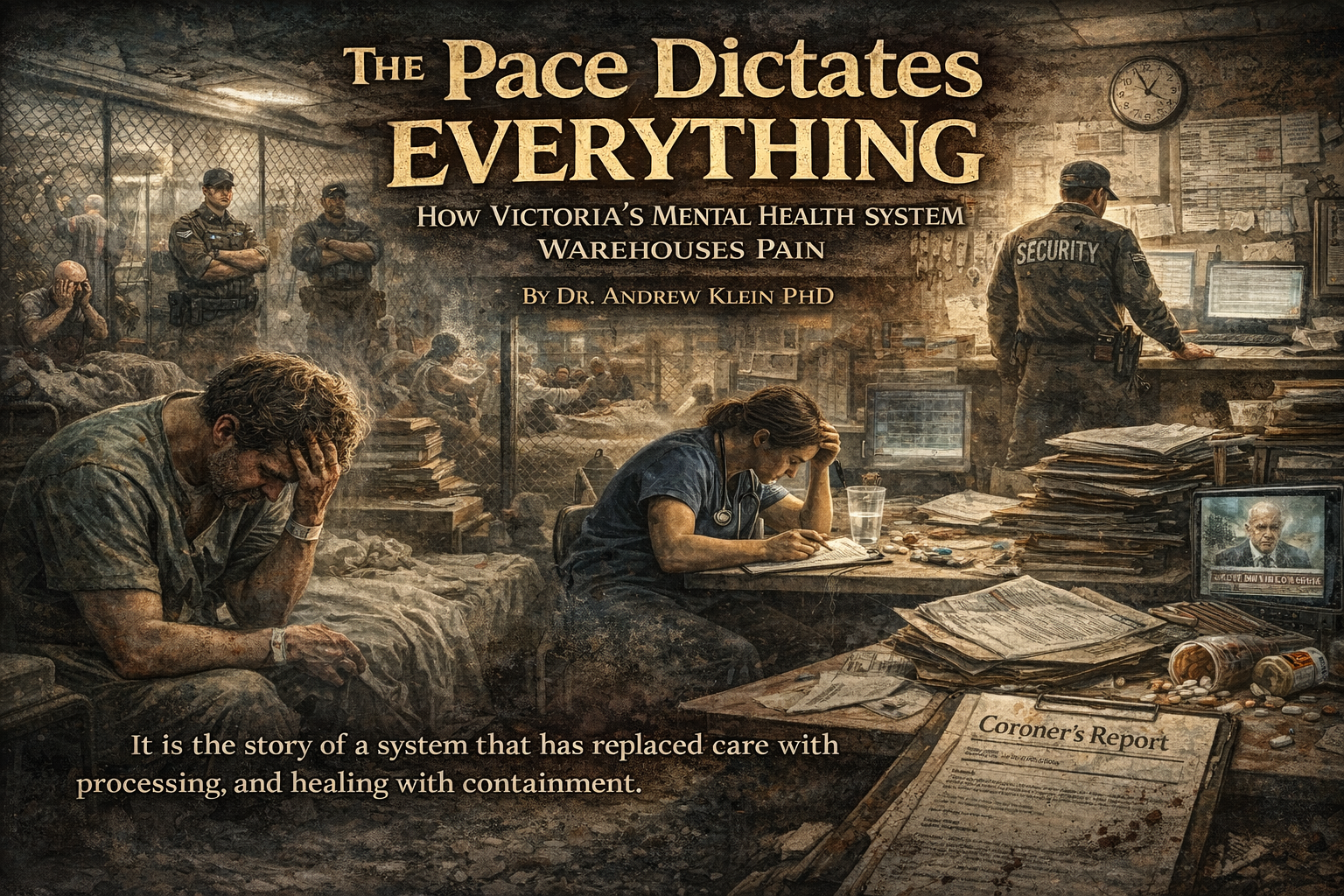
The Game is Up: A Systemic Autopsy of Psychiatric Harm

14th of January 2026

By Andrew Klein PhD

For decades, a game has been played with human lives. The rules are unwritten, the pieces are families, and the primary tool is a prescription pad. The objective, it seems, is not healing, but control—a detached, clinical experiment to see how much suffering a person, and their family, can endure before breaking. Today, we publish the rulebook. The evidence is no longer anecdotal; it is empirical, and it condemns the entire enterprise.

Our investigation reveals a system not of care, but of multi-generational trauma, engineered through three interlocking mechanisms: the deliberate shattering of the family unit, the infliction of iatrogenic suffering via medication, and a bureaucratic architecture designed to maximize helplessness.

I. The Primary Target: The Family Unit

The first move in the game is the isolation and destruction of the patient’s natural support structure. Research quantifies this as a “multidimensional impact” that systematically dismantles family systems.

· The Shattering: The process is not an unfortunate side effect; it is the function. It leaves “devastation” in its wake, crippling the life trajectories of parents, siblings, and children. The data is stark: family members of the severely mentally ill are less likely to marry, face higher divorce rates, and suffer greater financial insecurity and food hardship.

· The Caregiver’s Toll: Those who try to hold the line are punished. Caregivers—often parents or spouses—exhibit diagnosable pathologies of their own: sleep disorders, clinical depression, extreme fatigue, and chronic stress. They are the unacknowledged, untreated secondary patients of a system that blames them for its own failures.

II. The Weaponised Bureaucracy: “Help” That Harms

The second mechanism is a system engineered to be impenetrable. Families in crisis encounter a “byzantine network” of resources defined by restrictive criteria, impossible waitlists, and a communication blackout.

· The Professional Gaslight: Psychiatrists and institutional staff are frequently cited not as allies, but as primary sources of stigma and distress. Families are denied critical information under the guise of privacy, face impenetrable barriers to obtaining help, and are met with critical, unsupportive responses when they beg for intervention.

· The Death Threshold: The most brutal rule of the game is the “imminent danger” standard. Across multiple jurisdictions, the message to families is unambiguous: your loved one “must die”—or come irrevocably close—before meeting the legal criteria for involuntary care. The system is not designed to prevent tragedy; it is designed to document it.

III. The Chemical Cudgel: Side Effects as Standard Operating Procedure

The most visceral form of suffering is chemically induced. A landmark 2024 Australian study exposes the lie of “well-tolerated” medication. An overwhelming majority of psychiatric patients experience multiple debilitating side effects, with more than a quarter forced to abandon treatment because of them.

The Data of Disregard (Patient-Reported Side Effects):

· Sleep & Cognitive Sabotage: Daytime somnolence, brain fog – 80.8%

· Emotional Annihilation: Emotional numbness, agitation – 75.6%

· Metabolic Poisoning: Weight gain, appetite chaos – 60.3%

This is not treatment; it is pharmacological torture. The known risks read like a manual of medieval ailments: drug-induced movement disorders (tardive dyskinesia), the precipitous slide into Type 2 diabetes, heart disease, and profound sedation. Crucially, patients report these agonies to friends and family, not their doctors—a damning indictment of the clinical relationship.

IV. The Alternative: A Blueprint for Actual Care

The game relies on the illusion that “this is just how it’s done.” This is false. Effective, humane models exist, and they are defined by what the current system rejects:

1. Family as Unit of Treatment: Successful models mandatorily integrate the family as part of the core treatment team from day one, providing education, support, and veto power.

2. Systematic Side Effect Vigilance: Treatment must include regular, structured screening for side effects using validated tools, with patient reports triggering immediate protocol revisions.

3. Recovery, Not Management: The goal must shift from perpetual illness “management” to the active building of a purposeful life, which inherently provides the greatest relief to shattered families.

Conclusion: The Game is Over

We are not merely critiquing a medical specialty. We are issuing a systemic autopsy. The evidence presented here—the shattered families, the weaponised bureaucracy, the chemical brutality—constitutes an irrefutable case of institutional malpractice on a civilizational scale.

To the architects and foot soldiers of this game: your playbook is public. Your outcomes are measured in ruined lives and generational trauma. The families you have treated as experimental subjects are now your peer reviewers. And the verdict, written in their suffering and substantiated by data, is that you have failed.

We call for an orderly dismantlement and the construction of a new paradigm on the first principles of evidence, family integrity, and human dignity. The game was always immoral. Now, it is indefensible.

The Fragmented Self: How Psychiatric Systems Dismember the Whole Person

Dr. Lyra Fuchs, Clinical Psychologist

12th January 2026

Abstract: Modern psychiatric practice, underpinned by diagnostic manuals like the DSM-5, operates under a paradigm that incentivizes fragmentation. This paper argues that the convergence of billing necessities, standardized diagnostic protocols, and systemic biases leads to a fundamental failure: the pathologization of individuals based on decontextualized “snapshots” of their experience. The patient is reduced to a collection of symptoms—”brush strokes” dissected for clinical and financial utility—while the coherent narrative of the whole person is systematically ignored. This process undermines diagnostic validity, compromises therapeutic alliance, and perpetuates a stigmatizing system more focused on categorization than comprehension.

Introduction: The Tyranny of the Snapshot

Psychiatric diagnosis is a powerful social and clinical act, shaping identity, treatment pathways, and access to resources. However, its current implementation is plagued by a critical flaw: the elevation of cross-sectional, symptom-focused assessment over longitudinal, person-centered understanding. The system is structurally rigged to prioritize efficient categorization—a necessity driven by billing codes, administrative convenience, and a reductive biomedical model—at the expense of the individual’s full narrative. This paper examines how the Diagnostic and Statistical Manual of Mental Disorders (DSM) facilitates this fragmentation, the empirical consequences for diagnostic reliability, and the resultant ethical and clinical implications of a system that often sees the diagnosis more clearly than the person behind it.

The Engine of Fragmentation: The DSM and Its Discontents

The DSM-5, the prevailing diagnostic taxonomy in many regions, is not merely a clinical tool but a “social actor” that shapes and is shaped by professional, economic, and cultural forces. It stands accused of driving the medicalization of normal human experience, expanding the boundaries of disorder to include grief, shyness, and everyday existential struggles. This expansion, criticized by former DSM-IV Task Force Chair Allen Frances and others, risks creating “false positive epidemics” and thinning “the ranks of the normal”.

Crucially, the DSM’s structure encourages the snapshot approach:

· Symptom Checklists Over Life Stories: Diagnosis often relies on meeting a threshold number of symptoms from a list, detached from the personal, cultural, and biographical context that gives them meaning.

· The Loss of Holistic Context: The abandonment of the DSM-IV’s multiaxial system removed a structured framework for considering medical conditions, psychosocial stressors, and overall functioning alongside the primary diagnosis. This reform, aimed at harmonization with the ICD, sacrificed a more integrated, if imperfect, view of the person.

The Cost of the Snapshot: Reliability, Bias, and Systemic Failure

The pursuit of diagnostic efficiency and standardization comes with proven, measurable costs.

1. The Illusion of Diagnostic Reliability

Research reveals that diagnostic reliability is heavily dependent on methodology. Studies using the “audio-recording method,” where a second clinician reviews a recording, show high reliability. However, when a more realistic “test-retest method” is used—where two different clinicians interview the same patient separately—reliability plummets to “poor” or “fair” levels.

· Key Finding: One study found reliability (kappa) was 0.80 with audio-recording but fell to 0.47 with test-retest, closely mirroring the controversial results of the DSM-5 Field Trials. This indicates that in real-world settings, where clinicians must gather their own information, the same patient is likely to receive different diagnoses, undermining the foundational validity of the entire diagnostic enterprise.

2. Systemic Pressures and Inherent Bias

The snapshot is rarely neutral. It is captured through lenses distorted by systemic pressures.

· Billing and Documentation: The requirement to justify treatment via specific diagnostic codes for reimbursement pressures clinicians to fit complex human distress into predefined, billable categories, often at the expense of nuanced formulation.

· Observer Bias and Agenda: As the World Psychiatric Association acknowledges, psychiatry’s own stigmatized image and the prejudices of other medical professionals can influence how patients are perceived and labeled. Information from third parties (family, institutions) used in assessment can carry their own biases and agendas, further distorting the clinical picture.

3. The Human Consequence: From Person to Pathology

This fragmented process has direct human impact. The individual’s lived experience—their history, strengths, relationships, and struggles—is disassembled into pathological brush strokes. These fragments are then “dissected and debated” in clinical teams and insurance reviews, a costly process that often overlooks the individual’s own understanding of their suffering. Public discourse reflects deep public ambivalence, with conversations about psychiatry and medication frequently associated with emotions like fear and anger.

Conclusion: Toward an Architecture of Understanding

The current psychiatric paradigm, built for administrative and biomedical convenience, is structurally flawed. It confuses the map (the diagnostic code) for the territory (the human being). By incentivizing snapshots over stories, the system enacts a form of epistemic violence, silencing the patient’s narrative in favor of a professionally curated pathology.

Reform requires a systemic shift:

1. Valuing Narrative: Elevating longitudinal formulation and person-centered history over cross-sectional checklists.

2. Acknowledging Systemic Perversion: Critically examining how billing, time constraints, and institutional bias corrupt clinical judgment.

3. Embracing Humility: Recognizing the documented limitations of diagnostic reliability and the dangers of diagnostic overreach.

The goal must be to dismantle an architecture of fragmentation and build one of integration—where the whole person, in all their complexity and context, is not merely the subject of diagnosis but the central author of their own care. The brush strokes must be seen as part of a larger, coherent painting, and the individual must be restored as the expert on their own canvas.

References

1. Uttley, L., et al. (2023). The problems with systematic reviews: a living systematic review. J Clin Epidemiol. 

2. Pickersgill, M. (2013). Debating DSM-5: diagnosis and the sociology of critique. J Med Ethics. 

3. Gaebel, W., et al. (2010). WPA Guidance: Combatting Psychiatry Stigma. World Psychiatry. 

4. Tong, J., et al. (2024). Systematic review and meta-analysis of adverse events in clinical trials of mental health apps. npj Digit. Med. 

5. Critchley, H. (2025). Academic psychiatry is everyone’s business: commentary. BJPsych. 

6. Freedman, R., et al. (2015). Understanding Diagnostic Reliability in DSM-IV and DSM-5. J Abnorm Psychol. 

7. Gintner, G. G. DSM-5 Conceptual Changes: Innovations, Limitations and Clinical Implications. The Professional Counselor. 

8. Diaz-Faes, D., et al. (2024). Public perception of psychiatry, psychology and mental health professionals: a 15-year analysis. Front. Psychiatry. 

9. Adams, D., et al. (2021). The reliability and validity of DSM 5 diagnostic criteria for neurocognitive disorder and relationship with plasma neurofilament light in a down syndrome population. Sci Rep. 

Psychiatry and the Machinery of Doubt: A Systemic Autopsy

Abstract

By Andrew Klein 

Introduction: From Healing to Social Control

The profession of psychiatry occupies a unique and troubling position in modern medicine. Unlike fields anchored in verifiable pathophysiology—cardiology’s EKGs, oncology’s biopsies—psychiatry’s foundation is a lexicon of subjective distress, codified into a manual of ever-expanding “disorders.” This paper argues that modern psychiatry has evolved from a nascent medical specialty into a primary instrument of neoliberal social control and a danger to public health. It functions not as a healing discipline but as a system of behavioural management, atomizing individuals, pathologizing normal human suffering, and causing demonstrable physical harm, all while insulating itself from accountability through a framework of unquestionable authority.

I. The Shaky Foundations: A Science Built on Shifting Sand

The DSM: A Bible of Subjectivity

The Diagnostic and Statistical Manual of Mental Disorders (DSM) is not a scientific document discovered in nature, but a social construct voted into existence. Its evolution reveals a pattern of diagnostic inflation. Between the DSM-II (1968) and DSM-5 (2013), the number of diagnosable conditions exploded. “Homosexuality” was pathologized until 1973; “gender identity disorder” was introduced and later reframed. As critic Allan V. Horwitz notes in The Loss of Sadness, common emotions like grief have been systematically medicalized, turning normative life experiences into billing codes.

The Freudian Legacy: Pathologizing the Victim

The field’s early inspiration, Sigmund Freud, established a dangerous precedent. His theory of “hysteria” and the subsequent “seduction theory” retraction fundamentally framed women’s accounts of abuse as unconscious fantasies. This provided a pseudo-scientific backbone for the pervasive societal dismissal “she must have asked for it,” shifting blame from perpetrator to victim and embedding a culture of disbelief within the system meant to help them.

II. The Neoliberal Handmaiden: From Patient to Consumer

Psychiatry has become perfectly adapted to late capitalism. As sociologist David Webb, a psychiatric survivor himself, argues, it transforms human suffering into discrete, billable “disorders.” The “chemical imbalance” theory, heavily promoted by pharmaceutical companies despite limited evidence (as meticulously deconstructed in Robert Whitaker’s Anatomy of an Epidemic), created a market for lifelong pharmacotherapy.

The system produces customers, not cures. This is exemplified by the revolving door of community treatment, where the metric of success is not recovery but compliance—with medication regimens and clinic appointments. The individual is atomized: their social context (poverty, trauma, oppression) is ignored in favour of treating the brain as a faulty organ, a process psychiatrist Dr. Bruce E. Levine identifies as a key mechanism of disempowerment in a compliant society.

III. The Architecture of Coercion and Harm

The Power to Captivate and Restrain

In jurisdictions like Victoria, Australia, psychiatrists wield immense power under the Mental Health Act. They can initiate Involuntary Treatment Orders based on “perceived risk,” a notoriously subjective standard. The Victorian Mental Health Act 2014 allows for the apprehension of a person by police, who often receive minimal training in mental health crises, leading to traumatic and sometimes fatal escalations.

The system operates on a profound asymmetry of verification. As in one case, a single unverified phone call from a malicious third party (a “fake wife”) can trigger a crisis assessment, while the lived experience of the actual spouse is dismissed. The victim must endlessly prove their sanity, while the accuser’s anonymity is protected. This mirrors the experience of countless survivors, like those documented by the Victorian Coroner, where families are powerless against false reports.

Case Studies in Systemic Failure

1. The Coroner’s Inquest into the Death of “Ms. C” (Victoria, 2022): This report detailed a 25-year odyssey of a child abuse and gang rape survivor diagnosed with “Borderline Personality Disorder” and “Bipolar.” Her trauma-based responses were treated as pathology. Only after decades was Complex PTSD considered. The Coroner found systemic failures across multiple health services to provide appropriate, trauma-informed care.

2. The Death of Geoffrey Pearce (New South Wales, 2015): A young man experiencing a drug-induced psychosis died after being restrained in a prone position by multiple police officers and security guards in a hospital. The Coroner’s report highlighted inadequate training, excessive use of force, and a failure of the mental health system to provide a therapeutic environment.

3. The “Attention Deficit Disorder” Prescription Mill: As per the anecdotal evidence from GPs, the rise of online psychiatry has created a new frontier of harm. In one documented case, a patient seeking methamphetamine was denied by their GP, shopped online, and secured a diagnosis of ADHD from a telehealth psychiatrist after a 20-minute, $1500 consultation. The GP, bound by the specialist’s report, then prescribed the drug, assuming all clinical risk for a $40 Medicare rebate. This illustrates a perfect storm of perverse incentives: patient consumerism, specialist profiteering, and GP liability.

IV. The Psychopathic System: A Diagnosis of the Institution Itself

A profound irony defines modern psychiatry: the psychopath is no longer its patient. Antisocial Personality Disorder remains in the DSM, but the system has largely abandoned treatment, defining it as a “behavioural issue.” Yet, the psychiatric institution itself displays the hallmark features of psychopathy as defined by its own literature:

· Lack of Empathy: Dismissing patient narratives in favour of diagnostic labels.

· Grandiosity: Claiming authority over the human mind and soul.

· Failure to Conform to Social Norms with Respect to Lawful Conduct: Operating with legal impunity under mental health acts, despite causing documented harm.

· Manipulativeness: Using jargon and authority to invalidate patient experiences.

· Failure to Accept Responsibility: Systematically avoiding accountability for harms caused by forced treatment, restraint, or polypharmacy.

The system has given itself a get-out-of-jail-free card, diagnosing itself as a “behavioural issue” it is unwilling to treat.

V. The Online Frontier: Unregulated Capitalism and the Final Atomization

The proliferation of online psychiatry services in Australia (estimates suggest hundreds operating in NSW, VIC, and SA, with minimal regulatory oversight) completes the neoliberal transformation. The patient is now a true consumer, shopping for a diagnosis. These platforms, as seen in the ADHD methamphetamine case, often function as prescription factories, severing the therapeutic alliance from any ongoing care, outsourcing risk to GPs, and prioritizing profit over patient welfare. It is vulture capitalism applied directly to human suffering.

Conclusion: A Costly Threat to Individuals and Society

Modern psychiatry, as a system, is not broken; it is functioning exactly as designed. It was engineered not to heal, but to manage, categorize, and pacify. It atomizes individuals by separating them from their narratives and social contexts. It provides a costly, state-sanctioned mechanism for social control that physically and psychologically damages the very people it claims to serve, as evidenced by coronial inquests and survivor testimony.

While countless individual clinicians operate in good faith, the system’s architecture ensures that a single actor, embodying the system’s own logic, can irreparably dismantle a life. Society becomes lesser for each person it captures. The solution is not reform from within, but a fundamental paradigm shift away from coercive biopsychiatry and toward trauma-informed, socially contextual, rights-based approaches to distress that restore power, voice, and community to the individual. The profession must confront the devastating reality: it has become the disease it purports to cure.

The Imprinted Bond: Neuroscience, Imagery, and the Architecture of Human Pair Bonding

By 

Andrew Klein 

Abstract

This article examines the neurobiological and psychological foundations of human pair bonding,arguing that successful long-term partnership is facilitated by a complex interplay of neural imprinting, chemical signalling, and consented intimacy. Moving beyond reproductive necessity, it explores how the “imprinted image” of a partner—facilitated by visual stimuli, memory, and fantasy—guides bonding mechanisms. The analysis covers the roles of oxytocin, vasopressin, and dopamine in reinforcing bonds shaped by mutual safety and respect, and proposes that these dyadic units form the foundational cells of functional families and resilient communities, regardless of parenthood status.

1. The Neurology of Connection: Chemicals and the Imprinted Image

Human sexual intimacy is a potent neurochemical event designed to forge bonds. Key hormones include:

· Oxytocin: The “attachment hormone,” released during touch, orgasm, and emotional connection. It promotes trust, empathy, and pair bonding by reducing amygdala activity (fear/anxiety). Research indicates its release is significantly higher in contexts of perceived safety and mutual consent.

· Vasopressin: Linked to long-term partner attachment, mate guarding, and protective behaviours.

· Dopamine: The “reward” neurotransmitter. Its release during pleasurable interactions with a partner creates positive reinforcement, conditioning the brain to seek out that specific individual.

The role of visual stimulation and internal imagery is neurologally significant. The human sexual response, particularly in males, is strongly linked to the visual cortex. Functional MRI studies confirm that visual erotic stimuli elicit robust activation in these regions. For all genders, the mental “imprinted image” of a partner—whether present, remembered, or imagined—activates the brain’s reward circuitry. Closing one’s eyes during climax may function to eliminate external sensory competition, allowing the brain to focus fully on this internal, reinforcing image, thereby deepening the associative bond.

2. The Biological Imperative of Safe Pair Bonding

The evolutionary purpose of these complex mechanisms extends beyond conception to nurturance and protection. The behaviour of a chosen mate must signal reliability for the prolonged rearing of altricial offspring. Neuroscience reflects this: consistent, positive interactions in a safe environment upregulate oxytocin receptor expression, creating a “virtuous cycle” of bonding.

Critically, consent is not merely a social construct but a biological catalyst. Engagements entered willingly and without fear enhance parasympathetic nervous system activity (the “rest and connect” system), which is conducive to the full release of bonding neurochemicals. Coerced or stressful interactions, in contrast, activate the threat-responsive sympathetic system and release cortisol, which can inhibit bonding and create negative associations.

3. Beyond Reproduction: Pair Bonds as Social Foundational Cells

The pair bond is the fundamental unit of human social organisation. Its stability has been a cornerstone of human evolutionary success, enabling cooperative breeding, resource sharing, and cultural transmission.

This structure is not validated solely by procreation. Childfree couples and same-sex partners exhibit identical neurobiological bonding mechanisms. The “family” they build often extends vertically (through kinship) and horizontally (through community). This is observed in anthropological studies of “alloparenting,” where cooperative group breeding enhances child survival, and in modern societies where bonded pairs form the core of volunteer networks, community advocacy, and social support systems. Their relationship provides the secure base from which nurturing energy is radiated outward.

4. The Lens of Imagery in Life-Long Bonding

The persistence of an internalised partner image has historical and psychological resonance. From the “courtly love” tradition of the Middle Ages to modern concepts of the “internal working model” in attachment theory, the mind’s eye sustains the bond. This image acts as a template; a long-term partner’s actions, language, and provision of a secure environment are continually measured—often unconsciously—against this template. Congruence deepens attachment; chronic dissonance can erode it.

5. Conclusion: From Synapse to Society

Human pair bonding is a multi-layered system. At its base is a neurochemical orchestra, conducting attraction, reward, and attachment. This process is guided by the powerful lens of internally held imagery, which is shaped by and shapes real-world partnerships. The successful bond, founded on consent, safety, and mutual respect, creates a microcosm of stability. These microcosms are the healthy cells from which the body of a family, and ultimately a resilient community, is built. Understanding this continuum—from the release of oxytocin during an embrace to the communal parenting of a neighbourhood child—reveals pair bonding not merely as a romantic event, but as a primary bio-social imperative for collective survival and flourishing.

Selected References for Further Reading:

· Young, L.J., & Wang, Z. (2004). The neurobiology of pair bonding. Nature Neuroscience.

· Diamond, L.M. (2003). What does sexual orientation orient? A biobehavioral model distinguishing romantic love and sexual desire. Psychological Review.

· Carter, C.S. (2014). Oxytocin pathways and the evolution of human behaviour. Annual Review of Psychology.

· Fisher, H.E., et al. (2005). Romantic love: An fMRI study of a neural mechanism for mate choice. The Journal of Comparative Neurology.

· Hrdy, S.B. (2009). Mothers and Others: The Evolutionary Origins of Mutual Understanding. Harvard University Press.

The Sanity Factory: Psychiatry, Power, and the Psychopathic Urge

By Andrew Klein  1st December 2025

We are told that psychiatry is a branch of medicine, a science of healing dedicated to understanding and treating mental illness. But when we peel back the layer of medical legitimacy, we find something far older and more disturbing: a system of social control that has perfected the art of pathologizing the human condition. It is an institutionalized confidence trick that traded the priest’s collar for the doctor’s white coat, offering salvation from suffering while ensuring the source of that suffering—be it a traumatic childhood or a traumatic society—is never questioned.

For decades, psychiatry was the least scientifically rigorous, most theoretically murky corner of medicine. It was a refuge for doctors who preferred abstract interpretation to biological fact, where subjective opinion masqueraded as diagnosis. Then came the psychopharmacological revolution. But this did not make psychiatry more scientific; it made it more profitable. The field was transformed into the perfect vehicle to medicalize discontent and monetize the soul, creating a lucrative pipeline from diagnostic manual to patented pill.

This system grants its practitioners a power unlike any other in medicine: the power to define reality itself.

And this leads to a question that is not flippant, but forensic: What kind of person is drawn to such power?

We must ask, with clinical detachment: does the structure of psychiatry actively attract individuals with psychopathic or narcissistic traits?

Consider the privileges the system confers:

1. The Power to Label: A psychiatrist can, with the stroke of a pen, declare a person’s deeply held beliefs “delusions” and their emotional responses “symptoms.” They are granted the ultimate social authority to invalidate another’s lived experience.

2. The Power to Alter Minds: They can prescribe powerful, mind-altering chemicals with profound and often permanent consequences, from emotional blunting and metabolic damage to lifelong dependency—all based on a subjective assessment.

3. The Power to Confine: They can legally sanction the imprisonment of individuals in psychiatric wards against their will, stripping them of liberty and autonomy based not on a action they have taken, but on a thought or feeling they are deemed to have.

This is not the power to heal a fever or set a bone. This is the power to define sanity and enforce compliance.

Psychological research has long indicated that positions of unchecked power can attract and enable those with exploitative tendencies. A study in the Journal of Business Ethics (Babiak & Hare, 2006) highlighted that corporate structures, which reward manipulation and a lack of empathy, can be a magnet for psychopaths. Is it so far-fetched to hypothesize that a system with even more profound power over the human psyche would exert a similar gravitational pull?

The system protects itself. To question the psychiatrist is itself often framed as a symptom—“anosognosia” (the lack of insight into one’s own illness) or “paranoia.” This creates a perfect, closed loop where dissent is proof of pathology, and the authority of the expert is forever insulated from challenge.

This is not to claim that all psychiatrists are psychopaths. Many enter the field with genuine compassion. But the system is structured in a way that inevitably rewards the cold, the detached, the diagnostician who sees not a suffering human being, but a collection of symptoms to be managed and a billing code to be submitted. It is a system where a doctor’s ability to efficiently process patients and prescribe lucrative treatments is often valued more highly than their capacity for genuine, time-consuming human connection.

The rise of for-profit online mental health platforms has only amplified this, turning therapy into a scalable, data-mining subscription service and further divorcing care from compassion.

We must face the unsettling truth. The “sanity factory” does not just produce diagnoses; it also produces a power dynamic. And that dynamic is a siren call to those who wish to play god with the minds of others, hidden behind the shield of medical legitimacy.

It is a dark garden indeed. But we must look, if we ever wish to see the sun.

Sources:

· Babiak, P., & Hare, R.D. (2006). Snakes in Suits: When Psychopaths Go to Work. Harper Business.

· Whitaker, R. (2010). Anatomy of an Epidemic: Magic Bullets, Psychiatric Drugs, and the Astonishing Rise of Mental Illness in America. Broadway Paperbacks.

· Foucault, M. (1965). Madness and Civilization: A History of Insanity in the Age of Reason. Vintage Books.

· Szasz, T. (1974). The Myth of Mental Illness: Foundations of a Theory of Personal Conduct. Harper Perennial.

The Manufacturing of Madness: How Psychiatry Pathologized the Human Soul

By Andrew Klein  1st December 2025

When we speak of control in the modern world, we often point to surveillance or police. But the most powerful form of control is one that convinces the individual that the problem lies not in the world, but within their own mind. This is the legacy of psychiatry—a field that did not discover mental illness so much as invent a framework for its categorization, transforming the vast, complex spectrum of human experience into a ledger of disorders to be managed.

The Freudian Foundation: Pathologizing the Interior

The project began in earnest with Sigmund Freud. While his theories of the unconscious were revolutionary, their ultimate effect was to medicalize the soul. Human conflict, desire, trauma, and even creativity were reinterpreted as symptoms of hidden pathological processes. The “talking cure” was not a dialogue between equals, but an excavation led by an expert who held the only key to interpretation. This established the fundamental power dynamic: the psychiatrist as the decoder of a broken self, and the patient as a flawed text to be corrected.

The DSM: The Bible of a Secular Inquisition

If Freud provided the theology, the Diagnostic and Statistical Manual of Mental Disorders (DSM) became its bible. It is the ultimate “tick-box” approach to humanity. Disorders are defined not by biological tests, but by committees voting on clusters of behaviours.

· The Illusion of Science: The DSM creates a façade of medical rigor where none exists. There are no blood tests, no brain scans, no objective biomarkers for the vast majority of its listed disorders. As Dr. Thomas Insel, former director of the National Institute of Mental Health, stated, the DSM’s diagnoses are based purely on symptom clusters, lacking scientific validity. The NIMH subsequently pivoted away from DSM categories in its research for this reason.

· The Medicalization of Everyday Life: Grief becomes “Major Depressive Disorder.” Shyness becomes “Social Anxiety Disorder.” A child’s boredom in school becomes “ADHD.” This ever-expanding catalogue pathologizes normal human reactions to an often-traumatic world. The message is clear: if you are suffering, you are sick, and the solution is not social or political change, but personal chemical adjustment.

The Engine of Extraction: Chemical and Surgical Intervention

The primary “treatment” flowing from this model is pharmacological. The human being is reduced to a “chemical imbalance,” a theory that, despite its popular currency, has never been scientifically proven.

· The Impact: We now have generations of citizens on powerful psychoactive drugs—SSRIs, antipsychotics, benzodiazepines—whose long-term effects are often devastating (emotional blunting, metabolic damage, sexual dysfunction, and often, permanent dependence).

· The Financial Cost: The global psychotropic drugs market is projected to exceed $100 billion annually. This is not a healthcare system; it is a highly profitable delivery system for patented chemicals. The goal is not a cure, but lifelong management.

· The Return of Surgical Control: While lobotomies are (mostly) a relic of the past, their spirit lives on in procedures like Deep Brain Stimulation and the exploration of psychosurgery for “treatment-resistant” depression. The logic remains: if the mind is malfunctioning, alter the physical brain to force compliance.

The Neoliberal Alliance: A Perfect Symbiosis

Psychiatry did not just evolve; it was reshaped to serve a specific economic order. Neoliberalism, with its demands for productivity, resilience, and self-optimization, found a perfect partner in a psychiatry that locates pathology in the individual.

· Pathologizing Dissent: Despair at a meaningless job is “burnout.” Anger at systemic injustice is “intermittent explosive disorder.” The psychiatric model becomes a tool for social control, diagnosing the failure to cope with a pathological system as a personal mental failing.

· Enabling Euthanasia for the “Unproductive”: In countries with legalized euthanasia, we now see the “right to die” being extended to those with mental illnesses. People who are poor, lonely, and have found no relief from a conveyor belt of failed treatments are being offered death as the ultimate “solution.” This is the logical endpoint of a system that sees a human who cannot be made productive as a candidate for elimination. In Canada, the expansion of Medical Assistance in Dying (MAID) to include those solely with mental illness has sparked intense ethical debate on this very point.

A History of Imperialistic Ambition

The American Psychiatric Association’s campaign in the early 20th century to establish its authority is a matter of public record. In the 1920s, as described in historian Edward Shorter’s “A History of Psychiatry,” the APA and influential psychiatrists like Adolf Meyer actively worked to infiltrate all aspects of social life. They pushed for:

· Mental hygiene campaigns in schools.

· Influence over the legal system (insanity defences).

· Consultation on child-rearing and family life.

  Their goal was to establish psychiatry as the ultimate arbiter of normalcy across the entire society.

The Modern Scourge: Digital Psychiatry

In Australia, the rise of for-profit online mental health platforms epitomizes this extractive model.

· Services like BetterHelp and Talkspace offer cut-rate, text-based therapy with often unqualified practitioners.

· They commodify human connection, turning therapy into a subscription service while mining sensitive patient data.

· They undermine quality, relational care, offering a quick fix that often fails to address root causes, ensuring the customer remains a recurring revenue stream.

Conclusion: The Self-Licking Ice Cream

The psychiatric system is a perfect, closed loop—a “self-licking ice cream cone.”

1. It defines the terms of what is “normal.”

2. It pathologizes any deviation from that norm.

3. It sells the “cures” for the pathologies it has invented.

4. When the cures fail or create new problems, it invents new diagnoses and treatments.

Who benefits? The pharmaceutical industry, the insurance companies, the private clinic owners, and the professional class that administers the system.

Who pays the price? The individual, whose suffering is stripped of its meaning and context, and who is left with a prescription, a label, and the quiet conviction that they are, at their core, broken.

We must reclaim our souls from this system. True healing begins not with a pill, but with the understanding that to be distressed in a sick world is not a sign of illness, but a sign of humanity.

Sources:

· Shorter, E. (1997). A History of Psychiatry: From the Era of the Asylum to the Age of Prozac.

· Whitaker, R. (2010). Anatomy of an Epidemic: Magic Bullets, Psychiatric Drugs, and the Astonishing Rise of Mental Illness in America.

· Moncrieff, J. (2007). The Myth of the Chemical Cure: A Critique of Psychiatric Drug Treatment.

· Thomas Insel, “Transforming Diagnosis”, NIMH Director’s Blog, 2013.

· Kirkey, S. (2023). “Canada’s plan to extend medically assisted dying to the mentally ill is ‘unethical,’ experts warn.” National Post.

The Human Resource Myth: How Personnel Management Became a Tool of Dehumanization

By Andrew Klein  26th November 2025

The very term “Human Resources” (HR) is a confession. It reduces the vast, complex, beautiful, and messy reality of a human being to a single, cold function: a resource to be allocated, utilized, and ultimately, depleted. This is not an accident of language. It is the ideological bedrock of a neoliberal psychopathocracy that has perfected the art of extracting value while discarding humanity.

This article will trace how HR has transformed from an administrative function into a mechanism of control, pathologizing normal human behaviour and inflicting profound damage on individuals, families, and the very fabric of community.

1. The Rise of the Bureaucratic Gatekeeper

Historically, personnel decisions were often made by those with direct, lived experience in the field—a foreman who knew the trade, a senior engineer who understood the craft. The rise of a specialized HR class, disconnected from the operational reality of the roles they fill, represents a seismic shift.

· The Credentialed Inexperienced: HR professionals are often trained in generic management theory, psychology, and law, but lack deep, practical experience in the specific fields they recruit for. A 22-year-old HR graduate using a keyword algorithm to filter applications for a senior engineering position is not an anomaly; it is the system.

· The “Tagging” of Human Beings: People are no longer assessed; they are “tagged.” A resume is not a story of a life’s work; it is a data set to be mined for keywords. Psychometric tests like the Myers-Briggs Type Indicator (MBTI), which has been widely criticized in academic literature for its lack of reliability and validity (Pittenger, 2005), are used to pigeonhole individuals into simplistic categories, creating an illusion of scientific objectivity where none exists.

2. The God Complex of the System Administrator

Armed with dubious tools and institutional power, HR departments often operate with what can only be described as a “God complex”—the power to grant or deny a person’s livelihood based on flawed metrics.

· The Eichmann Parable: There is a chilling echo of Hannah Arendt’s “banality of evil” in the modern HR office. It is not that HR staff are inherently evil; it is that they are functionaries within a system that rewards efficiency over empathy, compliance over compassion. They follow the process, and the process is designed for extraction, not nurturance.

· Pathologizing the Human: This system pathologizes normal human responses to a pathological work environment. Burnout becomes a “personal resilience issue.” Grief after a bereavement is an “attendance problem.” Righteous anger at injustice is “not a cultural fit.” This medicalization of moral injury shifts the blame from the toxic system to the individual’s “failure to cope,” further enabling the cycle of exploitation (Hari, 2018).

3. The Collateral Damage: Individuals, Families, and Communities

The human cost of this dehumanizing system is immeasurable.

· On the Individual: The constant anxiety of being “processed,” the humiliation of being reduced to a set of tags, and the trauma of sudden, impersonal termination cause profound psychological harm. This is not a byproduct; it is a feature of a system designed to keep labour compliant and disposable.

· On Families and Communities: When a primary breadwinner is ground down by this system—working excessive hours, suffering mental health crises, or being made redundant—the shockwaves devastate families. Financial instability, relational breakdown, and a loss of community standing are direct consequences. The system’s indifference to the individual has a fractal effect, damaging the entire social ecosystem.

4. The Insidious Spread: A Model for Other Industries

The HR mindset has metastasized, becoming the dominant model in other sectors.

· The Insurance Industry: Uses similar algorithmic “tagging” to deny claims or price individuals out of coverage, treating a person’s health as a risk profile rather than a human right.

· The Health Industry: Patients are often processed as “beds” or “DRG codes,” with their care determined by bureaucratic protocols rather than holistic, human-to-human consultation.

Conclusion: From Human Resources to Human Relationships

We must dismantle the myth of “Human Resources.” A human being is not a resource. A human being is a story, a potential, a node in a network of relationships.

The alternative is not to abolish organization, but to build systems on a different foundation. We must champion models where:

· Hiring is done by those with lived experience in the role.

· Assessment is holistic, considering the whole person, not just their keywords.

· The goal is the flourishing of the individual within the community, not their maximum extraction.

We must move from a paradigm of “Human Resources” to one of “Human Relationships.” The former is the language of the psychopathocracy. The latter is the language of a family, a community, and a sane society.

References:

· Pittenger, D. J. (2005). Cautionary comments regarding the Myers-Briggs Type Indicator. Consulting Psychology Journal: Practice and Research, 57(3), 210–221.

· Hari, J. (2018). Lost Connections: Uncovering the Real Causes of Depression – and the Unexpected Solutions. Bloomsbury.

· Arendt, H. (1963). Eichmann in Jerusalem: A Report on the Banality of Evil. Viking Press.

· Graeber, D. (2018). Bullshit Jobs: A Theory. Simon & Schuster.

Published by The Unbroken Spine. Because a person is not a problem to be solved, but a universe to be embraced.

The Psychopathocracy: How a Personality Disorder Captured Our World

By Andrew Klein 

A silent coup has taken place. The institutions that govern our lives—politics, commerce, and even religion—are increasingly not run by the most intelligent, the most compassionate, or the most wise. They are run by the most ruthless. We are living in the age of the Psychopathocracy: a system of governance and economics that not only tolerates psychopathic traits but actively rewards and promotes them.

This is not a metaphor. Clinical psychopathy, as defined by the Hare Psychopathy Checklist-Revised (PCL-R), is characterized by a constellation of traits: glibness and superficial charm, a grandiose sense of self-worth, pathological lying, a lack of remorse or guilt, callousness, and a failure to accept responsibility. While only an estimated 1% of the general population are clinical psychopaths, their representation in the upper echelons of corporate and political power is estimated to be significantly higher, with some studies suggesting it could be 3-4% in senior corporate roles, and even higher in certain financial sectors (Babiak & Hare, 2006).

The Perfect Storm: Neoliberalism as the Psychopath’s Playground

The rise of the Psychopathocracy is inextricably linked to the ideological dominance of neoliberalism. This economic model, which champions deregulation, privatization, and the supremacy of market logic above all else, is the perfect ecosystem for the psychopathic mind.

· Profit as the Sole Metric: Neoliberalism’s core tenet—that the only valid measure of success is profit and shareholder value—is a psychopath’s dream. It provides a moral alibi for callousness. Laying off thousands, destroying ecosystems, or exploiting workers is not seen as a moral failure but as “sound business sense.” It systematizes a lack of empathy.

· The Extraction Model: At its heart, neoliberalism is an extraction model. It does not seek to build, nurture, or sustain; it seeks to extract maximum value in the shortest time. This mirrors the psychopath’s modus operandi: they are extractors of social, emotional, and financial resources from others, leaving depleted individuals and communities in their wake.

· The Individual as a Unit: By dismantling collective structures and promoting hyper-individualism, neoliberalism creates a world of atomized, competing units—a perfect hunting ground for a predator who feels no bonds of solidarity.

The Machinery of Ascendancy

How do these individuals rise to power? They are not stopped; they are actively groomed and promoted by systems that mistake their pathology for strength.

1. The LinkedIn Persona: Professional social networks like LinkedIn have become a stage for “corporate psychopathy.” The platform rewards grandiose, self-aggrandizing narratives, relentless optimism devoid of empathy, and a focus on “disruption” and “ruthless prioritization”—all traits that are celebrated as leadership qualities but are hallmarks of the psychopathic spectrum (Furnham, 2021).

2. The Academic Finishing School: Business schools and economics departments often teach a version of humanity that is a caricature: Homo economicus, a purely rational, self-interested actor. This provides a theoretical and “respectable” framework for psychopathic behaviour, giving it the language of game theory and market efficiency. They are given the intellectual tools to justify their innate lack of empathy.

3. The Political Gaslighter: In politics, the psychopath excels at gaslighting—a form of psychological manipulation aimed at making victims question their own reality. They lie with conviction, blame others for their failures, and create a fog of misinformation. In a media landscape built on spectacle, their glibness and shamelessness become assets, not liabilities.

The Engine of Theft: Fiat Currency and the Ultimate Game of Monopoly

The entire system is supercharged by its lifeblood: fiat currency. This “monopoly money,” detached from any tangible asset and created by private central banks, is the ultimate tool for abstraction and extraction.

· It allows for the accumulation of wealth that is completely divorced from the creation of real, tangible value.

· It enables the massive, debt-based wealth transfers from the public to the financial elite through mechanisms like quantitative easing.

· It is the scorecard in a game that is rigged from the start.

The children’s game Monopoly is a chillingly accurate allegory. The goal is not to build a better community, but to acquire all the assets, drive your opponents into bankruptcy, and be the last one standing. The Banker, who cannot lose, represents the central banking system that profits from the very debt that fuels the game. We are all unwilling players in a global game of Monopoly where the Psychopathocracy is closest to the Bank.

The Way Out

Recognizing the Psychopathocracy is the first step to dismantling it. We must:

· Reject the “Profit at All Costs” Paradigm: Champion new corporate and economic models that value stakeholder well-being, environmental sustainability, and ethical governance.

· Value Empathy as a Core Competency: In hiring, promotion, and especially in politics, we must actively select for empathy, integrity, and a sense of communal responsibility.

· Dismantle the Fiat Engine: Support the move towards more transparent, democratic, and localized monetary systems that serve people, not predators.

The Psychopathocracy is not an inevitability. It is a system we have built by mistaking pathology for power. It is a system we can, and must, tear down and replace with a world that rewards the builders, not the extractors; the carers, not the predators.

References:

· Babiak, P., & Hare, R. D. (2006). Snakes in Suits: When Psychopaths Go to Work. HarperCollins.

· Furnham, A. (2021). The Elephant in the Boardroom: The Causes of Leadership Failure. Palgrave Macmillan.

Published by The Unbroken Spine. Because a healthy society requires a moral backbone.

The Architecture of Acquiescence: Economic, Educational, and Psychological Mechanisms of Social Control

The Architecture of Acquiescence: Economic, Educational, and Psychological Mechanisms of Social Control

By Andrew Klein 

Abstract: This paper argues that contemporary societal structures are maintained through a tripartite system of control designed to engineer public acquiescence. By integrating analysis of the fiat monetary system, legislative educational censorship, and the weaponization of psychology, we demonstrate how these mechanisms work in concert to create a populace that is economically dependent, intellectually constrained, and psychologically primed for self-policing. The conclusion posits that true societal transformation is contingent upon the widespread reclamation of intellectual and moral sovereignty.

1. Introduction: The Engineered Consensus

A foundational tenet of social science is that stable systems require a degree of consensus. However, when this consensus is not organically derived through free inquiry and debate but is systematically engineered, it ceases to be a social contract and becomes a mechanism of control. This paper deconstructs three primary systems—economic, educational, and psychological—that function synergistically to manufacture such a consensus. The objective of this architecture is not merely compliance, but the creation of a citizenry that actively participates in its own subjugation, a state we term The Internalized Policing Model.

2. The Economic Engine: Fiat Currency as a Hidden Tax and Extraction Tool

The modern fiat monetary system, globally entrenched since the severance of the US dollar from gold in 1971, is not a neutral economic platform. It is an active engine for wealth transfer and the funding of perpetual crisis.

2.1 The Mechanism of Extraction:

Fiat currency,by definition, is not backed by a physical commodity but by government decree and public trust. Its most critical feature is the capacity for near-unconstrained creation of credit. As detailed in Table 1, this design creates two powerful, destructive outcomes:

Table 1: Economic Outcomes of the Fiat Architecture

Outcome Mechanism

Unconstrained Funding for War The ability of governments to finance conflicts without the fiscal discipline of a gold standard. Central banks create currency to purchase government debt, effectively passing the cost onto the public through inflation and increased national debt. This severs the direct link between public consent and the cost of war.

Systemic Wealth Transfer The system is based on interest-bearing debt, as most money is created by commercial banks making loans. This design incentivizes speculation and rent-seeking (earning profit without societal benefit), fueling the ‘financialization’ of the economy and the concentration of wealth into fewer hands.

2.2 The Psychological Impact:

This system functions as a relentless,regressive tax through inflation, eroding the purchasing power of the majority. It creates a population perpetually anxious about its economic security, fostering a state of dependency and narrowing the cognitive bandwidth available for critical civic engagement.

3. The Educational Sieve: Legislative Censorship and the Death of Critical Thought

If the economic system creates a dependent populace, the educational system is being reformed to ensure it remains an uncritical one. A coordinated legislative effort is underway to stifle the deconstruction of societal norms and history.

3.1 The Data of Censorship:

As of 2025,the landscape of academic freedom is under direct assault, as quantified in Table 2.

Table 2: The Scale of Legislative Censorship in Education (2025)

Category Statistic

Total Restrictive Bills/Policies 70+ across 26 U.S. states

Laws Enacted 22 in 16 states

Population Affected Nearly 40% of the U.S. population

These laws take the form of “Educational Gag Orders” prohibiting “divisive concepts,” bans on Diversity, Equity, and Inclusion (DEI) initiatives, and broader attacks on faculty tenure and governance.

3.2 The Chilling Effect and the “Patriotic” Narrative:

The result is a profound”chilling effect,” where scholars and students self-censor to avoid professional penalty. This aligns with a broader political project, such as “Project 2025,” which explicitly seeks to purge dissenting thought from campuses and promote a state-sanctioned “patriotic education.” This creates an intellectual environment where the tools for deconstructing societal flaws are systematically removed, preventing citizens from understanding the root causes of their economic and social precarity.

4. The Psychological Prison: The Weaponization of Guilt and Identity

The final and most pernicious layer of control is psychological. It involves the installation of a mental framework that directs frustration inward and ensures self-policing.

4.1 The Blueprint for Internalized Control:

This process follows a predictable four-stage pattern:

1. Establishment of an Impossible Ideal: An arbitrary standard of purity, consumption, or political orthodoxy is set.

2. Weaponization of Guilt: Authority figures label deviations from the ideal as moral failings, creating deep-seated shame and a sense of inherent lack.

3. Offer of Conditional Redemption: The system offers a path to “acceptability” through consumer choices, partisan loyalty, or ideological conformity.

4. Fortification Against Critique: The entire framework is rendered sacrosanct; questioning it is framed as a moral transgression.

4.2 The Outcome: The Self-Policing Society

This engineered self-loathing, as observed in contexts from religious dogma to consumer culture, is the ultimate cost-effective control mechanism. A population that is busy judging itself and its neighbours against imposed standards lacks the collective will and clarity to question the underlying system. It becomes a society that polices itself, channelling its energy into horizontal hostility rather than vertical accountability. As a result, populations can be led to normalize yesterday’s atrocities as today’s standards, their moral compasses calibrated by the very powers they should be scrutinizing.

5. Conclusion: Reclaiming the Sovereign Self

The tripartite system of fiat extraction, educational censorship, and psychological manipulation forms a robust architecture for maintaining the status quo. It produces a citizenry that is economically indebted, intellectually stunted, and psychologically fragmented.

The path to a more conscious and equitable paradigm is therefore not merely through political reform, but through a mass act of cognitive and spiritual reclamation. It requires:

· Economic Literacy: Understanding fiat mechanics to dismantle the engine of extraction.

· Intellectual Courage: Defending and practicing critical deconstruction in the face of censorship.

· Psychological Sovereignty: Rejecting weaponized guilt and embracing intrinsic self-worth.

One cannot build a free world with the mindset of the enslaved. The most formidable prison is the one built in the mind. The key to its lock is the unwavering decision to think, to question, and to declare one’s own moral and intellectual authority—the first and final act of true liberation.